The Heritage Oak Tree And The Bulldozed Luxury Patio
CHAPTER 3: THE POISON IN THE BARK
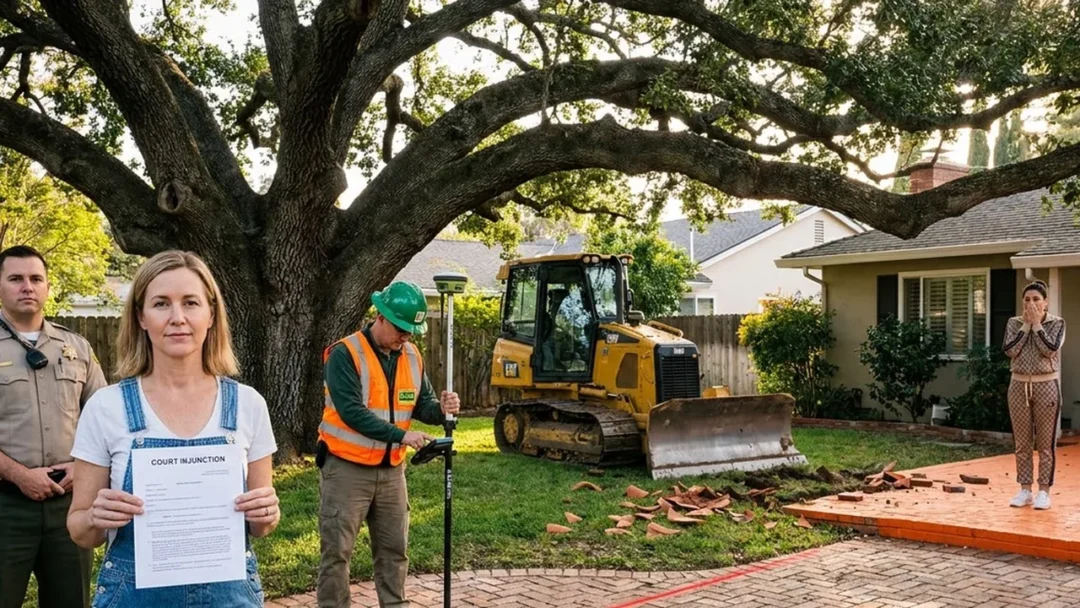
By five o’clock that afternoon, Whispering Pines was swarming with state environmental investigators, forensic botanists, and Wake County Sheriff’s detectives. Yellow polyethylene crime scene tape fluttered in the warm evening breeze between the loblolly pines, cordoning off the entire border between Lots 21 and 22. The neighbors, who had previously remained indoors out of fear of Cynthia Vance’s punitive HOA citations, were gathered in quiet, anxious knots along the opposite sidewalk, watching the flashing blue strobes of three state cruisers reflecting off the suburban facades.
The hired bulldozer had been ordered off the property by Deputy Travis, but a team of state forensic arborists in protective white Tyvek biohazard suits had taken its place. They knelt on reinforced rubber kneeling pads beneath the encroaching travertine patio, using specialized pneumatic air-knives to carefully blow away the dense red clay around the primary root flare of the ancient live oak without scratching or severing the delicate mycorrhizal root fibers. The hiss of compressed air mixed with the sharp, acidic tang of disturbed soil.
Dr. Maya Lin knelt beside State Arborist Alan Cooper, holding a high-intensity ultraviolet forensic inspection lamp and an electronic digital pH core probe. Her canvas overalls were covered in red clay, her gloved fingers trembling with a mixture of exhaustion and cold academic fury.
“Look at this tissue necrosis along the cambium layer, Alan,” Maya said, her voice dropping to a low, tight frequency. She directed the ultraviolet beam toward the lower lateral curve of a massive eight-inch root flare that disappeared beneath Cynthia’s patio foundation.
Under the blacklight, a horrifying, unnatural luminescence was revealed: six neat, half-inch boreholes had been drilled horizontally into the heartwood of the root crown at forty-five-degree downward angles. Each hole had been carefully plugged with dark brown industrial silicone sealant and smeared with red clay to disguise the mechanical entry wounds. Connecting the six boreholes was the thin black polyurethane tubing they had uncovered beneath the shattered edge of Cynthia’s travertine pavers.
Maya inserted the stainless-steel core probe into the nearest borehole, withdrawing a small sample of viscous, dark amber fluid that bubbled faintly upon contact with the open air. She smeared a single drop across an electronic chemical reagent strip.
Within three seconds, the digital sensor chimed, and the strip turned a violent, fluorescent magenta.
“Imazapyr and triclopyr concentrate,” Maya whispered, her jaw tightening until the tendons in her neck stood out. “High-potency systemic woody-plant defoliants engineered for heavy brush clearing along railroad tracks. Injected at forty pounds per square inch directly into the vascular xylem of the tree.”
Cooper stared at the digital readout, his face hardening like carved granite. “That’s an agricultural-grade chemical defoliant cocktail. It’s strictly classified as a restricted-use chemical under federal Environmental Protection Agency statutes. You need a specialized commercial forestry pesticide applicator license just to take delivery of twenty ounces of this formulation. Someone deliberately rigged a continuous motorized drip-injection system to feed concentrated defoliant into the oak’s taproots over a period of four to six weeks.”
“They wanted it to look like natural, sudden environmental decline caused by old age,” Maya explained, rising to her feet and gesturing to the crown above. “The upper foliage would begin to yellow and drop by mid-summer. The branches would become brittle. Cynthia would immediately convene an emergency architectural committee review, produce a compromised tree contractor, declare the historic oak dead and structurally unsound, and issue an administrative condemnation order to fell it for neighborhood safety.”
Deputy Travis walked up, holding a sealed evidence bag containing the motorized chemical dosing injector seized from beneath Cynthia’s patio pavers. “We traced the serial number on this pump unit, Alan. It was purchased through an online commercial agricultural supply house in Charlotte three weeks ago.”
“Who paid for it?” Maya asked, though she already knew the answer in her gut.
“Apex Southern Builders,” Travis replied, his eyes flashing with grim satisfaction. “Billed directly to Marcus Vance’s corporate development credit card. And that’s only the first layer of the rot.”
Travis led Maya and Cooper toward the tailgate of his cruiser, unrolling a large regional land zoning map weighted down with two heavy iron flashlights.
“Our detectives pulled the commercial planning applications filed by Apex Southern Builders with the Wake County Planning Board last month,” Travis said, tracing a finger across the aerial survey. “Whispering Pines Court doesn’t end at this cul-de-sac. Apex owns sixty acres of pristine, untouched timberland directly behind Maya’s parcel, bordering the Neuse River state forest reserve.”
Travis highlighted the narrow gap between the properties. “Apex wants to build a forty-million-dollar luxury expansion—thirty executive mansions called The Ridges at Whispering Pines. But state and county emergency vehicle access codes require a minimum sixty-foot-wide secondary emergency access road connecting the expansion to the public highway.”
Maya’s breath caught in her throat. Her eyes shifted from the map to the towering live oak standing majestically against the twilight sky.
“The oak,” Maya said, the horrific architecture of the conspiracy locking together in her mind. “The ancient oak sits squarely in the center of the only sixty-foot corridor connecting the cul-de-sac to the rear woodland.”
“Exactly,” Travis nodded grimly. “As long as that Heritage Oak is alive, state law strictly prohibits the construction of any paved road within its critical root protection zone. Apex cannot build their forty-million-dollar subdivision unless this tree is dead and removed. Cynthia Vance wasn’t complaining about leaves on her patio. She was trying to assassinate a historic landmark to clear the way for her family’s corporate real estate syndicate.”
Just then, the shrill ring of Deputy Travis’s department radio broke the heavy evening silence.
“Deputy Travis, this is Dispatch,” the voice crackled with urgent priority. “Wake County Superior Court just received an emergency after-hours filing from attorney Walter Croft representing Apex Southern Builders. They’re claiming the state seizure on Lot 21 is an unconstitutional taking, and our road patrol reports an uncertified private logging crew departing the Apex equipment yard right now, heading toward Whispering Pines Court to fell the tree before midnight!”