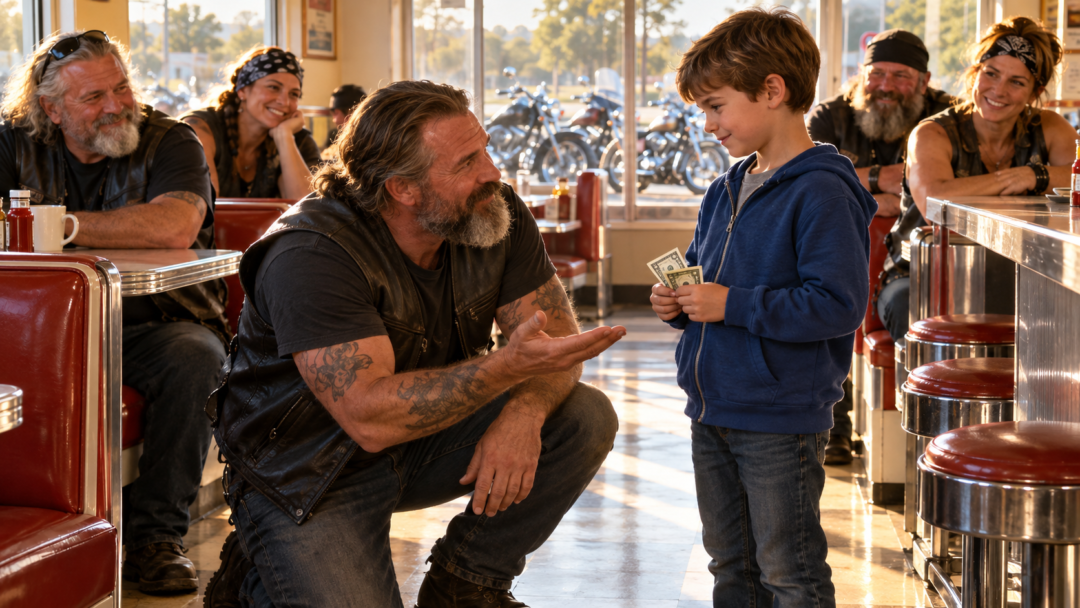
The Little Boy With Two Dollars And The Biker Superheroes
CHAPTER 3: THE FIFTY THOUSAND DOLLAR TRAP
Inside the air-conditioned manager’s office of the Silver Spur Diner, Hannah Miller sat on a comfortable vinyl sofa, sipping hot chamomile tea that the diner owner had brought her. Leo sat beside her, happily eating a bowl of vanilla ice cream with rainbow sprinkles, his blue zip-up hoodie unzipped as he colored a comic book page with crayons Rev Sullivan had retrieved from his motorcycle pouch.
Brody Hayes leaned against the heavy oak desk, studying a stack of carbon-copied financial receipts and promissory notes that Hannah had pulled from her glove compartment. Across the room stood Tank Evans and Rev Sullivan, their broad shoulders filling the doorway.
‘Tell us the whole story, Hannah,’ Brody said gently, his baritone steady and attentive. ‘How did an elementary school aide end up in the crosshairs of a predator like Raymond Cross?’
Hannah took a slow, trembling sip of tea, setting the mug down on the low coffee table. ‘My husband, David, was a fifth-generation peach farmer in Johnson City,’ she began softly, her voice heavy with grief. ‘Two years ago, David was diagnosed with acute lymphoblastic leukemia. We had rural health insurance, but the experimental chemotherapy trials in Houston weren’t covered by our policy. We burned through our savings, our crop insurance, and the tractor reserves within six months.’
Brody nodded grimly. ‘Medical bankruptcy.’
‘David was desperate,’ Hannah continued, a tear slipping down her cheek. ‘The bank wouldn’t issue a second mortgage on the orchard because our irrigation lines needed capital upgrades. That’s when Raymond Cross approached David at the farm co-op. Cross runs a private mezzanine lending LLC out of Austin called Hill Country Equity Partners. He offered David a short-term emergency bridge loan of ten thousand dollars to cover the next round of chemotherapy.’
‘And what were the terms on the paper?’ Tank asked from the doorway, his brow furrowing with suspicion.
‘David didn’t understand the fine print,’ Hannah whispered, her hands trembling in her lap. ‘Cross buried a predatory compounding acceleration rider in Section 8. The initial interest was eight percent, but if a payment was missed by more than forty-eight hours, the default rate compounded at forty percent monthly. When David passed away nine months ago, I was left alone with Leo and seventy acres of peach trees.’
Hannah pointed to the top document on the desk—a formal foreclosure notice stamped with a fraudulent collection seal.
‘Three weeks ago, Cross sent two armed men to my front porch,’ Hannah said, her voice shaking with residual terror. ‘They told me that with compounding default interest, administrative fees, and late penalties, David’s ten-thousand-dollar medical loan now stood at fifty-two thousand four hundred dollars. They gave me an ultimatum: pay fifty-two thousand dollars in certified cashier’s funds by five o’clock today, or sign a quitclaim deed surrendering the entire seventy-acre Miller Orchard to Cross’s development firm.’
‘Seventy acres of prime Hill Country frontage,’ Brody murmured, calculating the true market value in his head. ‘Along Highway 281, that parcel is worth at least two and a half million dollars to commercial resort developers.’
‘Cross doesn’t want the money,’ Hannah sobbed. ‘He wants the land. He already sold an option on the acreage to a luxury condominium developer in Dallas. When I refused to sign the quitclaim deed yesterday, his thugs slashed my tires while I was picking Leo up from daycare. And twenty minutes ago, as I was driving toward the sheriff’s substation in Blanco, a black Silverado boxed me in on the shoulder, threw that brick through my window, and sped away.’
Brody picked up the loan documents, examining the signatures at the bottom of the compounding rider. He adjusted the desk lamp, using his thumbnail to trace the ink lines of David Miller’s signature.
A cold, dangerous smile spread beneath Brody’s salt-and-pepper beard.
‘Hannah,’ Brody said, looking up with absolute certainty. ‘David never signed this compounding rider.’
Hannah gasped. ‘What?’
‘I spent four years in Marine forensic intelligence before I started this club,’ Brody explained, pointing to the jagged stroke at the tail of the signature. ‘Look at the ink density and the pen hesitation at the letter D. This isn’t David’s handwriting; it’s an autopen trace job. Cross forged David’s signature on the default rider after David was already hospitalized in Houston. Under the Texas Finance Code and federal lending statutes, this loan is criminally usurious, fraudulent on its face, and completely unenforceable.’
Rev Sullivan smiled coldly from the doorway. ‘Usury over forty-five percent is a third-degree felony in this state, Brody. That carries ten years in Huntsville.’
‘Exactly,’ Brody said, standing up and sliding the documents safely inside his leather vest pocket. ‘Cross thinks he’s meeting a defenseless, terrified widow at her farmhouse at five o’clock to steal two million dollars of generational heritage.’
Brody checked his tactical field watch. It was four-fifteen.
‘Tank, how are the tires on the wagon?’ Brody asked.
‘Mounted, torqued, and balanced with brand-new Cooper touring radials, Boss,’ Tank grinned, tapping his heavy wrench against his thigh. ‘That car is ready to roll.’
Brody turned back to Hannah, extending his hand to help her up from the sofa.
‘Hannah, you and Leo ride behind us in the wagon,’ Brody said, his voice ringing like an iron bell. ‘Let’s go home to the orchard and wait for Mr. Cross.’
Hannah looked down at her hands, where soil and peach sap had stained the cuticles through years of honest labor alongside her late husband. ‘David was the kind of man who would give the shirt off his back to any neighbor whose tractor broke down in harvest season,’ she whispered, her voice cracking with emotion. ‘He believed that if you worked hard and treated people right, God and the county would look after your family. But when Raymond Cross came into our lives with his smooth voice and his corporate contracts, he treated my husband’s desperation like an investment opportunity to be harvested.’
Brody’s hand tightened around the brass pen on the desk until the metal groaned under his grip. In the military, they called it predatory exploitation of vulnerable dependents; on the civilian road, it was just common cowardice dressed in a three-piece suit. ‘Men like Cross don’t understand the ground they walk on, Hannah,’ Brody said, his voice dropping into a register of cold certainty. ‘They think paper and money make them kings. But out here in the Hill Country, honor is measured in blood and promises. And David’s orchard isn’t going anywhere.’