The Lost Child On The City Bus And The Father’s Photo
CHAPTER 4: THE MONONGAHELA SUMP
“Twenty-four minutes,” Gage said, his voice flat, icy, and totally devoid of fear.
The four brothers looked at the glowing timer on the phone screen. In twenty-four minutes, sixty tons of industrial chemical waste would be released from the underground sump, flushing Lucas Campbell into the boiling toxic discharge pipes and sending a deadly plume of poison down the Monongahela River.
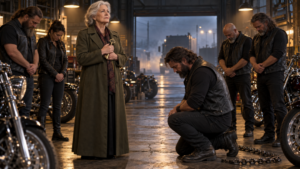
Gage turned to Ruth. “Tank and Preacher are taking you and Mia to our clubhouse in the Strip District. It’s built inside a former bank vault with three-inch reinforced steel doors and six armed brothers holding the gate. You’ll be safe there.”
Ruth took Gage’s hand in both of hers, her eyes pleading with the raw desperation of a mother who had no other hope left on earth. “Bring my boy home, Gage. Please. He’s all Mia has.”
Mia reached out from Ruth’s arms, her small hand patting Gage’s bearded cheek. “Bring Daddy home.”
Gage gently kissed the toddler’s forehead. “I’ll bring him home, little bird. I give you my sacred word.”
Tank and Preacher mounted their cruisers, escorting Ruth and Mia north toward the fortified clubhouse, while Gage, Bear, and Hawk wheeled their machines toward the dark, industrial wasteland of the Monongahela riverfront.
The abandoned Monongahela Coke Works was a grim, post-industrial nightmare sprawled across eighty acres of rusted iron, crumbling brick smokestacks, and shattered concrete along the river bluffs. Decades of heavy coal-coking operations had left the soil saturated with pitch and slag. A twelve-foot razor-wire security fence surrounded the perimeter, but the gates had been reinforced with fresh galvanized steel and warning signs: CORVUS ENVIRONMENTAL – RESTRICTED REMEDIATION SITE – AUTHORIZED PERSONNEL ONLY.
Gage brought his motorcycle to a halt behind a mountain of rusted railcar wheels two hundred yards from the western gate.
Through his night-vision binoculars, Gage surveyed the facility. The main entrance was guarded by two armored security trucks and four private contractors wearing tactical uniforms and armed with short-barreled carbines. Near the central pump house, six heavy industrial tanker trucks were lined up beside the subterranean discharge manifold.
“Surface entrance is a kill zone,” Bear whispered, checking the action on his twelve-gauge breaching shotgun. “They have thermal cameras sweeping the main asphalt.”
“We don’t go through the gates,” Gage replied, his combat engineering background identifying the site’s structural weakness instantly. “In the fifties, this plant used a six-foot gravity-fed river intake flume to draw cooling water from the riverbed. The discharge culvert empties into the mud flats forty yards below the coal barge slips. The grate was abandoned thirty years ago.”
Gage unstrapped a heavy portable oxy-acetylene cutting torch rig from his rear luggage rack, slipping the backpack harness over his shoulders.
The three men moved through the freezing mud along the river’s edge, using the dense river willow scrub and driving rain as concealment. Beneath the rusted wooden piers of the barge slip, they found the entrance: a massive six-foot corrugated iron culvert, choked with river silt, discharging a trickle of foul-smelling, chemical-laden water.
Gage struck his flint spark-lighter. A brilliant, needle-sharp blue flame erupted from the torch tip. With steady, practiced precision, Gage sliced through the rusted one-inch iron rebar of the culvert grate, kicking the glowing steel bars inward with a sharp CLANG.
They crawled through eighty yards of sludge-filled drainage pipe, emerging onto an iron catwalk fifty feet below the ground inside the cavernous subterranean sump vault.
The air inside was suffocating, burning their throats with the pungent, sweet stench of chlorine and industrial degreaser. The vault was illuminated by red industrial emergency beacons, casting bloody reflections across a massive, Olympic-pool-sized reservoir of churning, dark chemical sludge.
Suspended directly above the center of the toxic vat by a steel crane cable was Lucas Campbell.
His denim shirt was torn to shreds, his chest covered in chemical chemical burns and contusions, his head hanging low as the fumes rose toward his face.
Standing on the central control platform thirty feet away, wearing a tailored yellow hazmat slicker over his charcoal suit, was Kurt Sterling. Flanking him were four private security guards armed with submachine guns.
“Open the main sluice valve, Marcus,” Sterling commanded, checking his gold Rolex. “The rain has raised the river discharge rate to forty thousand cubic feet per minute. By the time the municipal monitoring station registers the trichloroethylene, the plume will be ten miles past Pittsburgh and the dilution will make attribution impossible. And our young chemist friend here will be dissolved beyond dental identification.”
“Not on my watch, Sterling!” Gage Thorne’s voice roared through the echoing cavern like a thunderclap.
Sterling spun around in shock.
Before the guards could raise their carbines, Hawk fired two heavy 37mm CS tear-gas canisters directly into the control booth. A blinding cloud of stinging chemical smoke engulfed the platform, sending the guards into a coughing, blinded frenzy!
Gage sprinted across the slick iron catwalk, the cutting torch roaring in his hand like a fiery sword!
As they waded through the frigid knee-deep mud beneath the barge slips, Hawk glanced up at the towering brick smokestacks of the coke works. “Gage, this entire riverbank is a superfund site waiting to blow. If Sterling’s crew has fifty tons of trichloroethylene stored in unlined underground pits, the vapors alone could ignite if an electric motor throws a single spark in that sump.”
“That’s why we move fast and silent,” Gage replied in a low whisper, checking the pressure regulators on his oxygen-acetylene rig. “Lucas knows the chemical volatility better than anyone. He designed the plant’s vapor recovery system before Sterling fired him. If Lucas is still breathing down there, he’ll know how to keep that vault from turning into a bomb.”