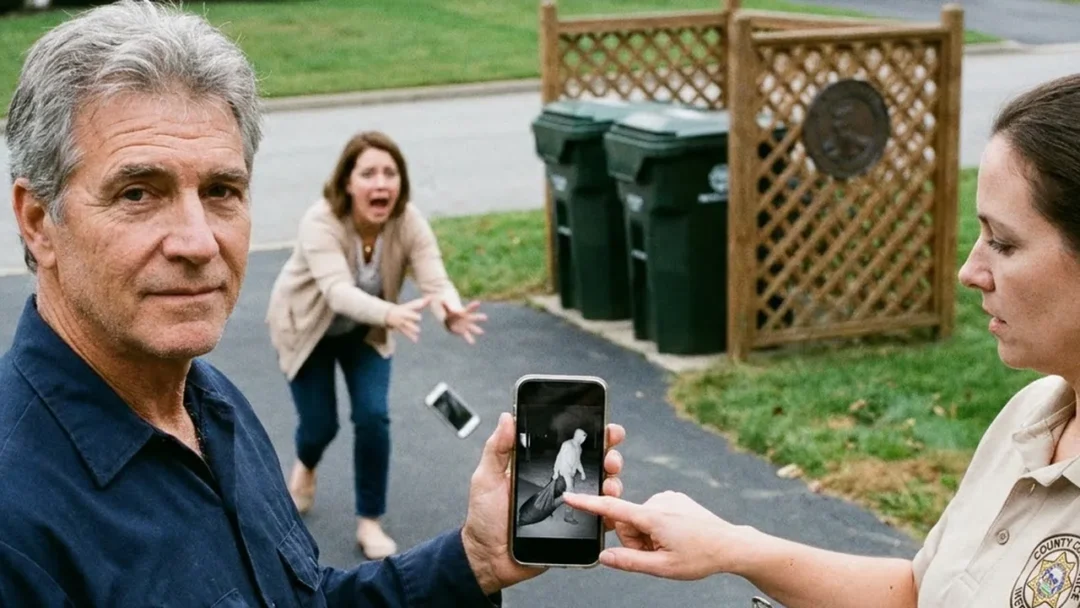
The Midnight Camera In The Cedar Screen And The Dumped Bag
CHAPTER 2: THE CAUSTIC RESIDUE AT MIDNIGHT
The heavy plastic lid of the green municipal bin snapped back against its hinges with a hollow clatter that echoed off the front facade of David’s house. Maria Gonzalez reached into her utility belt, pulled out a pair of thick, chemical-resistant nitrile gloves, and snapped them over her hands with practiced efficiency. She pulled a heavy-duty tactical flashlight from her holster, clicked the beam to high, and shone the brilliant white light straight down into the deep plastic barrel.
Lying at the bottom of the bin was the thick, sixty-gallon black contractor bag from the night-vision recording. It had split along its lower welded seam under the sheer weight of its contents. Thick, gray-white dust and chunks of brittle, patterned vinyl tiles had spilled out, mingling with a pool of viscous, amber-colored chemical sludge that emitted a sweet, sickening odor resembling industrial chloroform and burning rubber.
David leaned over the rim, shining his own inspection penlight along the interior wall of the green container. “Take a look at the plastic floor of the bin, Maria. That’s high-density polyethylene. It’s rated to hold motor oil, muriatic acid, and concentrated bleach without degrading. Look at what’s happening to the bottom ribs.”
Maria leaned in closer, holding her breath against the pungent chemical fumes. The heavy plastic floor of the municipal container was visibly blistering. The molded ridges were softening into a sticky, gummy goo, dissolving under the chemical action of the amber sludge. A steady drip of the corrosive liquid had leaked through the bottom drain plug of the bin, pooling on the concrete driveway pad below. Where the fluid had touched David’s driveway, the hardened clear concrete sealer had bubbled up like fried egg whites, leaving the bare aggregate pitted and chalky white.
“What is that smell?” Maria asked, pulling a laminated field test kit from her cargo pocket. “It’s too heavy for regular mineral spirits.”
“It’s methylene chloride,” David said, his voice flat and grave. “Navy yards used it by the drum back in the seventies for stripping epoxy off destroyer hulls before the federal government banned commercial use in consumer paint strippers. It dissolves paint in sixty seconds, softens plastic, and causes severe neurological damage if you inhale the vapor in an enclosed space. That’s why you can’t buy it at Home Depot anymore. It requires a commercial industrial abatement license just to purchase it.”
Across the driveway, Evelyn stood near the curb, her hands clutched tightly against her stomach as she watched Maria extract a disposable glass pipette and a packet of pH test strips from her field kit. Evelyn’s previous arrogance had vanished, replaced by a twitching, desperate anxiety.
“It was just some old remodeling scraps from my guest bathroom!” Evelyn called out, her voice pitching high and defensive. “My son Bradley was helping me replace a few broken floor tiles last weekend. We had some leftover solvent rags and scrap tiles. That’s all it is! You’re making a federal case out of a few old floorboards!”
“If it’s just bathroom scrap, Mrs. Vance, why didn’t you put it in your own ninety-six-gallon commercial bin across the street?” Maria asked without looking up. She uncapped a test vial and drew a three-milliliter sample of the amber sludge into the glass tube.
“My bins were full from yard trimming!” Evelyn stammered, smoothing the front of her designer athletic shirt with trembling fingers. “The trash truck comes on Tuesday mornings. I didn’t want the smell sitting in my garage for four days. Neighbors share disposal space all the time! It’s common courtesy!”
“Neighbors share yard clippings, Evelyn,” David said, stepping out from behind the cedar screen. “They don’t sneak across the asphalt at midnight in silk nightgowns to dump thirty pounds of illegal solvent into someone else’s bins. You put it in my bin because you knew the municipal waste collectors scan the RFID barcode tags on the side of every container before they tip them into the compactor truck. If a container catches fire or dissolves the compactor seals, the county trace leads directly to my street address, not yours.”
Maria dipped a specialized chemical indicator strip into the glass vial. Within three seconds, the pale yellow cellulose pad reacted violently, turning from yellow to dark indigo, and finally to a deep, pitch-black color that indicated an extreme concentration of chlorinated hydrocarbons and caustic stripping agents.
“Methylene chloride combined with volatile aromatic hydrocarbons,” Maria said, looking up from the test strip with a grim expression. “This isn’t leftover DIY paint stripper, Mrs. Vance. This is industrial-grade chemical solvent. And that’s not all.”
Maria used a pair of long wooden sampling tongs to lift one of the shattered vinyl floor tiles that had fallen out of the torn contractor bag. The tile was nine inches square, a faded mottled beige pattern with a thick black adhesive backing that looked like brittle tar.
David bent down, his eyes narrowing as he inspected the fibrous black adhesive clinging to the underside of the vinyl chunk. “Nine-by-nine vinyl composition tile with black cutback mastic,” David noted. “Every shipwright and historic restoration carpenter in Pennsylvania knows what that is. That tile was manufactured prior to 1980. The tile core contains fifteen percent chrysotile asbestos, and the black mastic adhesive underneath is forty percent pure amphibole asbestos fiber. When you rip these up dry without water misting and HEPA containment, you turn millions of microscopic asbestos needles into airborne dust.”
Maria’s jaw tightened. She carefully placed the tile fragment into a red biohazard specimen bag, sealed the zip-strip, and attached a yellow hazardous material tracking manifest.
“Commercial demolition waste containing friable asbestos and regulated industrial solvents,” Maria stated formally, pulling her portable printer from her kit. “Under Chapter 271 of the Pennsylvania Solid Waste Management Act, placing hazardous industrial waste or uncontained friable asbestos into a municipal residential waste stream carries a mandatory five-thousand-dollar fine per occurrence, plus criminal referral to the state Department of Environmental Protection.”
Evelyn took two stumbling steps backward, her eyes darting toward her sprawling brick house across the street. “You can’t prove that came from my house! That video just shows a woman carrying a bag! Anyone could be wearing that nightgown! You don’t have a search warrant for my property!”
Maria held up her clipboard, her finger pointing downward toward the asphalt pavement at Evelyn’s feet. “We don’t need a search warrant for the street, Mrs. Vance. Look down.”
The rising morning sun broke through the gray overcast sky, illuminating the black asphalt road with stark, unforgiving clarity. Running across the asphalt, beginning directly at the base of David’s cedar screen and leading straight across the roadway like a trail of breadcrumbs, was a continuous, gleaming line of wet amber droplets. Where each droplet had landed on the fresh blacktop sealcoat, the chemical solvent had dissolved the tar, leaving a trail of bleached, chalky circles that led directly to the side garage door of Evelyn Vance’s home.