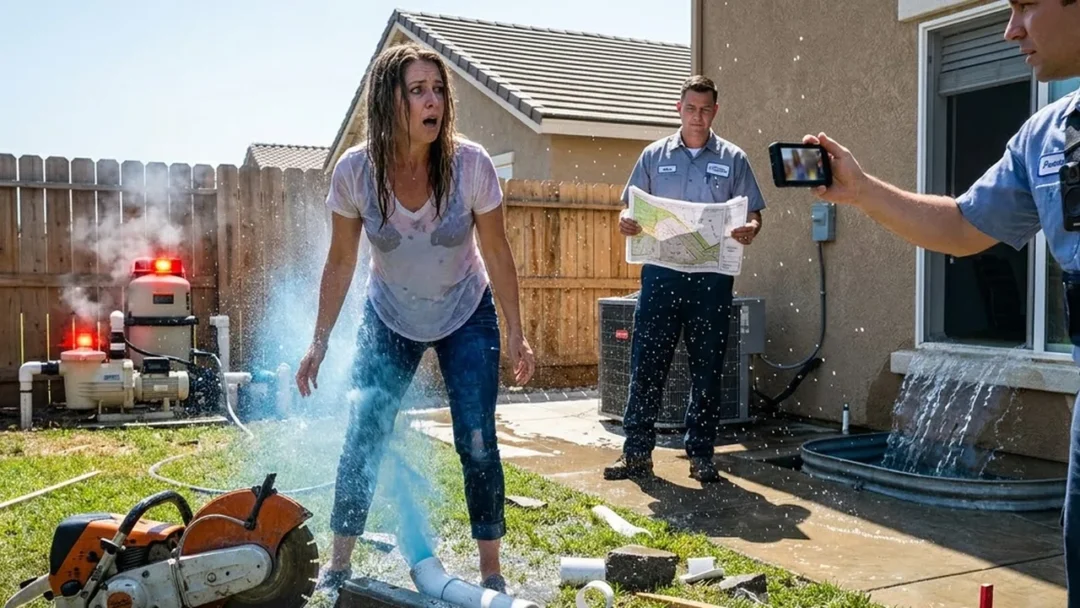
The Severed Pool Return Line And The Flooded Basement Window
CHAPTER 6: THE FLOOD TIDE OF RESTITUTION
The 4K video playback on Marcus’s tablet was crystal-clear, illuminated by the bright Florida sunlight.
The audio recording boomed with uncompromising fidelity:
“Chen! I told you yesterday was your final deadline to break up this illegal concrete curb! If it sits on my gravel, it gets cut!”
The screen showed Marcus pointing to the stamped brass medallion, explicitly warning Evelyn that she was standing above a live, pressurized commercial pool line.
It captured Evelyn’s sneering, arrogant retort:
“I don’t care who you are, boy… Watch how fast I clear my land!”
And then the high-speed footage showed Evelyn deliberately bringing the spinning diamond blade down through the brass medallion, slicing cleanly through the concrete envelope and severing the PVC core.
Deputy Vance watched the video twice, his expression hardening into cold disgust. He closed his tactical notepad with a sharp snap and turned to Evelyn.
“Mrs. Sterling, you have just provided the county with the most comprehensive recorded confession of intentional property destruction I have ever witnessed in twelve years of law enforcement,” Deputy Vance said.
“No… you don’t understand,” Evelyn stammered, backing away toward her flooded patio, her hands trembling violently. “I thought it was his! I thought he was stealing my land! I was defending my boundary!”
“Ignorance of your own property filings is not a defense, Mrs. Sterling,” Inspector Kowalski interjected harshly. “You operated commercial-grade pneumatic cutting machinery across a recorded utility corridor without an active 811 underground utility locate ticket. That is a direct Class One violation of the Florida Underground Facility Damage Prevention and Safety Act, carrying a mandatory five-thousand-dollar state civil penalty.”
Kowalski pulled a pad of yellow municipal citation notices from his satchel, rapidly filling out three separate forms. “Furthermore, because this unpermitted excavation caused an uncontrolled discharge of forty thousand gallons of chlorinated swimming pool water into the county storm drainage swale, I am citing you for illegal discharge under the Florida Clean Water Protection Ordinance. The county environmental division will assess cleanup and testing fees starting tomorrow morning.”
Deputy Vance stepped forward, pulling a formal carbon-copy summons from his duty belt. “And from the sheriff’s department, Mrs. Sterling, you are being issued a criminal summons for reckless endangerment and municipal code non-compliance. If Mr. Chen’s foundation had sustained so much as an eighth of an inch of water displacement, you would be riding to the Naples county jail in handcuffs right now.”
At that moment, a heavy commercial vacuum tanker from Collier Disaster Restoration rumbled down the palm-lined street, its massive diesel engine whining as the crew began dragging three-inch industrial suction hoses toward Evelyn’s flooded basement.
The restoration foreman, a tired-looking man with a digital moisture meter, took one look into the submerged light well and whistled softly.
“Ma’am,” the foreman called out to Evelyn, shaking his head. “You’ve got four feet of standing water over high-end hardwood, ruined custom cabinetry, electrical sub-panel submersion, and three hundred square feet of saturated drywall. Emergency extraction, structural dehumidification, and antimicrobial mold remediation is going to run you between eighty and one hundred and twenty thousand dollars minimum. And that’s before you hire an electrician to rewire your entire basement grid.”
Evelyn sank onto the wet travertine coping of her half-empty swimming pool, burying her face in her waterlogged leather gloves. She knew with sickening certainty that when she submitted the restoration invoice to her insurance carrier, Marcus’s 4K body-camera footage—subpoenaed by the county attorney—would guarantee an immediate, unappealable denial under the intentional-act exclusion clause. Every single penny of the catastrophic damage was coming directly out of her personal retirement accounts.
On the other side of the corridor, David Chen and Marcus Bell stood on David’s spotless, dry porch.
David looked down at his intact drainage swale, then offered Marcus a warm, appreciative handshake. “Marcus, your documentation saved this entire neighborhood months of frivolous litigation. Thank you.”
Marcus smiled, tapping the rugged casing of his body-worn camera. “Truth is the best plumbing tool there is, David. When people let spite blind their judgment, physics and gravity always balance the books.”
As the afternoon shadows lengthened across the Palmetto Palms fairway, the sound of industrial pumps thrummed peacefully in the distance, slowly draining the wreckage of Unit Eighteen. David Chen walked back inside his quiet, immaculate villa, closing his solid oak front door on the finished chapter of suburban arrogance, his home safe, his boundaries secure, and the truth permanently recorded.
The legal fallout of intentional property destruction in Florida is swift and merciless. Under Florida Statute section eight-hundred-and-six, malicious injury to buildings or underground utilities that exceeds one thousand dollars in value is classified as a third-degree felony. While criminal prosecutors often allow first-time offenders in suburban disputes to enter deferred prosecution programs, the civil liabilities remain entirely unshielded. Marcus Bell’s certified 4K body-worn footage represented an unassailable legal evidentiary packet. In court, there would be no conflicting eyewitness testimony, no ambiguous memories, and no plausible deniability. The camera had captured Evelyn’s sneering face, her deliberate refusal to heed licensed warnings, and the mechanical act of sawing through the stamped medallion.
Furthermore, Florida insurance case law is unequivocal regarding the Intentional Acts Exclusion. Chubb and other luxury underwriters maintain specialized forensic claim units specifically to investigate high-dollar water losses. The moment the claims adjuster reviewed the sheriff’s incident report and the video evidence showing the policyholder personally operating a demolition saw against her own water line, the claim would be denied in its entirety. Evelyn Sterling would be forced to pay every single dollar of the hundred-and-fifty-thousand-dollar basement restoration out of her own liquid assets, alongside county environmental fines and municipal emergency dispatch costs.
The restoration process would stretch across weeks of continuous industrial dehumidification, specialized mold testing, and complete rewiring of the subterranean living quarters. Neighbors from adjacent villas gathered along the perimeter fence, watching the convoy of disaster restoration trucks and county code enforcement vehicles with quiet, unmistakable satisfaction. For years, Evelyn had weaponized property bylaws to harass the community, but her own unchecked vindictiveness had finally delivered an indisputable verdict that no corporate litigator could appeal.