The Sunken Luxury SUV Beyond The Blackwood Cutoff Fence
CHAPTER 2: PAPERWORK IN THE PEAT
The kitchen of the Cole homestead smelled of brewed chicory, woodsmoke, and damp canvas. Silas stood at the sink, washing the grit from his calloused knuckles with yellow lye soap, while his daughter Hannah spread a series of topographic survey maps across the butcher-block table. At twenty-eight, Hannah carried herself with the sharp, watchful precision of an agricultural surveyor who had spent four years fighting predatory developers in state regulatory hearings before returning home to run the farm’s logistical accounts.
“That wasn’t just some weekend tourist from Northern Virginia, Dad,” Hannah said, pointing to a section of the county plat map highlighted in fluorescent yellow. “Julian Vance is the chief managing partner of Highland Ridge Capital. He bought up the five hundred acres across the creek six months ago. His name is all over the preliminary zoning filings for the municipal bypass.”
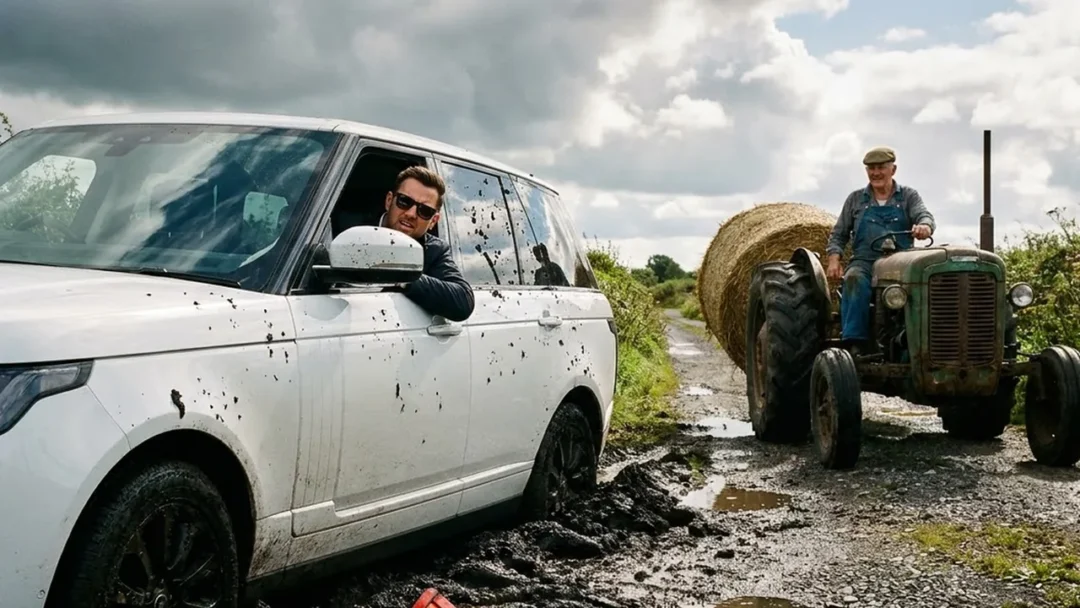
Silas dried his hands on a clean flour-sack towel and walked to the window. Outside, through the thinning mist, the rear roofline of the white Range Rover was still visible half a mile down the valley, canted precariously against the willow fence.
“He was carrying the paperwork, Hannah,” Silas said softly. “The briefcase broke open when he hit the sinkhole. I saw the red stamp. Augusta County Planning. An emergency condemnation petition.”
Hannah’s pencil froze over the paper. Her jaw tightened, the color draining from her cheeks before returning as a flush of cold, focused fury. “The county board doesn’t meet until next Tuesday. Unless…” She pulled her laptop toward her, typing rapidly with one hand while clicking through the county clerk’s public notice portal. Her fingers moved across the keyboard in a sharp, staccato rhythm as she bypassed the cached public notices and dug into the raw docket queue. “Here it is. Filed forty-five minutes ago under the expedited emergency agricultural safety statute. Warren Pike, the zoning administrator, called a special closed session for five o’clock this afternoon. Three hours from now. No public audience, no streamed audio, just executive deliberation behind locked doors.”
“On what grounds?” Silas asked, his voice steady as iron, though his eyes narrowed as he looked out at the misty timberline. “We’ve had cattle on these forty acres since my grandfather came back from the Argonne in 1919. My father cleared the lower run after the floods of thirty-six. There’s never been a safety complaint on this ridge in eighty years.”
“Drainage hazard and public obstruction,” Hannah read aloud, her voice trembling with disgust as she scanned the PDF document. “The filing claims Parcel 404 contains an unmanaged limestone sinkhole that compromises the structural integrity of the Blackwood Cutoff, presenting an imminent risk of catastrophic roadbed collapse to county school buses and commercial traffic. Under Chapter Nine of the revised county code, the zoning administrator can seize a ninety-foot public easement by executive order without an open referendum if the landowner fails to appear with certified engineering counter-proof at the time of the call.”
“Pike knows I don’t own an engineering firm,” Silas murmured, looking down at his rough, stained palms. “He knows hiring a hydrologist takes three weeks and ten thousand dollars upfront. And Vance was on his way to deliver the certified engineering bond to the courthouse when he tried to run me over on my own road.”
“Look at the exhibit list attached to the docket,” Hannah said, turning the laptop screen toward him. “A signed affidavit from Arthur Pendelton, Vance’s captive surveyor. It claims the roadbed has suffered twenty inches of lateral subsidence over the past three months due to improper agricultural drainage. It’s completely fabricated. They’re manufacturing an emergency to force a summary easement, and once they have the easement, they can lay their sewer trunk lines directly across our pasture to service the golf resort.”
Before Silas could answer, the deep rumble of an unsilenced diesel engine reverberated across the yard, vibrating the antique glass panes in the kitchen window. A dark blue flatbed utility truck belonging to Vance’s excavation contractor rolled down the lane, followed by a heavy industrial backhoe with steel tracks that clattered violently against the wet macadam. The heavy machinery convoy ground to a halt fifty yards short of the sunken SUV, exhaust plumes billowing into the damp gray canopy of the willows.
Silas grabbed his heavy oilskin duster from the wooden peg beside the kitchen hearth. “They aren’t just bringing a tow cable, Hannah. A backhoe on that saturated ditch will rip the whole limestone shelf apart. If they crush that bedrock, the sinkhole will open wide and swallow the whole roadbed before sunset.”
“Take this,” Hannah said, reaching into the fireproof steel lockbox beneath the desk. She handed him her heavy waterproof field camera, fitted with a high-resolution zoom lens, and a legal folder bound with faded crimson string. “The original county deed from 1938. The state highway commission signed it during the Works Progress Administration when they paved the state route into Waynesboro. Grandpa made sure every culvert, cattle ramp, and spring run was deeded in perpetuity with sovereign federal backing. Pike cannot override a federal grant with a county executive waiver.”
Silas took the leather-bound folio, tucking it inside his duster next to his heart. He stepped out into the damp chill. The rain had paused, replaced by a low, clinging fog that smelled of sulfur, iron, and damp dead grass. As he walked down the gravel shoulder, the driver of the flatbed truck—a burly man in an insulated orange safety vest named Gary Hatcher—stepped out, carrying a three-inch steel snatch strap and a heavy hydraulic winch hook.
Julian Vance was standing on the firm gravel crown, shivering violently in his ruined clothes. He had stripped off his cashmere pullover, leaving him in a mud-splattered silk undershirt that clung to his thin frame. His face was pale, his eyes wide and feverish as he pointed at the vehicle.
“Hook onto the rear subframe, Gary!” Vance ordered, his voice raw from screaming. “Pinch the frame and drag it out! Don’t worry about the bumper! Just get my briefcase out of the back! It’s four o’clock! I have sixty minutes to get to the clerk’s office before Pike convenes the board!”
“Hold on, Hatcher,” Silas said, stepping between the flatbed and the collapsed ditch.
Hatcher paused, looking between the farmer and the developer. “Mr. Cole, we’re just clearing the obstruction. The gentleman called for private recovery.”
“You drop that backhoe outrigger on this shoulder,” Silas said, pointing to the cracked shale along the road edge, “and you’ll fracture the limestone subterranean shelf that supports the whole western culvert. That culvert drains forty acres of bottomland. You crack it, the entire roadway drops five feet into the creek bed.”
“Shut up, old man!” Vance shrieked, lunging forward until he was inches from Silas’s chest, his breath hot and sour. “You don’t own this road! You don’t own the shoulder! In less than an hour, your whole damn meadow belongs to the Commonwealth of Virginia, and by tomorrow morning my scrapers will grade every inch of your cattle pasture into an eighteen-hole fairway! Hook the winch, Gary!”
Hatcher hesitated, but Vance shoved a folded wad of hundred-dollar bills into the contractor’s vest pocket. Hatcher cursed under his breath, kicked the winch release lever, and dragged the heavy steel cable down the embankment toward the Range Rover’s buried rear tow eye.
Silas did not reach for the cable. Instead, he raised Hannah’s digital camera and aimed the long telephoto lens directly into the hole Vance’s spinning tires had carved into the ditch bank.
The churning wheels had excavated a four-foot trench through the topsoil, stripping away decades of grass and clay. Protruding from the raw gray marl beneath the SUV’s sunken floorboard was not a natural rock formation, but a jagged, twelve-inch diameter corrugated PVC industrial drainage pipe. Thick, milky-white runoff was pulsing from the cracked pipe directly into the limestone subterranean reservoir, foaming with the sharp, acrid stench of industrial herbicide and commercial fertilizer.
“Look at that, Vance,” Silas said evenly, snapping three rapid photographs. “That’s not farm runoff. That’s a clandestine discharge line coming straight from your golf course construction pad.”
Vance’s face went dead white. He took half a step backward, his eyes darting toward the woods where the plastic pipe disappeared under his high security fence.
“That’s private infrastructure,” Vance stammered, his arrogance fracturing into panic. “You have no right to document that.”
“The county zoning code says otherwise,” Silas said. “And look what else your wheels uncovered.”
Beneath the crushed plastic pipe, half-buried in the original bedrock, sat a rectangular surveyor’s monument made of hand-chiseled granite, topped with a weathered circular bronze medallion that bore the date 1938 and a deeply engraved federal benchmark seal.