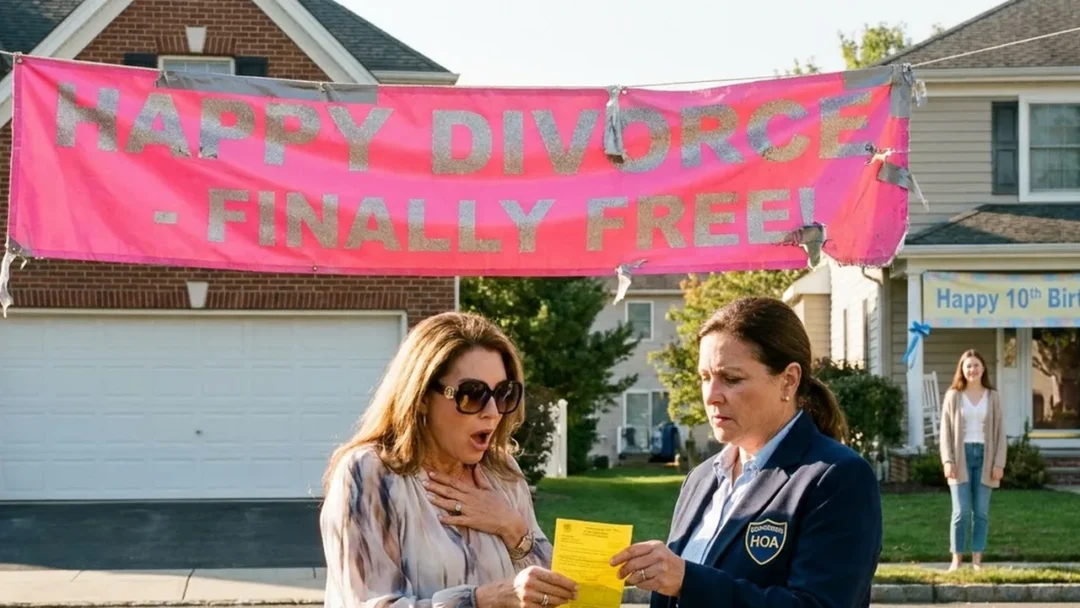
The Tattered Divorce Banner And The Twenty Four Hour Sign Rule
CHAPTER 2: THE HIDDEN WALL IN THE CARRIAGE BAY
The afternoon shadows lengthened across the suburban lawns, bringing a sharp, damp chill that smelled of woodsmoke and wet soil. Officer Gregory Shaw stood in his small office on the second floor of the Scarsdale Municipal Building, surrounded by architectural plot maps, building permits, and historical zoning ledgers dating back to the late nineteenth century. Spread across his wide oak desk was a high-resolution telephoto photograph he had taken of the brick wall behind Candace’s tattered divorce banner.
The photograph showed a clean, continuous horizontal groove cut three inches deep into the structural brickwork, intersecting with a vertical relief seam that outlined an eight-foot by eight-foot square directly behind the vinyl sheeting. It was not the work of a handyman repairing mortar; it was the precision work of an industrial diamond-blade concrete saw. A diamond saw required high-voltage three-phase power and heavy water cooling to prevent brick dust from suffocating the neighborhood. Shaw flipped through the village inspection permits for the past twenty-four months: Candace’s property had logged zero applications for masonry alteration, zero requests for structural renovation, and zero permits for electrical utility upgrades.
A knock sounded on the frosted glass door. Lauren Miller entered, holding a manila folder. “Officer Shaw? You asked to see the property boundary survey from my deed?”
Shaw looked up, gesturing toward a wooden armchair. “Please, sit down, Mrs. Miller. Thank you for coming.”
Lauren set the survey on the desk. “Leo had a wonderful birthday afternoon, Officer Shaw. The neighbors came over for cider, and not a single person complained about his little ribbon banner. But on my way down here, I noticed an unmarked commercial flatbed truck parked in Candace’s service drive. Two men in work jumpsuits were hauling heavy steel locking cabinets out of the basement bulkhead and loading them into an enclosed shipping container. They worked with extreme urgency, constantly checking the road.”
Shaw’s eyebrows tightened. He leaned forward, tapping the photograph on his desk. “Look at this, Mrs. Miller. That pink divorce banner wasn’t hung with exterior masonry tape or lightweight picture wire. It was secured with half-inch expansion anchor bolts driven directly into structural headers. And behind that vinyl is an unpermitted structural opening cut straight through the reinforced foundation of the carriage house.”
“Why would someone cut through their own foundation?” Lauren asked, studying the photograph with her science teacher’s analytical eye.
“Because if you want to move heavy, high-density objects in or out of a subterranean basement vault without rolling them up the front steps or through the finished living quarters, you cut an equipment hatch right behind a garage door,” Shaw explained, pulling up the Scarsdale tax assessor’s digital database on his desktop computer. “Candace’s husband, Richard Sterling-Price, is the principal owner of Sterling-Price Capital Holdings. Three months ago, his commercial real estate development firm filed for Chapter 11 bankruptcy in the Southern District of New York, claiming total insolvency and seventy million dollars in defaulted municipal bond obligations.”
Shaw clicked into the municipal building records. “Two weeks after that federal bankruptcy filing, Candace filed for an expedited uncontested divorce in Westchester County Supreme Court. Under the terms of the private separation agreement, Richard transferred the entire Scarsdale estate, plus all personal property and residential contents, to Candace as sole separate property, supposedly to satisfy marital support obligations. Under the New York Debtor and Creditor Law, a transfer made during insolvency is presumed fraudulent unless supported by legitimate consideration.”
“And that shields the property from the bankruptcy creditors,” Lauren said, the pieces clicking together with chilling clarity.
“It shields the property only if the transfer is legitimate and the separation is genuine,” Shaw replied, his eyes dark with suspicion. “Under federal bankruptcy law, if an insolvent debtor transfers assets to a spouse without fair consideration within two years of filing, it’s a fraudulent conveyance. But if you have forty million dollars in bearer bonds, untraceable gold bullion, and offshore cash reserves hidden in a sub-basement vault, you don’t want court-appointed bankruptcy trustees walking through your house during a liquidation inventory. You need a public distraction. You hang an obnoxious, controversial pink banner across the garage that screams matrimonial warfare to the whole world, daring the HOA to fight over free speech, while behind that very banner, you cut a vault door into the masonry to empty the cash into an unmarked shipping container.”
Shaw stood up, reaching for his coat and utility belt. “I’m calling Detective Paul Rossi at the State Police Financial Crimes Division. That pink banner isn’t just an eyesore, Mrs. Miller. It’s the curtain concealing a federal crime.”
Officer Shaw pulled a heavy steel flat-file drawer from the municipal vault, laying out the original 1928 architectural blueprints of the Oakmont estate. The drawings, hand-inked on linen drafting cloth, detailed eighteen-inch solid masonry footings designed to support a slate-roofed carriage bay and chauffeur’s quarters. ‘Whoever cut through that wall,’ Shaw observed, tracing the structural load lines with a wooden pencil, ‘bypassed the village building department entirely because any competent structural engineer would have condemned the structure on sight. By slicing through the lower foundation headers without installing temporary steel lally columns, they created an imminent shear collapse hazard. If a heavy wet snowfall hits Westchester this winter, the entire upper carriage floor could pancake into the basement. They risked the structural integrity of a historic neighborhood just to create a secret escape hatch for stolen cash.’ Lauren shook her head, horrified that someone could treat their own home with such reckless contempt.