The Tattered Divorce Banner And The Twenty Four Hour Sign Rule
CHAPTER 3: THE SHARPIE DATE AND THE PAPER TRAIL
By ten o’clock the following morning, Detective Paul Rossi of the New York State Police Financial Crimes Unit was seated in the conference room of the Scarsdale Municipal Building, surrounded by three cardboard archive boxes filled with subpoenaed bank records, commercial invoices, and digital court filings. Rossi was a compact, sharp-featured investigator with silver-flecked black hair, wearing an unbuttoned tactical trench coat over a dark suit, his gold shield resting beside an empty paper coffee cup.
Officer Gregory Shaw stood at the whiteboard, on which he had constructed a chronological timeline connecting Candace’s sign citations to the bankruptcy court filings in Manhattan.
“Let’s walk through the paper trail on this banner, Greg,” Detective Rossi said, clicking his ballpoint pen. “You’ve got the physical manufacturer’s stamp on the vinyl grommet?”
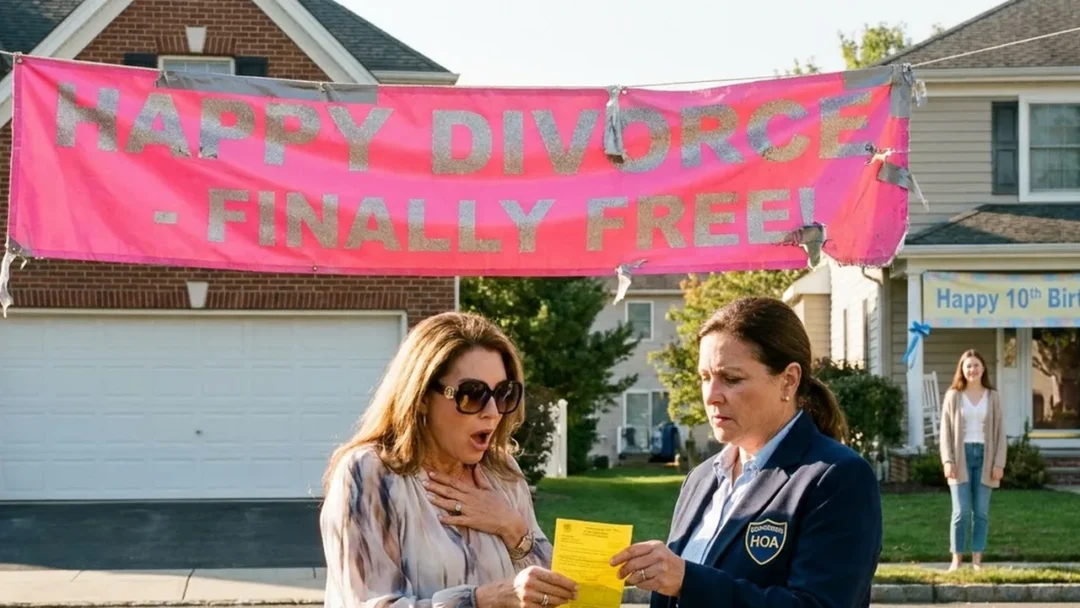
Shaw pulled a clear evidence sleeve from his briefcase. Inside was the ripped lower corner of the pink vinyl banner that had torn away in the wind, showing the manufacturer’s heat-embossed logo: Empire Signworks & Vinyl Fabrication – Long Island City, NY.
“We subpoenaed the production order from Empire Signworks yesterday afternoon,” Shaw said, tapping the board. “The order was placed by Candace Sterling-Price on April 12th. Total invoice: twenty-four hundred dollars for heavy-gauge military-spec vinyl, reinforced kevlar hems, and four half-inch industrial mounting anchors. The order specifically requested heavy opaque backing so that no light would penetrate the banner from either side.”
Rossi leaned forward, his dark eyes narrowing. “April 12th? Candace’s husband didn’t file for corporate bankruptcy until July, and she didn’t file for divorce until August. She ordered a twenty-foot Happy Divorce banner four months before the divorce even existed on paper. That establishes premeditation, intent to deceive, and a coordinated conspiracy.”
“It gets better,” Shaw continued, turning to the financial records. “The commercial invoice for that banner wasn’t paid from Candace’s personal checking account. It was paid via an electronic corporate wire transfer originating from an account titled Sterling-Price Capital Escrow Holding Four at Manhattan Commercial Trust. That specific escrow account was supposed to hold six million dollars in municipal infrastructure bond funds for a public school construction project in Yonkers. That account was frozen by federal court order in July when the funds vanished into offshore shell entities.”
“So she used stolen public bond money to manufacture the banner that hid the vault that stole the rest of the funds,” Rossi said, a grim smile touching the corner of his mouth. “The arrogance of these people is extraordinary. They stole money meant for school classrooms to print a vanity billboard.”
“And look at the date scrawled in the corner,” Shaw added, pointing to the Sharpie writing on the vinyl. “The marker reads 10/01 – COMPLIANCE EXEMPT. When I questioned her on the lawn, she claimed she put it up on October 1st as a public statement of personal liberation. But look at the weather logs for Westchester County. On October 1st, we had seventy-mile-per-hour wind gusts from Tropical Storm Nicole. A vinyl sheet of that size would have ripped right off the wall in twenty minutes. It wasn’t installed on October 1st. It was bolted into that brick wall on September 15th—the exact night the bankruptcy trustee issued an inspection order for the residence.”
The conference room door opened, and Lauren Miller stepped inside, carrying a digital camera. “Detective Rossi? Officer Shaw? I took these from my attic window forty minutes ago.”
Rossi took the camera and scrolled through the high-resolution images. Through the zoom lens, the photographs showed the rear service lane of Candace’s estate. Standing beside an unmarked Mercedes commercial van, wearing grease-stained canvas overalls and dark sunglasses, was a tall, silver-haired man holding a stainless steel pry bar. Despite the working-class clothes and the watch cap, the sharp profile and posture were unmistakable.
“Richard Sterling-Price,” Detective Rossi said, his voice dropping into a lethal whisper. “The ‘estranged’ ex-husband who supposedly vacated the premises under a restraining order six weeks ago and hasn’t been seen in the state of New York since August.”
“He never left the house,” Lauren said. “He’s been living in the subterranean carriage house behind that pink banner the entire time, packing the assets into shipping crates.”
Rossi closed his file with a heavy snap. “Judge Vance is going to love this. We’re getting a full felony search warrant for the estate, the garage, and the subterranean vault.”
Detective Rossi pulled out a series of notarized bank wire disclosures obtained through federal grand jury subpoenas from the United States Treasury’s Financial Crimes Enforcement Network. The documents detailed an intricate web of seventeen shell corporations registered to PO boxes in George Town, Grand Cayman, and Limassol, Cyprus. Every corporate entity was managed by nominee directors, but the underlying beneficial owner listed on the banking signature cards was Candace Sterling-Price using her maiden name. ‘She thought that by using her maiden name and routing the payments through an offshore digital escrow portal, domestic law enforcement would never connect the dots,’ Rossi explained, tapping the paper with his knuckle. ‘She didn’t realize that under modern banking compliance treaties, electronic wires over ten thousand dollars trigger mandatory international financial reporting. The paper trail wasn’t a labyrinth; it was an illuminated runway pointing directly to her front door.’ The evidence was airtight, leaving zero room for legal maneuvering.