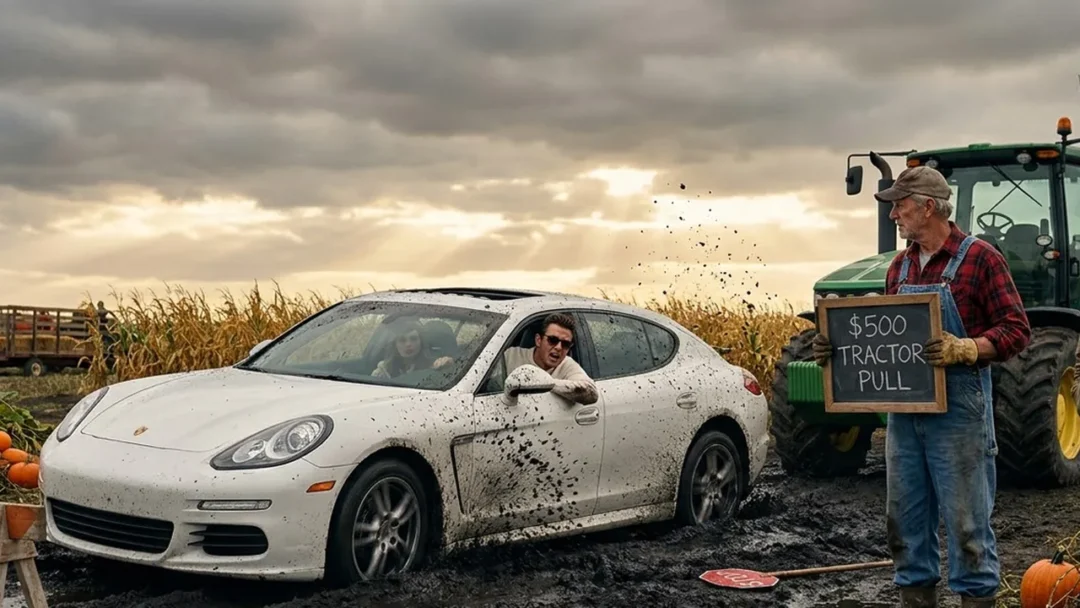
The White Sedan That Sank Beneath Harvest Hill
CHAPTER 4: WATER WHERE IT SHOULD NOT BE
The salt mist thickened as dusk fell over Hollow Reed Farm. The pumpkin fields stretched away into gray shadows, orange gourds glowing like dull embers against the dark earth. Walter sat on the tailgate of his pickup truck, oiling the steel links of a logging chain by the glow of a work light.
Owen walked up with a heavy brass flashlight and a multimeter. “I checked our bank balance. After paying for the festival tents and the health department cider permits, we have three thousand dollars in operating cash. We can’t post a ten-thousand-dollar bond by noon.”
“We won’t need to post it if we find the pump bypass,” Walter said, his voice steady as iron. “Priya’s right about one thing. Mechanical flooding leaves physical traces. Water doesn’t lie, even when people do.”
They crossed the dark fields on foot, keeping their flashlights angled low to avoid drawing attention from the highway. The air grew colder, thick with the pungent aroma of brackish mud and crushed reed stalks. At the eastern perimeter of the farm stood the abandoned brick pump house, built in the 1930s by the Works Progress Administration to regulate drainage between the freshwater cranberry bogs and the tidal estuary.
The pump house door was secured with a heavy forged-iron hasp and an American-made brass padlock that Walter had installed fifteen years ago.
Owen aimed his beam at the lock. The brass shackle had not been unlocked. It had been sheared clean through with heavy hydraulic bolt cutters. The severed lock hung crookedly from the hasp, held in place by a single twist of thin copper wire to make it look intact from the road.
“Someone was here last night,” Owen whispered.
Walter pushed the heavy timber door open. The hinges groaned in the stillness. Inside, the air was warm, smelling of grease, battery acid, and stagnant pond water. The massive cast-iron pump sat in the center of the concrete floor, its drive belt resting motionless on the flywheel.
Owen knelt beside the auxiliary junction box. The cover plate had been unbolted. Fresh copper wiring bypassed the farm’s automated timer switch, running directly to a portable commercial lithium battery pack tucked behind two rusted barrels of gear oil.
“They didn’t use the grid power,” Owen said, tracing the wire with his meter probes. “Grid power would have shown up on our monthly utility audit. They brought their own battery and hooked it to a digital relay switch.”
“Look at the discharge pipe,” Walter said.
A heavy four-inch flexible rubber discharge hose was clamped to the high-volume outflow manifold with fresh stainless-steel bands. The hose snaked out through an open ventilation grate at the back of the brick building, disappearing into the dense tallgrass along the property boundary.
Owen stepped through the low doorway and followed the hose through the reeds. Fifty yards out, the hose crossed the survey ditch and entered an overgrown access road leased by Pike Strategic Media for overflow festival parking. The hose ended in an underground drainage tile that fed directly into the culvert beneath the pumpkin lane.
“They pumped twenty-two hundred gallons of brackish estuary water straight under the tractor lane,” Owen said, taking high-resolution photographs of the battery serial number and the branded hose clamps. “Pike’s development company owns this leased strip. Their maintenance tags are right on the hose.”
A sharp twig snapped in the darkness twenty feet behind them.
Walter instantly killed his flashlight. “Who’s there?”
The wind rustled through the dry corn maze bordering the pump house meadow. For five seconds, there was no sound except the distant whistle of a coastal buoy. Then, a quick, shuffling step moved through the dry stalks.
Owen turned his beam toward the entrance of the corn maze. The yellow beam caught the edge of a beige wool coat and a flash of blonde hair ducking behind the twelve-foot corn wall.
“Lila?” Owen called out.
The figure did not answer. The dry stalks rattled violently as the intruder ran deeper into the six-acre maze.
“Owen, stay by the path,” Walter ordered, reaching into his coat for his radio.
“She has the unedited footage, Grandpa!” Owen yelled, already sprinting toward the maze opening. “If Chase deletes her cloud account tonight, we lose the only proof that refutes the video!”
Owen plunged into the dark labyrinth of towering corn. The leaves slashed at his face like dry paper ribbons. The ground beneath his boots was soft and treacherous. Behind him, the wind howled through the stalks, drowning out all footsteps until the maze became a suffocating puzzle of black turns and rustling shadows.
He rounded the third junction, breathing hard, and stopped.
Standing in the dead center of the crossing was not Lila Voss.
A tall man in a heavy black work jacket stood waiting under the cold autumn stars, holding an iron pry bar. In the pale beam of Owen’s flashlight, the man smiled with cold, professional efficiency.
“You’re very observant for a farm boy,” the man said. “Now hand over the phone and the tablet.”