They Ordered His Farm Truck Off the Shared Lane—Then He Read the Easement They Had Ignored for Years
Chapter 1: The Notice Under the Farm Truck Wiper
Samuel Walker saw the white rectangle beneath his windshield wiper before he saw the cattle nosing the fence.
He stopped halfway across the gravel turnout, one boot on the packed stone and the other still on the grass, and stared at it.
The truck had been sitting exactly where he had left it the night before: angled beside the weathered cattle gate, nose pointed toward the shared lane, livestock trailer hooked behind it. In forty minutes he was supposed to be on the county road headed toward a small farm twelve miles east, where a customer had six calves waiting to be hauled to the sale barn.
Samuel pulled the paper free.
NOTICE OF ACCESS VIOLATION.
Below that, in smaller type, it stated that overnight parking of commercial equipment within the maintained shared access corridor was prohibited effective immediately.
Samuel read the line twice.
Then he looked down at the gravel beneath his boots.
“This isn’t the lane,” he said.
Mary had come out carrying his thermos. “What?”
He held the notice toward her.
She read it without speaking.
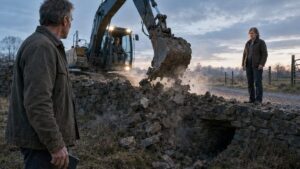
The shared lane ran from the county road past Samuel’s cattle gate, then curved uphill toward Edward Hall’s renovated event barn and two other properties beyond it. The turnout where Samuel parked had existed longer than Samuel had. His father had loaded cattle there. Feed trucks had backed into it. The veterinarian had used it when the pasture gate was too muddy.
Nobody had ever called it part of the lane.
Mary handed the notice back. “Edward?”
“Has to be.”
Samuel folded the paper once and shoved it into his shirt pocket.
The rumble of a pickup came from uphill.
Edward Hall appeared around the bend in a dark truck, slowed, then stopped alongside the turnout. He lowered the window.
“You saw the notice?”
Samuel rested one hand on the hood of his truck. “I saw it.”
Edward nodded as if that settled something. He was a few years older than Samuel, neat even at dawn, with a collared shirt under his work jacket. Since turning his old machine shed into an event barn three years earlier, Edward had begun carrying himself less like a neighboring farmer and more like a man responsible for a property people paid to photograph.
“We’ve got to keep the lane clear overnight,” Edward said.
“The lane is clear.”
“The turnout is included in the maintained access area.”
Samuel glanced deliberately at the open strip of gravel beside his truck. A delivery van could have passed. So could a pickup towing a stock trailer.
“It’s been good enough for thirty years.”
Edward’s jaw tightened. “That’s not the point.”
“It usually is when something’s been used the same way for thirty years.”
Edward looked toward the truck and trailer. “I’m not asking you to stop hauling. I’m asking you not to leave commercial equipment here overnight.”
Samuel felt the irritation rise, hot and familiar.
The truck was not a hobby. The hauling paid diesel bills, vet bills, property taxes. Some months it covered more than the cattle did. When Samuel had bought the heavier truck nine years earlier, nobody had objected. Edward himself had once borrowed the turnout so a roofing crew could turn around.
Samuel pointed toward the gate.
“This space serves my farm.”
Edward said, “It also serves the access road.”
“According to who?”
“The maintenance agreement.”
Samuel almost laughed.
He had signed plenty of checks for gravel and grading over the years, but he could not remember the last time he had read the agreement itself.
Edward must have seen the hesitation.
“We went through it after the insurance review,” he said. “We can’t have equipment narrowing emergency access.”
There it was: a new phrase. Insurance review.
Samuel filed it away without asking about it.
“I have a pickup east of town,” he said. “We can talk later.”
Edward shook his head. “Not with the truck sitting here.”
Samuel stared at him.
“You expect me to move it right now?”
“The restriction is effective immediately.”
For a few seconds neither man said anything.
Mary stood near the porch steps, thermos still in her hand.
Samuel could have pulled onto the lane and left. Instead he looked at the trailer, then toward the cattle gate, calculating. Moving the truck somewhere else before loading meant taking the trailer down to the lower equipment lot, backing it beside the machine shed, unhitching, then returning for it after daylight.
It would cost him at least half an hour.
He pulled his phone out and called the customer.
“I’m running late,” he said.
A pause.
“How late?”
Samuel looked at Edward’s truck.
“Forty minutes. Maybe more.”
The answer came quickly enough to tell him the customer had already been worried.
“I’ve got somebody else who can make it before eight.”
Samuel closed his eyes.
“All right.”
When the call ended, Edward had the sense not to say anything.
Samuel climbed into the white truck and started the engine.
He moved it.
By seven-thirty the trailer was parked behind his machine shed and the hauling job was gone.
Mary sat at the kitchen table with the notice between them.
“You going to call him?” she asked.
“I already talked to him.”
“That wasn’t talking.”
Samuel gave her a look.
She slid the paper toward him. “This says maintained shared access corridor. Do you know what that actually includes?”
“I know where the road is.”
“That isn’t what I asked.”
He leaned back.
His father would have called the whole dispute foolishness. A lane was where vehicles drove. A turnout was where they got out of each other’s way. Men who needed a written definition for either probably had too much time.
But his father had been dead eleven years.
And Edward had put the rule in writing.
Samuel’s phone buzzed.
A message from Edward contained a PDF.
Samuel opened it.
The first page was a recent map of the shared lane. A gray band marked the maintained access corridor from the county road to the properties uphill.
At Samuel’s cattle gate, the gray shading widened.
It spread across nearly the entire gravel turnout.
Samuel enlarged the image until the lines blurred.
Mary leaned over his shoulder.
“That’s your parking spot.”
Samuel nodded slowly.
The map made Edward’s claim look obvious.
Too obvious.
Samuel stared at the shaded shape and tried to remember ever seeing the turnout drawn that way before.
He couldn’t.
Chapter 2: The Map That Changed at the Fence Line
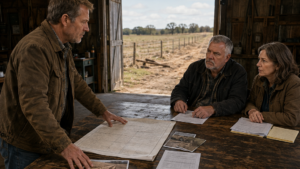
Samuel laid two maps side by side on the kitchen table and knew before breakfast that one of them was wrong.
The newer map was the one Edward had sent: clean digital lines, parcel numbers, the shared lane shown in gray. At the cattle gate, the gray corridor bulged outward and swallowed the turnout.
The older sheet came from a folder Mary had found in a metal filing cabinet beneath tax records and seed invoices.
It was a photocopy from years earlier, faint enough that Samuel had to hold it beneath the kitchen light.
On that version, the shared lane was a narrow strip.
The turnout sat beside it.
Separate.
Mary touched the newer map.
“When did this one get made?”
“I don’t know.”
“You paid road assessments with it attached.”
Samuel looked at her.
She opened another folder and pulled out a maintenance letter dated eighteen months earlier.
The newer map had been stapled behind it.
“You never looked.”
“I looked at what I owed.”
“You looked at the number.”
“That’s what the letter was about.”
Mary said nothing.
That irritated him more than an argument would have.
Samuel took both maps outside.
He walked from the porch to the cattle gate, carrying them in a clear plastic sleeve. Standing at the edge of the gravel, he tried to match the lines to the ground.
The lane itself was unmistakable. Two compacted tire paths ran uphill, pale against darker stone. The turnout widened toward Samuel’s gate, forming a rough triangle where trucks had swung for decades.
But there were no painted lines.
No curb.
No marker saying where maintained lane stopped and farm turnout began.
Edward came down the hill just after nine.
Samuel held up the maps.
“You got a minute?”
Edward looked at them, then parked.
They stood by the fence.
Samuel handed him the older copy. “Explain the difference.”
Edward studied it.
“That’s an old sketch.”
“It’s different.”
“The current maintenance map reflects the area we actually maintain.”
“You maintain the turnout?”
“We’ve put gravel there.”
“So have I.”
Edward handed the sheet back. “The agreement says shared access must remain unobstructed.”
“It says access. It doesn’t say my turnout belongs to the road.”
“The maintenance map shows the corridor.”
“That map is eighteen months old. The turnout’s been here fifty years.”
Edward’s voice remained level. “Samuel, I’m not trying to take your land.”
“Then stop drawing your road across it.”
Edward looked toward the event barn uphill.
A box truck was parked outside, and workers were unloading folding tables.
“We have events now,” he said. “We have deliveries, guests who don’t know the road, emergency requirements. What worked when three families used this lane isn’t automatically enough anymore.”
For the first time Samuel heard something beneath the rule.
Not authority.
Anxiety.
But Edward still had not answered the map question.
Samuel tapped the older sheet.
“Where does the agreement define the turnout?”
Edward frowned. “The maintained corridor is what matters.”
“That isn’t what I asked.”
Edward exhaled.
“If you want to make this legalistic, get the agreement.”
“I will.”
“Good.”
Samuel had expected resistance. The quick answer unsettled him.
Edward turned toward his pickup, then stopped.
“And you should know the next notice won’t just be paper.”
Samuel’s hand tightened around the maps.
“What’s that supposed to mean?”
“The maintenance group can recover costs for removing an obstruction.”
“Towing?”
“If necessary.”
Samuel stared at him. “You tow my truck off ground beside my own gate, we’re going to have a different problem.”
Edward looked back at him.
“That’s exactly the kind of reaction I’m trying to avoid.”
Then he got into the pickup and drove uphill.
Samuel spent the afternoon looking for the shared-road agreement.
Mary found it first.
It was only nine pages, recorded years earlier after the original farms had been divided into smaller parcels. Samuel read it standing at the counter.
The language was dry but understandable.
Each owner had rights of ingress and egress over the private lane. Each contributed to gravel and grading. No owner could place a fence, vehicle, structure, or other obstruction within the shared access in a manner that materially impaired passage.
Samuel read that paragraph three times.
“What does it say about the width?” Mary asked.
He searched.
Nothing clear.
Another section mentioned a maintenance corridor but referred to an attached exhibit.
The exhibit showed the lane.
At the cattle gate, the lines were faint.
Samuel leaned closer.
It did not look like Edward’s newer map.
It did not look exactly like Samuel’s older copy either.
“Well?” Mary asked.
Samuel lowered the pages.
“It says you can’t block the shared access.”
“You already knew that.”
“It doesn’t say where the turnout starts.”
“So neither of you knows.”
Samuel bristled.
“I know what Dad used.”
“That’s not the same thing.”
He folded the agreement too sharply, leaving a crease.
“You keep saying that.”
“Because you keep acting like everybody else remembers what your father remembered.”
Samuel turned toward the window.
The white truck sat behind the machine shed where he had moved it.
For the first time in nine years, it looked misplaced.
That evening he drove up to Edward’s event barn.
Edward was in the office near the side entrance, checking a delivery list.
Samuel placed the agreement on the desk.
“Show me.”
Edward looked up.
“Show you what?”
“Where it says the turnout is part of the lane.”
Edward flipped to the exhibit.
“This is the recorded access.”
“That line runs beside the gate.”
“It’s not surveyed to scale.”
“So your new map is?”
“It reflects maintenance.”
“That’s not ownership.”
Edward leaned back.
“You’re mixing ownership and access rights.”
“Then explain them.”
“I’m not your lawyer.”
Samuel almost answered sharply, but stopped.
That was the problem.
Neither of them actually knew.
Edward softened his voice slightly.
“Move the truck overnight until we sort it out.”
“You mean until I give up.”
“No. Until there’s no question about emergency access.”
Samuel picked up the papers.
“If you tow it, Edward, you’d better be certain.”
Edward met his eyes.
“I intend to be.”
Samuel drove home angry enough to call Charles Martin.
Charles had worked in the county recorder’s office before retirement and had spent decades untangling descriptions written when fences, creeks, stones, and oak trees were treated like permanent coordinates.
Samuel explained the maps, the agreement, the turnout.
Charles listened without interrupting.
When Samuel finished, Charles asked one question.
“What document created the right?”
“The road agreement.”
“No.”
Samuel frowned.
“That’s what we’ve got.”
“That may govern maintenance. I asked what created the right.”
“I don’t know.”
Charles was quiet for a moment.
“Then stop arguing from the maintenance map.”
Samuel looked at the papers spread across the table.
“What should I argue from?”
“You shouldn’t argue from anything yet.”
“That helpful attitude why you retired?”
Charles ignored him.
“Go to the county records office. Find the original easement tied to your parcel. Not the copy in your kitchen. Not Edward’s map. The recorded instrument that first put access across that ground.”
Samuel looked again at the faint lines near his cattle gate.
“And if it says the turnout belongs to the lane?”
“Then at least you’ll know.”
“And if it doesn’t?”
Charles paused.
“Then Edward may have been enforcing a map that never had the authority he thinks it has.”
Chapter 3: The Orange Stakes Across the Cattle Turnout
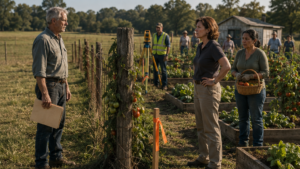
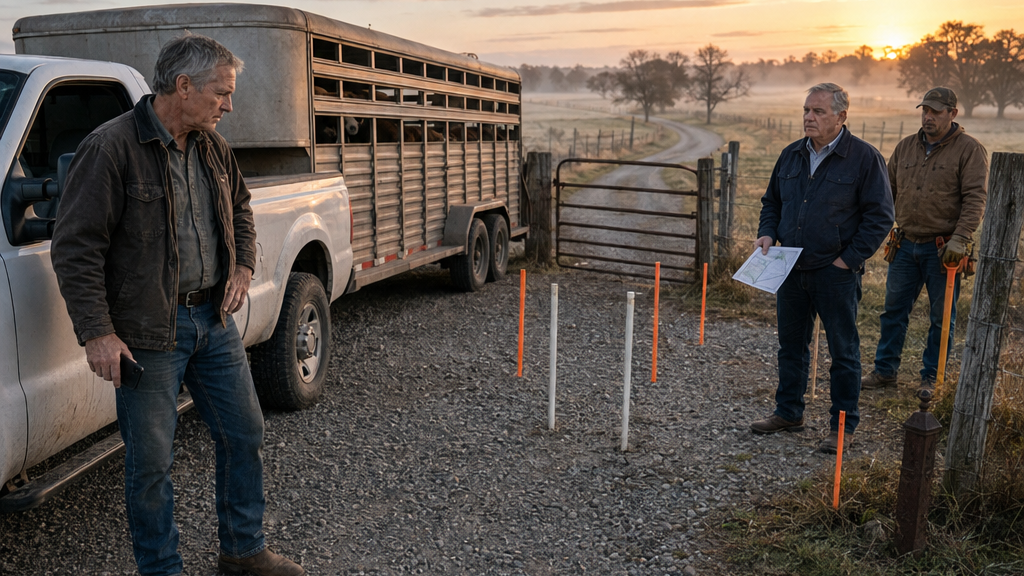
Two mornings later, Samuel came around the machine shed with a loaded livestock trailer and found six orange stakes planted across the turnout.
He hit the brake hard enough to make the cattle shift behind him.
The truck stopped crooked on the gravel.
Fresh fluorescent flags trembled in the headlights. A temporary white post stood near the cattle gate. Another had been driven near the outer edge of the turnout.
A road contractor was unloading tools beside a utility truck.
Edward stood with him.
Samuel shut off the engine.
For several seconds he stayed behind the wheel.
He could feel the cattle moving in the trailer. One hoof struck metal.
Then he got out.
“What is this?”
Edward walked toward him.
“We’re marking the maintained access boundary.”
“You’re marking it across my turnout.”
“The contractor is marking the corridor shown on the maintenance plan.”
Samuel looked at the stakes. “You said we were sorting it out.”
“We are.”
“With posts?”
“They’re temporary.”
Samuel walked to the first one.
It stood exactly where his trailer needed to swing.
“You boxed me in.”
“You can back out.”
“With cattle loaded?”
Edward’s expression changed slightly.
He had not expected the trailer to be full.
The contractor stepped away from his tools.
“I can pull the temporary marker if he needs to leave.”
Edward hesitated.
Samuel noticed.
That hesitation saved the morning from becoming something worse.
Samuel took his phone from his pocket.
Edward frowned. “What are you doing?”
“Documenting it.”
“Samuel—”
“You came onto the turnout and marked a boundary we’re disputing. I’m taking pictures.”
He photographed each stake, the cattle gate, the truck, the lane, and the position of Edward’s contractor.
The anger in him wanted something simpler.
Pull the posts.
Throw them in Edward’s truck bed.
Drive out.
Instead, Samuel remembered Charles’s voice.
Find what created the right.
He looked at the fence line.
Near the oldest cedar post, partly hidden by grass, was a rust-dark piece of iron he had seen all his life.
As a boy, he had been told not to strike it with the mower.
Samuel walked toward it.
“What’s that?” the contractor asked.
“Old survey pin.”
Edward glanced over. “Maybe.”
Samuel crouched and brushed dirt away with his glove.
The iron rod stood less than an inch above ground.
He looked toward the nearest orange stake.
They were not close.
“Got a tape?” he asked.
The contractor did not move immediately.
Edward said, “This isn’t a survey.”
“I didn’t say it was.”
The contractor handed Samuel a long tape measure.
Samuel hooked it at the old gatepost first.
He measured to the iron marker.
Then from the marker to Edward’s nearest stake.
Nine feet, eight inches.
He checked again.
Nine feet, seven and a half.
Edward crossed his arms.
“You don’t know what that pin marks.”
“No.”
Samuel straightened.
“But neither do you.”
He photographed the measurements.
The contractor walked closer and studied the ground.
“Your plan shows the corridor line running almost through this rod,” he said to Edward.
Edward looked down at the map in his hand.
Samuel heard the shift immediately.
Not agreement.
Uncertainty.
Edward said, “The maintenance plan isn’t a boundary survey.”
Samuel nodded. “Then why are you using it to put boundary stakes in?”
“They aren’t boundary stakes.”
“What are they?”
“Access markers.”
Samuel looked at the fluorescent flags cutting across his gravel.
“You can call them birthday candles if you want. They stop my trailer from turning.”
The contractor lowered his eyes, hiding what might have been a smile.
Edward did not.
“You’re making this harder than it needs to be.”
Samuel took a breath.
“No. I’ve been making it easy for years. That’s probably why we’re standing here.”
Edward glanced toward the livestock trailer.
“Move the cattle. We can finish after.”
Samuel shook his head.
“Nobody puts anything else in the ground until we know where that old marker belongs.”
“You don’t have authority to stop road maintenance.”
“And you don’t have authority to redraw my farm because your insurance company likes straight lines.”
That landed.
Edward’s face changed.
Only slightly, but enough.
Samuel saw it.
The contractor looked from one man to the other.
“I’m not getting in the middle of a title dispute,” he said. “If ownership or easement limits are contested, I need that cleared before I install anything permanent.”
Edward turned toward him.
“This is maintenance.”
“It stopped being maintenance when we started arguing over which side of an iron pin the work belongs.”
Edward’s mouth tightened.
For a moment Samuel thought he would order the contractor to continue anyway.
Instead Edward said, “Pull the two blocking markers so he can get out.”
The contractor removed them.
Samuel climbed back into the truck.
He eased forward, swung wide, and guided the trailer through the opening.
As he passed Edward, he lowered the window.
“I’ll be at the recorder’s office this afternoon.”
Edward said nothing.
That silence stayed with Samuel longer than any argument would have.
The county records office occupied the first floor of an old brick building beside the courthouse.
Samuel arrived after lunch with dirt still on his boots.
The clerk helped him search by parcel number.
The shared-road maintenance agreement came up first.
Then amendments.
Then several older references.
Samuel nearly skipped one entry because the recording date preceded the road agreement by decades.
Charles, who had agreed to meet him there, leaned over the terminal.
“Open that.”
The scan took a few seconds to load.
A typewritten document appeared.
The print was faded.
Samuel read the heading.
EASEMENT FOR ACCESS AND AGRICULTURAL USE.
His heartbeat changed.
Charles pointed to a legal description.
“Your parcel.”
Samuel scrolled.
The document granted passage over a strip leading from the county road toward what had once been a larger undivided farm.
That part was expected.
Then a second reference appeared.
Samuel leaned closer.
“…together with the established loading approach adjacent to the livestock gate…”
He read it again.
Charles said nothing.
Samuel felt a surge of satisfaction so sharp it almost embarrassed him.
“There.”
“Keep reading.”
Samuel did.
The scan referenced an attached sketch.
The attachment was stored separately.
The clerk retrieved it from another indexed image.
A crooked hand-drawn line showed the old lane.
Near Samuel’s present cattle gate was a widened shape.
Not exactly the modern turnout.
But unmistakably something more than the road itself.
Samuel put a finger against the screen.
“That’s it.”
Charles nodded cautiously.
“It’s something.”
“It’s the turnout.”
“Looks like a loading approach.”
“That’s what I’ve been saying.”
Charles gave him a sideways look.
“You’ve been saying your father parked there.”
Samuel ignored him.
The old sketch included measurements from a fence corner and a survey monument.
Samuel thought of the iron pin.
Nine feet from Edward’s orange stake.
He took out his phone and pulled up the photograph.
Charles compared it to the old sketch.
“This could matter.”
“Could?”
“You want certainty too quickly.”
Samuel looked back at the phrase: established loading approach adjacent to the livestock gate.
The words felt like vindication.
Edward’s clean digital map suddenly seemed flimsy beside them.
“Can I get certified copies?”
The clerk nodded.
While she prepared them, Samuel searched the index again.
The original easement contained another reference number in the margin.
An amendment.
Recorded seventeen years later.
Samuel opened it.
The first page dealt with maintenance.
The second adjusted seasonal access.
Then a sentence near the bottom mentioned emergency passage.
Charles leaned toward the screen.
Samuel read it slowly.
Whatever satisfaction he had felt began to cool.
The loading approach was protected.
But the document was not finished with him.
Still, one thing had changed beyond argument.
The turnout had not appeared because Edward’s maintenance committee drew it on a map.
It had been written into the land long before either man controlled it.
Samuel collected the certified pages.
On the way out, the clerk handed him one more index printout.
“There’s another cross-reference tied to that easement,” she said.
Samuel looked down.
A record number.
A date older than his white truck, older than Edward’s event barn, older than the maintenance committee itself.
Charles read over his shoulder.
“That,” he said, “is the one you need next.”
Samuel folded the printout carefully instead of stuffing it into his pocket.
For once, he wanted every line intact.
Chapter 4: The Easement Was Written for Livestock
The next record was only three pages long, but the sentence that mattered sat in the middle of the second page.
Samuel read it once.
Then again.
The easement, amended years after the original access agreement, preserved “the established livestock loading approach adjacent to the western gate for agricultural loading, unloading, and seasonal equipment passage.”
He looked at Charles.
“That’s the turnout.”
Charles kept his eyes on the page. “It certainly sounds like it.”
Samuel leaned back in the wooden chair at the records office.
For two days he had been listening to Edward talk about maintained corridors, clear passage, modern maps, and insurance requirements. Now the county’s own record said the widened ground beside Samuel’s cattle gate had a purpose.
Not convenience.
Not habit.
Purpose.
His father had not simply chosen a handy spot to park.
The land had been arranged to let the farm function.
Samuel tapped the page.
“So he can’t tell me I can’t use it.”
Charles finally looked up.
“That isn’t what this says.”
Samuel’s satisfaction dimmed.
“It says agricultural loading.”
“Yes.”
“Equipment passage.”
“Yes.”
“My truck is farm equipment.”
“Sometimes.”
Samuel frowned.
Charles turned the page over.
“There’s another amendment.”
The county clerk had included it in the packet. Recorded seventeen years after the livestock clause, it dealt mostly with grading and access after another parcel had been divided.
Near the bottom was a paragraph neither man had read carefully the day before.
Charles pointed.
Samuel read aloud.
“Nothing placed or maintained within any loading approach or access widening shall materially interfere with continuous emergency passage along the private lane.”
He stopped.
Charles said, “That matters too.”
Samuel looked toward the high windows.
“So now the turnout belongs to me and Edward.”
“No.”
Charles sounded tired.
“Stop trying to turn every sentence into ownership. One document preserves your agricultural use. Another protects passage. Those rights can overlap.”
Samuel folded his arms.
“My truck has sat there nine years.”
“That proves use.”
“It proves nobody considered it an emergency problem.”
“Until somebody did.”
Samuel almost snapped back.
Instead he pictured the truck with the large livestock trailer attached, parked at its usual angle. Most nights, there was plenty of room.
Most.
He drove home with certified copies on the passenger seat.
Mary was in the farm office when he came in.
He placed the livestock clause in front of her.
“There.”
She read it.
Her face brightened.
“So you were right.”
“I was.”
He put the emergency amendment beside it.
Mary read that one more slowly.
“Oh.”
Samuel sat down.
She looked toward the window, where the white truck was now parked near the machine shed.
“With the big trailer hooked up,” she said, “how much room is actually left?”
“Enough.”
“That wasn’t my question.”
Samuel stared at her.
Mary stood and walked to the filing cabinet. She pulled out a folder of hauling invoices.
“You remember the heifers we took west in June?”
“What about them?”
“You parked loaded the night before.”
“I had to leave at four.”
“And Edward had an event.”
“So?”
“One of their caterers called me because they couldn’t get a box truck around your trailer.”
Samuel remembered.
At the time he had blamed the driver.
There was a wide lane. People who could not handle a truck should not drive one.
Mary continued.
“You moved it after I came outside.”
“Because the driver was useless.”
“You moved it because he couldn’t pass.”
Samuel stood.
“That wasn’t an ambulance.”
“No. But it was the same width problem.”
He picked up the documents.
For an hour he walked the turnout with a tape measure.
Truck alone, plenty of clearance.
Truck and shorter trailer, still comfortable.
Truck and the twenty-eight-foot livestock trailer angled toward the gate, less.
Much less.
He stood in the gravel where Edward’s orange stakes had been and looked at the worn tracks.
The irritating truth was visible without a lawyer.
Edward’s map was too broad.
But Samuel’s certainty had been too broad too.
That afternoon, Samuel scanned the certified livestock easement and emailed it to Edward with one sentence:
This appears to confirm agricultural use of the turnout tied to my parcel.
He expected no immediate reply.
At four-thirty, Edward’s truck rolled down the lane.
Samuel met him by the gate.
Edward held a printed copy.
“I read it.”
“Good.”
“It doesn’t give you unrestricted parking.”
“It gives me agricultural loading.”
“It also says emergency passage stays open.”
Samuel nodded reluctantly.
Edward seemed surprised.
“I read that too.”
The silence between them changed.
For the first time, neither man could pretend the paperwork belonged entirely to his side.
Samuel pointed toward the turnout.
“Your map still isn’t right.”
“Maybe not.”
“And those stakes were wrong.”
Edward’s mouth tightened. “The contractor was marking the maintenance corridor.”
“With a plan that doesn’t match the recorded sketch.”
Edward looked toward the old iron marker.
“I’ve asked him not to do any permanent work.”
That was the nearest thing to backing down Samuel had heard.
He let it sit.
Then Edward said, “But the overnight restriction stays.”
Samuel’s head came up.
“You just read the easement.”
“I did.”
“And you’re still issuing violations?”
“If your truck or trailer narrows emergency clearance, yes.”
“You don’t get to decide that by yourself.”
“As maintenance chair, I have to respond to access problems.”
Samuel almost told him where he could put the title.
Instead he said, “Then measure it properly.”
Edward looked at him for a long moment.
“I intend to.”
The next morning Mary found the envelope first.
It had been clipped to the cattle gate in a clear plastic sleeve.
Samuel opened it standing in the turnout.
SECOND NOTICE OF ACCESS VIOLATION.
This time Edward had cited the emergency-passage amendment instead of the maintenance map.
Samuel read the notice twice.
It should have felt weaker than the first.
Instead it bothered him more.
Edward had changed his argument.
He had read the same records Samuel had.
And he was still pushing.
Chapter 5: Why Edward Would Not Let It Go
Samuel saw the insurance inspection vehicle outside Edward’s event barn before Edward saw him.
It was parked beside the main entrance, a plain gray SUV with a clipboard on the dashboard. A man in a jacket walked along the edge of the lane taking photographs toward the barn, the parking field, and the downhill curve that led past Samuel’s cattle gate.
Samuel slowed his truck.
The man stopped near the bend and aimed his phone directly toward the turnout.
Samuel pulled over.
Edward came out of the barn.
For a moment neither man spoke.
Then Samuel nodded toward the inspector.
“That why this started?”
Edward glanced back.
“It’s part of it.”
“Part?”
Edward put his hands in his jacket pockets.
“The carrier reviewed the property after the spring event.”
Samuel remembered that Saturday. Nearly eighty cars had filled Edward’s grass lot. A delivery truck had backed into the ditch. Someone had parked half on the shared lane until Samuel moved it.
“What happened?”
“Nothing happened.”
“Then why the review?”
“Because nothing has to happen before an insurer notices risk.”
The inspector walked farther uphill, leaving them alone.
Samuel got out.
“You could’ve said this the first day.”
Edward’s expression hardened.
“I told you there was an insurance review.”
“You said it like another rule you expected me to obey.”
“I expected the lane to stay clear.”
Samuel pointed downhill.
“The turnout isn’t the lane.”
“We’ve established that it has protected agricultural use. We have not established that you can leave a commercial truck and twenty-eight-foot trailer there whenever you want.”
“You didn’t start with twenty-eight feet. Your first notice said no commercial equipment overnight.”
Edward looked away.
That mattered.
Samuel stepped closer.
“You knew the documents were unclear, didn’t you?”
Edward did not answer immediately.
The barn doors stood open behind him. Inside, workers were setting tables beneath hanging lights. The old machine shed Samuel remembered had become polished timber, concrete floors, and bookings months in advance.
Edward finally said, “I knew the map and the old paperwork didn’t line up perfectly.”
Samuel stared.
“And you sent the notice anyway.”
“Yes.”
“Why?”
Edward’s face flushed slightly.
“Because I thought if I asked you to change voluntarily, you’d say no.”
Samuel almost laughed from disbelief.
“So you decided to tell me you had authority you weren’t sure you had.”
“I had responsibility.”
“That isn’t the same thing.”
“No,” Edward said. “It isn’t.”
The admission stopped Samuel.
Edward looked toward the barn.
“You think this place is doing better than it is.”
Samuel said nothing.
“We spent more than we planned converting it. The loan payments don’t care whether we have rain or cancellations. The carrier gave me a list after the review. Parking control. Fire access. Delivery routes. Lane clearance.”
He rubbed a hand across his jaw.
“One serious finding, and my premium goes up again. A worse one, they could refuse renewal.”
Samuel looked toward the polished barn.
For weeks he had assumed the business had made Edward more arrogant.
Now he saw another possibility.
It had made him afraid.
That did not excuse the notices.
But it changed their shape.
Edward continued.
“The inspector was here during an event in June.”
Samuel knew what was coming before he heard it.
“Your livestock trailer was at the turnout. A box truck had trouble getting through.”
Samuel thought of Mary’s folder.
“The box truck got through.”
“After you moved the trailer.”
“It wasn’t an emergency vehicle.”
“No. But the inspector wrote it down.”
Samuel looked toward the bend.
A fire engine would be wider.
Maybe not much.
Enough.
“So instead of bringing me the report,” Samuel said, “you redrew my turnout.”
Edward stiffened.
“I used the maintenance plan already on file.”
“A plan you knew might not control the boundary.”
“I needed action.”
“You wanted compliance.”
“Yes.”
The bluntness surprised both of them.
Edward lowered his voice.
“I thought you’d complain for a week and then park behind your shed.”
Samuel felt the anger return.
Not because Edward hated him.
Because Edward had counted on Samuel being easier to pressure than to persuade.
“And when I found the easement?”
“I still had the insurance problem.”
“So you kept writing notices.”
“I shifted to the emergency clause because that’s the actual issue.”
Samuel shook his head.
“You don’t get credit for finding the right reason after starting with the wrong one.”
“I’m not asking for credit.”
The insurance agent approached carrying a clipboard.
Edward stepped aside and spoke with him quietly.
Samuel could not hear the details, but the agent pointed down the lane twice and then toward the turnout.
When he left, Edward remained beside the barn.
Samuel said, “What happens if this isn’t resolved?”
Edward looked tired now.
“The carrier wants written access controls.”
“Controls meaning what?”
“Defined clearance. No obstruction during scheduled events. Responsibility for maintenance.”
“And if they don’t get it?”
“They reserve the right to change terms at renewal.”
Samuel understood enough insurance language to know what that meant.
Edward walked toward his office and returned with a sheet of paper.
He handed it over.
It was not another violation.
It was a notice of intent to request a formal access restriction through the road-maintenance group.
Samuel read the first paragraph.
“You’re asking them to prohibit overnight parking altogether.”
“If we don’t have an alternative.”
“You do.”
“What?”
“Measure the actual clearance.”
Edward shook his head.
“We’ve been arguing about that for two weeks.”
“No. We’ve been arguing about maps.”
Samuel folded the notice.
Edward said, “Then give me something workable.”
Samuel looked at him.
“You mean now you want me to solve it.”
“I want it solved.”
That was not an apology.
It was, however, the first useful sentence Edward had offered.
“How long?”
“Forty-eight hours.”
Samuel gave a short laugh.
“You spent months worrying about insurance and I get two days.”
“The maintenance group meets Friday.”
“You scheduled it already.”
“Yes.”
Again, no attempt to hide it.
Samuel slid the notice into his pocket.
On the drive home he passed the turnout slowly.
He saw it now from Edward’s direction.
The curve.
The narrowed sightline.
The cattle gate.
The place where Samuel’s longest trailer sat when he had a predawn haul.
For years it had meant one thing: room to work.
Now it carried someone else’s risk too.
Mary was at the desk entering receipts when he walked in.
He put Edward’s notice beside the keyboard.
She read it.
“What are you going to do?”
Samuel looked through the office window at the white truck.
His first answer came easily.
“Fight it.”
Mary waited.
He thought of the original easement.
The emergency amendment.
The June box truck.
Edward admitting he had enforced first because he expected Samuel to give in.
Then Samuel heard his own voice from a hundred arguments over the years:
That’s how we’ve always done it.
He sat down.
“Maybe not the way he expects.”
Chapter 6: Samuel Writes the Rule He Can Live With
Samuel tore his first response in half at six-thirteen the next morning.
The page had begun with three paragraphs about Edward’s lack of authority and ended with a threat to seek legal costs if anyone interfered with Samuel’s agricultural access.
Mary picked up one half from the kitchen table.
“This sounds like you want a judge.”
“I want him to stop.”
“That isn’t what you wrote.”
Samuel took the paper from her and dropped it into the trash.
Outside, the white truck was visible through the window. The trailer was unhooked. The turnout beside the gate lay empty.
He pulled a clean sheet toward him.
“What would you write?”
“I wouldn’t start with what he did wrong.”
“He did plenty wrong.”
“I know.”
She poured coffee.
“But you already proved that.”
Samuel leaned back.
That bothered him because it was true.
The old easement gave him agricultural use.
The emergency amendment limited that use where passage was materially impaired.
Edward’s maintenance map could not simply erase the turnout.
Samuel’s habit could not erase the emergency clause either.
He picked up a pencil.
“Truck without trailer needs about nine feet.”
Mary nodded.
“Trailer?”
“Depends how I angle it.”
“That’s the problem.”
By eight, Samuel was outside with the tape measure.
He began at the old iron survey marker.
This time he was not trying to prove Edward’s orange stakes wrong.
He measured usable width.
From the gatepost to the compacted edge.
From the lane center to the outer gravel.
Truck width.
Mirror clearance.
Trailer swing.
He marked measurements in a notebook.
At ten, Edward’s pickup appeared.
Samuel did not wave him away.
“I need your event-barn delivery width.”
Edward stopped.
“What?”
“Largest regular truck.”
Edward got out slowly.
“Usually eight and a half feet.”
“Mirrors?”
“Closer to ten.”
Samuel wrote it down.
“What about emergency access?”
Edward hesitated.
“The insurer wants twelve feet clear where possible.”
“Wants or requires?”
“Wants. The recorded amendment only says continuous passage.”
Samuel looked up.
“That’s the first distinction you’ve made in a while.”
Edward ignored the remark.
Together, awkwardly, they measured the bend.
Samuel parked the white truck in its usual position without the trailer.
More than twelve feet remained.
He hooked the shorter stock trailer.
Still enough if he stayed inside a line several feet from the lane.
Then he connected the long trailer and angled it the way he normally did before an early haul.
The open width narrowed.
Edward stood in the lane with the tape.
“Ten feet, seven.”
Samuel checked.
The number was right.
Neither said anything.
Finally Samuel said, “That’s not enough for what you’re asking.”
“No.”
Samuel unhooked the trailer.
Edward looked almost surprised.
“What?”
“I said no.”
“That’s usually where you start arguing.”
“I’m trying something new.”
Edward gave him a brief look that was almost amusement.
Samuel returned to the kitchen and wrote a proposal.
Agricultural loading and farm-truck parking would remain permitted within a measured portion of the turnout.
The lane would retain a defined twelve-foot emergency-clearance path.
The long livestock trailer could be staged overnight only when positioned inside the marked loading boundary.
During scheduled event hours, no trailer could extend toward the lane.
Temporary loading could still occur when necessary.
No party could install posts, barriers, or markers without written agreement.
Samuel stared at the last sentence for a long time before adding another.
Changes affecting access would be documented and recorded.
Mary read it.
“You put that in for yourself.”
“For everybody.”
“For yourself too.”
He did not argue.
Edward arrived that afternoon.
He read the proposal standing at the cattle gate.
When he reached the event-hours restriction, he nodded.
When he reached the clause barring unilateral markers, his mouth tightened.
When he finished, he handed it back.
“It doesn’t address maintenance liability.”
Samuel exhaled.
“There’s always something.”
“Yes. Because this is what I was trying to tell you.”
“No. This is what you should have told me.”
Edward looked away.
Samuel waited until the heat passed.
“What maintenance?”
“If the widened turnout is protected for your agricultural use, who pays when your trailers break down the gravel edge?”
“I’ve put gravel here for years.”
“Informally.”
Samuel nearly laughed.
There was the word again.
Informally.
The thing he had always preferred had become the source of half the dispute.
“What do you want?”
“Turnout maintenance tied to your parcel. Lane maintenance stays shared. Damage caused by event traffic stays mine where it can be identified.”
“That last part will be impossible to prove.”
“Then proportional contribution.”
Samuel shook his head.
“Too vague.”
Edward nodded.
“Then write something better.”
The challenge did not feel like the earlier ones.
Samuel looked at the turnout.
The old iron marker sat where it always had.
The orange stakes were gone.
He realized he no longer wanted the agreement simply to stop Edward.
He wanted whoever owned the properties twenty years from now to know what the ground meant.
That evening Samuel revised the document.
He added a maintenance formula based on the existing lane assessment, with extraordinary turnout repairs charged to the user who caused documented damage when possible and otherwise assigned to the parcel benefiting most directly.
Mary read the clause twice.
“That sounds like Charles.”
“He told me not to call him unless I was willing to read the whole sentence.”
“Smart man.”
Samuel printed three copies.
The next morning he met Edward at the turnout.
They measured once more, this time placing small temporary flags along the proposed clearance line.
The difference from the orange stakes was not lost on Samuel.
Those first markers had been placed to tell him where he could not go.
These were being placed to show where both men could.
Edward stood near the survey pin and checked the measurement.
“Twelve feet.”
Samuel nodded.
“And the truck stays inside that line.”
“When it’s parked.”
“Long trailer?”
“Only staged overnight if it clears the line.”
“Event days?”
“Same rule. If it doesn’t fit, it moves.”
Edward looked toward the event barn.
“That works for the insurer.”
“It works for the farm.”
Neither offered a handshake.
Not yet.
At noon Edward emailed comments on the revised agreement.
Most were minor.
One was not.
He still wanted the maintenance chair to retain unilateral authority to declare temporary restrictions when “conditions required.”
Samuel read the clause twice.
Then deleted it.
He replaced it with language requiring immediate temporary action only for an actual obstruction or emergency, followed by written notice and review.
Mary watched him print the final draft.
“You think he’ll sign that?”
“I think he wants his insurance problem solved.”
“And you?”
Samuel stacked the certified easement, the old sketch, the emergency amendment, and the new agreement in a folder.
“I want the next man who stands at that gate to have more than a story about what my father used to do.”
Friday afternoon, Samuel walked into the road-maintenance meeting carrying the folder.
Edward was already seated at the long table.
Two neighboring landowners sat across from him.
Samuel placed the documents in front of each of them.
On top was the revised access agreement, ready for signatures and recording.
Edward looked down at the paragraph limiting unilateral authority.
Then he looked at Samuel.
Neither man spoke.
This time, the map between them had blank signature lines.
Chapter 7: The Turnout Stayed, but the Handshake Changed
Edward crossed out the clause with one slow stroke of his pen.
Samuel watched the black line pass through the words granting the maintenance chair authority to impose temporary access restrictions at his sole discretion.
Nobody at the table spoke.
The two neighboring landowners had copies of the revised agreement in front of them. One had been reading every paragraph twice. The other had spent most of the meeting looking from Samuel to Edward as if waiting for one of them to turn the discussion back into the argument everyone had heard about for weeks.
Edward set the pen down.
“I can live without unilateral authority,” he said.
Samuel did not answer immediately.
That sentence mattered more than he wanted to show.
Edward turned the page.
“But I want the emergency language to stay.”
Samuel leaned forward.
“As written?”
“As written.”
The draft required a twelve-foot clear path through the lane and around the turnout whenever reasonably possible. It allowed temporary action without prior approval only when a vehicle, trailer, fallen tree, equipment failure, or other actual condition blocked immediate passage.
Afterward, whoever took action had to provide written notice.
No permanent posts.
No new boundaries.
No revised maps quietly adopted at a maintenance meeting.
Samuel had written those lines himself.
Now he looked at the paragraph that applied to him.
Agricultural loading remained protected within the turnout, but anything parked there had to stay inside the measured loading area. His longest trailer could no longer sit at the angle he had used for years if that narrowed the emergency corridor.
Edward tapped that section.
“You agree to this?”
Samuel looked through the window toward the lane.
His first instinct, weeks earlier, would have been to say the truck had always fit.
His father had parked there.
He had parked there.
Nobody had complained.
Those facts were still true.
They were also no longer enough.
“Yes,” Samuel said. “If the long trailer cuts into the clearance, I move it.”
Edward studied him as though checking for sarcasm.
Samuel gave him none.
One of the neighboring landowners spoke.
“So we’re not deciding who owns the turnout?”
Samuel shook his head.
“That’s not what this agreement needs to decide.”
Edward nodded.
“The recorded easement already tells us what rights exist. This clarifies how we use them now.”
The landowner looked relieved.
Samuel understood why.
For weeks the dispute had sounded like a choice between two absolutes: either Samuel could do whatever he wanted beside his gate, or Edward controlled the entire widened gravel area as part of the private road.
The documents had said something more difficult.
Samuel had protected agricultural access.
Edward had legitimate responsibility for shared passage.
Neither right erased the other.
The second landowner pointed to the maintenance section.
“What about repair costs?”
Edward said, “Shared lane stays under the existing assessment.”
Samuel added, “Turnout repairs tied mainly to farm use come to my parcel. If event traffic causes something specific, Edward handles it. If nobody can prove exactly what caused general wear, we use the percentage in the agreement.”
“That going to start another argument?”
Samuel looked at Edward.
“Probably someday.”
Edward almost smiled.
“Then at least the argument will start from the same page.”
Mary’s voice came back to Samuel from the kitchen table.
Everybody else remembers what’s written.
He had resented the idea when she said it.
Now he looked at the documents spread before them and understood what she had meant.
Memory worked well when everybody wanted the same thing.
Paper mattered when they did not.
The meeting lasted another hour.
They adjusted two sentences.
One dealt with snow piled along the turnout edge.
Another specified that scheduled event traffic could not be used as an excuse to block Samuel’s cattle gate.
Edward objected at first.
Samuel pointed to the original easement.
“Guests don’t outrank agricultural access.”
“No,” Edward said. “But livestock loading can’t close the lane during a hundred-person event either.”
“Then we schedule around each other when we can.”
“And when we can’t?”
Samuel thought about it.
“Farm necessity gets access. You get notice if I can give it.”
Edward nodded.
“That’s fair.”
The word sounded strange after weeks of notices.
When the last revision was made, Edward slid the agreement toward Samuel.
“There’s still one thing.”
Samuel waited.
“The old maintenance map.”
“What about it?”
“I’m withdrawing it as a boundary reference.”
One of the landowners looked up sharply.
Edward continued.
“It can stay in the maintenance file for gravel quantities and grading history. But it shouldn’t be used to define the easement.”
Samuel felt something inside him settle.
Not triumph.
Something quieter.
The map had been the first piece of paper that made him doubt his own ground. For days he had stared at the gray shading as though somebody could change forty years of use with a printer.
Now Edward was the one removing its authority.
Samuel said, “Put that in the minutes.”
Edward looked at him.
Then nodded.
“I will.”
The signatures came last.
Samuel signed first.
Edward signed beneath him.
The two landowners signed as witnesses to the maintenance-group approval.
There was no applause.
No dramatic silence.
Just pens scratching over paper and someone moving a coffee cup so the pages would not get stained.
Samuel preferred it that way.
Two days later, he and Edward met at the turnout with a tape measure, a can of temporary marking paint, and the recorded sketch.
The orange stakes were long gone.
Samuel hooked the tape at the old iron survey marker.
Edward walked the line with him.
“Twelve feet here,” Edward said.
Samuel checked.
“Twelve and three inches.”
“Good.”
They marked the edge lightly.
The new line did not cut across the turnout the way Edward’s first markers had.
It followed the practical shape of the ground.
Samuel parked the white truck inside it.
Plenty of room remained.
Then he connected the long trailer.
At the angle he had always preferred, the trailer crossed the line.
He stared at it.
Edward said nothing.
Samuel climbed into the cab, pulled forward, backed twice, and changed the angle.
When he got out again, the trailer sat fully inside the loading area.
Edward measured the remaining clearance.
“Twelve feet, one.”
Samuel looked at the trailer.
It was less convenient.
Not much.
Enough to bruise his pride if he wanted it to.
He did not.
“That works,” he said.
Edward rolled up the tape.
For several moments they stood beside the cattle gate.
The event barn was visible uphill through the trees. Samuel could hear faint hammering from somewhere near the parking field.
Edward said, “I should have brought you the insurance report first.”
Samuel looked at him.
Edward continued before Samuel could answer.
“I thought if I made it a rule, you’d move the truck. I figured explaining everything would turn into an argument.”
Samuel gave a dry laugh.
“You were right about the argument.”
“I was wrong about the rest.”
Samuel rubbed the dirt off the old survey pin with the toe of his boot.
“You knew the map was shaky.”
“Yes.”
“That’s the part I had trouble with.”
“I know.”
Samuel looked toward his truck.
“I wasn’t exactly helping.”
Edward raised an eyebrow.
Samuel disliked admitting things twice.
“I ignored the maintenance letters.”
Edward waited.
“I saw the amount due and threw the rest in a drawer.”
“I noticed.”
“And the big trailer did narrow the lane.”
“Sometimes.”
Samuel glanced at him.
“You don’t have to sound so pleased.”
“I’m trying not to.”
For the first time since the first notice appeared, Samuel laughed.
Only once.
Then it was gone.
Edward held out his hand.
Samuel looked at it.
Years earlier he would have considered a handshake enough.
A handshake for gravel.
A handshake for fence repairs.
A handshake for borrowing a tractor or letting a delivery driver turn around.
He had once believed writing things down meant you expected people to fail you.
Now the signed agreement waited in a folder on his kitchen table, ready to be recorded at the county office.
Samuel took Edward’s hand.
But he understood the gesture differently.
The handshake was not replacing the paper.
It came after it.
The next morning Samuel and Mary drove to the county recorder’s office.
The clerk reviewed the agreement, checked the parcel references, attached the older easement numbers, and slid the documents back beneath the glass for Samuel to verify.
He read every page.
Mary noticed.
“You want me to give you a minute?”
Samuel looked at her.
She smiled.
He finished reading.
“No. I’m done.”
“You sure?”
Samuel tapped the final page.
“For once.”
The clerk stamped the instrument.
The sound was small and mechanical.
Samuel found it strangely satisfying.
When they returned to the farm, he put the certified copy in the metal filing cabinet.
Not beneath seed invoices.
Not behind tax receipts.
He labeled the folder clearly.
Mary stood in the doorway.
“Your father would’ve hated that much paperwork.”
Samuel closed the drawer.
“He would’ve hated orange stakes worse.”
That evening he had an early cattle haul scheduled.
He hooked the long trailer to the white truck, loaded before dark, then positioned the rig inside the newly defined turnout.
It took one extra correction to keep the trailer behind the clearance line.
Samuel got out and checked it with his eye.
The shared lane remained open.
The cattle gate remained usable.
Nothing about the turnout looked dramatic.
Gravel.
Fence.
Old survey pin.
A truck that needed washing.
But for the first time, Samuel knew exactly what each part was allowed to do.
Edward drove past near sunset.
He slowed.
Samuel expected the truck to stop.
It did not.
Edward raised two fingers from the steering wheel and continued uphill.
Samuel returned the gesture.
The next morning, before dawn, Samuel walked toward the truck carrying his thermos.
He could see the windshield from twenty yards away.
Nothing was tucked beneath the wiper.
No white rectangle.
No warning.
No map.
He stopped beside the cattle gate and looked down the open lane.
Then he climbed into the truck, started the engine, and pulled away from the turnout his family had used for generations—still theirs to use, no longer theirs to misunderstand.
The story has ended.