When The Cold Gavel Strikes The Corrupted Silver Shield
CHAPTER 3: THE HALL OF BLACK WALNUT
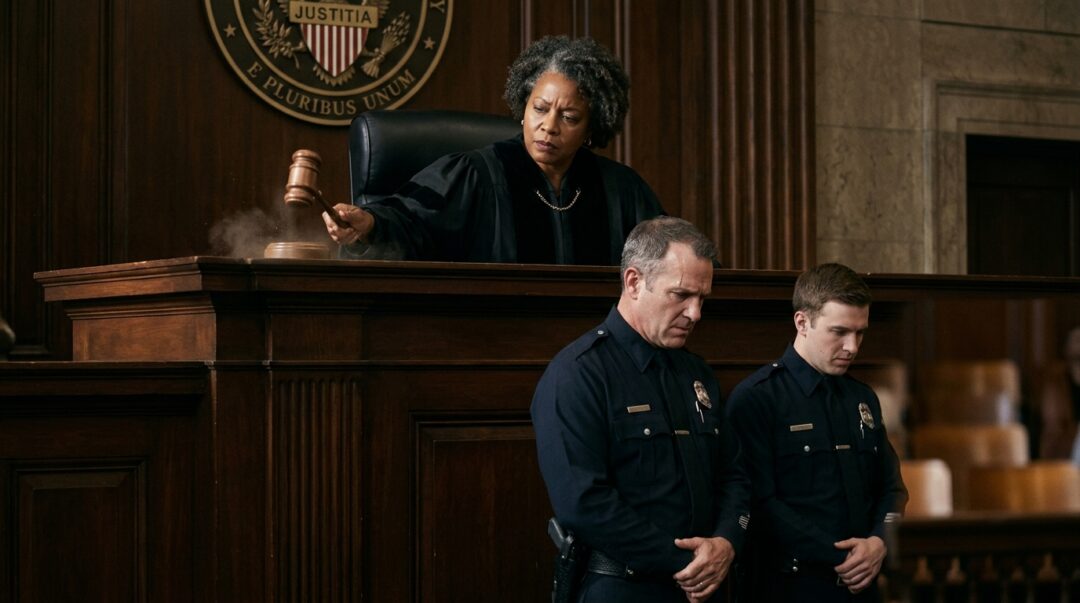
The Grand Chamber of the Supreme Court of Georgia in the Nathan Deal Judicial Center was an architectural cathedral designed to humble mortals. Thirty feet overhead, coffered walnut beams framed ornate brass lanterns that cast warm, dramatic pools of amber light across paneling of hand-rubbed Georgia timber. Flanking the monumental, elevated judicial bench were the banners of the United States of America and the State of Georgia, framing a five-foot relief of the Great Seal carved from mountain marble: Wisdom, Justice, Moderation.
Along the polished mahogany side gallery, twenty high-ranking state officials sat in stunned, breathless silence—the State Attorney General, the Director of the Georgia Bureau of Investigation, the City Solicitor, and several senior appellate clerks. The atmosphere carried the suffocating gravity of an impending military court-martial.
Sergeant Frank Malley and Officer Tyler Cruz stood side by side in the center aisle, thirty feet below the towering dais.
They were stripped of their utility belts, their badges, their firearms, and their radios. Malley’s starched uniform collar was soaked through with nervous sweat, his gray hair plastered against his temples, his thick fingers clutching his saucer cap against his belt buckle so tightly the brass chinstrap wire was biting into his flesh. Beside him, Officer Cruz stood at rigid attention, his gaze glued to the polished walnut floorboards, his breath coming in shallow, ragged hitches.
To the left, seated in the mahogany well, the official court stenographer sat behind her silent machine, fingers poised above the mechanical keys. Flanking the rail, four armed Judicial Marshals stood at parade rest, their white gloves resting lightly over their holstered sidearms.
At the center of the monumental bench, elevated five feet above the floor, sat a solitary figure draped in voluminous folds of black judicial silk.
Justice Victoria Sterling adjusted her tortoiseshell reading glasses. Her ivory linen suit was gone, replaced by the ancient, solemn vestments of the highest court in the sovereign state. Her South Sea pearls caught the overhead chandelier light. Resting on the sounding block beneath her right palm was a heavy, hand-carved gavel of solid Georgia hickory.
She did not speak immediately. She allowed the silence to stretch for forty agonizing seconds. The only sounds in the cavernous room were the gentle hum of the ventilation shafts and Malley’s loud, wet swallowing.
Then, Her Honor raised the gavel.
CRACK.
The sound struck like a rifle shot in an enclosed canyon, echoing through the timbered ceiling and causing both officers to flinch visibly.
“Do either of you know why you are standing before this bench today?”
Her voice was a magnificent, resonant boom that filled every corner of the vast courtroom without the slightest hint of shouting. It carried no hysterical anger; it carried the crushing, inexorable weight of two hundred years of constitutional jurisprudence.
Malley swallowed hard, clearing his throat with a dry, pathetic rattle. “Your… Your Honor. We were… we were executing a municipal perimeter clearance at Piedmont Park. We had no idea of your identity, Your Honor. If we had known you were a Justice of this court, we never would have approached you in that manner. It was an honest misunderstanding.”
“Is that your legal defense, Sergeant Malley?” Justice Sterling asked, her eyes boring through him like diamond drills. “That citizens of this state are only entitled to dignity, constitutional protection, and freedom from unlawful physical violence if they carry a judicial commission in their pocket?”
Malley’s face burned a violent crimson. He shifted his weight from boot to boot, trying to summon the bluster that had carried him through twenty internal affairs hearings. “Your Honor, police officers make split-second decisions in high-risk zones. The city council designated that park corridor as an active municipal work zone. We had reports of unauthorized persons trespassing near heavy equipment. Under qualified immunity doctrine and Title Seventeen of the Georgia Code—”
“Do not lecture me on qualified immunity, Sergeant Malley,” Justice Sterling cut him off, her tone dropping into a register of icy finality that froze the blood in his veins. She lifted a heavy legal folder from her desk. “Qualified immunity protects officers from civil liability when performing discretionary duties in good faith. It does not provide an impenetrable shield for criminal assault, nor does it sanction the weaponization of a police uniform to execute private, off-the-books commercial contracts.”
She tapped the documents before her. “At eleven o’clock this morning, the full bench of this court issued an emergency temporary restraining order against Piedmont Crescent Land Development Consortium, halting all excavation on public parkland. The developer’s registered agent was served at eleven-fifteen.”
She leaned forward, resting her elbows on the dark wood, looking down over her reading glasses. “At eleven-thirty, Sergeant Malley, you and Officer Cruz arrived in a municipal patrol cruiser. You did not check dispatch. You did not log your coordinates with 911. You arrived because you received an encrypted text message from Arthur Parrish’s personal security director, offering you five thousand dollars in off-duty cash to clear the promenade so their excavators could trench the lawn before our restraining order could be enforced.”
Malley’s knees trembled violently. “That’s… that’s a false accusation! There’s no proof of that! You cannot convict a veteran officer on rumors and hearsay!”
“Officer Cruz,” Justice Sterling said, turning her gaze toward the younger man. Her voice softened slightly, but lost none of its authority. “Step forward to the podium.”