The Dead Voicemail Knew Which Sister Held The Key
CHAPTER 1: THE CALL FROM THE DEAD LINE
The midnight fog rolled off the icy waters of Penobscot Bay, crawling across the rocky Maine bluffs and pressing against the salt-streaked kitchen window of the Voss farmhouse like a suffocating shroud. Outside, the steady drone of the Harbor Grove foghorn groaned through the darkness every thirty seconds—a low, mournful baritone that vibrated through the foundation timbers and set the antique iron pots hanging above the hearth swinging in lazy, rhythmic arcs. Down along the shoreline, the black rollers of the Atlantic broke against the jagged granite shelves, tossing up freezing sea foam that blew across the dead autumn blackberry brambles. Inside, the kitchen was silent save for the irregular ticking of an antique brass ship’s chronometer on the mantelpiece and the soft, rhythmic drumming of cold rain against the cedar shingles.
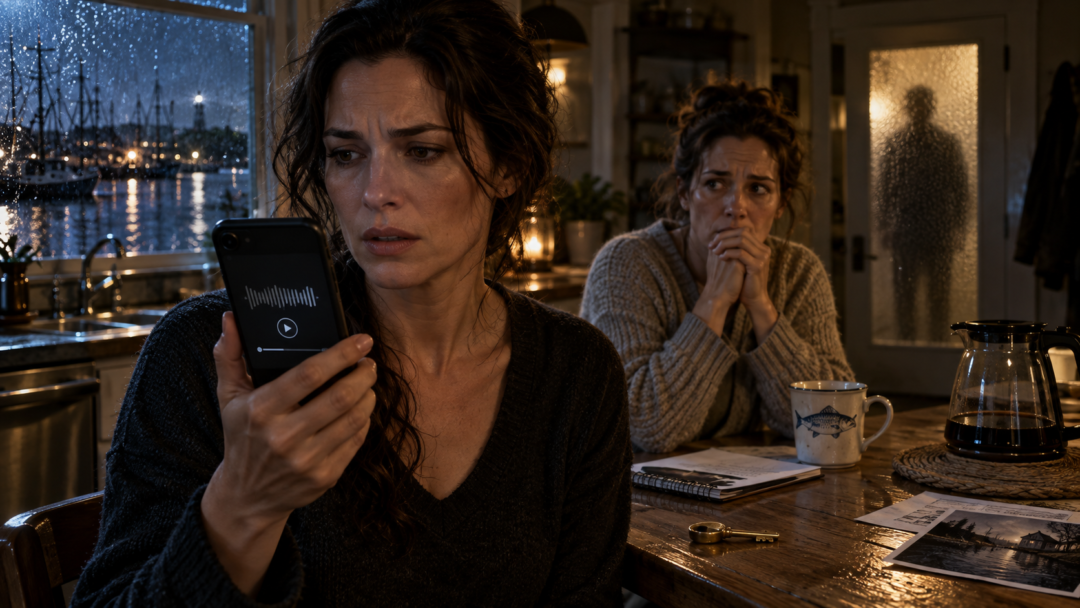
Mira Voss stood motionless by the porcelain sink, staring down at her smartphone resting on the dark formica counter.
She was thirty-eight years old, athletic and lean, wearing a heavy charcoal fisherman’s wool sweater with frayed cuffs over dark denim jeans and salt-caked leather deck boots. Her thick dark hair was pulled severely back into a tortoise-shell clasp, exposing high cheekbones and sharp, grey-green eyes that had spent fifteen years surveying maritime shipping manifests, investigating container damage, and auditing commercial vessel registries along the Atlantic seaboard. She was a woman who trusted facts, load displacement calculations, hydrostatic stability tables, and notarized bilge inspection logs. She did not believe in phantoms or curses, and she had spent her career exposing the careless frauds of shipowners who treated the North Atlantic as a private gambling parlor.
On the phone screen, glowing in the dimly lit room with an eerie, steady blue luminescence, sat an active incoming notification:
1 NEW VOICEMAIL — CALLER: DELLA (CARRIER DISCONNECTED).
Mira’s thumb hovered half an inch above the glass screen.
That telephone number had belonged to her older sister Della. But the contract had been terminated three years ago, on the very afternoon their father’s eighty-foot ocean tug, the North Star, had gone to the bottom of the Gulf of Maine with four men aboard during an unseasonal October squall. Della had thrown the phone into the harbor during the post-funeral argument, packed a single duffel bag, and vanished into the northern pulp towns along the Canadian border. For thirty-six months, Mira had sent monthly certified letters to post office boxes that returned unopened.
“That number’s been dead for three years,” Mira whispered, her voice rough with cold coffee and exhaustion.
Across the chipped enamel kitchen table, seated on a wooden ladderback chair beneath the low ceiling beams, sat Della Voss.
Della was forty-two, with softer, exhausted features, her dark hair streaked with premature silver around her temples and forehead. She wore a faded red flannel work shirt beneath a water-stained canvas barn coat, her calloused, grease-stained hands wrapped around a chipped ceramic mug filled with lukewarm black coffee. Her fingers were trembling—subtle, involuntary micro-spasms that caused the dark liquid to ripple against the white ceramic rim. She looked like a woman who had spent three years looking over her shoulder at every passing diesel truck on the highway.
Mira tapped the screen and pressed play.
She set the phone face-up on the formica between them, sliding the speaker volume to maximum.
The audio crackled with heavy white noise—the distinct, fluttering static of a high-frequency marine single-sideband radio bouncing off coastal granite ledges. Then came the sound of rushing wind, heavy ocean surf, and a woman’s voice. The voice was thin, mechanical, distorted by compression, but the cadence was chillingly familiar:
“You still have my key.”
The message ended with a harsh digital click. The screen went black.
Mira looked up. Her eyes were hard as harbor granite, boring into her sister’s bowed face. “You said you never wanted it back, Della. You said on the day of the memorial service that anything Father left in that harbor locker was cursed by blood.”
Della did not pick up her mug. Her eyes flicked toward the narrow hallway leading to the front porch—the exact direction Mira had been glancing toward for the past hour.
“I didn’t call you, Mira,” Della said, her voice barely a breath. “I haven’t had a mobile phone in eighteen months. I work cash at the herring cannery in Rockland, gutting fish twelve hours a day. I hitched three rides on logging trucks just to get down here before the gale hit. I arrived twenty minutes ago.”
“Then who is using your old SIM routing number?” Mira pressed, leaning forward across the table. “That voicemail used your old Verizon subscriber account ID. That doesn’t happen by accident. In maritime communications, that only happens when someone clones an active mobile subscriber register using an offshore transceiver and a commercial repeater tower.”
Della’s right hand moved toward her mug, but her fingers froze mid-reach. She pulled her hand back and tucked it deep into the pocket of her barn coat.
“You changed the deadbolts on the front door,” Della whispered, looking at the floorboards. “I heard the tumbler click when I walked up the driveway. You think I came back for money.”
“I don’t know what you came back for,” Mira said. “All I know is that Father died with his name slandered, and you disappeared the second the federal marshals asked for his voyage logs.”
Mira reached out, picked up the smartphone, and pressed the voicemail replay button.
The screen lit up. The static hissed through the speaker once more.
The woman’s voice began speaking—the exact same tone, the exact same words:
“You still have my key.”
Then, without pausing, the audio continued. The voice became louder, clearer, stripped of radio static, speaking in a low, terrifying whisper that sounded as if it were coming from three feet away:
“You still have my key. I’m outside.”
The phone speaker clicked dead.
Mira froze. Her hand remained suspended over the table, her pulse hammering against her eardrums.
“Della…” Mira whispered, her eyes wide as she looked at her sister. “You’re sitting right here.”
Della had gone completely white. Her jaw trembled, and she shrank back into the wooden chair as if trying to merge with the kitchen wall.
Mira turned slowly toward the front entryway.
At the end of the narrow hallway, illuminated by the single amber streetlamp at the edge of the coastal lane, stood the front door. The upper half was set with an oval pane of heavy, frosted Victorian privacy glass.
Through the translucent, pebbled glass, the sharp, black silhouette of a tall figure in a heavy sea slicker stood on the porch, motionless in the driving rain.
The figure was standing six inches from the glass, facing directly into the house.
Della’s chair scraped violently against the linoleum as she scrambled to her feet, her voice cracking in pure, hysterical terror:
“Don’t open it, Mira! Don’t look at it!”
CHAPTER 2: THE SMOKE ON THE LINOLEUM
The silence in the kitchen lasted three seconds, thick as wet wool.
Outside, the silhouette did not move. It stood like an iron post against the frosted glass, the amber glare of the streetlamp outlining the wide brim of an oilskin storm sou’wester hat and the broad shoulders of an industrial rubber deck coat.
Then, with sudden, explosive violence, the oval glass shattered inward.
A heavy, thirty-inch steel wrecking bar smashed through the center pane with a deafening crash, showering the hallway runner in glittering crystals of frosted glass. A hand gloved in black neoprene reached through the jagged opening, felt along the interior jamb, and flipped the thumb-turn of the heavy brass deadbolt.
The front door kicked inward on its hinges, slamming against the plaster wall.
A cylindrical metal canister—painted matte olive green with yellow stenciling—was hurled down the hallway, rolling across the hardwood and clattering onto the kitchen linoleum at Della’s feet.
A hiss like an angry viper erupted from the canister.
Thick, blinding plumes of grey chemical smoke billowed across the floor, carrying the suffocating, throat-scorching reek of military-grade hexachloroethane smoke.
“Down!” Mira shouted, grabbing Della by the collar of her canvas barn coat and shoving her flat onto the linoleum beneath the kitchen table.
Mira kicked the heavy oak table sideways, using the thick timber tabletop as a barricade between them and the hallway. Her eyes burned and watered from the toxic fumes, but she did not panic. She reached under the kitchen sink, grabbed a ten-pound pressurized Kidde dry-chemical fire extinguisher, and pulled the safety pin with her teeth.
Down the hallway, heavy, steel-toed rubber deck boots crunched over the shattered glass.
A man stepped through the doorway into the smoke-filled kitchen. He was broad-shouldered, six-foot-two, wearing black commercial salvage bibs and a tactical respirator over his nose and mouth. In his right hand, he held a heavy twelve-gauge Remington 870 marine shotgun with a nickel-plated finish.
“Where is the brass key, Della?” the intruder barked through the respirator diaphragm, his voice mechanical and muffled. “Wade Sterling wants the locker key, and he wants it before the two o’clock tide.”
Mira didn’t wait for him to clear the table.
She rose from behind the oak tabletop, aimed the nozzle of the dry-chemical extinguisher directly at the intruder’s respirator faceplate, and squeezed the trigger.
A roaring, ten-pound jet of pressurized monoammonium phosphate powder erupted from the brass horn.
The dense white chemical cloud struck the intruder squarely in the goggles and intake valves. The fine yellow powder blinded his optics and clogged the charcoal filter cartridges instantly.
The intruder roared in choked fury, dropping the shotgun to claw at his faceplate as he stumbled backward, coughing violently.
Mira swung the heavy steel cylinder like a baseball bat.
The base of the fire extinguisher struck the intruder across the side of his helmet with a resounding CLANG.
The blow knocked him sideways into the cast-iron stove. He hit the floor hard, dazed, gasping for air amidst the white chemical fog.
“Out the cellar!” Mira yelled, hauling Della to her feet.
She kicked the fallen shotgun under the stove, grabbed her heavy wool pea coat from the back of the door, and dragged Della through the pantry toward the exterior storm cellar stairs.
They burst through the double wooden storm doors into the howling coastal gale.
The rain hit them like flying gravel, washing the stinging smoke from their eyes. The wind was gusting at forty knots off the bay, whipping the branches of the spruce trees into a violent frenzy.
At the foot of the gravel driveway, half-hidden beneath the dripping boughs of a weeping birch, sat their father’s old 1998 Ford F-250 four-wheel-drive pickup truck—a rusted, two-tone blue workhorse that had hauled lobster traps and diesel engines for twenty-five years.
Mira sprinted to the driver’s side, pulled the spare ignition key from the magnetic hide-a-key box under the wheel well, and shoved Della into the passenger seat.
She leaped behind the wheel, jammed the key into the tumbler, and cranked the starter.
The heavy 7.3-liter diesel engine coughed twice, blew a cloud of black exhaust into the rain, and roared to life with a deep, vibrating tractor rumble.
Mira threw the transmission into reverse, spun the wheel, and backed out onto the dark coastal road, spraying wet gravel thirty feet into the ditch.
As she shifted into drive, she glanced into the rearview mirror.
Standing in the glare of the red taillights in the middle of the driveway was a second man in a yellow rain slicker, holding a heavy satellite communications phone to his ear, watching the truck disappear into the fog.
Beside her, Della was trembling so violently her teeth clicked together like river stones.
“He… he said Wade Sterling,” Della sobbed, clutching her bruised wrists. “Mira, Wade Sterling knows Father didn’t keep the salvage money in the bank. He knows it’s in the lighthouse locker.”
Mira kept both hands locked at ten and two on the steering wheel, her eyes boring through the dense wall of coastal fog. “Wade Sterling is going to learn that Arthur Voss’s daughters don’t give away what our father died for.”
CHAPTER 3: THE FOG ON THE BLUFFS
The old Ford diesel truck rumbled along the narrow, winding asphalt of Route 131, the two-lane coastal road that hugged the jagged granite bluffs between Harbor Grove and St. George. Dense banks of ocean fog rolled across the pavement in ghostly, shifting waves, reducing the reach of the truck’s yellow halogen headlights to twenty feet of slick black asphalt.
Mira flicked the heater fan to high. Hot air smelling of engine oil and damp horsehair blew over their boots, but Della remained shivering, her arms wrapped tightly around her chest.
“Talk to me, Della,” Mira said, her voice dropping into the quiet, surgical cadence she used when analyzing vessel collision reports. “Start with why Wade Sterling is hunting Father’s locker key three years after the funeral.”
Della swallowed hard, staring out through the wiper blades into the fog. “Six months ago, Wade Sterling called me in Rockland. He told me the IRS was conducting a retrospective audit of Harbor Grove Salvage & Drydock. He said Father had signed an off-the-books salvage indemnity contract for an ocean container barge that broke apart off Monhegan Island two weeks before the North Star went down.”
“The Chesapeake Trader,” Mira said instantly, her encyclopedic memory for maritime casualties kicking in. “A three-hundred-foot deck barge carrying twenty-four shipping containers of specialized copper wire and electronic telemetry gear. The Coast Guard marine casualty report ruled that the towline parted due to mechanical wear.”
“The towline didn’t part, Mira,” Della said, her voice cracking with bitter tears. “Sterling cut it. Father found out that Sterling had deliberately overloaded the barge’s ballast tanks to sink it in deep water, pocketing twelve million dollars in offshore casualty insurance from a syndicate in Hamilton, Bermuda.”
Mira gripped the steering wheel so hard her knuckles turned the color of bone. “And Father documented the sabotage.”
“Father kept the original daily wheelhouse logbooks,” Della wept. “He kept the fuel receipts, the divers’ underwater video cassettes, and the signed ballast orders with Wade Sterling’s initials. The night before the North Star sank, Father took the master logbook and locked it inside Locker 42 beneath the decommissioned Harbor Grove Lighthouse. He gave the brass key to me and told me that if anything ever happened to him at sea, I was to hand that key directly to the United States Attorney in Portland.”
“Then why didn’t you, Della?” Mira’s voice was razor-sharp, cutting through the hum of the engine. “Why did you run away to Rockland and leave that key in a drawer?”
Della buried her face in her hands. “Because Wade Sterling came to my apartment the night after the memorial service. He brought two men from the dock syndicate. He laid a photograph on my kitchen counter—a photograph of you, Mira, walking into your insurance office in Boston. He told me that if I ever unlocked that lighthouse safe, you’d have a fatal car accident on the Tobin Bridge before breakfast. I panicked. I threw my phone into the harbor, buried the key in my tackle box, and ran.”
“And what changed tonight?”
“Sterling received a formal grand jury subpoena yesterday morning,” Della said, looking up with terrified eyes. “The federal statute of limitations for maritime fraud and manslaughter expires at midnight tonight—exactly thirty-six months from the sinking. If the grand jury doesn’t receive the original logbook before the magistrate’s docket closes at sunrise, Sterling can never be prosecuted. He needs that book destroyed tonight.”
Before Mira could reply, twin beams of high-intensity xenon white light pierced the fog behind them.
In the rearview mirror, a massive three-ton industrial commercial derrick truck—painted safety orange with heavy steel push bumpers—emerged from the mist like a sea monster, closing the distance at sixty miles an hour.
“Mira!” Della screamed.
WHAM!
The heavy steel ramming bumper of the derrick truck slammed violently into the rear tailgate of the Ford pickup.
The concussion threw both sisters forward against their lap belts. The pickup skidded sideways across the rain-slick asphalt, its rear tires losing traction on the gravel shoulder, mere inches from the two-hundred-foot vertical drop down into the churning white surf of the Atlantic below.
Mira fought the wheel, counter-steering into the skid, slamming her boot down on the diesel throttle.
The 7.3-liter engine roared, the heavy tires biting into the gravel, pulling the truck straight just as the derrick truck surged forward to deliver a second, fatal ramming blow.
“Hold on!” Mira shouted.
Ahead, nearly swallowed by the dense fog, was the unpaved access turnoff for the Harbor Grove Light—a narrow, boulder-strewn gravel track marked with a weathered sign: ROAD CLOSED — GOVERNMENT PROPERTY.
Mira didn’t tap the brakes. She threw the wheel hard to the right, cutting the truck across the oncoming lane and launching the pickup down the rocky decline into the dark spruce woods of the lighthouse reservation.
CHAPTER 4: THE DECOMMISSIONED LIGHT
The old Ford pickup violently bounced over exposed granite ledges and deep mud ruts, its heavy suspension groaning under the abuse. Branches of stunted coastal fir whipped against the windshield like wet ropes as Mira guided the vehicle down the steep promontory toward the ocean.
Behind them, the massive derrick truck attempted to make the sharp, ninety-degree gravel turnoff.
Its high center of gravity and forty-foot turning radius worked against it. The heavy vehicle’s front wheels locked on the wet mud, skidding off the narrow roadbed and wedging its front axle immovably across two massive granite glacial boulders with a deafening metallic screech.
“He’s stuck!” Della gasped, looking back through the shattered rear window.
“The driver has a radio,” Mira said, keeping her eyes forward. “Sterling has boats in the harbor. We have ten minutes before they reach the point by water.”
The trees suddenly parted, opening onto the windswept, granite headland of Harbor Grove Point.
Perched on the edge of the jagged ocean cliffs, surrounded on three sides by the raging, ink-black waters of the Atlantic, stood the decommissioned 1874 lighthouse. Its eighty-foot cylindrical white granite tower was dark, its massive Fresnel lens shrouded in canvas, connected to a weathered, two-story stone keeper’s house that had stood empty since the automation of the coastal beacon in the 1970s.
Waves twenty feet high exploded against the base of the cliffs below, hurling cold salt spray fifty feet into the air.
Mira brought the truck to a halt behind the rusted iron fuel cistern, killed the engine, and grabbed a heavy steel tire iron from behind the bench seat.
“Where is the key, Della?”
Della unbuttoned the cuff of her flannel sleeve, drew out an antique brass key suspended from a braided loop of nylon seine twine around her wrist, and placed it into Mira’s hand.
It was an antique four-inch barrel key, stamped with the federal lighthouse service insignia: U.S.L.H.S. — LOCKER 42.
“Locker forty-two is in the oil cellar beneath the lantern stairs,” Della said, her voice steadying as the salt wind whipped her hair. “Behind the iron boiler plate.”
They vaulted out of the truck, running low against the gale across the sodden grass toward the keeper’s house rear storm entrance.
Mira wedged the tire iron into the gap between the heavy oak doors, levered her weight backward, and popped the rusted padlock hasp. The doors swung open with a screech of iron, revealing a flight of damp granite steps leading down into the subterranean darkness.
They hurried down into the stone foundation, pulling the heavy timber doors shut behind them and dropping the internal oak drop-bar into its iron brackets.
The cellar was ice-cold, smelling of dry sea salt, aged fuel oil, and wet granite. The rhythmic concussions of the waves outside reverberated through the eight-foot-thick foundation stones like artillery fire.
Mira flicked on her penlight, sweeping the beam across the granite walls.
At the far end of the cellar, recessed beneath the spiral iron staircase that ascended into the lantern tower, stood a bank of twelve heavy, riveted iron storage lockers installed for nineteenth-century lighthouse keepers.
Mira walked to the center locker. Stamped into the cast-iron plate in raised numerals was: 42.
She aligned the brass key, pushed it into the heavy tumbler, and turned it.
The heavy iron bolts retracted with a solid, echoing clank.
Mira swung the iron door wide.
Inside, resting on a dry cedar shelf, sat an olive-drab, waterproof pelican case stenciled in white paint: TUG NORTH STAR — LOGBOOKS & SALVAGE EVIDENCE — ARTHUR VOSS, MASTER.
Mira reached in, her fingers trembling as she pulled the heavy case into the beam of her flashlight.
“You found it.”
A voice echoed from the top of the iron spiral staircase.
Mira and Della spun around, Mira raising the tire iron in both hands, stepping protectively in front of her sister.
Standing on the third landing of the spiral stairs, illuminated by the amber beam of a high-intensity marine lantern, was Chief Noah Callahan of the Maine State Marine Patrol.
He wore his dark green patrol uniform beneath a waterproof tactical rain jacket, his gold badge pinned to his chest. In his right hand, his standard-issue Sig Sauer service pistol hung at his side, pointed safely toward the stone floor.
“Chief Callahan,” Mira said, her voice dropping into a low, dangerous tone. “Are you working for Wade Sterling too?”
Callahan slowly holstered his weapon, raising both hands to show they were empty. “If I were working for Sterling, Mira, you’d already be in handcuffs. I’ve been tracking Sterling’s offshore radio frequencies for six months. The Coast Guard Investigative Service is twenty miles out in a cutter, but Sterling has two high-speed salvage launches docking at the lighthouse pier right now. If we don’t get that case up into the lantern room, you’ll never live to see the dawn.”
CHAPTER 5: THE LANTERN IN THE TOWER
The wind outside the stone lighthouse screamed with renewed fury as Chief Noah Callahan descended the spiral iron stairs, his boots clanging softly against the open metal grating.
“Callahan,” Della said, her voice laced with deep suspicion, “you were on the dock when Sterling took over Father’s yard. You signed the impound release.”
“I signed the release because the county prosecutor ordered it, Della,” Callahan said, his weathered, fifty-year-old face creased with genuine regret. “Wade Sterling had two circuit judges in his pocket and a cousin in the state attorney general’s office. For three years, I’ve had to watch that butcher walk the harbor like a king while Arthur Voss’s daughters were driven out of town. But tonight, Sterling made a mistake. He used an unencrypted marine frequency to coordinate his enforcers.”
Callahan tapped his shoulder radio. “The Coast Guard cutter Thunderer is rounding Owls Head right now. They have federal warrants for Sterling’s arrest, but they’re fifteen minutes out through this sea state. Sterling knows he’s running out of time. He came here to burn this lighthouse with you inside.”
As if in answer to his words, the sound of heavy diesel marine engines roared from the harbor slip directly beneath the cliffs.
Through the narrow arrow-slit windows of the stone cellar, the blinding glare of three commercial halogen searchlights swept across the rocks, illuminating the crashing white surf and the granite walls of the lighthouse in blinding, theatrical brilliance.
From outside the heavy oak cellar doors came the sound of running boots, followed by the hiss of an industrial oxyacetylene torch biting into the exterior iron padlock brackets.
“They’re burning the hinges!” Callahan shouted, drawing his service weapon and unholstering a tactical flashlight. “Up the tower! Move! The lantern room has an iron hatch we can dog from the inside!”
Mira clutched the heavy waterproof pelican case to her chest, while Della grabbed the tire iron.
They sprinted up the spiraling iron rungs of the open staircase, their boots echoing through the hollow stone cylinder of the tower. Sixty feet of vertical rungs wound around the central masonry column, the air growing colder and smelling sharply of salt and ionized air as they climbed.
Behind them, sixty feet below, the heavy cellar storm doors were blown off their hinges with a violent crash.
“Callahan!” a voice boomed up the hollow granite tube—deep, cultured, and dripping with murderous arrogance. It was Wade Sterling. “Throw the case down the stairs and I let the girls take the patrol boat! Play the hero, and you all go out the lantern windows together!”
“Keep moving!” Callahan urged, leaning over the iron handrail to fire two warning shots down into the darkness.
The heavy 9mm rounds ricocheted off the lower iron stairs with ear-splitting shrieks, driving Sterling’s men back into the cellar archway.
Mira reached the top landing, threw her shoulder against the four-inch cast-iron hatch leading to the lantern gallery, and shoved it open.
They scrambled into the glass lantern room.
The chamber was an octagonal room of twelve-foot plate glass windows, crowned by a domed copper roof. In the center sat the historic, eight-foot-tall rotating classical Fresnel lens—a magnificent beehive of brass gears, counterweights, and thousands of hand-ground French crystal prisms that had focused harbor light for over a century.
Mira hauled the iron floor hatch shut, spun the heavy brass dogging wheel until the three-inch steel locking lugs engaged the frame, and collapsed against the pedestal.
Outside the glass, the storm raged with terrifying ferocity. The wind hit the lantern room at sixty knots, flexing the thick Victorian plate glass in its iron mullions. Below them, through the darkness, two thirty-foot commercial salvage tugs were tied to the lighthouse wharf, their deck searchlights trained straight up into the lantern gallery.
“They’re coming up the outside maintenance ladder,” Della whispered, pointing through the south window.
Through the rain-lashed glass, two men in black neoprene dive suits were scaling the exterior iron maintenance rungs that ran up the vertical face of the stone tower, carrying heavy crowbars and cutting torches.
“They’re going to breach the windows,” Callahan said, his jaw tightening as he reloaded his service pistol. “We can’t hold this glass against three points of entry.”
Mira looked at the massive glass prisms of the Fresnel lens, then down at the emergency electrical generator panel mounted on the pedestal.
A spark of brilliant, tactical insight ignited in her eyes.
“We don’t have to shoot them, Callahan,” Mira said, stepping to the brass control console. “We have seventy-five thousand candlepower of focused optical light sitting right here.”
CHAPTER 6: THE IRON RUNGS OVER THE WATER
Mira ripped the canvas protective shroud off the historic Fresnel lens, letting the heavy oiled cloth tumble to the copper floorboards.
The massive crystal apparatus stood before them, its brass clockwork gears gleaming beneath the penlight. Mounted dead center inside the crystal focal point was a modern twelve-hundred-watt high-intensity xenon arc lamp installed for emergency coastal navigation.
Mira reached beneath the pedestal, found the master knife switch for the auxiliary diesel generator, and threw it forward with both hands.
Down in the base of the tower, an old Detroit Diesel generator coughed, shuddered, and settled into a steady, vibrating roar.
Current surged through the heavy copper conduits.
HUMMMMMM.
The xenon arc lamp ignited with a blinding, incandescent brilliance that filled the lantern room with the light of a miniature sun.
Mira grabbed the manual rotation lever of the brass clockwork pedestal, disengaged the governor gear, and swung the massive crystal optic toward the south window where the two climbers were reaching the catwalk railing.
The multi-tiered crystal prisms concentrated the seventy-five thousand lumens into a laser-like, razor-sharp beam of pure, blinding white fire.
The optical beam struck the lead climber squarely in his night-vision goggles.
The intense, concentrated photonic blast overloaded the digital tubes instantly, blinding the climber in an explosion of white phosphor. The man screamed in pure agony, letting go of the iron rungs, his hands clawing at his face as he fell backward seventy feet through the darkness into the churning, boiling surf below.
The second climber scrambled backward down the rungs in hysterical terror, abandoning his cutting torch on the catwalk.
BANG!
A concussive shock shattered the north pane of the lantern room.
Wade Sterling had breached the exterior catwalk from the keeper’s house roof. He stepped through the howling gale, wrapped in a heavy charcoal cashmere overcoat soaked with salt spray, holding an antique double-barrel ten-gauge goose gun in both hands.
“Step away from the lamp, Mira!” Sterling roared over the wind, leveling the massive twin barrels at her chest.
Behind him on the narrow catwalk stood two of his salvage divers, leveling industrial steel wrecking bars.
Callahan raised his pistol, but Sterling fired his left barrel into the copper ceiling.
The deafening blast ripped a two-foot hole through the roof, showering the lantern room with copper shrapnel and rain. The concussion knocked Callahan to the floor, his service weapon skidding across the wet copper tiles and falling through the broken glass into the sea.
Sterling stepped across the shattered windowsill into the lantern room, the reek of gunpowder and wet cashmere suffocating the air.
His heavy, scarred face was twisted into a triumphant, psychotic grin.
“Arthur Voss always was a stubborn bastard,” Sterling sneered, leveling the remaining barrel directly at Della’s face. “And you two girls take right after him. Hand over the pelican case, Mira. Or your sister takes twelve pellets of double-ought buckshot through the teeth.”
Della stood frozen, her eyes wide, but her chin held high, refusing to plead.
Mira looked at Sterling. Her hands rested on the handle of the heavy waterproof pelican case sitting on the brass pedestal.
“You killed our father for twelve million dollars, Wade,” Mira said, her voice dropping into a register of icy, absolute certainty. “And you think you can buy his memory with an old goose gun?”
“I don’t need to buy it,” Sterling laughed, taking a step forward, reaching out with his left hand to snatch the case. “I’m going to take it, drop you over the catwalk, and tell the Coast Guard you fell while looting historical antiquities.”
Sterling’s fingers touched the handle of the pelican case.
Mira struck.
She didn’t pull the case back; she shoved it forward with all her strength directly into Sterling’s chest, using the forty-pound case as an iron battering ram.
The impact drove Sterling backward against the broken window frame.
Before he could pull the trigger, Della lunged from the side, swinging the heavy steel tire iron two-handed.
The tire iron struck the twin steel barrels of the shotgun with a ringing metallic CRACK, knocking Sterling’s aim wide.
The gun discharged harmlessly into the stormy sky as Sterling lost his footing on the rain-slick copper floorboards, stumbling backward through the broken glass onto the outside catwalk.
Mira vaulted through the broken window onto the narrow catwalk.
The freezing gale lashed her face, eighty feet above the raging Atlantic. Sterling scrambled to his feet, drawing a serrated rigging knife from his belt, lunging at her with desperate, feral malice.
Mira slipped his thrust, caught his wrist in an iron two-handed joint lock, and twisted his arm over the exterior safety railing.
Sterling screamed in agony, the rigging knife slipping from his fingers, tumbling into the abyss.
“Let me go!” Sterling shrieked, looking down at the boiling white waves crashing against the jagged rocks seventy feet below. “Mira… please! I’ll give you half the insurance! Six million dollars! Wired tonight!”
Mira held him pinned against the wet iron railing, her eyes cold as winter sea ice.
“Our father’s name isn’t for sale, Sterling,” she whispered into the wind.
From the dark waters of the bay, an immense, earth-shaking horn blast cut through the storm.
A three-hundred-foot United States Coast Guard cutter swept around Harbor Grove Point, its massive high-intensity searchlights illuminating the entire lighthouse tower in a blazing wall of pure white daylight.
Above the roar of the surf, an amplified command boomed across the water:
“THIS IS THE UNITED STATES COAST GUARD! DROP ALL WEAPONS AND STEP AWAY FROM THE RAILING! YOU ARE UNDER ARREST FOR MARITIME FRAUD, TREASON, AND MANSLAUGHTER!”
CHAPTER 7: THE HARBOR AT LOW TIDE
The dawn broke over Penobscot Bay in a breathtaking, crystalline expanse of pale gold, rose, and brilliant ocean blue. The storm had swept out to sea, leaving the air over Harbor Grove sharp, clean, and carrying the crisp scent of balsam fir and low-tide salt marshes.
At the municipal pier in Harbor Grove harbor, a crowd of fifty local lobstermen, boatyard mechanics, and townspeople stood along the wooden pilings in solemn, reverent silence.
Tied to the pier was the Coast Guard cutter Thunderer.
Flanked by two federal maritime marshals and Chief Noah Callahan, Wade Sterling was escorted down the steel gangway in heavy chrome handcuffs. His bespoke coat was ruined, his grey hair matted with dried salt foam, his face pale and sunken in utter, irreversible disgrace. Behind him, four of his salvage operatives were led toward federal transport vans, charged with multiple counts of maritime sabotage, conspiracy, and attempted murder.
On the main dock, standing beside their father’s rusted blue Ford pickup, were Mira and Della Voss.
They were wrapped in heavy wool Coast Guard blankets, each holding a warm paper cup of black coffee provided by the cutter’s galley. Between them on the truck’s tailgate sat the open pelican case, its waterproof compartments displaying the pristine, handwritten daily logs of Captain Arthur Voss.
Commander James Mitchell, lead investigator for the Coast Guard Investigative Service, walked down the pier, holding a certified federal evidence receipt.
He stopped before the sisters, taking off his service cap with profound professional respect.
“Ms. Voss,” Commander Mitchell said, addressing Mira and Della. “The forensic review of your father’s logbooks is complete. The entries verify beyond any legal doubt that Captain Arthur Voss refused to participate in the deliberate scuttling of the Chesapeake Trader, and that he was actively returning to port to file formal charges against Wade Sterling when his vessel was sabotaged.”
Commander Mitchell looked out over the quiet harbor, where the morning fishing fleet was preparing to cast off lines.
“By executive decree of the United States Maritime Administration and the Department of Transportation,” Mitchell announced, “all historic liability claims and liens against the estate of Captain Arthur Voss are officially vacated. The North Star has been formally declared a casualty of criminal sabotage, and full maritime insurance restitution—twelve million dollars—is hereby awarded to Mira and Della Voss.”
Della broke into quiet, healing sobs, burying her face in the wool blanket. Mira reached out with her arm, pulling her sister tightly against her shoulder, feeling the three years of crushing grief and estrangement dissolve into the clean morning air.
Chief Callahan walked up the pier, a faint, genuine smile touching his weathered face. He handed Mira an antique brass ring holding the master keys to the Harbor Grove Salvage & Drydock.
“The court appointed an interim receiver thirty minutes ago, Mira,” Callahan said. “The town council voted unanimously: the yard is returned to the Voss family. It’s yours.”
Mira looked at the brass keys in her palm, feeling their reassuring weight. She turned to Della, who wiped the tears from her cheeks and looked back with a fierce, quiet pride that belonged to four generations of Maine shipbuilders.
“What do we do now, Mira?” Della asked softly.
Mira looked out across the sparkling blue water toward the lighthouse at Harbor Grove Point, where the white tower stood proudly against the morning sun, unbroken by the storm.
“We go down to the yard, Della,” Mira said, a warm, genuine smile lighting her face for the first time in three years. “We hire back the crew. We fix the slipways. And we put the Voss name back where it belongs.”
Side by side, their hands linked together, the two sisters walked down the wooden pier into the bright, unshadowed dawn.