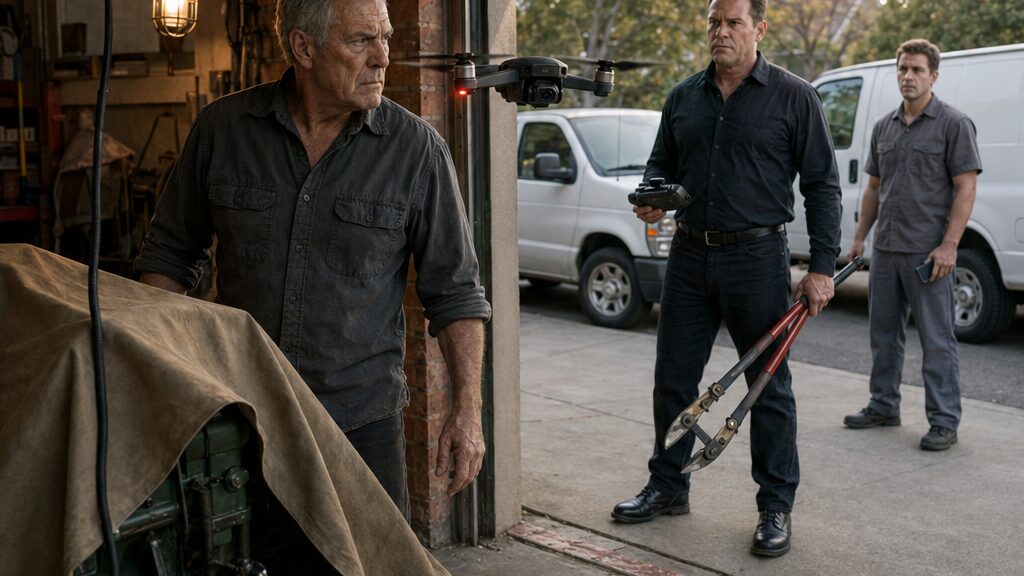
The Neighbor Who Flew a Camera Into My Garage Lost His Own Driveway
Chapter 1: The Red Light Inside Raymond’s Garage
The drone shot through the open garage door so fast that Raymond Lewis heard it before he saw it.
A hard mechanical buzz ricocheted off the brick walls. Then the machine stopped in midair less than two feet above the canvas-covered frame in the center of the garage.
A red light blinked beneath its camera.
Once.
Twice.
Recording.
Raymond set down the polished steel bracket in his hand. He did not move toward the drone. He did not shout. He simply watched it tilt forward, its lens angling toward the narrow opening in the canvas where a brass plate caught the late-afternoon light.
“Get your camera out of my house.”
His voice was low enough that the drone’s rotors nearly swallowed it.
The machine drifted sideways instead.
Its wake lifted a corner of the canvas, exposing part of the old machine beneath it: a heavy flywheel, two copper lines, and the dark green housing Raymond had spent six months restoring one careful inch at a time.
The drone dipped lower.
Raymond took one step forward.
It darted backward through the garage door.
Outside, two white commercial vans crowded the curb in front of Raymond’s house. One sat so close to his driveway that its rear bumper nearly aligned with the garage opening. The second was still moving, guided into place by Tyler Brown, Donald Miller’s senior employee.
Donald stood near the hood of the first van with a black controller in both hands.
He wore a clean work shirt with his company name stitched over the pocket, as though the shirt itself were a permit. The drone hovered above him, red light still blinking.
Raymond stopped at the threshold.
Between the driveway and the strip of pavement leading toward Donald’s property ran a faded painted seam. Raymond’s father had refreshed that line every few years until his hands became too unsteady to hold the brush.
Now the right rear tire of Donald’s van rested directly over it.
Donald smiled without looking up from the controller.
“Thought you kept something interesting in there.”
“You flew it inside.”
“It drifted.”
“You steered it.”
Donald finally raised his eyes. “Air doesn’t recognize property lines.”
Tyler shut off the second van and stepped down. He avoided Raymond’s gaze as he pulled a clipboard from the passenger seat.
Raymond took out his phone.
Donald’s smile tightened.
Raymond photographed the first van, then the second. He crouched slightly to capture the tire covering the seam. He recorded the curb, the distance from the driveway, and the drone hovering above Donald’s shoulder.
“You collecting another album?” Donald asked.
“Third notice was delivered Monday.”
“I read it.”
“Then move the vans.”
Donald glanced toward the street as though the request had come from someone far less important. “My crew needs access.”
“This is not your lot.”
“It’s a public curb.”
“The driveway clearance isn’t.”
Donald lifted one thumb from the controller. The drone rose, then glided toward the garage again.
Raymond’s hand closed around the phone.
The drone stopped just outside the threshold.
Donald noticed the movement in Raymond’s jaw and gave the slightest grin.
“A municipal officer already told me the curb was commercially usable.”
“She told you vehicles could park where parking is legal.”
“Same thing.”
“No.”
Tyler turned a page on his clipboard with more care than the action required.
Raymond looked at him. “You know that van blocks the turn.”
Tyler glanced toward Donald before answering. “We’re only unloading.”
“There’s nothing open.”
“We’ll be moving soon.”
Donald laughed. “He means when the work is done.”
Raymond had heard variations of that answer for six weeks.
At first it had been one van for twenty minutes. Then two vans through lunch. Then a trailer left overnight. Each time Raymond photographed the obstruction, wrote down the hour, and placed another polite notice in Donald’s mailbox.
He had believed the record would become heavy enough to stop the behavior on its own.
Instead, Donald had begun waving whenever Raymond took pictures.
Raymond stepped off the driveway and walked to the rear of the nearest van. The curb directly in front of his house was clear of any other vehicles, yet Donald had placed both vans there instead of using the open space farther down the block.
The choice was deliberate.
Donald followed him with the drone.
Its shadow moved over the pavement like an insect.
“You could park beside your own building,” Raymond said.
“Too tight.”
“You have a driveway.”
“I use my driveway.”
“You use more than your driveway.”
Donald’s face changed for a fraction of a second. Not guilt. Calculation.
Then the smile returned.
“You’ve let vehicles cross there for years.”
Raymond looked toward the narrow paved lane between the houses. Donald called it his driveway. Everyone on the street did. Delivery drivers, clients, even the city workers who had repaired the storm drain last spring.
Raymond said nothing.
Donald mistook the silence for retreat.
“My business is growing,” he continued. “You should be glad somebody around here is improving the neighborhood.”
Raymond raised the phone and took another photograph.
Donald’s smile vanished. “You take all the pictures you want. I’m not losing contracts because you like staring at an empty curb.”
The drone moved closer to Raymond’s face.
The buzzing sharpened.
Raymond held still until the red light was level with his eyes.
“Bring it inside again,” he said, “and the conversation changes.”
Donald gave the controller a small push. The drone slid past Raymond’s shoulder and crossed the garage threshold for the second time.
Tyler looked up quickly.
“Donald,” he said.
“It’s a camera, not a weapon.”
Inside the garage, the machine floated above the covered restoration project. The downdraft peeled the canvas back farther.
A brass plate became visible on the green housing.
LEWIS INDUSTRIAL, the first line read.
Beneath it, stamped by hand decades earlier, was another name.
ANTHONY LEWIS.
Raymond’s father.
Donald guided the camera closer.
The red light flashed across the brass letters.
Raymond crossed the garage in three strides, but the drone rose beyond his reach and shot back outside.
Donald laughed once, pleased by the speed of Raymond’s reaction.
“There it is,” he said. “So the garage does matter.”
Raymond stood beneath the hanging work light, the loosened canvas in one hand.
For the first time, the vans were no longer the worst part of the afternoon.
Donald had found the one thing Raymond had never allowed anyone outside his family to examine closely.
And now he knew exactly where to point the camera.
Chapter 2: The Driveway Everyone Thought Belonged to Donald
The citation was taped to Raymond’s garage door at eye level.
He found it the next morning before seven, its bright orange border stark against the gray metal. The printed notice accused him of obstructing shared vehicle access and ordered him to remove “temporary equipment and boundary markers” from the driveway area pending inspection.
Raymond read it twice.
The only equipment near the boundary was a folding work stand positioned eighteen inches inside his garage.
The only marker was the faded seam his father had painted across the pavement.
Across the narrow lane, Donald’s driveway was empty. Both commercial vans had already left.
Raymond pulled the notice free and saw Donald watching from his kitchen window.
By nine, Raymond was seated across from Patricia King in a municipal office that smelled of paper dust and burned coffee.
Patricia wore thin-framed glasses and kept three folders open in front of her, each one marked with a different department stamp.
“You filed four parking complaints,” she said.
“Three written. One online.”
“And Mr. Miller filed an access obstruction complaint yesterday afternoon.”
“After flying a drone into my garage.”
Patricia paused over her notes. “That matter isn’t part of this citation.”
“It is part of the dispute.”
“I understand that you see it that way.”
Raymond leaned back.
That sentence had ended more neighborhood arguments than any law ever had.
Patricia turned one of the folders toward him. A recent tax map showed the two houses, the curb, and a long rectangular strip running beside Donald’s property.
The strip was shaded as if it belonged to Donald.
“He claims this has been his established driveway for more than twenty years,” Patricia said.
“He bought the building twelve years ago.”
“He provided statements from the prior owner and two delivery companies.”
“They used it. That doesn’t mean they owned it.”
Patricia tapped the map. “Do you have a survey showing otherwise?”
Raymond’s eyes remained on the shaded strip.
In the weathered metal case beneath his kitchen sideboard was a hand-drawn survey older than the municipal building. The original deed lay under it, folded along lines that had nearly become permanent cracks.
He could have brought both.
Instead he had brought photographs of the vans.
“The curb is the immediate problem,” he said.
Patricia studied him. “Mr. Lewis, if you’re withholding ownership records, this is the moment to stop.”
“I’m addressing what happened yesterday.”
“And I’m trying to prevent what happens tomorrow.”
She slid the citation closer. “Mr. Miller says you placed equipment near the driveway to interfere with his vehicles.”
“The stand is inside my garage.”
“He says part of it extended beyond the threshold.”
“It didn’t.”
“Do you have a photograph?”
Raymond did. He opened his phone and showed her.
The image displayed the folded work stand, the garage threshold, and a measuring tape stretched along the concrete.
Patricia enlarged the photograph with two fingers.
“Precise,” she said.
“I expected an argument.”
“That may be the first thing we agree on.”
She examined the next images: the vans blocking the curb, the rear tire over the painted seam, the drone hovering near the garage.
For the first time, her expression shifted.
“The curb clearance is a separate issue,” she said. “This van is too close to your driveway entrance.”
“Both were.”
“I can order the nearest one moved and issue a warning on future obstruction.”
“That is what I asked for six weeks ago.”
“You asked the wrong department first.”
“I used the number on the city website.”
Patricia closed one folder. “The city website is not a promise of competence.”
The admission was so dry that Raymond almost smiled.
Almost.
She made a call while he waited. Ten minutes later, Donald arrived in a dark jacket, carrying a rolled map and the confidence of a man entering a meeting he believed he had already won.
“I thought this was routine,” Donald said.
“It was,” Patricia replied. “Then both of you brought property claims into a parking complaint.”
Donald unrolled his map across the desk.
It was newer than Patricia’s and cleaner than anything Raymond possessed. The driveway was labeled as part of Donald’s commercial parcel.
“There,” Donald said. “Tax assessor’s copy.”
“Tax maps do not always establish title,” Patricia said.
“They establish who’s been paying for it.”
Raymond looked at Donald. “Have you?”
Donald hesitated.
Only briefly, but Patricia noticed.
“My property taxes include the business parcel.”
“That wasn’t the question.”
Donald turned to Raymond. “You never objected to the driveway before.”
“You never flew a camera into my garage before.”
Patricia raised a hand. “The drone issue will not be resolved here.”
Donald leaned over the desk. “He’s trying to shut down my access because my company is expanding.”
“I’m trying to enter my own garage.”
“The vans were there for one afternoon.”
“Yesterday was not the first afternoon.”
Donald pointed at the painted seam in one of Raymond’s photographs. “And now he’s inventing a border.”
Raymond felt something cold settle behind his ribs.
His father had painted that line with a carpenter’s square, a snapped chalk string, and a brush worn down to half its width.
Inventing.
Patricia compared the maps again. “The available city records are incomplete. The lane may involve historic permissive use, an easement, or a boundary discrepancy. Until that is reviewed, neither of you should interfere with established access.”
Donald seized on the phrase. “Exactly.”
“That does not authorize parking across Mr. Lewis’s garage.”
Donald’s face hardened.
Patricia wrote a temporary order requiring one van to be relocated from the curb and all others to maintain clear entry. It was less than Raymond wanted, but it was the first official line Donald had been forced to obey.
Outside the municipal building, Donald caught up with Raymond.
“You could have talked to me,” he said.
“I sent three notices.”
“Notes aren’t conversations.”
“You ignored them.”
“You never answered when I asked for a formal access agreement.”
Raymond stopped.
Donald’s anger appeared genuine now, stripped of the smile.
“Two years ago,” Donald said. “I asked what you wanted. Rent, maintenance, whatever. You walked back into your garage.”
Raymond remembered.
Donald had stood near the lane with a folder under one arm. Raymond had seen the proposed agreement, thought of his father’s note inside the metal case, and refused to touch the subject.
“I did not agree,” Raymond said.
“You didn’t disagree either.”
Donald walked away before Raymond could answer.
That evening, Raymond spread an old family map across his kitchen table.
A pencil line ran from the curb, along Donald’s driveway, and behind the garage. His father’s measurements appeared in the margins in faded block numbers.
Raymond traced the line with one finger.
Then he folded the map, placed it inside the weathered metal case, and turned the key.
“Why lock it?”
Catherine stood in the doorway with her coat still on.
Raymond had not heard her enter.
Her eyes moved from the case to the orange citation lying on the table.
“If those papers can end this,” she said, “why are you hiding them?”
Chapter 3: A Promise Folded Beneath the Old Deed
Catherine opened the metal case before Raymond returned from the garage.
He had left the key in the lock.
That alone told her how distracted he had become.
Inside lay a bundle of deeds tied with cloth tape, several brittle tax receipts, a brass survey compass, and a hand-drawn map folded into quarters. The top document carried a date from more than a century earlier.
Catherine lifted it carefully.
The paper crackled.
A boundary description ran down the page in dense type, naming stone markers that no longer existed and distances measured in rods instead of feet. A later survey had been clipped behind it.
The pencil line on that survey did not stop at Raymond’s driveway.
It continued across the entire paved lane Donald used beside his building.
Catherine heard the garage door close.
She did not put the documents back.
Raymond entered the kitchen wiping his hands on a cloth. He stopped when he saw the open case.
“You had no right.”
“You left the key.”
“That is not permission.”
“Neither is silence.”
He set the cloth beside the sink.
Catherine held up the survey. “You own the driveway.”
“The deed covers the land beneath it.”
“That is the same thing.”
“No. Not always.”
“Donald thinks it is his.”
“Donald thinks many things are his.”
“And you let him.”
Raymond reached for the papers. Catherine pulled them back.
“How long have you known?”
“My whole life.”
The answer struck harder because he gave it without hesitation.
Catherine lowered the survey. “Then why did you sit in that office and let them treat this like some confused boundary argument?”
“Because it is more complicated than a line on old paper.”
She looked into the case again.
Beneath the deed lay a single sheet in Anthony Lewis’s handwriting. The ink had faded from black to brown. The note was short enough to read before Raymond could stop her.
The neighboring family had lost their work truck and nearly their home during a bad winter. Anthony had allowed them to widen the lane across Lewis land so deliveries could reach the rear workshop. No rent. No transfer. No permanent claim.
At the bottom, one sentence had been underlined.
Do not take this access away merely because you are angry.
Catherine read it aloud.
Raymond’s face tightened.
“He wrote that for you?”
“For whoever came after him.”
“He meant Donald?”
“He meant the land.”
“He meant kindness.”
“Yes.”
“And you think kindness means letting someone block your garage and send a camera inside?”
“No.”
“But that is what you’ve done.”
Raymond took the note from her and smoothed it on the table.
“My father gave access to a man who was trying to feed a family.”
“Donald is using it to run commercial vans past your bedroom window.”
“The principle does not disappear because the person changes.”
“The principle was generosity. This is intimidation.”
Raymond closed his eyes for a moment.
From the garage came the faint ticking of cooling metal.
Catherine had spent months calling the machine a project because Raymond never gave it another name. She had assumed it was one more piece of industrial equipment he had dragged home after retirement.
Now she looked through the kitchen doorway toward the garage.
“What is under the canvas?”
Raymond did not answer.
She waited.
Finally he said, “A compact steam drive.”
“For what?”
“For anything that needed turning without grid power. Pumps. Shop tools. Emergency equipment.”
“You built it?”
“My father designed it. I changed the valve system.”
“Together?”
“We were supposed to.”
The last word carried more weight than the rest.
Raymond returned the note to the case and sat down.
“He machined the housing before his hands started failing. I made the first flywheel. Then we argued about the governor assembly.”
Catherine leaned against the table.
“What kind of argument?”
“The kind where both men know they will finish it later.”
“But you didn’t.”
“No.”
Anthony had died before the next spring.
Raymond had left the unfinished machine beneath canvas for thirteen years. He had retired, cleared the garage, and begun again only after discovering the brass plate in a drawer.
Catherine looked at him differently now.
“You never told me.”
“You thought it was keeping me stuck.”
“I still think part of it is.”
Raymond’s eyes went toward the garage.
“It is the last thing we disagreed about.”
“That is exactly what I mean.”
He rose sharply enough to make the chair legs scrape.
“I am not selling the house.”
“I didn’t ask you today.”
“You’ve asked before.”
“Because this place has become a bunker. Every box is a memory. Every tool stays where he left it. And now Donald knows all he has to do is cross one faded line to control your entire day.”
Raymond faced her.
“You think leaving is strength?”
“I think choosing something before it is chosen for you might be.”
The words landed between them.
Outside, an engine started in Donald’s driveway.
Catherine pointed at the open case. “Use the deed.”
“No.”
“Why?”
“Because once I use it, I am not asking him to move a van. I am taking away access his property has relied on for decades.”
“He is relying on your fear of becoming cruel.”
Raymond’s voice dropped. “You did not hear my father ask me to protect that arrangement.”
“And he did not see Donald fly a camera over his name.”
Raymond looked at her.
She knew she had found the wound because he stopped defending himself.
Catherine softened, but only slightly.
“You’re protecting a dead promise more fiercely than your living home.”
The buzzing began outside before Raymond could answer.
Low at first.
Then rising.
Both of them turned toward the garage.
A red light appeared beyond the kitchen window, moving slowly along the side of the house.
Raymond crossed the room and opened the interior garage door.
The drone hovered just beyond the open outer entrance. Its camera faced inward.
Donald stood somewhere out of sight, controlling it.
The machine advanced until it floated above the painted seam.
Catherine was still beside the kitchen table. The deed lay exposed. The handwritten promise rested on top of it.
The drone tilted.
Its camera pointed past Raymond, through the doorway, directly toward Catherine and the open case.
“He heard us,” she whispered.
Raymond stepped into the garage.
The drone retreated several feet, then held position.
Its red light blinked steadily, patient as an eye.
This was no longer curiosity.
Donald was collecting something.
And Raymond understood, too late, that the thing
Chapter 4: Donald Needed Raymond to Look Dangerous
The front of Raymond’s garage disappeared behind a white commercial van before eight the next morning.
Donald stood in the street, guiding Tyler with one raised hand.
“Another foot,” he called. “Turn the rear toward the door.”
Tyler stopped the van at an angle. Its back corner extended across Raymond’s driveway, leaving less than three feet between the bumper and the brick wall.
“That blocks him,” Tyler said.
“For twenty minutes.”
“You said the client was meeting us at the yard.”
Donald lowered his hand. “Plans changed.”
Tyler looked toward Raymond’s closed garage door. “Did they?”
Donald’s expression warned him not to continue.
Bright yellow spray chalk marked two rectangles on the pavement. One began at Donald’s driveway and crossed the faded seam onto Raymond’s side. The second occupied part of the curb in front of Raymond’s house.
Donald stepped back to inspect them.
His company had secured two maintenance contracts the previous week. On paper, they looked like success: three additional sites, tight response windows, penalties for late arrival. In practice, they required four vans to leave within minutes of one another each morning.
Donald had no room for four vans.
The narrow yard behind his building could hold equipment or vehicles, but not both. Leasing another lot would consume most of the profit from the new contracts. Losing the side driveway would be worse. Without it, the vans could not reach the rear gate at all.
He had built his expansion around access he had never formally secured.
Now Raymond’s complaints threatened to expose that fact.
Tyler watched Donald refresh one of the chalk lines.
“That isn’t where the old paint is,” he said.
“The old paint means nothing.”
“It means Raymond thinks it does.”
“Raymond thinks silence makes him important.”
The garage door rattled upward.
Donald stepped onto his own side of the lane before Raymond appeared.
Raymond stood beneath the lifting door, one hand on the control. He looked first at the van, then at the yellow markings.
“Move it.”
Donald checked his watch. “Client inspection.”
“Move it now.”
“I need twenty minutes.”
“You had all night to arrange your vehicles.”
“And you had two years to answer a simple business proposal.”
Raymond walked to the edge of the garage. The steel seam beneath the door aligned with the faded painted line outside. Donald’s yellow rectangle crossed both.
“You asked me to sign away permanent access,” Raymond said.
“I asked for certainty.”
“You asked for ownership without using the word.”
“I offered maintenance and rent.”
“You offered less than the land was worth.”
Donald’s eyes narrowed. “So that was it.”
“What?”
“You ignored me because the number offended you.”
Raymond had ignored the agreement because he could not bring himself to explain a promise made over his father’s workbench. Donald had taken that silence and filled it with the interpretation that wounded him most.
Contempt.
Raymond bent and rubbed one of the yellow marks with his thumb. Chalk stained his skin.
“This line is false.”
“It’s temporary.”
“It crosses my property.”
“Then prove it.”
Raymond straightened.
Donald waited, almost inviting the answer.
From the passenger side of the van, Tyler saw something pass between the two men. Donald did not know exactly what Raymond possessed, but he was no longer certain the old man had nothing.
That uncertainty was driving him harder than confidence ever had.
A dark sedan turned onto the street.
Donald immediately changed his posture. He smiled and walked toward the curb.
“My clients,” he said. “Do not make a scene.”
Raymond looked at the blocked garage.
“You created the scene.”
The sedan parked farther down. Two visitors stepped out carrying folders. Donald moved quickly to intercept them before they could see Raymond measuring the remaining clearance beside the van.
The inspection lasted thirty-five minutes.
Raymond said nothing during it. He took photographs, recorded the van’s position, and wrote down the arrival and departure times.
That quiet made Donald increasingly restless.
When the visitors left, he approached Raymond at the curb.
“You enjoy this?” Donald asked.
“No.”
“You could destroy twelve jobs over a strip of pavement.”
“You have seven employees.”
“I have contracts that will create twelve.”
“Not on my land.”
Donald’s face flushed. “There it is again. Your land. Your garage. Your curb. You act as if the whole street should bend around whatever you’re hiding under that canvas.”
Raymond looked toward the drone case resting on Donald’s porch.
Donald followed his gaze.
“That camera showed nothing illegal.”
“It entered my garage.”
“You stepped toward it like you wanted a fight.”
“I wanted it outside.”
Donald leaned closer. “That is not what the recording looks like.”
Tyler heard the sentence from beside the van.
He waited until Raymond returned to the garage before confronting Donald.
“You’re keeping the footage?”
“Of course.”
“You told me the drone was for roof inspections.”
“It is.”
“You flew it into his garage.”
Donald opened the rear doors of the van. “He made a threat. I documented it.”
“He told you to leave.”
“He lunged at company property.”
“He stepped toward a camera inside his building.”
Donald slammed one door shut. “You know what happens if he gets the city to restrict this access?”
Tyler did not answer.
“I lose the new contracts,” Donald said. “Then I cut routes. Then I cut hours. You think he cares which one of you goes home without a paycheck?”
“He might not know.”
“He knows exactly what he’s doing.”
Donald’s voice lowered.
“He wants me angry. He wants me to make one mistake so he can say the business is dangerous. I’m not giving him that.”
Tyler looked at the spray chalk and the van still angled across Raymond’s entrance.
“What are you giving him?”
Donald reached into the van and removed a pair of heavy branch loppers.
The steel jaws were newly sharpened. Long handles, black grips, enough leverage to sever a thick limb.
Tyler stared at them. “What are those for?”
“The cable he hangs near the lane.”
“It’s inside the garage.”
“It swings outside when he works. Patricia said neither party should obstruct established access.”
“She didn’t tell you to cut anything.”
“I’m removing a hazard.”
“You’re crossing onto his property.”
Donald tested the handles. The jaws closed with a metallic bite.
“He says it’s his property. The current map says otherwise.”
Tyler stepped between Donald and the driveway.
“Wait for the review.”
“I cannot wait while he builds a case.”
Donald pushed past him and placed the loppers beside the porch.
Then he took out the drone controller.
Tyler watched the screen come alive. The camera feed showed Raymond inside the garage, tightening a fitting on the green machine. The outer door remained open for ventilation.
“You’re doing it again,” Tyler said.
“I need a clear view of the cable.”
“You need footage.”
Donald glanced at him.
The look was colder than anger because it contained a decision.
“When he comes out,” Donald said, “use your phone.”
“For what?”
“Everything.”
Tyler did not move.
Donald gave a small, impatient smile. “He has spent weeks photographing us. We are allowed to protect ourselves.”
“From what?”
“From whatever he does when he finally explodes.”
The drone lifted from the driveway.
Its red light began blinking.
Donald guided it over the yellow chalk, across the faded seam, and through Raymond’s open garage door.
With his other hand, he picked up the branch loppers.
Tyler saw Raymond turn toward the buzzing.
Then Donald stepped across the line and carried the steel jaws toward the hanging power cable.
Chapter 5: The Moment the Boundary Became Physical
The lopper blades closed around the cable before Raymond reached the garage entrance.
The cable dropped from a ceiling reel and fed power to the restoration machine through a protected floor connection. It hung entirely inside the garage, but Donald had reached past the threshold and trapped it between the steel jaws.
“Open those,” Raymond said.
Donald held the handles steady.
The drone circled behind him, its red light flashing against the brick wall.
“This cable swings into the access lane,” Donald said.
“You are standing inside my garage.”
“Shared access is under review.”
“The garage is not.”
Donald glanced toward the drone as though checking the camera angle.
Raymond noticed.
Outside, Tyler stood beside the van with his phone in one hand. He was not recording yet. His thumb rested above the screen.
“Put the loppers down,” Raymond said.
Donald pulled the cable outward. The reel clicked overhead, releasing several inches.
“There,” Donald said. “Across the line.”
“You dragged it there.”
“It’s there now.”
The drone drifted closer to Raymond’s face.
Its downdraft stirred the hair above his forehead and lifted dust from the workbench.
Raymond did not look away from Donald.
“You came here to manufacture an obstruction.”
“I came here to remove one.”
“You came here for a reaction.”
Donald’s mouth tightened.
“That is what you think everyone wants from you, isn’t it? A reaction. An argument. An excuse to invade your sacred little room.”
The lopper handles moved closer together.
The cable’s black insulation compressed between the blades.
Behind Raymond, the restoration machine ran at low testing power. Its flywheel turned slowly. The copper lines trembled with the rhythm of the small drive motor he had installed for calibration.
If Donald cut the live feed, the protective relay should trip.
Should.
Raymond had built industrial systems long enough to know that a safety device was not a promise.
“Release it,” he said.
Donald squeezed another inch.
A faint split appeared in the cable jacket.
Raymond stepped forward.
The drone darted between them.
Its lens came within inches of his cheek.
Donald smiled.
“There. That’s the face.”
Raymond stopped.
He understood the entire arrangement then: the angled van, the chalk marks, Tyler’s phone, the camera waiting for the moment when an old man with clenched hands looked unreasonable.
Donald did not need to win the boundary argument that morning.
He only needed Raymond to lose control on video.
Raymond backed one step away.
Donald’s smile faltered.
“Turn off the drone,” Raymond said.
“No.”
“Remove the loppers.”
“When the hazard is gone.”
“You damage that cable and you pay for the machine.”
Donald looked past him toward the exposed green housing.
“The old engine?”
Raymond’s gaze sharpened.
Donald had seen the brass plate. He had heard enough through the hovering camera to understand what the project meant.
“Your father’s name looked good on video,” Donald said. “Might help explain why you’re so emotional.”
Tyler lowered his phone.
“Donald,” he called. “Enough.”
Donald ignored him.
He shifted one foot forward.
The sole of his boot crossed the painted seam fully. Bright yellow chalk marked the pavement behind him; the old faded line remained beneath his heel.
The lopper blades bit deeper.
A strand of internal shielding snapped with a tiny metallic sound.
Raymond moved.
He did not grab Donald.
He seized the lower handle of the loppers and forced it outward. Donald resisted, but Raymond had spent four decades moving seized valves, bent shafts, and industrial components heavier than either man.
The jaws opened.
Raymond pulled the cable free and shoved it behind him.
Donald staggered sideways, then recovered.
“There!” he shouted toward Tyler. “You saw that.”
“I saw you cutting his cable.”
“I was removing an obstruction.”
“You reached inside.”
The drone swooped over Raymond’s shoulder and descended toward the machine.
The canvas had been removed for testing. The flywheel turned openly beneath the work light. If the drone struck it, shattered plastic could enter the mechanism—or the spinning wheel could throw the machine back into Raymond’s face.
Raymond lunged.
The drone climbed, but not fast enough.
His right hand closed around one landing arm.
The rotors screamed.
One blade struck his sleeve and tore the cloth without reaching skin. The drone bucked violently, its motors fighting his grip.
“Let go of it!” Donald yelled.
Raymond turned his face away from the rotors and caught the body with his other hand.
The red light blinked between his fingers.
“Shut it down.”
Donald held the controller against his chest. “You’re destroying company equipment.”
“Shut it down.”
“Put it on the ground.”
The drone twisted. One rotor clipped the back of Raymond’s knuckle. A bright line opened across the skin.
The red light continued to blink.
Recording.
Raymond saw Catherine at the kitchen table. The open metal case. His father’s note exposed to a stranger’s lens. Donald’s boot on the line. The lopper blades closing around the cable feeding the last unfinished work Anthony Lewis had touched.
He tightened his grip.
With his thumb, he drove pressure beneath the camera housing.
Plastic cracked.
Donald’s expression changed.
“Don’t.”
Raymond ripped the lens assembly free.
Wires stretched, then snapped. The camera hung in his hand like a blinded eye.
The drone’s remaining rotors still spun.
Raymond struck its chassis against the brick wall.
The first impact shattered one arm.
The second broke the battery housing open and killed the motors.
Silence fell for half a breath.
Then Raymond hit it a third time.
The body burst into black and white fragments. Pieces scattered across the pavement and landed beside Donald’s boots.
Raymond let the broken frame fall.
The detached lens remained in his bleeding hand.
Donald stared at the wreckage.
Tyler stared at Raymond.
A patrol car slowed at the curb.
Neither Raymond nor Donald had noticed it approaching. The officer behind the wheel had seen only the final blow against the wall.
Donald reacted first.
He dropped the loppers and raised both hands.
“Officer! He attacked me.”
Raymond looked at him.
Donald pointed at the fragments. “That was company property. He grabbed it out of the air and smashed it.”
The patrol car stopped.
The officer stepped out and placed one hand near the equipment at the belt.
“Everyone stay where you are.”
Donald moved toward the street. “I was documenting a property dispute. He threatened me yesterday, and now he’s destroyed the drone.”
“You carried loppers into my garage,” Raymond said.
“I was clearing a cable from shared access.”
“You pulled it across the line.”
“Because you rigged it there.”
The officer looked at the loppers, the severed cable jacket, and the broken machine. “Nobody touch anything.”
Raymond placed the detached lens on the edge of his workbench.
Blood from his knuckle marked the wood.
Donald stepped closer to the officer. His voice became measured, almost concerned.
“This man has been escalating for weeks. Complaints, photographs, threats. I have employees who are frightened to work beside him.”
Tyler looked at Donald.
Donald did not look back.
The officer turned to Tyler. “Did you witness what happened?”
Tyler’s phone was still in his hand.
He looked at Raymond, at the cable, then at the commercial vans on which his job depended.
His mouth opened.
Donald waited.
Raymond waited.
“I saw him destroy the drone,” Tyler said.
Donald pointed toward Raymond as though the answer settled everything.
“I want him arrested.”
Chapter 6: The Camera Broke Before the Story Did
“The footage may justify stopping the drone,” the officer told Raymond, “but it may not justify destroying it after you had control.”
The broken camera lens sat on Raymond’s workbench between them.
Outside, another officer photographed the loppers, the damaged cable, the yellow chalk, and the fragments scattered below the brick wall. Donald stood near his van giving a statement with broad gestures.
Raymond replayed the exterior security recording on a tablet.
The camera above his garage had captured the drone entering. It showed Donald crossing the faded seam with the loppers and reaching toward the cable. It showed Raymond opening the blades and pulling the cable free.
Then Donald’s body blocked part of the view.
The recording caught Raymond grabbing the drone and striking it against the wall.
It did not capture Donald’s instructions to Tyler.
It did not show what the drone itself had recorded.
Donald claimed its memory card had been damaged.
“You can see him inside the threshold,” Raymond said.
“I can.”
“You can see the cable was inside.”
“I can see where it was when the recording began. I cannot hear what either of you said.”
“He was cutting a live power feed.”
The officer examined the split insulation. “That matters. So does the number of times you struck the drone.”
Raymond looked at the fragments.
Three impacts.
The first had stopped the immediate danger. The second had disabled the motors. The third had been anger.
He could not pretend otherwise.
“I lost restraint,” he said.
The officer studied him, perhaps surprised by the admission.
“That does not make his entry lawful,” Raymond continued. “And his entry does not make every action I took lawful. I understand the difference.”
Behind them, Donald raised his voice.
“He planned this. He has been waiting for an excuse.”
Raymond turned.
Donald stood with Patricia King, who had arrived after receiving a call about a dispute involving the property under review. She carried a folder against her chest and looked less patient than she had in her office.
“You told me there would be no interference with established access,” Donald said to her.
“I did not authorize you to enter a garage with cutting equipment.”
“The cable crossed the lane.”
“The photographs do not support that.”
“He moved it back.”
Patricia looked at the damaged jacket. “After you pulled it.”
Donald’s certainty slipped.
Only slightly.
Then he pointed at the broken drone. “Whatever you think about the cable, he destroyed private equipment.”
Patricia turned to Raymond. “Do you have documentation beyond this camera?”
Raymond knew what she meant.
Not another angle.
The land.
The weathered metal case remained in the kitchen, still open from Catherine’s discovery. He had not yet decided to bring it outside.
He was still standing between his father’s promise and Donald’s boot.
Before he could answer, Tyler walked away from the van.
Donald saw him coming.
“Go back to the yard,” he said.
Tyler stopped beside the yellow chalk line. “I need to correct my statement.”
Donald’s face went still.
The officer gestured for Tyler to approach.
Tyler held out his phone. “I did not record the whole thing.”
“You told me to,” Donald said quickly. “You were supposed to document his behavior.”
Tyler looked at him. “That is the problem.”
Donald stepped forward, but the second officer moved between them.
Tyler unlocked his phone. There was no video of the confrontation. Instead he showed a message Donald had sent that morning.
Keep recording if Raymond finally explodes.
Below it was another message sent twenty minutes later.
Need proof he is unstable before the access review.
The officer read both.
Donald’s face reddened. “That is business protection. He threatened company property yesterday.”
“You flew it into his garage yesterday,” Tyler said.
“It drifted.”
“You told me you wanted footage of him reacting.”
Donald looked at Tyler as though the betrayal were more offensive than the truth.
“You know what happens to the contracts if we lose that driveway.”
“I know what happens to my job.”
“Then why are you doing this?”
Tyler’s hand tightened around the phone. “Because you carried those loppers in there after I told you not to.”
The statement altered the air more than the security footage had.
Donald was no longer the only man describing Raymond’s anger. Someone dependent on Donald had admitted the confrontation was planned.
The officer took Tyler aside for a full statement.
Patricia watched him go, then turned to Raymond.
“This prevents the simple version Mr. Miller wanted,” she said quietly. “It does not resolve the property issue.”
“No.”
“And it does not guarantee you face no claim for the drone.”
“I know.”
Donald heard them.
“You see?” he said. “He still destroyed it. He is still responsible.”
Raymond looked at the blood drying across his knuckles.
“Yes,” he said. “For the part that was mine.”
Donald seemed unsettled by the answer.
Patricia lowered her voice. “If you have older documents, this is the time. But understand what formal review could do. If the driveway is yours and you revoke permission, his business may lose practical access to the rear yard. He will challenge everything. Established use, implied rights, reliance, improvements. It could take months.”
“He threatened my home with steel blades.”
“That may strengthen your position. It will not make the process painless.”
Raymond looked past her.
The drone fragments lay along the boundary. One broken arm had landed on Donald’s side. The battery casing rested on his own. The red light was gone.
For years, Raymond had believed that refusing to use the deed preserved his father’s kindness.
Now he saw what his silence had preserved instead: ambiguity for Donald, avoidance for himself, and a boundary neither man had been forced to speak about honestly.
Catherine appeared in the garage doorway carrying the weathered metal case.
She did not hand it to him.
She simply placed it on the workbench beside the broken lens.
The choice remained his.
Raymond opened the lid.
Donald stopped speaking.
Raymond removed the century-old deed, the later survey, the tax receipts, and Anthony’s handwritten note. He laid them out one by one.
Patricia put on her glasses.
“What is this?” Donald asked.
Raymond unfolded the survey until the pencil boundary extended across the table.
Patricia traced it from the curb, through the lane, and behind Donald’s building.
Her expression sharpened.
“Where did you obtain this?”
“My family records.”
Donald stepped closer. “That map means nothing.”
“The deed description matches it,” Raymond said.
“You would have shown this before.”
“I should have.”
The admission cost him more than Donald understood.
Raymond looked at Patricia.
“I let my silence create the appearance that his access was permanent. That mistake is mine. It does not make the land his.”
Patricia examined Anthony’s note. “This describes permissive use.”
“Yes.”
Donald read over her shoulder.
His confidence finally broke.
“You cannot shut the driveway,” he said. “My vans need it.”
“You brought cutting tools across the boundary.”
“I was clearing a hazard.”
“You flew a camera into my home twice.”
“You smashed it.”
Raymond did not deny it.
He rested one hand beside his father’s note.
Anthony had asked that access never be withdrawn merely because of anger. Raymond had obeyed the words so rigidly that he had ignored their moral center.
The access had been given to protect a struggling neighbor.
It had never been intended to finance intimidation.
Patricia looked up. “A formal notice will still be required.”
“Prepare it.”
Donald stared at Raymond. “Think carefully. People depend on me.”
“Then you should have thought carefully before using them as protection from your choices.”
“That driveway has served my property for decades.”
“By permission.”
“You never told me.”
“No,” Raymond said. “I did not. That was wrong.”
For one second Donald looked almost vindicated.
Then Raymond turned the deed so the boundary faced him.
“But my failure to speak did not give you ownership.”
He took a blank sheet from Patricia’s folder and wrote the date and time at the top.
The officer watched from the garage entrance. Catherine stood silently beside the machine her grandfather had never finished.
Raymond signed his name beneath a single clear statement revoking all informal driveway permission, subject to formal service and review.
He slid the paper across the workbench.
“The access ends at midnight
Chapter 7: The Wall Built on Donald’s Side
The first steel survey stake went through the center of Donald’s yellow parking line.
The surveyor drove it into the pavement with three measured blows. Bright chalk broke around the stake, scattering across the corrected boundary like powder around a nail.
Donald stood beside his building with both hands in his jacket pockets.
His vans were gone.
One had been moved to a rented lot beyond the industrial district. Two were parked behind a warehouse under a month-to-month agreement that cost more than Donald had once offered Raymond for permanent access. The fourth had been sold to cover legal fees and the first payment on the new arrangement.
Raymond watched from his garage threshold.
The formal review had taken six weeks.
During that time, Donald’s attorney had challenged the deed description, the survey method, the family records, and the meaning of uninterrupted use. Each challenge had forced another inspection, another search through municipal archives, another careful unfolding of paper that had survived longer than either house’s plumbing, wiring, or roof.
The deed held.
The later surveys matched it.
The tax records showed that the Lewis family had paid assessments on the disputed strip for decades. Donald’s use had never been recorded as ownership, transfer, or permanent easement. Anthony Lewis’s handwritten note, supported by correspondence from the former neighboring family, confirmed that the driveway had been shared by permission.
Permission could be withdrawn.
Donald’s attorney had then argued reliance. The business had invested in rear storage, gates, and loading equipment because the driveway appeared permanent.
Patricia King had listened, reviewed the photographs of the drone and loppers, and replied that reliance did not create a right to intimidate the landowner into continued consent.
The incident had not decided the title.
It had decided whether neighborly access could reasonably continue.
Now the surveyors stretched a line from the curb stake toward the rear workshop. The cord ran through the exact place Donald had angled his vans, crossed the faded paint Raymond’s father had made, and followed the pencil measurements from the old map.
Patricia stood near the curb with a folder tucked beneath her arm.
“The corrected filing will be recorded this afternoon,” she told Raymond. “The temporary markers remain until the masonry footing is inspected.”
Donald looked toward her. “You say that as if the wall is necessary.”
Patricia did not raise her voice. “It is part of the settlement you signed.”
“I signed because the alternative was a damages claim designed to ruin me.”
Raymond stepped away from the garage.
“The alternative included repair costs, legal expenses, and interference with property.”
“And the wall costs less?”
“No.”
Donald gave a bitter laugh. “At least you admit it.”
The settlement required a ten-foot solid brick privacy wall built entirely on Donald’s side of the corrected line. It would begin behind the front setback, run beside Raymond’s garage, and continue far enough to block the rear yard and business operations from view.
Donald had to pay for it.
In return, Raymond had declined to pursue additional damages for the damaged cable, the interrupted project, the repeated obstructions, and the time consumed by the dispute beyond documented repair and review costs.
Donald had called that generosity theater.
Raymond had not answered.
The surveyors moved toward the rear lane. Patricia followed them.
Donald remained by the first stake.
When the others were out of hearing, he looked at Raymond.
“You had those papers the whole time.”
“Yes.”
“You knew before I bought this place.”
“Yes.”
“And you let me build around that driveway.”
Raymond’s jaw tightened. “You bought the property with a current title report.”
“The report showed the lane in regular use.”
“It did not transfer it to you.”
“You knew what I believed.”
“I knew what everyone called it.”
Donald stepped closer to the stake. “That is not an answer.”
“No,” Raymond said. “It isn’t.”
For once, Donald did not fill the silence with an accusation.
He looked toward the empty space where his vans had been parked.
“My first year here, I asked the previous owner whether the drive was included. He said it had always gone with the building.”
“That was not his decision to make.”
“I asked you two years later for an agreement.”
“You did.”
“You walked away.”
Raymond looked at the garage, at the brass plate visible beneath the work light.
“I should have told you the truth then.”
Donald’s expression shifted, not toward forgiveness but toward something less protected.
“I thought you were holding it over me,” he said. “Some old man with a secret who liked watching me spend money.”
“I was trying not to use it against you.”
“That looked exactly the same from my side.”
Raymond accepted the sentence without defense.
Donald rubbed his thumb along the edge of the survey stake.
“I suspected you had something,” he said.
Raymond looked at him.
“The way you watched the driveway. The photographs. That painted line. I knew there might be an older record.”
“Then why push harder?”
Donald stared at the pavement.
“Because you never used it.”
The honesty was small and ugly.
It was also complete.
“I thought you never would,” Donald continued. “I thought if I made the business big enough, the access would become too important to challenge. I thought you would complain and take pictures and go back inside.”
“You gambled on my silence.”
“Yes.”
Donald lifted his eyes. “And you gambled on my restraint.”
Raymond looked at the place where the loppers had closed around the cable.
“Yes,” he said.
Neither man had won that part.
The construction crew arrived the following Monday.
They cut the pavement on Donald’s side of the line and excavated a narrow trench for the footing. The work was loud, slow, and unforgiving. Concrete trucks blocked the street in scheduled intervals, but for the first time every vehicle remained clear of Raymond’s driveway.
Brick rose in horizontal courses.
At four feet, the wall blocked the view of Donald’s lower windows.
At seven, it cut off the rear yard.
At ten, it stood above both men, thick enough to make the space beside Raymond’s garage feel like a protected corridor.
Catherine visited on the day the final section was completed.
She found Raymond inside the garage adjusting the restored machine’s governor assembly. The damaged power cable had been replaced. The torn canvas had been folded and stored rather than returned to the frame.
The machine stood uncovered.
“You finally let it breathe,” she said.
Raymond tightened a fitting. “It was collecting dust under there.”
“That never bothered you before.”
“It does now.”
Outside, a mason scraped excess mortar from the final course.
Catherine walked around the green housing and touched the edge of the brass plate.
“Are you going to run it?”
“When the linkage is set.”
“You said that two weeks ago.”
“The linkage was wrong two weeks ago.”
She smiled faintly. Then her gaze moved to Raymond’s right hand.
The cut from the rotor had healed, leaving a thin line across the knuckle.
“You won,” she said.
Raymond set down the wrench.
“That is not the word I would use.”
“Donald lost the driveway.”
“He lost access.”
“He is paying for a wall.”
“Yes.”
“And you still look like someone handed you a bill.”
Raymond glanced toward the bricks.
“I waited until anger made the boundary for me.”
Catherine leaned against the workbench. “You also stopped him.”
“After I let it go too far.”
“That does not make what he did your fault.”
“No. It makes my silence mine.”
The mason called from outside.
Raymond and Catherine stepped into the narrow space beside the garage.
Donald stood on the far side of the unfinished corner. Only his head and shoulders remained visible above the last gap.
The mason lifted the final brick.
Donald looked at Raymond but said nothing.
Raymond did not offer an apology, and Donald did not ask for one.
The brick settled into mortar.
The mason tapped it level.
Donald disappeared from view.
For several seconds, Raymond listened.
No drone.
No van engine idling at the curb.
No branch loppers closing around a cable.
Only the scrape of the mason’s tool and the faint mechanical ticking from inside the garage.
Catherine touched Raymond’s arm.
“Show me the linkage.”
He looked at her.
She had never asked before.
They went inside together.
Raymond positioned her hand on the adjustment lever and explained how the governor balanced speed against load. Catherine listened, asked him to repeat one part, then turned the fitting a quarter turn under his guidance.
Raymond opened the fuel valve.
The machine coughed once.
The flywheel began to turn.
Slowly at first, then with a steady, controlled rhythm that filled the garage without shaking it.
The brass plate caught the work light.
ANTHONY LEWIS.
Catherine watched the wheel gather speed.
“Would he approve?” she asked.
Raymond listened to the mechanism his father had begun and his daughter had helped complete.
“Not of everything,” he said.
It was the most honest answer he had.
He walked to the garage entrance.
The curb in front of the house was empty. The old painted seam had vanished beneath new masonry and corrected pavement, but Raymond no longer needed the faded line to remind anyone where the boundary stood.
He lowered the garage door until only a band of daylight remained.
Then he stopped it.
Behind him, Catherine adjusted the machine while the flywheel turned smoothly.
Raymond left the door partly open and went back inside.
The story has ended.