The Old Man Kept His Hands Folded While the Officer Asked Who He Thought He Was
Chapter 1: The Chair Beneath the Interrogation Light
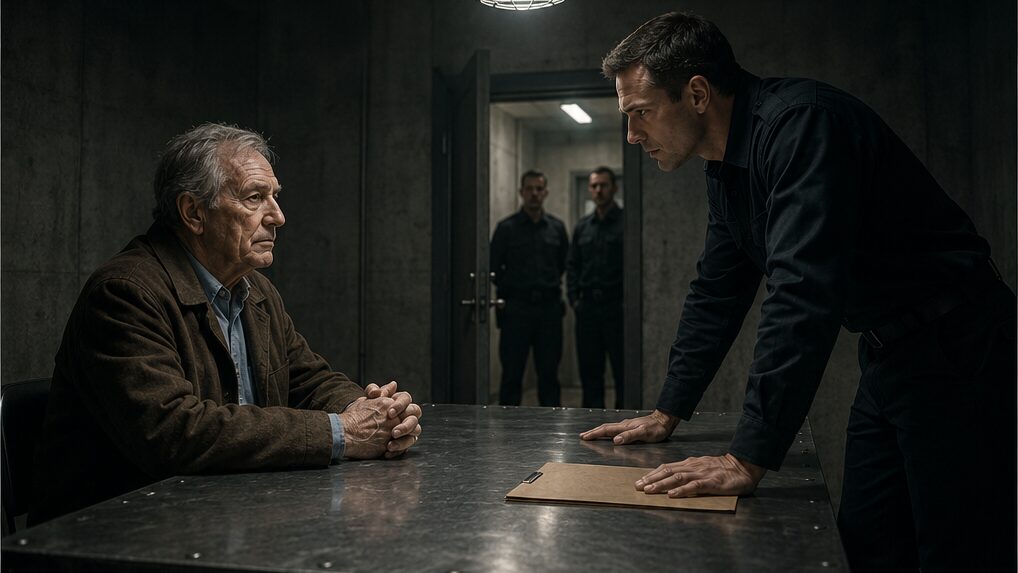
The officer’s palms hit the metal table hard enough to make William Carter’s fingers tighten, but not hard enough to make him flinch.
The sound ran through the room and came back smaller from the concrete walls. William kept his hands folded where they were, knuckle over knuckle, old skin drawn thin across the bones. Above him, the ceiling light hummed in its square cage. It had the pale, tired buzz of a place built for questions, not answers.
“Mr. Carter,” the officer said, leaning closer, “I’m going to ask you one more time. Who told you that you had clearance to come through that door?”
William looked at the man’s name strip before he looked at his face.
Hall.
The uniform was pressed clean. The sleeves were sharp. The shoulders were straight in the way men carried themselves when the building had given them authority and they were still deciding what to do with it. Justin Hall could not have been more than forty, maybe a little older, with the tired eyes of someone who had spent too many months being told that one missed detail could become a report, a report could become a hearing, and a hearing could end a career.
Behind him, through the half-open door, two uniformed personnel stood in the hall pretending not to watch. One held a tablet. The other had his thumbs tucked into his belt. Their faces were blurred by the brightness outside the room, but William could feel their attention the way he could feel the table’s coldness through his sleeves.
“I had an appointment,” William said.
His voice came out low. It had rough edges now. Age had done that. So had smoke, dust, long roads, dry air, and too many mornings when grief sat in his throat before coffee did.
Justin Hall straightened just enough to make a show of looking at the file in front of him. It was a thin folder, government tan, with William’s appointment letter clipped crookedly to the top. William had carried that letter from his kitchen table to the bus stop, from the bus to the visitor gate, from the gate to the intake desk, and from the intake desk to this room, where someone else had taken it from his hand as if paper became suspicious when held by an old man.
“You had a visitor request,” Hall said. “For a civilian records consultation. That does not give you access to the restricted corridor.”
“I didn’t enter a restricted corridor.”
“You were found beyond the marked line.”
William turned his eyes toward the door. The hallway outside looked new. Fresh paint. New camera domes tucked into corners. The facility had changed its skin more than once. But rooms had bones. Buildings remembered where doors had been even after men moved signs and renamed hallways.
“The marked line used to be before the second door,” William said. “Not after it.”
Hall stared at him.
William lowered his gaze again to his hands.
The officer laughed once, not loudly. It was not amusement. It was the short sound of a man deciding patience had been mistaken for weakness. “Used to be?”
William said nothing.
“Sir, this building isn’t a museum. You don’t get to walk wherever you remember walking thirty years ago.”
One of the men in the hall shifted. The sole of his boot squeaked lightly on the polished floor.
William felt the sound land in him.
Thirty years ago, the floor had not squeaked. The old tile had been dull and cracked near the south stairwell. Men came through with wet coats, oil on their cuffs, envelopes tucked under their arms. This room had not been a holding room then. It had been the receiving office for convoy records, with two desks pushed against the wall and a dented coffee urn on a cabinet beside the radiator. The radiator had clanged in winter. A clerk had kept peppermints in the top drawer. Men signed for sealed packets here, standing where Justin Hall now leaned over him.
William remembered because he had once stood in that doorway with Patrick Johnson beside him, both of them younger than Justin Hall was now, both of them waiting to hand over a folder neither one of them wanted to carry.
“Look at me,” Hall said.
William looked up.
Hall’s face was closer now. Close enough for William to see the tiny nick beside his jaw where he had shaved too quickly. Close enough to see irritation working hard to hide unease.
“Do you understand where you are?”
William let the question settle.
He understood more than the officer wanted him to. He understood the table, though it had been moved six feet from where the old desks used to stand. He understood the overhead light, new but hung from the same patched square in the ceiling. He understood the smell beneath the disinfectant, concrete dust and old paper. He understood a room that had once received accounts from men who were told to make memory official.
“I know where I am,” William said.
Hall held his stare. “Then start acting like it.”
William’s fingers pressed together once, then relaxed.
There had been a time when those hands could loosen a rusted fitting with a wrench and a strip of rag. A time when they could change a tire in the dark while someone held a covered flashlight low to the ground. A time when they could keep steady on a steering wheel after the windshield starred white and the man beside him stopped speaking.
Now the right thumb ached when rain was coming. The left index finger did not close properly. The younger guard at the intake desk had watched those hands search for the letter in William’s coat pocket and had said, too slowly, “Take your time, sir,” in the voice people used for children and old dogs.
William had taken his time.
He had learned, in life, that people who rushed old men often had no idea what those old men were carrying.
Hall tapped the folder. “You presented outdated paperwork. Your appointment wasn’t in the active system. You gave the name of a deceased service member in connection with restricted records. You passed a security line after being told to wait. Right now, the charitable version is confusion.”
William’s eyes moved to the folder.
“The other version,” Hall continued, “is false representation.”
The words were neat. Official. Small enough to fit in a report. Big enough to soil a man.
William breathed through his nose and kept his jaw still.
False representation.
Patrick would have hated that. Patrick Johnson had hated any phrase that let people hide plain wrong behind polished language. He had hated “incident” when someone meant mistake, “loss” when someone meant man, “delay” when someone meant no one cared enough to hurry.
William could almost hear him. Say what it is, Carter.
But Patrick was gone. Ruth Johnson was old now too. Older than William wanted to think about. She had waited through letters, calls, offices, transfers, and silence. She had been told the record was closed. She had been told there was no actionable discrepancy. She had been told, kindly and with no kindness at all, that some things were too old to correct.
William had come because promises did not expire just because the people who witnessed them died.
Hall turned a page. “You told the intake clerk you had previously submitted a correction statement.”
“I did.”
“There’s no accepted correction statement under your name.”
“I didn’t say it was accepted.”
Hall’s mouth tightened. “You see how that doesn’t help you?”
“It wasn’t meant to help me.”
Again, that flicker. Small, but there. A shift behind Hall’s eyes, as if something in William’s answer did not fit the shape of the report he had already begun writing in his head.
William watched him notice it and then push past it.
“Mr. Carter, when someone enters this facility with a story about old records and a name that triggers restricted files, I don’t get to assume good intentions.”
“No,” William said. “I suppose you don’t.”
“You suppose?”
William said nothing.
The overhead light hummed louder in the pause. Or maybe the room had grown quiet enough for him to hear it.
Hall closed the folder halfway. “Are you a veteran?”
The question came too late and too flat.
William looked at his folded hands.
At the intake desk, no one had asked that. They had asked for identification, appointment code, reason for visit, letter of authorization, current phone number, emergency contact, and whether he needed physical assistance. They had asked whether he knew which building he was in. They had asked whether anyone had driven him. They had asked if he was carrying medication.
No one had asked him that question until it became useful to their suspicion.
“Yes,” William said.
“Branch?”
William’s eyes returned to Hall’s face. He could answer. He could give dates, unit, motor pool assignment, convoy routes, names of places the younger man might know only from old maps and training films. He could say enough to change the air in the room.
Instead, he said, “Army.”
Hall waited, pen poised.
William did not add more.
“That’s it?”
“That’s what you asked.”
The officer’s cheek worked once.
In the hall, the man with the tablet glanced down as if the floor had suddenly become important. William saw it from the corner of his eye. Not shame, exactly. Discomfort. Discomfort was often the first crack in a room that had mistaken itself for certain.
Hall placed both hands on the table again, quieter this time. “You’re making this harder than it needs to be.”
William lifted his eyes slowly.
“No,” he said. “I’m keeping it as small as I can.”
The words changed the room.
Not much. The door did not open wider. No one apologized. The file did not clear itself. Justin Hall did not step back and become kind. But the pressure shifted by a fraction, the way a truck shifted when weight moved in the bed.
Hall studied him. “What is that supposed to mean?”
William looked past him to the wall behind the chair. There was a patch there, almost hidden beneath paint, where the old service window had been sealed. Men had once slid folders through it. Some came back stamped. Some came back with questions. Some disappeared long enough for wives to start calling.
“This room used to have a wire basket under that window,” William said.
Hall turned his head despite himself.
The painted wall gave nothing away.
William continued, “Incoming on the left. Outgoing on the right. If a packet needed command review, the clerk used a red pencil across the corner. Not a stamp. Pencil. Because stamps could be logged.”
Hall looked back at him. “Who told you that?”
William’s hands remained folded.
“No one who works here now,” he said.
The hall beyond the door had gone still.
For the first time since entering the room, Justin Hall did not look angry. He looked inconvenienced by uncertainty.
William felt no victory in it. A man could be wrong without being evil. William had known plenty of young men who stood too straight because they were afraid of bending. Hall had the look of someone trained to catch threats and not yet trained to recognize sorrow when it arrived wearing a worn brown coat.
“Why are you here?” Hall asked.
The question was quieter.
William looked at the folder, at the letter clipped to it, at the corner bent by someone else’s thumb.
He thought of Ruth Johnson opening her mailbox with two hands because arthritis had crooked the first knuckles. He thought of the last phone call, her voice careful, not asking him to go, not needing to. He thought of Patrick’s laugh, a hard sudden sound that always seemed surprised to find daylight.
Then William looked back at the officer leaning over his file.
“I told the clerk,” he said.
“Tell me.”
William drew one breath. His fingers tightened once more around each other, old bones holding old weather.
“I didn’t come for myself.”
Chapter 2: The Name on the Wrong Log
That morning, William had ironed the collar of his shirt even though the coat would cover it.
The iron was older than some of the people who now worked behind government desks. It hissed faintly as he guided it over the pale blue fabric, careful around the buttons, careful near the frayed place at the left cuff. He had not worn that shirt in months. Most days, he wore flannel, work pants, shoes with soles thick enough for slow walks to the grocery store. But the letter on the kitchen table had said consultation, and consultation sounded like the sort of word that deserved a collar.
The appointment letter lay beside his coffee cup. He had read it so many times the fold had begun to soften. His name was correct. William Carter. The date was correct. The facility address was correct. The department name was printed in clean black letters across the top.
The only part that mattered was buried in the middle.
Reference inquiry: Patrick Johnson service-record correction request.
William had underlined Patrick’s name once, then wished he had not. The line looked like impatience. He had folded the letter so the mark stayed inside.
Before leaving, he stood by the small table near the door where he kept his keys, bus card, and a photograph in a plain frame. The photograph showed two young men beside a truck with dust on its hood. William was one of them, though his own face had become strange to him over the years. Patrick Johnson stood beside him, one hand on the truck mirror, smiling like the camera had insulted him and he meant to answer by enjoying himself anyway.
William did not touch the frame.
“I’m going,” he said.
The house gave back the soft, ordinary silence of rooms where no one had answered for years.
He tucked the letter into his coat, checked the pocket twice, and stepped outside.
The bus ride took forty minutes. William sat near the front, one hand on the rail, the other over the folded letter. A young woman gave him her seat before he asked. He thanked her. She smiled and then looked at her phone. He watched storefronts pass, then office parks, then the long blank fencing near the federal complex.
The records facility stood beyond two gates and a wide paved approach that made every visitor feel visible before they even reached the door. The building was low, rectangular, and gray, with newer glass panels attached to old concrete like an apology that had come too late.
William paused near the visitor entrance to catch his breath.
Not because he was weak, he told himself.
Because he had learned not to hurry into places that could take more from you than they gave back.
Inside, the air smelled of floor wax and machine-cooled dust. A flag stood near the lobby wall, but William did not look at it for long. Flags were easy. Desks were harder. Desks were where people told you to wait, where they asked you to prove what had already happened, where they found a missing line and made it heavier than a life.
The intake clerk behind the glass looked young enough to be someone’s granddaughter. She wore a clipped badge and a polite smile that flickered when William slid the letter through the tray.
“Good morning,” she said. “Do you have a confirmation code?”
“It should be on there.”
She scanned the letter. Her eyes moved back and forth.
“Do you have a phone with the digital check-in?”
“No.”
“That’s okay.” The voice changed. Softer. Slower. “We can do it manually.”
William kept his hand resting on the counter, fingers lightly curled. “Thank you.”
She typed. The printer beside her clicked once, then stopped. She typed again.
“Can I see your photo ID?”
He passed it through.
More typing.
A line formed behind him: a contractor with a hard case, a woman in business clothes, a delivery driver holding a stack of sealed bins. William could feel them waiting. He had been the one waiting behind old men once. Back then, he had thought patience was something you gave. Now he knew it was something people measured and withdrew.
The clerk glanced at the letter, then at the screen. “Mr. Carter, I’m not seeing this appointment in today’s active visitor schedule.”
William looked at the letter.
“The date is today.”
“Yes, sir, I see that.” She smiled without showing teeth. “It may be a system issue. Who were you scheduled to meet?”
“It says civilian records consultation.”
“Do you have a staff contact?”
“No.”
She looked again. “And the record subject is Patrick Johnson?”
“Yes.”
“Is he with you?”
William did not answer immediately.
The contractor behind him shifted the hard case from one hand to the other.
“No,” William said.
“Is Mr. Johnson living?”
“No.”
The clerk’s hands paused above the keyboard.
The line behind William became quieter in the way lines did when people sensed a delay they could blame on someone.
“I’m sorry,” she said. “Are you next of kin?”
“No.”
“Legal representative?”
“No.”
“Then what is your relationship to the record subject?”
William had expected the question. He had practiced the answer while buttoning his coat. He still found that his mouth did not want to give it to the glass.
“I served with him.”
The clerk typed those words as if they were ordinary.
Maybe they were. Maybe, in that building, men arrived every week carrying names of the dead. Maybe old service had become one more dropdown menu.
“Purpose of correction request?”
William’s fingers moved toward the pocket where the letter had been, then stopped because the letter was already under the glass.
“There is an error in the account attached to his separation and casualty-related record.”
The clerk looked at him more sharply. Not unkindly. Alert now.
“That type of file may be restricted.”
“I know.”
“Do you have authorization from the next of kin?”
William reached into the inside pocket of his coat and removed a second envelope. This one was softer than the appointment letter, opened and closed too many times. Ruth Johnson’s handwriting crossed the front in blue ink. He passed it through.
The clerk read it. Her expression changed again, this time into something careful.
“Please wait one moment.”
She left her chair.
William stood at the counter. The contractor sighed behind him. The woman in business clothes checked her watch. The delivery driver leaned sideways to see whether another window would open.
William kept both hands folded over the edge of the counter.
The clerk returned with another employee, older than she was but still young to William. They spoke behind the glass in low voices. He heard “not in active schedule,” “restricted,” “old correspondence,” and “possible mismatch.”
The older employee opened the slot. “Mr. Carter, we’re going to need you to step aside while we verify this.”
William nodded.
“Just over there, please.”
Over there meant a row of plastic chairs beneath a security camera. William walked to them, aware of the line moving again behind him as if a stone had been removed from a stream.
He sat with his coat buttoned. His hands closed around nothing.
Ten minutes passed.
Then twenty.
People came and went. Badges beeped against the reader. A wall screen displayed visitor instructions in rotating panels. William read them all twice. No weapons. No recording devices. No unauthorized access. Visitors must remain in designated areas. Visitors must comply with all security personnel.
A junior guard approached him at the twenty-sixth minute.
“Mr. Carter?”
William looked up.
“We need to ask you a few questions about your paperwork.”
“I’ve already answered some.”
“I understand, sir. It’ll just take a minute.”
The guard gestured toward a side corridor.
William stood. The right knee took a moment to agree. The guard noticed and reached halfway toward him, then pulled his hand back as if uncertain whether assistance was kindness or insult.
William spared him the decision and walked.
The corridor smelled colder than the lobby. The walls were painted a greenish gray. Halfway down, a red line crossed the floor near a set of double doors. The guard stopped before it and spoke into his shoulder radio.
William looked past him.
Beyond the double doors, through a narrow wired-glass panel, he saw an old turn in the hallway. Something in the angle of it caught at memory. The facility had been remodeled, but the turn was the same. On the other side of that turn, if the bones of the place were what he thought they were, there would be an interior office with no windows and a patched section of wall where the record window used to be.
He took one step closer to the glass.
“Sir,” the guard said.
William stopped.
“I asked you to wait here.”
“I am waiting.”
“You crossed the line.”
William looked down.
His shoe was just past the red stripe.
He stepped back at once.
“I’m sorry.”
The guard’s face hardened, not because the mistake was large, but because he had been given something official to hold. “Please keep your hands visible.”
William looked at his hands.
They were empty.
“They are.”
The guard spoke into the radio again. His voice had changed. “I need Supervisor Hall at the east corridor checkpoint.”
William felt the building shift around him. Doors that had been only doors became watched doors. Lines that had been paint became evidence. The appointment letter, the widow’s note, the old correction request—everything he had brought to make the truth clearer—seemed suddenly to have arranged itself against him.
When Justin Hall arrived, he came quickly, with the contained anger of a man interrupted during something important.
“What happened?”
The junior guard explained. He did not exaggerate much. That almost made it worse. Outdated paperwork. Restricted record. No active appointment. Subject deceased. Visitor crossed marked security line after being told to wait.
Hall turned to William.
“Sir, why were you approaching the restricted doors?”
“I recognized the hallway.”
“That wasn’t my question.”
William held the officer’s gaze. “It was my answer.”
The junior guard looked down.
Hall’s jaw tightened. “Do you understand that this is a secure facility?”
“Yes.”
“Then you understand that wandering toward restricted records after presenting questionable authorization creates a problem.”
“I didn’t wander.”
“What would you call it?”
William glanced at the red line.
“A step.”
Hall stared at him for a long second, then looked to the junior guard. “Secure his documents. Put him in Interview Two.”
The guard hesitated. “Sir, he’s—”
“I can see how old he is.”
The words struck the corridor harder than Hall seemed to realize.
William folded his hands in front of him so no one would see the small tremor that had started in his right thumb.
The guard took the letter and Ruth’s envelope. He did it gently, which somehow hurt more than if he had snatched them. Then he gestured down the corridor.
“This way, sir.”
William walked past the red line only when told.
Interview Two waited at the end of a short hall. A concrete room. A metal table. One chair facing another. An overhead light.
William saw the sealed patch on the far wall before anyone asked him to sit.
For one moment, he was not seventy-eight years old. He was standing beside Patrick Johnson with dust on his boots and a folder between them that felt heavier than paper.
Then the junior guard pulled the chair back.
William sat.
His appointment letter lay in someone else’s hand. Ruth’s envelope had disappeared into the folder. The door stayed half open, just enough for the hallway to watch.
When Hall stepped in and put both palms on the table, William already knew the room had decided what he looked like before it asked who he was.
Chapter 3: Plain Clothes at a Military Desk
Anna Mitchell found the first inconsistency before anyone asked her to look for one.
The intake clerk had brought the folder to her desk with an apologetic whisper, as if old paper itself might cause trouble if handled too loudly. Anna had been reviewing digitized personnel amendments all afternoon, the kind of work that made names blur unless she forced herself to pause between them. She had learned early that haste in a records office did not look like haste. It looked like a clean screen, a checked box, a saved update, and a mistake that outlived everyone in the room.
She opened William Carter’s appointment letter first.
It was valid in format, but not active in the current visitor system. That could happen. Appointments created through legacy correspondence sometimes failed to migrate if the request had been initiated by mail instead of the online portal. Anna hated that phrase—failed to migrate. It made neglect sound like weather.
She checked the reference number.
No active appointment.
She checked the archive queue.
There it was.
Not cancelled. Not approved either. Suspended pending verification.
Anna leaned closer.
The suspension note was three weeks old and unsigned except for a department code. The letter should never have gone out. Or the appointment should never have been suspended. One of those things was wrong, and both had ended with a seventy-eight-year-old man sitting in Interview Two under security review.
She opened the linked file for Patrick Johnson.
A warning banner appeared.
Restricted historical service record. Partial casualty-related documentation. Next-of-kin correspondence attached.
Anna glanced toward the hallway.
From where she sat, she could not see Interview Two, but she could see the corridor leading to it. Two uniformed personnel stood near the door. One of them shifted now and then, trying not to appear interested. Justin Hall’s voice carried once through the concrete and died before the words reached her.
Anna looked back at the screen.
Patrick Johnson’s primary record was old enough to have passed through several systems. Scanned forms. Manual entries. A transfer summary. A separation note. A post-action administrative correction request marked unresolved. She opened that one first.
Most of the form was faint, the scan tilted slightly to the left. Several lines had been entered by hand. One section noted conflicting witness account. Another noted insufficient corroboration. A third line contained the words that made Anna sit very still.
Conduct classification retained pending absence of accepted correction statement.
She read it again.
Then she opened the correspondence log.
There were letters from Ruth Johnson. Polite at first. Then shorter. Then not angry, exactly, but stripped of all wasted courtesy. There were responses from offices with different names across different years. Each response sounded final until the next office found a way to make it temporary again.
Anna scrolled.
Near the bottom, she found an older reference to William Carter.
Potential witness. Statement received, not accepted. Hard copy not located.
She clicked the attachment icon beside it.
No image available.
Anna felt the small, familiar drop in her stomach that came whenever a missing document was not merely missing paper.
She stood and carried the folder down the hall.
At the corner near Interview Two, she heard Justin Hall’s voice.
“You’re making this harder than it needs to be.”
She stopped before the doorway.
Inside, William Carter sat beneath the overhead light. He wore a plain coat, plain shirt, dark trousers. No insignia. No cap. No visible announcement of service or importance. His hands were folded on the metal table as if he had placed them there deliberately and meant not to move them unless the room gave him a good reason.
Justin stood over him, shoulders squared.
The sight bothered Anna before she had language for why. She had seen people questioned in that room before. Contractors who forgot to declare equipment. Visitors who photographed restricted hallways. One angry man who tried to bluff his way into a personnel archive with a copied badge. But William Carter did not have the restless energy of someone caught in a lie.
He looked like someone conserving what little strength the day had left him.
Anna stepped into the doorway.
Justin turned. “Not now.”
“The appointment letter came from our side,” she said.
His expression tightened. “What?”
“It was generated from a legacy request. It shouldn’t have reached him if the verification was still suspended, but it did.”
“That doesn’t explain why he crossed a security line.”
“No,” Anna said. “But it explains why he believed he was expected.”
Justin looked annoyed that the distinction mattered.
William looked at Anna only briefly, then lowered his gaze. Not grateful. Not pleading. She wondered how many rooms had taught him not to spend gratitude too early.
“What about the deceased record subject?” Justin asked.
“Patrick Johnson,” Anna said.
At the name, William’s folded hands changed. Barely. A tightening at the fingers, then stillness again.
Anna saw it.
Justin did not.
“There is next-of-kin correspondence,” Anna continued. “Ruth Johnson gave written permission for Mr. Carter to assist with a correction inquiry.”
“Assist how?”
“As a witness, according to the old file.”
Justin looked back at William. “You told intake you served with him.”
“I did,” William said.
“Why didn’t you say there was an existing witness note?”
William’s eyes lifted. “I said I submitted a statement.”
“That’s not the same thing.”
“It was when I handed it over.”
For a moment, no one spoke.
Anna looked from William to Justin. The officer’s impatience had not vanished, but it had met something it could not push aside cleanly.
She opened the folder and placed it on the edge of the table, careful not to slide it at William like evidence against him.
“Mr. Carter,” she said, “the file says a statement was received but not accepted. It also says the hard copy can’t be located.”
William looked at the folder, then at her.
“That’s what they told Ruth?”
Anna swallowed. “In different words.”
He gave the smallest nod, as if confirming weather he had expected.
Justin pulled the folder toward himself. “Why was it not accepted?”
Anna hesitated. She did not want to say it in the hallway. She did not want to say it under that light. But the words were already in the file, and the room had been built for words people did not want spoken.
“The record says there was insufficient corroboration for a correction to Patrick Johnson’s conduct classification.”
William’s face did not change.
That was what made Anna understand the words had found their mark.
Justin frowned. “Conduct classification?”
Anna kept her voice professional. “There was an incident report attached to his service record. Later statements disputed part of it. The correction was never completed.”
Justin looked at William. “And you came here today because of that?”
William said nothing.
“Mr. Carter,” Justin said, sharper now, “this would go a lot faster if you stopped making people drag every answer out of you.”
Anna regretted not speaking before the sentence finished.
William’s hands remained folded.
“I won’t discuss Patrick Johnson in a corridor,” he said.
Justin exhaled. “This isn’t a corridor. This is an interview room.”
“The door is open.”
The two uniformed personnel outside looked away too late.
Justin glanced toward them, then back at William. Color rose faintly along his neck.
Anna stepped further into the room. “We can close the door.”
“No,” Justin said. “Not until we determine whether this remains a security matter.”
William’s gaze settled on him. There was no anger in it that Anna could see. That made it worse. Anger would have given Justin something easy to answer.
“You have my letter,” William said. “You have Ruth’s. You have your file. You have my name in it.”
“We also have a missing statement,” Justin said.
“No,” William said quietly. “You have a statement you lost.”
The room chilled around the sentence.
Justin’s hand closed on the folder. “Be careful.”
William’s eyes dropped again to his hands. “I was.”
Anna heard the second meaning before Justin did.
She looked at the old man and saw not confusion, not evasion, but a kind of discipline that had been mistaken for obstruction because it did not perform itself for younger people in a hurry.
The facility supervisor arrived ten minutes later, called by Justin and briefed by Anna in short, careful sentences. The supervisor stood just inside the doorway and listened with a face that had learned to reveal nothing until liability had been measured.
“This is no longer a lobby matter,” the supervisor said at last.
Justin nodded once, as if vindicated.
Anna felt irritation flare, then forced it down.
The supervisor continued, “The visitor’s documents are irregular, but the irregularity appears to involve our outgoing correspondence and an unresolved historical file. Mr. Carter will need to provide a formal statement before any restricted material is reviewed further.”
William looked up.
“Today?” Anna asked.
“If he wants the matter to proceed.”
Justin closed the folder. “And until then?”
“He remains here while we determine next steps.”
William’s right thumb pressed against his left hand.
Anna saw the tremor this time.
She wanted to say that he had come by bus. That he had stood in line. That the office had sent him a letter and then treated his arrival as an intrusion. But none of that would change the supervisor’s mind. In this building, pity had no field on the form.
The supervisor turned to William. “Mr. Carter, are you willing to give a formal statement regarding your connection to Patrick Johnson and the correction request?”
William did not answer quickly.
His eyes went to the patched wall behind Justin.
Anna followed his gaze and saw only paint.
Then William looked at the folder.
“Not in the hallway,” he said.
The supervisor gave a curt nod. “The statement can be taken here.”
William’s hands tightened once.
Anna thought he would refuse. Part of her wanted him to. Part of her wanted him to stand, reclaim his letter, and make the building feel the disgrace of watching him leave.
Instead, he looked at Justin Hall, then at the open door and the listening figures beyond it.
“When the statement is taken,” William said, “Ruth Johnson’s name stays out of casual talk.”
No one answered immediately.
The supervisor said, “That can be arranged.”
William nodded once.
Justin gathered the folder under his arm, still stiff, still guarded, but quieter than before.
As the supervisor stepped away to arrange the paperwork, Anna remained near the doorway. William did not look at her. He sat beneath the light with his hands folded, guarding a dead man’s name more carefully than anyone in the building had guarded his own.
Then Justin turned back from the hall.
“We’ll prepare a statement form,” he said. “You’ll need to sign it before records are released.”
William’s eyes stayed on the table.
Anna saw him understand what that meant before she did. The form would not simply invite truth. It would shape it. It would ask for admissions, clarifications, acknowledgments of procedure. It would protect the facility first.
William’s thumb pressed once into his palm.
And the door remained open.
Chapter 4: The Promise He Would Not Spend
By evening, the room had cooled enough for William’s hands to ache.
Someone had brought him water in a paper cup and set it on the metal table without meeting his eyes. Someone else had asked whether he needed medication. The question had been gentle, almost careful, but it still came after the door had been left open for half the facility to watch him sit under the light.
William had said no.
The truth was that he did have pills in the inside pocket of his coat, one for blood pressure and one for the old pain in his hip, but saying yes would have meant the coat leaving his reach again. It would have meant someone younger going through the pockets with blue gloves and a clipboard. It would have meant the appointment letter, Ruth’s envelope, his bus card, his house key, all lined up as if ordinary things became possible weapons in old hands.
So he sat.
The overhead light hummed. The paper cup softened where his fingers had touched it. His hands rested folded before him, not because they did not want to move, but because he had learned that stillness could keep a man from spending himself too soon.
On the other side of the wall, voices rose and fell. A phone rang twice. Shoes passed the door, slowed, then moved on.
William looked at the patched place where the old service window had been sealed.
He could see it as it was, not as it looked now. The wall had been cream then, yellowing near the radiator. The wire basket had hung beneath the window, crooked because one screw never held. Incoming left. Outgoing right. A red pencil slash meant command review. A blue clip meant next-of-kin correspondence. Patrick Johnson had teased him for remembering such things.
“You keep track of bolts, routes, and office furniture, Carter,” Patrick had said once. “You ever think about forgetting something useless?”
William had answered, “Not yet.”
Patrick laughed the way he always did, sharp and sudden.
In memory, they were not old. Neither one of them had gray hair. Neither one had learned the weight of an empty kitchen. Patrick’s sleeves were rolled, forearms dusty, one bootlace dragging until William told him to tie it before somebody else did. They were waiting beside a truck that had no business still running but did anyway because William had argued with it long enough to win.
That was how William remembered him best. Not in the final report. Not in the disputed line. Not in the thin language of the file.
Patrick alive, annoyed, loyal, hungry, stubborn, and always certain that laughter was a way to keep fear from thinking it owned the place.
The memory shifted without warning.
A road. Heat. The smell of fuel and metal. William’s hands tight on the wheel. Patrick in the passenger seat, reading from a folded route sheet and complaining that whoever had marked the alternate road had never driven anything heavier than a pencil.
Then the sound.
William closed his eyes.
He did not let the memory open fully. There were doors inside a man that should not be kicked open just because a clerk needed a sentence. He let himself remember only pieces: dust against the windshield, Patrick’s hand braced against the dash, William’s own voice saying stay with me though he no longer knew if he had spoken aloud.
Later, there had been forms.
There were always forms after the worst things. Men came with clipboards before they came with answers. Someone asked what time. Someone asked who had given the route change. Someone asked why Patrick had left the vehicle. Someone wrote down William’s words, then wrote them again in a way that made them cleaner and less true.
Patrick had not abandoned his post.
William had said it then.
He had said it in the receiving office with his right hand wrapped in gauze and his throat raw. He had said it to a clerk who would not look directly at the bandage on his forehead. He had said it while the red pencil marked the corner of the packet.
Patrick had gone back because the second truck had stalled in the open.
Patrick had gone back because there were two men pinned behind the disabled vehicle and no one could reach them fast enough.
Patrick had gone back because he was Patrick.
The report later used other words.
Deviation from assigned position.
Failure to remain with designated vehicle.
Insufficient corroboration.
William remembered standing in this very room, or the room this one had become, with his statement in his hands. He remembered the clerk saying the statement would be attached pending review. He remembered asking whether Ruth Johnson would see the correction. He remembered being told that next-of-kin notifications followed established channels.
Established channels.
A phrase could sound solid and still lead nowhere.
The door opened.
William opened his eyes.
Justin Hall stepped in carrying a clipboard and a narrow stack of forms. The light from the hallway outlined him for a second before the door swung partly closed behind him. He looked less angry than before, but not softer. Fatigue had taken the sharpest edge from his face and left the rest.
Anna Mitchell stood behind him, holding the tan folder against her chest.
The supervisor was not with them.
“We’ve prepared a preliminary statement,” Justin said.
William looked at the clipboard.
“Prepared by who?”
“By this office,” Justin said. “Based on the circumstances of your arrival and the documentation we have.”
Anna’s eyes moved briefly to William, then away.
Justin set the clipboard on the table and turned it toward him. “This acknowledges that you entered beyond the visitor boundary without current clearance, that your appointment was not active in the system, and that no records will be released until the matter is reviewed.”
William read the first few lines.
The words were not false in the way people thought falsehood worked. No sentence shouted. No lie stood up naked. It was worse than that. Each sentence carried one clean fact and arranged it so the person reading would never feel the room, the red line, the letter sent from their side, the dead man’s name, the old promise.
William did not touch the pen.
Justin watched him. “Signing this doesn’t close your request. It just lets us document the incident and move forward.”
“Move forward where?”
“To the formal review.”
“And if I don’t sign?”
Justin’s mouth tightened. “Then the security irregularity remains unresolved.”
William nodded once.
Security irregularity. Conduct classification. Insufficient corroboration. False representation.
He had spent half his life listening to people make small cages out of careful words.
Anna stepped closer. “Mr. Carter, there may be room to add a statement of context.”
“May be,” William said.
She accepted the correction with a small lowering of her eyes.
Justin tapped the form. “This is standard.”
William looked at him then.
“No,” he said quietly. “It’s familiar.”
Justin’s expression changed. “What does that mean?”
William looked down at the printed lines. His hands remained folded beside the clipboard. He could sign it. He could let the building have this small protection in exchange for the chance to reach Patrick’s file. That would be practical. Men survived institutions by letting them keep their pride.
But Ruth Johnson’s envelope had already been taken from his hand once today. Patrick’s name had already been spoken under suspicion. And here was another paper making the room clean by making him smaller.
He thought of Patrick in the passenger seat.
Tell Ruth, Patrick had said, or William had dreamed he said it. Memory had worn grooves around the words until he no longer trusted the exact sound of them, only the weight.
Tell Ruth I did right.
William had made promises in his life that he failed because he was tired, or proud, or afraid, or simply too late. This one had not left him.
He unfolded his hands.
The movement was small, but both Justin and Anna watched it.
William placed one finger on the first line of the statement. “This says I entered beyond the visitor boundary without current clearance.”
“You did cross the line,” Justin said.
“After your office sent me a letter telling me to come.”
“That’s separate.”
“No,” William said. “That’s the part you need separate.”
Justin took a slow breath. “Mr. Carter—”
William’s voice did not rise. “This says no accepted correction statement exists under my name.”
“That’s what the file shows.”
“The file shows you lost the one I gave.”
Anna’s face tightened, not in denial. In recognition.
Justin looked toward her.
She said carefully, “The archive does reference a received statement.”
“But not the statement itself,” Justin said.
“No,” Anna said. “Not the image.”
William’s hand returned to the table. He folded his fingers again before the tremor could show too plainly.
“I won’t sign a paper that makes your missing thing look like mine.”
The silence that followed was not comfortable.
Justin stared at him for a long moment. “You understand we can’t proceed without documentation.”
“I understand documentation,” William said.
His throat felt dry. He reached for the paper cup, lifted it, and took one small drink. The water had gone warm and tasted faintly of cardboard.
Anna shifted her grip on the folder. “We can request a revised form.”
Justin turned to her. “That requires supervisor approval.”
“Then request it.”
His eyes hardened. “You’re not in charge of security.”
“No,” she said. “But the record is not as clean as we thought.”
William looked between them. He saw Justin’s pride, Anna’s caution, and the invisible shape of the building pressing on both. He had no wish to make enemies of clerks and guards. They were not the ones who had written Patrick wrong the first time. But they were standing where the old wrong had reached forward into today.
Justin picked up the clipboard. “Fine. We’ll revisit the language.”
William said nothing.
At the door, Justin stopped and looked back. “If this is really about Patrick Johnson, you’re going to have to say more than you’ve said.”
William’s hands tightened.
For a moment, the room shifted again. Dust. Heat. Patrick’s head turned toward him. A laugh cut short. A promise made because refusing a dying man was not something William knew how to do.
He looked at Justin Hall, who had the impatience of a man who did not yet know that some truths came out damaged if pulled too hard.
“I know,” William said.
Justin waited as if there might be more.
There was not.
He left with the clipboard. Anna remained for one extra second in the doorway.
“Mr. Carter,” she said, “is Ruth Johnson expecting a call tonight?”
William looked at the paper cup.
“She stopped expecting calls a long time ago.”
Anna’s face changed, and then she nodded.
When she left, the door did not close all the way. The hallway light made a pale stripe across the floor.
William sat beneath the hum, hands folded, and understood that by morning he would have to spend the part of the promise he had kept private for decades.
Chapter 5: The Room Listens Without Applause
By morning, someone had changed the arrangement of the chairs.
William noticed before anyone spoke.
The metal table was the same, bolted heavy and cold at the center of the room. The overhead light still hummed. The patched wall still kept its silence. But the second chair had been pulled back from the table instead of placed close enough for a man to loom. A third chair had been added near the side, angled toward the folder rather than toward William.
It was not kindness. Not yet.
But it was a different shape.
William had slept little. He had been allowed to go home after signing a temporary visitor-hold release that did not admit fault and did not release records. A facility vehicle had taken him because the last bus had come and gone while people argued over forms. The driver had not made conversation. William had been grateful.
At home, he had placed his keys on the small table, stood before Patrick’s photograph, and said nothing at all. Then he had sat in the kitchen until the room grew dark around him. Twice, he reached for the phone to call Ruth Johnson. Twice, he stopped.
What could he tell her?
They lost it once. They may lose it again.
No. He would not make her wait inside another maybe.
Now, back beneath the light, William sat with both hands resting flat on the metal table. Not folded. Not yet. The surface was cold enough to wake the ache in his fingers.
Justin Hall entered carrying the revised form. Anna Mitchell followed with the folder and a slim black binder. The supervisor came last and remained standing near the wall.
Justin’s uniform looked as pressed as it had the day before, but his face did not. There were faint half-moons under his eyes. He placed the form on the table without pushing it toward William.
“We revised the statement language,” he said.
William looked at the page.
Anna spoke before he asked. “It acknowledges that the facility issued correspondence that led you to appear for a consultation. It also notes that your crossing of the boundary occurred during a verification delay and that no malicious intent has been established.”
William read slowly.
The words were still stiff. They still belonged to a building defending itself. But they had made room for him to stand inside the truth without bending his head.
He nodded once.
Justin watched the nod as if it cost him something to want it.
“There’s also a formal testimony form,” Anna said. “Separate from the visitor incident. If you’re willing, your statement today can be attached to the reopened correction review.”
William looked at the black binder.
Patrick Johnson’s name appeared on a tab near the top.
He kept his hands flat. If he folded them, he might not open them again.
The supervisor cleared his throat. “Mr. Carter, before we begin, I want to make clear that this review does not guarantee a correction. It allows us to examine whether the original classification should remain, be amended, or be escalated.”
William looked at him. “That sounds like no in a longer coat.”
Anna looked down.
Justin’s mouth moved slightly, almost not a smile. Then it disappeared.
The supervisor said, “It means process.”
“I know what it means.”
The supervisor did not answer that.
Anna opened the binder. “The record states that Patrick Johnson left his assigned vehicle during a convoy disruption. The initial report classified the action as deviation from assigned position during an active security event. Later correspondence challenged the classification, but no accepted witness statement was available in the file.”
William listened to Patrick being reduced again. Left. Assigned. Deviation. Event.
Words without dust on them.
Justin took the seat across from him.
That mattered more than William wanted it to.
The officer did not lean forward. He did not plant his palms on the table. He sat with the form before him and a pen in his hand.
“Mr. Carter,” Justin said, quieter than yesterday, “we need you to tell us what you saw.”
William looked at the pen.
“I told them before.”
“I know.”
“No,” William said. “You know the file says that.”
Justin accepted the correction. “Then tell us what you gave them before.”
The overhead light hummed.
William drew his hands back from the table and folded them in his lap for a moment where no one could see. His right thumb trembled. He pressed it into his palm until it stopped.
When he placed his hands back on the table, they were steady enough.
“We were third vehicle in the line,” he said. “Patrick Johnson was riding with me because the second truck had been giving trouble all week and command wanted someone who knew its habits nearby. He knew that engine. He could hear a misfire before the driver could feel it.”
Anna wrote.
William watched the movement of her pen. It helped, somehow, to see words arrive slowly instead of vanish into a screen.
“The route had changed that morning. Not by us. We were told the main road was blocked. The alternate road put us in open ground longer than anybody liked.”
He stopped.
No one pushed him.
That helped too.
“The second truck stalled after the first blast,” William said. “Not from damage at first. Fuel line problem, maybe shaken loose. Men were pinned there. Patrick saw it before the rest of us had our heads clear.”
Justin’s face had gone still.
“Was he ordered to leave your vehicle?” Anna asked.
“No.”
The supervisor shifted against the wall.
William looked at him. “That’s the part they kept.”
Anna’s pen paused.
William continued. “He wasn’t ordered. He chose. There’s a difference between abandoning a place and going where you’re needed.”
The words sat on the metal table between them.
Justin lowered his eyes to the form.
William did not let himself look away. “Patrick went back because the second truck had men inside and fire under it. He carried a line. I had the wheel. I was trying to angle us for cover. He yelled that he’d be right back.”
His mouth dried.
Anna’s pen moved again, slower.
“He reached them,” William said. “Got one out. Went back for the other. That’s when the second hit came.”
The room had no sound but the light.
William pressed his palms flat to the table. Cold bit into the joints. It was good. It kept him there.
“When I gave my statement, I told them he left his assigned vehicle to assist trapped personnel under active threat. I said he acted with judgment. I said the route change put us where we shouldn’t have been. I said the stalled truck had been reported before that day.”
The supervisor spoke carefully. “The file contains no maintenance warning attached to that convoy packet.”
William looked at him.
“I know.”
Anna turned a page in the binder. “There is a reference to a vehicle readiness dispute in a separate logistics note, but it was not attached to the incident packet.”
Justin looked at her. “You found that?”
“This morning.”
The supervisor’s posture changed. “Why wasn’t that in the primary record?”
Anna’s answer was quiet. “It was indexed under equipment, not personnel.”
William closed his eyes for one brief second.
There it was. Not the whole truth. Not enough by itself. But a door, cracked open after decades because someone finally looked in the place where the truth had been filed wrong.
Justin rubbed one hand along his jaw. “So the system split the record.”
Anna nodded. “Part of the context lived in logistics. Part in personnel. The correction request seems to have referenced both, but the witness statement image is missing.”
The supervisor looked at William. “Do you have a copy?”
William shook his head.
He had kept many things: Patrick’s photograph, Ruth’s letters, an old route patch with the stitching coming loose. But not a copy of the statement. Back then, he had believed that handing truth to the right window meant truth would remain whole.
“I trusted the basket,” he said.
No one understood at first.
Then Justin glanced toward the patched wall.
Incoming left. Outgoing right.
Something in his face shifted.
The supervisor began speaking about review standards, corroborating documents, archival retrieval, and the limits of testimony. William let the words pass around him. Some mattered. Most were walls being built before anyone knew whether a door would be needed.
Anna interrupted once, respectfully, and pointed to the logistics note. Justin asked two questions that did not sound like traps. The supervisor agreed to request full archival retrieval from the old equipment file.
It was not victory.
It was movement.
Near the end, Justin slid the revised visitor statement toward William. “This one doesn’t say you admitted wrongdoing.”
William read it again. Then he signed.
His signature looked thinner than it once had, the W less certain, the C angled like it wanted to rest. He placed the pen down carefully.
Justin looked at the signature, then at him. “Thank you.”
William felt the word approaching him and stepped around it.
“If you find enough to correct Patrick’s record,” he said, “Ruth Johnson hears it before I hear anybody thank me.”
Anna looked up.
The supervisor said, “Mr. Carter, there are notification procedures—”
“No,” William said.
No one moved.
He had not spoken loudly. He did not need to.
“Ruth spent years receiving procedure. If there is truth, she receives that first.”
Justin’s eyes stayed on him.
Then, slowly, he nodded. “We can note next-of-kin priority.”
The supervisor looked as though he might object, then did not.
William folded his hands on the table again, but this time the gesture did not feel like holding himself closed. It felt like keeping the promise in place until the room caught up to it.
Chapter 6: When Silence Became His Answer
The records review room had no overhead cage light.
That should have made it easier.
Instead, William missed the harshness of the interview room. At least there, the room had told the truth about itself. The review room tried to be pleasant. It had a long table with a wood-grain surface, soft chairs, a wall screen, a coffee machine on a side counter, and a framed print of a quiet field beneath a blue sky. The print bothered him most. It offered peace too cheaply.
William sat at one end of the table with the black binder before him.
Anna Mitchell sat to his left, a legal pad open, two pens placed parallel above it. Justin Hall sat across from William, not in the center, not in command, but close enough to listen. The supervisor stood by the wall screen, speaking to someone on the phone in a low voice. Two records board members appeared on the screen from another office, their faces flattened by the camera.
A stack of newly retrieved pages lay beside the binder.
The old equipment note had been found.
So had a partial routing memo. So had a maintenance warning from the morning of the convoy, signed by someone whose name had been blacked out in one copy and left visible in another. The documents did not create a miracle. They did not bring Patrick back or make the original report vanish. But they moved weight. They put context where absence had been standing.
The missing witness statement had not been found.
William had known it would not be.
A missing thing, gone long enough, became part of the structure built around it. People learned to step where it wasn’t.
The supervisor ended the call and turned to the room. “We have enough to accept supplemental testimony for review. Mr. Carter, your statement today will be recorded, transcribed, and attached to the reconsideration packet. You may decline to answer any question you believe exceeds your memory or personal knowledge.”
William nodded.
Justin looked down at his hands.
William noticed that the officer had placed them flat on the table, palms down, as if teaching himself not to reach for authority too quickly.
Anna switched on the recorder.
A small red light appeared.
William looked at it and felt, absurdly, like he was back in the old receiving office, waiting for a clerk to decide whether words belonged to him after he said them.
“Please state your full name,” Anna said.
“William Carter.”
“Please state your connection to Patrick Johnson.”
William looked at the binder. Patrick’s name sat on the tab, typed straight and black.
“I served with him,” he said. “I drove with him. I knew his habits, his temper, the way he checked an engine twice if somebody told him once was enough.”
One of the board members glanced down, perhaps at a form. The other watched him closely.
Anna did not interrupt.
William continued. “He was not careless. He was not trying to prove anything. He was not leaving his place because he panicked.”
The supervisor folded his arms, then seemed to think better of it and let them fall.
Anna asked, “What do you remember about the convoy event related to his record?”
William told them.
He did not give them everything. Some things belonged to the dead and the men who had stood beside them. But he gave what the record needed. He gave sequence. Weather. Vehicle order. The warning signs on the second truck. The route change. The first blast. The stall. The fire. Patrick’s choice.
He did not call Patrick brave until asked.
“Would you characterize his action as brave?” one board member said through the wall screen.
William looked at the flat, distant face.
“I would characterize it as Patrick,” he said.
The room waited.
William sighed once through his nose. “If that’s not enough for your form, then yes.”
Anna wrote that down.
Justin closed his eyes briefly.
The questions continued. Some were careful. Some were clumsy. William answered the ones that deserved answers and corrected the ones that bent the scene out of shape.
“Did he abandon his assigned position?”
“He left my vehicle.”
“So yes?”
“No,” William said. “A position is not a seat. His duty moved when the men in that truck needed him.”
Anna’s pen stopped for a second.
The board member on the screen leaned closer. “Mr. Carter, the original classification appears to have relied on the fact that no order was given authorizing him to leave your vehicle.”
“No order was given telling him to breathe either,” William said.
The supervisor looked sharply at him.
William lowered his eyes to his hands. “Strike that if you need to.”
Anna’s mouth tightened at one corner, then smoothed.
The board member said, “We need clarity, Mr. Carter.”
“So did Ruth.”
No one answered.
William had not meant to say it. Not like that. Ruth’s name entered the room and changed the air more than any document had. She was no longer a next-of-kin line. She was an old woman somewhere beyond the facility walls, waiting without admitting she waited.
Anna asked softly, “Did Patrick Johnson speak to you after he returned to the second vehicle?”
William’s hands closed.
There it was.
The part he had avoided even in memory. The place where testimony became something else. He could refuse. The supervisor had said he could. He could say he did not believe it belonged in the record. He could keep Patrick’s last words where they had lived all these years, inside him, untouched by transcription.
But Patrick’s record had been wrong because silence had been convenient for everyone except the dead.
William looked at Justin.
The younger man did not look away. He did not hurry him. He did not lean forward. For the first time, William saw not the officer from the metal table, but a man trying to understand the cost of asking.
William unclasped his hands.
The movement hurt. His fingers had stiffened around each other. He laid both palms on the table and let them rest open.
“He got one man out,” William said. “He went back for the other. I saw him reach the door. I saw him pull. I heard him yelling, but not the words. After the second hit, I got to him.”
He stopped.
The room seemed to draw back.
“He knew he was hurt,” William said. “He knew before I did. He grabbed my sleeve. He said, ‘Tell Ruth I did right.’”
Anna’s pen did not move.
William kept his palms open. If he closed them now, he might disappear into the old dust and not return.
“I told him I would,” he said. “I gave the statement. I wrote the letter. I answered what they asked. Then the record stayed the way it was.”
The supervisor’s voice was lower when he spoke. “Mr. Carter, why didn’t you continue pursuing it earlier?”
The question was fair. That made it harder.
William looked at the print of the quiet field on the wall. “I did. Then Ruth asked me to stop for a while because every answer reopened it. Then my wife got sick. Then offices changed names. Then years became something people used against the truth.”
No one spoke.
“And because,” William said, “I was ashamed.”
Anna looked up.
William did not look at her. “I handed my words to this building once. I believed that was enough. When it wasn’t, I told myself I had done what I could. That was easier than admitting I got tired.”
The red light on the recorder held steady.
Justin’s hands had curled slightly on the table. He noticed and flattened them again.
The supervisor asked two more questions. The board members asked for clarification on the route memo and the maintenance note. Anna read back parts of William’s statement to confirm accuracy. He corrected a time. He corrected the position of the second truck. He corrected the phrase “went back toward danger” to “went back toward the men.”
At last, Anna turned the final page toward him.
“This is the statement acknowledgment,” she said. “It does not finalize the correction, but it attaches your testimony and the supporting documents to the record review.”
William picked up the pen.
His fingers did not want to close around it. For one foolish second, he thought of the young clerk from decades earlier taking his paper through the window. Incoming left. Outgoing right. Red pencil across the corner.
He had trusted the basket.
He would not trust it now without leaving his name where they could not pretend it had never been.
He signed.
The room remained quiet after the pen left the page.
The supervisor gathered the documents with more care than he had shown the day before. The board members said the review would be expedited. Their faces vanished from the screen, leaving William reflected faintly in the dark glass.
Anna stopped the recorder.
Justin stayed seated.
The supervisor said, “Mr. Carter, we will contact Ruth Johnson according to the priority note once the correction decision is entered.”
William nodded. “She hears plain language.”
“Yes.”
“Not classification amended pursuant to review.”
The supervisor looked embarrassed. “Plain language.”
William stood slowly. His hip caught, then released. Anna reached halfway toward him, then stopped before making the same mistake the junior guard had made.
He appreciated that.
In the hallway outside the review room, Justin walked beside him without speaking. They passed the corridor with the red line. The stripe looked smaller now. Paint on a floor. Still capable of causing trouble, but smaller.
Near the turn toward the lobby, Justin stopped.
“Mr. Carter.”
William turned.
Justin’s face had lost its official hardness, but what remained was not simple remorse. It was discomfort, responsibility, and the beginning of something that might become humility if he allowed it to keep working.
“I was wrong yesterday,” Justin said.
William waited.
“I treated you like a problem before I understood what problem you were trying to solve.”
William looked at him for a long moment. “That part happens a lot.”
Justin accepted it without defense.
“I can file a disciplinary note on myself,” he said. “For the handling of the interview. The open door. The way I questioned you.”
William’s hands hung at his sides.
There would have been a time when he wanted that. Not for revenge, he would have told himself, but for the record. Another correction. Another official line admitting what had been done poorly.
But Justin Hall’s shame would not help Ruth Johnson read Patrick’s corrected record. It would not change the red line. It would not teach the next guard what to ask an old man before deciding he was confused.
William looked down the hall toward the lobby, where visitors stood in line with documents in their hands.
He did not answer immediately.
Chapter 7: The Door Opened Before He Knocked
One week later, William Carter stopped before the visitor entrance and looked for the red line before he looked for the door.
The morning was bright enough to turn the glass front of the records facility into a mirror. For a moment, he saw only himself: worn brown coat, pale blue collar, shoulders slightly bent, one hand closed around the envelope he had carried from home. Then the automatic door opened from inside before he reached for the handle.
Justin Hall stood there in uniform.
He did not call through the glass. He did not motion impatiently. He stepped back and held the door as if William were expected, because this time he was.
“Good morning, Mr. Carter,” Justin said.
William paused on the threshold.
Behind Justin, the lobby moved with its usual controlled noise. Badges beeped. Shoes crossed polished floor. The intake clerk looked up from behind the glass, recognized him, and straightened with a small, uncertain smile.
William stepped inside.
“Morning,” he said.
Justin did not reach for his elbow. He did not ask whether William needed help. He walked beside him at William’s pace, close enough to guide, far enough not to herd.
At the intake desk, a new sign had been taped beside the visitor instructions. It was plain white paper in a plastic sleeve, temporary and unpretty.
Visitors with legacy appointments, mailed authorization letters, or historical records inquiries: please request manual verification before proceeding beyond intake.
William read it once.
Justin watched him read it.
“It’s temporary,” Justin said. “The permanent version has to go through review.”
William nodded. “Temporary things can still stop a mistake.”
The intake clerk slid a visitor badge through the tray. “Mr. Carter, your consultation is active. Records review is expecting you.”
Her voice did not slow down for him this time. She did not make it bright or soft. She simply spoke to him like a man with business in the building.
William took the badge.
“Thank you,” he said.
He placed it on his coat carefully, though the clip resisted his fingers. Justin waited without reaching.
At the corridor, they stopped before the red line.
The paint was the same. The rule was the same. But beside it, a small floor stand had been placed with an arrow and the words Wait here for escort.
William looked at it, then at Justin.
Justin’s face colored faintly. “That should have been there before.”
“Yes,” William said.
No more than that.
Justin accepted it.
They walked past the line together.
When they reached Interview Two, the door was open wide. The overhead light was off. Daylight from the hallway softened the concrete walls. The metal table remained bolted to the floor, but the chairs had been moved again. Two chairs on one side. One across. No chair pushed back in a corner. No body positioned to loom.
Anna Mitchell stood near the patched wall with a folder held against her side.
“Mr. Carter,” she said.
“Ms. Mitchell.”
She smiled a little at the formality, then lowered her eyes to the envelope in his hand. “Ruth Johnson arrived a few minutes ago. She’s in the records consultation room. I thought you might want to see this room first.”
William did not answer.
He stepped inside.
The room was smaller without the light pressing him down. The metal table reflected a dull gray shape of his hand when he rested it on the edge. He did not fold his fingers. He let them lie open, palm down, old veins raised, the skin spotted and thin.
Justin remained by the doorway.
William looked at the table, then the patched wall, then the chair where he had sat while men watched from the hall.
“You changed the chairs,” he said.
Justin nodded. “Yes.”
“Why?”
Justin’s eyes moved to the table. “Because I remembered standing over you.”
The answer was plain enough that William did not need to press it.
Anna opened the folder. “The correction decision was entered yesterday afternoon. The official notification is ready for Mrs. Johnson. The language is plain, as requested.”
William looked at her.
She handed him a copy.
He read slowly. The words did not heal anything. They could not. But they did not hide either.
Patrick Johnson’s record had been amended to reflect that he left his assigned vehicle to assist trapped personnel during an active convoy emergency. The prior conduct classification had been removed. The correction cited supplemental witness testimony, recovered logistics documentation, and review of fragmented historical records.
William read Patrick’s name twice.
The paper trembled once in his hand, and he steadied it against the table.
No one spoke over him.
At last, he handed the copy back to Anna. “Ruth should have the first clean one.”
“She will.”
Justin stepped farther into the room. “Mr. Carter, about what I asked last week.”
William turned.
“The disciplinary note.”
Justin nodded. “I prepared one. I haven’t filed it yet.”
William studied him. The younger man looked different in the same uniform. Not smaller. Not broken. Just less protected by the belief that being right was the same as doing right.
William rested both hands on the table.
“I don’t need your shame in a file,” he said.
Justin’s throat moved.
William continued, “I need the next old man with a letter to be asked what he came for before he’s treated like he stole something.”
Justin looked toward the sign in the hall. “That change has started.”
“Started is not finished.”
“No,” Justin said. “It isn’t.”
William nodded once. That was enough.
They walked together to the consultation room.
Ruth Johnson sat near the window, a purse on her lap and both hands folded over it. She was smaller than William remembered, though he knew memory had cheated. Grief kept people fixed at the age they were when the worst thing happened. Time did not ask permission before continuing.
Her hair was white now, pinned back neatly. She wore a dark cardigan and polished shoes. When she saw William, she tried to stand.
He shook his head once.
She remained seated, but her hands tightened on the purse.
“William,” she said.
“Ruth.”
Anna entered quietly with the folder. Justin stayed near the door, not hiding, not intruding.
Anna sat across from Ruth and placed the document on the table between them. She did not begin with procedural history. She did not say pursuant to review. She did not say classification language.
“Mrs. Johnson,” Anna said, “Patrick Johnson’s record has been corrected. It now states that he left his vehicle to help trapped personnel during the convoy emergency. The previous conduct note has been removed.”
Ruth stared at the paper.
For several seconds, nothing in her moved.
Then one hand left her purse and reached toward the page. Her fingers stopped just before touching Patrick’s name.
“They put that in writing?” she asked.
“Yes,” Anna said.
Ruth looked at William.
He had prepared for anger. He had prepared for tears. He had prepared for her to ask why it had taken so long, because she had a right to that question and he had no answer large enough for it.
Instead, she said, “He told me you would try.”
William’s hands closed at his sides.
“I should’ve tried longer.”
Ruth looked back at the page. “Maybe. But you came.”
That was not forgiveness, not exactly. It was not absolution. It was an old woman placing a fact gently where regret had wanted to sit.
Anna slid the clean copy toward her.
Ruth touched Patrick’s name.
Justin looked down.
William saw it, and for the first time since the metal table, he felt no need to make the younger man look up. Some lessons entered better when a man’s eyes were lowered.
After the papers were signed and the copies placed in Ruth’s envelope, William walked her to the lobby. She held the envelope against her chest with both hands. At the door, she turned to him.
“I’m going to read it at home,” she said. “Out loud.”
William nodded.
“He always hated being misquoted.”
A small sound escaped William before he could stop it. Not quite laughter. Close enough.
“Yes,” he said. “He did.”
Ruth left in the care of a waiting driver. William watched until the car moved beyond the gate.
When he turned back, Justin was standing near the corridor.
“Your badge,” Justin said, then immediately added, “When you’re ready.”
William unclipped it slowly and handed it over.
Justin took it without brushing his fingers, careful in a way that no longer felt afraid of age but respectful of it.
At Interview Two, Anna was gathering the remaining papers. The overhead light was still off. Justin stepped inside, looked once at the table, and reached for the wall switch—not to turn the light on, but to check that it was down.
William stood in the doorway.
His hands hung open at his sides.
The room no longer asked him who he thought he was. It had not earned the right to answer for him either. It was only a room again: concrete, table, chairs, patched wall, old air.
William turned toward the exit.
Behind him, Justin closed the door partway, then stopped. He looked at the open doorway, the hall beyond it, and the table inside.
Then he stepped back into the room and switched off the remaining hallway spill from the interview light panel, leaving the metal surface dull and quiet.
William walked out through the lobby at his own pace.
No one hurried him.
The story has ended.