The Locket She Almost Sold Before Learning What It Remembered
Part I — The Price of Rain
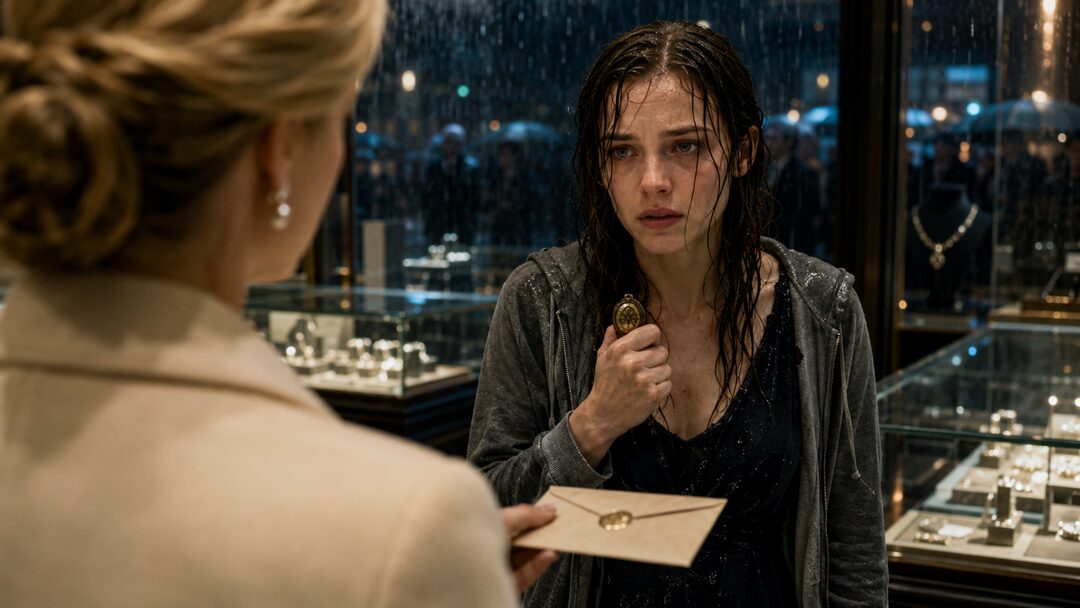
Emily Bennett walked into Collins Estate Jewelers seven minutes before closing, soaked through her gray hoodie, wearing a black dress underneath that looked too expensive for her boots and too ruined to return.
The bell above the door gave one polite ring.
The older man behind the counter looked up.
For one second, Emily saw herself the way he must have: wet hair stuck to her cheeks, mascara blurred beneath her eyes, ripped jeans under the hem of a gala dress she had hidden beneath the hoodie, one hand pressed hard around something small and gold.
Behind her, rain scratched down the windows.
In front of her, diamonds slept under glass.
“Can I help you?” the man asked.
His voice was calm, trained by decades of people bringing him things they hoped were worth more than their lives had become.
Emily stepped to the counter and opened her hand.
The locket lay in her palm, oval and old, with a tiny hinge along one side and a blackened chain coiled around it like a question.
“How much can you give me for this tonight?” she asked.
The man did not reach for it right away.
That scared her more than if he had laughed.
“I’m Charles Collins,” he said. “And you are?”
“Someone who needs rent money before morning.”
His eyes moved from her face to the locket. Not greedily. Not like a man appraising gold.
Like a man hearing a voice from another room.
“I’ll need to examine it.”
Emily placed it on the glass.
Her fingers did not want to let go. Her mother had worn the locket under her blouse for years, close to her heart, even when the chain turned her skin green. When Emily was little, she used to ask whose picture was inside.
Her mother always said, “A man who knew how to make promises.”
That was all.
Later, when rent was late and groceries became arithmetic, Emily asked why they didn’t sell it.
Her mother’s answer changed.
“Never sell that unless there’s no other door left.”
Tonight, there was no door.
There had only been a ballroom, a senator’s daughter, Daniel Whitman’s hand at Ashley’s waist, and Patricia Whitman placing an envelope of cash into Emily’s palm like she was tipping a coat-check girl.
Emily had left the envelope in a champagne bucket.
She had kept the locket.
Charles lifted it with clean white gloves and brought it beneath a small lamp. He turned it once, twice, then opened the hinge with a tool so thin Emily barely saw it.
Inside was the portrait.
A young man in black-and-white, formal jacket, steady eyes, hair combed back with the confidence of someone who had never had to explain why he belonged anywhere.
Beneath the portrait was an inscription, worn nearly smooth.
Emily had never been able to read all of it.
Charles could.
His mouth changed first.
Not much. Just enough.
“What?” Emily asked.
He closed the locket.
The sound was small.
In the silent store, it was final.
“Where did you get this?”
“My mother.”
“Her name?”
Emily pulled her hoodie tighter across her chest. “Why?”
“Because I need to know.”
“No, you need to tell me if it’s worth anything.”
Charles looked toward the front windows. The rain blurred the streetlights into gold lines. Outside, people hurried under umbrellas, dressed in dark coats, laughing from restaurants they could afford.
Inside, he reached beneath the counter and pressed a button.
The front door locked.
Emily stepped back. “What are you doing?”
“Miss Bennett—”
“I didn’t tell you my last name.”
“No,” Charles said softly. “You didn’t.”
The air went cold in a way the rain had not managed.
Emily looked at the locket on the counter, then at him.
“Who is he?” she asked.
Charles removed his glasses and cleaned them with a cloth he did not need. His hands were too controlled.
“The man in the portrait,” he said, “is Robert Whitman.”
Emily almost laughed.
Of course.
Of course the night would not stop there.
She had heard that name for three hours under crystal chandeliers while rich people raised glasses to the Whitman Foundation and applauded a family that had turned generosity into a brand.
Robert Whitman.
Founder of Whitman House.
Dead patriarch.
Boston royalty.
Daniel’s grandfather.
Emily looked down at the locket again.
“No,” she said.
Charles did not answer.
“No,” she repeated, because one word was all she had. “My mother didn’t know those people.”
Charles’s silence said otherwise.
Emily leaned over the counter. “Can you buy it or not?”
“I can’t.”
“Can’t, or won’t?”
“Both.”
“I need money.”
“I understand.”
“No, you don’t.” Her voice cracked, and she hated it. “You don’t understand anything. I have six hours before my landlord changes the lock. I walked here in the rain because I couldn’t afford a cab. I am asking you what that piece of gold is worth, not what memory it offends.”
Charles looked at her then with something worse than pity.
Recognition.
“That locket may be worth more than money,” he said.
“People only say that when they already have money.”
He flinched.
Good, Emily thought. Let something land.
Charles reached under the counter again, but this time he brought out an old leather-bound book, not cash. He placed it beside the locket and did not open it yet.
“Your mother’s first name,” he said.
Emily should have left.
She should have picked up the locket, gone back into the rain, found a pawnshop with neon lights and no questions.
Instead, she heard herself answer.
“Laura.”
Charles closed his eyes.
“Laura Bennett,” Emily said. “And if you know that name, you’re going to tell me why.”
Part II — The Gala Door
Before that night, Emily had believed humiliation had a shape.
She thought it was loud. A slap of laughter. Someone pointing. A cruel word spoken clearly enough for everyone to hear.
She was wrong.
Humiliation could wear pearls and speak in a low voice.
Three hours earlier, Patricia Whitman had smiled at Emily in the lobby of the Whitman Foundation gala and said, “The staff entrance is around the side, dear.”
Emily had been wearing a black dress Daniel once said made her look “unfairly beautiful.” She had bought it secondhand, altered the straps herself, and covered it with the gray hoodie until she reached the hotel because it was raining and because she did not want anyone on the subway staring.
Daniel had told her to come.
Not in those exact words.
He never said anything dangerous in exact words.
But he had held her in his apartment two nights before, his mouth in her hair, and whispered, “I’m tired of hiding you.”
She had believed him because she wanted to.
That was the worst part.
Not that he lied.
That she brought her own hope to the lie and handed it to him.
At the gala, the ballroom glittered in layers: gold light, white flowers, donors with soft hands, photographers waiting for the right family smile. Emily had stood near the entrance for twelve minutes before Daniel saw her.
His face had changed.
Not with joy.
With fear.
Then Patricia appeared at Emily’s elbow, cream coat draped over her shoulders, hair dry and flawless though rain hammered the hotel canopy outside.
“Emily,” she said, as if greeting an error. “How brave of you to come.”
“I’m here for Daniel.”
“Of course you are.”
That was the first cut. Gentle. Clean.
Patricia glanced at Emily’s hoodie, folded over her arm. “You must be cold. Someone can find you a place to wait.”
“I don’t need to wait.”
“No,” Patricia said. “I suppose you’ve done enough of that.”
Across the room, Daniel stood on the platform beside Ashley Monroe, the senator’s daughter. Ashley wore pale blue silk and the relaxed expression of a woman who had never had to wonder whether she was being introduced or hidden.
When the announcement came, Daniel did not look at Emily.
That was how she knew.
Not when the foundation chair called Ashley “the future of the Whitman family.”
Not when applause rose.
Not when Daniel took Ashley’s hand.
Only when Emily searched his face and he looked anywhere else.
Patricia pressed an envelope into Emily’s hand.
“Girls like you survive best,” she said, “when you know what not to ask for.”
Emily had wanted to throw the envelope in her face.
Instead, she smiled.
That was the most painful thing pride had ever made her do.
She walked to the champagne table, dropped the envelope into the ice bucket, and left before anyone could see her cry.
Daniel called eight times.
She did not answer.
By the time she reached Collins Estate Jewelers, her shoes had filled with rainwater and the locket had left an oval mark in her palm.
Now Charles stood across from her, looking at her mother’s name as if it had entered the room before she did.
“How did you know her?” Emily asked.
“I knew of her.”
“That’s not an answer.”
“No.”
“Then try again.”
Charles opened the leather-bound book, but not all the way. His fingers rested on a page near the back. The paper had yellowed at the edges, covered in narrow handwriting and small typed receipts pasted into rows.
“This store has served Boston families for a long time,” he said. “Engagement rings. Anniversary pieces. Estate sales. Repairs. Things people want remembered, and things they want quietly changed.”
Emily stared at him.
“My mother cleaned hotel rooms,” she said. “She bought canned soup on sale. She counted quarters for laundry. Whatever story you think she belongs to, you’re wrong.”
“I hope I am.”
“Don’t say that like kindness.”
Charles took the locket again and opened it under the lamp.
He angled the inscription toward her.
Emily leaned in despite herself.
The old words were faint, but now, under the white light, she could read more than she ever had.
To Laura, before all names. J.W.
Her throat tightened.
“J.W.,” Charles said. “Joseph Whitman.”
Emily did not breathe.
“Robert Whitman’s son,” Charles continued. “Daniel Whitman’s father.”
“No.”
“I’m not saying what it proves yet.”
“You’re saying enough.”
“I’m saying this locket was not a casual gift.”
Emily grabbed the edge of the counter.
Daniel’s father.
Patricia’s late husband.
The man Daniel rarely talked about except to say he had been complicated, brilliant, difficult, impossible to please.
Emily had seen one portrait of Joseph Whitman in Daniel’s study. A man with cold eyes and a hand on young Daniel’s shoulder, as if even affection had to be arranged.
“My mother never married anyone,” Emily said.
“Are you sure?”
“She would have told me.”
Charles’s face softened, and Emily hated him for it again.
“Would she?”
The store seemed suddenly too bright.
Behind the glass, diamond necklaces lay in velvet trays, each tagged and measured, every value known. Emily thought of her mother’s jewelry box: a cracked blue dish with one locket, two buttons, and a pair of earrings that turned Emily’s ears red.
Her mother had died with unpaid bills in the kitchen drawer and Daniel’s name never spoken in her house.
Never trust gifts from people who can afford silence.
That was what Laura Bennett had said.
Emily had thought it was bitterness.
Now it sounded like evidence.
A sharp knock hit the locked front door.
Emily turned.
Daniel stood outside in the rain, soaked through his navy suit, hair plastered to his forehead, one hand on the glass.
For one terrible second, her heart moved toward him before the rest of her remembered not to.
His mouth shaped her name.
Charles looked from Daniel to Emily.
“Do you want him inside?”
No.
Yes.
Never.
Please.
Emily picked up the locket and closed her fist around it.
“Open the door,” she said.
Part III — What He Called Love
Daniel entered with the rain.
Not dramatically. Not like a man coming to rescue anyone. He slipped through the door Charles unlocked, breathing hard, scanning the store before his eyes found Emily’s hand.
The one holding the locket.
There it was.
The order of his concern.
“Emily,” he said. “I’ve been calling you.”
“I noticed.”
“You ran out.”
“You announced an engagement.”
His face tightened.
“It wasn’t supposed to happen like that.”
She laughed once. It sounded wrong in the polished store. “How was it supposed to happen? Softer? With better lighting?”
“Please don’t do this here.”
“Where should I do it, Daniel? Your apartment? The back hallway of a hotel? Somewhere your mother can decide whether I’m visible?”
He looked toward Charles. “This is private.”
“No,” Emily said. “That’s the problem. Everything with you is private.”
Daniel’s jaw shifted. He was cold, drenched, furious, and still beautiful in the unfair way money sometimes made people look even when ruined. His tie hung loose. His sleeve cuffs were dark with rain. He looked like he had crossed the city for her.
Once, that would have been enough.
Once, Emily would have let the sight of him wet and breathless rewrite the whole night.
Daniel took a step closer.
“What did he tell you?”
Emily’s fingers tightened around the locket. “So there is something to tell.”
His silence answered too quickly.
Charles moved behind the counter. “Mr. Whitman, I suggest you let her ask her questions.”
Daniel’s eyes cut to him. “This has nothing to do with you.”
“I’m afraid it does.”
Daniel saw the ledger then.
His face changed.
Not in surprise.
In recognition.
Emily felt the shift like a second slap.
“You knew about the book?” she asked.
“No,” Daniel said.
But the word came too fast.
“You knew about something.”
“Emily, listen to me.”
“I have been listening to you for two years.”
He reached for her, then stopped. He always knew when not to touch her in front of witnesses. That, too, was a kind of training.
“You don’t understand what my family is,” he said.
“I understand better tonight.”
“No, you don’t. They don’t lose. They don’t forgive. If you walk into this without knowing what you’re holding, they’ll take it from you and make you look unstable before breakfast.”
“Like your mother tried to make my mother look?”
His eyes flickered.
There.
A door cracked open.
Emily stepped toward him. “What did Patricia tell you about Laura Bennett?”
Daniel looked at Charles. “You had no right.”
“He didn’t put my mother’s name in your mouth,” Emily said. “You did.”
Daniel lowered his voice. That was always how he drew her in. The room could be burning, and Daniel would find a way to make his voice the only place that sounded safe.
“My mother said your mother knew my father. That there had been… a situation. Before I was born.”
“A situation.”
“I didn’t know details.”
“You didn’t ask.”
“I was told not to.”
“And that worked for you?”
His face twisted. “Don’t make me into someone who didn’t love you.”
Emily almost closed her eyes.
Because he had loved her. That was what made the damage so hard to name.
Daniel loved her in rooms with locked doors. He remembered she hated olives. He kept the cheap peppermint tea she liked in a cabinet beside imported coffee. He could tell from one text when she was pretending to be fine. He once sat on the floor of her apartment and fixed a broken heater with his own hands because she refused to call the landlord again.
But he had also introduced her as “a friend” to a cousin at a restaurant.
He had asked her not to post photos.
He had said, “Timing matters.”
He had said, “Trust me.”
The cruelest cages were the ones lined with tenderness.
Charles cleared his throat. “There is another record.”
Emily turned.
Charles’s face had gone gray.
“What record?” Daniel asked.
Charles opened the ledger fully now. His finger moved down the page to an entry dated twenty-five years earlier.
“Laura Bennett brought a ring here,” he said. “A wedding band. To be resized.”
Emily’s ears rang.
Charles continued, “I was an apprentice then. I handled the intake. The ring was engraved inside. Laura and Joseph. The date was three months before Joseph Whitman married Patricia.”
Daniel said, “That’s impossible.”
“Many things are impossible until someone pays enough to make them official.”
Emily looked at Charles. “You knew.”
“I suspected.”
“No. Don’t polish it. You knew.”
His shoulders sagged, just a little.
“A week later, Patricia Whitman came in with two attorneys. My employer was told the entry had been mistaken. The customer had used a false name. The ring had been sentimental, not marital.” His voice thinned. “We were asked to correct the record.”
“And you did.”
“My employer did.”
“And you stayed.”
Charles did not defend himself.
That silence was the first honest thing he had given her.
Daniel backed away from the counter. “Where is that record now?”
Charles looked at him. “Here.”
Daniel’s eyes flashed. “Do you understand what you’re doing?”
“For the first time in a long while,” Charles said, “yes.”
Emily stared at the ledger until the ink blurred.
Laura and Joseph.
Before Patricia.
Before Daniel.
Before Emily learned that some families did not bury truth. They displayed a prettier one on top of it and invited people to applaud.
Her phone buzzed in her hoodie pocket.
She ignored it.
Daniel’s phone buzzed next.
He looked down.
Emily watched his face.
“What did you do?” she asked.
Daniel did not answer.
A black town car pulled to the curb outside.
Then another.
Patricia Whitman stepped out beneath a large umbrella held by a man in a dark coat. She wore cream, because of course she did. Even the rain seemed to know not to touch her.
Ashley Monroe emerged behind her in pale blue silk and a winter coat thrown over her shoulders.
At Patricia’s side walked a narrow man with a leather folder.
Daniel whispered, “I called her before I came in.”
Emily looked at him.
The old ache inside her went very still.
“You called your mother.”
“I was trying to protect you.”
“No,” Emily said. “You were trying to manage me before she got here.”
Outside, Patricia looked through the glass and smiled.
Not warmly.
Successfully.
Part IV — The Woman in Cream
Charles did not want to unlock the door.
Patricia did not knock twice.
She stood under the awning as if the city had arranged the rain to frame her arrival. Behind her, several people from the gala clustered nearby, drawn by the familiar scent of money in distress. A photographer lifted a camera, then lowered it, uncertain whether the moment was permission or danger.
Patricia simply waited.
That was power too: making other people open doors.
Charles opened it.
“Mrs. Whitman,” he said.
“Charles.” Patricia stepped inside and folded her umbrella without looking at it. Someone behind her took it from her hand. “How unfortunate that we’re all meeting this way.”
Ashley entered next, pale and perfect, her eyes red enough to suggest either tears or anger. The attorney followed with the leather folder tucked against his ribs.
Patricia looked at Emily last.
“Dear,” she said, “you must be freezing.”
Emily smiled faintly. “You keep saying things like you care whether I’m cold.”
Daniel moved between them. “Mother, not here.”
“Daniel, you have made ‘not here’ a family tradition. It hasn’t served us well tonight.”
Ashley let out a small breath. “Can someone please tell me what she’s doing with that thing?”
That thing.
Emily opened her hand. The locket sat there, warm from her skin.
Patricia’s eyes touched it, and for the first time, her face lost one fraction of polish.
Then it returned.
“How sentimental,” she said. “Laura always did like old stories.”
Emily felt Daniel stiffen beside her.
Charles said, “You knew the locket.”
“I know many things that come through old houses.”
“It came through my mother,” Emily said.
Patricia looked at her with patient disappointment. “Your mother was given many chances to live quietly.”
The sentence landed harder than an insult because it was dressed as mercy.
Emily stepped closer. “Was she Joseph Whitman’s wife?”
Ashley turned sharply. “What?”
The attorney opened his folder. “Mrs. Whitman, I advise—”
Patricia raised one hand. He stopped.
“She was troubled,” Patricia said. “Charming, at first. That was part of the trouble. Men like Joseph were easily moved by women who mistook attention for destiny.”
Emily’s throat burned. “Careful.”
“Your mother was paid generously.”
Daniel said, “Mother.”
“For her comfort,” Patricia continued. “For yours, eventually. If she chose hardship over discretion, that was not our doing.”
Emily remembered being ten years old, watching her mother count coins at the kitchen table under a weak yellow light.
She remembered Laura smiling when there was not enough.
She remembered a winter coat with one missing button.
She remembered her mother holding the locket after a bad phone call and saying, “Some people call it peace when only one side is allowed to speak.”
Emily looked at Patricia. “You gave her money to disappear.”
“I gave her options.”
“No. You gave her a price.”
Patricia’s smile cooled. “Everyone has one.”
Then she reached into her coat and pulled out an envelope.
Emily almost laughed. Same gesture. Same hand. Same soft execution.
“Take this,” Patricia said. “Go home. Sleep. In the morning, a car will bring you to someone who can help you find stability. There is no need to make yourself a public curiosity.”
Ashley stared at Daniel. “Did you know about this?”
Daniel did not answer.
That was becoming his native language.
Patricia extended the envelope toward Emily.
“Your mother’s mistakes don’t have to become your life.”
Emily looked at the envelope.
Then at Daniel.
“Say something,” she said.
His face was wrecked.
“Em,” he whispered. Only he called her that, and for one weak second the name found the old door in her chest.
“Say something true,” she said.
He looked at the locket. Then at his mother.
Patricia’s voice softened. “Daniel.”
One word. A leash made of silk.
Daniel turned back to Emily. “Let me handle this.”
It was the gentlest way he had ever asked her to disappear.
Emily nodded once, almost to herself.
“That’s what I thought.”
He reached for her wrist.
Not roughly.
Worse.
As if her body still remembered belonging to him. As if every night she had fallen asleep against his shoulder had become permission. His fingers closed around her, warm despite the rain.
“Please,” he said. “Don’t do this.”
Emily looked down at his hand.
She wanted to cry.
She wanted to forgive him.
She wanted to go back two hours, two years, before she understood that being hidden could feel like being held if the room was dark enough.
Then she pulled her wrist free.
The movement was small.
Everyone saw it.
Outside the glass, a few more faces had gathered. Someone from the gala. Someone with a phone. The photographer lifted his camera again.
Patricia noticed.
Emily noticed Patricia noticing.
For the first time that night, the room’s balance changed.
Emily opened the locket.
Part V — Before All Names
The hinge gave its quiet click.
No one spoke.
Emily held the locket under the store light the way Charles had, but this time she did not offer it for appraisal. She held it like a witness.
“The inscription says,” she began, and her voice almost failed.
She swallowed.
No.
Not now.
“To Laura, before all names. J.W.”
Patricia said, “That proves nothing.”
Charles stepped from behind the counter with the ledger in both hands.
His movement startled Emily. Until then, he had seemed part of the store: polished wood, velvet trays, old guilt under glass. Now he looked like a man stepping out of a portrait where he had been standing still for too long.
“It proves enough to ask why the corresponding ring entry was altered,” he said.
The attorney moved forward. “Mr. Collins—”
Charles placed the book on the counter and turned it toward Emily.
Laura Bennett. Wedding band resize. Engraving: Laura and Joseph.
Date.
Signature.
Emily touched the line with one finger.
Her mother’s name looked different in ink that old. Less like a burden. More like a fact.
Charles’s voice lowered. “I was there when the correction was requested. I was young. I was afraid of losing my position. Later, I told myself no one would benefit from reopening it.”
Patricia’s face hardened. “You are misremembering.”
“I have done that for years,” Charles said. “Not tonight.”
Ashley’s eyes moved from the ledger to Daniel. “Daniel?”
He looked ruined now. Not wet. Not embarrassed. Ruined.
“What did you know?” Emily asked.
Daniel closed his eyes.
Patricia said, “Daniel, think carefully.”
Emily said, “For once, don’t.”
His eyes opened.
“I knew there was something about Laura Bennett,” he said.
Ashley made a small sound.
Daniel kept looking at Emily. “My mother told me your mother had tried to attach herself to my father before he married her. She said your family had made claims before. She said if I kept seeing you, people would use you.”
Emily’s laugh broke in the middle. “Use me.”
“I didn’t know about the marriage.”
“But you knew I was dangerous to your family.”
He flinched.
“You knew enough to hide me better,” she said.
His voice cracked. “I loved you.”
“I know.”
That was the line that hurt him.
Good.
Let truth hurt everyone evenly for once.
Emily looked from Daniel to Patricia. “I don’t know what this makes me. I don’t know if Joseph Whitman was my father. I don’t know if your family stole my mother’s life with lawyers and polite envelopes. I don’t know if the man I loved is my brother, or just a coward from a family that collects cowards like heirlooms.”
Daniel’s face went white.
The room held its breath.
“But I know this.” Emily closed her hand around the locket. “I am not selling it.”
Patricia’s expression sharpened. “Be reasonable.”
“No.”
“You are cold, broke, and alone.”
Emily smiled then, not because anything was funny, but because Patricia had finally said something plain.
“Yes,” Emily said. “And you still can’t afford what I’m holding.”
The photographer outside took a picture.
Patricia heard the click.
Her eyes moved toward the window. For one instant, fear showed through the cream and pearls and perfect posture.
Not fear of Emily.
Fear of being seen failing to reduce her.
Daniel stepped toward Emily again, slower this time. “Come with me. Please. We can figure this out away from them.”
“Away from who?” Emily asked. “Your mother? Your fiancée? The people watching? Or the part where I get to speak?”
Ashley said, very softly, “Daniel.”
He turned toward her as if remembering she existed.
Emily almost pitied her.
Almost.
Ashley had not made the machine. But she had been happy to stand where it placed her.
Patricia lowered her voice. “Emily, you are emotional. This is not the moment to make decisions that affect families.”
“My mother was a family.”
No one answered.
That was the sentence the room could not absorb.
Emily picked up the ledger page copy Charles had torn free from a duplicate binder. He had gone pale after doing it, as if paper could bleed money from the walls. He also slid a business card across the glass.
“An attorney,” he said. “She owes me nothing, which makes her safer than someone who does.”
Emily took it.
Daniel watched her pocket the card.
It seemed to hurt him more than her anger had.
Maybe because anger still belonged to him. This did not.
Patricia’s voice became very quiet. “If you walk out with that, you will regret it.”
Emily looked at her.
“I already regret what I stayed for.”
Then she turned toward the door.
Daniel followed her two steps. “Em.”
She stopped, but did not turn around.
“You once told me,” he said, “that I was the only place you felt safe.”
Emily closed her eyes.
Yes.
She had said that.
In his apartment, after her mother’s funeral, wearing one of his shirts, too tired to pretend she did not need him. He had held her all night. He had ordered soup. He had kissed her forehead like grief could be negotiated if someone rich enough loved you gently.
She opened her eyes.
“You were a room with no windows,” she said. “I mistook that for shelter.”
Daniel did not answer.
Emily opened the door herself.
The rain had softened to a cold mist.
Behind her, Patricia began speaking to the attorney in low, urgent words. Ashley was crying now, silently, turned away from Daniel. Charles stood beside the counter like an old guard finally abandoning the wrong gate.
Emily stepped outside.
The people under the awning made space for her.
No one knew what she was yet.
Neither did she.
But for the first time that night, their not knowing did not make her smaller.
Part VI — What She Kept
By morning, the city looked rinsed.
Emily sat in a diner near South Station with Charles’s spare overcoat around her shoulders, sleeves too long, coffee cooling untouched in front of her. Her hair had dried in uneven waves. Her boots were under the table, still damp. Her phone lay faceup beside the locket.
Charles had left an hour earlier after paying for breakfast she had not ordered and would not eat.
He had given her three things: a copy of the ledger entry, the attorney’s card, and an apology that did not ask to be forgiven.
That made it easier to accept.
Outside, commuters moved past the window with paper cups and folded umbrellas, already inside the next day. Emily watched them and wondered how many people were carrying names they had not been allowed to use.
Her phone buzzed.
Daniel.
Tell me where you are. Please.
She stared at the message until the screen dimmed.
Then she touched it awake again.
There were so many things she could have written.
Did you love me?
Did you know?
Did your mother tell you to choose Ashley?
Did you ever plan to say my name in a room full of people?
But every question begged him to become a better answer than he had been.
Emily turned the phone facedown.
The locket sat open beside her coffee.
In daylight, the portrait looked less grand. Robert Whitman’s face was only a face now. Old paper. Fading ink. A man who had built a name large enough for others to hide inside.
Emily looked instead at the inscription.
To Laura, before all names.
For years, she had thought the locket was proof that her mother had loved someone who left.
Now she saw something else.
Someone had once written Laura’s name as if it mattered before every other name that came after. Before Whitman. Before Patricia. Before Daniel. Before Emily learned to shrink herself in rooms where other people’s histories had better lighting.
It did not fix anything.
Her mother was still gone.
The rent was still due.
Daniel was still on the other side of a silence he had helped build.
And somewhere across the city, Patricia Whitman was already turning truth into strategy.
Emily closed the locket, then opened it again.
Not because she doubted it was real.
Because she could.
The waitress came by with a pot of coffee. “Warm that up for you?”
Emily looked at the cup.
Then at the street.
Then at the locket.
“Yes,” she said.
Her voice sounded rough, but it was hers.
The waitress filled the cup and moved on.
Emily picked up the attorney’s card.
For a moment, she imagined her mother at twenty-four, maybe wearing a ring too loose for her finger, maybe believing a promise because she needed one. She imagined Laura standing where Emily had stood, in front of polished people who spoke softly while taking everything.
Emily wished she could tell her mother that silence had not protected them.
She wished she could tell her that the locket had made it through.
Instead, she slipped it over her own neck.
The gold rested cold against her skin.
Her phone buzzed again.
She did not turn it over.
Outside, the morning widened over Boston, pale and uncertain. Emily lifted the coffee with both hands and let the heat steady her.
She had walked into the jewelry store to sell the last thing her mother left her.
She walked out with the first thing that had ever truly belonged to them both.