What the Old Man Heard in the Metal Before Anyone Listened
Part I — The Man They Put Beside the Table
The first thing Captain Kevin Walker said when he saw Robert Miller touch the prototype was, “We’re letting janitors tune rifles now?”
He said it quietly, but not quietly enough.
The range went still for half a second. Wind dragged dust across the concrete lanes. Three uniformed observers looked away as if they had not heard. Andrew Brooks, the civilian evaluator in the black polo, kept his eyes on his tablet, which was worse. He had heard and decided it was not worth correcting.
Robert did not look up.
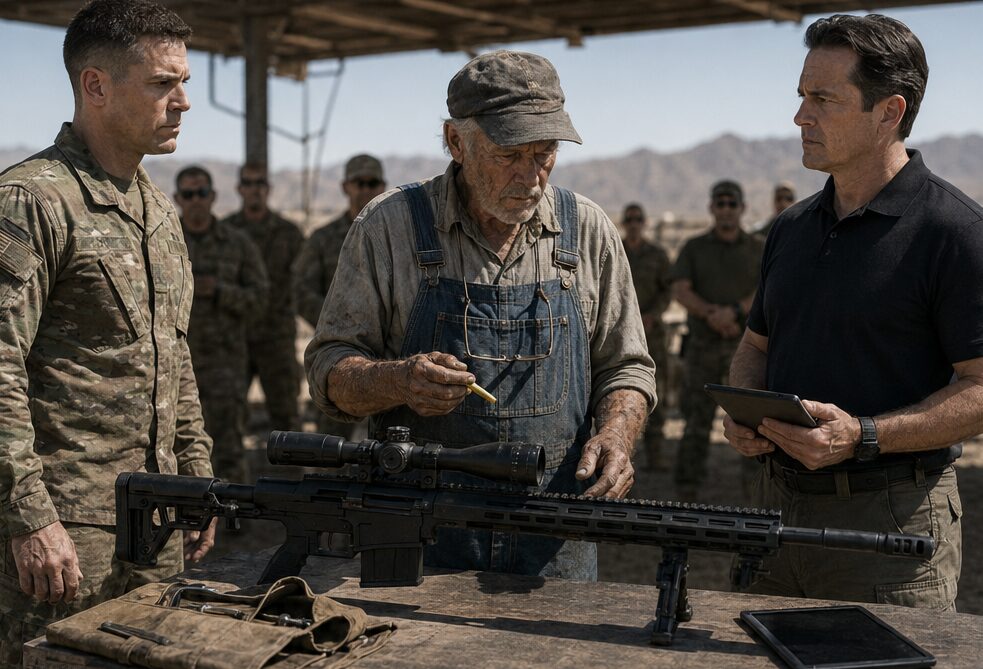
He stood beside the firing table in faded denim overalls, a gray cap pulled low over his forehead, and a pair of thick glasses hanging from a cord against his chest. His hands were scarred and darkened by oil no soap ever fully removed. He looked less like a weapons specialist than a man someone had called to fix a mower.
The rifle on the table looked like it belonged to another century than he did.
Matte black. Long optic. Clean machined rails. Prototype stabilizing assembly hidden under a narrow housing near the chamber. It had a serial plate, two inspection tags, and a contractor logo Andrew kept angling toward the camera as if the rifle were already a success story waiting for paperwork.
Robert’s hand rested near the bolt.
He did not grip it. He listened through his fingers.
Kevin watched him with the controlled irritation of a young officer trying not to show impatience in front of civilians.
Andrew tapped his screen. “Mr. Miller, we appreciate you coming out. We just need a quick inspection before we resume.”
Robert finally looked at him. “Then you should’ve called somebody quick.”
One of the observers coughed.
Kevin’s jaw tightened. “The system already went through inspection.”
“Then why’d it fail twice?”
No one answered fast enough.
That was the first thing Kevin disliked about him. Not the overalls. Not the slow walk. Not the way he handled a multimillion-dollar evaluation like an inconvenience at a farm shed.
It was that the old man asked questions like he already knew the answer.
Andrew stepped closer, tablet tucked against his ribs. His boots were too clean for the range. “The deviations were within recoverable limits.”
Robert looked downrange, toward the distant target stations shimmering in the heat. “Recoverable for who?”
Kevin gave a short laugh. “It missed by inches, not feet.”
Robert turned his head then. His eyes were pale and tired behind the glasses.
“Inches are where people live.”
The words landed harder than the volume deserved.
Andrew cleared his throat. “We have a review panel arriving this afternoon. The prototype needs to complete the sequence. Mr. Miller has maintained this range for years, and his background gives us a useful legacy perspective.”
Legacy perspective.
Robert almost smiled at that.
He had been an armorer longer than Kevin had been alive. He had watched young men carry equipment into heat, fear, dust, rain, and orders that sounded clean only when spoken indoors. He had learned that a weapon did not have to fail loudly to ruin a life. Sometimes it only had to lie by a fraction.
But Andrew did not want that history.
Andrew wanted an old man beside the table so the report could say a retired specialist had been consulted.
Robert touched the side of the rifle again. The metal was warmer than it should have been.
“Who cleaned the bolt channel?” he asked.
Kevin blinked. “What?”
“Who cleaned it?”
“My team.”
“Who adjusted the optic mount after the second sequence?”
Kevin glanced at Andrew. “Engineering.”
“Was it fired after cooling?”
Andrew looked up from his tablet.
Robert repeated the question. “Was it fired after cooling, or did you reset the table and call the drift environmental?”
Kevin’s face hardened. “The engineers already checked all that.”
Robert slid his glasses onto his nose.
“Then they checked it wrong.”
This time, nobody coughed.
Kevin stepped forward. “You need to step back.”
Robert did not move.
The old man was not big. He had a narrow frame, a stoop in one shoulder, and the kind of stillness that made younger men mistake him for weak. But his hand stayed near the rifle, and something in the set of his mouth made the order hang useless in the air.
Andrew lowered his voice. “Captain, let’s not turn this into a scene.”
“It’s already a scene,” Kevin said. “We’re delaying a formal evaluation because a caretaker doesn’t like the cleaning log.”
Robert looked at the rifle, not at him. “I don’t care about your log.”
Kevin pointed toward the shaded equipment shed behind the line. “You’ve got ten minutes. Then the museum piece goes back in the shed.”
The insult was sharper than the first.
Robert absorbed it without flinching.
He reached into the front pocket of his overalls and took out a short yellow grease pencil, worn down nearly to the paper. He turned it once between his fingers.
Then he bent over the prototype and began.
Part II — Ten Minutes
The first thing Robert did was nothing.
That bothered Kevin most.
He did not start unscrewing parts. He did not grab tools. He did not perform expertise for the men watching him. He leaned close, worked the bolt once, and listened.
Metal answered differently to people who had spent their lives hearing it.
A dry click. A soft hitch. The faint delay between movement and seating.
Robert worked it again.
Kevin folded his arms. “We’ve run full diagnostics.”
Robert ignored him.
Andrew angled his tablet toward the rifle and started recording.
“For documentation,” he said.
“For blame,” Robert said.
Andrew’s mouth tightened, but he did not stop recording.
Robert removed the bolt and inspected the channel with a small light from his pocket. He held the rifle at a slight angle, not enough to look dramatic, just enough to catch residue on the inner lip of the assembly housing.
He marked the spot with the grease pencil.
A pale yellow line appeared on the expensive black metal.
Andrew stiffened. “Careful with the finish.”
Robert looked at him.
Andrew said nothing else.
Kevin saw the mark and shook his head. “You’re marking a prototype housing with a pencil.”
“It’ll wipe off.”
“That’s not the point.”
“No,” Robert said. “It isn’t.”
He touched the optic rail next. Then the barrel. Then the small joining point where the stabilizing assembly met the receiver. His fingers moved slowly, but nothing about them was uncertain.
The watchers shifted behind him.
Two minutes became four.
Four became seven.
The range heat pressed down on everyone. Even under the shade cover, sweat gathered at Kevin’s collar. Robert seemed unaware of the discomfort. He rolled one sleeve higher and leaned over the rifle until his glasses slid down his nose.
Then he stopped.
He pressed his thumb beside a screw no one had noticed.
“There,” he said.
Andrew stepped closer. “What?”
Robert did not answer.
He took a small wrench from his tool roll. The roll was old canvas, stained and folded with care. Every tool had its place. No foam cutouts. No labels. No polished kit.
Kevin saw it and almost made another comment.
He held it back.
Something about the old man’s hands stopped him.
Robert loosened the housing just enough to test movement. He did not disassemble the rifle. He did not alter the system. He tested the give under pressure, then under heat, then under cooling.
Andrew checked his watch.
Kevin said, “Time.”
Robert kept working.
“Mr. Miller,” Andrew said, sharper now. “We have a schedule.”
Robert straightened slowly. “Your sight isn’t the problem.”
Kevin gave him a look. “We know that.”
“Your barrel isn’t either.”
“Also known.”
Robert tapped the yellow mark with the grease pencil. “This shifts when it gets hot. Not much. Enough.”
Andrew’s eyes narrowed. “The assembly passed thermal testing.”
“On a bench?”
“In controlled evaluation.”
“That’s a yes.”
Kevin stepped in. “It held zero through the first sequence.”
“It would.” Robert set the wrench down. “That’s why it’s dangerous.”
The line hit strangely.
Kevin did not want it to.
Robert looked downrange. “A bad system that fails obvious gets pulled. A polite liar keeps getting trusted.”
Andrew lowered the tablet. “That’s colorful, but not technical.”
“It’s technical enough.”
“No,” Andrew said. “It isn’t. This prototype represents three years of development and a major readiness initiative. We’re not suspending an evaluation because you have a feeling.”
Robert turned fully toward him for the first time.
“I don’t have feelings about metal.”
Kevin almost laughed, but the sound did not come.
Robert pointed at the rifle. “You fire it clean, cooled, rested, it behaves. You fire it hot, with the shooter under time, after repeated cycling, it drifts. Not enough for a paper failure. Enough for a living one.”
Andrew’s face changed.
Only slightly.
Kevin saw it.
Not fear exactly. Recognition, maybe. Or calculation.
“So run it again,” Kevin said. “Same sequence. I’ll put it on target.”
Robert looked at him then, and for the first time Kevin felt the old man was not seeing him as an officer.
He was seeing him as a body behind the glass.
“No,” Robert said.
Kevin’s patience snapped. “You don’t command this range.”
“No,” Robert said. “But I know what this rifle wants you to trust.”
Andrew inserted himself between them. “We’re completing the official sequence. Mr. Miller, your objection will be noted.”
Robert’s eyes did not leave Kevin.
“That won’t be enough.”
“It’s going to have to be,” Andrew said.
Kevin took the shooting position.
He lowered himself behind the rifle, set his shoulder, adjusted his cheek to the stock, and settled his breathing. The movement was practiced and clean. He had done it thousands of times.
Robert watched the line of his neck.
Watched the cheekbone press into the same place.
Watched one finger settle near the guard.
The range disappeared.
For half a second, Kevin was not Kevin.
He was a younger man with sunburned skin and a nervous grin, lying behind another rifle in another heat, a strip of tape wrapped around one finger because he had split the nail loading crates before dawn.
Steven.
Robert heard the old voice again.
You sure about this one, Mr. Miller?
He had answered yes.
Because the command wanted yes.
Because the bench test had given him yes.
Because everyone needed yes so badly that no had started to sound like disloyalty.
Kevin inhaled and held.
Robert’s hand moved before thought did.
“Stop.”
The word cracked across the range.
Kevin lifted his head, furious. “What the hell are you doing?”
Robert stepped between him and the rifle.
Andrew’s voice went cold. “You just interfered with a formal evaluation.”
Robert felt every eye on him.
The old shame rose, familiar as oil.
He could still step aside. Let the test continue. Let the report stay clean. Let Andrew file him as a difficult old man and Kevin remember him as a fool.
He had done that once.
He had stepped aside once.
He had let men with better uniforms and cleaner language tell him uncertainty was not proof.
Robert placed his palm flat on the rifle table.
“I signed off on one like this before,” he said. “I won’t do it twice.”
Part III — The Name Under the Number
Nobody spoke for three seconds.
Then everyone spoke at once.
Kevin pushed himself up from the rifle. “One like this? What does that mean?”
Andrew said, “Mr. Miller, this is not the time for personal history.”
Robert looked at Andrew. “That depends on whether your history is inside this gun.”
The word hung there. Ugly, simple, exact.
Andrew’s expression shut down.
Kevin noticed that too.
Robert reached for the prototype and turned it slightly, exposing the underside of the stabilizing assembly. The stamped internal part number sat half hidden near the housing seam.
His thumb brushed dust away.
He read it once.
Then again.
His face went quiet in a way Kevin did not like.
Andrew said, “That’s proprietary.”
Robert whispered, “No.”
Kevin moved closer. “What?”
Robert took his glasses off, cleaned them on his sleeve, and put them back on. It bought him two breaths.
The number was not the same. Of course it was not the same. Four decades and a contractor redesign had dressed it up. But the sequence buried in the middle was familiar. A legacy reference. A field modification code. His field modification code.
He had written that geometry after Steven died.
Not for glory. Not for patents. Not for a contractor’s brochure. He had written it because the old assembly had drifted under heat, and he needed to understand why a young man had trusted his work and paid for it.
He had submitted the fix with warnings.
Do not deploy without stress-condition validation.
Do not evaluate under cooled bench cycles alone.
Do not assume recovery between sequences.
Those notes had vanished into an archive.
The shape had not.
Robert looked at Andrew. “You knew.”
Andrew did not answer fast enough.
Kevin turned on him. “Knew what?”
Andrew lowered his tablet. “The design has a long development lineage. That’s common.”
“My name was attached to it,” Robert said.
Kevin stared at him.
The insult from earlier returned to the range and stood there between them.
Museum piece.
Janitor.
Caretaker.
Andrew’s voice became smooth. “Your legacy work was referenced in the background materials, yes. That’s part of why we asked you to observe.”
“Observe?”
“To provide informal continuity.”
Robert laughed once. It had no humor in it.
“You brought me here to bless it.”
Andrew’s face reddened. “We brought you here because you have experience.”
“You brought an old man in overalls so the file could say I looked at it.”
Kevin’s eyes moved from Andrew to Robert. Something in him shifted. Not apology. Not yet. But the ground under his certainty had cracked.
Robert leaned on the table. His hands ached. They always did when the weather was dry, but now the ache traveled up his arms.
Kevin asked, quieter, “What happened before?”
Andrew said, “Captain, we don’t need to—”
“Yes,” Kevin said. “We do.”
Robert looked downrange.
The targets were too far to see clearly without glass, pale squares trembling in the hot air.
He spoke without drama because drama would have made it easier to dismiss.
“Long time ago, we had a modified system in the field. Different platform. Same problem wearing a different coat. It passed the clean tests. Passed the first strings. Drifted when it got hot and stayed hot.”
Kevin’s face tightened. “How bad?”
“Inches.”
Kevin did not say anything.
Now he understood that word differently.
Robert continued. “There was an extraction. Bad information. Bad timing. A young marksman named Steven was covering a corridor. He trusted the rifle because I told him he could.”
The range seemed to shrink.
“He missed by inches?” Kevin asked.
Robert nodded once.
“What happened?”
Robert’s mouth pressed into a line.
Andrew looked away.
“That’s not in the report,” Robert said.
“I’m asking you.”
Robert picked up the grease pencil and rolled it between his fingers.
“Two civilians died in the confusion. Steven didn’t come home. The official language said battlefield uncertainty. Visibility. Movement. Stress.”
He swallowed.
“All true. None of it the truth.”
Kevin looked at the rifle.
Andrew spoke carefully. “You cannot tie an old classified incident to this evaluation based on visual similarity and memory.”
Robert turned toward him. “I’m not tying it to memory. I’m tying it to the number you hoped I wouldn’t read.”
Andrew’s grip tightened around the tablet. “This is exactly why we have protocols.”
“No,” Robert said. “This is why protocols need men who remember what they’re for.”
Kevin flinched slightly at that.
Robert saw it.
He had not meant to wound him, but maybe the wound was useful.
Andrew stepped closer, lowering his voice. “Mr. Miller, let’s speak privately.”
“That means you’re done speaking plainly.”
“It means I’m giving you a chance to avoid making a serious accusation in front of witnesses.”
Robert looked at him for a long moment.
Then he picked up the prototype and set it back on the bench exactly where Kevin had been aiming from.
“No,” he said. “We’re out of private chances.”
Part IV — The Test That Wasn’t on the Form
Andrew followed Robert toward the shade beside the equipment shed anyway.
Kevin stayed close enough to hear.
That, Robert noticed, was the first honest thing the captain had done all morning.
Andrew’s voice dropped to a polished murmur. “You’re emotional.”
Robert almost smiled. “That word gets cheaper every time someone uses it to avoid being responsible.”
“We can add a note. We can recommend further review. The evaluation can proceed today, and we can correct the assembly before broader deployment.”
Robert looked at him. “So the form survives first.”
“The process survives,” Andrew said.
“People keep saying that like the process breathes.”
Andrew’s mouth tightened. “You are not the only person with responsibility here.”
“No,” Robert said. “I’m just the one old enough to recognize the smell.”
Andrew leaned closer. “If you derail this without proof, the review board will not see you as a whistleblower. They’ll see an elderly former technician with unresolved trauma interrupting a controlled evaluation.”
There it was.
Not shouted. Not crude. Worse.
The clean version of the insult.
Kevin’s face changed.
Robert accepted the blow. He had lived long enough to know that humiliation came in uniforms, polo shirts, legal language, and sympathetic voices.
Andrew continued, softer now. “Let us handle this properly. You’ll be credited as a consultant. Your concerns will be documented. You’ll be protected.”
“Protected from what?”
“From being blamed for something that isn’t yours.”
Robert looked back toward the rifle.
“That’s the trouble,” he said. “Part of it is.”
Kevin stepped forward. “We need proof.”
Robert turned to him.
The old anger in him rose, but it was not for Kevin alone. It was for every clean table where danger had been renamed acceptable variance. Every young face told to trust the thing handed to him. Every old report that had learned to sound reasonable because the dead were not there to interrupt.
Kevin held his gaze. “I’m not saying you’re wrong. But if I stop this on your word, Brooks buries it. If I refuse to shoot, they call it fear. We need proof.”
Andrew seized on that. “The official sequence is the proof.”
“No,” Robert said. “The official sequence is the hiding place.”
He walked back to the table.
His body moved slower than he wanted it to. His hip hurt. His hands hurt. His breath had gotten shallow, and he hated that Kevin might notice.
But he reached the rifle before anyone stopped him.
He took a blank evaluation sheet from Andrew’s clipboard.
“What are you doing?” Andrew demanded.
Robert uncapped a pen with his teeth and wrote his name across the bottom.
Robert Miller.
The letters looked unsteady.
He hated that too.
Under it, he wrote: I interrupted the sequence. I requested stress-condition validation. I accept responsibility for the delay.
He handed the sheet to Kevin.
“Put that with your record.”
Kevin stared at the page.
Andrew said, “That has no procedural standing.”
“Then it won’t hurt you,” Robert said.
Kevin looked up.
Something passed between the young officer and the old caretaker. Not friendship. Not forgiveness. Something more useful.
Decision.
“What test?” Kevin asked.
Andrew snapped, “Captain.”
Kevin did not look at him. “What test?”
Robert pointed downrange. “Not the cooled sequence. Not the pretty one. Five controlled rounds. No full reset. Timed cycling. Barrel stays hot. Shooter stays in position. You’ll feel it behave at first. That’s the trick.”
Kevin nodded slowly. “And then?”
“And then it tells the truth.”
Andrew’s voice hardened. “This is outside the approved protocol.”
Robert looked at him. “So was dying because a form looked clean.”
Silence took the range again.
This time, Kevin did not rush to fill it.
He picked up the signed sheet and folded it once, carefully, as if the paper had weight.
Then he said, “Run the sequence.”
Andrew stared at him. “You are making a mistake.”
Kevin took his place behind the rifle.
“Maybe,” he said. “But I’d rather make it where everyone can see.”
Part V — Where the Drift Appeared
The first round landed clean.
Andrew exhaled through his nose, almost smiling.
Robert stood behind Kevin’s right shoulder, close enough to watch the rifle, far enough not to crowd the shooter. The other observers had stopped pretending boredom. Every face on the line was fixed on the target monitor.
Second round.
Clean.
Kevin did not move except to cycle and breathe.
He was good. Robert allowed himself to notice that. The captain had discipline in his bones even if pride sat on top of it. His cheek stayed set. His shoulder absorbed the rifle without fighting it. His right eye remained steady through the optic.
Third round.
Still acceptable.
Andrew glanced at Robert.
The look said: You are almost out of ghosts.
Robert said nothing.
He watched the housing near the yellow grease mark.
Heat did not announce itself like guilt did. It entered quietly. Expanded quietly. Asked metal to become just slightly more than itself.
Fourth round.
The hit walked.
Not enough for a dramatic gasp. Not enough for a movie moment. Not enough for a man who wanted denial to lose it.
But Robert saw Kevin feel it.
The captain’s cheek stayed down, but his brow shifted. His breathing changed. He had aimed true and received a lesser truth back.
Andrew stepped toward the monitor. “Still within—”
“Don’t,” Kevin said.
The word surprised everyone, including Kevin.
Robert kept his eyes on the rifle.
“Last one,” he said.
Kevin reset only as much as the sequence allowed. Sweat ran from his temple into the dust on his cheek. His finger settled. His breathing slowed.
For one stretched second, Robert saw Steven again.
Not the end. He never let himself see the end if he could help it.
He saw the beginning.
A young man grinning over a crate, tape on one finger, asking if the modification was good.
You sure about this one, Mr. Miller?
Robert had been sure enough.
That was the sentence that had followed him for forty years.
Sure enough.
Kevin fired.
The monitor updated.
The round landed off the vital mark by a narrow, damning margin.
The exact kind of miss that could be explained away by wind, fatigue, shooter error, or bad luck if the room wanted comfort more than truth.
Nobody moved.
Andrew’s face had gone pale beneath his tan.
Kevin lifted his head slowly from the rifle. He did not look at Andrew. He looked at Robert.
Robert stepped forward.
His hands were steady when he removed the rifle from the table. They stayed steady as he opened the assembly housing enough to expose the marked part. They stayed steady as he drew the grease pencil from his pocket.
Only when he touched the yellow tip to the metal did they begin to tremble.
He marked the defective assembly with a thick line.
Not elegant.
Not official.
Visible.
Andrew said nothing.
Kevin said nothing.
Robert capped the pencil.
His voice came out low, and for a moment it did not sound meant for any of them.
“Not again.”
The words carried farther than he intended.
The range had heard commands all morning. It had heard technical language, schedule pressure, polite dismissal, rank, irritation, and the dry clack of expensive parts.
Now it heard an old man refuse to bury the same truth twice.
Andrew finally reached for his tablet. “The evaluation will be suspended pending further—”
“No,” Kevin said.
Andrew looked at him. “Excuse me?”
Kevin stood. His uniform was dusty now. His cheek was red where the stock had pressed against it. “The evaluation failed under stress-condition validation requested by Mr. Miller. His statement goes in the file. The target sequence goes in the file. The part number goes in the file.”
Andrew’s eyes narrowed. “Captain, choose your wording carefully.”
Kevin looked at Robert’s yellow mark on the rifle.
“I am.”
Robert did not thank him.
He did not need to.
He set the rifle down and stepped back from the table.
For the first time that morning, no one told him where to stand.
Part VI — The Pencil Returned
By late afternoon, the range had changed without looking different.
Same dust.
Same benches.
Same white heat over the target lanes.
But the men around the table had lowered their voices. Andrew made calls under the shade canopy, each one quieter than the last. The observers gathered the printed target records. Someone photographed the yellow mark on the assembly before anyone could wipe it away.
Robert packed his tools in the old canvas roll.
One wrench at a time.
One slot at a time.
He had imagined this moment before, though never clearly. In the harsher versions, someone shouted. In the kinder versions, someone apologized in a way that fixed nothing but sounded nice.
The real moment was smaller.
Paper moved.
Men avoided his eyes.
A machine that should not have been trusted was no longer moving forward, at least not today.
That had to be enough.
Robert folded the tool roll and tied it with the frayed cord. His hands ached badly now. He pressed the fingers of one hand into the palm of the other and waited for the worst of it to pass.
Behind him, Kevin said, “Mr. Miller.”
Robert did not turn immediately.
He had been called worse that morning. He had also been called useful without the word ever being spoken. He was not sure which one tired him more.
Kevin stepped beside him, holding something small.
The grease pencil.
Robert looked at his empty pocket and realized he had left it on the table.
Kevin held it out.
No salute. No speech. No grand performance for the others to witness.
Just the pencil, shortened by years of use, its yellow tip blunted from marking what everyone else had missed.
Robert took it.
Kevin’s voice was quieter than it had been all day. “I was wrong.”
Robert slid the pencil into his pocket.
“Yes.”
Kevin accepted that.
The old man respected him a little for not trying to soften it.
After a moment, Kevin said, “I thought you were trying to prove something.”
Robert looked toward the range table. Andrew was attaching Robert’s signed statement to the official packet now. He handled it like a thing that might stain him.
“I was,” Robert said.
Kevin waited.
Robert adjusted his cap. “Just not to you.”
The captain nodded, though the words clearly hurt him. Maybe they needed to.
“I’m sorry,” Kevin said.
Robert looked at him then.
He saw the clean haircut, the young officer’s posture, the fear hidden behind discipline. He saw pride cracked open into something better. He saw Steven for half a second and forced himself not to punish Kevin for wearing the shape of memory.
“Being wrong is survivable,” Robert said. “Staying wrong is what gets people killed.”
Kevin absorbed the line as if it had been assigned to him.
Across the range, Andrew looked over.
For once, he did not call Robert over.
He waited.
That was the thing Robert noticed.
The evaluator with the clean boots and the tablet waited beside the table as if the old man in overalls might still have something the record needed.
Robert lifted his tool roll.
He was still old. His hip still hurt. His hands still shook if he held them too long in the open air. Steven was still gone. Forty years had not bent backward and corrected itself.
But the truth had moved.
Not far.
Enough.
Robert walked back to the rifle table because the report was not finished and because no one else in that place knew exactly where to place the next yellow line.
The observers stepped aside.
Kevin did too.
Robert set down his tools, took out the grease pencil, and leaned over the black metal once more.
This time, when he touched the rifle, everyone watched as if his hands were part of the evidence.