The Man in the Second Row Brought More Than a Memory
Part I — The Second Row
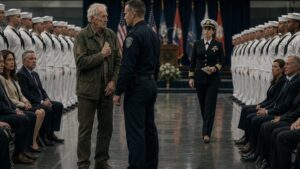
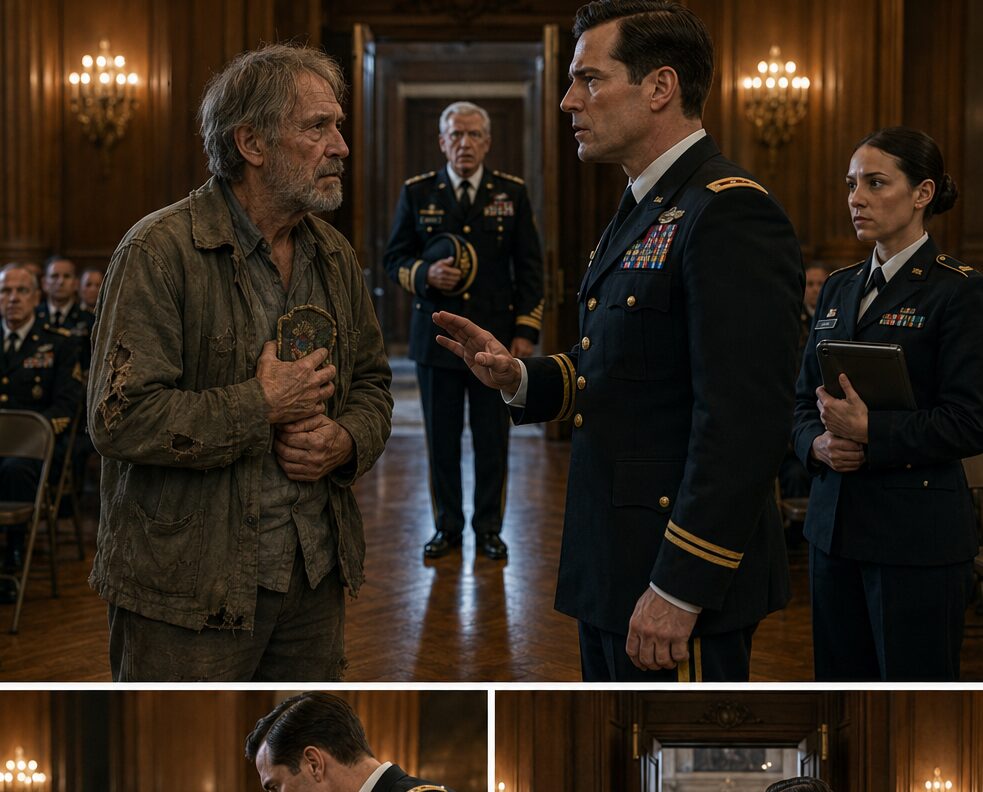
The old man was sitting in the second row when Colonel Benjamin Grant stopped in the middle of the aisle and pointed at him.
Every conversation in the hall thinned at once.
The cadets by the wall went still. The families near the front turned carefully, as if looking too quickly might make them part of it. The brass chandelier above them shone on polished shoes, pressed sleeves, framed citations, and one man who looked as if he had walked in from a bus station after sleeping under its roof.
His beard was gray and uneven. His field jacket was torn at one cuff. His boots were clean enough to show he had tried, but old enough to show trying had not helped much.
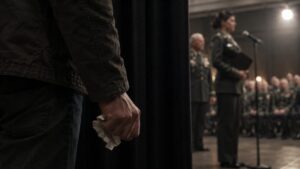
In both hands, he held a faded patch.
Black thread formed a heron with its wings half-spread. Beneath it were three broken stars.
Benjamin stared at him for one full second too long.
Then he said, loud enough for the front rows to hear, “Sir, this is a closed event. Not a public waiting room.”
The old man lifted his eyes.
They were not confused. That made the moment worse.
“I was invited,” he said.
His voice did not rise. It did not ask for kindness. It simply put the words in the room and left them there.
Captain Maria Miller moved in from the side with a tablet pressed to her chest. She was responsible for the ceremony schedule, the press list, the seating chart, the reception line, and, apparently, whatever this was becoming.
“Colonel,” she said softly, “I can check—”
“I already see the problem,” Benjamin said.
He did not lower his finger.
The ceremony hall at Fort Halden had been restored to look older than anyone inside it: dark wood panels, high windows, a flag folded behind glass, a row of portraits whose faces had all learned the same severe expression. That morning it was supposed to honor retirees, promote the incoming commander, and unveil a framed citation connected to Operation Night Heron, an old classified mission recently cleared for ceremonial mention.
It was not supposed to begin with an old man in a torn jacket clutching an unknown patch in the second row.
“What’s your name?” Benjamin asked.
The old man looked past him toward the podium, where a framed program rested under the lights.
“Donald Mason.”
Maria tapped fast. The screen painted her face with a pale glow.
There was a pause.
Benjamin turned his head slightly. “Captain?”
Maria swallowed. “I don’t have that name on the guest list, sir.”
A small shifting sound moved through the room.
Donald looked down at the patch.
His hands were trembling now, but the tremor changed when his thumb touched the black heron. It did not disappear exactly. It settled into something older than fear.
Benjamin saw it.
His eyes narrowed.
“Where did you get that?”
Donald did not answer.
Benjamin stepped closer. “That insignia is not current. It’s not on today’s program. It’s not authorized for display.”
“It was never authorized for much,” Donald said.
The line should have sounded bitter.
It sounded tired.
Benjamin’s jaw tightened. He had spent his life around men who decorated their stories until the truth could no longer breathe. He had seen strangers appear at ceremonies with borrowed pins, fake unit crests, invented memories, and eyes hungry for attention they had not earned.
His father had taught him that honor was kept clean by refusing impostors at the door.
And Benjamin was about to become commander of Fort Halden in a room full of witnesses.
He reached for control the way other men reached for a railing.
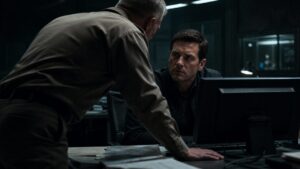
“Sir, I’m going to ask you once,” he said. “Put the patch away and step outside with Captain Miller.”
Donald’s gaze stayed level.
“No.”
The single word changed the air.
Benjamin’s face did not move, but every officer nearby felt the temperature drop.
“Excuse me?”
Donald pushed himself up from the chair.
He did it slowly. Not dramatically. One palm on his knee, then the other on the chair arm. His body argued with him, but he rose anyway until he stood almost eye to eye with the colonel.
He was shorter by an inch. Somehow he looked less small standing.
“I said no.”
Two military police officers near the rear exchanged a look and started forward.
Maria’s mouth opened. “Sir—”
Benjamin lifted a hand to stop her. “Escort him out.”
Donald looked at the approaching men, then at the podium.
He did not run. He did not plead.
He only said, “I waited thirty-eight years outside doors like this. I’m not leaving this one before somebody says their names.”
Benjamin took one sharp step toward him.
Before he could speak, the rear doors opened.
A man in formal dress entered beneath the carved archway, moving slowly but with the old command of someone rooms still made space for. His silver hair was combed back beneath a peaked cap. His shoulders had thinned with age, but not enough to soften the effect of him.
Retired General Steven Whitaker had arrived early.
He saw Benjamin first.
Then Donald.
Then the patch.
His face changed before he could prevent it.
“Stop,” Steven said.
The two officers halted.
Benjamin turned. “General, we have an unlisted civilian causing a disruption.”
Steven did not seem to hear him.
He was looking at the black heron.
His mouth worked once, as if he had swallowed a word that had waited decades to come out.
Then he said, almost too quietly, “Where did you get that, Donald?”
No one in the hall moved.
Benjamin looked from Steven to Donald.
“You know him?”
Steven’s eyes finally met Donald’s.
Donald gave him the smallest nod.
“Not well enough,” Donald said.
Part II — The Patch
Maria felt the room tilt around her.
A minute earlier, the old man had been a seating mistake. Now a retired general was speaking his name like a prayer he had failed to finish.
Benjamin’s voice hardened to cover his confusion. “General, if there’s a concern, we can handle it in my office.”
“No office,” Donald said.
Steven flinched at the words.
Donald saw it.
Good, he thought.
Not with satisfaction. With a dull, old recognition. Some men only remembered a room had doors after they had locked someone else out.
“Mr. Mason,” Maria said carefully, “we’re ten minutes from opening the hall to guests. If you’ll come with me, we can verify—”
“You tried to verify me already,” Donald said.
Maria stopped.
He was not cruel about it. That made it worse.
Benjamin looked at Steven. “What is this?”
Steven removed his cap slowly. His fingers were long, spotted, and steady until they reached the brim.
“The patch belongs to Night Heron.”
The name landed with strange force. Not loud. Heavy.
Maria looked down at her tablet and typed it into the archive search field.
One result appeared.
Then three red bars.
RESTRICTED SUMMARY. PARTIAL RELEASE. PERSONNEL DATA UNAVAILABLE.
Her throat tightened.
“Sir,” she said to Benjamin, “there is a file.”
Benjamin did not look at her. “Operation Night Heron is in today’s program because of my father.”
Donald’s thumb moved across the patch.
“Yes,” he said. “That’s why I came.”
Benjamin’s expression closed.
Steven stepped forward. “Donald, not here.”
Donald laughed once. It was a dry sound, almost without humor.
“Where, then?”
Steven had no answer.
Donald looked around the hall: the portraits, the rows of chairs, the waiting flags, the framed citation on the podium. All of it had the clean shine of a story that had been handled by many careful hands.
“I sent letters,” Donald said. “Three of them. One every ten years. First one came back sealed. Second one came back with a form. Third one didn’t come back at all.”
Maria lowered her tablet a little.
Benjamin’s gaze flickered.
Donald saw that too. The tiny opening before pride closed it again.
“I didn’t come for your medals,” Donald said. “I didn’t come for lunch. I didn’t come because I wanted a chair with my name on it.”
He lifted the patch.
“I came because you printed a lie.”
Benjamin’s face sharpened. “Careful.”
Donald looked at him fully then.
The room seemed to understand before Benjamin did that the old man had been careful for longer than most of them had been alive.
Steven said, “Colonel, we should postpone the citation portion until—”
“No,” Benjamin said.
He turned to Donald.
“My father’s name is on that program because he brought people home when others could not. If you have a personal grievance, it does not give you the right to stand here and attack a man who spent his life serving this country.”
Donald’s hands tightened.
For a second, Maria thought he might fold.
Instead, he asked, “Did he ever tell you about the checkpoint?”
Benjamin blinked.
Donald nodded, as if that answered everything.
“No. I didn’t think so.”
The rear doors opened again. Staff began guiding early guests into the outer lobby. Voices floated in: cheerful, unaware, already softened for ceremony. The hall was filling with time.
Benjamin’s control began to look less like strength and more like a wall holding back water.
Steven came close enough that only the front rows could hear him.
“Donald,” he said, “there are families attached to that file.”
“There were,” Donald said. “Children then. Grandparents now. The risk is gone.”
“Not all of it.”
Donald’s eyes moved to the framed citation.
“No. Just the risk to reputations.”
Steven looked down.
That silence did more damage than any accusation.
Maria stared at the search result on her tablet. Under the redactions, one line had loaded.
CIVILIAN ASSET: STATUS UNKNOWN.
She looked at Donald’s boots, his jacket, the patch in his hands.
Then she looked at the colonel who had almost ordered him dragged out.
“Sir,” she said, voice low, “there’s a personnel anomaly.”
Benjamin’s eyes snapped to her.
“A what?”
Maria wished she had chosen a less dangerous word.
She turned the tablet toward him.
Benjamin read the line.
His mouth tightened. “That doesn’t prove anything.”
Donald said, “No. It proves exactly what they wanted it to prove.”
Guests began entering the hall now. Dress shoes clicked on the polished floor. Families looked toward the disturbance with polite uncertainty. A child asked a question and was hushed. A photographer raised his camera, then lowered it when Maria glared.
Benjamin leaned toward Steven.
“Tell me what he is claiming.”
Steven’s eyes stayed on Donald.
“He isn’t claiming enough.”
Part III — The Names Inside
The first thing Steven told them was not the story.
It was a correction.
“Night Heron was not a single-man plan,” he said.
Benjamin stared at him.
The sentence had cracked something so old inside him that he did not yet know where the pieces had gone.
“My father led that operation.”
“Your father survived that operation,” Donald said.
Benjamin turned on him. “Do not talk about him like that.”
Donald’s face changed—not anger, not triumph.
Pity.
Benjamin hated it immediately.
“Your father was brave,” Donald said. “I won’t take that from him.”
“You couldn’t.”
“No,” Donald said. “But I can give back what he took.”
The words carried across the first few rows.
A woman in a navy dress stopped halfway to her seat. Two cadets stared straight ahead with the terrified discipline of young people witnessing their superiors become human.
Steven exhaled slowly.
“Five men crossed the border after the embassy route collapsed,” he said. “Unofficially. No unit designation. No support after first contact. Their job was to retrieve a group of American families trapped at the old mission compound.”
Maria listened with the tablet held uselessly in both hands.
She had expected a verification problem. She had found a sealed room under the floor of the event.
Steven continued. “Donald was the radio operator. Also the medic when the medic went down.”
Benjamin looked at Donald as if seeing a second image trying to rise over the first.
The torn jacket remained. The uneven beard. The old boots. But now another man stood inside them: younger, moving through dark roads with a radio pressed to his ear, carrying people who had not known his name.
Donald looked at Maria’s tablet.
“Did the report call me civilian asset?”
Maria hesitated.
“Yes.”
Donald nodded. “That was an improvement. First draft called me unconfirmed local support.”
Benjamin’s eyes moved sharply to Steven.
Steven did not deny it.
“Why?” Benjamin asked.
The question was too small for what he meant.
Why was this not in the record? Why had his father never told him? Why was this man standing here now? Why had Benjamin pointed at him?
Steven’s face showed the exhaustion of a man who had spent decades rehearsing an answer and still found it insufficient.
“Because command withdrew acknowledgment after the extraction route collapsed. Because the families were still vulnerable. Because names connected to the mission could have created consequences for people we had just gotten out.”
“And later?” Donald asked.
Steven closed his eyes briefly.
No one saved him from answering.
“Later,” Steven said, “silence had become convenient.”
Benjamin stepped back as if the word had touched him physically.
Donald looked down at the patch.
“For thirty-eight years,” he said, “I told myself convenient and necessary can look the same if you stand far enough away.”
He rubbed the seam with his thumb.
“My brother never got to stand far away.”
The hall doors opened wider. More guests entered. The ceremony had become a whisper spreading through the room.
Benjamin saw a framed portrait of his father near the side display: Colonel Timothy Grant, straight-backed, unsmiling, a man whose photograph had hung in Benjamin’s childhood hallway like a commandment.
Every promotion, every hard choice, every corrected salute, every lecture about discipline had carried that face.
“My father did not steal anything,” Benjamin said.
He sounded younger than he wanted to.
Donald looked at him.
“No,” he said. “He let them hand him something that wasn’t his alone. Then he kept holding it.”
Benjamin’s face flushed.
“You walk in here dressed like this, with no record, no invitation, and you expect me to let you rewrite my father’s life in front of his peers?”
Donald’s voice dropped.
“I walked in dressed like a man who stopped being useful to the story.”
That line hit Maria first.
Then Steven.
Then, finally, Benjamin.
Donald turned the patch over.
For the first time, Maria saw that its back had been sewn shut with darker thread, almost brown against the old fabric. Donald’s fingers worked at the seam carefully, almost tenderly. Not tearing. Opening.
Steven whispered, “Donald.”
Donald ignored him.
The thread loosened.
The back of the patch unfolded like a secret that had grown tired of being well-behaved.
Five names were stitched inside.
Not printed. Not embroidered by machine. Hand-sewn, uneven, cramped.
Jacob Mason.
Timothy Grant.
Steven Whitaker.
Two others whose names Maria did not know.
The room seemed to lean closer without moving.
Benjamin stared at the second name.
“My father’s name is in there,” he said.
“Yes,” Donald said.
“Why?”
“Because he was there.”
Donald touched the first name.
“And because my brother said if one man came home, all five names came home with him.”
Benjamin’s throat worked.
“Your brother?”
Donald nodded.
“Sergeant Jacob Mason planned the last route after the convoy road failed. He held the checkpoint long enough for the families to get through.”
He did not say more. He did not need to.
Some details were too heavy to lift into public speech.
Steven’s eyes had filled, but nothing fell.
Benjamin looked at him.
“You knew.”
Steven answered like a man stepping into weather he had earned.
“Yes.”
“And you let the citation stand?”
“Yes.”
“And my father?”
Steven’s mouth tightened.
“Your father asked me to keep the sealed report sealed.”
Benjamin stared as if he had been struck by the cleanest possible version of pain.
Donald folded the patch back halfway, not hiding the names, only protecting them from too much air.
“He also asked me,” Donald said.
Benjamin looked at him sharply.
Donald’s face was unreadable.
“The families still had relatives over there. The children were young. Names in the wrong hands could have followed them. Your father said silence was still service.”
“And you believed him?”
Donald looked at the patch.
“I wanted to.”
Part IV — The Program
The hall was full now.
People sat with programs in their laps, pretending not to study the old man at the front. The ceremony had not begun, but something more dangerous had already started.
Maria’s phone buzzed with three messages from staff.
PRESS ARRIVED.
DO WE DELAY?
COLONEL?
She looked at Benjamin.
He stood beneath the lights, trapped between a father in a frame and an old man with five names in his hands.
Steven said, “We can move the citation. Handle this properly.”
Donald looked at him.
“Properly?”
Steven lowered his eyes.
Donald’s voice stayed calm. “That word did a lot of work for a lot of years.”
Benjamin rubbed a hand once across his mouth. It was the first unpolished gesture Maria had seen from him all morning.
“If I let this go forward,” he said, “I damage men who cannot answer.”
Donald’s face hardened.
“No. You answer for what the living kept using.”
Benjamin looked at the crowd. Families. cadets. retirees. reporters. People who had come expecting clean gratitude and finger food after.
He looked at the program in his hand.
The section was marked with a small gold seal:
Recognition of Operation Night Heron and the Leadership of Colonel Timothy Grant.
His father’s name seemed to darken on the page.
He remembered being ten years old, watching Timothy polish his shoes at the kitchen table before a memorial event. His father had told him, “A uniform is a promise, Benjamin. Never wear one halfway.”
Benjamin had lived by that.
Now he wondered how many promises a man could keep while breaking another.
Steven stepped closer to Donald.
“Let me make the statement.”
“No.”
“You don’t have to carry this in front of them.”
Donald looked at the full hall.
“I already carried it where nobody could see.”
Maria felt something close in her throat.
Donald’s hands trembled again. He pressed the patch flat between his palms.
“Old men have spent too long letting men with cleaner uniforms speak for the dead.”
No one answered him.
There was nothing useful to say.
The ceremony start time passed by one minute.
Then two.
The murmurs grew.
Benjamin turned to Maria. “Begin recording.”
She blinked.
“Sir?”
“For the archive,” he said.
Her fingers moved before her fear could catch them.
She opened a formal recording file. Her hands were cold.
Benjamin walked to the podium.
The room settled with trained obedience. Even the civilians felt it. Authority had entered its proper place, and for a moment, everyone seemed relieved to have a shape they recognized.
Benjamin placed both hands on either side of the prepared remarks.
He did not look at Donald.
He began with the welcome. His voice was firm enough. He honored the retirees. He recognized families. He thanked the staff.
Maria watched the program on the podium.
The page waited for him.
So did the room.
So did the old man in the second row.
When Benjamin reached the citation section, his voice slowed.
“Today,” he read, “we also recognize the legacy of Operation Night Heron, long held in restricted record, and the leadership of Colonel Timothy Grant, whose planning and resolve—”
He stopped.
Silence dropped hard.
Benjamin looked at the words.
Then at his father’s portrait.
Then at Donald.
For the first time that morning, he seemed to understand that command was not the power to keep a room comfortable.
It was the burden of making discomfort honest.
He turned the page over.
A small sound moved through the hall.
Benjamin did not explain.
He gripped the podium once, then let go.
“Mr. Donald Mason,” he said, voice carrying to the back, “please come forward.”
Donald did not move immediately.
For one second, he looked almost frightened.
Not of the room. Of what it would cost him to finally enter it.
Then he stood.
No one helped him.
He walked slowly down the short aisle between the rows, the black heron patch held in his left hand. The same people who had watched him be pointed at now watched him pass. Their faces had changed, but change did not erase the first look they had given him.
Donald knew that.
He carried that too.
At the podium, Benjamin stepped aside.
Not far.
Enough.
Donald stood before the microphone.
The patch trembled.
The room waited for a speech.
Donald did not give them one.
Part V — What the Room Finally Heard
“There were five names inside the patch,” Donald said.
His voice was rough, but it held.
He opened the back seam again and laid the patch on the podium as if setting down something living.
“Jacob Mason,” he said.
He paused.
“My brother. He could read a road by listening to what wasn’t moving on it. He gave away his gloves to a girl who wouldn’t stop shaking.”
The room stayed silent.
“Timothy Grant,” Donald said.
Benjamin’s face tightened, but he did not look away.
“He kept moving after he should have fallen down. He carried two children through a drainage ditch and told them it was a game because they were too small to understand fear.”
A woman in the third row covered her mouth.
Donald touched the third name.
“Steven Whitaker.”
Steven closed his eyes.
“He was young enough to think orders and right were supposed to be the same thing. He learned different before sunrise.”
The old general’s chin dipped.
Donald named the fourth man. Then the fifth.
For each, one detail.
Not history.
Not glory.
A joke told under a broken awning. A canteen passed to someone else. A radio battery warmed under an armpit. A man humming so the children would follow the sound.
By the time Donald finished, the room had no polished story left.
It had people.
Benjamin stood beside the podium with his hands at his sides, every medal on his chest suddenly looking less like proof and more like responsibility.
Donald looked down at the patch.
“My brother’s last order was not to win,” he said.
The microphone carried his breath.
“It was not to avenge anybody. It was not to make sure the right man got remembered.”
He looked at Benjamin then.
“It was, ‘Get them home.’”
Benjamin’s face broke, but only slightly. Enough to show the man beneath the rank. Not enough to ask the room to comfort him.
Donald continued.
“So we did. And afterward, silence made sense for a while. There were families to protect. There were names that could still put people at risk. I understood that. I agreed to that.”
His hand flattened over the patch.
“But silence is supposed to guard the living. It is not supposed to feed on the dead.”
No one moved.
Donald looked out over the hall, and for the first time that morning, he let them see that he was tired.
Not weak.
Tired.
“I did not come here to shame Colonel Grant’s son,” he said. “I did not come to take his father from him. A man can be brave and still benefit from a lie. Both can be true. That is the part nobody likes.”
Benjamin lowered his eyes.
Donald turned back to the patch.
“I came because my brother’s name was not in the program. Neither was mine. Neither were the others, except where they served somebody else’s story.”
His voice thinned, then steadied.
“I am not asking you to clap.”
No one did.
“I am asking you to correct the record.”
The sentence landed without ornament.
Maria felt it enter the archive before her fingers even moved.
Benjamin stepped back to the microphone.
For a moment, he could not speak.
Then he removed the framed citation from its stand.
The small action made the room inhale.
He held it at his side, not hiding it, not displaying it.
“This citation,” he said, “will not be entered into the Fort Halden archive in its current form.”
A ripple passed through the crowd.
Benjamin looked at Donald.
“The archive will be corrected to include the names Mr. Mason spoke today. It will include his service. It will include Sergeant Jacob Mason’s role in the extraction route.”
His jaw tightened.
“And it will include the fact that official recognition came late.”
He turned to Maria.
“Captain, enter that recording into the permanent file.”
Maria’s voice almost failed.
“Yes, sir.”
Steven moved then.
Slowly, the old general stepped in front of Donald.
For a second, Donald looked as if he might step back.
Steven raised his hand in salute.
Not grandly. Not for the cameras.
His fingers trembled at the edge of his brow.
Donald stared at him.
The salute remained.
At last, Donald returned it.
His hand was not crisp. His elbow did not rise perfectly. His jacket sleeve sagged where the cuff had torn.
No one in the room mistook it for anything less than exact.
Part VI — A Loose Thread
Afterward, people did not rush Donald.
That was a mercy.
The ceremony continued, but it had changed shape. The retirements still happened. The promotions were still read. Families still stood for photographs. But the room had lost its easy shine, and maybe that was the first honest thing it had done all morning.
Maria worked at a side table, entering names into a temporary archive file until the official system could be amended. She typed carefully.
Donald Mason.
Jacob Mason.
She paused before the old classification line.
CIVILIAN ASSET: STATUS UNKNOWN.
She deleted it from the draft correction.
Then she wrote:
Surviving member and witness.
It was not enough.
It was a start.
Benjamin found Donald near the display case after the hall had thinned.
The black heron patch lay on the table between them.
Donald was working one loose thread free from its edge.
Benjamin watched him for a moment.
“My father told me a uniform was a promise,” he said.
Donald did not look up.
“He was right.”
Benjamin absorbed that.
Then Donald added, “He just didn’t tell you promises can conflict.”
The words were not forgiveness.
Benjamin understood that.
He stood straighter, but not the way he had before. Less like a wall. More like a man trying to remain standing after something inside him had moved.
“I’m sorry,” he said.
Donald’s fingers stopped.
Benjamin continued, “Not because I didn’t know. I should have asked better once I knew I didn’t know.”
Donald looked at him then.
Benjamin forced himself not to look away.
“I’m sorry I assumed you had no truth worth hearing.”
The hall had grown quiet around them.
Donald studied his face, perhaps looking for the father in it, perhaps trying not to.
At last, he nodded once.
“That apology is yours,” he said. “The rest belongs to the record.”
Benjamin accepted it.
Steven remained near the rear doors, cap under one arm, looking older than he had when he entered. Donald saw him but did not call him over. Some debts did not need another conversation to remain unpaid.
Maria approached with an archival envelope.
“I can log the patch today,” she said. “If you’re ready.”
Donald looked down at the black heron.
For thirty-eight years it had fit in his coat pocket, under mattresses, inside drawers, behind old bills, beneath his palm on nights when names came back louder than sleep.
Now it looked small on the table.
Too small for what it had carried.
He placed it in the envelope.
Then he held up the loose thread he had taken from its edge.
Maria saw it and said nothing.
Benjamin saw it too.
Donald slipped the thread into his wallet, behind a faded photograph no one asked to see.
“I’m not giving all of it away,” he said.
No one told him he should.
Outside the hall, afternoon light touched the old stone steps. Guests walked to their cars more quietly than they had arrived. Somewhere behind Donald, the archive had begun changing in clean digital lines, one correction at a time.
He walked down the steps without help.
At the bottom, he paused and looked back once.
The hall that had nearly removed him now held the names.
Not safely. Not fully. Not soon enough.
But held them.
Donald put one hand over his wallet, feeling for the thread.
Then he kept walking.