The Morning He Finished What No One Else Could Understand
Part I — The Penny in the Frost
The first laugh came before Frank Hayes even knelt down.
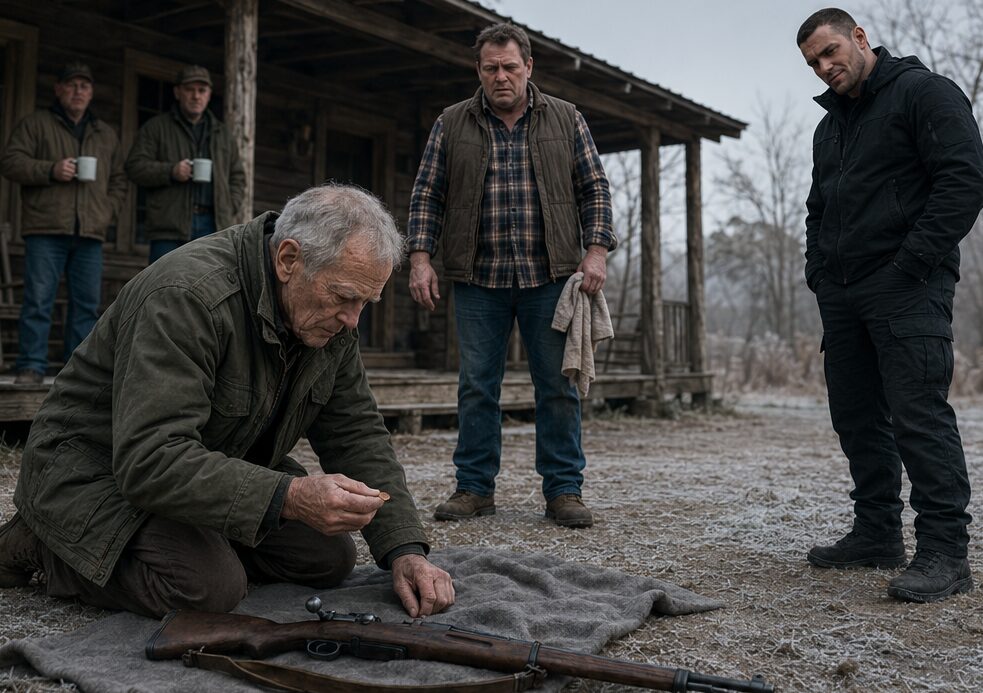
It was small, almost polite, the kind of laugh younger men used when they wanted an old man to know he was being watched. Frank heard it from the porch of the Pine Ridge Veterans Lodge, where three men stood with coffee steaming in paper cups and their hands buried in expensive jackets.
He did not look up.
He spread a worn gray blanket across the frost-stiff dirt. Then he laid the old bolt-action rifle on it as carefully as if he were setting down a sleeping child.
Tyler Miller leaned against the porch rail and smiled.
“Careful, Mr. Hayes,” he called. “That thing might kick harder than you remember.”
One of the other men snorted into his coffee.
Frank’s fingers paused on the rifle stock for half a second.
Then they moved again.
He was seventy-six, lean as fence wire, with silver stubble along his jaw and a right knee that did not bend without complaint. His field jacket hung loose on him. The cuffs were frayed. The zipper had been replaced with a brass one that did not match.
To Tyler, he looked like half the men who drifted into the lodge on winter mornings: old, quiet, proud in a way that made younger men uncomfortable.
To Frank, Tyler sounded like every boy who had lived long enough to mistake breathing for understanding.
Frank reached into the inside pocket of his coat.
He brought out a penny.
The copper was dark with age. He rubbed it once against his thumb, not to shine it, but to feel the edge.
The porch went quieter.
Tyler lowered his cup.
“No way,” he said, and now his smile widened. “You’re not actually doing the penny thing.”
Frank bent slowly. His knee trembled when it touched the cold ground.
That made Tyler smile again.
Andrew Walker stepped out from the lodge door, wiping his hands on a towel. He was the manager, broad-shouldered and tired-eyed, the kind of man who could quiet a room without raising his voice. He saw the blanket. The rifle. The penny.
Then he saw Frank’s face.
“Frank,” he said carefully, “you don’t have to do this today.”
Frank placed the penny upright in the dirt.
It fell.
The men on the porch laughed again, but softer this time. Uneasy.
Frank picked it up and set it again.
Andrew came down the steps. “Really. Nobody needs you to prove anything.”
Frank did not look at Tyler. He did not look at the others.
He kept one hand near the penny, shielding it from the wind.
“I’m not proving,” he said.
His voice was quiet enough that the men had to lean in to hear it.
“I’m finishing.”
The laugh died on the porch.
Tyler’s smile stayed, but something behind it changed. A flicker. Annoyance, maybe. Or curiosity he did not want to show.
“Finishing what?” he asked.
Frank adjusted the rifle by half an inch.
“That’s not yours to start.”
Tyler pushed off the rail.
He had the build of a man who wanted everyone to know he still ran miles before breakfast. Close-cropped hair. Clean boots. A black tactical jacket that looked too new for the mud around the lodge. He had served, people said. He had gone overseas. He had come back sharp-edged and loud where other men came back silent.
The older members tolerated him because he fixed broken locks and carried heavy boxes without being asked.
The younger ones admired him because he talked like pain was something you could dominate.
Tyler stepped down into the frost.
“Come on,” he said. “Everybody’s heard the story. Frank Hayes could split a penny from two hundred yards. Frank Hayes never missed. Frank Hayes could do miracles with iron sights.”
Frank’s jaw tightened.
Not much.
Just enough for Andrew to see.
Tyler saw it too, and mistook it for pride.
“I mean, if that’s the show,” Tyler said, spreading his hands, “we’re all here.”
Frank finally looked at him.
His eyes were pale and dry.
“It was never a show.”
For the first time that morning, nobody answered.
The penny stood crooked in the dirt between them, small and ridiculous in the wide gray cold.
Then the wind took it.
It tipped over again.
Frank reached for it, slow and steady, while Tyler watched the old man’s hand shake.
Part II — What the Old Wood Remembered
Frank’s hand shook until it touched the rifle.
Then it stopped.
That was the first thing Andrew noticed.
The tremor ran through Frank’s fingers while he pinched the penny, while he pushed himself lower, while he fought his own knee into position. But the moment his palm settled against the wooden stock, the shaking vanished as if someone had turned a key.
Andrew had seen men fake confidence. He had seen men perform pain. This was neither.
This was habit.
Old habit.
Frank moved the rifle an inch left, then a breath right. He checked the ground with two fingers, felt the frost, pressed a small groove into the dirt, and set the penny there again.
The younger men stopped laughing.
Tyler folded his arms. “You always make it this dramatic?”
Frank did not answer.
Andrew stepped closer, meaning to take the rifle, or the penny, or maybe just the whole morning out of Frank’s hands before Tyler made it ugly.
Then he saw the mark.
Near the trigger guard, carved shallow into the old wood, were two initials.
W.W.
Andrew stopped.
His father used to say those initials like they belonged in a room by themselves.
William Walker.
Not family, despite the name. Not by blood. But in the lodge, names had always been more complicated than blood. William had been his father’s closest friend before Andrew was born, a young scout with a grin in every photograph and a face nobody at Pine Ridge had seen past twenty-two.
Andrew had heard fragments.
Not the whole story.
Never the whole story.
“Frank,” Andrew said, lower now. “That rifle wasn’t yours.”
Frank’s thumb slid over the initials.
Too late.
Tyler noticed.
“What’s that?” he asked.
“Nothing,” Frank said.
Andrew looked from the initials to the penny. “It was William’s.”
Frank’s face closed so completely that Andrew regretted saying the name aloud.
Tyler’s eyes sharpened. “William who?”
Frank pressed the penny deeper into the dirt.
“Leave it.”
But Tyler was already walking closer. He smelled a story now, and stories were safer to challenge than silence.
“So this is about another legend?” Tyler said. “Another name on the wall nobody’s allowed to question?”
Andrew turned on him. “Enough.”
“No, I’m serious.” Tyler pointed toward the lodge. “Every time I come here, it’s the same thing. Old guys whispering around plaques and photographs like the rest of us are supposed to bow our heads over stories we never got to hear straight.”
Frank’s head came up.
“You want straight?”
Tyler’s mouth opened.
Nothing came out.
Frank’s voice stayed calm, which somehow made it harder.
“That rifle belonged to William Walker. He was twenty-two. He carried pennies in a cloth pouch because his little sister told him copper brought luck.”
The wind moved across the clearing.
The penny trembled but held.
Frank looked at it instead of Tyler.
“Every morning, he’d take one out and say, ‘If I make it home, I’m buying coffee with this exact penny.’ Same joke. Same grin. Like he could annoy fate into leaving him alone.”
Andrew swallowed.
His father had never told that part.
Frank’s hand slid along the stock, stopping over the initials.
“The night before the last operation, William handed me one. Said if I made it back and he didn’t, I should send one clean through the morning every year. So he’d know the world hadn’t swallowed his name.”
Tyler’s expression shifted.
Just slightly.
Not remorse yet. Not belief.
Defense.
“People say things before bad days,” Tyler said. “Doesn’t mean you owe them your whole life.”
Frank looked at him.
“No,” he said. “You owe them what you promised.”
The line landed harder than anger would have.
Tyler looked away first.
Andrew stared at the penny.
It no longer looked like a target.
It looked like something left waiting.
Part III — The Story Nobody Wanted Clean
Tyler hated the silence after that.
He hated how the other two men on the porch had stopped drinking their coffee. Hated how Andrew stood like a son at a closed door. Hated how Frank could say three sentences and make everyone feel small.
So he did what he always did when a room grew tender.
He struck at it.
“Everybody’s got a story,” Tyler said. “Some people just get better at using theirs.”
Andrew’s face hardened. “Tyler.”
But Frank raised one hand.
Let him.
Tyler’s jaw flexed. He was too far in now to retreat without feeling exposed.
“I’ve met a lot of men who came back and turned every bad day into a holy object,” Tyler said. “You can’t question them. You can’t laugh. You can’t say maybe they remember it better than it was.”
Frank watched him without blinking.
Tyler pointed toward the penny.
“Maybe this is grief. Maybe it’s guilt. Maybe it’s just one more old man making everybody stand around while he proves he used to matter.”
The words hung in the frost.
Too cruel.
Too honest.
One of the younger men on the porch whispered, “Man, come on.”
Tyler ignored him, but his ears had gone red.
Frank looked down at the penny, then at the rifle.
When he spoke, his voice had lost none of its steadiness.
“You froze.”
Tyler’s face changed.
Andrew went still.
Frank did not say it like an accusation. That made it worse.
“Convoy road,” Frank said. “Hot morning. Bad bend. You heard the first blast and your body stopped taking orders.”
Tyler took one step forward. “You don’t know anything about me.”
“I know the look.”
“You don’t know anything.”
“I know shame gets loud when it has nowhere to go.”
Tyler’s hands curled.
For a second, Andrew thought he might swing at a seventy-six-year-old man in front of the lodge.
But Tyler only laughed once.
It sounded broken before he could hide it.
“You think that makes us the same?”
“No,” Frank said. “I think it makes you dangerous when you start punishing other men for carrying what you can’t set down.”
Tyler looked at the ground.
The wind cut between them.
Frank turned back to the rifle, but Andrew had caught the tremor beneath his control. Not in his hands now. In his breathing.
“Frank,” Andrew said softly, “what happened out there?”
Frank did not answer at first.
He adjusted the penny.
It fell again.
This time nobody laughed.
He picked it up. Set it upright. Pressed dirt to its base with one careful finger.
When he spoke, his voice seemed to come from a place far colder than the clearing.
“People think William died because I missed.”
Andrew blinked. “Did you?”
Frank’s eyes stayed on the penny.
“No.”
That single word changed the air.
Tyler looked up.
Frank continued, each sentence clipped short enough to survive.
“There was a ridge. Fog lifting. Two men moving where they shouldn’t have been. William was pinned in the low wash with three others. I had one clean lane and one second to use it.”
His thumb moved over the initials.
“I made the shot.”
The clearing stayed silent.
“And William still didn’t come home.”
Andrew’s face lowered.
Tyler’s anger faltered, confused by a truth that did not give him anywhere easy to stand.
Frank’s mouth tightened.
“That’s the part nobody puts in stories,” he said. “Sometimes you do exactly what you were trained to do. Sometimes your hand is steady. Sometimes your eye is clear. Sometimes you’re right.”
He looked at Tyler then.
“And someone still doesn’t get to grow old.”
Tyler swallowed.
The words had gone under his jacket somehow. Through the expensive fabric. Into the place he tried to keep armored.
Frank leaned down again, slower this time.
His knee shook badly.
Andrew moved without thinking. “Let me help you.”
Frank’s hand snapped up.
Not violent.
Final.
“This one is mine.”
Andrew stopped.
Frank’s face softened a fraction, as if he regretted the sharpness but not the meaning.
“I carried it this far,” he said. “Let me carry the last foot.”
Part IV — Keeping the Wind Off
The wind would not let the penny stand.
It came in thin hard breaths across the clearing, slipping under the blanket, lifting the edge, worrying at the copper until it tipped and flashed and vanished into the frost.
Frank searched for it on his hands and knees.
His right knee dragged.
The movement made Tyler flinch.
Not because it was pathetic.
Because it wasn’t.
There was something terrible about watching an old man refuse rescue when every part of his body had earned it.
Andrew bent and found the penny first.
He held it out.
Frank took it without thanks, because thanks would have made it help, and help would have changed the thing.
He set it again.
The penny fell.
Tyler opened his mouth.
The old version of him had a line ready. Something about calling it a day. Something about how the morning had won.
But Frank’s earlier words rose before he could speak.
Shame gets loud when it has nowhere to go.
Tyler shut his mouth.
He stepped forward instead.
Frank looked at his boots.
Tyler said nothing. He only moved to the side where the wind came hardest and stood with his body blocking it.
One of the men from the porch understood and came down too.
Then the other.
Andrew stayed behind Frank, not touching him, just near enough to catch him if the world made it necessary.
For a minute, nobody spoke.
That silence did what apologies could not.
It changed the shape of the morning.
Frank set the penny upright again.
This time it held.
Tyler stared at it.
A ridiculous little coin. Brown. Worn. Almost worthless.
He thought of the things men carried because they could not carry the person.
A watch.
A photograph.
A phrase.
A road they avoided.
A morning they never described correctly.
Frank lowered himself behind the rifle.
It took him longer than anyone expected.
He put his left elbow into the frost. Shifted. Winced once. Pressed his cheek to the cold stock.
The clearing narrowed around him.
Andrew watched Frank’s hands.
Tyler watched his face.
The other men watched the penny.
Frank’s breathing changed first. It slowed until the white clouds from his mouth came evenly, then barely at all. The tremor left him. Age stayed in his bones, in his joints, in the thin skin at his wrists, but it no longer owned the moment.
The old wood remembered him.
Or he remembered himself.
Andrew had seen plenty of men hold rifles at the lodge range. Most tightened around the object, trying to command it.
Frank did not.
He settled into it like a question he had answered fifty times and still dreaded hearing.
Tyler suddenly understood that the penny was not a target.
It was a name.
Frank’s finger rested near the trigger.
The whole clearing held its breath.
Then the penny moved.
Not from wind.
A slight shift in the dirt.
Frank lifted his head.
Nobody breathed.
The penny leaned, hesitated, and fell flat.
For one second, the old man’s face emptied.
Not frustration.
Not embarrassment.
Loss.
It was so naked and brief that Tyler looked away.
Frank closed his eyes.
Andrew crouched beside him but did not touch him. “We can set it again.”
Frank opened his eyes.
“No,” he said. “I can.”
He pushed himself up. His knee buckled once. Andrew’s hand twitched, but he kept it back.
Frank found the penny.
Set it upright.
Pressed the frost.
Adjusted the blanket edge.
Returned to the rifle.
This time, as he lowered himself down, Tyler stepped wider against the wind. The other men copied him.
Frank did not look at them.
But he knew.
Part V — What Stayed in the Morning
The shot cracked across the clearing.
Birds tore out of the trees.
The penny leapt from the dirt and vanished in a copper blink.
No one spoke.
For a long breath, there was only the fading echo moving through the pines and the hard white smoke of Frank’s exhale.
Tyler was the first to move.
He searched the frost with his eyes, suddenly afraid they would not find it. Afraid the morning would take even that small proof and make fools of them all.
Andrew found it near the blanket.
He crouched, but he did not pick it up.
“Frank,” he said.
Frank pushed himself up slowly.
His face showed nothing. That was almost worse than if he had wept.
He came to where Andrew pointed.
The penny lay on its side in a shallow scrape of frost.
It had not split clean in half.
It was marked along one edge, torn open just enough to show a bright copper line under the tarnish. A near-impossible kiss of metal against metal. Not perfect. Not theatrical.
True.
Frank stared at it for a long time.
Tyler waited for him to smile.
He did not.
Frank bent and picked it up.
His fingers shook again.
He carried it back to the rifle and pressed the marked edge against the carved initials.
W.W.
His lips moved.
The others barely heard him.
“Morning came, William.”
Andrew turned away.
One of the younger men wiped his nose with the back of his glove and pretended the cold had done it.
Tyler stood with his hands hanging empty at his sides.
He had wanted to see an old man fail.
Then he had wanted to see an old man succeed.
Now both wishes felt childish.
Frank sat back on his heels, the rifle across the blanket in front of him, the penny in his palm.
Andrew approached carefully. “Frank.”
Frank closed his hand around the coin.
“I didn’t want anyone here,” he said.
His voice was not angry. It was simply tired.
Andrew nodded. “I know.”
“No,” Frank said. “You don’t.”
Andrew accepted that.
Frank looked toward the lodge. In the front window, behind the reflection of trees, the memorial board hung near the fireplace. Rows of names. Some polished. Some faded. Some added because paperwork said they belonged there. Some missing because grief had been messy and men had been careless.
“Your father asked me once why I never put William’s name back up after the board got replaced,” Frank said.
Andrew’s throat tightened. “He told me you said no.”
“I did.”
“Why?”
Frank looked at the penny in his hand.
“Because I was the only one still saying it right.”
Andrew did not understand at first.
Then he did.
A name on a board could become decoration. A story told too often could become entertainment. A promise shared with the wrong people could become a performance.
Frank had not hidden William because he cared too little.
He had hidden him because he cared too much, and wrongly, and for too long.
Tyler stepped closer, slower than before.
He picked up the spent casing from the frost.
He held it in his palm, not offering it yet.
“I was out of line,” he said.
Frank did not look at him.
Tyler swallowed.
The old urge came back, the one that wanted to make the apology bigger so it would be over faster. To explain the convoy. To explain the bend in the road. To explain the morning his hands had not moved when everyone expected them to.
But Frank had not asked.
And for once, Tyler did not use his pain to buy forgiveness.
He only said, “Do you want me to keep the wind off next year?”
Frank looked at him then.
Not warmly.
Not cruelly.
As if measuring whether the question was an offering or another performance.
Tyler held still.
Frank’s eyes dropped to the casing in Tyler’s hand, then to the place where he had stood against the wind.
At last, Frank gave one small nod.
It was not absolution.
It was permission.
Tyler accepted it like it weighed more.
Part VI — The Name Returned Quietly
Andrew took the memorial board down after lunch.
No announcement. No ceremony. No speech by the fireplace while men stared into coffee cups and pretended not to feel cornered by tenderness.
He carried the board into the back office, laid it across his desk, and found the old box of brass nameplates his father had kept in the bottom drawer.
Frank stood by the door with the penny in his coat pocket.
Tyler waited in the hall.
He did not come in until Andrew asked him to hold the board steady.
The nameplate was there, wrapped in brittle tissue.
William Walker.
Andrew stared at it longer than he meant to.
“My dad kept it,” he said.
Frank’s mouth moved as if he almost smiled.
“Your dad kept everything.”
Andrew fixed the plate beneath the others.
The small screws were stubborn. The wood had swollen with years. Tyler held the board firm while Andrew worked, and Frank watched from the doorway, one hand resting on the frame like he might need to leave if anyone said too much.
Nobody did.
When the name was back in place, Andrew stepped aside.
Frank came forward.
His walk was stiff now. The morning had taken its price from his knee, his back, his breath. But he did not look smaller.
He took the penny from his pocket.
For a moment, Andrew thought he would keep it.
Instead Frank wedged it into the lower corner of the wooden frame, just tight enough to stay.
The marked copper edge caught the light.
Not shining.
Just visible.
Tyler looked at it and understood that the coin was not proof for them. It was not a trophy. It was not even forgiveness.
It was a door left slightly open.
Frank touched William’s name once.
Then he let his hand fall.
Andrew wanted to say something worthy. Something about memory, or duty, or the lodge doing better. But every sentence that came to him sounded like it belonged on a plaque, and the morning had already proved how little plaques could carry by themselves.
So he said the only true thing.
“We’ll keep it there.”
Frank nodded.
“You’ll say his name?”
Andrew answered softly. “Yes.”
“Not like a legend.”
“No,” Andrew said. “Like a man.”
Frank looked at him for a long moment.
Then he turned and walked out of the office.
Tyler moved aside to let him pass.
In the hallway, Frank stopped beside him.
Neither man looked at the other.
After a while, Frank said, “Next year, stand a little farther left. Wind comes different off the pines.”
Tyler’s face tightened.
He nodded once.
“I will.”
Frank left without another word.
Outside, the frost was already thinning where the sun touched it. The blanket was folded over Andrew’s arm. The old rifle was back in its case. The clearing looked ordinary again, which seemed impossible after what it had held.
Tyler stood on the porch and watched Frank walk toward his truck.
The old man moved slowly.
Not weakly.
Slowly.
There was a difference Tyler had not known how to see that morning.
At the edge of the lot, Frank paused and looked back toward the lodge window.
From outside, the memorial board was only a dark rectangle beyond the glass.
No one passing by would notice the penny in the frame.
No one would know why one name had returned that day.
No one would understand why an old man had spent fifty years sending copper through the morning for a friend who never got to grow old.
But inside the lodge, the penny stayed.
And for the first time in a long time, Frank did not have to carry the name alone.