The Day Virginia Brought the Brown Case to the Desert
Part I — The Beginner Tables
The young instructor smiled at Virginia like she had wandered into the wrong part of her own life.
“Ma’am,” he said, one hand raised in that careful way people used when they wanted to sound kind while moving someone aside, “this lane is for the long-distance challenge. The beginner tables are down by registration.”
Behind him, two men in faded green shirts looked over from the shade of a canopy. One of them smirked. The other pretended not to.
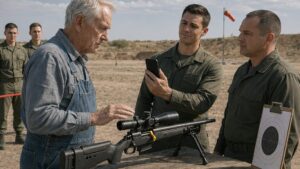
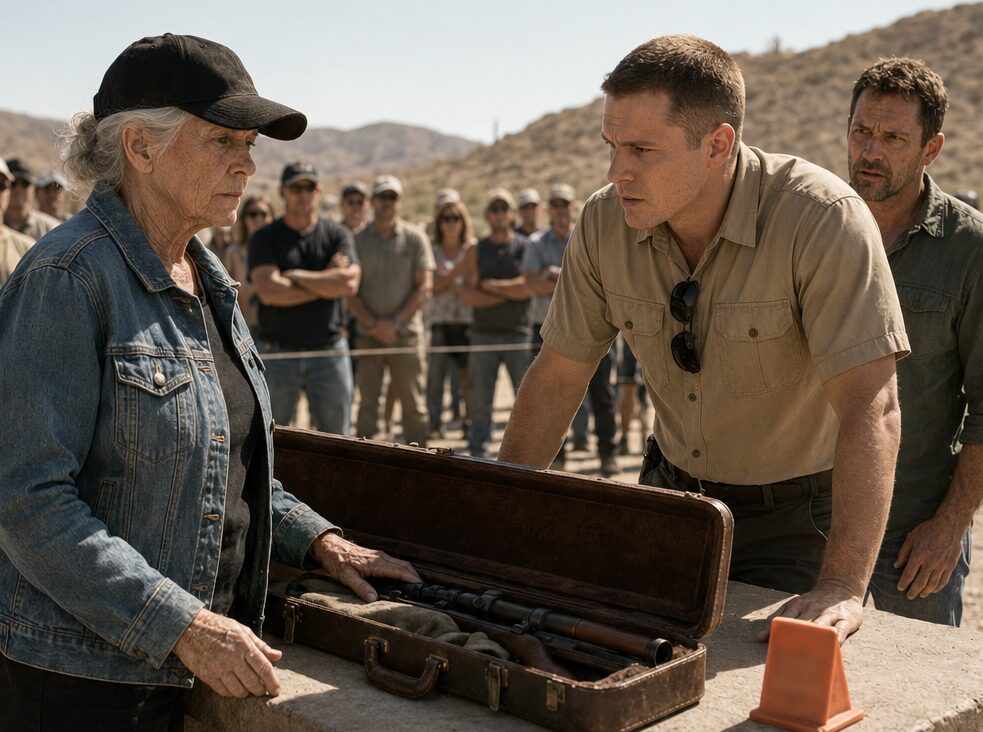
Virginia Collins stood with both hands on an old brown rifle case, the leather cracked at the corners and darkened where years of palms had carried it. Her silver hair was tucked under a black cap. Her denim jacket was too warm for the Arizona morning, but she kept it buttoned anyway.
She looked at the instructor’s name tag.
Daniel.
He was maybe thirty-two. Clean sunglasses. Tan tactical shirt. Radio clipped to his shoulder. The kind of man who believed that if he said something calmly, it became respectful.
Virginia did not move her case.
“I registered,” she said.
Daniel glanced toward the sign-up table, then back at her, still smiling. “For the open lanes?”
“For the challenge.”
The smile weakened.
The two men under the canopy had stopped pretending not to listen.
Daniel cleared his throat. “The memorial challenge?”
Virginia nodded once.
He reached for the clipboard hanging from a nail on the post beside the shooting bench. “Name?”
“V. Collins.”
He ran his finger down the list, slowly at first, then again as if the page had embarrassed him.
There it was.
V. Collins. Paid entry. Long-distance memorial challenge. Lane Four.
The event had been advertised for months at the veterans’ center and the diner and the hardware store: a charity range day in the desert, raising money for families whose names had already been printed on a white banner near the entrance. Most people came for raffle tickets, burgers, old stories, and the chance to watch the impossible target ring once or twice if some retired marksman got lucky.
Nobody expected an elderly woman with careful steps and a brown case to walk up to Lane Four.
Daniel lowered the clipboard.
“That target sits way out there,” he said.
“I saw it.”
“It’s not a casual lane.”
“I know.”
He looked at her hands. They were thin, sun-spotted, and still resting on the case.
“With respect,” he said, “that rifle may be a lot for your shoulder. Heat’s already climbing too. We’ve got chairs under the tent if you want to watch first.”
The word watch landed worse than he meant it to.
Virginia had been watching for forty-six years.
She watched wind move sand off a ridge. Watched headlights crawl through heat haze. Watched men become dots and dots become names and names become things people forgot to print.
She did not say any of that.
She only lifted the latches on the brown case.
The first click was small.
The second sounded louder than it should have.
The smirking man under the canopy leaned closer to his friend.
Virginia opened the case.
Inside, the rifle lay wrapped in a faded gray-green cloth. The scope was old but clean. The wood stock had been rubbed smooth where a cheek had rested against it. Everything in the case had been arranged with a patience that made Daniel’s polished equipment look temporary.
His smile disappeared.
Virginia unfolded the cloth just enough to free the rifle. Not all the way. Never all the way.
She set the rifle on the bench like she was setting down a memory that could still bruise.
Then she took five cartridges from a small box inside the case and placed them in a straight line.
One.
Two.
Three.
Four.
Five.
Her left hand trembled after the last one.
When she touched the rifle, it stopped.
The man under the canopy whispered, not quietly enough, “Old-timers keep all kinds of things they shouldn’t use anymore.”
His friend gave a short laugh.
Virginia heard them. She did not look over.
A woman learned, after enough years, which insults deserved an answer and which deserved to be outlived.
Daniel stepped closer, suddenly more official.
“I’ll need to inspect the firearm.”
Virginia turned her head.
“For safety,” he added.
The word gave him cover. He knew it. She knew it.
She moved back half a step.
Daniel picked up the rifle with competent hands. He checked it as he had checked hundreds before. Clear chamber. Condition. Scope mount. Bore. He was professional enough not to be careless with the weapon.
But then his hand drifted toward the folded cloth inside the case.
Virginia’s voice cut across the bench.
“Not the cloth.”
The range seemed to narrow around them.
Daniel froze, fingers inches above the fabric.
The two men under the canopy stopped smiling.
Virginia’s face had not changed much, but something in her eyes had come forward, sharp and old.
Daniel withdrew his hand.
“I wasn’t going to damage it.”
“I said not the cloth.”
He straightened, embarrassed now. A few people near the raffle table had turned around.
For the first time that morning, Daniel looked at Virginia not as a problem to manage, but as a person who might be standing on the edge of something he could not see.
Still, pride came fast.
“All right,” he said, too briskly. “We’ll keep this controlled.”
Virginia looked down at the five cartridges.
“We will.”
Part II — The Things Men Miss
The man who had whispered from the canopy walked over first.
He was broad-shouldered, red at the neck, with a green shirt stretched tight across his chest. His friend followed a few steps behind, quieter, eyes narrowed against the light.
“Daniel giving you trouble?” the first one asked, as if trouble were something amusing.
Daniel shot him a look. “Not now, Patrick.”
Patrick held up both hands. “Just checking.”
The quieter man came closer to the bench. His name tag read Joseph. He did not smile now. His attention had settled on the inside lid of Virginia’s case.
There, almost hidden by age and shadow, was a small stitched patch.
Not bright. Not showy. Not the kind sold at surplus stores to men who liked stories better than history.
Joseph leaned in before he could stop himself.
Virginia saw him notice.
His expression changed.
It was not recognition exactly. It was the look of a man who had opened a door and realized someone else had been standing in the dark on the other side.
Daniel missed it.
“Ma’am,” he said, “before I let you continue, I need to ask where you trained with this platform.”
Patrick let out a small sound. “Here we go.”
Virginia placed one palm flat on the bench. The wood was hot already.
“Near a border nobody was supposed to admit we crossed.”
Patrick’s eyebrows rose.
Daniel gave the polite half-laugh men used when they thought an old person had confused memory with theater. “I’m asking seriously.”
“So am I.”
Joseph did not laugh.
He looked again at the patch inside the case, then at Virginia’s cap, then at the cloth she had refused to let Daniel touch.
“What detachment was that?” Joseph asked quietly.
Virginia did not answer.
That silence did more than any answer could have.
Daniel noticed Joseph’s face. “You know that patch?”
Joseph’s eyes did not leave the case. “I know enough to stop guessing.”
Patrick shifted, uncomfortable now.
A voice over the loudspeaker announced raffle tickets near the food tent. Someone laughed too loudly at another lane. A brass casing hit concrete somewhere down the line.
Virginia kept her eyes on the far target.
It stood almost invisible in the shimmer, a small pale square fixed beyond the ordinary lanes. Behind it, low desert hills rose like folded paper. The challenge was mostly for show. Hit the target, ring the little steel bell mounted behind it, get your name posted near the memorial banner, and the event sponsors added a donation.
People liked almost-impossible things when the cost of missing was only applause.
Virginia had not come for applause.
She turned her head toward the banner near registration.
White vinyl. Blue lettering. Twelve names. Families seated beneath it in folding chairs, accepting handshakes from strangers who meant well.
Her eyes moved down the list.
Not there.
Of course not.
She had known before she came. She had known for years. Still, the absence found the same place in her chest every time.
David Walker.
Not printed. Not announced. Not officially eligible for the clean language people used at events like this.
He had been many things in the paperwork.
Attached.
Advisory.
Unconfirmed.
Transferred.
Lost in language before he was lost in earth.
Virginia closed the case lid halfway, then opened it again.
Leaving would be easy.
She had become talented at leaving before anyone asked the question she could not answer.
But near the banner stood a woman in a white shirt under a light jacket, holding a folded program. Her hair was pulled back. Around her neck, something small caught the sun.
Virginia saw the initials before she meant to.
D.W.
Her hand tightened on the bench.
Joseph followed her gaze.
“You know her?” he asked.
“No.”
But that was not the truth.
Virginia knew the baby photograph that had been tucked behind the radio in David’s pack. She knew the way he said my girl when the desert nights got too quiet. She knew he had practiced signing birthday cards with his left hand because his right was always dirty from equipment.
She knew he had once said, “If I don’t go home, don’t let them make me sound braver than I was.”
She had promised nothing aloud.
Some promises did not need to be spoken to become permanent.
Daniel stepped into her line of sight. “We’re about ten minutes from the challenge window. I can still move you to a standard lane.”
Virginia looked at him for a long moment.
“Do you always offer smaller places to people before you know what they came to carry?”
Patrick looked away.
Daniel’s jaw tightened. “I’m trying to keep the range safe.”
“No,” Virginia said. “You’re trying to keep it comfortable.”
The words were not loud.
That made them worse.
Part III — The Missing Name
The crowd gathered slowly, the way crowds do when they pretend they are not gathering.
A few people came for the challenge. A few came because Daniel’s voice had sharpened. A few because they saw an old woman at Lane Four and wanted to see whether she would prove them right or wrong.
Virginia hated them for that, then forgave them because she had been young once too.
Young people believed age was a place other people went.
Daniel put a small orange marker on the bench. NOVICE SUPERVISION.
Virginia read it.
So did Joseph.
So did Patrick.
“Is that necessary?” Joseph asked.
Daniel did not look at him. “For safety.”
“There’s that word again,” Virginia said.
Daniel’s face flushed beneath his sunglasses. “Ma’am, I have procedures.”
Virginia turned fully toward him then.
For the first time, everyone nearby saw how tired she was.
Not weak. Tired.
There was a difference, and suddenly it mattered.
“You keep saying safety like I came here careless.”
The range quieted around them.
Daniel opened his mouth, but Joseph stepped close enough that only he and Daniel could hear.
“That patch is real,” Joseph said. “And you need to stop performing authority.”
Daniel’s expression changed as if Joseph had put a hand on his chest.
Patrick muttered, “Joe—”
“No,” Joseph said, still low. “We were laughing at somebody we didn’t understand. That’s enough.”
Virginia looked away from all of them.
The woman by the banner had turned now. The one with the D.W. necklace. Her eyes moved from the old rifle case to Virginia’s face, then back again. She did not approach.
Not yet.
Daniel removed the orange marker.
He did it without drama. Just picked it up and set it beneath the bench.
It was not an apology.
It was the first honest thing he had done.
Virginia reached for the rifle.
A murmur passed through the small crowd. The heat made everything waver. Faces, hills, the distant pale target. The whole world seemed made of something that might vanish if looked at too hard.
She eased herself onto the stool behind the bench.
Her knees complained. Her shoulder ached before the rifle even touched it. Her breath came shallower than it once had. Age did not ask permission; it simply arrived with paperwork of its own.
Daniel started to speak.
“Before you—”
Then he stopped.
Virginia did not thank him.
She set the rifle against the rest, not hurried, not theatrical. She slid one cartridge forward with two fingers.
The first of the five.
Her hand hovered over it.
For a moment the range disappeared.
There was another desert.
Another heat.
A younger man beside her, face half-shadowed under a scarf, trying to make a joke because fear sat too close if nobody spoke.
“You’re staring again, Virginia.”
“I’m spotting.”
“You’re judging.”
“You breathe like a man trying to move a mountain.”
David had laughed at that. He had been twenty-eight and already tired in the eyes. He could make a joke while checking a sightline. He could be afraid without becoming useless. That was the thing she remembered most clearly. Not bravery. Usefulness under fear.
The day everything broke, she had read the wind and watched the road and heard the convoy call in wrong coordinates.
If she corrected them, the convoy lived.
If she held silence, David might have time to move.
She corrected them.
The convoy lived.
David did not come back.
That was the simple version. The version that fit inside one sentence. The version that ruined a life because it was too small to hold the truth.
Back at Lane Four, Virginia pressed the cartridge into place.
Daniel watched her hands.
They were steady.
Joseph watched Daniel watching, and said nothing.
Patrick had stopped folding his arms.
“Virginia?”
The voice came from behind the line.
She knew before turning.
The woman from the banner stood several feet away with the folded program pressed against her stomach.
Virginia looked at her necklace, then at her face.
The years had not been kind enough to hide David there. His daughter had his eyes. Not the color. The waiting in them.
“I’m Carolyn,” the woman said. “Carolyn Walker.”
Virginia closed her eyes once.
When she opened them, Carolyn was still there.
“I know,” Virginia said.
Carolyn’s fingers tightened around the program. “Did you know my father?”
No one moved.
Even the desert seemed to hold still.
Virginia could have said many things. She could have said classified. She could have said not now. She could have hidden behind the old walls that had kept her upright.
Instead she looked at the rifle.
“Yes.”
Carolyn’s mouth trembled, but she steadied it. “Were you with him?”
Virginia touched the stock lightly with her fingertips.
“In some of the places where he was most himself.”
That answer hurt Carolyn more than no would have. It also gave her something no official letter ever had.
Daniel stepped back from the bench.
This time, not because procedure told him to.
Because he understood the lane was not his anymore.
Part IV — The Name She Had Not Said
Carolyn did not ask the next question.
That made Virginia grateful and afraid.
Some questions waited better than people did.
The loudspeaker crackled, then died. No one announced the challenge. No one needed to. The small crowd already knew something had shifted, even if most of them did not understand what.
Virginia settled behind the rifle.
The cloth inside the case remained folded, its edge visible beneath the lid. A small line of stitching showed at one corner.
D.W.
Carolyn saw it.
Her breath caught.
Virginia heard that small sound and nearly stood up.
Not because she was embarrassed.
Because grief, when recognized by someone else, became heavier for a moment before it became shared.
“You don’t have to do this,” Carolyn said.
Virginia almost smiled.
Everyone had been telling her what she did or did not have to do all morning.
But Carolyn said it differently.
Not as doubt. As mercy.
Virginia kept her cheek near the stock. “I know.”
“Then why?”
The question moved through the hot air and found the place where every year had been stored.
Virginia looked through the scope.
The target shimmered.
Her right eye watered. She blinked once, then again.
Through the glass, distance became a circle. The pale square. The faint bell behind it. Heat rising. A breath of wind slipping left to right.
She could feel the old work returning, not as youth, not as strength, but as language.
Wind. Light. Drag. Patience.
People mistook age for forgetting. Often it was the opposite.
The body forgot what it could once do. The mind remembered too much.
Virginia’s finger rested outside the trigger guard.
“I told him once,” she said, almost too quietly, “that if he made it home, he could tell his daughter the truth himself.”
Carolyn stood very still.
“And if he didn’t?” Carolyn asked.
Virginia swallowed.
“I never answered.”
The silence after that was not empty.
Daniel stood beside the lane marker, holding his clipboard like it had become useless. Joseph had taken off his cap. Patrick looked down at the ground.
No one clapped. No one whispered. Nobody wanted to be caught being a spectator to this.
Virginia inhaled.
The desert moved again.
Another memory came, sharp and useless.
David pressing the gray-green scarf into her hand because her own had torn. “You keep it,” he had said. “You’re the one who complains about dust.”
“You’re the one who breathes like a mountain.”
“Then spot me better.”
He had smiled when he said it.
Later, when she found the rifle, the scarf had been wrapped around the scope.
She never knew who had done that.
Maybe David.
Maybe someone who understood that objects sometimes needed witnesses too.
At Lane Four, Virginia adjusted the rifle.
Daniel took half a step forward out of habit.
Then stopped himself again.
His hand opened at his side.
He turned to the small crowd and said, “Everyone behind the line, please.”
His voice was different now.
Not louder. Lower.
“Give her room.”
The words moved through the group. People stepped back. Folding chairs scraped. Someone hushed a child. The range became a wide, waiting thing.
Virginia heard Daniel place the clipboard down.
She heard Joseph breathe.
She heard Carolyn’s program crinkle in her fist.
The first cartridge was loaded.
The other four waited in their straight line.
Years she had not come.
Years she had mailed anonymous checks.
Years she had started letters to Carolyn Walker and torn them up before the second sentence.
Years she had thought silence was the last respectful thing she could give the dead.
Virginia closed her left eye.
The target steadied.
She whispered a name.
“David.”
Not to summon him.
Not to ask forgiveness.
Only because she had said it before every difficult thing she had survived, and this would be no different.
Part V — The Bell in the Distance
The shot cracked across the desert.
For one impossible second, nothing answered.
The sound went out and vanished into the hot white distance.
No bell.
No movement.
No proof.
Virginia stayed behind the rifle, cheek pressed to the stock, eye still through the scope. She did not breathe. Nobody around her did either.
Daniel looked toward the target, then back at her, and for the first time that morning he looked young.
Patrick squinted. “Did it—”
The bell rang.
Small.
Clear.
Late enough to break everyone before it gave them back to themselves.
The crowd did not cheer immediately.
That was the mercy of it.
There was a silence first, and in that silence Virginia felt the shot arrive somewhere inside her that had been waiting longer than the target had.
Then applause began.
Not roaring. Not wild. A few hands at first. Then more. Then the whole group, because people were relieved to have something simple to do with complicated feeling.
Virginia lifted her head from the rifle.
Her shoulder hurt.
Her eye burned.
Her hand, away from the stock now, trembled badly.
Daniel moved toward her, then stopped short. “Mrs. Collins—”
“Virginia,” she said.
He took off his sunglasses.
The gesture looked awkward on him, which made it honest.
“Virginia,” he said. “I’m sorry.”
She looked at him.
He wanted more. A sentence that would clean the morning. A permission to feel forgiven. But she had not come to manage his discomfort.
After a moment, she said, “Do better sooner next time.”
Daniel nodded.
That was all he got.
That was enough.
Carolyn had not clapped.
She stood with one hand on the necklace and the other holding the program so tightly the paper had creased down the middle.
Virginia opened the case.
This time, she unfolded the cloth fully.
It was not much to look at. Faded gray-green fabric, softened by age, repaired once with thread that did not match. Along one edge, initials had been sewn by an unskilled hand.
D.W.
Carolyn took one step forward.
“My father’s?”
Virginia nodded.
“He gave it to me because mine tore,” she said. “I meant to return it.”
Carolyn let out a breath that was almost a laugh and almost something else. “It took you a while.”
Virginia looked down at the cloth.
“Yes.”
The honesty of that single word did more than any apology could have.
Carolyn came closer, but did not reach for it.
“Was he brave?” she asked.
The question was small. Childlike. Adult. Impossible.
Virginia thought of all the wrong answers.
Yes, like a statue.
Yes, like the stories want men to be.
Yes, in a way that would make your grief easier to organize.
She would not give Carolyn a polished stranger.
Virginia folded the cloth once over the bench.
“He was tired,” she said. “Scared. Stubborn.”
Carolyn’s eyes filled.
Virginia touched the initials with two fingers.
“And brave anyway.”
Carolyn covered her mouth.
For a moment, the applause behind them felt far away, like weather happening in another town.
Joseph turned his head. Patrick wiped at his eye with the heel of his hand and looked irritated with himself.
Daniel walked to the memorial table.
The event volunteers had a board there for challenge winners. Daniel picked up a marker. He hesitated only once.
Under the printed line for V. Collins, he wrote another name.
David Walker.
No rank. No explanation. No claim bigger than the act itself.
Just the name.
Carolyn saw it.
Virginia did too.
Something inside her resisted the sight. Old habit. Old caution. Old fear that naming him in public would disturb the fragile dignity of what had been kept private.
Then Carolyn reached for the cloth.
“May I?”
Virginia’s hands tightened.
For forty-six years, the cloth had lived with the rifle. In closets. Under beds. In the trunk of a car when she moved states. In motel rooms when she could not sleep. It had been the one piece of David that nobody corrected, redacted, or filed away.
She had thought carrying it meant loyalty.
Now Carolyn stood in front of her with David’s eyes and an empty space where a father should have been.
Virginia lifted the cloth.
For a second, she almost pressed it to her own chest.
Instead, she placed it in Carolyn’s hands.
Carolyn held it like she was afraid it might disappear.
“He talked about you,” Virginia said.
Carolyn looked up quickly.
Virginia almost stopped there. It would have been safer. Cleaner. But some truths did not need to be large to be owed.
“He said you hated carrots. He said you slept with one sock off. He said when he got home, he was going to build you a treehouse even if the yard had no tree.”
Carolyn laughed then.
It broke in the middle.
“My mom said he made things up.”
“He did,” Virginia said. “But not that.”
Carolyn pressed the cloth to her chest.
Virginia closed the rifle case.
The sound of the latches was softer this time.
Part VI — The Case Was Lighter
By noon, the heat had flattened the shadows beneath the benches.
People returned to raffle tickets and paper plates and ordinary conversations spoken too loudly after an emotional interruption. That was how life protected itself. It resumed.
Virginia did not mind.
She sat alone for a few minutes at Lane Four with the closed brown case in front of her. The rifle was inside. The cloth was not.
That absence changed the weight more than she expected.
Daniel approached without his clipboard.
“I took down the supervision marker,” he said.
“I noticed.”
“I also told registration the donation goes under both names.”
Virginia looked toward the memorial table.
David Walker was still written there in Daniel’s careful block letters. Temporary marker on a temporary board. It would not fix paperwork. It would not change the past. It would not turn a missing name into a full life.
But Carolyn stood near it, staring.
Sometimes a small public truth was all the world could bear at once.
And sometimes it was enough to begin.
Daniel shifted his weight. “I thought I was helping.”
Virginia looked at him then.
“I know.”
That seemed to hurt him more than if she had accused him.
She picked up the case.
Daniel reached instinctively to help.
Virginia gave him one look.
He stopped.
Then, after a beat, he stepped aside instead.
That was better.
Joseph waited near the end of the lane. Patrick stood behind him, hands in his pockets, shame sitting awkwardly on his broad face.
“Ma’am,” Patrick began.
Virginia raised an eyebrow.
“Virginia,” he corrected.
She waited.
He rubbed the back of his neck. “I was out of line.”
“Yes.”
Joseph almost smiled.
Patrick swallowed. “I’m sorry.”
Virginia looked at him for a moment long enough to make him stand inside the apology.
Then she nodded once.
Not forgiveness exactly.
Recognition of effort.
Carolyn came last.
She still held the folded cloth. Her fingers rested over the initials.
“I don’t know what to ask you,” she said.
Virginia understood.
Questions were easy until the person who could answer them appeared. Then they became doors.
“You don’t have to ask today.”
Carolyn looked toward the parking lot, then back at Virginia. “Will you be here next year?”
Virginia almost said no.
She had finished what she came to do. She had made the shot. She had spoken David’s name. She had given away the cloth. A clean ending presented itself, neat and false.
Instead she looked at the desert beyond the lanes.
The hills had not changed. They never cared who survived long enough to remember them.
“I don’t know,” Virginia said.
Carolyn nodded. “Can I write to you?”
Virginia looked at the closed case in her hands.
For years she had kept letters unwritten because the first sentence seemed impossible.
Now Carolyn was offering to begin differently.
“Yes,” Virginia said.
Carolyn’s face changed, not into happiness exactly, but into something that had room for it.
She reached out.
Virginia thought Carolyn meant to take her hand. Instead, the younger woman touched the top of the brown case gently, as if greeting something that had carried too much for too long.
“Thank you for keeping it,” Carolyn said.
Virginia’s throat tightened.
She could have said I should have done more.
She could have said I was the reason he did not come home.
She could have said the sentence she had carried like a stone until it had worn itself smooth.
But Carolyn was not asking for Virginia’s punishment.
She was thanking her for what had survived.
So Virginia only said, “He kept me too.”
The words surprised her.
They seemed to surprise Carolyn as well.
For the first time all morning, Virginia’s hands did not tremble when she lifted the case.
She walked toward the parking lot slowly, because she was seventy-six and the desert was hot and dignity did not make knees young again.
Behind her, the event kept going.
A bell rang at another lane. People laughed. Someone called out a raffle number. Daniel’s voice carried over the range, calmer now, less eager to own every inch of it.
At the memorial table, Carolyn stood beside the board where David Walker’s name had been written beneath Virginia’s.
The marker would fade.
The board would come down.
The day would become a story people told imperfectly.
But Carolyn had the cloth.
Daniel had the lesson.
Joseph had spoken when silence would have been easier.
And Virginia had the brown case, lighter by one piece of fabric and heavier by one returned name.
At her car, she set the case carefully across the back seat.
For a moment, she rested her palm on the lid.
Then she took off her black cap, wiped the sweat from her forehead, and looked once more toward Lane Four.
She had not been forgiven by the desert.
The desert did not forgive.
But she had stopped asking it to.
Virginia got into the car, closed the door, and sat with both hands on the wheel until her breathing settled.
On the passenger seat lay the event program Carolyn had given her.
A phone number was written across the top.
Below it, in careful handwriting, were three words.
Tell me more.
Virginia touched the paper once.
Then she started the engine and drove away with the empty space in the case beside her, not healed, not free, but no longer alone.