The Morning He Finally Let His Sleeve Stay Rolled Up
Part I — The Booth by the Window
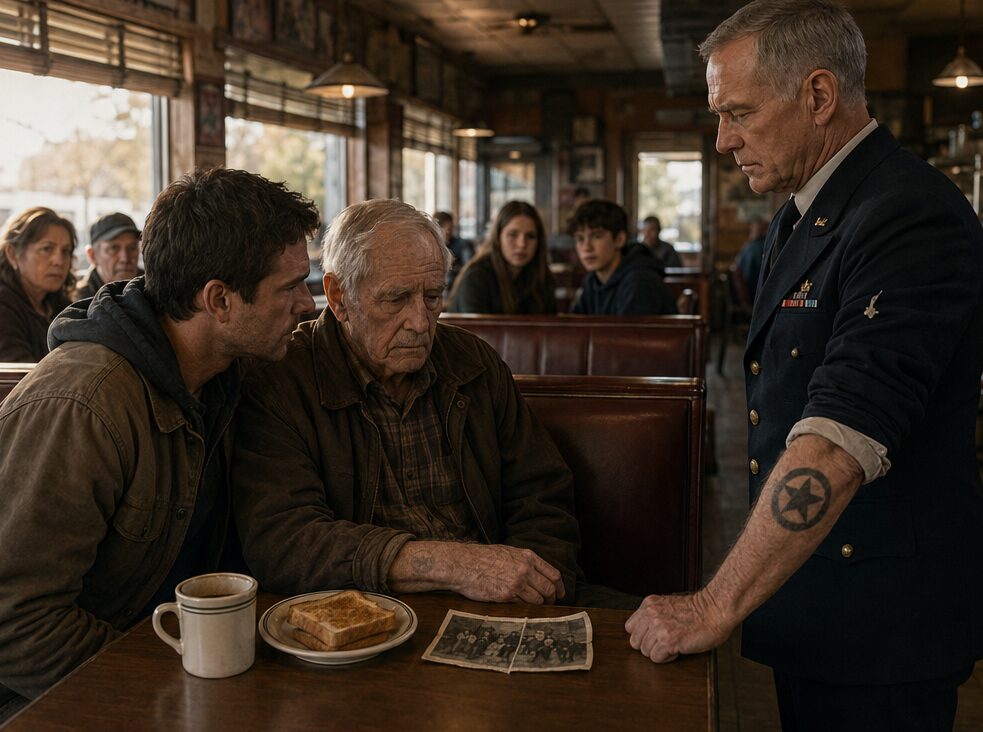
Samuel’s hand shook just enough to scatter toast crumbs across the table, and Nicholas reached for the butter knife like the whole diner was watching.
“Grandpa, let me do it before you make a mess,” he said under his breath.
He did not say it loudly.
That made it worse.
Samuel’s fingers closed around the knife. His knuckles were thin now, the skin loose and pale, the veins raised like blue thread. He had dressed the way he always dressed when Nicholas took him to Miller’s Diner after his appointment: brown jacket, faded plaid shirt, collar buttoned wrong, sleeves rolled halfway up because the place was always too warm.
The waitress glanced over.
Nicholas saw the glance. He saw the crumbs. He saw the old coffee stain near Samuel’s cuff. He saw everything people might notice, and shame moved through him before love could catch it.
“Just give it here,” Nicholas muttered.
Samuel pulled his arm back.
For one second, his sleeve shifted higher.
The tattoo showed.
It was barely more than a ghost now: a faded circle around a small star, ink blurred by age until it looked less drawn than remembered. It sat on the inside of Samuel’s forearm, pale blue against skin that had gone soft and spotted.
At the next table, two teenage boys stopped scrolling their phones.
One leaned toward the other and whispered, not quietly enough, “Looks like some prison thing.”
The other laughed into his soda.
Nicholas felt heat climb up his neck.
“Grandpa,” he said, sharper now, “roll your sleeve down.”
Samuel looked at him for a long moment. Not angry. Not wounded in any way Nicholas could name. Just tired, as if Nicholas had asked him to put away something heavier than skin.
Then Samuel set the knife down.
He tugged the sleeve over the tattoo.
The bell above the diner door rang.
Nobody noticed at first. Miller’s Diner was the kind of place where bells rang every seven minutes: delivery men, retired couples, contractors in dusty boots, mothers with children sticky from syrup.
But this time, the room shifted.
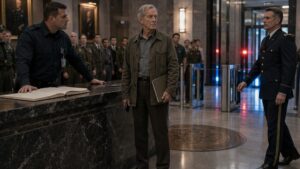
The man who walked in was older, maybe late fifties, gray hair cut short, posture too straight for the room. He wore a dark formal service uniform with polished shoes and a chest full of quiet authority. Not flashy. Not ceremonial in the way parades were ceremonial. Controlled.
He paused just inside the door.
Donna Miller, the owner, lifted a coffee pot. “Sit anywhere you like.”
The man did not move.
His eyes had landed on Samuel.
Nicholas felt it before he understood it. The man was not looking at the booth. He was not looking at Nicholas. He was looking at the place where Samuel’s sleeve had just been pulled down.
Samuel picked up his coffee cup with both hands.
The man crossed the diner slowly.
Nicholas straightened. “Can we help you?”
The man stopped beside their booth.
Samuel did not look up.
For a moment, no one spoke. The teenagers at the next table went quiet. Donna lowered the coffee pot onto the counter without pouring.
Then the man reached for his own sleeve.
He unbuttoned the cuff.
Rolled the fabric upward.
And there it was.
A circle. A star. Darker than Samuel’s, sharper, newer, but unmistakably the same.
Nicholas stared.
The officer placed his forearm on the edge of the table, not touching anything, just letting the symbol face Samuel like a question that had taken decades to arrive.
Samuel’s fingers tightened around the coffee cup.
“Sergeant Hayes,” the officer said.
The name did not belong in the diner.
It landed between the coffee and the toast like something pulled from under the floorboards.
Nicholas stood halfway out of the booth. “Who are you?”
The man did not look at him. His eyes stayed on Samuel.
Samuel set down his cup with care. A little coffee trembled over the rim and darkened the napkin beneath it.
“You’ve got the wrong man,” Samuel said.
His voice was quiet.
The officer’s answer was quieter.
“No, sir. I’ve spent twenty years looking for the right one.”
Part II — The Man with the Same Sign
The diner did what public places do when private pain enters them.
It pretended not to watch.
Forks slowed. Coffee cups hovered. Someone near the counter stopped chewing. Donna wiped the same clean spot on the counter three times.
Nicholas stepped fully into the aisle now. He was thirty-one, broad-shouldered from years under cars, still wearing his work boots though it was his day off. He had brought Samuel here because the doctor’s office was nearby, because Donna gave Samuel free refills, because breakfast out was easier than admitting the old house was getting harder to manage.
He had not brought him here to be confronted by a stranger in uniform.
“What do you want with him?” Nicholas asked.
The officer finally turned. His face was composed, but his eyes were not. There was something in them Nicholas did not like. Not threat. Not exactly grief.
Need.
“My name is Charles,” he said. “I only need five minutes.”
Samuel’s mouth tightened.
“No.”
Charles looked back at him. “Sir—”
“I said no.”
The word was not loud, but it carried enough weight that Nicholas turned toward his grandfather with surprise.
Samuel did not sound confused.
He did not sound old.
He sounded like a door being locked.
Charles reached inside his jacket. Nicholas’s hand moved before he thought. “Hey.”
Charles stopped and lifted his palm slightly, a careful gesture. “It’s only a photograph.”
He removed a folded picture, its creases soft from years of being opened and closed. He placed it on the table beside Samuel’s plate.
Samuel did not touch it.
Nicholas looked down.
Nine young men stood outside a low concrete building under a white, brutal sun. Their sleeves were rolled. Some smiled. Some tried to. One had a bandage around his neck. One held up two fingers behind another man’s head. They were young in the reckless way old photos make everyone young, as if they did not know history was already taking aim.
On each visible forearm was the same circle and star.
Nicholas looked from the photograph to Samuel.
He searched the faces.
He found his grandfather only because of the eyes.
The young Samuel in the picture stood near the edge, lean and unsmiling, one hand hooked through a strap across his chest. There was no stoop in him. No tremor. No food stain. No soft confusion people assumed when they saw him take too long counting change.
Nicholas felt something shift under his ribs.
He had never seen this photograph.
Not in the hallway boxes. Not in the albums his mother kept. Not even after Grandma Ruth died and Nicholas helped clean out the closet where Samuel had kept forty years of bills, old coats, and a cigar tin full of buttons.
“You were in this?” Nicholas asked.
Samuel stared at the edge of the photograph.
“That picture should’ve burned,” he said.
Charles closed his eyes briefly, as if the words had struck exactly where he expected.
“My father kept it in his Bible,” he said.
Samuel’s gaze lifted.
It was the first time he looked directly at Charles.
The air in the diner changed again.
Nicholas heard the bell over the grill. Heard someone’s spoon tap a mug. Heard the teenagers breathing too quietly beside them.
“Who was your father?” Samuel asked.
Charles reached out, but did not touch the photograph. He pointed to a young man standing two places from Samuel, laughing at something outside the frame.
“Eric.”
Samuel looked away so fast Nicholas almost missed it.
“Eric talked too much,” Samuel said.
A strange, fragile expression crossed Charles’s face.
“Yes,” he said. “He did.”
Samuel’s jaw worked once.
“Then he should’ve known better.”
The words were cold enough that Nicholas flinched.
Charles did not.
“He told me if I ever found the man with the faded star, I was to stand up straight, show my arm, and say thank you.”
He rolled his sleeve a little higher. The tattoo looked almost black against his skin.
Samuel’s eyes went to it.
“That yours?” he asked.
Charles understood the question.
“No, sir. Not from then.”
“Then don’t wear it like you earned it.”
Nicholas inhaled sharply. “Grandpa.”
Charles took the correction without moving. “I got it after my father died.”
Samuel gave a bitter little breath that was not quite a laugh.
“Sons,” he said, “turn pain into monuments when they don’t know what it cost.”
The line hit the table and stayed there.
For the first time since Charles had entered, Nicholas felt embarrassed for someone other than Samuel.
He looked at the officer’s face, expecting anger.
But Charles only nodded once.
“You may be right,” he said. “That’s why I’m here.”
Part III — The Photograph No One Touched
Samuel tried to leave after that.
He did not announce it. He simply slid his hand to the edge of the table, pushed against it, and started to rise.
His knees did not cooperate.
Nicholas moved automatically to help.
Samuel’s eyes cut to him. “Don’t.”
The word stopped him.
Samuel gripped the seat with one hand and stood in a slow, stubborn motion that made his whole body shake. The diner watched him pretend it did not cost him.
Charles stepped back to give him room.
Donna came around the counter. “Samuel, honey, I can clear the back office if you all need—”
“No back room,” Samuel said.
But he moved toward the hallway that led to the restrooms, away from the table, away from the photograph, away from the arm that matched his own.
Nicholas followed.
“Grandpa.”
Samuel kept walking.
“Grandpa, stop.”
At the hallway entrance, Samuel braced one hand against the wall. There was a framed newspaper clipping there from twenty years ago, something about Donna winning a pie contest. His fingertips rested under the glass as if the wall itself were the only honest thing left.
Nicholas lowered his voice. “Why didn’t we know?”
Samuel did not answer.
“My whole life,” Nicholas said, “every time Mom asked about your service, you changed the subject. Every time I asked, you said it was paperwork and bad food. And now some officer walks in with your tattoo and an old picture and calls you sergeant?”
Samuel looked at him then.
The hallway light made him look smaller. Or maybe Nicholas had made him smaller for years and was only now seeing the damage.
“You were ashamed of us knowing?” Nicholas asked.
Samuel’s expression shifted.
Not anger.
Worse.
Disappointment.
“Coming home alive,” Samuel said, “is not the same as coming home clean.”
Nicholas had no answer for that.
From the dining room, Charles’s voice came softly. He was speaking to Donna, maybe telling her he was fine, maybe asking her not to interfere. Nicholas could not make out the words.
“What happened?” Nicholas asked.
Samuel looked toward the booth, where the photograph still sat untouched beside the toast.
“It was called North Lantern,” he said.
The name meant nothing and somehow sounded like a place Nicholas should have known.
“We were told to hold a crossing long enough to move people out. Families. Wounded men. Drivers who had no idea where the road ended. It was supposed to be twelve hours.”
“How long was it?”
Samuel’s fingers curled against the wall.
“Longer.”
Nicholas waited.
Samuel’s eyes were not in the diner anymore. They were somewhere with heat in the walls, dust in the mouth, radios breaking into pieces of voices.
“The star wasn’t official,” he said. “No commander gave it to us. Nine of us made it with a needle and burned thread behind a supply station because one of the boys said official things get lost. We made a promise.”
Nicholas swallowed. “What promise?”
“If one of us got out,” Samuel said, “the names of the others wouldn’t disappear.”
The words were simple.
That was why they hurt.
Nicholas looked back toward the booth. Toward the teenagers, who were no longer pretending not to listen. Toward Charles, who stood beside the table as if guarding something no one else could see.
“So why did you let us think you were nobody?” Nicholas asked.
He regretted the sentence the second it left his mouth.
Samuel did not soften it for him.
“Because nobody asks a nobody to explain why better men died.”
Nicholas felt his throat close.
For years, he had thought Samuel’s silence was a blank wall. Something stubborn. Something inconvenient. Something that made family dinners awkward and school projects impossible. Other kids brought in old photos of grandfathers in uniform. Nicholas had brought a baseball glove and said Samuel used to play shortstop.
He had never thought silence could be a room full of names.
Behind them, Charles said, “Sergeant.”
Samuel closed his eyes.
“Don’t call me that.”
“I have something else,” Charles said.
Samuel turned.
Charles stood at the mouth of the hallway, holding an envelope. It was yellowed, sealed, and soft at the corners. A name was written across the front in a hand that had pressed hard into the paper.
Nicholas could see only the first word.
Samuel.
Charles held it carefully.
“My father wrote it for you,” he said. “He made me promise not to open it.”
Samuel stared at the envelope.
His voice changed.
“He’s gone?”
Charles nodded. “Eleven years.”
Samuel looked down.
For the first time that morning, his hand did not shake.
Part IV — The Name Missing from the Wall
They returned to the booth because Samuel chose to.
Not because Nicholas guided him.
Not because Charles asked again.
Samuel walked back through the diner with one hand grazing the booth backs for balance. When Nicholas reached toward his elbow, Samuel did not look at him this time.
He only said, “Don’t lift me.”
Nicholas withdrew his hand.
Samuel sat. Slowly. Painfully. But by himself.
Charles remained standing.
Donna came close enough to speak quietly. “I can ask folks to give you space.”
Samuel looked around the diner.
At the teenagers.
At the contractors.
At the old couple near the front.
At Donna, who had served him coffee every Wednesday for six years and still knew almost nothing about him.
“No,” he said. “Let them hear what they’ve already started listening to.”
Donna’s face changed. She nodded and stepped back.
Charles placed the envelope beside the photograph.
Samuel did not open it.
“What aren’t you saying?” he asked.
Charles’s discipline wavered.
Only a little.
Enough.
“There’s a new memorial wall at the county hall,” Charles said. “Names recovered from North Lantern. My father worked on it before he died. Others did after. Records were scattered. Some sealed. Some wrong.”
Samuel’s face gave nothing away.
Charles continued, “Eight names from the star photograph are listed.”
Nicholas looked at the picture.
Nine young men.
Eight names.
His stomach tightened before the answer came.
“Yours isn’t,” Charles said.
Samuel’s eyes lifted.
Charles took a breath. “The official report says you abandoned the crossing before the final convoy moved.”
The diner seemed to lose all sound.
Nicholas looked at his grandfather, waiting for outrage. Denial. A curse. Something.
Samuel only stared at Charles.
Then he looked at the photograph.
Not at himself.
At the others.
“My father said that was a lie,” Charles said. “He said it until the day he couldn’t speak anymore.”
Samuel’s lips parted slightly.
“He said you stayed after retreat was ordered. He said you carried men out. He said the convoy lived because someone made the road look occupied after it wasn’t.”
Samuel’s eyes moved, slowly, to the sealed envelope.
“The correction can’t move forward without your statement,” Charles said. “I’m sorry. I know that isn’t fair.”
Samuel laughed once, softly, with no humor.
“Fair.”
The word sounded older than he was.
Nicholas sat beside him, stunned by the shape of it. For years he had thought Samuel was hiding from memory. But memory had not merely waited for him.
It had written him down wrong.
The teenagers at the next table no longer looked smug. One stared at the floor. The other held his phone against the tabletop with both hands, screen black.
Samuel reached for the envelope.
His fingers trembled again now.
Not from age alone.
Nicholas wanted to help. Every instinct in him moved toward doing, fixing, taking over. He had spent years tying Samuel’s shoelaces when Samuel took too long, ordering for him when he paused, answering questions meant for him because it was faster.
He saw, suddenly, how much of his help had looked like erasure.
Samuel struggled with the sealed flap.
Nicholas folded his hands under the table.
Samuel tore the envelope open himself.
Inside was one sheet.
The writing was cramped, uneven, but legible. Samuel unfolded it. His eyes moved across the page.
No one asked him to read it aloud.
He did anyway.
“Sam,” he began, and stopped.
His mouth tightened at the old name.
He started again.
“Sam, if my boy found you, then I finally did one thing right.”
Charles lowered his head.
Samuel read slowly.
“He’ll want to thank you. Let him. Not for you, if you can’t stand it. For me. For the boys who didn’t get old enough to hate being thanked.”
Samuel’s voice roughened.
Nicholas looked away, then forced himself to look back.
Samuel continued.
“You carried Thomas, Joseph, and Paul when the smoke came sideways. You stayed with the broken radio after the retreat call. You made them think we were still holding the crossing, and every truck that left had your ghost on the road behind it.”
Samuel paused.
His hand tightened around the paper.
“You refused the recommendation because you said the count was still wrong. I called you a stubborn fool then. I was right. But not about the part that mattered.”
Charles’s face had gone pale.
Samuel read the last lines almost too quietly to hear.
“If shame is the only thing keeping you silent, put it down. Tell somebody the truth wasn’t shame. Make sure they spell the names right.”
Samuel lowered the letter.
The diner was still.
No one moved for the coffee.
No one pretended anymore.
Nicholas could hear his own breathing.
Charles said, “My father believed you saved his life.”
Samuel looked at him then.
For the first time that morning, there was anger in his face that was not defensive. It was old and clean and terrible.
“Your father saved mine,” he said.
Part V — The Names at the Table
Charles blinked.
Samuel folded the letter once, carefully, and laid it beside the photograph.
“You’ve carried the wrong half of the story,” he said.
Charles stood very still.
Samuel looked down at his covered forearm.
Then he rolled up his sleeve.
Not quickly. Not dramatically. Button by button. Fold by fold.
The faded circle appeared.
The small star.
The old blue promise.
Nobody whispered now.
Samuel placed his arm on the table. The skin trembled. The tattoo did not.
“The crossing was gone by then,” he said. “Not the road. The idea of it. Orders said hold. Then orders said leave. Then the radio said both, depending on which broken piece you believed.”
His voice was controlled, but each sentence seemed to cost him.
“We were nine when we marked ourselves. We thought that made us brave. It didn’t. It made us scared together.”
Charles slowly sat across from him.
Not as an officer now.
As a son.
Samuel nodded toward the photograph.
“Your father laughed too much because if he stopped, he’d hear everything else.”
A faint, broken smile moved across Charles’s mouth.
“He did that at home too.”
“I carried three,” Samuel said. “That part’s true. I stayed with the radio. That’s true. I sent false traffic until the battery coughed itself dead. That’s true.”
He touched the photograph, finally, but only at the corner.
“But I didn’t walk out clean. I crawled under a culvert after the last truck. Thought I was finished. Thought maybe that was fair.”
Nicholas felt those words enter him slowly.
Thought maybe that was fair.
Samuel looked at Charles.
“Eric found me.”
Charles’s eyes shone.
“He came back?” he asked.
Samuel shook his head. “He never left the way the report says. He was looking for the missing count. He dragged me far enough that men with better legs could carry me. I owed him breath. Every year after, I owed him breath.”
Charles looked as if something inside him had been rearranged.
“My father never said that.”
“He wouldn’t.”
“Why?”
Samuel’s answer was immediate.
“Because he understood debt.”
The diner held that sentence.
Samuel looked at the letter again. “He also understood I was a coward about one thing.”
Nicholas whispered, “You weren’t a coward.”
Samuel turned to him, not unkindly.
“You don’t get to clean that word for me just because you love me.”
Nicholas closed his mouth.
Samuel’s gaze softened by a degree.
“But you can listen while I put it where it belongs.”
He looked at Charles. “I let the Army write me wrong because I thought being named right would mean standing above men who stayed young forever. I thought silence was respect.”
His fingers tapped once against the table.
“It wasn’t. Not all the way.”
Charles slowly rolled up his own sleeve again.
He placed his forearm beside Samuel’s.
The two tattoos faced each other: one dark and deliberate, one faded and almost gone.
Samuel looked at Charles’s mark.
“You still shouldn’t have put that on without knowing,” he said.
Charles accepted it. “I know.”
“But you came to learn.”
“Yes, sir.”
Samuel held his gaze.
“Then learn their names.”
Charles straightened.
Not stiffly. Not performatively.
Ready.
Samuel looked at the photograph.
“Thomas.”
Charles lowered his eyes.
“Joseph.”
Donna, behind the counter, pressed one hand to her apron.
“Paul.”
Nicholas watched Samuel’s mouth shape each name as if returning something borrowed.
“Andrew. Mark. David. Eric.”
Charles swallowed hard at his father’s name.
Samuel paused before the last.
Then he said, “Samuel.”
Nicholas looked at him sharply.
Samuel did not look away from the picture.
“That name belongs there too,” he said. “Not above. Not apart. With them.”
Charles stood.
He did not salute at first. Maybe he wanted to. Maybe he knew Samuel would hate it.
Then Samuel gave one small nod.
Charles came to attention.
No one in the diner clapped.
That was what saved the moment.
No cheap thunder. No easy release.
Just the sound of a man standing straight while an old man’s trembling hand rested beside a promise almost worn away.
“I’ll submit the correction,” Charles said. “Today.”
Samuel nodded.
“Spell Eric’s name right.”
Charles’s mouth tightened. “I will.”
“And the others.”
“Yes.”
Samuel leaned back. Suddenly he looked every one of his eighty-two years. The force that had held him upright seemed to leave without warning.
Nicholas moved, then stopped himself.
Samuel noticed.
A faint tiredness passed through his eyes. Almost approval.
Part VI — The Sleeve Stayed Up
Sound returned slowly to Miller’s Diner.
A fork touched a plate.
Coffee poured.
Someone near the counter cleared his throat and then thought better of speaking.
Donna came to the booth with a fresh pot, but she did not ask if anyone needed anything. She simply refilled Samuel’s cup and set it down with both hands, as if the cup itself required respect.
The teenagers at the next table stood to leave.
One of them hesitated.
For a second Nicholas thought the boy might apologize. Maybe Samuel thought so too. But the boy only looked at the tattoo, then at Samuel’s face, and lowered his eyes before walking out.
It was not enough.
It was something.
Charles gathered the letter carefully but left the photograph on the table.
Samuel pushed it back toward him. “That’s yours.”
Charles shook his head. “It was my father’s. He wanted you to have it if I found you.”
Samuel stared at the nine young men.
Nicholas wondered what it felt like to outlive a photograph so completely that even your own face in it looked like someone you owed an apology to.
Samuel slid the picture closer.
His thumb rested near the corner, not covering any of them.
Charles buttoned his sleeve, then stopped halfway and left it open.
He looked at Samuel.
“Sergeant Hayes.”
Samuel’s eyes narrowed, but there was less fight in it now.
“Just Samuel.”
Charles nodded. “Samuel.”
Then he turned and walked toward the door.
The bell rang when he left.
No one spoke until the sound faded.
Nicholas sat down slowly beside his grandfather.
There were a hundred things he wanted to say. Apologies lined up inside him, each one useless in a different way.
I didn’t know.
I should have asked.
I shouldn’t have rushed you.
I shouldn’t have been ashamed.
I shouldn’t have thought quiet meant empty.
Samuel picked up the butter knife.
His hand shook.
Nicholas saw the tremor and felt the old instinct rise in him again.
Take the knife. Fix it. Make it easier. Make it faster. Keep people from looking.
Instead, he picked up the plate and slid the toast a little closer to Samuel.
Then he let go.
Samuel glanced at him.
Nicholas forced himself to keep his hands still.
Samuel buttered the toast slowly. Unevenly. A smear at the edge. A small tear in the bread. Crumbs on the table again.
Nobody laughed.
Nobody looked away.
Nicholas watched the hand he had mistaken for weakness move with stubborn care over an ordinary piece of toast.
The same hand, he now knew, had held a broken radio.
Had dragged itself through dust.
Had carried names longer than Nicholas had been alive.
Samuel took a bite, chewed, and looked out the window at the street.
His sleeve remained rolled up.
Nicholas did not tell him to fix it.
After a while, Samuel spoke without turning.
“Your grandmother knew some.”
Nicholas nodded, though Samuel could not see him.
“She knew enough not to ask for the rest.”
“I’m sorry,” Nicholas said.
Samuel kept looking out the window.
“For what?”
Nicholas’s answer caught in his throat.
For the toast. For the sleeve. For every time I made you smaller because your silence made me uncomfortable.
But Samuel had already taught him something that morning.
Not every truth needed to be cleaned into a speech.
So Nicholas said only, “For looking away.”
Samuel’s eyes closed once.
When he opened them, they were wet but steady.
“Well,” he said, “don’t.”
Outside, Charles paused beside his car. He took out his phone, looked back once through the diner window, and then began typing.
Inside, Samuel finished his toast.
The photograph lay beside his coffee.
Nine young men stood in the sun, their sleeves rolled up, all of them marked by a promise stronger than orders.
Samuel touched the edge of the picture.
Not to hide it.
Not to push it away.
Just to keep it near while the morning went on.