The Christmas Window Everyone Pretended Not To Look Through
Part I — The House Across the Street
Nicole sat in her car with the engine running long after the windshield had cleared.
Across the street, her mother’s house glowed gold against the snow. Warm lights. Garland around the porch rails. Shadows moving through curtains. Every year the same picture. Every year she helped pay for it.
Inside, people laughed.
Nicole could hear it faintly even through the closed windows of her car.
She tightened her grip on the aluminum pie tin in her lap.
Sweet potato pie. Her father’s recipe.
The second one sat boxed on the passenger seat beside a wrinkled gift bag she almost hadn’t brought.
Nobody had actually invited her.
That was the part she kept trying not to think about.
Her sister had texted three days earlier:
Dinner starts around six if you want to stop by.
If you want to stop by.
Like she was a neighbor. Like she lived two streets over instead of forty minutes away in an apartment with water stains on the ceiling.
Nicole looked back at the house.
Through the big front window, she saw Barbara laughing in the kitchen while carrying a tray of glasses. Perfect hair. Cream sweater. Gold earrings. Calm smile.
And around Barbara’s waist was their father’s Christmas apron.
Red fabric. Faded pockets. Small stitched snowmen along the hem.
Nicole had packed that apron away herself after the funeral.
Her mother had cried when she folded it.
“Not yet,” her mother had whispered back then. “I can’t look at his things yet.”
Now Barbara wore it casually while passing out wine.
Nicole felt something small and sharp move under her ribs.
Nobody inside looked toward the street.
Nobody noticed her car.
Nobody noticed she was already there.
A few years ago, that would’ve hurt differently. Back then she would’ve convinced herself they were busy. Distracted. Normal.
Tonight it felt worse.
Tonight it felt accurate.
Her phone buzzed.
A message from her mother.
Drive safe. Roads are slick.
Not:
Where are you?
Not:
Are you coming?
Nicole stared at the text until the screen went black.
Then she picked up the pie and got out of the car.
Snow crunched beneath her boots.
By the time she reached the porch, Barbara was already opening the door.
“Oh,” Barbara said.
Not happy. Not unhappy either.
Just surprised.
“You’re here.”
Nicole held up the pie slightly. “That’s usually how dinner works.”
Barbara smiled too quickly. “Come in before you freeze.”
Warmth rushed over Nicole the second she stepped inside.
Cinnamon. Ham. Pine candles.
Family noise.
Her mother sat near the fireplace in a pale blue cardigan, smiling at relatives Nicole barely recognized anymore.
“Nicole!” her mother said brightly. “You made it.”
Made it.
Like surviving traffic had been the concern.
Nicole bent and kissed her cheek anyway.
Her mother smelled like face powder and peppermint tea.
“You should’ve called if you needed anything from the store,” Nicole said quietly. “I passed three pharmacies open.”
“Oh, Barbara handled everything.”
Of course she did.
Barbara took the pie from Nicole’s hands.
“Oh good,” she said. “Dessert.”
Nicole almost laughed.
Not your pie. Not Dad’s recipe. Just dessert.
William appeared beside Barbara carrying wine bottles.
“Nicole,” he said warmly. “Good to see you.”
He always sounded genuinely glad to see her. That somehow made it worse.
He kissed Barbara’s temple as he passed.
Easy. Comfortable. Public.
Nicole pulled off her coat slowly while relatives glanced toward her and then away again.
She caught pieces of conversation.
“…Barbara hosted the whole thing…”
“…house looks beautiful…”
“…your mother’s lucky…”
Lucky.
Nicole hung her coat in the crowded hallway closet and noticed an envelope partially hidden beneath a pile of catalogs on the side table.
County Treasurer.
Past-due tax notice.
Addressed to her mother.
Nicole frowned.
She’d mailed the tax payment herself in October.
Before she could pull the envelope free, Barbara appeared beside her.
“Oh, don’t worry about that,” Barbara said lightly, taking the stack of mail. “Mom keeps every piece of paper like it’s historical evidence.”
Nicole stared at her a second too long.
Barbara’s smile held steady.
“Can you help me in the kitchen?” she asked.
Not a request.
A redirect.
Nicole followed her anyway.
Because that was what she always did.
Part II — The Useful Daughter
The kitchen was overheated and loud.
Barbara moved through it like someone hosting a magazine spread. Adjusting trays. Refilling drinks. Smiling at everybody with calm efficiency.
Nicole washed dishes no one else noticed.
At some point William wandered in holding a beer.
“You hear about the sunroom plans?” he asked Barbara casually.
Barbara shot him a quick look Nicole almost missed.
“What sunroom plans?” Nicole asked.
William leaned against the counter. “Oh, eventually when your mom downsizes. We figured opening up the back wall would—”
Barbara cut in fast.
“Nothing’s finalized.”
But William kept talking because he didn’t understand danger until after it arrived.
“It’ll be a great property,” he said. “Especially with this neighborhood now.”
Property.
Nicole dried her hands slowly.
“You already talking renovations?”
Barbara laughed softly. “Can we not do this tonight?”
Do what?
Nicole wanted to ask.
Notice things?
Her mother called from the living room.
“Nicole, honey, can you fix the television sound? It’s doing that thing again.”
Of course.
Nicole walked into the living room while Barbara stayed behind smiling at guests.
By the time Nicole fixed the television, refilled ice, found batteries for a toy, and helped her elderly aunt with her coat zipper, dinner had already been served.
No one intentionally excluded her from the table.
That was the brilliance of her family.
They simply arranged themselves naturally until there was nowhere comfortable left to sit.
Nicole ended up beside the children.
Her mother smiled across the table.
“You always were good in a crisis.”
Nicole looked down at her plate.
A crisis.
That was apparently what she was for now.
During dinner, relatives praised Barbara constantly.
“This whole evening is beautiful.”
“You make everything look effortless.”
“Your mother must be so relieved having you nearby.”
Nicole chewed slowly.
Three months earlier she’d covered her mother’s cardiology bill after insurance problems.
Last spring she paid for the furnace repair.
Two years ago she emptied her savings account to keep the house from refinancing after her father died.
Nobody at the table knew that.
Or maybe they did.
Maybe it was simply less pleasant than centerpieces and folded napkins.
Barbara reached for the gravy boat.
“You okay?” she asked quietly.
“Fine.”
“You seem tense.”
Nicole almost smiled at that.
“You know what’s funny?” she said softly. “People only say that to women after they’ve decided not to listen to them.”
Barbara’s expression tightened.
“Not tonight, Nicole.”
There it was again.
The family slogan.
Not tonight.
Not now.
Not here.
Not in front of people.
Never directly.
William suddenly spoke up.
“We should really talk about assisted living options next year though.”
The room shifted slightly quieter.
Their mother looked down at her napkin.
Barbara forced a smile. “William.”
“What?” he said. “It’s practical.”
Nicole looked at her mother. “You’re moving?”
“No,” her mother said quickly. “Nothing’s decided.”
Barbara avoided Nicole’s eyes.
And suddenly Nicole understood something before she had proof.
Decisions had already been made.
She just hadn’t been included in them.
Part III — The Envelope in the Drawer
Later, Nicole stood alone in the upstairs hallway pretending to look for wrapping tape.
Really she was trying to breathe.
The house still smelled like her father in certain corners. Cedar aftershave. Dusty books. Coffee.
She passed the closed office door and stopped.
Inside that room, she had once sat with her father at seventeen while he explained mortgage payments on yellow legal pads.
“You keep a house alive through boring things,” he’d told her. “Most love looks boring from the outside.”
After he died, Nicole became the boring thing.
Bills.
Appointments.
Repairs.
Medication calls during lunch breaks.
Emergency pharmacy pickups.
And somehow Barbara still became the daughter people admired.
Nicole opened the office drawer searching for tape.
Instead she found a folder.
Property transfer documents.
Her mother’s signature.
Barbara’s name.
Filed six months ago.
Nicole stared without moving.
The room went strangely quiet around her.
Six months.
Six months while she kept mailing checks for taxes.
Six months while Barbara accepted her help.
Six months while everyone thanked Barbara for “holding things together.”
Nicole heard footsteps downstairs and quickly shoved the papers back.
Her hands shook.
When she returned to the kitchen, Barbara was slicing the pie Nicole brought.
Their father’s recipe.
Guests smiled as they ate it.
“Nobody makes sweet potato pie like this,” one aunt said.
Barbara smiled politely. “It’s a family recipe.”
Nicole stared at her.
A family recipe.
Not Nicole’s.
Not Dad’s.
Just another thing absorbed into the performance.
Barbara noticed her expression immediately.
“Can we talk later?” she asked quietly.
Nicole looked at the pie server in her hand.
At the apron around her waist.
At the house.
At all the years that suddenly rearranged themselves into something uglier.
Then her mother appeared carrying folded fabric.
Their father’s apron.
“Barbara,” she said warmly. “You should keep this. You’re the one who still makes the holidays feel like holidays.”
Nicole felt the room tilt slightly.
Barbara froze.
“Mom…”
But their mother kept smiling.
“It belongs with you now.”
Nicole set down her wineglass carefully.
Nobody looked at her.
Not immediately.
That somehow hurt more.
She walked to the front door and grabbed her coat.
Barbara followed halfway into the hallway.
“Nicole.”
“I forgot something in the car.”
“Can we please not make this weird?”
Nicole stared at her sister.
“Barbara,” she said quietly, “you transferred the house.”
Barbara went pale.
“It wasn’t like that.”
“You let me keep paying bills.”
“We were going to tell you after the holidays.”
After the holidays.
After dessert.
After the performance.
Nicole nodded once and walked outside before Barbara could touch her arm.
Snow hit her face sharply.
Across the street, Christmas lights blinked calmly from neighboring houses.
Inside the living room, everyone resumed talking faster than Nicole expected.
Like the interruption had already passed.
Through the big front window, she watched Barbara laughing too loudly now. Watched her mother touching the apron folded in Barbara’s lap.
Watched her family continue.
Without her.
Nicole opened her car door.
The second pie sat untouched on the passenger seat.
She had baked two because she knew one never lasted long enough.
She picked it up slowly.
Then she looked back at the window.
Warmth.
Laughter.
Her father’s apron.
Her money in the walls.
Her name nowhere inside the room.
Something inside her finally stopped trying to survive politely.
Nicole crossed the yard.
Lifted the pie.
And threw it.
Part IV — The Sound Everybody Heard
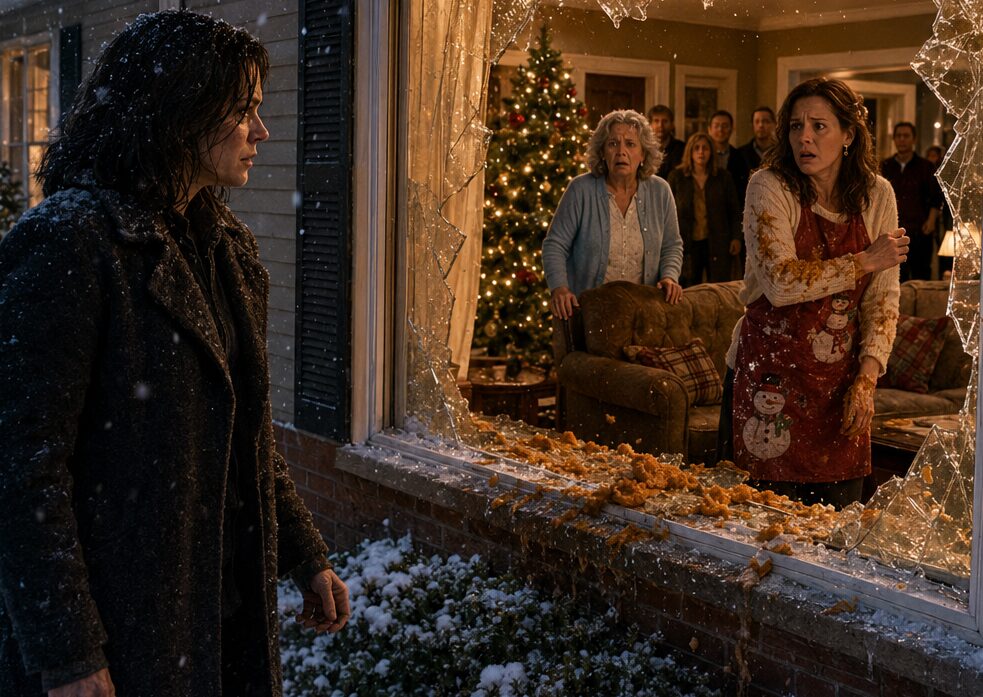
The window shattered with a sound so sharp the whole street seemed to stop breathing.
Glass burst inward.
Sweet potato filling exploded across the carpet, the sofa, the Christmas tree skirt.
Someone screamed.
A child started crying.
Barbara stumbled backward, hands over her mouth.
For one perfect second, nobody moved.
Nicole stood in the snow breathing hard while cold air poured through the broken window into the glowing living room.
Then chaos arrived all at once.
“What the hell?”
“Oh my God—”
“Nicole!”
Neighbors’ porch lights flicked on up and down the street.
William rushed toward the doorway, but Nicole stepped inside before he reached it.
Glass cracked beneath her boots.
Her mother stared at her like she no longer recognized her.
Barbara’s face had gone white.
Nicole looked around the room slowly.
At the relatives.
At the ruined carpet.
At the pie dripping from the edge of the coffee table.
At the family trying desperately to understand whether this was tragedy or embarrassment.
Finally she said, very calmly:
“Now it looks honest.”
Nobody answered.
William exhaled hard. “Okay. Everybody just calm down.”
Barbara rounded on Nicole. “Are you insane?”
“No,” Nicole said. “I’m finally caught up.”
“Not in front of everyone.”
Nicole laughed once at that.
There it was again.
Not in front of everyone.
Barbara stepped closer, voice low and shaking.
“You scared the kids.”
“You stole Mom’s house while I paid her taxes.”
A silence spread across the room so complete it felt physical.
William looked toward Barbara sharply.
Their mother stood up too quickly from the couch.
“Nicole—”
“No,” Nicole snapped. “No more smoothing this over.”
Barbara’s eyes filled instantly.
“We weren’t hiding it to hurt you.”
“You hid it because you knew exactly how it looked.”
Their mother pressed a hand against her chest.
“It was my decision.”
Nicole turned toward her.
“Was it your decision when I paid the furnace bill?”
“Nobody asked you to.”
That landed harder than the window breaking.
Nicole blinked.
Her mother kept talking quietly now, voice trembling.
“You always decide what people need before they ask.”
Nicole stared at her.
Outside, people were gathering on sidewalks pretending not to stare.
Barbara noticed too.
“Oh my God,” she whispered. “The neighbors.”
And suddenly Nicole understood something with absolute clarity.
The broken window upset her mother less than the witnesses.
Part V — What The House Was Built From
William started ushering relatives toward the dining room.
“Give everybody space,” he muttered.
Nobody wanted to leave.
That was the ugly thing about family disasters.
People hated them until one happened near enough to watch.
Barbara wiped at tears angrily.
“You think this was easy for me?”
Nicole almost laughed again.
Easy.
Barbara pointed toward the kitchen.
“You got to be the devoted daughter. You got credit for suffering.”
“Credit?” Nicole repeated.
“Yes.” Barbara’s voice cracked. “You think people didn’t compare us? You think I didn’t hear it my whole life?”
Nicole stared.
Barbara took a shaky breath.
“You paid bills. You showed up crying and exhausted and dramatic and everyone acted like that meant you loved Mom more.”
“I did love her more,” Nicole shot back before she could stop herself.
The room went still again.
Barbara flinched like she’d been slapped.
And Nicole immediately hated herself for meaning it.
Their mother sank slowly into the couch.
“You girls…” she whispered.
Barbara wiped her face hard.
“You know what it’s like,” she said to Nicole, “to spend years trying to make everything calm after you walk into a room?”
Nicole opened her mouth.
Closed it again.
Because somewhere deep down, she did know.
Barbara looked toward the shattered window.
“I hosted every holiday because somebody had to. I stayed nearby because somebody had to. I listened to Mom panic every night because somebody had to.”
Nicole’s anger shifted uneasily.
Not gone.
Just complicated now.
William spoke carefully.
“Your mother thought giving Barbara the house would stabilize things.”
Nicole looked at him sharply.
“Stabilize what?”
Nobody answered fast enough.
And that was answer enough.
Her divorce.
Her apartment.
Her overdue credit cards.
The way relatives lowered their voices around her lately.
Her mother finally looked up.
“I was afraid,” she admitted softly.
“Of what?”
“That if something happened to me… you’d need more than I could give.”
Nicole stared at her.
“So you gave everything to Barbara.”
“No,” her mother whispered. “I gave the house to the daughter I thought could keep it.”
The sentence hollowed the room out.
Nicole suddenly understood the real wound beneath everything else.
This had never only been about money.
Her family no longer saw her as someone stable enough to belong at the center of things.
She was the helper.
The emergency contact.
The difficult daughter.
Useful in crisis.
Uncomfortable in photographs.
Her mother looked toward the ruined window with tears in her eyes.
“Why do you always make things ugly?”
Nicole swallowed hard.
Because the answer had been waiting inside her for years.
“Because,” she said quietly, “you only listen once they are.”
Nobody spoke after that.
Snow blew through the broken opening into the living room.
Cold air settling over warm furniture.
The neighbors outside slowly drifted away one by one once it became clear there would be no police cars. No ambulances. Just family.
Which was somehow messier.
Part VI — The New Window
Three weeks later, Barbara mailed the apron to Nicole without a note.
Just a plain shipping box left outside her apartment door.
Nicole carried it inside carefully.
The fabric still smelled faintly like cinnamon and laundry detergent.
She hung it on a hook in her kitchen beside the stove.
But she never wore it.
Sunday dinners continued at her mother’s house after Christmas.
Nicole stopped inventing excuses for missing them.
She simply stopped going.
At first Barbara texted.
Then less often.
Then mostly about practical things.
Mom’s prescription changed.
Can you send the cardiologist number again?
Do you know where Dad kept the warranty folder?
Nicole answered when she could.
But something had shifted permanently.
Not shattered.
Not healed either.
Just rearranged.
In January, Nicole drove past the house on garbage pickup morning.
The broken front window had been replaced.
Perfect glass again.
From the street, the house looked exactly the same.
Warm lamp in the corner.
Curtains half open.
Her mother stood near the dining room table holding a coffee mug.
For a second Nicole considered pulling into the driveway.
She imagined walking inside.
Barbara looking up carefully.
Everyone trying very hard to act normal.
The old choreography waiting for them again.
Then her mother turned slightly toward the new window.
And suddenly she looked smaller than Nicole remembered.
Older.
Not cruel.
Not innocent either.
Just human.
Nicole rested her hands on the steering wheel.
There had been a time when she would have parked immediately. Walked inside. Fixed the next problem. Paid the next bill. Filled the next silence.
Because being needed had once felt close enough to being loved.
But the distance between those things finally looked clear now.
Nicole kept driving.
And behind her, the repaired window disappeared into the snow.