The Summer Everyone In Pine Ridge Kept Talking About Samantha’s Driving Lesson
Part I — The Mailbox At The Center Of The Street
The car stopped halfway inside the brick mailbox.
Not beside it. Not touching it.
Inside it.
Samantha sat frozen behind the wheel with both hands locked so tightly around the steering wheel her knuckles had turned gray. The white DRIVING SCHOOL sign on the roof blinked weakly in the middle of Pine Ridge Lane while folding chairs scraped against driveways all around her.
Someone laughed.
Not cruelly at first. More shocked than cruel.
Then phones came out.
“Oh my God, is she okay?”
“Did she hit Barbara’s house?”
“No, the mailbox—”
“Don’t stand there, call somebody.”
The mailbox had exploded across the curb in chunks of decorative red brick. One side still stood upright with the gold-painted number hanging crookedly from it like it couldn’t decide whether to fall or not.
Samantha finally lifted one hand from the wheel and covered her mouth.
That was when somebody started recording.
“You had the brake too!” Gregory shouted from the passenger seat. “I hit my brake too!”
His voice cracked halfway through the sentence.
Traffic crawled at the entrance to the subdivision. Children abandoned the block party tables to stare. A woman in yoga clothes whispered something to another woman and both immediately looked at Samantha with the same expression people used when passing road construction after an accident.
Not fear.
Relief it wasn’t them.
A patrol SUV rolled slowly into the cul-de-sac.
Samantha felt heat rising up her neck so fast she thought she might faint.
She was twenty-six years old.
Twenty-six, living with her mother again, taking driving lessons in a neighborhood full of people grilling hot dogs under patriotic paper streamers while children rode scooters in circles.
And now half the subdivision was watching her breathe like she’d forgotten how.
“Miss?” the officer said gently through her open window. “Can you step out for me?”
She nodded too quickly.
The moment she stood up, her knees nearly folded.
Gregory was pacing already, one hand pulling repeatedly at the collar of his faded blue polo shirt.
“The brake locked late,” he kept muttering. “I told the company this car was pulling.”
Nobody answered him.
The neighbors were more interested in Samantha.
A teenage boy standing near a lemonade table lifted his phone higher for a better angle.
Samantha turned instinctively away from him.
And finally saw the woman walking down the driveway.
Perfect hair.
Cream-colored athletic jacket.
White sneakers that somehow stayed spotless on suburban sidewalks.
The woman stopped beside the broken mailbox and stared at it with calm disbelief.
Then she smiled.
Not warmly.
Publicly.
“Oh,” she said softly. “Well. Everybody’s alright. That’s what matters.”
The officer stepped toward her. “Ma’am, this is your property?”
“Yes.” Her eyes shifted to Samantha. “I’m Deborah.”
Several neighbors visibly straightened when she spoke.
Samantha didn’t know why until someone whispered behind her.
“That’s the HOA president.”
Of course it was.
Of course the one thing Samantha had managed to hit in the entire neighborhood belonged to the woman everybody was trying to impress.
Deborah walked closer.
Samantha expected anger.
Instead Deborah touched her arm lightly and said, loud enough for everyone nearby to hear, “Honey, accidents happen.”
The crowd relaxed instantly.
The performance had been chosen.
Compassion.
Samantha opened her mouth to apologize, but nothing came out.
Her throat hurt too much.
Deborah looked back at the ruined mailbox with measured sadness.
“It’s just a mailbox,” she said.
But she kept looking at it.
Not Samantha.
The mailbox.
Like something much larger had cracked open there.
Behind them, somebody replayed the crash video out loud.
The sound of impact echoed across the street.
Samantha closed her eyes.
And the neighborhood remembered her immediately.
By evening, the video was already inside the Pine Ridge community Facebook group.
Samantha discovered this because her mother accidentally opened it at dinner.
“Oh,” Shirley whispered.
Too late.
Samantha had already seen herself frozen beside the car thumbnail.
Her own body looked unfamiliar in screenshots.
Hands over mouth.
Hair falling loose.
Eyes wide.
Someone had captioned it:
FINAL EXAM ENERGY 😬
“People are disgusting,” Shirley said quickly.
But she didn’t close the app.
She kept reading.
“Oh no.”
“What if kids had been there?”
“I feel bad for her honestly.”
“Gregory always seemed distracted.”
“At least Deborah handled it gracefully.”
Gracefully.
Samantha pushed her chair back.
“I said I’m sorry,” she muttered.
“Nobody said you didn’t.”
“They’re acting like I drove through a daycare.”
Shirley sighed the way she always sighed before difficult conversations.
“Honey, you have to understand how neighborhoods work.”
Samantha laughed once under her breath.
“That sounds threatening.”
“It’s not threatening.” Shirley rubbed her forehead. “It’s just… people talk. So the best thing you can do is smooth things over.”
“I apologized.”
“Again.”
Samantha stared at her.
“You want me to apologize again?”
Shirley lowered her voice. “You still need to pass your test. We can’t afford another driving school. Deborah already said she’s willing to work something out instead of filing everything through insurance.”
Something tightened in Samantha’s chest.
Work something out.
She suddenly understood that the accident wasn’t over.
It had only changed shape.
Three days later, Deborah brought over banana bread.
Not homemade.
Store-bought, still inside clear bakery packaging.
But she carried it like an offering.
“Oh, don’t look so nervous,” she laughed when Samantha opened the door. “I’m not collecting debt.”
Samantha forced a smile.
Deborah stepped halfway inside anyway.
Their house suddenly looked smaller under her gaze.
The old carpet.
The crowded entry table.
The stack of unopened mail near the wall.
“You have such a sweet home,” Deborah said carefully.
Samantha hated how kind it sounded.
Shirley appeared immediately from the kitchen.
“Oh Deborah, you didn’t have to do this.”
“Nonsense. We’re neighbors now.”
Not neighbors, Samantha thought.
Witnesses.
Deborah sat at the kitchen table like she belonged there.
“We’ll figure out the mailbox later,” she said. “Honestly, the neighborhood’s mostly worried about you.”
Samantha almost asked who “the neighborhood” was supposed to mean.
Instead she kept staring at the banana bread.
Deborah smiled gently.
“You know,” she said, “everyone keeps saying how brave you were afterward.”
Samantha blinked.
“Brave?”
“Yes. You looked completely overwhelmed, poor thing.”
The words landed like fingers pressing directly into a bruise.
Because Deborah wasn’t comforting her.
She was preserving the image.
Part II — Everyone Already Knew Her Face
Within two weeks, Samantha became recognizable in Pine Ridge.
Not famous.
Worse.
Familiar.
At the grocery store, a cashier asked carefully, “You doing okay after the driving thing?”
At the pharmacy, two women stopped talking when she entered the aisle.
Children occasionally pretended to steer invisible cars into mailboxes whenever she walked past the park entrance.
Nobody meant to be cruel.
That was the problem.
Cruelty would have been easier to hate.
Instead the neighborhood treated her like shared community material.
Something embarrassing everybody now jointly owned.
And Deborah stayed at the center of it.
Every conversation somehow returned to the accident.
“She’s recovering from a rough summer,” Deborah told people during a neighborhood barbecue while Samantha stood three feet away holding paper plates.
“She’s working very hard though.”
Working very hard.
Like Samantha was a middle-school student recovering from disciplinary trouble.
Gregory called once to apologize.
“I shouldn’t have yelled,” he admitted over the phone. “I panicked.”
Samantha sat in the laundry room floor while speaking to him because it was the only room in the house where she couldn’t hear her mother listening nearby.
“You looked scared too,” she said quietly.
“I was scared.” He laughed without humor. “Two more complaints and they cut my hours.”
There was a pause.
Then he added softly, “You know none of them care about the mailbox, right?”
Samantha frowned.
“What?”
“They care about the story.”
The line stayed with her all week.
Deborah invited Samantha to a neighborhood planning committee meeting after that.
“You should come,” she insisted. “People will stop seeing you as the driving-school girl if they get to know you.”
Samantha almost said no.
Then Shirley said from across the kitchen, “That’s actually very thoughtful.”
So she went.
Big mistake.
The meeting took place in Deborah’s immaculate living room where decorative candles sat untouched beside framed family beach photos.
Everybody spoke too brightly.
Too carefully.
A woman named Katherine squeezed Samantha’s shoulder and said, “I’m just glad you’re getting your confidence back.”
Another woman asked if she still got nervous near intersections.
Someone else joked lightly, “At least you’ll never forget that street now.”
The room laughed.
Not hard.
Just enough.
Samantha smiled automatically because not smiling would have looked worse.
Then Deborah told the story again.
Not maliciously.
That was what made it unbearable.
She reenacted the moment she walked outside and saw the car inside her mailbox. People laughed politely at Gregory’s panic and murmured sympathetically when Deborah described Samantha standing there “absolutely shattered.”
Samantha realized halfway through the story that Deborah never once looked at her while telling it.
She looked at the audience.
Like she was hosting something.
On the drive home, Shirley said, “See? They’re trying.”
Samantha stared out the window.
“No,” she said softly. “They’re enjoying themselves.”
A month after the crash, Samantha learned Deborah had rejected the insurance settlement.
Not because the amount was unfair.
Because she “preferred handling things personally.”
Gregory told her accidentally.
“She what?”
“She told the company she didn’t want lawyers involved.”
Samantha felt suddenly cold.
“But why?”
Gregory hesitated too long.
Then finally said, “You really don’t know?”
That night Samantha opened the neighborhood Facebook group again.
Dozens of posts.
Community cleanup photos.
School fundraiser announcements.
Lost dog alerts.
And buried between them:
Deborah Reynolds Appreciation Post 💛
Thank you for showing patience and compassion during difficult situations this summer. Pine Ridge is lucky to have leaders like you.
There were forty-seven comments.
Several mentioned Samantha without using her name.
“She handled that young woman with such grace.”
“Most people would’ve reacted very differently.”
“She protected the whole neighborhood from becoming hostile.”
Samantha kept scrolling.
And suddenly understood.
Deborah didn’t want resolution.
Resolution ended attention.
Part III — The Kindness That Stayed Too Long
After that realization, everything changed shape.
Every kindness became surveillance.
Every invitation became management.
Every smile became ownership.
Deborah began dropping by unexpectedly.
Sometimes with muffins.
Sometimes with neighborhood flyers.
Sometimes just to “check in.”
And Shirley always let her inside.
“You isolate too much,” Shirley told Samantha one night after Deborah left. “People are trying to support you.”
“No,” Samantha snapped. “They’re trying to supervise me.”
“That’s unfair.”
“Is it?”
Shirley folded laundry harder.
“You don’t understand what embarrassment can do to people.”
The sentence hung there strangely.
Samantha looked up slowly.
“What does that mean?”
Shirley went still.
Then sat down heavily at the kitchen table.
“When I was your age,” she said quietly, “I drove through the front window of a pharmacy.”
Samantha blinked.
“What?”
“I mixed up the pedals.”
“You never told me that.”
“I never drove again.”
The room suddenly felt unfamiliar.
Shirley stared at her own hands.
“People talked about it for years,” she whispered. “Everywhere I went, somebody remembered.”
Samantha sat down slowly across from her.
“You’ve been scared this whole time.”
“I’ve been trying to protect you.”
“No,” Samantha said gently. “You’ve been trying to protect yourself from watching it happen again.”
Shirley looked like she wanted to argue.
Instead she started crying quietly into both hands.
It was the first honest thing either of them had done in weeks.
The safety meeting happened on a Thursday evening.
Deborah called it a “community conversation about responsible driving awareness.”
Everyone knew what that meant.
Folding chairs filled the clubhouse.
Coffee sat untouched near store-bought cookies.
Samantha almost didn’t go.
Then she imagined Deborah telling the story again without her there to interrupt it.
So she went anyway.
The moment she entered, conversations softened.
Not stopped.
Softened.
Like people were adjusting volume around an injured animal.
Deborah greeted her warmly.
“I’m so glad you came.”
Samantha noticed several phones already sitting face-up on tables.
Waiting.
The meeting started with traffic concerns near the school entrance.
Then golf-cart safety.
Then Deborah sighed lightly and said, “And of course we all remember the unfortunate incident this summer.”
There it was.
The room shifted toward Samantha without fully looking at her.
Deborah smiled sadly.
“I think moments like that remind us how important patience and compassion are as neighbors.”
Samantha felt heat climb her neck again.
The same heat.
The same helplessness.
Deborah continued gently, “Because public mistakes can be traumatic.”
Something broke loose inside Samantha then.
Not loudly.
Quietly.
She stood before she fully realized she was moving.
And for the first time since the accident, she stopped covering her mouth.
“I need you to stop telling this story.”
The room froze.
Deborah blinked.
“I’m sorry?”
“You keep saying you’re helping me,” Samantha said carefully. “But you tell the story every chance you get.”
“That’s not fair—”
“I know exactly how I looked that day.” Samantha’s voice shook once, then steadied. “I know everybody here saw it. I know people still replay the video.”
Nobody moved.
“You say it was just a mailbox,” Samantha continued. “But somehow I’ve had to keep paying for it socially every single week since it happened.”
A man near the back lowered his eyes.
Samantha looked around the room.
“I made one mistake in public,” she said. “And this neighborhood turned it into entertainment.”
Silence.
Heavy and humiliating.
But not for Samantha this time.
Deborah’s smile hardened slightly.
“I think everyone here has only tried to support you.”
“No,” Samantha said softly. “You liked needing me to stay embarrassed.”
The words landed cleanly.
Too cleanly.
Deborah stared at her as if she had violated some invisible social contract.
The meeting ended twenty minutes early.
Part IV — The Street Fair
The retaliation came quietly.
Neighbors stopped waving at Shirley first.
Then Deborah mentioned during casual conversations that Samantha had been “emotionally overwhelmed lately.”
One woman asked Shirley privately whether Samantha was “doing alright mentally.”
Shirley repeated this at dinner like she expected Samantha to apologize for it.
Instead Samantha said, “You know she’s doing this on purpose now.”
Shirley rubbed her temples tiredly.
“You embarrassed her publicly.”
Samantha laughed in disbelief.
“She’s been embarrassing me publicly for months.”
“That’s different.”
“No,” Samantha said. “It isn’t.”
Three days later, Samantha started looking at apartment listings.
Tiny studios.
Bad carpeting.
Places above laundromats.
None of them felt realistic.
But for the first time in months, impossible felt cleaner than trapped.
The annual Pine Ridge Fall Fair arrived in October.
String lights crossed the clubhouse lawn.
Children painted pumpkins at folding tables.
Neighbors carried paper cups of cider while discussing weather and property taxes and school schedules.
Samantha almost skipped it.
Then Shirley said quietly, “If you disappear completely, they’ll never let it go.”
So she came.
Deborah saw her immediately.
Of course she did.
“Glad you made it,” she said smoothly.
Samantha nodded once and kept walking.
That should have been the end of it.
Then somebody screamed near the parking area.
Not terror.
Shock.
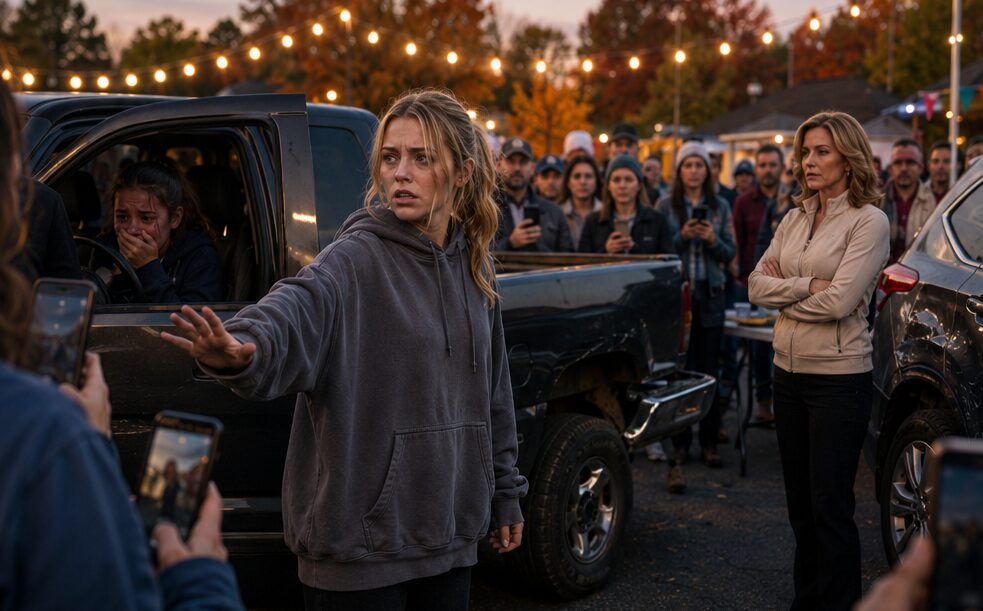
A teenage girl had clipped a parked SUV while trying to reverse her father’s truck.
The sound wasn’t even dramatic. Just metal scraping badly enough to make everybody turn at once.
And instantly the crowd moved.
Phones lifted.
People rushed closer.
“Oh no.”
“She’s crying.”
“Someone should call her dad.”
The girl sat frozen behind the wheel with both hands locked tightly around it.
Exactly the same way Samantha had.
Someone near the front laughed nervously.
Another person started recording.
Samantha saw the girl lift one shaking hand toward her mouth.
And suddenly the entire summer returned at once.
The heat.
The staring.
The awful feeling that your worst moment had become public property before you even understood it yourself.
Deborah was already moving toward the truck.
Calm.
Authoritative.
Ready to manage the scene.
Samantha got there first.
“Back up,” she said sharply.
The crowd hesitated.
“She’s fine,” someone replied.
“No,” Samantha said. “You’re surrounding her.”
The teenage girl looked barely old enough to drive.
Tears ran down her face.
One man continued filming anyway.
Samantha stepped directly between his phone and the truck window.
“Seriously?”
“I’m just documenting—”
“No,” she said. “You’re enjoying this.”
The sentence hit harder than she intended.
People shifted uncomfortably.
Deborah arrived beside her.
“Samantha,” she said carefully, “let’s stay calm.”
But Samantha was calm now.
That was the difference.
She looked at the girl inside the truck.
“You can breathe,” she said gently. “Nobody’s hurt.”
The girl nodded rapidly.
“You don’t have to get out yet.”
Deborah crossed her arms.
“We should probably let adults handle this.”
Samantha looked at her.
Then at the small crowd holding phones.
Then back at Deborah.
“She doesn’t need an audience.”
Nobody spoke.
A few people slowly lowered their phones.
The silence felt different this time.
Not judgmental.
Ashamed.
Samantha opened the truck door carefully and helped the girl step out.
The girl whispered, “I’m sorry.”
And Samantha almost smiled.
Not because it was funny.
Because she finally understood how many people apologized automatically when they felt publicly small.
“You don’t owe everybody a performance,” she said quietly.
Deborah heard it.
Her expression changed for only a second.
Something colder than anger.
Irrelevance.
Part V — The Road Out Of Pine Ridge
Samantha passed her driving test on a gray Tuesday morning.
No celebration.
No dramatic music swelling in her chest.
The instructor simply checked a box, handed over paperwork, and said, “You did fine.”
Fine.
After everything, that word almost made her laugh.
She drove home alone afterward.
No Gregory.
No Shirley.
No one watching.
The steering wheel felt lighter without witnesses.
As she entered Pine Ridge, familiar houses passed slowly beside her windows.
The rebuilt mailbox stood at the corner of Deborah’s driveway.
Perfect again.
Of course it was.
A woman walking her dog gave Samantha a hesitant little wave.
Samantha waved back.
Another neighbor pretended not to see her at all.
Children rode bicycles near the sidewalk.
Nobody stopped.
Nobody pointed.
But she could still feel the memory of it living underneath the street.
Communities never fully forgot.
That was the truth.
They just became quieter about what they enjoyed.
As Samantha turned down her street, she saw Deborah standing on her porch arranging fall decorations.
For one brief second, both women looked directly at each other.
Deborah did not wave.
Neither did Samantha.
There was nothing left to negotiate between them.
Samantha kept driving.
Past the clubhouse.
Past the pool entrance.
Past the street where the driving-school car had climbed halfway into brick and turned her into a neighborhood story.
She expected triumph.
Instead she felt something stranger.
Space.
Not forgiveness.
Not victory.
Just distance between herself and the version of her that had stood in the road with both hands covering her mouth while strangers decided who she was.
Her phone buzzed at the red light near the subdivision exit.
A message from Shirley.
Drive safe.
Samantha stared at it for a long moment before smiling faintly.
Then the light changed.
And this time, she kept moving.