The Night Everyone Finally Understood What The Ballroom Was Really For
Part I — The Slide That Should Not Have Appeared
The ballroom smelled faintly of roses, wine, and expensive carpet cleaner.
Stephanie sat alone at Table Twelve wearing a black dress she had bought on clearance three hours earlier because everything she owned suddenly felt too tired for a room like this.
Crystal chandeliers glowed overhead. Donors laughed too loudly. A jazz trio played near the stage while servers carried tiny plates nobody seemed hungry enough to finish.
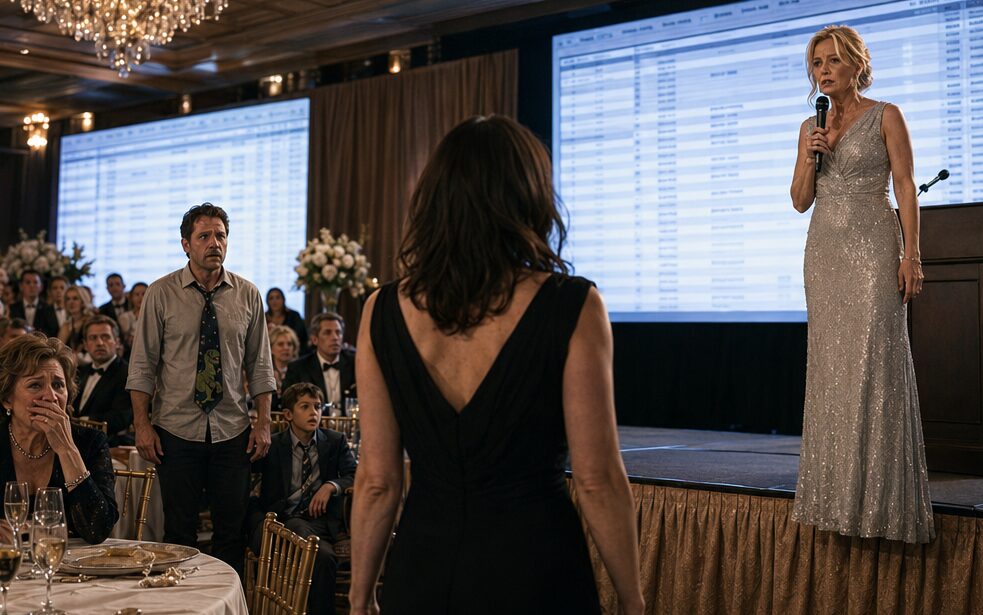
At the podium, Brenda looked perfect.
Silver gown. Calm smile. One hand resting lightly against the microphone like she belonged there.
“Tonight,” she said warmly, “is about expanding what care can look like in our community.”
Applause rolled across the ballroom.
Stephanie didn’t clap.
Her eyes were fixed on the projection screen behind Brenda.
A slide had appeared for less than two seconds before vanishing again.
Most people probably missed it.
But Stephanie had seen the words clearly.
CLOSURE TRANSITION TIMELINE
Her stomach tightened so suddenly she nearly stood up.
Then the next polished slide appeared.
Photos of smiling children.
Volunteer appreciation graphics.
Future growth initiatives.
As if nothing had happened.
Stephanie looked around the room.
Nobody else seemed disturbed.
At the front tables, donor couples smiled at each other over wine glasses. Near the stage, board members nodded with practiced concern during Brenda’s speech about “sustainable compassion.”
Sustainable.
Stephanie almost laughed.
Two days ago, a mother had cried in the parking lot because her son’s home therapy visits had suddenly been “restructured.”
Last week, volunteers lost hours without explanation.
Three vendors had quietly stopped answering calls.
And now there was a closure timeline.
A closure timeline.
Stephanie gripped the edge of the tablecloth hard enough to wrinkle it.
Across the ballroom, her mother noticed immediately.
Amy gave her a warning look from Table Seven.
Not now.
That was what the look meant.
Please don’t embarrass us.
Amy had spent her entire life communicating through facial expressions instead of direct sentences.
Stephanie looked away first.
Onstage, Brenda continued smoothly.
“No family should ever feel abandoned in moments of vulnerability.”
The room applauded again.
Stephanie felt heat rise into her face.
Because six weeks ago, she had repeated almost the exact same sentence to new volunteer recruits.
She had said it proudly.
Back when she still believed it.
A waiter appeared beside her.
“Another sparkling water?”
Stephanie shook her head too quickly.
The waiter moved away.
Onstage, Brenda introduced a new branding campaign for the nonprofit.
A sleek video began playing.
New logos.
New brochures.
A future-centered slogan floating across the screen.
COMMUNITY CARE WITHOUT LIMITS
Stephanie stared at it in disbelief.
Last month, the organization had canceled weekend home visits because of “temporary budget pressure.”
Michael had nearly lost it when she told him.
His son depended on those visits.
“You people keep saying temporary,” he had told her quietly in the parking lot. “But temporary always seems permanent for families like mine.”
At the time, Stephanie defended the organization.
Now she wished she hadn’t.
The video ended to thunderous applause.
Brenda smiled modestly.
“Before dessert,” she said, “I’d like to share some exciting developments about our future transition strategy.”
Transition.
The word landed differently now.
Stephanie watched the slideshow operator near the side curtain shuffle nervously through files.
Then it happened again.
Another accidental flash.
This time longer.
A spreadsheet.
Staff reduction phases.
Volunteer communication delay.
Family notification target date.
The slide vanished instantly.
But not before Stephanie saw it.
Not before she saw Brenda see it too.
For one tiny second, Brenda’s composure cracked.
Just enough.
Just enough to confirm everything.
Stephanie suddenly understood something awful.
This gala was not celebrating expansion.
It was covering an ending.
And everyone in the room was helping.
Three weeks earlier, Stephanie still believed the nonprofit could survive.
She had spent nearly seven years volunteering there after her divorce. At first it gave structure to her life. Then it became the center of it.
The nonprofit wasn’t just therapy scheduling and fundraiser emails.
It was casseroles left on porches.
Parents crying quietly beside minivans.
Retired women folding blankets in church basements.
Volunteers driving children to appointments because exhausted fathers were working double shifts.
It felt real.
That was why this hurt.
Not because money was disappearing.
Because trust was.
The first crack came during a Tuesday volunteer meeting.
Brenda stood at the front of the room wearing cream-colored slacks and calm confidence.
“Just a few temporary staffing adjustments,” she explained.
Nobody challenged her directly.
That was the culture here.
Questions were softened until they barely sounded like questions.
Afterward, in the hallway, Stephanie overheard two therapists whispering.
“Did you hear they canceled the Oak Street program?”
“I heard donor retention dropped.”
“I heard we’re restructuring.”
Nobody said closure.
Not yet.
That evening Amy came over carrying soup containers and unsolicited advice.
“You look exhausted,” she said immediately.
“I am exhausted.”
“You care too much.”
Stephanie almost snapped at her.
Instead she opened the soup.
Amy watched her carefully.
“You need to understand something,” she said. “Communities like this survive on reputation.”
“What does that mean?”
“It means people don’t forgive public embarrassment.”
Stephanie hated how calmly she said it.
As if embarrassment mattered more than truth.
But Amy grew up poor in a town where humiliation could follow a person for years. She believed survival meant staying agreeable.
“You don’t survive around people like this by embarrassing them,” Amy said quietly.
Stephanie remembered the sentence later.
Especially at the gala.
Especially when the room went silent.
The real turning point came in the parking lot outside the therapy center.
Michael stood beside his old pickup truck while his son slept in the backseat under a dinosaur blanket.
Rain hammered the pavement.
“They cut his Thursday sessions,” Michael said.
Stephanie tried to stay calm.
“They’re adjusting schedules temporarily—”
“Please don’t say temporarily again.”
His voice never rose.
That made it worse.
“You know what rich people call panic?” he asked. “Information they don’t want poor people getting too early.”
Stephanie opened her mouth.
Nothing came out.
Because part of her already suspected he was right.
Michael rubbed his forehead hard.
“My kid finally started sleeping through the night because of this place.”
Stephanie looked toward the building.
The lights inside seemed dimmer lately.
“They wouldn’t just shut it down,” she said weakly.
Michael gave her a tired look.
“You really still believe that?”
That question stayed with her for days.
Part II — The Things People Pretended Not To Notice
The gala preparations became unbearable once Stephanie started seeing the gaps.
Everywhere she looked, something felt staged.
Volunteers were asked to increase donor outreach while staff hours quietly disappeared.
The organization ordered custom floral arrangements while delaying equipment replacements.
Neighborhood mothers hosted bake sales for “future expansion projects” that no longer existed.
And still Brenda smiled through everything.
That was the worst part.
She never looked cruel.
Only controlled.
One afternoon Stephanie arrived early for a donor planning meeting and found Brenda alone in the conference room staring at unpaid invoices.
For a moment she looked older.
Smaller somehow.
Then she noticed Stephanie and immediately straightened.
“Long day?” Stephanie asked carefully.
Brenda smiled.
“They all are lately.”
The invoices disappeared into a folder.
Just like that.
Performance resumed.
The neighborhood Facebook group turned strange around the same time.
Rumors spread in careful language.
“Has anyone else had scheduling delays?”
“Maybe they’re restructuring services?”
“Heard exciting changes are coming!”
Nobody wanted to sound negative.
Negative people lost invitations around here.
At school pickup lines and grocery stores, conversations became cautious dances around obvious fear.
Stephanie started avoiding people entirely.
Then came the envelope.
It arrived by mistake on a Thursday afternoon.
BOARD TRANSITION MATERIALS — CONFIDENTIAL
Stephanie almost returned it unopened.
Almost.
Instead she sat inside her car outside Amy’s apartment complex and read everything.
Layoffs finalized.
Facility closure timeline.
Donor communications prepared months earlier.
Family announcements delayed until after the gala.
One line made her physically ill.
Maintain optimistic public messaging to preserve transition stability.
Preserve transition stability.
Children were losing care.
Families were fundraising for programs already being dismantled.
And the gala had been planned anyway.
Stephanie sat frozen in the driver’s seat long after sunset.
When her phone rang, she nearly jumped.
Brenda.
Stephanie stared at the screen before answering.
“Hello?”
“Can we meet tomorrow?” Brenda asked.
Her voice sounded unusually tired.
“About what?”
A pause.
“About what you received.”
They met at a coffee shop near the hotel hosting the gala.
Brenda arrived perfectly dressed as always, but Stephanie noticed the cracks now.
The concealer under her eyes.
The stiffness in her shoulders.
The way she held her coffee without drinking it.
“You opened the packet,” Brenda said.
“Yes.”
Brenda nodded once.
“I figured.”
Stephanie waited for anger.
Instead Brenda looked exhausted.
“We were trying to buy time.”
Stephanie almost laughed.
“That’s what you call this?”
“If donor confidence collapsed too early, services would’ve ended immediately.”
“They’re ending anyway.”
“Yes,” Brenda said softly. “But not as fast.”
Stephanie stared at her.
“You lied to families.”
Brenda’s expression tightened.
“I delayed panic.”
“That’s not the same thing?”
“No,” Brenda said firmly. “It isn’t.”
For the first time, real emotion slipped into her voice.
“You think I don’t know what this looks like? You think I wanted this?”
Stephanie said nothing.
Brenda looked out the window.
“I mortgaged my house six months ago trying to keep programs running.”
That landed harder than Stephanie expected.
“I stopped taking a salary in February,” Brenda continued. “I thought we could recover after the donor pullback.”
Stephanie suddenly remembered all the tiny signs.
The tiredness.
The frantic donor dinners.
The constant optimism.
Not fraud exactly.
Desperation.
But desperation had still become deception.
“You should’ve told people,” Stephanie said quietly.
Brenda closed her eyes briefly.
“And watched donors disappear overnight? Watched parents panic before we even secured transfer options?”
“You don’t get to decide how much truth people can handle.”
Brenda looked at her then.
A long look.
“Actually,” she said quietly, “leadership is mostly deciding which truths arrive slowly enough to survive.”
Stephanie hated the sentence because part of it sounded real.
That was what frightened her most.
That night Amy made chicken casserole in silence while Stephanie sat at the kitchen table staring at unopened mail.
“You’ve barely eaten all week,” Amy said.
Stephanie pushed food around her plate.
Finally she said, “What if keeping people calm becomes lying?”
Amy didn’t answer immediately.
“Sometimes,” she said carefully, “people need time before bad news.”
“They’ve known for months.”
Amy sighed.
“You always think honesty fixes things.”
“No. I think people deserve it.”
“And then what? Public scenes? Everybody turning on each other?”
Stephanie looked at her mother.
Amy’s lipstick was perfect even at home.
Hair sprayed carefully.
Napkins folded neatly.
An entire life built around appearing composed.
“You know what happens to women who become difficult?” Amy asked softly.
Stephanie almost said:
What happens to children whose services disappear while donors drink champagne?
But she didn’t.
That silence sat between them instead.
Part III — The Ballroom Before The Fall
The gala arrived with freezing rain and valet parking.
Stephanie nearly stayed home.
She stood in her apartment staring at the black dress hanging from the closet door while her phone buzzed with volunteer updates and donor reminders.
Then Michael texted her.
Any news yet?
She typed three different replies.
Deleted all of them.
Finally:
Not officially.
Three dots appeared.
Then disappeared.
No response.
That somehow felt worse.
The ballroom looked even more extravagant than the planning previews.
Towering flower arrangements.
Gold table numbers.
Custom projection screens.
A silent auction lined with luxury spa packages and vacation homes.
Community care had never looked richer.
Stephanie spent the first hour moving through conversations she barely heard.
“Stephanie, you look beautiful.”
“So exciting to see all this growth.”
“Brenda has really carried this organization.”
“You volunteers are angels.”
Angels.
The word made her tired.
Near the auction tables, two donor wives whispered beside champagne glasses.
“I heard they’re restructuring leadership.”
“I heard national expansion.”
“I heard Brenda’s exhausted.”
“Well, she always looks incredible.”
Stephanie walked away before they noticed her listening.
At Table Seven, Amy sat beside wealthy retirees and smiled carefully through every conversation.
When Stephanie approached, Amy lowered her voice immediately.
“Please don’t look upset.”
“That’s your first concern?”
Amy glanced around nervously.
“Not here.”
That sentence nearly broke something in Stephanie.
Not here.
Meaning:
truth had acceptable locations.
Pain had approved rooms.
Public comfort mattered more than reality.
Then Brenda took the stage.
And the room transformed instantly.
That was her gift.
She knew how to make wealthy people feel generous instead of guilty.
“How lucky we are,” Brenda began warmly, “to belong to a community that refuses to look away from families in need.”
Applause.
Always applause.
Stephanie watched parents seated near the back tables.
People who actually needed the services.
They looked uncomfortable in borrowed suits and discounted dresses while donors occupied the center tables closest to the stage.
Even seating arrangements carried hierarchy.
Brenda spoke about hope.
Expansion.
The future.
Then came the accidental slide.
Again.
Longer this time.
CLOSURE TRANSITION TIMELINE
Family Notification Schedule
Staff Reduction Phase III
Board Continuity Dinner
The screen flickered.
The operator panicked and changed slides immediately.
But Stephanie saw several people exchange confused looks.
Brenda kept speaking.
As if nothing happened.
That was the moment Stephanie realized the room still didn’t understand.
They saw words.
She saw betrayal.
And suddenly the pressure inside her became unbearable.
Because she had helped recruit volunteers.
She had reassured parents.
She had repeated Brenda’s speeches almost word for word.
She had participated.
Not maliciously.
But participation still counted.
Brenda smiled toward the audience.
“We are entering a new chapter together.”
Stephanie stood up.
The movement felt strangely loud despite the music.
Several nearby guests turned immediately.
Amy’s face went pale across the room.
Stephanie barely noticed.
Her heart hammered so hard she thought she might actually faint before reaching the stage.
Brenda paused for half a second.
Just enough.
“Stephanie?” she said carefully.
The microphone amplified the concern in her voice.
Concern sounded dangerous in public.
Like a parent managing instability.
Stephanie heard someone whisper:
“What’s happening?”
She kept walking.
A board member stood halfway from his chair.
Another moved toward the aisle.
Stephanie reached the front of the ballroom.
“Show the previous slide,” she said.
Nervous laughter scattered through the room.
Brenda kept smiling.
“We can discuss operational details later—”
“When were the families supposed to find out?”
Silence.
Not complete silence.
Silverware sounds.
A cough somewhere.
But the social silence mattered more.
The room froze around the question.
Brenda’s expression shifted almost invisibly.
“Stephanie,” she said softly, “this isn’t the right setting.”
And there it was.
The sentence everyone used when truth threatened aesthetics.
Stephanie felt suddenly calm.
“No,” she said. “This is exactly the setting.”
Part IV — What The Room Finally Heard
Two board members approached carefully from opposite sides.
Not aggressive.
Embarrassed.
Like men trying to remove a drunk relative from a wedding.
Brenda kept her smile fixed in place.
“Families are already being transitioned,” she said into the microphone. “We’re managing a very sensitive process—”
“You mean hiding it.”
A few people gasped quietly.
Amy covered her mouth across the ballroom.
Stephanie knew exactly what her mother was thinking.
This will follow us forever.
But another feeling had started pushing past the shame now.
Relief.
Terrible, dangerous relief.
Brenda looked directly at her.
“You don’t understand the financial realities.”
“No,” Stephanie said. “I understand parents were fundraising for programs you already planned to close.”
The room changed then.
Subtly.
Donors stopped smiling.
People sat differently.
Attention sharpened.
At the back table, Michael stood up slowly.
His son’s dinosaur tie hung crooked against his shirt.
“You told us services were stable,” he said.
Brenda looked genuinely pained.
“We were trying to prevent immediate disruption.”
“My son already lost sessions.”
A woman near him added quietly, “Mine too.”
The pressure shifted.
Not toward chaos.
Toward recognition.
That was more dangerous.
One of the board members finally reached Stephanie.
“Maybe we should continue this privately.”
Stephanie looked at him.
“For who?”
He didn’t answer.
Because everybody knew the answer.
Privately meant:
where discomfort could be controlled.
Brenda stepped away from the podium for the first time all night.
The movement itself felt like failure.
“I was trying to keep this organization alive,” she said.
And suddenly she sounded less polished.
More human.
“I thought if we could stabilize donor confidence long enough—”
“With another branding campaign?” Stephanie asked.
Brenda flinched.
Just slightly.
That mattered.
“You think this was vanity?” Brenda asked quietly. “I haven’t slept through a night in eight months.”
Stephanie believed her.
That was the problem.
The room sensed it too.
Brenda wasn’t evil.
Just trapped inside a system that rewarded performance over honesty until she could no longer separate them.
Tears filled Amy’s eyes suddenly.
Stephanie noticed with shock.
Not anger.
Not humiliation.
Something sadder.
Recognition maybe.
Brenda looked around the ballroom.
At the donors.
The volunteers.
The families.
The giant glowing screens behind her.
Then she finally said it.
“We are closing operations in two weeks.”
Nobody moved.
“I wanted more time before announcing it publicly.”
A parent began crying quietly near the back.
Another volunteer stared at the floor.
Some donors looked furious.
Others looked ashamed.
Stephanie felt strangely hollow.
This wasn’t victory.
It was collapse finally speaking out loud.
Brenda’s voice cracked slightly.
“We believed we could still secure partnerships. We believed—”
“You kept asking people for hope after you stopped having any,” Stephanie said.
The sentence landed hard because it was true for both of them.
For a long moment nobody spoke.
Then Michael started clapping.
One slow clap.
Not triumphant.
Almost exhausted.
People turned toward him.
Then another parent joined.
Then another.
The sound spread unevenly across the ballroom.
Not applause for destruction.
Applause for finally ending the performance.
Stephanie looked toward Amy.
Her mother was crying openly now.
Not trying to hide it anymore.
And somehow that hurt more than the confrontation itself.
Later, people would describe the night differently.
Some said Stephanie embarrassed the organization.
Some said Brenda had no good options.
Some blamed donors.
Others blamed management.
But almost everyone agreed on one thing:
the room never felt the same after the applause started.
Because once people heard honesty spoken plainly, all the polished language around it suddenly sounded artificial.
Part V — Smaller Rooms
The nonprofit closed thirteen days later.
The signs disappeared first.
Then the volunteers.
Then the therapy equipment.
The building looked abandoned long before it officially emptied.
Neighborhood gossip kept moving for weeks.
People chose sides politely.
That was how communities like this fought.
Not loudly.
Through invitations that stopped arriving.
Conversations that shortened.
Tight smiles at grocery stores.
Amy hated all of it.
One afternoon she sat in Stephanie’s kitchen turning a coffee mug slowly between her hands.
“I spent my whole life trying not to become difficult,” she said quietly.
Stephanie looked up.
Her mother rarely admitted things directly.
Amy stared at the table.
“My mother used to say embarrassment could ruin a family faster than poverty.”
Stephanie said nothing.
“Maybe I believed that too much.”
The sentence stayed between them awhile.
Then Amy added softly, “You looked terrified that night.”
“I was.”
“But you still stood up.”
Stephanie swallowed hard.
“I think I was more afraid of sitting there.”
Amy nodded slowly.
For once, neither of them tried to smooth the moment over.
Brenda resigned without making another public statement.
Stephanie heard she sold her house.
Someone claimed she moved closer to her sister in Milwaukee.
Someone else said she was consulting for another nonprofit already.
Nobody knew for sure.
But a month later, Stephanie found an envelope in her mailbox.
No return address.
Inside was a short handwritten note.
You were right that people deserved honesty sooner.
I still don’t know if I could have survived saying it myself.
— Brenda
Stephanie read it three times.
Then folded it carefully and placed it inside a kitchen drawer without showing anyone.
The church basement smelled like dust and burnt coffee.
Folding chairs scraped against the floor while volunteers carried boxes of donated supplies through the narrow hallway.
Smaller rooms now.
No projection screens.
No donor tables.
No polished speeches.
Just parents trying to help each other survive another month.
Michael waved from across the room while helping his son color at a plastic table.
Amy arranged paper cups beside a coffee urn with intense concentration.
Stephanie carried another stack of chairs downstairs and paused halfway.
People were laughing softly somewhere inside the basement room.
Not performative laughter.
Real laughter.
Messy and tired.
The kind that didn’t need microphones.
For the first time in months, the silence inside her felt different.
Not resolved.
But honest.
Amy looked up as Stephanie entered.
For a second neither woman spoke.
Then Amy reached for another stack of cups and said quietly, “We’ll probably need more chairs.”
Stephanie looked around the crowded basement.
At the parents.
The volunteers.
The children.
At how small everything suddenly was compared to the ballroom.
And somehow how much more real.
“Yeah,” she said softly.
“We probably will.”