The Winter Decorations Nobody Knew How To Take Down Anymore
Part I — The Cupcake Nobody Wanted
Laura scraped pink frosting off the hospital tray table with the edge of a plastic spoon while her daughter pretended not to watch.
The frosting had dried into the grooves.
It had been there since three in the morning, after Samantha from Emily’s class dropped off holiday cupcakes with little candy snowmen on top and Kathleen forced herself to eat half of one before throwing up into a blue basin beside the bed.
Now the room smelled faintly sweet and sour at the same time.
“Do we have to keep all this up?” Kathleen asked softly.
Laura looked around the room.
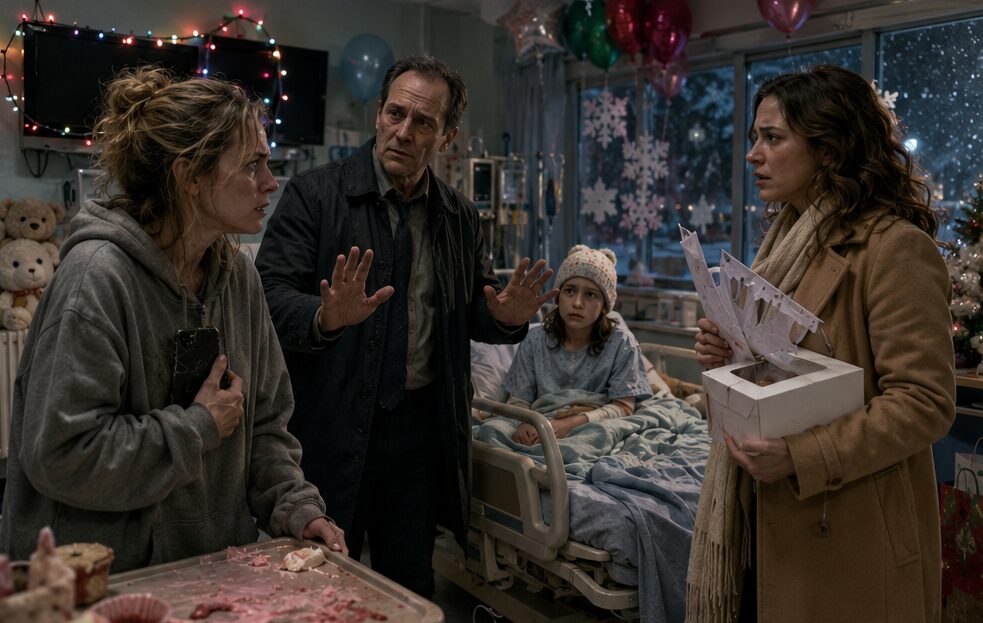
Paper snowflakes taped to the window. A glitter banner from the church group downstairs. Stuffed animals lined along the radiator. Three unopened gift bags on the chair by the door.
Someone had hung battery-powered Christmas lights around the television.
The lights blinked weakly in the daylight.
Laura swallowed.
“You want me to take them down?”
Kathleen nodded once.
“They make me tired.”
The sentence landed harder than crying would have.
Laura peeled one paper snowflake from the glass. Tape residue stayed behind like a faded mark.
Her phone buzzed on the chair.
RONALD.
She almost ignored it.
Almost.
“What?” she answered quietly.
Her ex-husband hesitated first. He always hesitated when he knew something would upset her.
“Brenda wants to stop by today.”
Laura stared at the blinking lights.
“No.”
“It’ll be quick.”
“No.”
“She already bought stuff for Kathleen.”
“That sounds like a decision you should’ve discussed before she bought stuff.”
Another silence.
“She’s trying, Laura.”
Laura laughed once without humor.
Trying.
Brenda had vanished after the second hospitalization in September. Too busy. Too overwhelmed. Too many church events. Too much “not wanting to intrude.”
Meanwhile Laura had learned how to sleep sitting upright in vinyl chairs.
She knew which vending machine ate dollar bills.
She knew which nurses cried in supply closets.
She knew how long insurance companies could leave you on hold before you stopped sounding human.
“She’ll be here around four,” Ronald said carefully.
Not asking.
Informing.
Laura closed her eyes.
“If I tell her not to come, I’m the bitter ex-wife, right?”
“That’s not fair.”
“No?” she whispered. “You get to go home at night, Ronald.”
The line went quiet again.
That was another thing he did. Silence until the other person got tired first.
Kathleen shifted weakly in bed.
Laura lowered her voice. “Fine. Twenty minutes.”
After she hung up, she realized her hands were shaking.
Kathleen watched her carefully.
“You don’t have to fight today,” the little girl whispered.
That hurt worse than anything else.
Because children only learned sentences like that from repetition.
At three-thirty, Laura tried fixing Kathleen’s knit cap while the girl dozed.
The bruises on her arm looked darker today.
The IV line beeped softly beside the bed.
Outside the room, someone laughed too loudly in the hallway. Somewhere farther down, another child was crying.
Hospital sounds never stopped. They only changed shifts.
At 3:58, Laura saw Brenda before Brenda saw her.
Perfect camel-colored coat.
Carefully curled hair.
Large bakery box balanced in one hand.
A giant white teddy bear under the other arm.
Ronald followed behind carrying balloons.
The bear was almost bigger than Kathleen.
Laura felt something cold move through her chest.
Brenda entered smiling too brightly.
“There’s my girl.”
Kathleen opened her eyes slowly.
And immediately tried to smile back.
That almost broke Laura more than the visit itself.
Brenda rushed forward arranging bags on every available surface.
“Look what we brought you. Matching pajamas. Hot chocolate mix. Oh—and wait till you see these cupcakes.”
More cupcakes.
Laura’s jaw tightened.
Ronald hovered near the door like a man trying not to touch exposed wires.
Brenda already had her phone out.
“Can we get one picture first? Everyone’s been asking how she’s doing.”
Laura looked at Kathleen.
The child’s shoulders had stiffened under the blanket.
“She’s tired,” Laura said.
“It’ll take two seconds.”
Brenda moved beside the bed anyway.
“Smile, sweetheart.”
The flash went off.
Kathleen blinked hard against the light.
Laura suddenly hated every decoration in the room.
Every ribbon.
Every balloon.
Every fake cheerful thing people brought because it made them feel useful.
Brenda leaned over Kathleen carefully.
“I know this hasn’t been fun, honey, but everybody loves you so much.”
Kathleen nodded politely.
Politely.
Like a hostess trapped at her own party.
And Laura realized with sudden terrifying clarity that her daughter had started managing adults instead of being a child.
Part II — The Woman Everyone Thought Was Wonderful
Brenda started coming twice a week after that.
Always carrying something.
Matching blankets.
Craft kits.
Holiday socks.
Tiny battery candles.
One afternoon she arrived with a portable printer so Kathleen could “decorate the walls with memories.”
Laura found her taping smiling photos beside the heart monitor.
Photos from before the relapse.
Zoo trips.
School concerts.
Beach weekends.
A version of Kathleen that no longer looked real inside this room.
“You don’t have to turn this into a scrapbook,” Laura said tightly.
Brenda froze for half a second.
Then smiled again.
“I just thought she’d like reminders of normal life.”
Kathleen stared at the ceiling.
Not agreeing.
Not disagreeing.
Just enduring.
The nurses noticed the tension.
Laura could tell.
People got overly cheerful around uncomfortable families.
One nurse named Susan entered a room one morning, saw Brenda filming Kathleen opening a package, and immediately backed out again pretending she forgot supplies.
Even Ronald noticed it.
“You could try being civil,” he muttered one evening while Laura signed insurance forms.
She looked up sharply.
“Civil?”
“You’re hostile every second she’s here.”
“She’s staging Christmas in an oncology wing.”
“She cares about Kathleen.”
Laura laughed bitterly.
“Easy to care for twenty minutes at a time.”
Ronald rubbed his forehead.
“She’s trying harder than you think.”
“Then where was she in September?”
No answer.
Again.
Silence as survival strategy.
Laura was beginning to hate silence almost as much as fake cheerfulness.
Three days later, Laura overheard Brenda in the hallway.
“She’s doing better today,” Brenda was saying softly into her phone. “The fundraiser page really touched people.”
Laura stopped walking.
Fundraiser?
“…yes, we posted some photos from this week,” Brenda continued. “People just want to support her.”
Laura felt heat climb her neck.
That night, after Kathleen finally fell asleep, Laura searched online.
She found it immediately.
A church fundraiser page.
Photos of Kathleen smiling weakly in bed.
Brenda sitting beside her holding cocoa cups.
Captions about hope and strength and community.
Over nine thousand dollars raised.
Comments flooded underneath.
Brenda is such an angel.
So beautiful to see family come together.
Your kindness inspires everyone.
Laura stared at the screen until the words blurred.
Nobody had photographed her asleep in the chair at four in the morning with hospital bills under her elbow.
Nobody called exhaustion inspiring when it wasn’t pretty.
The next afternoon Brenda arrived carrying wrapped presents.
“Guess what?” she said brightly. “The neighborhood school sent cards.”
Kathleen looked overwhelmed immediately.
“There are a lot,” she whispered.
“That means people care,” Brenda said.
Laura finally snapped.
“She doesn’t owe people a performance because they mailed glitter paper.”
The room went still.
Brenda blinked.
“I wasn’t saying she owed anyone anything.”
“You post pictures constantly.”
“It’s a fundraiser.”
“She’s not a fundraiser. She’s a kid.”
Ronald stepped between them automatically.
“Okay—”
“No,” Laura said sharply. “I’m tired of everybody acting like this room is some inspirational holiday movie.”
Brenda’s face flushed.
“I’m trying to help.”
“You’re trying to be seen helping.”
The words landed hard.
Even Kathleen flinched.
Brenda slowly lowered the gift bags.
For the first time, her smile disappeared completely.
“You think I enjoy being here?” she asked quietly.
Laura almost answered yes.
But something in Brenda’s face stopped her.
Not anger.
Fear.
Raw and ugly and quickly hidden again.
Brenda picked up her coat.
“I’ll come back another day.”
After she left, Ronald stared at Laura in disbelief.
“What was that?”
Laura shook with adrenaline.
“That was me being honest.”
But later that night, while digging through unpaid mail inside her tote bag, she found a hospital statement stamped FINAL NOTICE.
Balance due: $8,742.
Underneath it sat another envelope already opened by Ronald earlier that week.
PAID IN FULL THROUGH COMMUNITY CARE FUND.
Laura sat frozen.
Same amount.
Same account number.
Her throat tightened slowly.
The fundraiser.
Part III — What Kathleen Heard When Adults Whispered
Kathleen stopped talking whenever visitors came.
Laura noticed it before anyone else.
The little girl who used to chatter endlessly about school gossip and cartoons now measured every sentence carefully.
Like she was afraid words might trigger something.
One afternoon Laura found her awake after midnight watching snow hit the parking garage outside.
“You should sleep,” Laura whispered.
Kathleen didn’t look away from the window.
“Are you mad at Brenda forever?”
Laura sat carefully beside the bed.
“I’m mad at some things.”
Kathleen nodded slowly.
Then, very quietly:
“I pretend to feel sicker sometimes.”
Laura stared at her.
“What?”
Kathleen twisted the blanket in her hands.
“If I look happier, people leave faster.”
The room suddenly felt airless.
“But if Brenda thinks I’m having a bad day, she stays longer.”
Laura felt shame hit her in waves.
Not because Kathleen manipulated anyone.
Because she’d learned to.
Children learned emotional management from the adults around them.
“You don’t have to make people stay,” Laura said softly.
Kathleen finally looked at her.
“Everybody keeps acting like if they stop trying really hard around me, something bad will happen.”
Laura opened her mouth.
Nothing came out.
The next morning Ronald arrived unusually early carrying coffee.
Real coffee. Not vending machine sludge.
Laura almost thanked him before remembering she was angry.
“We need to talk,” he said quietly.
That sentence rarely led anywhere good.
He sat near the window rubbing the cardboard cup between his palms.
“Brenda tried visiting more at the beginning.”
Laura frowned.
“What?”
“She came by a lot in September.”
“That’s not true.”
“It is.”
Laura stared at him.
“You told her not to come?”
Ronald looked exhausted.
“You hated her being here.”
“She disappeared.”
“She stopped after you made it obvious she wasn’t wanted.”
Laura stood abruptly.
“That’s unbelievable.”
“She was trying, Laura.”
“By posting photos online?”
“She raised money that literally kept you from drowning.”
Laura flinched.
Ronald exhaled hard.
“I thought keeping distance would reduce conflict.”
Instead it had fed it.
Fed every resentment until it became its own ecosystem.
Laura sank back into the chair slowly.
“You let me believe she didn’t care.”
“I let both of you believe whatever avoided another fight.”
There it was.
Ronald’s real talent.
Not peacekeeping.
Delay.
Brenda returned two days later during a snowstorm.
Laura almost expected her not to.
The roads were terrible.
The hospital windows rattled softly with wind.
Brenda entered carrying no gifts this time.
Just soup containers and a pharmacy bag.
She looked tired.
Actually tired.
Not polished tired.
Human tired.
“I brought the anti-nausea refill,” she said quietly.
Laura nodded once.
Neither woman apologized.
The silence between them felt less sharp now. More exhausted.
Kathleen smiled faintly seeing Brenda.
Not a forced smile.
A real one.
It lasted maybe three seconds.
Still enough for Laura to notice.
Brenda sat carefully beside the bed.
“You feeling okay?”
Kathleen shrugged.
“You don’t have to act cheerful for me,” Brenda said suddenly.
Laura looked up.
Brenda stared down at her own hands.
“My sister used to do that.”
The room went still.
“She hated hospitals,” Brenda continued quietly. “Everybody kept trying to keep her positive. Like fear was contagious.”
Laura said nothing.
Brenda swallowed.
“She died when I was fourteen.”
There it was.
The missing thing.
Not manipulation.
Panic.
Brenda’s cheerfulness wasn’t confidence.
It was defense.
A desperate attempt to outrun terror.
Laura suddenly remembered every forced smile differently.
Every bright voice.
Every staged moment.
Not performance alone.
Protection.
Poorly aimed protection.
And somehow that made everything worse.
Because villains were easier to hate than frightened people.
Part IV — The Night Everything Finally Broke
The complication started just before Christmas Eve.
Kathleen developed a fever after treatment.
Nothing catastrophic.
But enough to restart tests, monitoring, medication adjustments.
Enough to put everyone back on edge instantly.
By evening the snowstorm had worsened outside.
The hospital glowed pale blue against the dark parking lot.
Laura had been awake nearly thirty hours.
Ronald paced.
Brenda kept organizing things that didn’t need organizing.
Straightening blankets.
Rearranging cards.
Adjusting decorations.
Laura felt each movement like a needle under her skin.
At some point a volunteer dropped off a tray with punch cups and packaged cookies.
More holiday cheer.
More brightness forced into exhaustion.
Kathleen drifted half-asleep beneath the blinking lights.
Brenda suddenly stood.
“I have an idea.”
Laura’s stomach tightened immediately.
Brenda pulled a folded paper banner from her tote.
“Merry Christmas, Kathleen.”
Ronald forced a smile.
“That’s nice.”
Brenda began taping the banner near the window.
Then she unpacked tiny battery candles.
Mini stockings.
A fresh paper snowflake.
Laura stared in disbelief.
“Seriously?”
Brenda froze.
“She’s having a hard night. I just thought—”
“You always think.”
Ronald immediately stepped in.
“Laura.”
“No.” She stood so quickly the chair scraped hard against the floor. “No more pretending this is magical.”
Kathleen stirred weakly.
Brenda’s face tightened.
“I’m trying to make it less miserable.”
“You’re trying to make yourself feel useful.”
“That’s not fair.”
“You want photos. Smiles. Proof you showed up.”
Brenda looked genuinely wounded.
“I have been showing up.”
“Now,” Laura snapped. “After the worst part.”
Ronald moved closer carefully.
“Stop.”
But months of exhaustion had already crossed some invisible line.
Laura grabbed the paper snowflake from the window and ripped it down.
Tape snapped sharply.
The room changed instantly.
Brenda stared at her.
Laura kept going.
She yanked the blinking lights loose.
A balloon drifted upward toward the ceiling.
“You don’t get to decorate suffering,” Laura said, voice breaking. “You don’t get to walk in here acting like joy fixes anything.”
Brenda stepped backward.
“I never said it fixed anything.”
“You love being seen caring more than actually caring.”
The sentence hit like glass breaking.
Ronald grabbed Laura’s arm.
“Enough.”
She jerked away too hard.
The tray table slammed sideways.
Punch spilled across the floor.
Plastic cups scattered.
Kathleen started crying.
Not loudly.
That somehow made it worse.
“Please stop,” she whispered.
Nobody did.
Brenda’s eyes filled suddenly.
“You think I’m pretending because if I stop smiling in rooms like this, I can’t breathe.”
Silence cracked for half a second.
Then Kathleen pushed herself upright weakly.
“I don’t want people acting happy for me anymore.”
Everything stopped.
Even the hallway noise outside seemed to disappear.
Kathleen’s face crumpled.
“I’m tired,” she whispered. “I’m so tired of everybody trying to turn this into something nice.”
Laura felt the rage drain out of her body all at once.
Leaving only shame.
On the floor beside the bed, the torn paper snowflake had fallen into spilled punch.
Its edges curled red and soft.
Nobody moved.
Not Laura.
Not Brenda.
Not Ronald.
A nurse quietly opened the door, took one look at the room, and closed it again without speaking.
And for the first time in months, nobody tried to force the moment into something hopeful.
Part V — The Things Nobody Said Out Loud
Kathleen came home three weeks later.
Temporary discharge.
More treatments ahead.
More uncertainty.
But home.
The neighborhood responded like a parade route.
Cards in the mailbox.
Casseroles.
Porch decorations.
A glowing reindeer someone placed on the lawn without asking.
Laura stood in the living room staring at it through the curtains.
Then she unplugged it.
Inside, the house still smelled faintly like dust and winter air.
Kathleen moved slowly now, conserving energy without meaning to.
Laura removed most of the decorations people had delivered to the hospital.
The banners.
The blinking lights.
The giant stuffed animals.
She filled three trash bags before stopping.
One paper snowflake remained taped crookedly to Kathleen’s bedroom mirror.
Laura reached for it.
Paused.
Left it there.
Brenda visited the following Sunday.
No gifts.
No balloons.
No photos.
Just a grocery bag with soup containers and math worksheets from school.
Laura answered the door in silence.
Brenda looked nervous standing on the porch.
Actually nervous.
“I can come back later.”
Laura stepped aside.
“That’s fine.”
Kathleen brightened seeing her.
Not dramatically.
Just honestly.
The three of them sat in awkward quiet at the kitchen table while snow fell outside.
Brenda helped with fractions.
Kathleen complained about decimals.
Laura folded laundry nearby pretending not to listen.
At one point Brenda laughed softly after Kathleen made a sarcastic comment about homework.
A real laugh.
Small.
Unperformed.
Laura realized it was the first time she had ever heard it.
Later, while Brenda washed soup containers at the sink, she spoke without turning around.
“I took the fundraiser page down.”
Laura looked up.
Brenda shrugged slightly.
“It started feeling wrong.”
The kitchen stayed quiet.
Then Ronald, sitting near the doorway, finally said the thing he should have said months earlier.
“I made this worse.”
Both women looked at him.
He swallowed hard.
“I kept trying to manage everybody instead of telling the truth.”
Nobody rushed to comfort him.
But nobody argued either.
That was new.
That night, after everyone left, Kathleen stood brushing her teeth while staring at the crooked snowflake on the mirror.
“You can take it down if you want,” Laura said softly.
Kathleen considered that.
Then shook her head.
“No.”
“Why?”
The little girl touched one bent paper edge carefully.
“It looks tired now.”
Laura felt something twist painfully inside her chest.
Not broken.
Not healed either.
Just honest.
She switched off the bathroom light and watched the snowflake remain faintly visible in the dark.