The Day She Stopped Being Easier To Admire Than To Know
Part I — The Room Above the Ballroom
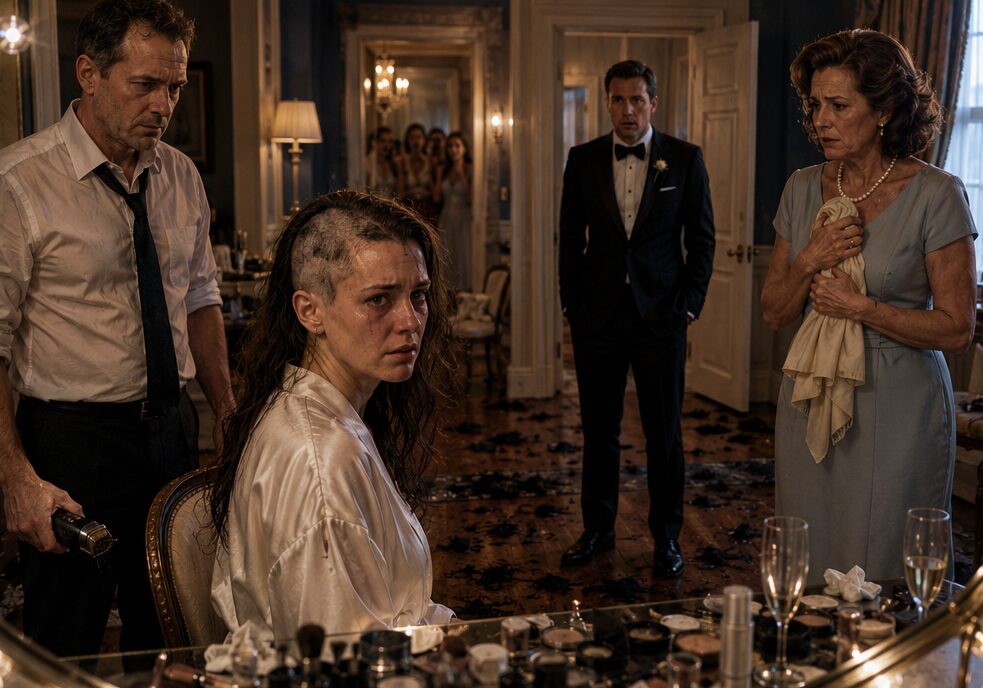
“If I tell you to stop halfway through,” Amanda said quietly, staring at herself in the mirror, “don’t listen to me.”
The clippers buzzed alive behind her.
Her brother, Michael, stood near the vanity in rolled-up dress shirt sleeves, looking deeply wrong inside the pale blue bridal suite. He was broad-shouldered, tired-eyed, and still wearing the wrinkled black tie he’d slept in after the rehearsal dinner.
Their mother froze with a section of Amanda’s dark hair wrapped around her fingers.
Downstairs, the string quartet had started playing.
People were arriving.
Champagne glasses were already clinking somewhere below the hotel ballroom ceiling while Amanda sat barefoot in a silk robe asking her family to ruin the single thing everyone loved most about her.
Nancy recovered first.
“Honey,” she said carefully, “we can still—”
“No.” Amanda swallowed hard. “Please just do it before I become somebody else again.”
Michael looked at her through the mirror.
“You sure?”
“No,” she said instantly.
Then she closed her eyes.
“Do it anyway.”
The first pass of the clippers sounded louder than the quartet downstairs.
Amanda jerked when the vibration touched the back of her neck. A thick section of dark hair slid over her shoulder and fell onto the hardwood floor.
For one strange second nobody moved.
Not Amanda.
Not Nancy.
Not even Michael.
The hair looked unreal there. Too dark. Too heavy.
Like proof of something nobody wanted to name.
Then Amanda broke.
A sound tore out of her so suddenly Nancy gasped. Amanda folded forward in the chair, both hands over her mouth, shoulders shaking violently.
“Oh God,” Nancy whispered. “Oh sweetheart—”
She reached instinctively toward the fallen hair as if she could somehow put it back.
Michael didn’t stop.
Amanda had cornered him outside the elevators at midnight the night before, mascara already smudged from crying.
“If I panic,” she’d said, gripping his wrist hard enough to hurt, “you cannot let Mom save me from this.”
So he kept going.
More hair slid down the cape.
Outside the suite, somebody laughed in the hallway.
Then the laughter stopped.
Amanda heard whispering.
A bridesmaid knocked softly.
“Amanda? You okay in there?”
Nobody answered.
Michael ran the clippers again.
Another heavy lock dropped to the floor.
The silence outside sharpened immediately.
Amanda cried harder.
Nancy’s face had gone pale in the mirror. Even now she kept fussing automatically — straightening the robe collar, smoothing the vanity tissue box, adjusting the flowers beside the champagne bucket.
Tiny acts of repair.
Tiny acts of denial.
“Amanda,” she whispered, “people are going to see—”
“I know.”
“You’ll regret doing this today.”
Amanda laughed once through tears.
“That’s the problem,” she said. “I regret everything after it already belongs to everybody else.”
Another knock.
This one sharper.
“Amanda? The photographer’s here.”
Michael muttered under his breath, “Jesus.”
Nancy stood abruptly and opened the door only a crack.
“We need a moment.”
The bridesmaid on the other side blinked.
Then her eyes lowered.
Toward the floor.
Toward the hair.
Amanda watched recognition spread across her face like cold water.
“Oh my God.”
The door shut again immediately.
Too late.
The story had already left the room.
Michael unplugged the clippers for a second.
“You wanna breathe?”
Amanda looked down at the hair scattered around her bare feet.
Her grandmother used to brush it for hours when she was little.
The Carter women’s crown.
That’s what she’d called it.
Amanda had spent most of her life learning how to wear it correctly.
By sixteen, people touched her hair before they touched her shoulder.
By twenty-two, strangers described her as composed before they described her as intelligent.
By thirty-one, she had become so good at making other people comfortable that nobody noticed she disappeared whenever she entered a room.
Downstairs, applause burst faintly through the ceiling.
Somebody had probably arrived.
Somebody important.
Nancy pressed trembling fingers against her own pearls.
“We cannot let this become a spectacle.”
Michael looked at her flatly.
“It became a spectacle the second we started treating her like one.”
Nancy flinched.
Amanda stared at herself in the mirror.
Half bride.
Half stranger.
And for the first time all morning, she could breathe.
Then her phone began vibrating across the vanity.
Again.
Again.
Again.
Messages flooded the screen.
IS EVERYTHING OK???
WHY ARE PEOPLE SAYING YOU CUT YOUR HAIR
Amanda stared at the notifications.
Outside the suite, footsteps multiplied.
The wedding had started climbing upstairs.
Part II — Performance Theater With Flowers
By eleven-thirty, the entire hotel knew something was wrong.
Not officially.
Officially, there had been “a delay.”
But wealthy Southern weddings ran on information the way old houses ran on wiring — hidden inside walls, humming constantly, impossible to fully shut off.
The florist knew because a bridesmaid cried in the hallway.
The catering manager knew because the planner started drinking Diet Coke too fast.
The planner knew because Nancy pulled her aside and whispered the phrase “temporary emotional situation” with the strained smile of someone trying not to faint.
And by noon, guests downstairs were inventing explanations faster than facts could keep up.
“She’s sick.”
“No, apparently she found messages on his phone.”
“I heard it’s for charity.”
“Cancer awareness?”
“Oh my God, how brave.”
Amanda heard fragments through the suite door while Michael swept hair into a pile with a hotel towel.
The worst part wasn’t the gossip.
It was how quickly everyone needed the story to become inspirational.
Nobody could tolerate randomness. Or grief without a purpose.
Nancy paced near the windows with her phone pressed to her ear.
“Yes, Reverend, we are still proceeding.”
Pause.
“Yes, I understand guests are asking questions.”
Pause.
“No, there has not been a medical emergency.”
Her voice tightened slightly on the last word.
Amanda sat quietly while Michael trimmed uneven sections with scissors.
Her scalp felt cold.
Exposed.
Real.
“You missed a spot,” she murmured.
Michael snorted softly.
“You’re surprisingly calm for somebody detonating a country club.”
“I’m not calm.”
“Then what are you?”
Amanda thought about it.
Then shook her head.
“I don’t know yet.”
A knock interrupted them.
Not soft this time.
Nancy opened the door halfway and immediately stiffened.
Jonathan stood there in his tuxedo.
Perfect posture. Perfect tie. Perfect control.
Until he saw Amanda.
His face changed so quickly it almost hurt to watch.
Not disgust.
Not even anger.
Just total disorientation.
Amanda realized suddenly that she had never surprised him before.
Not once in four years.
“Nancy,” he said carefully, eyes still locked on Amanda, “can I talk to her alone?”
Nancy hesitated.
Michael didn’t.
“Probably overdue,” he muttered, brushing past Jonathan toward the hallway.
Nancy lingered another painful second before leaving too.
The suite door clicked shut.
Silence settled.
Jonathan looked at the floor first.
At the hair.
Then at Amanda.
“You could’ve warned me.”
Amanda laughed weakly.
“That probably would’ve defeated the purpose.”
“What purpose?”
There it was.
The question everyone wanted.
Amanda opened her mouth.
Nothing came out.
Because she still didn’t know how to explain a lifetime in one sentence.
Jonathan sat slowly across from her.
“You scared everybody.”
“I know.”
“They think you’re having some kind of breakdown.”
“Maybe I am.”
“Amanda.”
His voice sharpened slightly for the first time.
“Do you still want to marry me?”
The room went still.
Amanda stared at him.
Not because she didn’t love him.
That would’ve been simpler.
Jonathan was patient. Stable. Kind in the organized, reliable way people admired publicly.
But suddenly she could not separate loving him from succeeding at him.
Could not tell where intimacy ended and performance began.
“I don’t know,” she whispered.
Jonathan blinked hard.
Not dramatic.
Not shattered.
Just genuinely stunned.
“Is this about me?”
“No.”
Then she stopped.
“Yes.”
He looked exhausted already.
“That clears things up.”
Amanda almost apologized automatically.
The reflex rose inside her so fast it frightened her.
Smooth it over.
Make it easier.
Make him comfortable.
She pressed her nails into her palm instead.
“I think,” she said slowly, “I’ve spent my whole life becoming whoever made the room calmer.”
Jonathan leaned back in the chair.
Outside the suite, somebody hurried past whispering, “She shaved it all off.”
Neither of them spoke for several seconds.
Then Jonathan said quietly, “You could’ve told me you were unhappy.”
Amanda looked at him carefully.
“That’s the thing. I don’t know if I was unhappy.”
“Then why does this feel like a goodbye?”
Because she didn’t know who she was without being beautiful enough to simplify things for other people.
Because every compliment she’d ever received came attached to relief.
Because her mother relaxed visibly when Amanda entered a room looking polished.
Because arguments ended faster when she smiled.
Because her grandmother’s crown had eventually started feeling less like inheritance and more like management.
But she couldn’t say all that yet.
So instead she whispered, “I think I disappeared somewhere.”
Jonathan stared at her for a long moment.
Then, quietly:
“I don’t know how to help you if you won’t let me understand the problem.”
Amanda looked down at the dark hair still trapped beneath the vanity chair.
Maybe that was the problem.
Nobody ever asked whether she understood it either.
Part III — The Story Everyone Preferred
By one o’clock, social media had done what small Southern communities always did with discomfort.
It dressed it up.
Amanda discovered this when one of the bridesmaids accidentally left Instagram open on the vanity.
BraveBride was already trending locally.
Someone had posted a blurry hallway photo of Amanda entering the suite earlier that morning beside the caption:
She shaved her head in support of children’s cancer research before her wedding today. Absolute angel.
Thousands of likes.
Heart emojis.
Prayer hands.
Admiration.
Amanda stared at the screen in disbelief.
“She didn’t even ask me.”
Michael looked over her shoulder and barked out one short laugh.
“There it is.”
“What?”
“Performance theater with flowers.”
Amanda almost smiled despite herself.
Then another post appeared.
This one less kind.
Guess the groom cheated lol
Another:
Imagine paying for this wedding
Amanda locked the phone and shoved it away.
Her scalp suddenly burned.
Nancy entered the suite carrying makeup wipes and panic.
“The officiant says we need to decide now.”
She stopped when she saw Amanda’s face.
“What happened?”
“Nothing,” Amanda said.
“That’s not true.”
Amanda looked at her mother for a long moment.
Nancy still looked immaculate somehow. Lipstick untouched. Hair sprayed into elegant certainty.
Even fear could not fully disorder her.
Then Amanda noticed the tremor in her hands.
Small.
Constant.
“I maxed out two credit cards for this wedding,” Nancy said suddenly.
Amanda blinked.
Nancy laughed once, brittle and embarrassed.
“There. Honest enough for today?”
“Ash—” She stopped herself, correcting softly. “Amanda, I needed this to go well.”
Not because she was shallow.
Not entirely.
Amanda knew what people forgot about women like Nancy.
They remembered the perfection.
Not the terror underneath it.
Nancy had spent years surviving humiliation quietly after Amanda’s father lost most of their savings. Years making elegance out of instability. Years learning that polished daughters opened doors that unpaid bills could not.
Amanda had become part child, part reassurance.
“You think I care about the flowers?” Nancy asked tightly. “I care that people stop looking at us like we’re falling apart.”
Amanda swallowed hard.
For a second, she saw her mother clearly.
Not cruel.
Just exhausted from holding dignity together with both hands.
And suddenly the haircut felt less like rebellion and more like inheritance too.
Different shape.
Same desperation.
Michael leaned against the wall near the minibar.
“You know what nobody’s asking?” he said.
Neither woman answered.
“What if Amanda’s tired of being the family mascot?”
Nancy closed her eyes briefly.
“That is not fair.”
“No,” Michael agreed. “It’s just accurate.”
“Amanda had opportunities because she worked for them.”
Michael laughed quietly.
“And because she looked like a Southern magazine cover while doing it.”
Nancy’s expression cracked.
Only for a second.
But Amanda saw it.
Recognition.
The awful kind.
The kind people spend years avoiding because once you see it, you can’t unsee the structure holding your whole family upright.
A soft knock interrupted them.
One of the hotel staff stood outside nervously.
“Ma’am,” she said to Nancy, “guests are beginning to ask whether the ceremony’s been canceled.”
Nancy thanked her politely.
The woman hesitated before leaving.
Then added awkwardly:
“You still look beautiful, by the way.”
Amanda almost burst into tears again.
Because the woman meant it kindly.
Because kindness could still feel like a cage.
Part IV — The Walk Downstairs
At two-fifteen, Nancy tried one last time to cover Amanda’s head with a silk scarf.
Amanda pulled away instinctively.
Nancy froze.
The movement hurt them both.
“I’m trying to help,” she whispered.
Amanda looked at her mother carefully.
Then, gently, she took the scarf from Nancy’s hands and placed it aside.
“I know.”
That was the unbearable part.
Most of the people hurting her loved her.
Michael appeared near the suite door.
“They’re lining guests up.”
Nobody moved.
The room felt suspended outside time now.
Half-finished champagne glasses. Hair clippings trapped in grout lines. Makeup brushes abandoned across the vanity like evidence.
Jonathan arrived a minute later.
His face looked calmer.
Not happier.
Just more honest.
He looked at Amanda for several long seconds.
Then asked quietly:
“If we do this today… are you actually here with me?”
Not:
Do you love me?
Not:
Are you embarrassed?
Not:
What will people think?
Just:
Are you here?
Amanda opened her mouth.
Nothing came.
Because she genuinely didn’t know.
And for once, nobody rushed to rescue the silence.
Downstairs, the quartet started again.
Michael exhaled slowly.
“Well,” he muttered, “guess we should either get married or traumatize four hundred rich people.”
Nancy shot him a look.
Amanda laughed unexpectedly.
A real laugh this time.
Small. Broken. Human.
And something inside the room loosened.
Not fixed.
Just loosened.
Michael opened the suite door.
Whispers immediately surged from the hallway.
Relatives pretending not to stare.
Bridesmaids avoiding eye contact.
An aunt openly crying.
Amanda stepped out anyway.
The elevator ride down felt endless.
Nobody spoke.
A hotel employee stared determinedly at the floor numbers.
When the doors opened, silence spread through the ballroom entrance almost physically.
Amanda could feel people trying to solve her with their eyes.
Trying to decide which story would make her manageable again.
Brave.
Unstable.
Attention-seeking.
Inspirational.
Heartbroken.
Anything except unknowable.
The ceremony space glittered with expensive flowers and candlelight.
Everything looked painfully beautiful.
Jonathan offered his arm.
Amanda hesitated.
Then took it.
Not because things were fixed.
Because uncertainty was finally honest.
As they walked forward, Amanda heard somebody whisper behind her:
“She’s still going through with it?”
Like she was an event instead of a person.
At the altar, the officiant smiled too brightly.
“We are gathered here today—”
“Wait.”
Amanda’s voice wasn’t loud.
But it stopped the entire room.
She turned slowly toward the guests.
Hundreds of faces.
Concerned.
Curious.
Hungry.
For explanation.
For comfort.
For a version of events that returned the world to normal.
Amanda looked at them for a long moment.
Then she said quietly:
“I can’t spend the rest of my life being easier to look at than I am to know.”
Silence.
Not dramatic silence.
Real silence.
Confused. Heavy. Breathing silence.
Amanda turned toward Jonathan.
“If we start now,” she asked him softly, “for real… would you still want this?”
Jonathan looked terrified.
Not of her.
Of honesty.
The answer took long enough that Amanda felt her heartbeat in her throat.
Then he said:
“I don’t know yet.”
A few people gasped quietly.
But Jonathan kept looking directly at her.
“But I think this is the first time I’ve actually met you.”
Amanda closed her eyes.
Not from pain.
From relief so sharp it almost felt like grief.
Part V — What Stayed After the Music Ended
Nobody knew exactly how to behave afterward.
That became the strange mercy of the afternoon.
Without a script, people revealed themselves.
Some guests left immediately, offended by uncertainty itself.
Others stayed too long, lingering near the dessert table pretending concern while collecting details.
The florist cried in a hallway for reasons nobody fully understood.
Nancy spent twenty minutes apologizing to people who did not deserve apologies.
Then suddenly stopped.
Amanda noticed it from across the ballroom.
An older woman approached Nancy with the careful expression people use before saying something cruel politely.
Nancy listened.
Smiled tightly.
Then, for the first time all day, said:
“She’s my daughter. Not a centerpiece.”
The woman blinked.
Nancy walked away before she could answer.
Amanda felt something shift quietly inside her chest.
Not forgiveness.
But movement.
Michael found Amanda near the side terrace overlooking the golf course.
“You survived,” he said.
“Barely.”
He handed her a paper plate with untouched wedding cake.
Amanda laughed softly.
“You stole cake from my own reception?”
“Technically this isn’t a reception anymore. It’s a social recovery operation.”
She smiled despite herself.
The evening air felt cool against her scalp.
Every breeze startled her now.
Michael leaned against the railing.
“You know Mom’s gonna be weird about this for years.”
“I know.”
“You okay with that?”
Amanda thought about the ballroom behind them.
The whispers.
The pity.
The strange admiration.
The exhaustion.
Then she touched the rough stubble along the back of her head.
Not polished.
Not graceful.
Not beautiful in the familiar way.
Just real.
“I don’t think I can go back,” she admitted quietly.
Michael nodded once.
“Good.”
Jonathan stepped onto the terrace a few minutes later.
Still wearing his tuxedo.
Still carrying uncertainty like something fragile.
Michael glanced between them.
Then muttered, “I’m emotionally exhausted,” before disappearing back inside.
Amanda looked out over the dark lawn.
“You don’t have to stay.”
“I know.”
“You also don’t have to decide tonight.”
Jonathan stood beside her.
For a while neither spoke.
Inside the ballroom, staff began clearing glasses.
The quartet had stopped playing hours ago.
Finally Jonathan said:
“You know what scares me?”
Amanda looked at him.
“I thought we were honest because we never fought.”
Amanda winced slightly.
“Yeah.”
“And now I’m realizing maybe we just never said anything dangerous.”
The words settled between them quietly.
True things usually did.
Amanda leaned against the railing.
“When I was little,” she said softly, “people used to touch my hair before they talked to me.”
Jonathan listened.
“And after a while, I started helping them. I made myself into whatever version got the best reaction.”
She laughed once without humor.
“You’d be amazed how rewarding it is to become emotionally convenient.”
Jonathan stared out at the dark course.
Then asked carefully:
“Do you think you ever loved me?”
Amanda answered immediately.
“Yes.”
That part hurt most.
Because love had existed here.
Real love.
Just tangled inside performance until neither of them could separate one from the other.
Jonathan nodded slowly.
“I loved you too.”
Past tense.
Present tense.
Neither clarified.
Inside, somebody dropped a tray.
The sound echoed briefly through the ballroom.
Amanda looked toward the windows where guests still moved in scattered clusters beneath the chandeliers.
All day people had tried to explain her.
Fix her.
Translate her into something easier to consume.
And suddenly she understood something terrifying.
If she married Jonathan tonight exactly as planned, everyone would relax.
The story would become manageable again.
A strange little wedding incident.
A brave emotional moment.
A beautiful recovery.
And she would disappear right back into it.
Jonathan followed her gaze.
Then quietly said:
“I think if we do this eventually… it has to be different.”
Amanda looked at him.
“Different how?”
“No pretending calm means healthy.”
A weak smile touched her mouth.
“That sounds miserable.”
“Probably.”
“But real?”
Jonathan nodded.
“Maybe for the first time.”
The wind moved lightly across Amanda’s scalp again.
This time she didn’t flinch.
Behind them, the ballroom lights dimmed one row at a time.
Neither of them reached for the other.
Neither walked away.
And for the first time in years, Amanda sat inside uncertainty without trying to make it beautiful for anyone else.