They Called Her Soup Pot Junk Before Learning Why She Fed Children For Free
Chapter 1: Steam Rising Before The Black SUV Arrives
By four o’clock, the steam from Carolyn Bennett’s soup pot had begun to cloud the front window of the little grocery on Ward Street.
It always happened before the school buses turned the corner. The old glass, scratched by years of wind and taped flyers, blurred at the edges until the faded letters of BENNETT’S MARKET looked as if they were floating. Carolyn wiped the window with the corner of her apron, but the fog returned almost at once, warm and patient, carrying the smell of chicken broth, onions, pepper, and the heel ends of bread she had toasted that morning.
Inside the store, three shelves stood mostly bare. A row of canned tomatoes. Two bags of flour. A few boxes of cereal Daniel had told her were priced too low. Near the register sat a jar with a handwritten label: SOUP FUND. Most days it held quarters, a few folded dollars, and the kind of loose change people dropped in without meeting her eyes.
Carolyn did not count it until closing.
Counting made kindness feel like business.
She tightened the knot of her gray apron and lifted the lid from the old steel pot. The handle was wrapped in a strip of faded blue cloth because the metal got too hot. William had wrapped it that way years ago, after burning his thumb and pretending it did not hurt. The cloth had been washed thin. Carolyn could have replaced it. She had a drawer full of clean towels. But her hand knew that strip. Her fingers found it without looking.
The first boy appeared across the street, pretending not to look at the storefront.
He was the taller one, maybe ten, with a backpack hanging from one shoulder and the wary posture of a child who had learned not to ask for anything directly. His younger brother followed him, stepping around a crack in the sidewalk with careful concentration. They stopped beside the newspaper box that had not held newspapers in three years.
Carolyn ladled soup into two paper bowls.
The younger boy looked through the window and then looked away.
She carried the bowls outside with two napkins folded beneath them and two pieces of bread tucked against the side. The cold touched her wrists where her sleeves had ridden up, but the bowls warmed her palms.
“Afternoon,” she said.
The taller boy shifted his backpack. “Afternoon, Mrs. Bennett.”
His brother watched the bread.
“Bus late today?”
“No, ma’am.”
That was all he gave her. Carolyn did not press. Children who came hungry often had a dozen reasons ready to explain why they were not hungry. She had heard all of them: already ate, not allowed, waiting for my mom, just looking, don’t need anything. Pride was a thin coat, but it was still a coat, and she never snatched it off anyone.
She held out the bowls.
The younger boy’s hand came up, then stopped. “We don’t got money today.”
“You already paid me by standing still long enough to warm your fingers.”
He looked uncertain, as if this might be a trick.
Carolyn lowered her voice. “Go on. Eat it while it’s warm.”
The taller boy accepted first. His eyes did not meet hers until the bowl was secure in both hands. “Thank you.”
His brother copied him, whispering the words into the steam.
Carolyn gave them the bread last. She always gave the bread last. Soup filled the stomach; bread made a child feel as if the meal had an ending.
A woman pushing a stroller slowed near the curb. Carolyn recognized her from the apartments over the laundromat, though she did not know her name. The woman’s gaze moved from the boys to the pot, then to Carolyn. She gave a small, embarrassed nod.
Carolyn lifted a third bowl before the woman could ask.
“There’s enough,” Carolyn said.
The woman stopped pretending she was only passing by.
Inside, the old refrigerator clicked and hummed. A delivery notice lay unopened near the register. The light above the dairy case flickered the way it had been flickering for two weeks. Carolyn knew there were things she needed to fix, bills she needed to answer, forms she needed to sign. Daniel had left three messages about all of them.
She had listened to the first message halfway through.
Mom, we need to talk about the numbers.
She had deleted the second before he finished saying her name.
Now, standing in the cold with steam rising in front of her face and three people eating quietly on the sidewalk, Carolyn let herself believe there were still numbers that did not belong in columns.
A school bus sighed at the corner. Brakes squealed. More children spilled out in clumps, laughing, shoving, dragging jackets half off their shoulders. Most of them passed without stopping. A few waved. One girl pointed at the pot and asked if it was noodle day.
“Tomorrow,” Carolyn said.
The girl groaned dramatically and kept walking.
Carolyn smiled despite herself. The expression pulled at the fine lines around her mouth. Her knees ached. Her right thumb had stiffened from holding the ladle. She should have gone inside and sat down on the stool behind the counter.
Instead she reached for another bowl.
The younger boy had finished quickly. Too quickly. He held the empty bowl as if unsure whether to throw it away or return it. Carolyn took it from him.
“Leave that to me.”
“Mrs. Bennett,” he said, “my mom says we shouldn’t bother you.”
“You tell your mom I’m very hard to bother.”
That earned half a smile.
The street settled into its usual late-afternoon rhythm. Cars rolling past the pawn shop. A delivery driver arguing with the back door of the bakery. Music thudding faintly from someone’s open window. The Bennett’s Market sign creaked above Carolyn’s head whenever the wind came from the east.
Then the black SUV turned onto Ward Street.
Carolyn noticed it because it moved too smoothly for the block. Clean paint, polished windows, tires that had not collected the gray dust from the curb. It slowed in front of the grocery and stopped where customers used to park when William was alive and the store still had a butcher counter.
Her hand tightened around the ladle.
The driver’s door opened.
Daniel stepped out in his navy suit, one hand already reaching inside his coat pocket, his face set in the look he used when he had decided not to be angry and had become angry about having to decide it.
He looked at the boys first.
Then at the pot.
Then at Carolyn.
The taller boy took one step back, bowl still in hand.
Carolyn lowered the ladle into the soup. The steam rose between her and her son, softening nothing.
Daniel shut the SUV door. The sound was clean and final.
“Mom,” he said.
She wiped her hand on her apron. “Daniel.”
He came around the front of the vehicle, shoes shining against the cracked sidewalk. He did not greet the children. He did not look inside the store. He stopped close enough that Carolyn could smell cold air and aftershave.
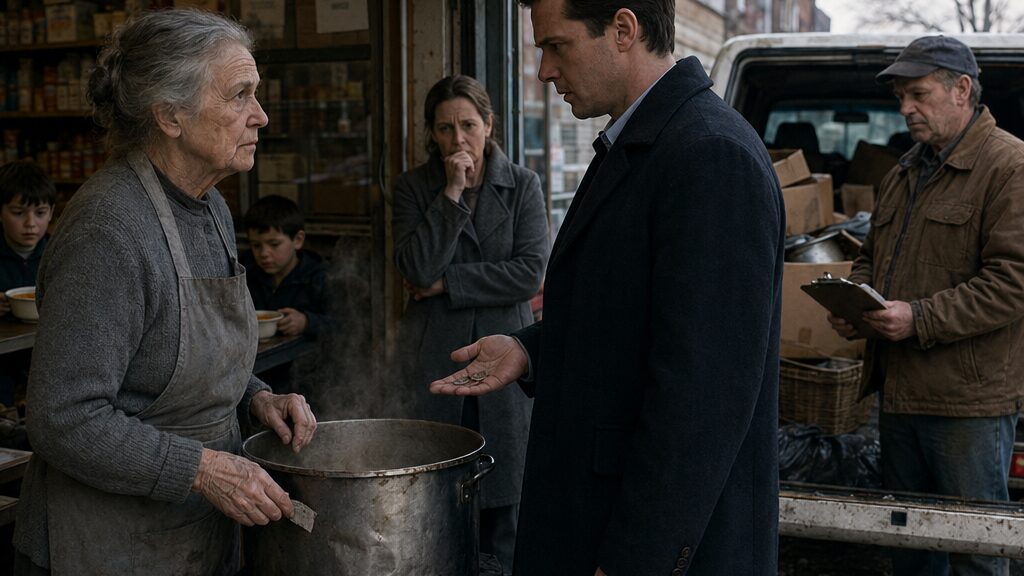
From his pocket, he drew out several coins and opened his palm.
They sat there bright and small.
Carolyn looked at the coins before she looked at his face.
Daniel’s voice was low, but the boys heard it anyway.
“So this is what you’re doing with the food I paid for?”
Chapter 2: The Coins In Daniel’s Open Hand
For a moment, Carolyn heard only the soup pot.
It made a soft knocking sound when the broth shifted against the sides, a sound she knew from thousands of afternoons. Metal settling. Heat working. A meal staying alive. Around it, Ward Street seemed to hold its breath: the boys with their bowls, the woman by the stroller, the bakery door half-open across the street.
Daniel’s palm remained between them.
Three quarters. Two dimes. A nickel. He had not pulled them from the register. Carolyn knew register change by feel, knew the worn edges and sticky pennies from children’s hands. These coins were clean, almost warm from his pocket, selected for the gesture.
He wanted her to see them.
She did.
“Put your hand down,” she said.
His jaw moved once. “I asked you a question.”
“No. You made an accusation.”
The taller boy lowered his soup bowl as if it had become evidence. His brother pressed the bread to his chest.
Daniel glanced at them then, and something like discomfort flickered across his face. It disappeared quickly. “You two should head home.”
“They’re eating,” Carolyn said.
“They can eat somewhere else.”
The younger boy flinched.
Carolyn turned slightly, not enough to put her back to Daniel, just enough to place herself between her son and the children. “Finish your soup.”
Daniel let out a breath through his nose. “Mom, don’t do this out here.”
“You started out here.”
That quieted him for one second. Not because he was ashamed enough to stop, but because he hated losing the shape of an argument. Daniel had always needed things in order. Homework squared with the edge of the table. Shoes lined straight. Bills paid before the envelope crease softened. As a boy, he had sorted jelly beans by color and eaten the green ones last. As a man, he had found a profession that rewarded him for turning messy lives into clean plans.
Carolyn had once been proud of that.
She still was, in places she did not let him see.
“I’ve been going through the statements,” he said. “The supplier invoices. The utilities. The property tax notice you didn’t tell me about.”
Carolyn felt the woman with the stroller look away.
“That’s family business,” Carolyn said.
“It became my business when you asked me to cover the electric bill.”
“I asked for a loan.”
“You asked me on the day they were going to shut it off.”
The taller boy set his bowl on the edge of the newspaper box. “We can go, Mrs. Bennett.”
“No,” Carolyn said, too quickly.
Daniel’s face tightened. “See? This is exactly what I’m talking about. You’re giving away food you can’t afford, and now you’re making kids feel responsible for it.”
The words struck harder because part of them was true. Carolyn hated that. Truth used badly had a sharper edge than a lie.
She looked at the boys. “You are not responsible for grown people forgetting their manners.”
The younger one stared at his shoes.
Daniel closed his fingers over the coins, then opened them again. “This is what came out of your donation jar yesterday. Sixty cents, Mom. Sixty cents after you handed out half a case of bread and soup you made from inventory.”
“I made it from vegetables the produce man would have thrown away.”
“And broth you bought. And bread we paid for. And gas. And containers. And your time, if that still counts for anything to you.”
“My time is mine to spend.”
“Not when you’re calling me because you can’t pay bills.”
The woman with the stroller murmured, “Come on,” to the child inside and began to move away. Carolyn watched her leave with the third bowl untouched on the folding table.
That hurt more than Daniel’s voice.
He saw it. Of course he saw it. Daniel noticed damage when it supported his point.
“People are watching,” he said.
“Then stop performing.”
His eyes sharpened. “I’m performing?”
Carolyn reached for the empty bowl the younger boy had returned and stacked it carefully with the others. Her hands needed a task. If they did not have one, they would tremble, and if Daniel saw that, he would soften in the wrong way. He would become gentle and still take the pot.
“Go inside,” she told the boys. “There are napkins by the counter.”
They hesitated.
“Go on.”
They slipped past her into the store, still carrying their food. The bell above the door gave its tired little ring.
Daniel watched them disappear between the shelves. “You can’t keep doing this.”
Carolyn looked at him. “Feeding children?”
“Pretending this place is still what it was.”
The sentence landed between them like a box dropped too hard.
Bennett’s Market had once been bright. Not fancy, never that, but full. William had stacked oranges in pyramids that children tried to touch. Carolyn had kept the counter jars filled with peppermints and butterscotch. Daniel and Linda had done homework on flour sacks in the back room. At Christmas, William hung lights around the window and claimed they brought in customers, though half the bulbs blinked out by New Year’s.
Now the aisles had gaps. The floor curled near the freezer. The painted sign had faded until Bennett looked more like Benn.
Carolyn knew what the store was.
She also knew what it was not.
“It isn’t dead because you stopped looking at it,” she said.
Daniel’s expression shifted, wounded before it hardened. “That’s unfair.”
“So is weighing soup in your palm like loose change.”
He looked down at the coins, then closed his fist.
A car honked behind his SUV. Daniel ignored it. The driver went around, muttering through the window.
“I met with the bank,” Daniel said.
Carolyn did not move.
“And a realtor,” he added.
There it was. Not a surprise exactly. More like hearing the crack after seeing the glass bend.
“You had no right.”
“I had every right to get information before this gets worse.”
“Information,” she repeated.
“Options.”
“For whom?”
“For you.” His voice rose, then lowered again. “For all of us. Linda is worried sick. I’m getting calls from vendors. The back steps are rotten. The health inspector could shut you down if he came on the wrong day. You are one fall away from nobody having a choice.”
Carolyn’s anger wavered because she heard the fear underneath. She wished she did not. Fear in a child, even an adult child, still pulled at old instincts. She wanted to touch his sleeve and tell him she was not gone yet.
Instead she said, “And your answer is to decide before asking?”
“I have asked. You don’t answer.”
“I don’t answer orders dressed as questions.”
The bell rang again. The taller boy came out with both empty bowls stacked neatly. His brother followed, wiping his mouth with the back of his sleeve. They placed the bowls on the folding table.
“Thank you,” the older boy said.
Carolyn nodded. “You get home before dark.”
They hurried away, not running, but close.
Daniel watched them go. His face was unreadable.
When they reached the corner, he opened his fist and dropped the coins into the donation jar on the table. The sound was small, bright, and cruel.
“There,” he said. “Now the books are balanced.”
Carolyn stared at the jar.
The coins sat on top of the folded dollars, shining as if they had done something useful.
Daniel adjusted his coat. “Linda and I are coming tomorrow morning. We’re cleaning the back room, the pantry, and that kitchen. Anything expired goes. Anything broken goes. Anything you haven’t used in a year goes.”
Carolyn felt cold at the base of her throat. “No.”
“Mom.”
“No.”
“We’re not asking permission to keep you safe.”
She looked up at him then, slowly. “Listen to what you just said.”
For an instant, something uncertain crossed his face.
Then he stepped back toward the SUV. “Tomorrow. Nine o’clock.”
“Daniel.”
He opened the door.
She meant to say many things. That he was still her son. That the store was not a corpse. That there were objects in that kitchen older than his certainty. That some promises had to be held in both hands or they spilled.
What came out was quieter.
“Don’t touch the pot.”
Daniel paused with one hand on the door.
He did not ask why.
That was what told her he would.
Chapter 3: Boxes Marked Keep, Donate, And Trash
Linda arrived first the next morning with coffee, cardboard boxes, and the careful smile of a daughter who had rehearsed being calm in the car.
Carolyn watched her through the front window. Linda balanced two drink trays against her hip and nudged the door open with her shoulder, cheeks pink from the cold, hair pinned too tightly at the back of her head. Behind her, the trunk of her sedan stood open. Flattened boxes leaned against a roll of white trash bags. A stack of labels sat on top, printed in block letters.
KEEP.
DONATE.
TRASH.
Carolyn had unlocked the store at seven, though she had not opened the sign. She had made soup anyway. Not a full pot. Half. Enough to warm the kitchen and make the morning smell like itself.
Linda set the coffee on the counter. “I brought you the kind you like.”
“I like the kind I make.”
“This has less grounds in it.”
Carolyn looked at her.
Linda’s smile trembled. “That was supposed to be a joke.”
“I know.”
The silence that followed was not angry yet. It was worse: polite, brittle, full of boxes waiting to be unfolded.
Linda took one cup from the tray and held it out. Carolyn accepted it because refusing would give Linda something easy to be hurt about. The cup warmed her fingers through the cardboard sleeve. It tasted burnt and sweet.
“Daniel’s parking,” Linda said.
“I saw his car.”
“He wants to start in the back room.”
“Daniel wants many things.”
Linda removed her gloves finger by finger. “Mom, please don’t make today harder than it has to be.”
Carolyn set the coffee down. “For whom?”
Linda closed her eyes briefly, and Carolyn saw how tired she was. Not yesterday tired. Months tired. The kind that lived under makeup and behind lists. Carolyn almost softened.
Then Linda lifted the labels.
“We’re just sorting,” she said. “Nothing leaves today unless you agree.”
Carolyn looked past her to the open trunk.
Linda followed her gaze and flushed. “The boxes are just to organize.”
The bell above the door rang before Carolyn could answer. Daniel entered carrying a plastic storage bin and a clipboard. He wore no suit today, only a pressed shirt under a wool coat, but he looked no less official. His eyes moved over the counter, the coffee, the pot visible through the kitchen doorway.
“Morning,” he said.
Carolyn did not return it.
He placed the bin on the counter. “Let’s begin with expired pantry items, then equipment. Linda, can you take pictures of anything we might sell?”
“Sell?” Carolyn said.
Daniel turned toward her. “If something has value and you don’t use it, we should consider it.”
“There is no ‘we’ in my cupboards.”
His mouth tightened. “Mom, we talked about this.”
“You talked. I stood here.”
Linda stepped between them with a box unfolding in her hands. “Let’s just start with food dates, okay? That’s not emotional. Dates are dates.”
Carolyn almost laughed. Dates were everything. Birthdays. Death days. The winter William wrapped the pot handle. The afternoon Daniel first stood on a milk crate to reach the register. The day Linda learned to braid bread with flour on her nose. The last day Carolyn had cooked for William before the hospital took the smell of onions from his clothes.
But Linda was already walking toward the pantry.
The back room had once held extra stock from floor to ceiling. Now it held a little of everything the store had been unable to stop being: sacks of flour, old display baskets, holiday tins, a stool with one loose leg, paper bags folded flat, a broken scale William had meant to fix, and jars Carolyn washed because glass should not be thrown away if it could still hold something.
Daniel stood in the doorway and surveyed it like a property inspector.
“This is worse than I thought,” he said.
Carolyn moved past him. “It is a pantry, not a crime scene.”
Linda touched a stack of jars. “Mom, why do you need all these?”
“They hold broth.”
“They’re empty.”
“Not always.”
Daniel wrote something on his clipboard. Carolyn hated the sound of the pen. It made the room feel as if it belonged to whoever could describe it most efficiently.
Linda began with the top shelf. She checked dates, murmuring them aloud. “June. Last August. This one’s fine. This one is four years old.”
“It’s baking powder,” Carolyn said. “Not a patient.”
“It’s going in trash.”
“It can clean the sink.”
“Mom.”
Carolyn took the can from her and placed it on the counter. “Then put it by the sink.”
Daniel reached around her and dropped it into a trash bag.
The sound was small. Too small for how it felt.
Carolyn stared at the bag.
Daniel exhaled. “We cannot debate every can.”
“Then stop touching them.”
Linda put a hand to her forehead. “We’re trying to help.”
“No,” Carolyn said. “You are trying to finish.”
That stopped Linda.
For a moment, Carolyn regretted it. Linda’s face changed in a way that made her look twelve years old, caught between crying and insisting she was not. Then Daniel opened another box, and the room moved again.
The first hour passed in fragments.
Cans knocked together. Paper rustled. Linda sneezed from dust. Daniel carried two bags to the rear door and set them outside. Carolyn retrieved one jar, one dented lid, one small scoop with a cracked handle. Each time, Daniel watched as if she were proving his point.
When Linda found the recipe cards, Carolyn was across the room rescuing a flour sack.
They were in a small metal tin behind the spice jars. Not hidden, exactly. Kept. The tin had blue flowers painted on the lid, nearly rubbed away where William’s thumb used to open it. Linda lifted it, smiled sadly, and said, “Oh, I remember this.”
Carolyn turned too quickly. Pain shot through her hip.
“Put that down.”
Linda froze. “I was only looking.”
“Put it down, Linda.”
Daniel glanced over. “What is it?”
“Recipes,” Linda said. “Old ones.”
“Scan them,” Daniel said. “Then we can toss the originals if they’re stained.”
Carolyn crossed the room and took the tin from Linda’s hands.
No one spoke.
She held it against her apron. The metal was cold. Inside were cards softened at the corners, written in William’s square uneven hand and Carolyn’s narrower script. Soup base. Sunday rolls. Peach preserves. Chili for rain. On the back of one card, in faded pencil, William had written, Don’t forget extra bread.
Linda’s voice softened. “Mom, no one’s taking them right now.”
“Right now,” Carolyn repeated.
Daniel rubbed his eyes. “This is exactly why we need a system.”
Carolyn opened the tin, removed one card without letting them see which, and slid it into her apron pocket.
Daniel noticed. “What was that?”
“A recipe.”
“For what?”
“For minding your own business.”
Linda made a helpless sound. “Mom.”
But Carolyn had already shut the tin.
They moved next into the kitchen.
The pot sat on the stove, its lid tilted to let steam escape. It was not beautiful. It was wide, steel, dented near the base, darkened underneath from years of flame. One handle had the blue cloth tied around it. The other handle was bare and slightly bent. To Daniel, Carolyn knew, it looked like an old commercial pot past its useful life.
To Carolyn, it was the weight of William’s hand over hers the first time they made too much soup on purpose.
Daniel stopped in front of it. “This thing needs to go.”
Carolyn’s chest tightened.
Linda said, “Maybe not today.”
“It’s dented, it’s heavy, and she can barely lift it. It’s a burn hazard.”
“I lift it fine.”
“You drag it,” Daniel said. “I watched you.”
“That is not the same as being unable.”
Daniel took a label from the roll.
Carolyn stepped forward. “Don’t.”
He looked at her, and she saw he had prepared himself for this. Prepared to be firm. Prepared to be the adult. That was the part that made her want to slap the label from his hand.
Instead, she held still.
“Mom,” he said quietly, “it’s just a pot.”
Linda looked down.
Daniel pressed the label to the pot’s side.
TRASH.
The white sticker clung crookedly above the dent.
Carolyn felt something inside her go very calm.
The soup simmered beneath the lid, steady and low. She could smell onion, pepper, and the bones she had boiled before dawn. She could feel the recipe card against her thigh where it rested in her apron pocket.
She did not peel the label off.
Not yet.
Daniel mistook her silence for surrender. He turned to Linda. “Call the donation pickup. Ask if they can come today.”
Chapter 4: The Pot They Tried To Throw Away
Gregory Hayes arrived at eleven-thirty in a white pickup with a dented tailgate and a magnetic sign on the door that read CLEAN HAUL DONATION & REMOVAL. Carolyn heard the truck before she saw it, the low cough of the engine turning in from Ward Street, the tires crunching against old salt near the curb.
By then, the kitchen had been divided into territories.
Daniel’s boxes lined the back wall. Linda had written on them in thick black marker, though her handwriting grew less certain as the morning wore on. KEEP sat on one box filled mostly with tax records, a working flashlight, and two sealed bags of rice. DONATE held mixing bowls, old curtains from the store windows, and three stacks of mugs with chipped handles. TRASH bulged with things Carolyn would have repaired if given a quieter day.
The soup pot still sat on the stove.
The label remained on its side.
TRASH.
Carolyn had not touched it. Not because she accepted it, but because there were moments when a person had to let a wrong thing show itself plainly.
Daniel mistook her stillness for progress. He moved faster after that. He carried bread baskets to the front. He stacked pantry cans by date. He spoke to Linda in a clipped voice about liability and square footage and what a buyer might expect. Linda answered softly, as if gentleness could change the nature of what they were doing.
Carolyn kept moving too. She wiped the counter. She tied bread into napkins. She lowered the flame beneath the pot so the soup would not burn. Her body felt oddly separate from her, all joints and breath and old instruction.
When the bell over the door rang, two boys stepped inside and stopped.
The taller one noticed the boxes first. Then the labels. Then the pot on the stove.
“Mrs. Bennett?” he asked.
Carolyn turned with a bowl already in her hand. “You’re early.”
“We had half day.”
His brother stood close behind him, eyes fixed on the TRASH label.
Daniel came in from the back room carrying a folded table. “Not today, boys.”
Carolyn set the bowl down carefully. “There is soup.”
“Mom.”
“There is soup,” she repeated.
Linda entered behind Daniel, holding Carolyn’s old apron hooks in one hand. They had been screwed beside the kitchen doorway since William put them there, three brass hooks shaped like small leaves. One held Carolyn’s winter apron, one held a grocery tote, and one had held William’s cap until the day she folded it away.
Carolyn looked at the holes in the wall where they had been.
Linda saw her looking. “They were loose.”
“They held.”
“One screw was almost out.”
“Then it needed a screw.”
Daniel turned toward the boys. “Come back another day.”
The younger boy’s face reddened. “We can pay.”
He dug into his pocket with desperate seriousness and pulled out two pennies and a button.
Carolyn’s throat tightened.
Daniel’s eyes flicked to the tiny offering and then away, as if embarrassed for everyone in the room. “That’s not what this is about.”
“Then stop making it about money,” Carolyn said.
Gregory knocked on the open doorframe before stepping in. He was a broad-shouldered older man in a brown jacket, with a clipboard of his own and the cautious expression of someone used to walking into other people’s arguments.
“Bennett pickup?” he asked.
Daniel raised a hand. “That’s us.”
Carolyn looked at her son. “No.”
Gregory paused. His gaze moved from Daniel to Carolyn, then to Linda, then to the boys. “I can wait outside.”
“No need,” Daniel said. “Most of it’s ready near the back. Some items out front.”
“Nothing is ready,” Carolyn said.
Linda spoke quickly. “Mom, we agreed to sort.”
“I agreed to stand here while you sorted. I did not agree to have strangers haul my kitchen away.”
Daniel’s control cracked at the edge. “This is why I called him. Because every time we get close to doing what needs to be done, you change the rules.”
Carolyn stepped toward the stove. “You put a trash label on my pot.”
“It’s unsafe.”
“It is full of soup.”
“It is too heavy for you. It is dented. It is not sanitary for serving outside.”
Gregory shifted near the doorway. “Maybe I should—”
“Stay,” Carolyn said.
The word surprised even her. It came out quiet, but it held.
Daniel set the folded table against the wall. “Fine. Let everyone hear it. You want to keep feeding kids from a pot you can barely lift while this building falls apart and the bills pile up? You want Linda and me to pretend that’s noble?”
The taller boy moved closer to his brother.
Carolyn lifted the pot lid. Steam rose at once, softening the hard edges of the room. The smell of broth and pepper filled the kitchen. She took the ladle and filled two bowls, slower than usual because her wrist was stiff and everyone was watching. She placed bread on top of each napkin.
“Eat at the counter,” she told the boys.
Daniel stepped in front of her. “No.”
Carolyn looked at him. “Move.”
“Not until you hear me.”
“I have heard you since yesterday.”
“No, you’ve ignored me since Dad died.”
Linda flinched. Gregory looked down at his clipboard.
The room changed around William’s absence. It always did when someone said it plainly. The pot simmered behind Carolyn, patient as breathing.
Daniel’s face had gone pale under the anger. “You think this is about soup? It’s about you refusing to admit you can’t do this anymore.”
Carolyn held the bowls steady.
“I can admit what is true,” she said. “I cannot admit what you invented because it makes your plan easier.”
“My plan is to keep you alive.”
“By emptying me first?”
His eyes flashed. “That is not fair.”
“No. It is precise.”
Linda whispered, “Mom, please.”
Outside, the pickup’s engine ticked as it cooled. Through the front window, Carolyn saw the donation boxes Daniel had already carried to the sidewalk. Bread baskets. A crate of pantry cans. The brass apron hooks on top of a towel. Her winter apron half-slipping from the pile.
Something in her chest became still.
She handed the bowls to the boys. “Go sit.”
They obeyed without a sound.
Then Carolyn turned off the stove.
She wrapped her hand around the blue cloth on the pot handle and turned the pot so the label faced Daniel fully. The white sticker had curled at one corner from the heat.
TRASH.
She peeled it slowly.
The paper resisted at first, then came away with a soft tearing sound. A gray strip of adhesive remained on the steel. Carolyn folded the label once. Then again. Her fingers were steady now.
Daniel watched her with a look that was almost fear.
Carolyn held out her other hand. “Give me the coins.”
“What?”
“The coins you used yesterday.”
“They’re in the jar.”
She walked to the sidewalk table, took the coins from the donation jar one by one, and returned. Three quarters. Two dimes. A nickel. She placed them in Daniel’s palm before he could stop her.
Then she laid the folded TRASH label on top of them.
Daniel looked down.
Carolyn’s voice was not loud. It did not need to be.
“Is this what you think a promise is worth?”
No one moved.
Linda’s eyes filled, though Carolyn could not tell with what. Daniel’s fingers curled slightly under the weight of the coins and the paper label, as if he wanted to close his fist but knew it would look like hiding.
“A promise to who?” he asked.
Carolyn turned back to the stove. “Not today.”
Daniel stared at her. “You can’t keep doing that. You can’t throw out half a sentence and expect everyone to stop.”
“You have thrown out half my kitchen.”
“That is not the same thing.”
“No,” Carolyn said. “It is heavier.”
Gregory cleared his throat gently. “Ma’am, I don’t take anything unless the owner says so.”
Daniel’s head snapped toward him. “I hired you.”
Gregory did not raise his voice. “Yes, sir. But I don’t load from a lady’s stove while she’s cooking from it.”
The younger boy’s spoon clinked against his bowl.
Daniel turned back to Carolyn, anger and humiliation crossing his face in quick succession. “You’re making this impossible.”
“I am making it mine.”
Linda stepped toward the pot. “Mom, maybe we can just pause.”
“No,” Daniel said. “Pausing is how we got here.” He pointed toward the boxes outside. “Gregory, load what’s already on the sidewalk.”
Carolyn’s breath caught.
The apron hooks. The baskets. The pantry cans. Her winter apron.
Gregory hesitated.
Daniel’s voice sharpened. “They’re outside. Load them.”
Carolyn moved before anyone could help or stop her. She walked past Daniel, past Linda, out through the front door and into the cold. The wind pressed her apron against her knees. A neighbor across the street slowed beside the bakery. A delivery driver turned his head.
Carolyn reached the sidewalk pile as Gregory lowered the truck gate.
Daniel followed. “Mom, don’t make a scene.”
She placed both hands on the old soup pot, which Gregory had not touched yet but Daniel had moved near the door. It was warm through the steel, heavy even emptying toward half.
“You want this pot gone,” she said.
“We can discuss it inside.”
“No. You brought it outside.”
Linda came to the doorway, one hand at her mouth.
Daniel took a step closer. “Mom.”
Carolyn looked at the truck bed, at the open space waiting to receive pieces of her life. Then she looked at her son.
“If that pot goes,” she said, “you will have to carry me with it.”
The street seemed to quiet around the sentence.
Daniel did not move.
For the first time since he had arrived, he looked less like a man in charge than a boy who had reached for something hot and could not understand why it burned.
Chapter 5: The Recipe Card Hidden In Her Apron
By evening, the pot was back on the stove, but nothing else had returned to its proper place.
The bread baskets sat on the floor beside the register. The brass apron hooks lay on the counter, their screws in a paper cup. The donation boxes had been dragged back inside and left beneath the front window, labels facing outward like accusations that had lost confidence.
KEEP.
DONATE.
TRASH.
Daniel had gone without saying goodbye. He had folded the TRASH label and the coins into his coat pocket, whether from anger or confusion Carolyn did not know. Linda stayed long enough to put away the bowls, wipe the counter twice, and tell Carolyn she would come back later.
Carolyn had said, “You do that.”
Linda had touched the doorframe where the hooks used to be before leaving.
Now the store was closed. Outside, the streetlights made pale circles on the sidewalk. The boys had gone home. The donation jar sat empty except for a receipt someone had folded into a square. Carolyn turned the sign to CLOSED and locked the door, though everyone knew the back entrance still stuck if pushed hard enough.
She did not sit at first.
Sitting made the day catch up.
Instead, she washed the ladle. She rinsed bowls already clean. She wiped the same spot near the stove until the cloth came away dry. The soup had cooled. Fat gathered in small golden circles on the surface, trembling whenever she moved near it.
At last, her hip insisted.
Carolyn lowered herself onto the kitchen stool and took the recipe card from her apron pocket.
The card had softened with years of handling. The corners were rounded, one edge stained brown where broth had spilled long ago. William’s handwriting leaned slightly upward, as if even his words expected better weather.
Winter soup, he had written at the top.
Below that: bones if we have them, onion, carrot, celery, pepper, no measuring when cold. Extra bread.
On the back, in smaller pencil: Don’t forget the boy at the door.
Carolyn placed the card flat on the counter and set her palm over it.
The bell at the front door gave one faint metallic tremble. Not opened. Just moved by wind against the frame. She waited. Nothing followed.
A minute later, there was a soft knock at the back.
Linda did not wait for an answer before opening the door, but she opened it only a few inches. “Mom?”
Carolyn covered the card with her hand. “You have a key.”
“I wasn’t sure if I still should use it.”
That was not the kind of sentence Linda usually said. Carolyn looked at her daughter properly then. Linda had changed out of her neat sweater into an old coat, the one with a missing button she kept in her car. Her eyes were red. In one hand she carried the winter apron, folded carefully.
“You forgot this in the box,” Linda said.
“I didn’t forget it.”
Linda stepped inside and set the apron on the counter. “No. I guess you didn’t.”
The kitchen smelled of cooled soup, dust, and the faint sharpness of cardboard. Linda looked around at the half-packed room as if seeing the damage differently in the quiet.
“Daniel shouldn’t have called Gregory today,” she said.
Carolyn said nothing.
“I shouldn’t have taken the hooks off the wall.”
“No.”
Linda accepted it with a small nod. She leaned against the counter but did not sit. “I thought if we made things cleaner, you’d feel better.”
“Did you?”
“I thought maybe if the room looked less like Dad had just stepped out, we could all breathe.”
Carolyn lifted her hand from the card. “Your father has been dead nine years.”
“I know.”
“Then why are you still trying to clean him out of corners?”
Linda’s face tightened, but she did not leave. That was new. As a girl, she had fled from hard feelings into chores. As a woman, she had built a life out of being useful before anyone asked. Carolyn could see the same habit in the boxes, the labels, the coffee she had brought like a peace offering no one requested.
Linda’s gaze dropped to the recipe card.
“Is that the one you hid?”
Carolyn slid it toward herself, but not away.
Linda read the front without touching it. “Winter soup.”
Carolyn stared at William’s handwriting.
“He wrote that after the first hard freeze of ’86,” she said.
Linda grew still. She would have been little then. Too little to remember properly, old enough to carry feelings without dates attached.
“It was after the furnace went out?” Linda asked.
“No. After the boy.”
Linda frowned.
Carolyn ran her thumb along the card’s edge. For years she had kept the story folded inside the recipe, not secret exactly, but unoffered. A grief could become part of a room that way. People walked around it. Dusted near it. Learned not to ask why one chair was never moved.
“He came to the back door,” Carolyn said. “Not much older than those boys today. Maybe nine. He had no coat. Your father was closing. I was counting the register.”
Linda’s breathing changed.
“He asked if we had bread we were throwing away. Not bread to buy. Bread we were throwing away.”
Carolyn could see him still, though she had tried not to. Thin wrists. Shoes too large. Pride so fierce he nearly shook with it.
“I told him we didn’t throw away good bread,” Carolyn said. “Which was true and not kind. William gave him a loaf and soup from our dinner. The boy ate on the back step because he wouldn’t come in.”
“What happened?”
Carolyn looked at the pot.
“He came back twice. Then he didn’t. Later we heard his family moved. Then we heard other things. Maybe true. Maybe not. There was a fire in one of the buildings on Coleman Avenue that winter. A child was hurt. Some said it was him.” She swallowed. “I never knew for sure.”
Linda’s eyes glistened. “Mom.”
“I don’t claim a tragedy that may not be mine. But I remember your father sitting right there, holding this card, saying if a child asked us for thrown-away bread again, we would not make him ask twice.”
Linda pressed her fingers to her mouth.
“That was the promise?” she whispered.
“One of them.”
“One of them?”
Carolyn looked at the card, and for a moment her voice almost failed. She let it rest. Then she tried again.
“There are promises you say once and promises you keep saying with your hands.”
Linda reached for the stool across from her but stopped, asking silently. Carolyn nodded.
Her daughter sat.
For a while, neither of them spoke. The refrigerator hummed. A car passed outside. Somewhere above the store, old pipes knocked.
Linda touched the folded apron. “Why didn’t you tell us?”
Carolyn gave a tired laugh without humor. “When? Between Daniel telling me I’m unsafe and you labeling my cupboards?”
Linda winced. “That’s fair.”
“It is not entirely fair.” Carolyn rubbed her thumb against the card. “I did not tell you because I did not want it examined. People examine a thing and think they own it better.”
“I wasn’t trying to own it.”
“No. You were trying not to be afraid.”
Linda’s eyes lifted.
Carolyn leaned back on the stool. Her hip throbbed. Her hands ached from the morning’s quiet war. “I know the steps are bad. I know the shelves are empty. I know I cannot lift what I used to lift.”
“Then let us help.”
“Help begins with asking where to put your hands.”
Linda looked toward the doorway where the hooks had been. “I’m sorry.”
Carolyn believed her. That did not fix the holes in the wall.
“Daniel has a realtor coming,” Linda said quietly.
Carolyn closed her eyes.
“He didn’t tell you because he knew you’d say no.”
“I would.”
“He thinks if you see the numbers, you’ll understand.”
Carolyn opened her eyes. “I understand numbers. I do not worship them.”
“The building needs work.”
“Yes.”
“The store may not survive.”
Carolyn looked at the pot again. Cold now. Silent now. Still present.
“Then we will speak of what survives,” she said.
Linda reached across the counter, not for Carolyn’s hand but for the edge of the recipe card. She stopped before touching it.
“May I?”
Carolyn waited long enough for the question to matter.
Then she slid the card across.
Linda read the back. Don’t forget the boy at the door.
Her tears fell without sound. She wiped them quickly, embarrassed, but Carolyn pretended not to notice.
At the front of the store, headlights moved across the window and disappeared.
Linda looked up. “Daniel’s going to push tomorrow.”
Carolyn took the recipe card back and returned it to her apron pocket.
“Then tomorrow,” she said, “he can learn the difference between pushing and being invited in.”
Chapter 6: The Store Was Not Empty Yet
The realtor wore soft shoes and spoke as if every sentence had been sanded smooth.
She arrived two days later with a tablet, a measuring tool, and a smile that made no promises. Daniel walked beside her, pointing out ceiling height, street frontage, storage space, rear access. Linda followed them with her arms folded, quieter than she had been during the cleanup. Carolyn stood behind the counter, her apron tied, the soup pot warm on the stove but not yet carried outside.
She had made less soup again.
That compromise had cost her more than anyone knew.
The realtor paused near the front window. “There’s good visibility from the street.”
Daniel nodded. “The block is changing. There’s been interest in café space.”
Carolyn looked at the empty cereal shelf.
Café space.
As if the building had been waiting all these years to be pronounced attractive by someone who did not know where William had stood to fix the Christmas lights. As if the walls were not already full of fingerprints and cold mornings and children counting pennies for milk.
The realtor glanced at Carolyn. “It has character.”
Carolyn had heard that word before. In property talk, character meant old but not yet condemned.
“It has a roof leak near the back,” Carolyn said.
Daniel turned. “Mom.”
“What? She should know its character.”
The realtor’s smile held. “That’s helpful, actually.”
Daniel’s phone buzzed. He looked at it, ignored the call, then returned to his careful tour. “Back steps need repair. Electrical upgrades. Flooring. Some commercial kitchen concerns.”
“Concerns,” Carolyn repeated.
He did not answer.
The realtor stepped toward the kitchen doorway. “May I?”
Carolyn moved aside, not because she welcomed it, but because blocking doorways tired a person. The woman looked around the kitchen and made notes. Her eyes touched the pot, the brass hooks Linda had reattached the night before, the recipe tin now placed deliberately on the shelf above the stove.
“Still operating food service?” she asked.
“Soup,” Carolyn said.
“Informally,” Daniel added.
Carolyn looked at him. “Warmly.”
The realtor glanced between them and found something on her tablet that required attention.
Linda came to stand beside Carolyn. She had not told Daniel about the recipe card. Carolyn knew because he still moved with the confidence of a man who believed the main issue had not yet been named.
“Mom,” Linda said softly, “did you eat breakfast?”
Carolyn reached for a stack of paper bowls. “Coffee.”
“That’s not breakfast.”
“It was coffee with milk.”
Linda’s mouth tightened in the familiar family shape of worry turning into accusation. She caught it this time and let it go.
Daniel did not.
“You skipped again?” he asked from the kitchen doorway.
Carolyn kept arranging bowls. “I am standing upright.”
“That’s not an answer.”
“It is the answer you can see.”
Daniel came closer. “This is what I mean. You’re feeding half the block and not feeding yourself.”
“Half the block would be an exaggeration.”
“Mom.”
The realtor stepped back toward the front, pretending to study the windows.
Linda said, “Daniel, not now.”
“Yes, now. Because everyone keeps acting like I’m the villain for noticing reality.”
Carolyn looked at him fully. The anger from the previous days had changed in her. It had cooled into something heavier, harder to lift but easier to aim.
“I do not think you are a villain.”
Daniel blinked, thrown by that.
“I think you are frightened,” she said. “And I think you are loud when you are frightened.”
His face closed. “I’m the only one willing to say this isn’t working.”
“No,” Carolyn said. “You are the only one saying it with a trash label.”
The realtor’s measuring tool beeped near the window.
Daniel lowered his voice. “Can we not do this in front of strangers?”
“You brought the stranger.”
Linda touched Carolyn’s arm gently. Not stopping her, just reminding her of breath.
The bell rang.
Sarah Miller entered with a canvas tote over one shoulder and a folder clutched against her coat. She paused when she saw the realtor, then looked to Carolyn.
“I can come back.”
Carolyn knew Sarah from the elementary school three blocks over. She had come in for milk, then bread, then once for soup when a child in her office had not eaten since the night before. After that, she had begun leaving small bills in the donation jar when she could.
“No,” Carolyn said. “Come in.”
Daniel looked impatient. “We’re in the middle of something.”
Sarah’s posture stiffened, but she kept her voice polite. “So am I.”
The realtor took this as an opportunity to measure the far wall.
Sarah approached the counter and set down the folder. “I heard there was some question about the soup table.”
Daniel’s eyes narrowed. “From who?”
“Children talk. So do mothers.” Sarah looked at Carolyn. “I didn’t want to overstep.”
Carolyn glanced at the folder. “Yet here you are.”
A small smile touched Sarah’s mouth. “Here I am.”
Daniel reached for the folder, but Sarah did not release it until Carolyn nodded. That small deference warmed Carolyn more than the coffee had.
Inside were pages. Not official forms. Not legal threats. Just names with identifying details carefully limited: family of four, motel housing; grandmother raising two children; father between jobs; mother working nights; child with lunch account debt. Beside each note were dates, not daily, but often enough.
Daniel read the first page, then the second. His expression shifted from suspicion to discomfort.
“What is this?” he asked.
Sarah stood straight. “A partial list of families who’ve made it through bad weeks because your mother kept soup on.”
Carolyn did not like the phrasing. It made her sound larger than she was. “Sarah.”
“It’s not charity theater,” Sarah said gently. “I know.”
Daniel closed the folder halfway. “Why didn’t anyone tell us?”
Carolyn almost laughed. “You mean why didn’t hungry people file reports?”
Linda touched the folder’s edge. “These are school families?”
“Some. Some neighbors. Some people passing through who heard there was a place you could get something warm without being asked to prove you deserved it.”
The realtor had stopped measuring.
Daniel noticed and flushed. “No one is saying the soup doesn’t matter.”
Carolyn looked at the TRASH box still tucked near the end of the counter. “The pot heard otherwise.”
Daniel’s hand tightened around the folder. “This doesn’t solve the bills.”
“No,” Carolyn said.
“It doesn’t repair the steps.”
“No.”
“It doesn’t make it safe for you to carry that pot.”
“No.”
The room quieted because she had not argued.
Daniel looked at her, uncertain.
Carolyn rested one hand on the counter. She felt each year in the knuckles. She felt the morning she had skipped food because there were only three rolls left and the boys had come early. She felt the lie inside her own stubbornness, the way she had pretended endurance was the same as strength.
“I know it cannot go on the way it has,” she said.
Linda’s eyes lifted.
Daniel did not speak.
Carolyn looked toward the kitchen, where the pot waited under its lid. “But neither will it end by you clearing me out like a tenant who already died.”
The realtor lowered her tablet. “I can step outside.”
“No,” Carolyn said. “You can hear this too. Buildings are not empty just because someone with a clipboard says potential.”
Sarah looked down at her hands, hiding approval.
Daniel set the folder on the counter. “What are you asking for?”
The question was quieter than his others. Not soft, exactly, but no longer sharpened before it left his mouth.
Carolyn did not answer quickly. Quick answers had gotten them labels and boxes.
“I am asking,” she said, “for one evening at that kitchen table. No realtor. No driver. No boxes moving while my back is turned. You, Linda, and me. We talk about what I can keep doing, what I cannot, what can leave, and what no one touches unless I say.”
Daniel looked exhausted. Younger, somehow.
“And if the numbers say sell?” he asked.
“Then the numbers can sit at the table too,” Carolyn said. “They do not get the only chair.”
Linda gave a small, broken laugh and pressed her fingers beneath her eyes.
The realtor closed her tablet. “I’ll send preliminary notes. No rush from my end.”
Daniel nodded, barely.
Sarah picked up the folder, then hesitated and left it on the counter. “Keep it for tonight,” she said.
Carolyn watched Daniel look at the pages again.
For the first time, he did not look as if he knew where everything belonged. He looked at the empty shelves, the repaired hooks, the warm kitchen, the folder of unnamed hunger, and the pot he had tried to throw away.
Outside, the school bus sighed at the corner.
Carolyn reached for the bowls.
Daniel saw her hand move and stepped forward out of habit, maybe to stop her, maybe to help.
She looked at him.
He stopped.
Then, carefully, he asked, “Do you want me to carry it outside?”
Carolyn held his gaze long enough for the question to settle into the room.
“Not today,” she said. “Today you may open the door.”
Chapter 7: Not Everything Is Yours To Save
The kitchen table had been cleared for the meeting, but not cleaned of its history.
Carolyn had left the scratches visible. The pale ring where William used to set his coffee. The small burn mark near the edge from the year Daniel tried to toast marshmallows over a birthday candle. The darker groove Linda had carved by accident with a bread knife when she was fourteen and furious about something Carolyn could no longer remember.
She had removed the boxes from beneath it herself.
Not because Daniel had asked. Not because Linda had suggested. Because if they were going to sit down and talk about what could stay and what could leave, Carolyn wanted everyone’s knees to fit under the same table.
The soup pot rested on the stove behind her, clean and empty. The recipe tin sat beside it. The folded TRASH label lay near Carolyn’s place, smoothed flat but still creased. Daniel’s coins sat on top of it.
Daniel noticed them the moment he entered.
He came in through the front, not the back. Carolyn heard him pause near the counter, heard the bell settle. Linda arrived a few minutes later with a folder and no boxes. She looked at the table, at the pot, at Carolyn, and took off her coat without speaking.
Daniel remained standing.
Carolyn waited.
Finally he pulled out a chair and sat across from her. Linda sat between them, not quite mediator, not quite daughter, both hands wrapped around a mug of tea she had made herself without asking where anything was.
That, Carolyn thought, was already something.
Daniel placed a stack of papers on the table. “I brought the numbers.”
“I see that.”
“And repair estimates.”
“I see those too.”
“And the realtor’s preliminary valuation.”
Carolyn nodded once. “Do the papers need tea?”
He looked up, confused.
“They have the best seat at the table.”
Linda lowered her eyes, but Carolyn saw the corner of her mouth move.
Daniel did not smile. He shifted the papers aside, though, and folded his hands. “Okay.”
The word was small. It did not fix anything. It made room.
Carolyn reached into her apron pocket and took out the recipe card. She placed it beside the coins.
Daniel’s gaze went to it.
“This is not a trial,” she said. “I am not presenting evidence so you can decide whether I am allowed to care about my own things.”
Daniel’s jaw tightened, but he stayed quiet.
“I will tell you enough because you are my children. Not because you earned it by emptying shelves.”
Linda flinched. Daniel looked down.
Carolyn rested her fingers on the card. “Your father wrote this after a winter when a boy came to the back door asking for bread we were throwing away. He was hungry enough to ask and proud enough to pretend he only wanted trash.”
Daniel’s expression changed.
Carolyn did not look away from him. “Your father fed him. We both did. The boy came back twice. Then he vanished from the neighborhood. We heard rumors later. A fire. A family moved in the night. A child hurt. We never knew if it was him.”
Linda had heard this part, but her eyes still filled.
Daniel’s voice was low. “Why didn’t Dad ever tell me?”
“You were a child.”
“I wasn’t always a child.”
“No,” Carolyn said. “But by the time you were old enough, the promise had become a habit. Habits are quieter than stories.”
Daniel looked toward the stove. “The soup.”
“The soup. The bread. The pot. The table. The jar. The way a child can stand outside and not have to ask twice.”
Daniel rubbed both hands over his face. “Mom, I didn’t know.”
“No,” Carolyn said. “You didn’t.”
He looked wounded by the plainness of it.
She let him be.
The refrigerator clicked on. Somewhere beyond the back wall, a pipe knocked. The building made all its old sounds around them, as if reminding everyone it had not agreed to be discussed as a number only.
Daniel picked up one estimate. “The back steps are unsafe.”
“Yes.”
“The floor near the freezer has to be repaired.”
“Yes.”
“You owe more than you told us.”
“Yes.”
Linda turned toward her. “Mom.”
Carolyn lifted one hand. “Do not soften the truth because I am old. I know what I owe. I also know what I own.”
Daniel’s eyes moved from the papers to her face.
“I own the right,” she said, “to be asked.”
He swallowed.
“I own the right to say that a cracked bowl can go, and a cracked memory may stay until I am ready. I own the right to decide that a shelf of expired cans is trash and that a pot with a dent is not. I own the right to need help without being treated like I have already left the room.”
Linda put her tea down. Her hands were trembling.
Daniel’s voice came out rougher than before. “I thought if I got it done fast, you wouldn’t have to suffer through every little decision.”
“You thought suffering was in the choosing.”
He looked at the labels stacked near the counter.
“It was in having no choice,” Carolyn said.
The sentence settled over the table, and this time no one rushed to answer it.
Linda reached into her folder. “I made something.” She pulled out three sheets of blank paper, each with a title written by hand. “Not labels for boxes. Just categories, maybe.”
Carolyn read them.
ASK ME.
KEEP FOR NOW.
READY TO GIVE.
The words blurred slightly. She blinked until they cleared.
Linda slid the pages toward her. “You can change them.”
Carolyn touched the first sheet. “Ask me,” she read.
“I should have started there,” Linda said.
Daniel leaned back, eyes on the ceiling for a moment. “I should have too.”
Carolyn did not accept it yet. Apologies could be another way of hurrying a person along.
She picked up the old TRASH label and placed it in front of Daniel. “Read it.”
He looked at her.
“Out loud,” she said.
Linda stopped breathing for a second.
Daniel stared at the folded label. The black letters were still legible though the paper had bent and softened from being carried in his pocket.
“Trash,” he said.
Carolyn nodded. “That is the word you put on your father’s pot.”
His face tightened.
“That is the word you put on my work before asking what work it was still doing.”
He opened his mouth, then closed it.
“That is the word you put where the children could see it.”
Daniel’s eyes dropped.
Carolyn’s voice remained even, but it cost her. “I am not telling you this so you can feel ashamed and then call shame the same as change. I am telling you because the next time your hand reaches for a label, I want it to remember that not everything is yours to name.”
Daniel sat very still.
Linda wiped beneath one eye.
After a long moment, Daniel pushed the repair estimates toward the center of the table. “What do you want done first?”
Carolyn looked at him sharply.
He held up a hand, palm open, empty this time. “I’m asking.”
The word asking felt almost unfamiliar in his mouth.
Carolyn looked at the papers, then at the kitchen, then at the pot.
“The steps,” she said. “No child should come to the back door and fall through my neglect.”
Daniel nodded and wrote it down.
“The freezer floor can be repaired after.”
He wrote that too.
“The old curtains can go. The cracked mugs can go. The broken scale stays until I decide whether I want it repaired or remembered.”
Linda wrote under KEEP FOR NOW.
Carolyn turned toward the boxes. “The pantry will be sorted with me sitting here. If I say a thing goes, it goes. If I say it stays, it stays for now. If either of you thinks I am wrong, you may tell me why once. Not five times. Not louder. Once.”
Daniel’s mouth moved, almost a smile, almost grief. “That’s a rule.”
“It is.”
Linda whispered, “Good.”
Carolyn picked up the recipe card. “The soup table changes.”
Both of them looked at her.
She kept her eyes on the handwriting. “Not every day. Not alone. Not if I have skipped my own breakfast. Sarah can help find volunteers. The jar stays. The children do not pay to prove they are hungry.”
Daniel nodded slowly.
“But the pot stays with me,” Carolyn said. “The recipe stays with me. The first bowl is mine to serve.”
“No one’s taking it,” Linda said.
Carolyn looked at Daniel.
He held her gaze. “No one’s taking it.”
She believed that he meant it in that moment. She also knew moments needed structures if they were going to last.
“Then write it down,” she said.
Daniel took a blank page from the printer tray near the counter. At the top he wrote in his clean, square hand: Mom decides before anything leaves.
He turned the page around for her to see.
Carolyn read it once. Then again.
The words were not perfect. Nothing was. But they were a door opened from the correct side.
She took the pen from him and added beneath it: Help begins with asking.
Linda cried then, quietly, without apology.
Daniel looked at the page for a long time. Then he reached for the coins on the table. Carolyn watched his hand close around them, expecting him to pocket them again.
Instead, he placed them beside the SOUP FUND jar near the counter.
“Not yet,” Carolyn said.
He stopped.
She looked at the jar, then at him. “Tomorrow. When the pot is full.”
Daniel pulled his hand back.
For the first time in days, he listened before finishing the gesture.
Chapter 8: The First Bowl She Chose To Keep
Two weeks later, the front window of Bennett’s Market fogged again.
Not as heavily as before. The pot was not as full. The table was smaller. The old folding legs had been replaced with a sturdier stand Daniel found at a restaurant supply warehouse, and Linda had sewn a washable cloth for the top from fabric Carolyn chose herself. The bread basket was the same one, though Daniel had sanded the splintered handle after asking if he could.
The sign above the table no longer said FREE SOUP in Carolyn’s hurried marker.
Sarah had written the new one in careful blue letters.
WARM MEALS — TAKE ONE IF YOU NEED ONE, LEAVE WHAT YOU CAN, ASK NOTHING OF YOUR PRIDE.
Carolyn had objected to the last part as too long.
Sarah had said, “Good. People should slow down to read it.”
The back steps had been repaired. The freezer floor had been patched. The broken scale sat on a shelf marked KEEP FOR NOW, where it watched over a smaller pantry with fewer expired cans and more space between what remained. The boxes had not disappeared, but their words had changed. ASK ME leaned against the back wall. READY TO GIVE held old curtains, mugs, and three pans Carolyn admitted she had not used since Linda still wore braids. KEEP FOR NOW held the scale, William’s cap, the recipe tin, and a few things Carolyn was not ready to explain to anyone.
Daniel had not brought up the realtor again.
Not because the question was gone. Carolyn was too old to confuse silence with solution. The numbers still sat in a folder. The building still needed more than love and soup. But the conversation had moved from around her to with her, and that changed the weight of the room.
On the first afternoon of the new meal corner, Carolyn tied on her mended apron.
Linda had washed it and repaired the frayed pocket with tiny stitches Carolyn pretended not to admire. The patch was plain, strong, and slightly crooked. Carolyn liked it better for that.
“You sure you don’t want me to carry the pot out?” Daniel asked.
He stood near the stove in rolled-up sleeves, looking uncomfortable in an apron Sarah had insisted all volunteers wear. His said BENNETT’S in blue letters across the front. He had put it on without comment, though Carolyn saw him glance down at it twice as if learning a language.
Carolyn tested the pot handle. The blue cloth had been replaced with a new strip cut from William’s old work shirt. That had been her decision. She had kept the original strip in the recipe tin, folded beside the card.
“I want you to stand there,” she said.
Daniel stopped reaching. “Here?”
“There.”
He moved six inches to the left.
“If I need you,” she said, “I will ask.”
He nodded.
Linda stood by the bowls, counting them into neat stacks. “And if you don’t ask but look like you need help?”
Carolyn gave her a look.
Linda smiled faintly. “I may ask if you want help.”
“That is acceptable.”
Sarah came in from outside with a small bag of rolls donated by the bakery. “Two families already asked if you were really opening today.”
Carolyn adjusted the flame under the pot. “It is not a grand opening.”
“No,” Sarah said. “Just a door.”
That, Carolyn thought, was close enough.
At four o’clock, the first school bus sighed at the corner.
Carolyn felt the sound in her ribs. For years it had meant hurry, bowls, bread, watch the weather, count the children without seeming to count. Today it meant all that and something else: witnesses, boundaries, help close enough to reach but not close enough to smother.
The taller boy came first, his brother half a step behind. They stopped at the window and stared at the new table, the sign, Daniel in the apron, Linda by the bowls.
The younger boy whispered something.
The taller one shook his head.
Carolyn opened the door herself. Cold air entered, bright and sharp. “You planning to read the sign all afternoon?”
The taller boy smiled, shy with relief. “No, ma’am.”
His brother looked at Daniel.
Daniel looked back, then stepped aside.
Carolyn noticed. So did Linda.
“Come in if your hands are cold,” Carolyn said. “Or stay out if pride requires freezing.”
The younger boy gave a quick grin and came inside.
Carolyn took the ladle. Her wrist hurt, but not too badly. She filled the first bowl halfway, then stopped. Everyone in the room became too still.
She looked down into the soup. Carrots, onion, chicken, pepper. No measuring when cold. Extra bread.
For a moment, she saw William’s hand wrapping cloth around the handle. Saw the boy at the back door, asking for what might be thrown away. Saw Daniel as a child eating green jelly beans last. Saw Linda with flour on her nose. Saw herself at the table two weeks earlier, telling them suffering had been in having no choice.
She lifted the bowl.
Then she turned and set it at her own place behind the counter.
Linda blinked.
Daniel looked at the bowl, then at Carolyn.
Carolyn picked up a spoon and took one careful sip.
It was hotter than she expected. Too much pepper. Not enough salt. Good.
She swallowed.
“First bowl is mine,” she said.
Daniel’s eyes reddened before he looked away.
Linda pressed both hands against the stack of bowls as if holding them steady required all her strength.
Carolyn filled the next two bowls for the boys. She added bread, one piece each, then a second after a moment because they were growing and winter did not care about careful portions.
“Eat it while it’s warm,” she said.
They took the bowls to the small counter by the window.
The donation jar sat beside the sign, empty except for the folded receipt Carolyn had kept from before. Daniel stood near it with his hand in his pocket. Carolyn saw the movement and waited.
He withdrew the same coins.
Three quarters. Two dimes. A nickel.
He did not hold them out to her this time. He did not spread them in his palm like proof. He looked at Carolyn first.
She gave one small nod.
Only then did he drop them into the jar.
The sound was still small and bright, but it had changed. Coins against glass. Not accusation. Not balance. Beginning.
Sarah turned away to wipe the table, though nothing had spilled.
Linda took a roll from the bakery bag and placed it in the basket. “Need another sleeve of bowls?”
Carolyn checked the stack. “Not yet.”
Daniel looked toward the stove. “The flame’s a little high.”
Carolyn glanced at it. He was right.
He did not move.
She let three breaths pass, then said, “Lower it.”
Daniel crossed to the stove and turned the knob with exaggerated care, as if touching the flame of someone else’s life. When he stepped back, he waited.
“Good,” Carolyn said.
It was not forgiveness. Not all of it. Not yet. It was a word placed where a bridge might begin.
Outside, more children passed. Some waved and kept going. A woman with a stroller paused near the window, reading the sign. Carolyn recognized her. The woman looked embarrassed again, but less ready to flee.
Carolyn lifted a bowl.
The woman opened the door. “I can pay Friday.”
Carolyn set bread on the napkin. “Then today is not Friday.”
The woman’s mouth trembled. She accepted the bowl with both hands.
Daniel looked at the floor.
Carolyn saw it, but she did not rescue him from the feeling. Some feelings needed to be carried all the way to understanding.
The afternoon settled into a new rhythm. Sarah wrote down volunteer hours. Linda washed bowls. Daniel opened the door when hands were full and said, “Careful, it’s hot,” to a child as if the sentence mattered. Carolyn served slowly. She sat when her hip demanded it. She ate the rest of her first bowl before filling another round.
Near closing, Daniel brought the ASK ME box from the back room. He set it beside the table but did not open it.
Carolyn raised an eyebrow.
“I found the old curtains,” he said. “You already said those could go. But there are some Christmas lights tangled in them.”
Carolyn pictured the half-blinking strands William had insisted brought customers.
She wiped her hands on her apron. For a moment, the old answer rose automatically: keep them, leave them, don’t touch them, not yet. Then she looked at the repaired window, the smaller table, the boys finishing soup, the jar with coins inside, and Daniel waiting.
“Bring them here,” she said.
He did.
The lights were worse than she remembered. Green wire stiff with age. Two bulbs cracked. Dust caught in every twist. Carolyn held them in her lap and felt no lightning strike of memory, no command from the past. Only a tired fondness.
“These can go,” she said.
Daniel nodded, but did not reach.
Carolyn smiled a little. “You may take them.”
He did, gently.
Linda watched from the sink, her face soft with something like surprise.
Carolyn touched the recipe tin on the shelf beside her. Some things stayed because their work was not done. Some things left because they had finished speaking. The difference could not be decided by labels printed before breakfast.
At dusk, the boys returned their bowls. The younger one paused at the door.
“Mrs. Bennett?”
“Yes?”
“Will you be here tomorrow?”
Carolyn looked at the pot, at Daniel rinsing the ladle, at Linda hanging the mended apron on the brass hook, at Sarah folding the table cloth with careful hands.
“Not every tomorrow,” Carolyn said. “But tomorrow, yes.”
He nodded as if this was enough.
After they left, Carolyn turned the sign to CLOSED. The window remained fogged at the edges. Through it, Ward Street blurred into light and shadow, not young again, not saved, but still present.
Daniel stood near the donation jar. “Mom?”
She looked back.
“I’m sorry,” he said.
There were many easy answers. It’s all right. I know. Forget it. None of them were true enough.
Carolyn took the empty bowls from the counter and stacked them.
“I know you are,” she said. “Now keep asking.”
Daniel nodded.
Carolyn lifted the pot lid one last time. Steam rose into her face, warm and familiar. She breathed it in, then reached for the ladle.
The first bowl had been hers.
The next one, when morning came, would be chosen too.
The story has ended.