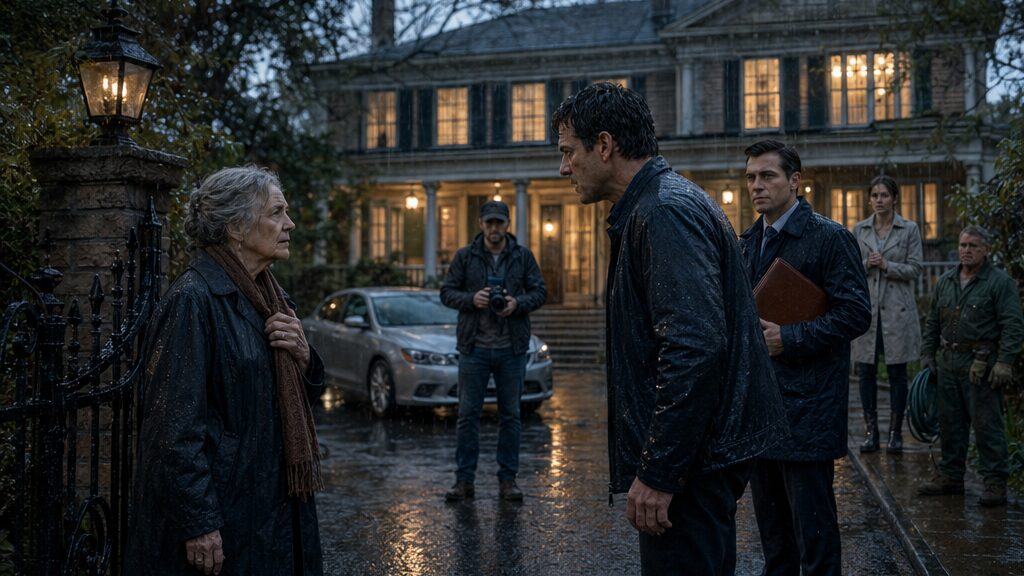
When Her Children Put The House Up For Sale, She Stood Outside The Gate In The Rain
Chapter 1: The Woman Outside The Locked Gate
The rain had been falling since late afternoon, soft at first, then steady enough to turn the streetlamps into trembling yellow circles on the pavement. By seven, the gutters along Briar Lane were carrying leaves downhill in thin brown streams, and the iron gate in front of Virginia Bennett’s house shone black under the water.
Virginia stood on the sidewalk outside it, one hand wrapped around the cold bar of the gate, the other clutching the brown wool scarf at her throat.
She had not meant to be outside this long.
The key was in her coat pocket. She had touched it three times already, felt the familiar oval head of it beneath the lining, and still she had not taken it out. The gate had stuck that morning when Dennis Walker came by to clear the drain near the driveway. He had said the hinge needed oil. Virginia had nodded, thanked him, and told him not to worry over it in the rain.
Now the gate was not stuck. She knew that. The lock waited for the key the way it always had.
Still, she stood there.
Beyond the bars, the house rose back from the road with its porch lights on. It was not grand the way strangers imagined when they slowed down to look at it. It was old and broad-shouldered, with chipped paint on the lower trim and ivy that had to be cut back every spring. The front porch sagged on the left if you knew where to look. One upstairs shutter had been repaired so many times that the slat lines no longer matched. But in the rain, behind the iron, with the lamps glowing in the windows, it looked almost formal.
Like something protected.
Like something waiting.
Virginia tightened the scarf. Her late husband had bought it from a church table one December because he said brown suited her better than red. She had laughed at him then. “You only say that because the red one costs six dollars more.”
He had brought it home anyway, folded inside tissue paper, and she had worn it every winter since.
A bicycle tire hissed against the wet curb behind her.
“Mom?”
Virginia turned.
Brian Bennett swung one leg off a black bicycle and caught himself with a boot on the pavement. His dark jacket was beaded with rain, his face flushed from the ride. He was fifty-one years old, but in that moment, with rain dripping from his hair and his jaw clenched too hard, Virginia saw the boy who used to race the length of the driveway and then blame the gravel when he fell.
“What are you doing out here?” he demanded.
His voice cracked through the rain. Not loud enough for the whole street, but loud enough to make Virginia’s fingers close tighter around the gate.
“I was taking air.”
“Taking air?” He looked past her at the house, then back at her. “It’s raining.”
“I noticed.”
“You scared Kimberly half to death. She called the house twice. She called me because you weren’t answering.”
“I don’t carry the phone into the yard.”
“You’re not in the yard.” He wheeled the bicycle closer until it stood between her and the curb. “You’re standing in the street in the dark.”
Virginia looked down at the front tire, angled across the sidewalk. A small red reflector blinked whenever rain struck it. “I’m on the sidewalk.”
“That is not the point.”
“No,” she said quietly. “I suppose it isn’t.”
Brian rubbed a gloved hand over his mouth. He had his father’s mouth when he was angry, a straight line trying to hold back too much. But his father’s anger had usually been aimed at leaky pipes, bad weather, broken tools. Brian’s anger came with lists.
“Did you forget the code?” he asked.
Virginia blinked once.
“The gate code,” he said. “Did you forget it?”
“I have a key.”
“Then why are you standing out here?”
She could have told him the truth, or some of it. That she had come outside to look at the west corner of the fence where the realtor’s flyer had been tucked between the bars that afternoon. That she had stood there reading the printed promise of “discreet valuation” until the words blurred. That she had gone back inside, made tea, let it cool, and come outside again because the house suddenly felt crowded by decisions she had not made.
Instead, she said, “I was thinking.”
Brian let out a breath that was almost a laugh and almost not. “Mom, this is what we’re talking about.”
“This?”
“Yes, this. Standing outside alone in the rain. Not answering calls. Making everybody wonder if you fell or wandered off or—”
“I did not wander.”
“I didn’t say you did.”
“You did,” Virginia said. “You just put it in a softer coat.”
He looked away toward the house. The rain caught on his eyelashes. For a moment she saw exhaustion there, not just irritation. He had come across town after work. On a bicycle, apparently, because he hated trying to find parking on her narrow street when the drainage crew left cones along the curb. His shoulders rose and fell, and she almost touched his sleeve.
Then he said, “We can’t keep pretending this is working.”
The porch light hummed behind the gate.
Virginia’s hand slipped into her pocket and closed around the key. “What is ‘this,’ Brian?”
“You know what I mean.”
“I would like to hear you say it.”
He stared at her, rain sliding down the side of his face. “The house. You here alone. The repairs. The stairs. The gate that sticks half the time. The heating system Dennis keeps patching together like it’s still 1985.”
“It was installed in 1998.”
“That doesn’t help your case.”
Virginia looked through the bars toward the front door. Inside, the hall lamp would be lit. The umbrella stand would be exactly where she left it. The small rug near the stairs would be crooked because she had caught it with her heel that morning and not yet straightened it. To Brian, those things had become evidence.
“You and Kimberly have been talking,” she said.
“We’ve been worried.”
“That is not the same answer.”
His expression tightened. “Fine. Yes. We’ve been talking.”
“About me.”
“About what’s best.”
Virginia took the key out but did not put it in the lock. She held it against her palm, hidden by her fingers. “You could have talked with me.”
“We tried. Every time we bring it up, you change the subject.”
“Because every subject seems to end with me leaving my home.”
Brian’s gloved hand lifted, pointing not quite at her, not quite at the house. “Nobody is throwing you out.”
The words were wrong. They landed between them too quickly, as if he had been practicing against an accusation she had not made.
Virginia looked at him then, really looked. His wet hair, his jaw, the restless impatience of his foot near the bicycle pedal. Behind all of it there was something frightened, but fear in Brian had always dressed itself as management.
“What have you done?” she asked.
He frowned. “What?”
“What have you and Kimberly done?”
“Nothing has been decided.”
“That is another answer that is not an answer.”
“Mom.”
“Brian.”
He wiped rain from his forehead and spoke in a lower voice. “Tomorrow we’re having a family meeting. Kimberly is coming over. I asked someone to give us numbers. Just numbers.”
“Someone.”
“A realtor.”
Virginia held still.
“He’s not listing anything,” Brian said quickly. “He’s just coming to look. We need to know what we’re dealing with.”
“We?”
“You know what I mean.”
“Yes,” she said. “I’m beginning to.”
His face changed. A flash of guilt crossed it and was gone. “This is exactly why I didn’t want to tell you out here.”
“No. You didn’t want to tell me before I had to watch a stranger walk into my house with your permission.”
“Don’t make it sound like that.”
“What should I make it sound like?”
“Like your children are trying to keep you safe.”
Virginia slid the key into the lock. The old mechanism resisted, then gave with a heavy click she felt in her wrist. Brian reached forward as if to help, but she pushed the gate open herself. It moved inward a foot, groaning on its hinges.
She stepped through, then paused.
Brian stood outside with the bicycle, wet and rigid, as if he had ridden there to rescue her and found himself accused of trespass.
For a moment she wanted to say his name gently. She wanted to ask whether he had eaten, whether the ride had hurt his knee, whether he still kept antacids in his desk drawer. Mothering rose by habit even when it had nowhere safe to go.
Instead, she said, “Your father built this gate because he believed a home should not be entered by force.”
Brian’s mouth tightened. “Dad built a lot of things that don’t work anymore.”
Virginia absorbed that quietly. Then she pulled the gate open wider.
“You may bring your bicycle in before it rusts,” she said.
He did not move.
“Tomorrow,” he said, “we’re having the meeting whether you like it or not.”
Virginia looked at the house, then at the black iron shining between them.
“That,” she said, “is what worries me.”
Chapter 2: The Meeting They Called Care
By noon the next day, Virginia had straightened the rug by the stairs, wiped the kitchen counters twice, and put the brown scarf over the back of the chair beside the living room window.
She did not wear it.
The house smelled faintly of lemon polish and rain-damp wood. The storm had passed before sunrise, but water still dripped from the eaves in uneven beats, tapping the metal awning outside the side door. Virginia had opened two windows for air even though the May morning was cool. She did not want the house to feel shut up when her children arrived. Shut up was a phrase people used before they said worse things.
The tea tray sat on the low table: three cups, a plate of crackers, the small jar of orange marmalade Kimberly liked though she always said she was trying not to eat sugar. Virginia had almost put out four cups, then stopped.
She did not know the realtor. He did not get tea yet.
At twelve thirty-five, Kimberly Carter came through the front door without knocking, then stopped herself in the hall. “Mom?”
“In here.”
Kimberly appeared in the living room carrying a canvas tote bag against one hip. She was forty-eight, neat even when tired, with her hair pinned at the back and worry folded into the corners of her mouth. She kissed Virginia’s cheek too quickly, then looked at her face for signs.
People had begun doing that. Searching her eyes as if confusion left fingerprints.
“You look tired,” Kimberly said.
“I am tired.”
Kimberly flinched. “I didn’t mean—”
“I know what you meant.”
A car door closed outside. Brian’s voice followed, speaking into his phone. Kimberly glanced toward the window. Through the glass, Virginia saw her son cross the wet path with a folder tucked beneath his arm. He did not look at the gate when he came through it.
Kimberly set the tote bag beside the couch. Something glossy and blue peeked from the top.
Virginia sat in her armchair. It had been her husband’s chair first, then hers after he died because she could not bear seeing it empty across from her every evening. The left arm was worn where his hand had rested through years of ball games and bills and late-night weather reports.
Brian entered with rain on his shoes and purpose in his shoulders.
“Okay,” he said, before sitting. “Let’s just talk.”
Virginia picked up her teacup. “That would be new.”
Kimberly’s eyes dropped to her lap.
Brian placed his folder on the table, careful not to touch the tea tray. “Mom, we’re not here to fight.”
“You said the meeting would happen whether I liked it or not. I may have mistaken that for an invitation to fight.”
His jaw flexed. Kimberly leaned forward. “Can we please start over?”
Virginia looked at her daughter. Kimberly’s concern was different from Brian’s. Softer, but not harmless. It came wrapped in calls to doctors, articles printed from the internet, a voice that dropped lower whenever she used the word fall.
“Start,” Virginia said.
Kimberly pulled the blue brochures from the tote and laid them on the table. Not too close to Virginia, not yet. On the cover, an older couple smiled in a garden too green to be real. Behind them, a building with wide windows promised independence in letters large enough to be read by adult children across a room.
“I visited two places,” Kimberly said. “Just to understand what options exist.”
“Places.”
“Communities,” Kimberly corrected gently. “Not nursing homes. Apartments. Meals if you want them. Transportation. People around.”
“I have people around.”
“Dennis is eighty-one,” Brian said.
“Dennis is seventy-six.”
“That’s still not a support system.”
Virginia took a sip of tea. It had gone bitter. “I was unaware people expired as neighbors after seventy-five.”
Kimberly closed her eyes briefly. “Mom.”
Brian opened the folder. Papers slid against each other with a dry whisper that made Virginia think of hospital forms.
“I brought repair estimates,” he said. “The porch, the furnace, the upstairs bathroom, the back gutter, the driveway drainage. Even being conservative, it’s a lot.”
Virginia looked at the top page without reaching for it. “I know what the house needs.”
“With what money?”
Kimberly said, “Brian.”
“No, we have to be honest.” He tapped the folder. “This isn’t about memories. It’s about whether the house is safe and sustainable.”
“There it is,” Virginia said.
“What?”
“The sentence people say when they are about to put a price on a life.”
Brian sat back. “That’s not fair.”
“Neither is discussing my home as if I am already unable to hear you.”
Silence moved through the room. Rainwater ticked outside.
Kimberly reached into the tote again and removed a smaller folder, cream-colored, expensive-looking. She held it with both hands. “Frank Miller is a realtor Brian knows through work. He said he could do a valuation without any obligation.”
Virginia looked from the folder to Kimberly’s face. “You said you visited two places.”
“I did.”
“And he said he could do a valuation.”
Kimberly’s expression weakened. “Yes.”
“So there are two roads on your map. One out of my house, and one away from it.”
Brian leaned forward. “Mom, the house may be worth far more than you think. That could pay for care, comfort, anything you need.”
“I need to be asked before strangers are invited to measure my rooms.”
“Nobody is measuring anything today.”
Virginia watched his eyes. Brian was not a good liar. He was not a cruel man, either, and somehow that made his pressure harder to bear. Cruelty could be rejected cleanly. Fear pretending to be efficiency kept finding new doors.
“When is he coming?” she asked.
Kimberly looked at Brian.
“Just to talk,” Brian said.
“When?”
The doorbell rang.
No one moved.
The sound seemed to travel through the walls, up the staircase, into rooms where children had once slept and argued and left wet towels on the floor. Virginia set down her teacup slowly. The china clicked against the saucer.
Brian stood. “I told him one o’clock.”
Virginia looked at the mantel clock. It was one minute before.
“You told him to come before this conversation had begun.”
“I thought if he explained—”
“You thought if a stranger sat in my living room, I would behave.”
His face colored. “That is not what I thought.”
Kimberly whispered, “Brian, maybe he should wait.”
The bell rang again, shorter this time.
Virginia rose from the chair. Her knees protested, and she hated that both her children noticed. She did not hurry. She crossed to the window first and looked out through the lace curtain.
A silver car sat at the curb. A man in a navy raincoat stood on the porch holding a leather folder. Behind him, near the sidewalk, another person lifted a camera bag from the trunk.
Virginia’s hand went to the back of the chair where the scarf waited. She touched the wool but did not pick it up.
“There is a photographer,” she said.
Brian came to the window. “Just exterior shots. For reference.”
Kimberly stood now. “You said valuation.”
“It helps to have records.”
“Records for whom?” Virginia asked.
Brian did not answer quickly enough.
The doorbell rang a third time.
Virginia walked past her children into the hall. Her hand hovered near the knob, then rested there. The brass was cold. She could see, in the narrow glass panel beside the door, the blurred shape of Frank Miller waiting under her porch roof.
Her house held its breath behind her.
When she opened the door, Frank smiled with professional warmth, the kind that never entered the eyes until a contract was possible.
“Mrs. Bennett? Frank Miller. It’s a pleasure.”
Virginia did not step aside.
Behind her, Brian said, “Mom, let him in.”
Virginia looked at the realtor, then at the wet path leading back to the gate.
“Mr. Miller,” she said, “has anyone told you I agreed to sell my house?”
The smile faltered only slightly.
In that small pause, Virginia knew.
Chapter 3: Pictures For A Listing She Never Approved
Frank Miller held his leather folder against his chest as if it might protect him from the silence in Virginia’s doorway.
“I was told,” he said carefully, “that the family was exploring options.”
“The family,” Virginia repeated.
Behind her, Brian made a sound of frustration. Kimberly said nothing.
Frank glanced past Virginia into the hall, then back at her. He was polished in the way of men who spent much of their lives stepping into other people’s kitchens and praising natural light. His shoes were clean despite the wet path. His smile returned in a reduced form.
“No pressure at all,” he said. “I’m only here to provide information.”
Virginia looked toward the curb. The person with the camera bag had closed the trunk and stood beside the silver car, waiting.
“And the photographs?” she asked.
“Reference only. For valuation accuracy.”
“Photographs of a home not for sale.”
“Mom,” Brian said, coming closer. “Exterior photographs. That’s all.”
Virginia turned slightly. “Did you tell him the family was ready to move forward?”
Brian’s eyes flicked to Frank.
That was answer enough.
Kimberly stepped into the hall. “Maybe we should reschedule.”
“No,” Brian said. “We’re all here. Let’s at least get the facts.”
Virginia looked at her son, then at the realtor, then at the camera bag near the curb. She felt suddenly very tired. Not weak. Not confused. Tired in a place deeper than bone, where years of being reasonable had settled into dust.
“Facts,” she said.
“Yes,” Brian replied. “Facts.”
She took the brown scarf from the chair and wrapped it around her shoulders. Brian watched the motion as if the scarf itself confirmed something he feared about her: fragility, stubbornness, winter carried too long into spring.
Virginia stepped onto the porch.
“Where are you going?” Kimberly asked.
“To see what facts look like from outside.”
The rain had thinned to a mist, but the air remained silver and cold. Frank moved aside to let her pass. Brian followed, already speaking.
“Mom, don’t turn this into something dramatic.”
Virginia went down the porch steps carefully. The photographer straightened by the car and lifted a hand in uncertain greeting.
“No interior photographs,” Virginia said.
The photographer looked at Frank.
“No one said interior,” Frank replied smoothly. “Just the frontage, the lot line, maybe the driveway approach.”
“The driveway approach has belonged to this house longer than any of us have belonged to our opinions,” Virginia said.
Frank’s smile disappeared completely, then returned as a business expression. “Of course.”
Brian came down the steps behind her. “This is exactly what I meant yesterday. Every practical thing becomes emotional.”
Virginia turned toward him. “You brought a realtor and a photographer to my home without permission.”
“I brought information.”
“You brought witnesses to a decision I have not made.”
His voice lowered. “Because you won’t make one.”
Kimberly came onto the porch but did not descend. Her arms were folded, not in anger, but against the cold. “Brian.”
“No,” he said, looking up at her. “We keep circling this. She thinks if she refuses to talk long enough, time stops. It doesn’t. The porch is rotting. The furnace is one cold snap from dying. The upstairs bathroom leaked into the pantry last winter. She’s outside in the rain at night. She doesn’t answer the phone. How long are we supposed to pretend this is independence?”
The photographer stared at the ground.
Frank adjusted the folder under his arm.
Virginia felt each item land. Porch. Furnace. Bathroom. Phone. Rain. He had arranged them like evidence, and the worst part was that none of them were invented. The house did need work. She did forget the phone in other rooms. She had stood outside in the rain.
Truth, she thought, could still be used as a blunt object.
“I have not asked you to pretend,” she said.
“You’ve asked us to ignore reality.”
“No. I have asked you to enter my reality before replacing it with yours.”
Brian’s face tightened. “That doesn’t mean anything.”
“It means,” Virginia said, “that a house is not unsafe because it is old. A woman is not confused because she is quiet. And a son is not caring simply because he is in a hurry.”
His eyes flashed. For a second he looked less like a grown man and more like a boy caught doing something he had already convinced himself was necessary.
Frank cleared his throat. “Perhaps I should come back another time.”
Brian held up a hand. “No. Please. Just take the exterior shots.”
Virginia turned to him slowly.
“Brian,” Kimberly said from the porch, sharper now.
“It’s a photograph,” Brian snapped. “Not a sale.”
“To you,” Virginia said.
The photographer lifted the camera halfway, uncertain whether obedience belonged to Brian, Frank, or the woman standing in the drive.
Virginia walked toward the gate.
The old iron bars were still wet from the night before. Drops clung to the curled work at the top where her husband had once run his thumb and declared it unnecessary but handsome. She had teased him for that. Unnecessary but handsome had described half the things he loved.
Brian followed her. “Where are you going now?”
Virginia did not answer. She reached for the gate, intending to pull it closed, not all the way, just enough to stop the camera from looking straight into the house. But the end of her scarf slipped from her shoulder, caught on one of the iron curls, and tugged her back.
For one undignified second she was trapped by wool and metal.
Brian stepped forward. “Mom, stop. You’re going to hurt yourself.”
“I am caught, not collapsing.”
“Let me—”
“No.”
The word came out quiet, but it held.
He stopped.
Virginia worked the scarf free herself. Her fingers were slower than she wanted them to be. The wet wool clung to the iron. She eased it loose thread by thread while everyone watched: Brian with impatience, Kimberly from the porch with worry, Frank with professional discomfort, the photographer with the camera lowered against his chest.
When the scarf finally came free, Virginia folded the caught end into her palm. A few brown fibers remained on the gate.
She looked at Brian.
“When did my home become something you could open for strangers without asking me?”
The street seemed to quiet around the question.
Brian’s mouth parted, then closed. “That’s not fair.”
“You keep saying that.”
“Because you keep making us sound cruel.”
“No,” Virginia said. “I am asking when concern gave you a key to my consent.”
Kimberly came down from the porch. “Mom…”
Virginia did not look away from Brian. “If I had called a company to empty your apartment while you were at work, and I told you it was because I worried about your stress, would you call that care?”
“That’s different.”
“Because you are younger?”
“Because I’m not—” He stopped.
Old.
The unsaid word hung between them, more honest than the rest.
Virginia nodded once, not in victory. It hurt too much to be victory.
Frank took a step back. “Mrs. Bennett, I apologize if there was any misunderstanding.”
“There was no misunderstanding,” Virginia said, still looking at her son. “There was an understanding that did not include me.”
The photographer shifted his weight. The camera strap creaked.
From the side path came the scrape of a boot on wet gravel. Dennis Walker had entered through the small service gate with a coil of garden hose over one shoulder and a pair of work gloves tucked into his belt. His gray hair was flattened by mist, and his old green jacket shone dark at the seams.
He took in the scene without asking for explanation: Frank’s folder, the camera, Kimberly’s pale face, Brian near the gate, Virginia holding her scarf like a bandage.
“Mrs. Bennett,” Dennis said gently. “You all right?”
“I am.”
Brian turned on him, grateful for a target. “Dennis, this is family business.”
Dennis looked at him for a long moment. “Been watching this family mind its business for forty years.”
“That doesn’t make it yours.”
“No,” Dennis said. “But it does mean I know when the gate is being used wrong.”
Brian laughed once, sharply. “The gate is being used wrong?”
Virginia closed her eyes for half a breath.
Dennis glanced at her, asking permission without words. She gave none. She could not. Not yet.
So he only said, “Your father built that gate after the night you don’t remember.”
Brian’s expression changed, irritation buckling into confusion. “What are you talking about?”
Kimberly stepped off the last porch step. “What night?”
Virginia turned toward the house.
The front windows reflected the gray sky. Behind the glass were curtains she had hemmed herself, a hallway floor her husband had sanded on his knees, walls that had heard every ordinary sound a family could make: crying babies, slammed doors, birthday songs, arguments over homework, the cough that worsened in his final winter.
She had spent years letting her children keep certain memories soft around the edges. She had thought that was mercy.
Now the soft edges were being used to cut her out.
“Not today,” she said.
Brian moved closer. “No. You don’t get to do that. You can’t throw out some mysterious line and then walk away.”
“I did not throw it out. Dennis did.”
Dennis lowered his eyes. “I’m sorry.”
Virginia shook her head once. She was not angry with him.
Kimberly’s voice trembled. “Mom, what night?”
Virginia folded the scarf carefully over her arm. The caught threads showed like a small wound.
“The night your father decided no one would ever again come through that entrance believing fear gave them ownership,” she said.
Brian stared at her. “That doesn’t answer anything.”
“No,” Virginia said. “It doesn’t.”
Frank shifted the folder from one hand to the other. “I think it may be best if I leave.”
“Yes,” Virginia said. “I think it may.”
Brian looked at him. “Frank—”
“No,” Kimberly said softly. “Let him go.”
The photographer returned the camera to the bag. No pictures had been taken. The silver car pulled away a minute later, its tires whispering along the wet curb.
Brian remained by the gate, breathing hard through his nose, his bicycle from the night before still leaning beneath the porch where he had left it. Kimberly stood halfway between him and Virginia, divided by blood and doubt.
Virginia walked back toward the house.
At the steps, Brian called after her, “You can’t keep hiding behind stories.”
She stopped but did not turn.
Behind her, the iron gate moved slightly in the wind, not closing, not opening.
Dennis’s quiet voice carried through the damp air.
“Brian,” he said, “she remembers that night better than any of us.”
Virginia went inside before her son could ask again.
Chapter 4: The Night Behind The Iron
For two days, Virginia let the house return to its ordinary sounds.
The furnace clicked before dawn. The refrigerator hummed in the kitchen. Somewhere behind the wall near the downstairs closet, the old pipes knocked three times whenever she ran hot water, as if the house had a private code. She watered the fern by the back window, sorted mail into piles, and wrote a check for the electric bill with the same slow care she had used for forty-seven years.
Brian did not call.
Kimberly called twice and hung up once before Virginia could reach the phone. The second time, she left a message that began with “Mom, I don’t want to push,” which meant she did, only with less force.
Virginia listened to the message while standing by the kitchen sink. Outside, the iron gate sat closed at the end of the drive. A few brown threads from her scarf still clung to one of the curled bars, too small to see from the street but bright in her mind.
On the third morning, Kimberly came alone.
She knocked.
That mattered enough that Virginia opened the door.
Kimberly stood on the porch holding a paper bag from the bakery on Hill Street. “I brought the rolls you like.”
“I still have teeth,” Virginia said.
Kimberly’s mouth trembled into the smallest smile. “I know.”
Virginia stepped aside.
They ate at the kitchen table because the living room still felt full of Frank Miller’s folder, though he had taken it with him. Kimberly broke her roll into careful pieces but did not eat much. Virginia buttered hers and waited.
Her daughter finally said, “I didn’t know Brian had asked for photographs.”
“No.”
“I knew about Frank. I knew Brian wanted numbers. I didn’t know he’d said we were ready.”
Virginia looked at the rain-streaked window above the sink. “Were you?”
Kimberly’s fingers stilled over the plate.
“I was scared,” she said.
“That is not what I asked.”
“I know.” Kimberly swallowed. “Part of me was ready for someone else to tell us what to do.”
Virginia heard the honesty and did not soften too quickly. “It is tempting.”
“What is?”
“Handing the trouble to a person with a folder.”
Kimberly stared down at the crumbs. “Mom, what did Dennis mean?”
Virginia stood and carried her plate to the sink.
“About the night Brian doesn’t remember,” Kimberly added.
Water moved in the pipes when Virginia turned the faucet. Knock. Knock. Knock.
“Brian was six,” Virginia said. “You were three. He remembers the bicycle he got that Christmas, and the dog that bit the mailman, and how your father let him stay up late for the moon landing rerun. He does not remember how close we came to losing this place.”
Kimberly did not speak.
Virginia turned off the water. “Your grandfather had a brother. Frank, though not our Frank Miller. He had charm enough to make bad ideas sound like favors. Your father trusted him with a repair loan after the first roof leak. The paperwork was not what your father thought.”
Kimberly’s face changed. “Someone tried to take the house?”
“Tried to make us sell it fast. To him. For less than it was worth.” Virginia dried her hands on a towel. “He came here one night with two men and a paper your father had never agreed to sign. It was raining. He said we were behind, said he was saving us from embarrassment. He said family should settle things quietly.”
The kitchen seemed smaller around the memory.
Virginia could still see her husband at the front door, one hand pressed flat against the wood, his work shirt damp at the collar. She could see Brian at the top of the stairs in his blue pajamas, rubbing his eyes. Kimberly had slept through most of it, a warm weight in Virginia’s arms. Outside, headlights had cut across the wet driveway. Voices had risen. Her husband, usually patient to the point of foolishness, had said one sentence so quietly the whole porch went still.
“No one enters my home by making my wife afraid.”
Kimberly’s eyes shone. “Dad said that?”
“He said it once. Then he spent the next two years paying lawyers and roofers and banks and anyone else who needed paying.” Virginia folded the towel. “The gate came later. Not because he wanted to keep people out. Because he wanted anyone who came in to know there was a line.”
Kimberly looked toward the front hall as if she could see through the walls to the iron bars. “Why didn’t you tell us?”
“You were children.”
“We’re not children now.”
“No,” Virginia said. “Now you are the ones arriving with papers.”
Kimberly flinched, and Virginia regretted the sharpness, though not the truth.
“I’m sorry,” Kimberly said.
Virginia sat again, slowly. “I do not want your sorrow if it only lasts until the next estimate.”
“It isn’t just estimates.” Kimberly pressed her palms to the table. “The upstairs bathroom did leak. You didn’t tell us for three weeks. The porch board near the swing is soft. You stand on chairs to reach things you shouldn’t. I am not trying to steal your life.”
“I know.”
“Do you?” Kimberly’s voice cracked. “Because every time I say I’m afraid, you hear Brian.”
Virginia looked at her daughter then, and the kitchen blurred a little. Kimberly had been the child who stood in doorways with both hands on the frame, watching before entering. She had grown into a woman who mistook vigilance for love because no one had taught her where worry should end.
“I hear my own fear too,” Virginia said.
Kimberly wiped her cheek quickly. “Of what?”
“That if I accept one hand on my elbow, you will take the house key from the other.”
Neither of them moved.
Then Kimberly reached into her tote and pulled out a small notepad, not a brochure. “What if we made a list you control? Repairs. Help. Calls. What you want, not what we already decided.”
Virginia looked at the notepad. It was plain yellow paper, the kind she used for grocery lists. No glossy smiles. No promises of cheerful old people in buildings she had never seen.
“Brian won’t like that,” she said.
“I know.”
“He thinks a fast decision is the same as a correct one.”
Kimberly lowered her eyes. “He found the old repair ledger in the desk yesterday.”
Virginia’s hands went still.
“He came by after you didn’t answer. I told him to leave it alone, but he said he needed real numbers. Mom, he saw the furnace notes, the roof patches, the drainage bills.”
Virginia pushed back her chair.
“Mom—”
“Where is it?”
“He took pictures of some pages. He left the book in the desk.”
Virginia walked to the hall, Kimberly following. In the small front room, the rolltop desk stood beneath a framed watercolor of the house in summer. Virginia lifted the cover. The ledger was there, but not where she kept it. Someone had shoved it sideways into a stack of envelopes.
She opened it.
Her husband’s handwriting filled the early pages, square and dark. Later came hers, smaller, more cautious: dates, names, repairs, payments made in installments, notes about which contractor had been honest and which one had overcharged for copper flashing. It was not proof of collapse. It was a record of endurance.
Virginia touched one line from twenty-two years before.
Gate hinge reinforced. D said no charge. Paid him anyway.
Kimberly stood in the doorway. “I’m sorry.”
Virginia closed the ledger. “He will use this.”
“He thinks it proves the house is too much.”
“No.” Virginia held the book against her chest. “It proves the house has been cared for.”
Outside, a car slowed near the gate, then moved on. Virginia did not look up.
Kimberly said, “He wants another meeting.”
Virginia kept one hand on the ledger and one on the edge of the desk.
“Then he shall have one,” she said.
Chapter 5: The Offer That Sounded Like Rescue
The bank smelled of carpet cleaner, paper, and the faint burnt edge of coffee kept too long on a warmer.
Virginia had not been inside that branch since the lobby was remodeled. The old teller windows were gone, replaced by low desks and glass partitions that made everyone appear polite and trapped. A young clerk offered her water. Virginia thanked her and declined. She did not want a plastic bottle sweating in her hand while she discussed the price of staying home.
Brian sat beside her, knees angled toward the desk, phone facedown near his thumb. Kimberly sat on Virginia’s other side. She had come because Virginia asked, not because Brian had. That difference sat quietly between them.
Across the desk, the bank clerk scrolled through numbers on a monitor. “A home equity line is possible,” the clerk said, “but with fixed income and the existing maintenance costs you’ve listed, the rate may not be ideal.”
Brian leaned forward. “That’s what I’ve been saying.”
Virginia looked at him. “You have been saying many things.”
The clerk glanced between them and chose the computer screen.
Brian lowered his voice. “Mom, I’m not trying to embarrass you. I’m trying to avoid pretending the math isn’t math.”
Virginia almost smiled. Her son had always trusted numbers more than rooms. Numbers did not remember what you had promised. Numbers did not know which stair creaked or which window caught the morning light first.
“What about a smaller repair loan?” Kimberly asked.
“Possible,” the clerk said. “But again, depending on scope.”
Brian opened his folder, the same one from the first family meeting, now thicker. “The scope is the problem. Porch, furnace, drainage, bathroom. If we do this piece by piece, we burn cash and still end up needing to sell later.”
“We do not burn cash,” Virginia said. “We spend it.”
“On a house that’s swallowing it.”
Virginia turned her head.
Brian looked tired. There were shadows under his eyes she had not noticed in the living room because anger had lit him too brightly. Now, under bank lights, his face looked gray at the edges.
The clerk excused herself to print options. As soon as she left, Brian rubbed both hands over his face.
“I have a buyer,” he said.
Kimberly stiffened. “You what?”
“Not a buyer. An investor. Someone Frank knows. Cash offer. No listing, no open house, no strangers walking through. As-is. We could avoid months of repairs and showings and stress.”
Virginia stared at the glass partition behind the empty desk. In its reflection, she saw herself small between her children.
“We,” she said.
Brian closed his eyes. “Mom.”
“Did this investor see photographs?”
“No interior ones.”
“Because none were taken.”
“Exterior. County records. Frank knows the neighborhood.”
Kimberly’s voice was sharp. “Brian, you said we were slowing down.”
“I said we needed options.”
“You mean you needed pressure.”
He turned on her. “You were scared too.”
“I still am. That doesn’t mean we drag her to the finish line.”
“The finish line?” Virginia said.
Both of them went quiet.
She placed her purse in her lap and fastened the clasp though it was already closed. “How much?”
Brian hesitated.
Virginia looked at him until he answered.
He named an amount. It was more money than she had ever imagined saying aloud in connection with her house. It was less than the house was worth if treated with patience and respect. It was both a rescue and an insult, which made it dangerous.
Kimberly whispered, “That’s low.”
“It’s cash,” Brian said. “No repairs. No waiting. Mom could choose a good place, not the cheapest place. She could stop worrying about pipes and gutters and whether Dennis can still climb a ladder.”
Virginia’s anger softened at the wrong moment. Not because he was right, but because his voice had changed on Dennis’s name. He was frightened. Beneath all the folders and calls and force, he was frightened of finding her one morning at the bottom of the stairs. He was frightened of bills. He was frightened of failing and calling it love too late.
“Brian,” she said, “are you in trouble?”
His face closed.
Kimberly turned toward him. “What?”
“I’m fine.”
Virginia waited.
“I said I’m fine.”
She had heard that tone before from him as a teenager, standing in the kitchen with a cracked headlight outside and a story already prepared.
The clerk returned with papers, and the conversation folded itself back into safe shapes. Rates. Terms. Monthly payments. Risks. Alternatives. Virginia listened, asked two questions, and thanked the clerk by name because clerks remembered who treated them as people.
Outside, the afternoon had cleared. The pavement shone under weak sun. Brian walked ahead to the curb, then stopped near his car. Kimberly stayed beside Virginia.
“Mom,” she said quietly, “did you mean that? About Brian?”
“I meant the question.”
“Do you think—”
“I think he is pressing too hard for a man with nothing caught under the wheel.”
Brian turned back. “Are you coming?”
At the house, he did not come inside at first. He stood on the porch, looking at the yard, the sagging left edge, the old maple near the driveway where his father had once hung a tire swing. Virginia unlocked the door and left it open behind her.
Eventually he entered.
“I don’t have debts the way you’re thinking,” he said.
Virginia was in the kitchen removing her gloves. Kimberly stood by the sink, very still.
Brian dropped his keys on the table. “Business has been slow. I co-signed something I shouldn’t have. It’s manageable.”
“Then why didn’t you say so?” Kimberly asked.
“Because this is exactly what happens. Suddenly it’s about me instead of the actual problem.”
Virginia folded her gloves. “The actual problem seems to have several rooms.”
Brian laughed without humor. “Fine. Yes. Selling the house would make things easier for everyone. Is that what you want me to say?”
“No,” Virginia said. “I want you to stop calling it only care.”
His eyes reddened. “I am trying to care.”
“I know.”
That seemed to hurt him more than accusation.
He looked toward the hallway. “I can’t do this forever. You think I’m trying to take something from you. Maybe I am. Maybe I’m trying to take the call I’m going to get one day saying you fell and nobody knew. Maybe I’m trying to take the guilt before it arrives.”
Kimberly covered her mouth with one hand.
Virginia moved to the stove though there was nothing on it. She rested her palm near the burner and felt the cool enamel beneath her skin. The house did not rescue her from this. It only held the three of them inside the truth.
“There will be another meeting,” Brian said. “One more. Frank can bring the paperwork just so we understand what signing would look like.”
Kimberly said, “Brian, no.”
Virginia turned.
“One more meeting,” she said.
Both children looked at her.
Brian’s face shifted first, relief breaking through exhaustion. He misunderstood so quickly that Virginia almost corrected him out of pity.
“We’ll keep it simple,” he said. “No pressure.”
Virginia picked up her purse from the chair. “No,” she said. “We will not keep it simple.”
He frowned.
She walked to the front hall and looked through the glass panel beside the door. At the end of the drive, the gate stood closed, black against the pale street.
“Sunday,” she said. “You may bring what you think needs to be brought.”
Brian exhaled, as if some door had opened.
Virginia touched the key in her pocket.
“And I will bring what I need.”
Chapter 6: The Papers On Her Own Table
On Sunday, Virginia opened the gate before anyone arrived.
She did it slowly, with both hands, leaning her weight into the iron until the hinges gave their familiar groan. The morning was clear and cold. Sunlight touched the tops of the bars first, then slid down the black metal in narrow lines. The brown threads from her scarf were still caught there. She had left them on purpose.
Dennis Walker stood on the other side with a toolbox in one hand and a paper bag in the other.
“You sure?” he asked.
Virginia removed the key and slipped it into her pocket. “No.”
He nodded as if that were a complete answer. “Brought biscuits.”
“You brought tools.”
“Brought both.”
She let him in.
By noon, the dining room table was cleared except for four things Virginia had placed with care: the old repair ledger, a yellow notepad, the gate key, and her brown scarf folded in a square. She had not put out tea. This was not a visit that needed softening.
Kimberly arrived first, carrying nothing but her purse. She paused when she saw Dennis in the side yard tightening the loose hinge on the service gate.
“Mom asked me,” Dennis said before she could speak.
Kimberly nodded. “Good.”
That single word stayed with Virginia longer than she expected.
Brian arrived at one with Frank Miller.
Frank looked less polished this time, or perhaps more cautious. His folder was thinner than before, but Virginia knew what paper could do even when it traveled lightly. Brian carried his own folder and wore the expression of a man determined to remain calm until others forced him not to.
In the dining room, Frank stopped at the sight of the ledger and scarf. Brian noticed the gate key.
“What’s this?” he asked.
“A meeting,” Virginia said.
He set his folder down but did not sit. “Mom, I thought we agreed to review the listing paperwork.”
“You agreed to bring it.”
Kimberly sat beside Virginia without being asked. Brian saw that and looked away.
Frank cleared his throat. “Mrs. Bennett, I want to say first that I regret the misunderstanding the other day. My role here is only to provide clarity.”
“Clarity is welcome,” Virginia said. “Pressure is not.”
Frank nodded and opened his folder. “This is a standard listing agreement. Nothing would be active until signed. There are also disclosure forms, preliminary market analysis, and suggested preparation steps.”
Brian sat now, leaning forward. “Just look at it.”
Virginia did. Frank slid the top pages across the table. She read the first line, then the second. Her name appeared in print beside the property address. Seeing both together made her feel oddly distant from herself, as if a stranger named Virginia Bennett owned the house and might be persuaded to leave it.
She placed one hand flat on the paper.
Brian’s shoulders loosened slightly.
Then she pushed it back.
“I will not sign.”
His face hardened. “You haven’t even read it.”
“I read enough to know what it asks.”
“It asks permission to help you sell when you’re ready.”
“No,” Virginia said. “It asks me to turn readiness into a signature you can point to later.”
Frank looked down at his folder.
Brian’s voice rose. “That is not fair.”
Kimberly whispered, “Brian.”
“No. She does this. She makes every practical step sound like betrayal.”
Virginia unfolded the yellow notepad. “Here are practical steps.”
Brian stopped.
She put on her reading glasses. Her hands shook once, and she let them. She would not hide every tremor just to keep him from using it, and she would not perform strength as if age were a courtroom charge.
“First,” she said, “Dennis will handle monthly exterior checks. Gutters, gate, porch boards, drainage. He has agreed to tell me what he cannot do, and I have agreed to believe him.”
From the hallway, Dennis said, “In writing, if needed.”
Virginia continued. “Second, the downstairs study will be converted into a bedroom before winter. Kimberly found a contractor for estimates, not decisions.”
Kimberly nodded. “Estimates only.”
“Third, a home-care nurse will come twice a week for six weeks. After that, I decide whether the schedule helps or insults me.”
Brian stared at the paper. “A nurse?”
“Yes.”
“Since when?”
“Since I called.”
“You called?”
Virginia looked at him over her glasses. “The telephone works in both directions.”
Kimberly pressed her lips together, not smiling exactly.
Virginia went on. “Fourth, the upstairs bathroom repair begins before anything cosmetic. Fifth, no realtor, buyer, photographer, moving crew, assisted living coordinator, or investor enters this property without my invitation.”
Frank sat very still.
Brian’s hand closed around the edge of his folder. “And how are you paying for all that?”
“With my savings, a small repair loan if the terms are acceptable, and by not selling my home below value to a cash investor because my son is afraid.”
His face went white in patches. “You had no right to bring that into this.”
“You brought it in when you made my house the answer to a question you would not ask out loud.”
Kimberly looked between them. “Brian?”
He stood. The chair legs scraped hard against the floor. “So that’s what this is. You two talked, and now I’m the villain.”
“No,” Virginia said. “You are my son. That is why this hurts more.”
“You think I want your money?”
“I think you want relief.”
He laughed, but it broke halfway. “And that’s wrong?”
“No. But taking mine without my consent is.”
The room went quiet.
Frank closed his folder. “Mrs. Bennett, I believe my part here is finished.”
Brian turned. “Frank, sit down.”
Frank did not. “No. I was told there was family agreement. There is not.”
He gathered his papers, careful to leave nothing behind. At the door, he paused. “For what it is worth, Mrs. Bennett, the house deserves a patient sale if you ever choose one.”
“If,” Virginia said.
He nodded. “If.”
When he left, the house seemed to breathe out.
Brian remained standing. Kimberly’s eyes were wet, but she did not speak for him. That was another small mercy.
Virginia picked up the gate key and laid it on top of the unsigned listing agreement Brian had not yet taken back.
“Your father gave me this key after the gate was finished,” she said. “He said a lock was only fear unless the person inside could choose when to open it.”
Brian looked at the key, then at her.
“I am not locking you out,” she said. “But I am done letting you push your way in and call it love.”
His mouth twisted. “So you’d rather keep the house than trust your own children?”
The question struck exactly where he meant it to.
Virginia’s fingers tightened around the edge of the table. For one moment she saw him at six years old at the top of the stairs, small and frightened, hearing adult voices below. She saw him grown now, still frightened, still trying to end the fear by controlling the door.
“No,” she said. “I would rather trust my children in a house where I am still allowed to be their mother.”
Brian looked away first. His shoulders rose, then fell.
From outside came the low groan of the gate as Dennis tested the hinge. Open. Close. Open.
Virginia did not move until the sound stopped.
Chapter 7: Who Gets To Open The Gate
For several weeks after the Sunday meeting, the house did not become peaceful.
Peace, Virginia decided, was too clean a word for what came after a family stopped pretending. What came instead was awkwardness, then silence, then small offerings made without knowing whether they would be accepted.
Kimberly came on Tuesdays with groceries and left the receipt on the kitchen counter, not because she expected repayment, but because Virginia had asked her not to make help invisible. The first time, Virginia wrote a check. The second time, Kimberly accepted it without argument. The third time, she brought a notebook and asked where Virginia wanted the canned soup kept.
“Not the top shelf,” Virginia said.
Kimberly looked up quickly.
Virginia added, “I have learned one or two things from being lectured.”
Her daughter laughed, but softly, as if laughter might disturb something still healing.
The downstairs study changed slowly. Dennis helped move the bookcase away from the inner wall. A contractor came, looked at the room, and spoke directly to Virginia. She liked him for that before she liked his estimate. The home-care nurse arrived on a Thursday morning with a canvas bag and kind eyes. Virginia disliked the idea of her immediately, then liked her more when she did not pretend not to notice.
“I’m here for six weeks,” the nurse said. “Then you can fire me.”
Virginia had considered answering sharply, but the woman’s face held no pity. So Virginia said, “We will see whether you earn firing.”
The nurse smiled. “Fair.”
Brian did not come for nineteen days.
He called once and left a message so stiff it sounded as though he had written it on a legal pad first. He said he hoped she was well. He said he was glad she had arranged help. He said he needed time.
Virginia listened to it twice, then deleted it. Not out of anger. Out of mercy. He would not have wanted that version of himself kept.
On the twentieth day, an envelope arrived.
It was plain white, with Brian’s handwriting across the front. No return address, though he had dropped it through the mail slot himself; Virginia knew because the gate had not opened, and because the envelope carried a faint wet mark from the morning mist.
She left it on the hall table until after lunch.
Then she made tea, sat in her husband’s old chair, and opened it with the small brass letter opener from the desk.
Mom,
I have started this three times and made it worse each time.
I wanted to say I was only trying to help. That is true, but not enough. I was trying to help in a way that made me feel less afraid. I used your house like a solution before I treated it like your home. I told myself I was being practical because that sounded better than admitting I was scared and embarrassed and in trouble.
I should have told you about the business. I should not have talked to Frank before you agreed. I should not have spoken over you in your own driveway.
I do not know how to fix what I did. I am not asking you to make me feel better about it.
I am sorry.
Brian
Virginia sat with the paper in her lap until the tea cooled.
There were things missing. There always were in apologies. He had not mentioned the photographer. He had not named the investor. He had not said he understood the gate, only that he understood he had crossed it wrongly. But he had not asked her for comfort. That mattered.
She folded the letter and placed it inside the repair ledger between the page with the reinforced gate hinge and the first estimate for the downstairs study.
Later that afternoon, Kimberly arrived with a bag of apples and a small potted basil plant. She found Virginia on the front porch, watching Dennis at the gate.
“He oiled it again?” Kimberly asked.
“He says the hinge likes attention.”
Kimberly sat in the other porch chair. The left board beneath it had been replaced two days before. Fresh wood made a pale rectangle among the weathered planks.
“Brian wrote to you,” Virginia said.
Kimberly looked at her hands. “He told me.”
“He did not ask me to call.”
“That’s new.”
“Yes.”
For a while they watched Dennis test the gate. Open. Close. Open. The movement was smoother now, the groan lower, almost companionable. Across the street, a neighbor pulled weeds near the curb and pretended not to look over. People had noticed the realtor’s car that day. They had noticed when it did not return.
“Mom,” Kimberly said, “do you still want me to come next Tuesday?”
Virginia heard what lived under the question: Do you want me near, or have I become part of the pressure too?
“Yes,” she said. “But not with groceries unless I ask.”
Kimberly nodded. “Coffee?”
“That would be acceptable.”
“With the receipt?”
“Always.”
Kimberly smiled down at the porch boards.
Near the gate, Dennis lifted one hand. “Mrs. Bennett, try it now.”
Virginia rose carefully. Kimberly started to stand too, then stopped herself. Virginia noticed and was grateful.
She walked down the path alone.
The yard had begun to dry after weeks of spring rain. The maple leaves were fully open now, bright and new, though the trunk was scarred where the old tire swing had rubbed against it. The driveway still needed work. The gutter above the dining room still dipped. The house remained itself: imperfect, expensive, too large in some seasons and exactly the right size in others.
At the gate, Dennis handed her the key.
“Should open easy,” he said.
Virginia slid it into the lock. The mechanism turned cleanly. She pushed, and the gate moved inward without protest.
“Well,” Dennis said, pleased but trying not to show it too much. “That’s better.”
Virginia stood with her hand on the iron.
For years she had thought of the gate as something her husband built against fear. Then as something he left behind. Then, lately, as something her children had tried to treat as an inconvenience, an old barrier between their urgency and her obedience.
But now, with the hinge oiled and the key warm from her palm, it felt less like a defense than a question asked each day.
Who enters?
Why?
By whose choice?
A car slowed near the curb.
Brian’s car.
Kimberly rose from the porch but did not come down the steps. Dennis looked at Virginia, then at the latch. He did not offer advice.
Brian parked across the street and got out slowly. He wore a gray jacket and no expression ready-made for the moment. In one hand, he carried nothing. No folder. No papers. No brochures. He crossed to the sidewalk and stopped outside the open gate.
“Hi,” he said.
Virginia’s hand remained on the iron. “Hello.”
He looked past her toward the house, then at the repaired hinge, then at Dennis, then back at his mother. “Kimberly said the contractor started.”
“She said correctly.”
“That’s good.”
“Yes.”
He put his hands in his jacket pockets. He looked younger with nothing to hold.
“I don’t need to come in,” he said. “I just wanted to say it outside first.”
Virginia waited.
Brian swallowed. “I’m not asking about the house.”
“I hear that.”
“And I’m not asking you to forgive me today.”
“That is wise.”
A brief, pained smile crossed his face and disappeared. “I talked to someone. About the business. A debt counselor. It’s not fixed, but it’s mine to fix.”
Virginia felt something in her chest loosen, not enough to open completely, but enough to breathe around.
“I’m glad,” she said.
He nodded. His eyes went to the gate beneath her hand. “I keep thinking about what you said. About being allowed to be our mother.”
Virginia looked back at the porch. Kimberly stood there holding the basil plant against her chest, trying not to look as if she were listening.
“I did not stop being your mother when I became old,” Virginia said.
“I know.”
“No,” she said gently. “You are learning.”
He accepted the correction with a small nod.
A breeze moved through the maple, scattering drops left from the morning. One landed on Virginia’s wrist.
Brian shifted his weight. “Can I come by this weekend and fix the loose strip near the pantry door?”
Virginia studied him. The old part of her wanted to say yes too quickly, to reward the gentleness, to mend the day by pretending the tear had been smaller than it was. Another part, the wiser and more tired part, knew that love repaired badly when rushed.
“You may come by,” she said. “You may look at it. If it needs fixing, we will decide who fixes it.”
Brian looked down, then nodded. “Fair.”
Virginia stepped back.
The gate stood open.
Brian noticed, and his eyes lifted to hers.
She did not make a ceremony of it. She simply turned and walked toward the house, leaving him to follow if he chose. He did, slowly, closing the gate behind him only when Virginia glanced back and said, “Leave it open.”
He stopped.
“For now,” she added.
He let it stand.
On the porch, Kimberly moved aside so their brother could pass, but he did not pass yet. He stood at the bottom step and looked at the new board, the old rail, the brass number beside the door, the chair where his father had once sat shelling peas into a bowl. Virginia watched him see the house without converting it into value.
Not fully. Not forever. But for that moment.
Inside, the hall smelled of lemon oil and basil.
Virginia hung the brown scarf on the peg by the door instead of carrying it with her. The wool still showed the place where the iron had caught it, a faint pulled thread near the end. She smoothed it once and let it be.
Kimberly went to the kitchen to put on coffee. Dennis packed his tools by the side path. Brian remained in the hall, hands empty, eyes on the rooms.
Virginia walked to the front door and looked back down the drive.
The gate was open inward.
Not wide. Not carelessly.
Enough.
She had not won the house as if it were a prize. She had kept the right to decide what keeping meant. There would be more repairs, more arguments, more mornings when the stairs felt steeper than she wanted to admit. There might come a day when she chose another place, a smaller place, a place with fewer doors to lock and fewer gutters to clear.
But that day would arrive by invitation, not ambush.
Virginia touched the key in her pocket, then took her hand away.
Behind her, Kimberly asked where the coffee filters were, though she knew perfectly well. Brian answered before Virginia could, and got it wrong.
Virginia smiled without turning around.
“Second cabinet,” she said.
Outside, the gate waited in the spring light until she chose to close it.
The story has ended.