The Morning Ruth Bennett Was Taken To Sign Away The House She Still Called Home
Chapter 1: The Boxes Arrived Before Ruth Said Yes
The first box appeared beside Ruth Bennett’s kitchen table at 8:17 in the morning.
She knew the time because the clock over the stove had a tired click in it, a little hitch before the minute hand moved, and she had been watching it while the kettle warmed. The box had not been there when she rinsed her cup. It had not been there when she took two slices of bread from the bag and put one back because she was not as hungry as she had thought. Then the front door opened, Brian called, “Mom?” in the tone people used when they had already let themselves in, and the box entered before he did.
He carried it against his chest with his chin tipped over the top, like he was delivering something harmless.
Behind him came Nicole with two more flattened boxes under one arm and a white folder tucked beneath the other. She smiled too brightly, the way she smiled at restaurant hosts when a table was not ready.
“Morning, Ruth,” Nicole said. “We brought coffee.”
Ruth looked at the kettle, which had begun to murmur on the stove.
“I have coffee.”
“This is from that place Brian likes,” Nicole said, setting a paper cup on the counter. “Less trouble.”
Ruth did not answer. She watched Brian place the box on the floor beside the table where John had once sat every morning with his work boots unlaced and his spoon balanced across his cereal bowl. The box was new and clean, the kind with folded handles punched into the sides. It smelled faintly of cardboard dust and store shelves.
Brian straightened and looked around the kitchen.
“You sleep okay?” he asked.
“Well enough.”
“Take your medicine?”
Ruth turned off the burner before the kettle could whistle. “I am standing here.”
“That’s not what I asked.”
“No,” she said. “It never is.”
He rubbed the back of his neck. He looked tired, but Brian always looked tired lately, even when he arrived with plans. At fifty-two, he had his father’s shoulders and none of his father’s patience. He wore a navy jacket Ruth did not recognize, expensive-looking, the zipper pulled too high for the warmth of her kitchen.
Nicole unfolded one of the boxes with quick, practiced hands. The cardboard snapped into shape.
“What is that for?” Ruth asked.
Nicole paused as if the question surprised her. “Just sorting. Nothing final.”
“Sorting what?”
“Only the things you don’t use,” Brian said. “We talked about this.”
“You talked.”
“Mom.”
There it was already. The soft warning in his voice. Not anger yet. Not quite. The sound of a son trying to keep himself kind while moving his mother out of the way.
Ruth picked up the kettle and poured hot water through the little metal filter John had bought her years ago after she complained that the electric coffeemaker made every cup taste like plastic. The grounds bloomed dark and bitter. Her hands were steady, and she was glad of that.
Nicole opened the white folder. “I printed the assisted living brochures again. Just so they’re all in one place. The one on Maple has a garden club. And a salon. Their dining room is actually very nice.”
Ruth looked at the folder but did not reach for it. The top page showed a smiling gray-haired woman holding a mug in a room so clean it looked borrowed.
“I have a dining room,” Ruth said.
Nicole’s eyes flicked toward the narrow doorway, toward the room with the covered table and the stack of mail Ruth had been meaning to sort.
“You don’t use it,” Nicole said gently.
“I use it when I have people to feed.”
Brian sighed. “That’s part of what we mean.”
The words landed quietly, but Ruth felt them all the same. The house heard them too. She had always believed houses kept the shape of what was said inside them. This one had held babies crying, John laughing, Sarah slamming doors, Brian practicing apologies before prom nights, neighbors singing off-key on Christmas Eve. Now it held the small insult of a box opening beside her table before she had agreed to leave.
Brian moved toward the back hallway. “I want to check the bathroom rail again.”
“It is still attached to the wall.”
“It wobbled last week.”
“It wobbled because you pulled on it like you were starting a lawn mower.”
He stopped and turned. “You fell in March.”
“I slipped.”
“You fell.”
“I bruised my hip. I did not surrender my citizenship.”
Nicole gave a short laugh, then swallowed it when no one joined her.
Brian’s face tightened. “Nobody is saying that.”
Ruth took her coffee to the table. The box blocked the chair where John used to sit, so she pulled out the one beside it. Her brown coat hung on the back, though the house was warm enough. She had put it there the night before after coming in from the porch, and in the right pocket was the folded paper.
She touched the coat without meaning to.
Brian noticed. He always noticed the wrong things.
“Are you cold?”
“No.”
“You keep wearing that coat inside.”
“It has pockets.”
“So do sweaters.”
“Not the right ones.”
Nicole slid the brochures across the table, carefully avoiding the water ring near Ruth’s cup. “Nobody wants to rush you. But there are waitlists, and if we get your name in now, you’ll have choices.”
Ruth glanced at the top brochure. A woman in a coral cardigan smiled beneath the words Independent Living With Support When You Need It.
“Choices,” Ruth said.
“Yes.”
“Do I get one today?”
Brian leaned both hands on the back of John’s chair. The box sat between them like a new family member no one had introduced.
“You get all of them,” he said. “That’s why we’re doing this before there’s an emergency.”
“What emergency?”
“The stairs. The stove. The gutters. The porch boards. The basement steps. The fact that you don’t always answer your phone.”
“I was in the yard.”
“For three hours.”
“I was pulling weeds.”
“You’re eighty-one.”
“The weeds did not ask.”
His jaw shifted. “This is what I’m talking about. You make jokes like this isn’t serious.”
Ruth looked past him through the kitchen window. The backyard was damp from last night’s rain. John’s old shed leaned a little to the left, as it had for fifteen years, resisting collapse mostly out of habit. Beyond it, the maple tree had begun to leaf out, green showing at the tips like a decision.
The house did need work. Ruth knew every loose hinge, every soft board, every pipe that knocked in the wall when the upstairs sink ran too long. She was not blind. She was not foolish. She was tired of everyone acting as though noticing decay gave them ownership of the cure.
Nicole rose and walked toward the small built-in shelf near the dining room. She lifted a ceramic hen Sarah had painted in fourth grade.
“This can probably go in donation,” Nicole said. “Unless you want to keep it.”
Ruth set her cup down.
“That is Sarah’s.”
“Right, but does she want it?”
“It is not asking to be wanted.”
Nicole held it carefully, but her face had changed. The bright smile had thinned. “Ruth, we can’t keep every single thing because it has a memory attached.”
“We?”
Brian stepped in. “Nicole is trying to help.”
“I did not ask her to sort my daughter’s hen.”
“Mom, please.”
The word please scraped at her more than anger would have. It made him sound patient. It made her sound difficult.
Ruth stood and took the ceramic hen from Nicole’s hands. It was ugly in a dear way, the red paint uneven, one eye bigger than the other. Sarah had cried because the glaze bubbled on the wing. John had called it perfect and placed it on the shelf himself.
Ruth returned it to its spot.
For a while, no one spoke.
Then Brian reached into his jacket and pulled out a folded sheet of paper. Not Ruth’s paper. His was crisp, printed, businesslike.
“I made an appointment for tomorrow,” he said.
Ruth looked at him.
“At the title office,” he continued. “Not to sign anything final. Just to talk. Paul Harris said he can explain the process better than I can.”
“What process?”
Brian’s eyes flicked to Nicole, then back. “The sale process.”
The kitchen seemed to shrink around the word.
Ruth’s hand went again to the coat pocket. Beneath the brown fabric, beneath the worn lining John had once mended with black thread because he could not find brown, her fingers found the folded paper. It was soft at the creases from years of opening and closing, though she had not opened it in weeks.
“You called a man about selling my house,” she said.
“Our house, in a way,” Brian said, then winced as if he heard himself too late. “I mean, the family house.”
“No,” Ruth said. “You meant what you said.”
Nicole closed the folder. “It’s only a conversation. If you hear it from someone neutral—”
“A man waiting to make money from selling my house is neutral?”
Brian’s patience finally cracked. “What do you want me to do? Wait until you fall down the basement stairs? Wait until a pipe bursts? Wait until the place is worth half as much because every repair got delayed?”
Ruth looked at her son. For one sharp second she saw him at ten years old, standing in the same kitchen with mud on his shoes and a broken window behind him, furious because guilt had made him afraid. He had grown taller, harder, better dressed. He still did not know what to do with fear except throw it at someone else.
“I want you,” she said slowly, “to ask before you bring boxes.”
He looked away.
Nicole gathered the brochures into a neat pile, though no one had disturbed them. “Tomorrow is at ten.”
Ruth did not say she would go. She did not say she would not.
Brian picked up the empty box and moved it away from John’s chair, as if that small correction could undo the morning. “Just hear him out, Mom.”
After they left, the house took a long breath.
Ruth stood alone in the kitchen and listened to their car pull away. The paper cup of coffee Nicole brought sat untouched beside the sink. She poured it out, rinsed the cup, and set it in the recycling bin because waste was waste, even when it came dressed as kindness.
Then she took the folded paper from her coat.
She did not open it. Not yet.
She held it against her palm and looked at the box by the table, the one Brian had forgotten to take.
On its side, in thick black marker, Nicole had already written: KITCHEN — KEEP / DONATE.
Ruth folded her fingers around the paper until the old creases pressed into her skin.
Chapter 2: The Lobby Where Everyone Spoke Around Her
The title office had marble floors that made Ruth Bennett’s shoes sound cheaper than they were.
Every step clicked too softly, as if the floor swallowed anything that did not belong. The lobby smelled of lemon polish, new paper, and perfume from the woman at the reception desk. A glass wall separated the waiting area from a hallway of closed doors. Behind it, men and women in suits moved with folders tucked against their sides, never hurried, never uncertain.
Ruth stood just inside the entrance with her brown coat buttoned to the throat.
Brian had offered to take the coat in the parking lot. Nicole had offered again in the elevator. Ruth had refused both times because the folded paper was in the inside pocket now, close enough that she could feel it whenever she breathed.
“You okay?” Sarah asked beside her.
Ruth turned. Her daughter had arrived late, cheeks flushed, hair pulled back in the distracted way of someone who had driven too fast and then pretended not to. Sarah wore work clothes, a green blouse beneath a black cardigan, and carried no folder. That comforted Ruth more than it should have.
“I am in a building where people whisper at rugs,” Ruth said.
Sarah smiled, but only halfway. “Brian said this was informational.”
“Brian says many things.”
Across the lobby, Brian stood with Nicole and Paul Harris, a tall man in a dark suit with silver hair combed neatly away from his forehead. Paul had the kind of smile that showed practice instead of pleasure. He nodded while Brian spoke, and his eyes moved once toward Ruth, then away again, as if she were the subject of a meeting but not one of its participants.
Nicole held a slim folder against her chest. She had dressed carefully: cream jacket, gold earrings, low heels. Not flashy. Respectable. Ruth wondered when respectability had become a weapon in the family.
Brian came over. “Paul’s ready for us.”
“For what?” Ruth asked.
“To sit down.”
“You said talk.”
“That’s what I mean.”
Paul approached with a hand extended. “Mrs. Bennett. Paul Harris. Good to finally meet you.”
Finally. As though Ruth had been delaying his life.
She looked at his hand, then shook it because John had taught the children that manners were not surrender. Paul’s palm was smooth and warm.
“We have a conference room prepared,” he said. “Your son has done a careful job gathering information.”
“My son has been busy.”
Brian exhaled. “Mom.”
Paul’s smile did not move. “I understand these transitions can feel emotional.”
“These transitions,” Ruth repeated.
Nicole touched Brian’s sleeve. “Maybe we should sit.”
They moved toward the glass hallway. Ruth followed because Sarah walked beside her, not because anyone had earned her obedience. A security guard stood near the reception desk, hands folded in front of him. He did not look threatening. He did not need to. He was another person in a uniform inside a building where Ruth had not been asked what she wanted.
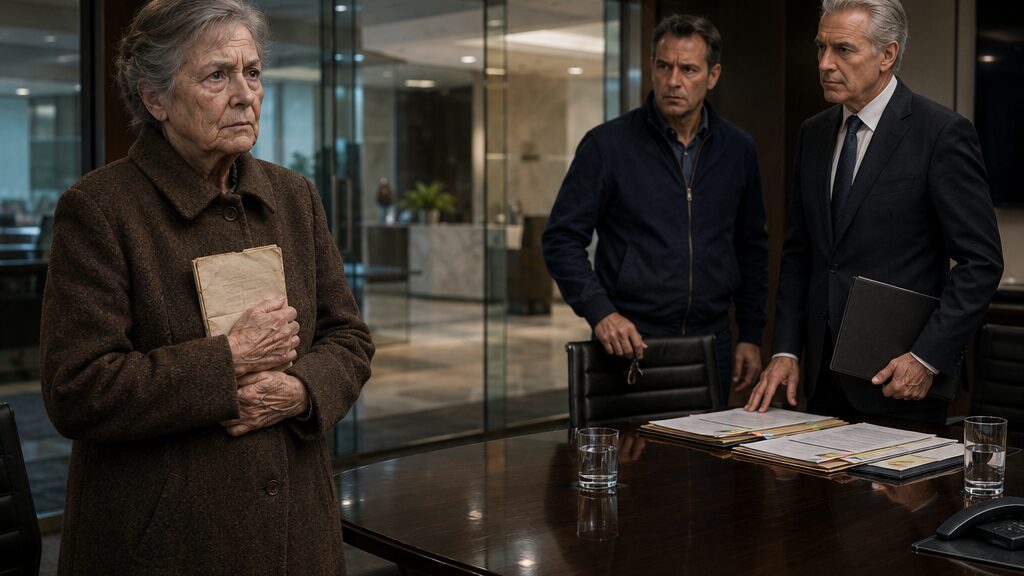
The conference room had a long table, a pitcher of water, six glasses, and a stack of papers arranged before the chair at the head of the table. Ruth stopped in the doorway.
There were small colored tabs on some pages.
Sign here, the tabs said without speaking.
Paul pulled out a chair. “Mrs. Bennett.”
Ruth did not sit.
Brian did. Nicole did. Sarah remained standing for a second, uncertain, then slowly lowered herself into a chair halfway between Ruth and Brian.
Paul took the chair nearest the papers. “Before anything else, I want to reassure you. No one is trying to push you faster than you’re comfortable with.”
Ruth looked at the tabs.
“Then why are there places marked for my name?”
Brian put his hands flat on the table. “They’re standard forms. Paul just printed examples.”
Paul folded his hands. “Exactly. Authorization to prepare listing materials, preliminary disclosure, permission to obtain payoff and property information. These are not a sale contract.”
“They are not nothing either,” Ruth said.
Nicole leaned forward. “Ruth, the house can’t even be properly evaluated unless people can access records.”
“The house can be evaluated by asking the person who lives in it.”
“That’s not what she means,” Brian said.
“It rarely is.”
Paul cleared his throat softly. “Perhaps we should begin with goals. Brian tells me the family is hoping for a smooth process that protects you financially and reduces your responsibilities.”
“The family,” Ruth said.
Paul glanced at Brian, then back. “Yes.”
“Which family?”
Brian’s face colored. “Mom, don’t do this.”
“I am asking.”
Sarah shifted in her chair. “Brian, maybe we should slow down.”
Nicole’s smile returned, tight at the edges. “That’s all we’re trying to do. Slow down enough to make a plan before something happens.”
“Something has happened,” Ruth said. “I was brought to a signing room.”
“It’s a conference room,” Paul said.
Ruth turned her eyes to him. “Does the name change what it is for?”
For the first time, Paul’s smile faltered.
Brian stood. “Nobody tricked you. I told you we had an appointment.”
“You told me I would hear information.”
“You are hearing information.”
“About a decision you already made.”
The silence that followed had weight. Even the air conditioner seemed to lower itself.
Nicole opened her folder. “The photographer is penciled in for this afternoon only because weekends book up. We can cancel if we have to.”
Ruth looked at her.
Sarah’s head turned sharply. “Photographer?”
“For preliminary listing photos,” Nicole said. “Not public. Just to be ready.”
Brian sat down again. “Nicole.”
“What? She’s going to find out.”
Ruth felt the paper inside her coat pocket like a second heartbeat.
Paul adjusted the stack of forms. “Mrs. Bennett, it may help to remember that preparing does not remove your control. It simply gives your family options.”
“My family has options,” Ruth said. “I have a house.”
Brian’s voice dropped. “A house you can’t maintain.”
“A house you stopped visiting except to inspect.”
“That’s unfair.”
“It is accurate.”
He looked wounded, and for one instant Ruth hated that she could still hurt him. A mother’s anger had no clean edge. It cut the hand that held it.
Nicole tapped one page with a manicured finger. “The Maple residence has an opening. It may not last. If we wait until you have another fall, you might not get a choice at all.”
“There it is,” Ruth said.
“What?”
“The word another. Like the first one made me property.”
Brian pushed back from the table. “You’re twisting this.”
“No. I am finally hearing it straight.”
Paul slid one document forward. The paper whispered against the polished table.
“This form would allow us to begin gathering necessary details. Again, not final. It only authorizes—”
Ruth raised one hand.
The room stopped.
She did not raise it high. She did not shake. She simply lifted it, palm outward, as John used to do when neighborhood boys ran across his seeded lawn. Not cruel. Not loud. Enough.
“Mr. Harris,” she said, “why are you speaking to my son about my house while my name is on your paper?”
Paul’s mouth opened, then closed.
Brian stood again. “Because I’m trying to help you.”
Ruth turned to him. “Then say what you are helping me do.”
“We’ve been saying it.”
“No. Say it without brochure words. Say it without safety. Say it without smooth process. Say the thing you brought me here for.”
His eyes flicked toward the receptionist visible through the glass wall. Toward the guard. Toward Nicole. Toward Sarah.
Ruth waited.
Brian’s voice came out rough. “To sell the house.”
There it was. Small. Ugly. Real.
Ruth reached inside her coat and pulled out the folded paper.
It looked worse in that room than it had in her kitchen. Old, soft, creased at uneven angles. One corner had gone gray from years of being held. Against the polished table and white forms, it looked like something rescued from a trash can.
Nicole’s expression changed first. Embarrassment, then irritation.
“Ruth,” she whispered, “please don’t do this here.”
Ruth held the paper to her chest.
“I am not doing this,” she said. “This was brought here.”
Paul spoke carefully. “Mrs. Bennett, if that is a deed or legal document, I’d be happy to make a copy.”
“No.”
Brian rubbed both hands over his face. “Mom, we don’t need Dad’s old papers right now.”
At the word Dad, Ruth’s fingers tightened.
“This,” she said, “is the last thing your father wrote in that kitchen.”
Sarah went still.
Brian’s anger dimmed, not gone, but interrupted.
Nicole’s eyes moved from the paper to Brian. “What is it?”
Ruth did not answer her. She looked at Paul.
“I will not sign a paper in a room where everyone knows the plan except the woman being asked to disappear from it.”
“Mom,” Brian said, quieter now.
She turned toward the door.
Sarah rose. “I’ll drive you.”
“I rode with Brian,” Ruth said.
“I’ll drive you,” Sarah repeated.
For a moment, no one moved. Then Paul gathered the top sheet and tapped it once against the stack, as if restoring order by aligning paper edges.
Brian followed Ruth into the lobby. “This isn’t over.”
Ruth stopped beside the reception desk. The security guard looked away, pretending not to listen.
“No,” Ruth said. “But it is over for today.”
Outside, the April air was cool and wet against her face. Sarah hurried to bring the car around. Ruth stood beneath the awning, the folded paper still pressed flat beneath her hand.
Behind her, through the glass, she could see Brian talking to Paul. Nicole stood with her arms folded. Paul was nodding the way men nodded when money had been delayed but not yet lost.
Sarah’s car pulled up.
Before Ruth opened the door, Paul stepped outside.
“Mrs. Bennett,” he called.
She turned.
His voice was professional again, polished smooth. “I do need to be transparent. The buyers your son mentioned are very motivated, but they won’t wait indefinitely.”
Ruth looked at him, then at the folded paper in her hand.
“That makes two of us,” she said.
She got into Sarah’s car and closed the door before anyone could explain her life to her again.
Chapter 3: The House Looked Smaller With Strangers Measuring It
Sarah Carter had not been inside her mother’s house in three weeks, and that fact sat beside her in the car like another passenger.
She kept both hands on the wheel after pulling into the driveway, though the engine was off. Ruth was already unbuckling her seat belt, movements small and controlled, the folded paper returned to the hidden pocket inside her brown coat.
The house looked the same from the street. White siding that needed washing. Front steps with one corner patched in a darker wood. Porch rail painted by Ruth two summers ago, uneven but determined. A clay pot near the door held nothing but soil and last year’s stem, brown and brittle.
Sarah had been meaning to come by and clear it out.
She had been meaning many things.
“Do you want me to stay?” she asked.
Ruth looked through the windshield at the porch. “Do you want to?”
The question was not sharp, but Sarah felt it.
“Yes,” she said. “I do.”
Ruth nodded once and opened the door.
Inside, the house smelled of coffee, lemon dish soap, and the faint old-wood scent Sarah associated with rainy afternoons and being told to take her muddy shoes off. The box Brian had brought still sat by the kitchen table. KITCHEN — KEEP / DONATE stared up in Nicole’s careful black letters.
Sarah looked at it. “She wrote on it already?”
“She is efficient.”
“Mom.”
Ruth removed her coat and hung it on the back of a chair. For a second, Sarah saw how tired she was. Not fragile exactly, but worn thin at the edges, like cloth folded too many times along the same crease.
“I didn’t know about the photographer,” Sarah said.
Ruth filled the kettle. “No.”
“I wouldn’t have agreed to that.”
“Did anyone ask you?”
Sarah had no answer.
The kettle had only just begun to heat when tires crunched in the driveway.
Ruth turned her head toward the window.
A white van stopped behind Sarah’s car. A man in work pants stepped out, carrying a camera bag and a collapsible measuring stick. Nicole got out of the passenger side, phone pressed to her ear. Brian was not with her.
Sarah’s stomach tightened.
“Oh no,” she said.
Ruth stood very still.
Nicole knocked once and came in before anyone answered. “Hi. I know this looks abrupt, but since we’re all here, I thought we could just get the basics done. Nothing gets posted. It’s only prep.”
The man hovered behind her at the threshold. “Afternoon.”
“It is not afternoon,” Ruth said.
He looked at Nicole, uncertain.
Sarah stepped forward. “Nicole, she said no.”
Nicole lowered the phone. “She said no to signing today. Pictures are different.”
“Pictures of what?” Ruth asked.
“Rooms,” Nicole said. “Measurements. Condition. It helps Paul advise us.”
“Paul can advise someone else.”
Nicole shut the door behind the man as if cold air, not disrespect, were the issue. “Ruth, please don’t make this harder than it needs to be.”
Sarah heard herself say, “You need to leave.”
Nicole stared at her. “Excuse me?”
“The photographer. He needs to leave.”
The man raised a hand slightly. “I can come back another time.”
“No,” Nicole said quickly, then softened her voice. “We’re paying him for the hour.”
Ruth looked at the man. “Did you know I had not agreed?”
His face reddened. “Ma’am, I was just told to do measurements.”
“Then measure this,” Ruth said. “The distance from my front door to your van.”
Sarah almost laughed, but the laugh caught in her throat.
The man looked relieved to have been given an exit. “I’ll wait outside.”
Nicole watched him go, then turned on Sarah. “Great. Very helpful.”
Sarah folded her arms. “What are you doing?”
“What Brian should have done weeks ago.”
“This is Mom’s house.”
“Which is exactly why someone has to be realistic.” Nicole gestured toward the ceiling. “There’s a water stain in the upstairs hall. The porch boards are soft. The furnace is ancient. She fell once already. Are we all supposed to wait until something terrible happens and then act shocked?”
Ruth reached for the kettle though it had not boiled. Sarah noticed and moved closer, but Ruth set her hand on the counter, steadying herself before anyone could help.
“I am in the room,” Ruth said.
Nicole closed her eyes briefly. “I know you are.”
“No,” Ruth said. “You know where I am standing. That is not the same.”
For a moment Nicole seemed almost ashamed. Then her phone buzzed, and the shame vanished beneath irritation.
“It’s Brian,” she said.
“Let it ring,” Sarah said.
Nicole answered it anyway and walked toward the dining room, speaking low. “Yes, I’m here. No, she’s upset. Sarah is making it worse.”
Sarah followed, anger carrying her before she decided to move.
The dining room had become a holding place for things no one wanted to decide. Mail, folded tablecloths, a basket of old greeting cards, a framed school photo of Brian with missing front teeth. Nicole stood beside the cabinet and lifted a stack of papers, looking for a clear surface.
“Don’t touch that,” Sarah said.
Nicole covered the phone. “I need somewhere to write.”
“You have a car.”
Ruth appeared in the doorway. Her eyes went not to Nicole, but to the small shelf near the window where the ceramic hen stood. Sarah saw her mother’s attention flick from the hen to the doorway and back again, as though checking whether all the old witnesses were still present.
Nicole ended the call. “Brian says the buyers may walk if we drag this out.”
Ruth laughed once, without humor. “The invisible buyers are impatient with the woman who did not invite them.”
“They’re not invisible. They’re a young family.”
“A family,” Ruth said.
“Yes. With children. They love the school district.”
Sarah heard the mistake as soon as Nicole said it.
Ruth’s face changed, but only slightly. A closing, not a break.
“This house has had children,” Ruth said.
Nicole softened her tone. “And now it could again.”
Sarah stepped between them. “Stop.”
But Nicole was looking around now with the quick inventory gaze Sarah recognized from the morning’s box. The dining room was no longer a room. It was square footage, light, staging potential.
“We’d need to clear most of this before real photos,” Nicole said, almost to herself. “The table could stay if we remove the cover. The cabinet makes it look crowded.”
Ruth walked to the cabinet and rested one hand on its edge.
John had built it badly and proudly the year Sarah was born. One drawer stuck unless lifted while pulled. The left door never stayed shut in summer. Ruth kept birthday candles inside, and batteries, and the good scissors everyone was accused of taking.
“It stays crowded,” Ruth said.
Nicole’s lips pressed together. “Fine. For now.”
The words were small, but Sarah saw Ruth hear them.
For now.
A little later, after Nicole left with the photographer and a promise that “this conversation was not finished,” the house felt bruised. Sarah found Ruth in the kitchen, standing before the open cabinet where the old recipe tins were kept.
“Mom?”
Ruth did not turn around. “She would throw away Sarah’s hen.”
Sarah’s throat tightened. “I wouldn’t let her.”
“You weren’t here when she picked it up.”
No accusation. That made it worse.
Ruth took a blue tin from the cabinet. It had once held Danish butter cookies and now held recipe cards, rubber bands, and old keys no one had matched to locks in years. She opened it, reached into her coat pocket, and removed the folded paper.
Sarah watched her mother place it beneath the recipe cards.
“Is that Dad’s?” she asked.
Ruth closed the tin. “It is mine.”
Sarah accepted the correction.
They spent the next hour doing small things because large things were too dangerous. Sarah took the forgotten box out to her car. Ruth wiped the table though it was already clean. The kettle was reheated and forgotten twice.
Near four o’clock, Sarah found Nicole’s white folder on the dining room chair.
“She left this,” Sarah said.
Ruth looked up from the sink.
Sarah opened it only enough to find a phone number. Instead, the top page slid loose.
It was a printed draft, not official, but unmistakable.
COMING SOON.
Below the heading was Ruth’s address.
Three bedrooms. Original charm. Rare opportunity. Ideal for buyers ready to make memories.
Sarah felt heat rise in her face.
Ruth took the page from her hand. She read it slowly, lips moving once around the words make memories.
Then she folded the draft along its printed center and set it on the table.
“Well,” Ruth said, voice quiet as dust. “At least they know what the house is for.”
Chapter 4: Brian Called It Safety Until Ruth Asked About Money
Brian came back just after supper without knocking.
Ruth was at the kitchen table with the Coming Soon draft folded beside her saucer. Sarah had stayed, though she had offered twice to leave if Ruth wanted quiet. Ruth had said quiet was what everyone else preferred when they were doing things they did not want named, so Sarah remained and washed the same three dishes too slowly.
The front door opened. Brian called, “Mom,” and then appeared in the kitchen doorway with rain darkening the shoulders of his jacket.
He saw Sarah first. Then the paper on the table.
His face changed.
“Nicole left that by mistake,” he said.
Ruth lifted her cup. “That is one word for it.”
Sarah dried her hands on a dish towel. “You knew about the photos.”
Brian stepped fully into the kitchen. “I knew Nicole had talked to someone. I didn’t know she was going over today.”
“But you knew enough,” Ruth said.
He looked at her. “Mom, I can’t fight everyone at once.”
“No one asked you to fight your wife. We asked you to hear your mother.”
His mouth tightened at the word we, as if Sarah standing beside Ruth had changed the rules unfairly.
“I’m hearing you,” he said. “I’ve been hearing you say no to every practical solution for six months.”
Ruth glanced toward the empty chair across from her. “Sit down, Brian.”
It surprised him. She could tell. He had come prepared to stand, to pace, to carry his anger around the room like a shield. But he sat because she had used the voice she once used when he came home past curfew and tried to make himself look taller than the truth.
Sarah remained by the sink.
Ruth unfolded the listing draft and smoothed it with her palm. The words looked even worse beneath the yellow kitchen light.
“Rare opportunity,” she read.
Brian exhaled. “That’s standard language.”
“Original charm.”
“Mom.”
“Ideal for buyers ready to make memories.”
His gaze dropped.
Ruth folded the page again. “Do you know what kind of memories?”
“Of course I do.”
“No. You know the word. That is not the same.”
He leaned back. “Are we really going to pretend this house is the way it was? Dad’s gone. We’re grown. The grandkids barely come here because you don’t like the noise anymore.”
“I like the noise. I dislike being visited like a duty.”
Sarah looked down.
Brian regretted it; Ruth saw that. But regret did not pull the words back.
He rubbed both eyes with the heels of his hands. “The roof estimate came in higher than I thought.”
Ruth waited.
“The porch has to be done. The downstairs bath needs work if you’re going to keep using it. The furnace guy said you’re lucky it made it through winter.” He lowered his hands. “Do you know what all that costs?”
“Yes.”
“You haven’t seen the current numbers.”
“I have lived in a house since before you could spell numbers.”
“That’s not an answer.”
“No,” Ruth said. “It is a reminder.”
Sarah came to the table and sat beside her mother. “Brian, why didn’t you tell us about the estimates?”
“I tried. Nobody wants to talk about anything real.”
“Selling Mom’s house behind her back is not talking about something real.”
“I did not do it behind her back.”
Ruth looked at him over her cup.
He looked away first.
Rain ticked against the window above the sink. In the yard, water gathered in the low place near the shed and reflected the kitchen light in broken pieces. Ruth remembered Brian at twelve, digging a trench there with John after a storm, both of them muddy to the knees, both proud of a drainage ditch that lasted less than a month. John had laughed until he coughed. Brian had taken the failure personally.
“You said the buyers would not wait,” Ruth said.
“That’s what Paul told me.”
“Where did buyers come from before the house was for sale?”
Brian said nothing.
Sarah turned toward him. “Brian.”
He pushed his chair back slightly, then stopped. “Paul knew a couple looking in the neighborhood. I mentioned there might be a property coming up.”
“Might be,” Ruth said.
“I said might.”
“Did you tell him the owner had not agreed?”
His jaw worked. “I told him it was complicated.”
Ruth let the silence sit. She had learned long ago that silence made people either think or fill the room with the part of the truth they had hoped to avoid.
Brian filled it.
“I can’t keep doing this,” he said.
“Doing what?”
“Being the one who gets the calls. Being the one who checks the gutters, the bills, the doctors, the insurance, the taxes. Sarah gets to visit and feel bad. I get to be the bad guy because I’m the one saying what has to happen.”
Sarah flinched but did not argue.
Ruth looked at her son. The anger in him was old, but the exhaustion was newer. She did not want to pity him. Pity softened places she needed firm.
“You resent me,” she said.
Brian’s head snapped up. “No.”
“You resent the house.”
“I resent pretending.”
“Then do not pretend.”
He laughed once, a harsh, humorless sound. “Fine. You want me to not pretend? The house is too much. You don’t call when something breaks. You wait until it’s worse. You act like accepting help is the same as being dragged away. And every time I walk in here, I see another thing Dad meant to fix, another thing I’m supposed to know how to fix, and I don’t. I don’t know how to be him.”
The last sentence left him smaller.
Ruth’s hand moved toward the recipe tin on the counter, then stopped before touching it. Sarah saw the movement. Brian did not.
“You were not asked to be him,” Ruth said.
“Feels like it.”
“No. You decided the only choices were become him or sell what he left.”
Brian stared at the table.
Sarah spoke softly. “Is this about money too?”
He looked at her, angry again because anger was easier. “Everything is about money eventually.”
“That isn’t an answer,” Ruth said.
He breathed through his nose. “Nicole and I helped with the property taxes last year.”
Ruth’s eyes sharpened. “You told me you moved money from my account.”
“I covered the difference first because you were short. Then I transferred it back after your pension deposit.”
Sarah sat up. “You never told me that.”
“You never asked.”
Ruth folded her hands in her lap so they would not show the sudden cold that moved through them. “How short?”
“Not much.”
“Brian.”
“Enough.”
The stove clock clicked. The minute hand moved.
He looked at the window. “Nicole’s hours were cut in January. We had the boys’ tuition. My truck needed work. Then the taxes came, and the roof estimate, and Paul said the market was strong right now. I thought if we waited another year, the house would cost more than it gave back.”
Ruth heard it clearly then. Not greed alone. Not cruelty. A knot of fear, numbers, embarrassment, and impatience pulled tight until he had decided the simplest solution was to move her out and call it mercy.
“You thought the house should give back,” she said.
Brian’s face reddened. “That’s not what I meant.”
“But it is what you measured.”
He stood too quickly. The chair legs scraped the floor. “What do you want from me? To let you rot here because Dad wrote some sentimental note you won’t even show us?”
Sarah looked from Brian to Ruth.
Ruth’s chest tightened, but her voice stayed even. “Do not use your father as a hammer.”
He regretted that too. She saw it pass across his face, a shadow and then defense.
“I’m trying to keep you safe,” he said.
“No,” Ruth said. “You are trying to make your fear stop.”
He grabbed his keys from his pocket. “Maybe you should be afraid.”
“I am.”
That stopped him.
Ruth rose slowly. Her hip ached from sitting too long, and she hated that Brian noticed. She placed both hands on the back of John’s chair and looked at her son.
“I am afraid of falling,” she said. “I am afraid of the furnace. I am afraid of waking up one morning and realizing the house has become more than I can manage. I am afraid of needing help from children who speak to me as if help is something they own and I must earn by obeying.”
Brian’s eyes shone, but he said nothing.
“I am not refusing reality,” Ruth continued. “I am refusing to be removed from it.”
Sarah’s hand covered her mouth.
Brian looked toward the dining room, toward the cabinet John built, the one Ruth would not let Nicole move. His shoulders lowered a fraction.
Then his phone buzzed.
He looked at the screen and the moment closed.
“It’s Paul,” he said.
Ruth sat back down.
Brian did not answer, but he looked at the phone long enough for everyone to know he wanted to.
“If you walk out now,” Sarah said, “you’re choosing the sale conversation over this one.”
He put the phone in his pocket. For half a second, Ruth thought he would sit again.
Instead he said, “I need air.”
He left through the front door. A moment later, his car started, but it did not leave right away. It sat in the driveway, engine running, headlights bright against the rain.
Ruth went to the counter and touched the blue recipe tin.
Sarah watched her. “Mom?”
Ruth lifted the tin, then set it down again.
“Not tonight,” she said.
Outside, Brian’s car backed into the street and drove away, carrying with it the conversation that still had not become finished.
Chapter 5: The Last Thing John Wrote In The Kitchen
Ruth did not sleep much after Brian left.
The house made its usual night sounds: the furnace clicking itself awake, a pipe knocking once behind the downstairs bathroom wall, rain dripping from the porch gutter into the metal pan she kept beneath the bad corner until someone could replace the joint properly. Familiar noises, all of them. Not comforting exactly, but known.
At three in the morning she came downstairs in her robe and slippers, one hand skimming the banister though she did not lean her weight on it. The kitchen was dark except for the weak bulb over the stove. The clock clicked. The minute hand dragged itself forward.
Sarah was asleep on the couch beneath the quilt with the faded blue squares. She had meant to go home, then said she was too tired to drive, though Ruth knew guilt when it wore a daughter’s face. A half-empty mug of tea sat on the coffee table beside her phone.
Ruth stood in the doorway and watched her a moment.
Sarah had been the baby who would not nap unless the vacuum ran. John used to push the machine through the hallway long after the carpet was clean, whispering, “Anything for the queen,” while Ruth laughed into a dish towel. That hallway now had a scuff near the baseboard where Nicole’s box had scraped the wall yesterday.
Ruth went to the kitchen.
The blue recipe tin sat where she had left it. She pulled it close and opened the lid.
The smell rose first: paper, old vanilla, a little cinnamon from a recipe card stained years ago. Inside were cards in Ruth’s handwriting, John’s mother’s handwriting, Sarah’s careful teenage printing, newspaper clippings gone yellow at the edges, rubber bands, two keys, and the folded paper.
She lifted it out.
It had not always been so soft. Once, it had been a page torn from a hardware store notepad, clean and stiff, with a logo across the top and a little printed hammer in the corner. John had carried those pads in the glove compartment of his truck. He wrote lists on them: filters, nails, grass seed, washer for sink, call Brian, cake candles.
This list had been on the kitchen counter the morning after his last good day.
Ruth sat down at the table and unfolded it.
The creases resisted at first, then gave.
John’s handwriting had always leaned right, impatient to get where it was going. Near the top he had written, Porch rail, upstairs hall stain, pantry hinge, maple roots, back step. Beside some items were measurements. Beside others were question marks. Halfway down, the writing changed. It wavered. The letters grew larger, less obedient.
At the bottom, in pencil instead of pen, he had written:
Ruthie — don’t let them rush you out of the rooms where we became a family. If you go, go because you are ready. Not because they are.
The first time Ruth found it, two days after the funeral, she had sat on the kitchen floor because the chair seemed too far away. She had been angry with him for writing it. Angry that he had known. Angry that he had left her with a sentence that sounded like love and a burden at once.
The floorboards creaked.
Ruth looked up.
Sarah stood in the doorway, quilt around her shoulders.
“I didn’t mean to wake you,” Ruth said.
“You didn’t.” Sarah’s voice was rough with sleep. “I heard the tin.”
She came in slowly, as if approaching a room where something sacred had been broken. Her eyes dropped to the paper.
“Is that it?”
Ruth looked at John’s handwriting. “Yes.”
“Can I sit?”
Ruth nodded.
Sarah sat across from her, where the box had been before Sarah put it in her car. The absence of the box felt like a kindness.
For a while, Ruth said nothing. She slid the paper across the table.
Sarah did not grab it. She drew it close with two fingers and read.
The first time through, her face barely changed. The second time, her mouth tightened. On the third, tears gathered but did not fall.
“He knew?” Sarah whispered.
Ruth looked toward the window, where dawn had not yet begun. “He knew houses become questions after funerals.”
“We never talked about selling it then.”
“No. You were grieving. Brian was making phone calls. You were both good children. But your father had seen families before ours. He knew what worry does when it finds property.”
Sarah touched the edge of the page. “Why didn’t you show us?”
Ruth took her time answering. She could have said because it was private. Because grief made her selfish. Because she feared they would call it sentimental and prove John right. All were true. None were whole.
“Because I did not want to use him against you.”
Sarah closed her eyes.
“And because,” Ruth added, “if I showed it, then I would have to admit he wrote it because he thought I might need defending from my own children.”
The words lay between them.
Sarah covered her face with one hand. “Mom.”
“I know.”
“No, you don’t. I should have noticed this was happening.”
“You have a job. A life.”
“I have excuses.”
Ruth almost corrected her. Mothers were trained to reduce their children’s guilt, to cut it into pieces small enough to swallow. But Sarah was no longer a child, and some guilt deserved to remain whole long enough to teach.
“You wanted peace,” Ruth said. “Peace often looks like silence from a distance.”
Sarah lowered her hand. “I thought Brian was being intense, but I thought maybe he was right. After your fall, I kept picturing you on the floor, not being able to reach the phone.”
“So did I.”
Sarah looked at her.
Ruth folded her hands. “Do you think I liked lying there? Do you think I did not see the ceiling and think, This is how they will decide for me?”
The tears spilled then, silently.
Ruth looked away to spare her. The kitchen window had begun to pale. The backyard emerged in layers: first the shed roof, then the maple trunk, then the dark square of John’s garden bed, where nothing had been planted this year.
“I need help,” Ruth said.
Sarah wiped her cheeks. “Okay.”
“I hate that sentence.”
“I know.”
“No,” Ruth said. “You know it as a kind daughter. I know it as the woman who used to lift your brother out of the bathtub with one arm while stirring soup with the other. I know it as someone who carried laundry up those stairs for forty years and now counts the steps when she comes down.”
Sarah listened.
“I do not want to be foolish,” Ruth said. “I do not want pride to leave you finding me in a place I should not be found. But I will not trade one fear for another.”
“What’s the other?”
Ruth touched John’s note. “That I will still be alive, but everyone will speak about me in past tense.”
Sarah’s breath caught.
Outside, a car passed slowly, tires hissing on the wet street.
Sarah read the note again. “Brian needs to see this.”
Ruth pulled the paper back, not sharply, but enough.
“He needs to hear me first.”
Sarah nodded. “Then let him hear you.”
“I do not want a war.”
“It’s already been one. You were just the only one not calling it that.”
Ruth gave her a tired look.
Sarah almost smiled. “Sorry.”
“No. You may be right. I dislike it.”
They sat until the stove clock clicked through another minute. Morning light spread over the table, touching the old page, the pencil line, Sarah’s damp face, Ruth’s hands.
“What would help look like?” Sarah asked.
Ruth looked at the list. Porch rail. Hall stain. Pantry hinge. Maple roots. Back step.
The house had not asked to become a battlefield. It had asked, plainly, for repairs.
“A railing that does not wobble,” Ruth said. “The back step fixed. Someone to look at the furnace before winter. A phone I can carry in my pocket that calls somebody if I fall.”
Sarah nodded, as if taking dictation without paper.
“And no more strangers measuring rooms while I am alive inside them.”
“That seems fair.”
“And if I decide someday to leave, no one says finally.”
Sarah covered Ruth’s hand with hers. “Okay.”
Ruth looked down at their hands. Sarah had John’s hands, square-palmed, capable, with a small burn near one thumb from some ordinary life Ruth had not witnessed.
“Read it again,” Ruth said.
Sarah blinked. “The note?”
“Yes.”
Sarah picked up the paper carefully and read John’s words aloud.
Her voice broke on ready. She started again. This time she made it to the end.
Ruth listened, not because she needed to know the words, but because hearing them in Sarah’s voice changed them. They were no longer only a widower’s warning hidden in a recipe tin. They were a door opening.
When Sarah finished, she folded the paper along its old lines, but more gently than Ruth ever had.
“Brian needs to hear it,” Sarah said again.
Ruth took the paper and held it flat between both hands.
“Yes,” she said. “But not as an excuse.”
“As what?”
Ruth looked around the kitchen: the worn table, the cabinet John built badly, the stove clock with its stubborn click, the shelf where the ceramic hen watched with one uneven eye.
“As the beginning of what I should have said without it.”
Chapter 6: The Offer Ruth Made Instead Of An Apology
Ruth invited them for eleven because she did not want breakfast mistaken for comfort or lunch mistaken for hospitality.
Brian came first. He parked in the street instead of the driveway, which Ruth noticed from the living room window but did not mention. Nicole arrived with him, lips pressed together, carrying no folder this time. Sarah was already there, sitting at the end of the couch with a notebook on her lap and a pen she kept clicking until Ruth looked at her.
“Sorry,” Sarah said, and set it down.
Ruth had placed four chairs in the living room, not around the kitchen table. The table had too many ghosts for what needed to be said. She sat in John’s old armchair because it was the best chair and because everyone had forgotten she was allowed to choose the best chair in her own house.
The blue recipe tin sat on the small table beside her.
Brian saw it and looked away.
Nicole stood near the doorway. “Would you rather do this in the kitchen?”
“No,” Ruth said.
Nicole sat.
For a moment, all of them listened to the house. A truck passed outside. The furnace hummed. Somewhere in the wall, a pipe ticked as if keeping count.
Ruth began before Brian could.
“I am not apologizing for yesterday.”
Brian’s eyes lifted.
“I embarrassed you in that office,” she said. “That is true. But you brought me somewhere to be managed, not heard. Embarrassment was already in the room before I touched it.”
Nicole shifted. “Ruth, nobody wanted you embarrassed.”
“You wanted me agreeable. You confused the two.”
Sarah looked down at her notebook, not writing.
Brian leaned forward. “I’m sorry about the photographer.”
Ruth waited.
“And the forms,” he added.
Still she waited.
“And not being clear.”
She nodded once. It was not forgiveness, but it was acceptance of the sentence as far as it went.
Nicole drew a breath. “I should not have brought anyone here. I thought if we got information, it would make things less emotional.”
Ruth looked at her. “Information is not less emotional when it is gathered like evidence.”
Nicole’s face flushed. “I understand.”
Ruth was not sure she did. But it was enough for now.
She reached for the blue tin and opened it. The folded paper lay on top of the recipe cards. She lifted it but did not pass it around.
“Your father wrote this before he died,” she said.
Brian’s mouth tightened at once, bracing.
“I am going to read one line. Not because it decides everything. Not because a dead man gets to run the house more than the living woman sitting in it. But because he saw something in all of us that I did not want to see.”
Brian stared at the floor.
Ruth unfolded the paper. Her eyes found the line though she knew it without looking.
“Don’t let them rush you out of the rooms where we became a family,” she read. “If you go, go because you are ready. Not because they are.”
Nicole’s eyes moved to Brian.
He did not speak.
Ruth folded the paper once, then placed it on the small table beside the tin. Not in anyone’s hands. Not offered for inspection.
“This is not a deed,” she said. “It is not a will. It does not make me right and you wrong by itself.”
Brian swallowed.
“But yesterday, in that lobby, it was the only thing in the room that remembered I was a person before I was a problem.”
Sarah’s eyes filled again. She blinked hard and picked up the pen just to hold onto something.
Brian said, “I never meant to make you feel like that.”
“I believe you.”
The answer seemed to hurt him more than disbelief would have.
Ruth leaned back. The chair creaked under her. “I also believe you wanted the sale.”
He started to answer, but she lifted one finger.
“No brochure words today.”
His mouth closed.
Nicole clasped her hands. “We are worried, Ruth.”
“I know.”
“The house really does need work.”
“I know.”
“You cannot do all of it alone.”
“I know.”
Each answer landed plainly. No battle in it. That seemed to unsettle Nicole more than argument.
Ruth turned to Sarah. “Read what you wrote.”
Sarah opened the notebook. “Porch rail replacement. Back step repair. Furnace inspection before fall. Bathroom rail checked and reinstalled if necessary. Hall stain inspected for roof leak. Medical alert device. Weekly grocery trip or delivery, Mom’s choice. Sunday check-in call, but not ten calls if she doesn’t answer the first one. Contractor estimates from at least two people, not Paul’s contacts.”
Brian glanced up. “Paul doesn’t do contractors.”
“No,” Ruth said. “Paul does urgency.”
Sarah continued. “No listing, photography, buyer conversations, or title office appointments unless Mom requests them in writing or says yes in front of both of us.”
Nicole’s eyebrows rose. “In writing?”
Ruth looked at her. “You liked paperwork yesterday.”
Sarah pressed her lips together.
Brian did not smile, but something in his face loosened.
“There’s more,” Sarah said. “If Mom has another fall, we discuss added help. We do not automatically discuss selling. If a doctor says she needs a different living arrangement, Mom is included in the conversation from the first sentence. If Mom decides later that she wants to sell, the choice is hers and we help without saying finally.”
The room went quiet.
Brian looked at Ruth. “You and Sarah wrote all this?”
“Mostly Sarah,” Ruth said. “I corrected the parts where she became bossy.”
Sarah made a wounded sound. “Fair.”
Nicole leaned back. “And how is this paid for?”
There it was. Practical. Necessary. Dangerous.
Ruth had prepared for the question, but preparation did not make pride easier to swallow.
“I have savings,” she said.
Brian shook his head. “Not enough for everything.”
“I know. I will use some. We will prioritize repairs. I will not replace what can safely wait.”
“That still may not cover—”
“I am not finished.”
He stopped.
Ruth looked at the window. Sunlight had come out weakly, catching dust over the mantel. John used to say dust proved a house had better things to do than impress strangers.
“I will speak with the bank about a small home repair loan if needed,” she said. “Sarah offered to go with me. Not to speak for me.”
Brian’s face tightened with something like shame.
“And,” Ruth said, forcing the next words past the stubborn place in her throat, “I will accept the medical alert device. I will keep the phone with me in the yard. I will not climb the basement steps carrying laundry. I will let someone come twice a month for heavier cleaning if we can find a person who does not rearrange my drawers.”
Nicole looked down at her hands.
Brian’s voice was quiet. “Why wouldn’t you say this before?”
Ruth almost laughed. “Because I did not want to need it before.”
No one answered.
Then Brian said, “The taxes.”
Ruth turned to him.
“I should have told you,” he said. “I covered the difference and moved it back. I told myself it didn’t matter because no money was missing. But I should have told you.”
“Yes,” Ruth said.
“I was embarrassed.”
“I know.”
“And angry.”
“I know that too.”
He leaned forward, elbows on knees. “I don’t want your money.”
Nicole closed her eyes briefly, and Ruth saw the strain cross her face. Not greed. Not only that. Fear had many respectable costumes.
Ruth spoke gently, but not softly. “The house is not your rescue from being overwhelmed.”
Brian nodded once, barely.
Nicole said, “We were looking at everything at once. The house, your safety, the boys, bills. I think I started seeing the sale as the only door out.”
“It may be a door someday,” Ruth said. “It is not one you get to push me through.”
Nicole looked at her then. Really looked. “All right.”
Brian rubbed his jaw. “Paul is going to call me again.”
“Then answer,” Ruth said. “Tell him the owner has not authorized a sale.”
The word owner changed the room.
Not mother. Not widow. Not risk. Owner.
Brian took out his phone. His thumb hovered. “Now?”
Ruth said nothing.
He dialed.
Everyone listened to the ring through the small speaker. When Paul answered, Brian’s voice came out rough but clear.
“Paul, it’s Brian Bennett. We need to stop all sale preparation. No listing, no buyer conversations, no forms. My mother has not authorized it.”
A pause.
“No. Not delayed. Stopped.”
Another pause.
Brian looked at Ruth while Paul spoke. “If that changes, she’ll contact you herself.”
He ended the call.
Nicole stared at the floor. Sarah wrote nothing. Ruth felt a trembling in her hands and folded them before anyone saw.
Brian slipped the phone back into his pocket. “He said the buyers will move on.”
Ruth nodded. “Then they have somewhere to go.”
He let out a breath that was almost a laugh and almost not.
The meeting did not become warm. No one hugged. No one cried in a way that repaired years. But the air changed. The house was no longer holding its breath.
Brian stood after a while and walked to the front window. He looked out at the porch rail.
“I can come Saturday,” he said. “To take measurements. For the rail. Not the house.”
Ruth considered him. “Bring your own pencil.”
He nodded.
Sarah finally wrote something down.
Nicole rose and picked up her purse. At the doorway, she stopped. “Ruth?”
“Yes.”
“I shouldn’t have touched the ceramic hen.”
Ruth looked toward the dining room.
“No,” she said. “You shouldn’t have.”
Nicole accepted that, which was better than an apology she expected to be rewarded for.
When they left, Brian paused on the porch. Through the window, Ruth saw him look at the rail, then at the steps, then back at the house as if seeing work instead of value.
A few minutes later, Ruth noticed his car had not moved.
Sarah looked out. “He’s still there.”
Ruth joined her at the window.
Brian sat behind the wheel, both hands on it, head bowed. Then he started the car and pulled away from the curb.
But he did not turn toward his own house.
He turned toward town, toward the title office, and for a moment Ruth felt the old fear rise again before she could tell whether he was going to undo what he had just begun or finish it properly.
Chapter 7: The House Stayed Hers Because Ruth Said When
Ruth did not ask Sarah to drive her to the title office.
She put on her brown coat after breakfast, folded John’s note along its tired lines, and slid it into the inside pocket. The paper did not crackle the way it had days before. It seemed flatter now, less like something hidden and more like something carried.
Sarah stood near the front door with her keys in her hand.
“I can take you,” she said.
“I know.”
“You don’t have to go there alone.”
Ruth buttoned her coat. “I am not going alone because I have no one. I am going alone because I need to arrive that way.”
Sarah looked as if she wanted to argue and was proud of herself for not doing it. “Call me after?”
“Yes.”
“And before, if you want.”
Ruth gave her a look.
“Fine,” Sarah said. “After.”
The porch rail still wobbled. Ruth placed one hand on it lightly, not trusting it, not pretending otherwise. The morning was cold enough to make her breath show. Across the street, the neighbor lifted a hand from beside a trash bin, and Ruth lifted hers back.
Brian’s car was not in front of the house. That had kept her awake half the night after he drove toward town. She had imagined him undoing the phone call, apologizing to Paul, finding some new way to make the sale seem inevitable. Then, near ten, Sarah’s phone had buzzed with a message.
He says he’s going to the office tomorrow morning to cancel in person.
Ruth had read it twice, then handed the phone back.
Now she rode the bus downtown because she had ridden buses long before she rode in children’s cars, and because the route passed the old library, the bakery that had become a tax office, and the corner where John once pulled over in a thunderstorm to fix a stranger’s wiper blade with a twist tie. The city had changed its signs and windows, but the turns remained where they had always been.
The title office looked even colder in daylight.
Inside, the marble floors still swallowed her steps. The receptionist looked up, recognition moving across her face before professionalism covered it.
“Good morning,” she said. “Can I help you?”
“My name is Ruth Bennett. I am here to see Paul Harris.”
The receptionist’s fingers hovered over the keyboard. “Do you have an appointment?”
“No.”
Before the woman could answer, Brian stepped out from the glass hallway.
He stopped when he saw Ruth.
For a second, he looked like a boy caught somewhere he had no business being. Then he walked toward her, slower than usual.
“Mom.”
“Brian.”
“I was just leaving.”
“Did you finish?”
His eyes moved to the receptionist, then back. “Yes.”
Paul appeared behind him with a folder in his hand. His smile began automatically, then failed when he understood no one in the lobby needed it.
“Mrs. Bennett,” he said.
“Mr. Harris.”
Brian cleared his throat. “I told him there’s no authorization. Nothing moves forward.”
Paul adjusted his cuff. “As I explained to Brian, without your written consent, we cannot proceed with listing preparation. Any previous conversations were preliminary.”
Ruth looked at him until his eyes met hers fully.
“Then say it to me,” she said.
Paul paused. “Of course. Mrs. Bennett, your property will not be listed, photographed, marketed, or prepared for sale by this office unless you authorize it.”
“And if I never do?”
“Then it will not be handled by this office.”
Ruth nodded. “That was simple.”
Brian looked at the floor.
Paul’s face colored slightly. “I regret if the earlier meeting felt uncomfortable.”
“It did not feel uncomfortable,” Ruth said. “It was wrong.”
The receptionist became very interested in her screen.
Paul held the folder against his side. “Understood.”
Ruth did not need more from him. Not an apology dressed for business. Not a longer explanation. She had come to hear the sentence said in the room where no one had asked her the right question.
She turned toward the door.
Brian followed her outside.
For a moment, they stood beneath the same awning where Ruth had waited for Sarah after walking out. The street was damp from an overnight mist. Cars passed, tires whispering. The building’s glass reflected Ruth’s brown coat and Brian’s navy jacket side by side, not touching.
“I didn’t come to restart it,” Brian said.
“I know that now.”
“I should have told you before I came.”
“Yes.”
He nodded, accepting the correction without defense. That was new enough to be noticed.
Ruth started down the sidewalk toward the bus stop.
Brian walked beside her. “Can I drive you home?”
“I took the bus.”
“That doesn’t answer the question.”
“No,” she said. “It answers another one.”
He almost smiled. “Can I ask the one I meant?”
“You may.”
“Can I drive you home?”
Ruth considered the bus sign, the bench still wet, the ache already gathering in her hip from standing on marble floors. Pride, she had learned, could become another person giving orders if one let it. She had not fought to choose only so she could refuse every kindness.
“Yes,” she said.
Brian’s shoulders lowered.
In the car, he did not turn on the radio. Ruth appreciated that. The town moved past in brief, ordinary pieces: a child dragging a backpack, a delivery driver stacking crates, two men arguing cheerfully outside the hardware store. At a red light, Brian gripped the wheel and spoke without looking at her.
“I was scared,” he said.
Ruth watched the light.
“I know fear doesn’t excuse it.”
“No.”
“But I was. Every time the phone rang late, I thought it was going to be you on the floor or a neighbor saying there was an ambulance. Then I’d get mad because I was scared, and then I’d feel guilty for being mad. Selling the house started to feel like one decision that would stop all the other decisions.”
The light turned green. He drove.
“Your father used to do that too,” Ruth said. “Try to fix a feeling with a tool.”
Brian let out a small breath. “Did it work?”
“Depends on the tool.”
He glanced at her. “I don’t want the house because I want money.”
“I believe you.”
His throat moved. “But the money part was there.”
“I know.”
“I hated that.”
“I know that too.”
They pulled up in front of the house just before noon. Sarah’s car was in the driveway. A ladder leaned against the porch, and Sarah stood on the top step, reaching awkwardly toward the porch light with a new bulb in one hand.
Brian parked at the curb. “She shouldn’t be on that ladder.”
Ruth looked at him.
He caught himself. “May I get that before she falls and you both tell me I’m controlling?”
Ruth opened her door. “You may offer.”
Sarah turned when they came up the walk. Relief moved over her face before she hid it badly.
“How did it go?” she asked.
Ruth looked at Brian.
He stepped to the porch. “It’s canceled. Properly.”
Sarah closed her eyes for a second. “Good.”
Brian pointed to the ladder. “Do you want help with that?”
Sarah looked at Ruth, then back at him. “Yes. Thank you.”
He held the ladder while she climbed down, then changed the bulb himself, careful not to make a performance of it. Ruth stood at the foot of the steps and watched her children negotiate the small task without turning it into a referendum on her life.
The porch light came on though it was midday, a soft yellow glow in the glass.
“Wrong time to test it,” Sarah said.
“It works,” Brian said.
Ruth climbed the steps slowly. Brian’s hand moved as if to help, then stopped halfway. She saw the effort that took. She also saw the worry beneath it.
“At the elbow,” she said.
“What?”
“If I need steadying. Offer your elbow. Do not grab my arm like I am falling before I have fallen.”
Brian nodded. He offered his elbow.
Ruth took it for the last step.
Inside, the house smelled faintly of dust and coffee. Sarah had opened the curtains. Light fell across the living room floor, showing scuffs, threads in the rug, the place where John’s chair had worn two shallow dents into the wood beneath it.
The blue recipe tin sat on the side table where Ruth had left it.
Brian looked at it but did not ask.
Ruth removed John’s folded note from her coat and smoothed it once on her palm. Then she folded it again, neater than before, and placed it back inside the tin beneath the recipe cards.
Not hidden. Kept.
By Saturday, Brian returned with a pencil behind his ear and a tape measure he did not use until Ruth said, “Now.” He measured the porch rail while Sarah wrote down numbers. Nicole came later with sandwiches from the deli and stood awkwardly in the kitchen until Ruth pointed to the cabinet.
“Plates are where they have always been,” Ruth said.
Nicole opened the correct door on the second try.
No one mentioned selling.
They did mention the furnace, the back step, the medical alert device, which Ruth disliked immediately but agreed to wear after Sarah found one that looked less like a punishment. Two contractor estimates came in. One was too high. One was reasonable. Ruth chose neither right away because choosing slowly was not the same as refusing.
A week later, Brian fixed the pantry hinge badly, then fixed it again. Sarah arranged grocery delivery but still came on Sundays because Ruth said delivery did not know how to sit and drink coffee. Nicole asked before sorting a stack of magazines and accepted the answer when Ruth said no.
Not everything became gentle. Brian still spoke too quickly when worried. Ruth still heard criticism in questions that were only questions. Nicole still looked at certain crowded shelves as if they made her fingers itch. Sarah still apologized too much. Love, Ruth thought, did not become clean simply because everyone agreed to stop making a mess.
But the house changed.
Not into the past. That was not possible.
It changed into a place where help entered through the front door and waited to be invited further.
One evening near the end of the month, Ruth sat on the porch while Sarah changed the bulb over the side steps. Brian stood below, holding the ladder, his pencil behind his ear again. Nicole carried a bag of takeout containers from the car and asked whether the kitchen table was clear enough or whether Ruth wanted to eat outside.
Ruth looked at the porch boards, the repaired rail, the maple leaves moving in the dusk.
“Outside,” she said.
Brian glanced toward the door. “Want me to bring out the chairs?”
Ruth considered the question. Not the task. The shape of it. Want me to.
“Yes,” she said. “Bring the folding one for yourself. Your father’s chair stays where it is.”
Brian nodded and went inside.
The porch light glowed above them, soft and steady. Ruth leaned back and listened to Sarah fuss with the side bulb, Nicole opening containers, Brian moving carefully through the front room.
In her coat pocket there was no paper. John’s note was in the tin, inside the house, among recipes and old keys and ordinary things that still had uses.
For the first time in days, Ruth did not need to touch it to remember what it said.
Brian returned with the chairs and stopped at the threshold, waiting while Ruth shifted her feet to make room.
She looked at him standing there, not entering until invited, and felt the ache of what had happened. It did not vanish. It joined the house, another mark in the wood, another place to step carefully.
“Well?” she said. “Are you coming in or measuring the doorway?”
Brian smiled then, small and tired and real.
He stepped onto the porch because Ruth had asked him to.
The story has ended.