The Old Man in the Orange Jumpsuit Would Not Tell the Judge Why He Took the File
Chapter 1: The Man They Brought In Wearing Orange
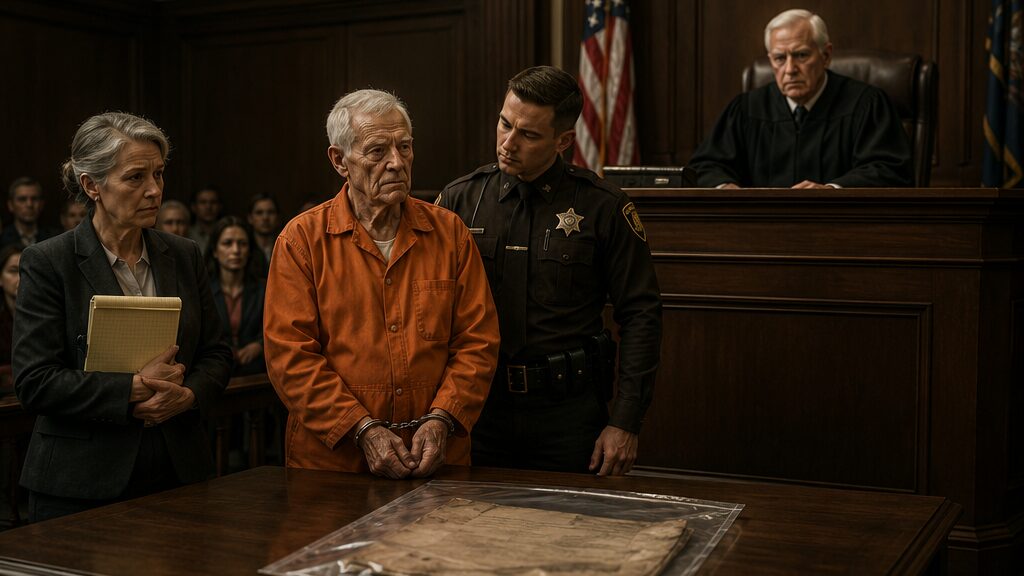
The orange jumpsuit was too large in the shoulders and too short at the wrists.
James Bennett noticed that before he noticed the cold.
He stood beneath the pale lights of the county jail intake room while the clerk behind the glass typed with two fingers and did not look at his face. The air smelled of floor bleach, old coffee, and rain carried in on other people’s shoes. Somewhere beyond the holding door, a man coughed until a deputy told him to quiet down. James kept his hands low, the chain between the cuffs resting lightly against the front of the jumpsuit.
“Name,” the clerk said.
“James Bennett.”
The clerk frowned at the screen as though James had answered incorrectly. “Date of birth.”
James gave it.
The typing stopped for a moment. The clerk finally glanced up, first at his white hair, then at the cuffs, then at the orange cloth bag folded on the counter with his civilian clothes inside.
“You got any medical conditions we need to know about?”
“No.”
The deputy beside him shifted. His nameplate read Carter. Young man. Straight back. Polished belt. Tired eyes that had decided tiredness was the same as authority.
“He had blood pressure pills in his jacket,” Tyler Carter said.
James looked at the property bag. His faded gray jacket was inside, sleeves tucked inward by someone who had not cared where the old seams bent. In the same bag was a wallet, a handkerchief, a key ring with two keys, and a small square of paper the deputy had taken from him twice already.
Not the file. They had taken the file before the jail. That had gone into evidence.
“Blood pressure,” the clerk said, typing again. “Anything else?”
James shook his head.
Tyler gave a short laugh through his nose. “You want to tell them about the courthouse incident, Mr. Bennett?”
James looked at him. Not sharply. Not with anger. Just enough for Tyler to feel seen.
The deputy’s mouth tightened. “Fine. Don’t.”
The clerk printed a band and peeled it from a strip. When she reached for James’s wrist, he turned his hand so she would not have to pull at the cuff. She paused at that. Only a second. Then the band closed around his skin with a plastic snap.
“Hold out your hands.”
James obeyed.
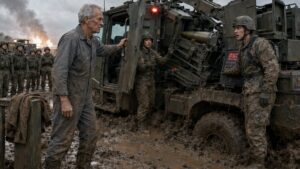
Age had changed his hands more honestly than mirrors had changed his face. The knuckles were larger now. The veins stood up in blue ropes. A faint brown scar ran from the base of his thumb toward the wrist, pale at the edges where the skin had tightened badly a long time ago. In the bright jail light, his hands did not look like hands that had once worked quickly in mud, smoke, and the red dark beneath a poncho.
They looked like old hands.
Tyler noticed the scar and looked away from it.
“Anything sharp?” the clerk asked.
“No.”
“Anything we missed?”
James could have said many things.
He could have said that the file did not belong in a plastic sleeve marked evidence. He could have said that the corner was already damaged before he touched it. He could have said the archive supervisor had no right to leave a box of correction requests beneath a leaking radiator. He could have said the name inside the file had been said wrong for forty-nine years.
Instead he said, “No.”
They walked him through a side corridor after intake, past a row of cinder-block walls painted a color that was not quite white. Each step made the chain at his ankles whisper. Tyler walked a half pace behind and to the left, close enough to steer him if he stumbled, far enough to show anyone watching that he did not need to.
“You understand what happens this morning?” Tyler asked.
James kept walking.
“First appearance. Judge looks at the complaint. Public defender talks. Maybe bond. Maybe not, depending on how stubborn you feel.”
The corridor narrowed near the courthouse connector. Rain tapped against high windows with wire mesh embedded in the glass. James could not see outside, only the gray light. He had come into the courthouse as an employee for eleven years, mostly before sunrise, pushing a dust mop over marble floors while attorneys rushed past him without lowering their voices. He knew which hallway tile clicked loose near the probate office. He knew the vending machine on the second floor kept taking dollar bills after midnight. He knew the archive room smelled faintly of paper, metal, and cold steam.
He had never entered from this door.
Tyler nudged him around a turn. “You worked here, right?”
James nodded.
“Janitorial?”
“Yes.”
“That why you knew where the file room was?”
James said nothing.
Tyler sighed. “You know, making everybody guess doesn’t help you.”
No, James thought. It helps someone else.
In the holding corridor behind Courtroom Two, Nancy Cooper waited with a yellow legal pad against her chest. She was not young, and James trusted that more than he expected to. Her gray-streaked hair was pinned loosely at the back. She had reading glasses hanging from a chain and a rain spot on one shoulder of her coat.
“Mr. Bennett,” she said. “I’m Nancy Cooper. The court appointed me for this morning. We have about four minutes.”
“That’s all right.”
“No, it is not all right, but it is what we have.” She looked at Tyler. “Can I speak with him?”
Tyler folded his arms. “Right here.”
Nancy gave him a patient look that did not ask his permission so much as wait for his manners to catch up.
He stepped away three paces.
Nancy lowered her voice. “The complaint says you entered a restricted archive room after hours and removed a county-held military casualty correction file from sealed storage. They’re calling it theft of government property and obstruction. The archive supervisor says you refused to return it.”
James looked at the floor.
“Did you refuse?”
“I handed it to the deputy.”
“After they stopped you outside.”
“Yes.”
“Why did you take it?”
His cuffed hands moved before he could stop them. His right index finger pressed lightly against the pad of his left thumb, flattening paper that was no longer there. A habit. A foolish one.
Nancy noticed.
“Mr. Bennett,” she said, softer, “if there is a reason, I need to know it.”
“There is.”
“Then tell me.”
He looked past her toward the courtroom door. The brass handle had been polished so often it had lost its edges. On the other side, voices rose and fell. A docket day. Names turned into numbers. Problems reduced to charges. The court had its own weather, and it did not care who came in wet.
Nancy waited.
James liked that she waited. Most people filled silence with themselves.
Finally he said, “Not in the hall.”
“We can ask for more time.”
“No.”
“You may be held if you do not explain yourself.”
“I know.”
A flicker of irritation crossed her face, not cruel, only frightened on his behalf. “Are you protecting someone?”
James looked at her then.
Nancy inhaled once. “All right. That is something. Is someone in danger?”
“No.”
“Is the file evidence of a crime?”
James thought of a young man’s name typed wrong, then stamped into record, then repeated by people who had never heard his voice.
“Yes,” he said. “But not mine.”
Before Nancy could ask another question, the courtroom door opened.
A bailiff leaned out. “Bennett.”
Tyler stepped forward. “That’s us.”
James straightened without meaning to. The chain at his ankles drew tight, then settled. Nancy saw the movement. So did Tyler. Neither said anything.
As they guided him toward the door, a clerk inside the courtroom read from a sheet in a flat, practiced voice.
“Next matter, county versus James Bennett. Related file concerning deceased service member Stephen Ward—”
James stopped.
Tyler’s hand touched his elbow. “Keep moving.”
The clerk continued, careless with the shape of it.
“Stephen Warden.”
James turned his head toward the courtroom.
Not anger. Not fear. Something older than both crossed his face and was gone.
Tyler gave his elbow a firmer push. “Come on.”
James stepped through the doorway in orange, under the eyes of the room, and the name followed him in wrong.
Chapter 2: When the Officer Stood Before the Judge
Courtroom Two was smaller from the defendant’s side.
James had polished the gallery benches years ago, kneeling with a rag and a tin of lemon oil while the courthouse slept above him. He had dusted the flag stand, swept under the counsel tables, wiped fingerprints from the swinging gate. From those places, the judge’s bench had looked like furniture.
Standing before it in chains, it looked like a wall.
Judge Thomas Walker sat behind the bench with his robe folded black around him and his white hair combed neatly back from his forehead. He had a face trained by years of listening for what mattered and dismissing what did not. That morning, James could feel himself being sorted into the second category.
Nancy stood beside him with her pad open.
Tyler Carter positioned himself near James’s left shoulder. Not touching now. Watching.
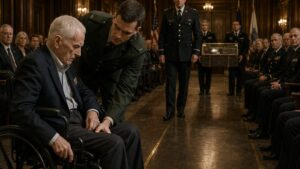
Behind and slightly to the judge’s right, a man in a dark military dress uniform sat in a chair that had been placed there for the veterans court docket scheduled later that morning. James noticed him because he noticed uniforms before faces. Pressed sleeves. Ribbons placed with care, not vanity. Cap resting on one knee. Shoes black enough to catch the courtroom light.
The man looked to be in his late forties. Patrick Sullivan, according to the small placard near his chair. Military liaison officer. He sat still, as though stillness were part of his training, but his eyes were not idle.
Judge Walker glanced down at the file in front of him. “Mr. Bennett, you are charged with unlawful entry into a restricted county archive and theft or attempted theft of a government record. The record in question appears to be an old military casualty correction file maintained as part of a memorial petition. Do you understand the charge?”
“Yes, Your Honor.”
His voice sounded rough in the room.
Nancy leaned slightly toward him, ready to speak if he faltered.
The judge looked over his glasses. “The complaint indicates you were found leaving the archive area at approximately 7:42 p.m. with a sealed file folder concealed under your jacket.”
James looked at the evidence table.
The file lay inside a clear plastic sleeve. County label. Red evidence sticker. The folded corner had not been smoothed. A dark water stain spread at the lower edge like an old bruise.
His fingers twitched.
Judge Walker noticed the movement. “Mr. Bennett?”
“I understand.”
“You are a former courthouse employee?”
“Yes.”
“Retired janitorial staff?”
“Yes.”
The judge’s mouth tightened, not unkindly, but with the disappointment of a man seeing a small breach in a system he believed should hold. “Then you knew the archive was restricted.”
“I knew.”
“And you knew you were not permitted to remove county records.”
“Yes.”
Nancy touched the edge of the table. “Your Honor, if I may, I have only just met Mr. Bennett. I would ask for a brief continuance so I can understand the circumstances before the court addresses conditions.”
Judge Walker looked at her, then back at James. “Does your client wish to offer any explanation now?”
Nancy turned to James. Her expression was careful. Please, it said without saying it.
James kept his eyes on the file.
“No, Your Honor.”
A faint sound moved through the gallery. Someone whispering. Someone shifting. James did not turn. He could feel people looking at the orange jumpsuit, not at him.
Judge Walker leaned back. “Mr. Bennett, silence is your right. It is not always your friend.”
“I know.”
Tyler made a small impatient movement beside him. The leather of his belt creaked.
The judge lifted the complaint again. “This appears to involve a memorial correction petition connected to a service member named Stephen Warden.”
James’s head rose.
The room did not change, but for James it narrowed until only the judge’s mouth remained.
Nancy saw his face. “Your Honor—”
“Ward,” James said.
The judge paused. “Pardon?”
James swallowed. His throat felt dry enough to scrape.
“His name was Stephen Ward.”
Judge Walker checked the paper. “The typed notation says Warden in two places.”
“It’s wrong in two places.”
Tyler exhaled through his nose. Not quite a laugh this time, but close enough. “Sir, you can’t just interrupt the judge over a spelling—”
James did not look at Tyler.
“Say his name right,” he said.
The courtroom went very still.
Judge Walker’s eyes sharpened. “Mr. Bennett, you will let counsel speak for you.”
“He has had people speak wrong for him long enough.”
Nancy’s hand closed around her pen.
Tyler stepped closer. “That’s enough.”
Behind the bench, Patrick Sullivan stopped looking like a man waiting through someone else’s docket.
His gaze had moved to the evidence sleeve.
“Your Honor,” Patrick said.
Judge Walker turned slightly, surprised less by the interruption than by the tone. “Colonel Sullivan?”
Patrick rose.
The movement was quiet, but it changed the room more than any gavel could have. He stood straight, cap in his left hand at his side, right hand relaxed but precise. He did not look at the spectators. He looked first at the file, then at James.
“May I approach the evidence table?”
Judge Walker hesitated. “For what purpose?”
Patrick’s eyes remained on the water-stained corner. “There may be military record context the court should not misread.”
A low murmur started in the benches. Judge Walker silenced it with one glance.
“This is a first appearance, Colonel.”
“Yes, Your Honor.”
“And you are not a party.”
“No, Your Honor.”
Something about the answer made Judge Walker study him more carefully. “Approach.”
Patrick stepped down from beside the bench. He did not stride. He moved with restraint, as though crossing in front of James required permission from something older than court procedure.
At the evidence table, he bent slightly toward the plastic sleeve without touching it. His eyes scanned the exposed corner of the top page. The typed form was faded, but the block letters remained legible. REQUEST FOR CASUALTY STATUS CORRECTION. Attached note. Old routing code. Field notation in cramped blue ink at the margin.
James felt his chest tighten.
Patrick’s face changed by almost nothing. That was why James saw it clearly. The jaw set. The breath paused. His shoulders squared as if a command had been given somewhere only he could hear.
He looked at James’s hands.
The scar near the thumb. The way the fingers pressed lightly, index to thumb, as if holding gauze flat against wind.
Then Patrick looked at James’s posture.
Not fully at attention. The ankle chain made that impossible. But close enough. Especially when Stephen’s name had been spoken.
Patrick turned back to the judge. His voice lowered.
“Your Honor, may I ask Mr. Bennett one question?”
Nancy moved. “I would like to know the question first.”
Patrick nodded once, accepting the correction immediately. That, too, the room noticed.
“I want to ask whether he made the handwritten notation visible on that form.”
Judge Walker looked at James. “Did you?”
James said nothing.
Nancy whispered, “Mr. Bennett.”
Patrick did not press. He looked at the file again and read the marginal note aloud, not loudly, not for drama.
“‘Pressure dressing failed. Evac record incomplete. Ward stayed with the boy.’”
James closed his eyes.
Only for a moment.
When he opened them, Patrick was looking at him differently. Not with pity. James could have borne pity, but he would not have trusted it. This was worse and better. Recognition.
Patrick stood straighter.
“Sir,” he said to James, and the word was not casual. “Were you a medic?”
Tyler’s eyes flicked toward James.
Judge Walker’s expression changed in smaller steps: annoyance, curiosity, caution.
James did not answer immediately. The room waited for rank, unit, history, some grand statement to explain the man in orange.
James gave them none.
“Yes,” he said.
Patrick’s cap shifted in his hand. He did not salute. Not there, not with James in chains, not for a moment he did not yet understand. Instead he took one step back from the evidence table and lowered his voice further.
“Your Honor,” he said, “I recommend the court handle that file as a service casualty record until its status is confirmed. And I recommend Mr. Bennett be addressed by name.”
Tyler’s face reddened.
Judge Walker looked at Patrick, then at James, then at the file in the plastic sleeve.
“Mr. Bennett,” the judge said, carefully this time, “is there a reason you removed this record?”
Nancy’s eyes turned to James, urgent again.
Patrick waited.
Tyler waited.
The gallery waited.
James looked at the water stain at the corner, at the paper that had survived war, storage, carelessness, and rain from a courthouse pipe only to be trapped in plastic under a red sticker.
Then he looked at the judge.
“Yes, Your Honor.”
The judge leaned forward. “What is it?”
James heard again the clerk saying Warden. He heard a much younger voice in a place with no courtroom walls saying, Tell her I didn’t leave him.
His hand closed against the chain.
“I took it,” James said, “because nobody would say his name right.”
Judge Walker frowned. “That is not an answer.”
“No,” James said. “It is not.”
Patrick did not sit down.
Chapter 3: The Name Beneath the Water Stain
Nancy Cooper had defended men who lied badly, men who lied well, and men who believed their own lies by the time the cuffs came off.
James Bennett did not fit any of them.
He sat across from her in the small interview room beside Courtroom Two, wrists uncuffed now but still bearing the red marks of the metal. Tyler Carter stood outside the door, visible through the narrow rectangle of reinforced glass. He had turned slightly away, pretending not to listen. Nancy suspected he heard every third word.
On the table between her and James lay her yellow pad, two pens, and a paper cup of water he had not touched.
“You understand,” she said, “that you just admitted in open court you took the file.”
“Yes.”
“You understand that was against my advice, though I did not have time to give it properly.”
The faintest trace of apology moved across his face. “Yes.”
“And you understand that ‘nobody would say his name right’ is not a legal defense.”
James looked down at his hands. Without the cuffs, they seemed less prisoner-like and more vulnerable. He placed his right index finger against the left thumb again. Press. Smooth. Hold.
Nancy drew a line under a note she had already written twice: does not deny taking file.
“Mr. Bennett, I need you to help me. Not with everything. Not all at once. But enough so I can keep you from making this worse.”
“I already made it worse.”
“Maybe. Maybe not. Why did Colonel Sullivan recognize the file?”
“He knows forms.”
“Many people know forms.”
“Not that one.”
Nancy waited.
James looked toward the door. “He saw the old correction route. The kind they used when a body came through one place and the paper came through another.”
His voice had flattened. Not emotionless. Controlled against emotion.
“You were involved in the original record?”
“Yes.”
“As a medic?”
He nodded.
“Stephen Ward served with you?”
James’s fingers stopped pressing.
“For part of a day.”
Nancy did not write that down immediately. “Part of a day?”
“That was enough.”
The heater clicked in the wall. A pipe knocked once and quieted. Nancy had spent half her professional life in rooms like this, hearing half-truths under bad lighting. Still, something in the way James guarded the dead man’s name made the room feel less like a courthouse interview room and more like a place where she should not move too quickly.
“The file concerns a memorial petition,” she said. “Who filed it?”
“His daughter.”
“Rachel Miller?”
James looked up.
Nancy turned her pad so he could see the name she had copied from the complaint. “She is listed as the petitioner. The archive supervisor says you asked about this file repeatedly over the last year. Is that true?”
“Yes.”
“Does Rachel Miller know you?”
“No.”
“Does she know you served with her father?”
“No.”
Nancy let out a quiet breath. “Why not?”
James looked at the cup of water. “Because she deserves better than hearing it in a hallway from an old man in orange.”
That was the first answer he had given that felt like a door opening.
Nancy lowered her pen. “Hearing what?”
He did not answer.
“Mr. Bennett.”
He looked tired then. Not old, though he was that too. Tired in the way of someone who had carried an object so long that putting it down would hurt worse than keeping it.
“I wrote a statement years ago,” he said. “It did not go where it should have gone. Or it went and came back. I don’t know. Papers were not clean then.”
“What statement?”
“That Stephen Ward did not desert his position.”
Nancy felt the case shift under her hands.
The word desert did not belong in the room the same way theft did. Theft was a charge, a box on a form. Desert was a stain people inherited.
She wrote it slowly. “The record says he deserted?”
“The bad one does.”
“And the correction file says otherwise?”
“It asks them to say otherwise.”
“Who is them?”
James almost smiled. It was not a happy expression. “Everyone who stamped it and passed it along until nobody owned it.”
Nancy leaned back. “So you took the file because you thought it proved he had been wrongly recorded as a deserter.”
“No.”
She frowned. “No?”
“I took it because they were going to lose it again.”
“Who told you that?”
“Nobody had to.”
“That will not hold up in court.”
“I know.”
“Mr. Bennett, suspicion is not enough.”
He looked at her then, and the softness left his eyes.
“Counselor, when a ceiling pipe leaks over one box and the dry boxes get moved but that one stays on the floor, that is not suspicion. When a clerk tells a woman her father’s petition is incomplete because the page with the witness note is missing, and I saw that page with my own writing on it last Thursday, that is not suspicion. When an archive supervisor says old military papers are duplicated somewhere else when they are not, that is not suspicion.”
Nancy wrote quickly now.
James’s voice lowered again. “It is the second burial.”
The words stayed in the room.
Outside the glass, Tyler shifted.
Nancy looked up. “Did you tell anyone this?”
“I filed a maintenance note about the leak.”
“That is not the same.”
“I asked to speak to the archive supervisor.”
“And?”
“He said I was retired.”
“He said that?”
James nodded.
Nancy’s mouth tightened. “What did you do then?”
“I waited until the cleaning crew changed shifts.”
“Mr. Bennett.”
“I know.”
“You entered with an old key?”
“No. The door was propped. They had fans in there for the damp.”
That helped and did not help. Nancy wrote it down.
“Why not call Rachel Miller?” she asked. “If the file concerned her father, why not tell her?”
James’s gaze dropped again.
“That is the part you are not telling me.”
“It is the part that belongs to her first.”
“She is part of the case now. If she comes into that courtroom angry and the prosecutor presents you as a man who stole her father’s record, you may lose the one person who could understand why you cared.”
James said nothing.
Nancy tried another way. “Did Stephen Ward do something that day?”
James’s hand pressed against his thumb again.
“Mr. Bennett.”
The door opened before he answered.
Tyler stood there, less impatient than before but trying to hide it. “Ms. Cooper. There’s a woman asking about the case.”
Nancy turned. “What woman?”
“Says her name is Rachel Miller.”
James closed his eyes.
Tyler glanced at him, then back to Nancy. “She says the file was her father’s. She wants to know why the man who stole it is wearing chains.”
Nancy gathered her pad, but James spoke before she stood.
“Don’t bring her in here.”
“It may help,” Nancy said.
“No.”
“Mr. Bennett—”
“Not here.”
The firmness in his voice surprised even Tyler. Nancy studied him for one long second.
Beyond the door, a woman’s voice rose in the hallway. Not loud enough to be unruly. Loud enough to be hurt.
“I just want to know what he did with my father’s name.”
James flinched as if the words had crossed the room and struck him.
Nancy saw it.
Tyler saw it too.
For the first time that morning, the deputy did not look at the orange jumpsuit first. He looked at the old man inside it.
James opened his eyes and stared at the table.
“Please,” he said.
It was the first time he had asked for anything.
Chapter 4: A Promise Kept Too Long in Silence
The archive room had always been coldest before noon.
James remembered that even when he was not in it. Cold came first, then paper. Paper had its own smell when kept too long in metal drawers: dust, glue, old ink, and the faint sourness of damp cardboard. The courthouse had newer rooms with glass walls and motion lights, but the archive lived below the main floor where the pipes ran exposed along the ceiling and the radiators hissed in winter like tired men.
He had cleaned there for eleven years.
Before that, he had avoided it for almost thirty.
He had not planned to find Stephen Ward in a county basement. Men who died far from home were supposed to come back as folded flags, not as misfiled paper in a box under a leaking pipe. But one November evening the veterans’ clinic receptionist had stopped him while he was changing trash bags near the lobby.
“You used to serve, didn’t you?” she had asked.
James had looked at the mop handle in his hand. “Long time ago.”
“There’s a woman trying to fix something for her father’s memorial application. She keeps getting bounced between offices. She said the courthouse has old local service files. I don’t know who else to ask.”
James should have said he did not know either.
Instead he had asked, “What name?”
The receptionist had looked down at the form in her hand. “Stephen Ward. Or maybe Warden. The papers don’t match.”
The mop handle had slid slightly in James’s grip.
That was the first time in years the name had entered the room without permission.
After that, the courthouse changed around him. The hallway outside the archive became longer. The lock on the records room became louder. The old maintenance notes pinned beside the boiler seemed suddenly like orders left unread.
He had gone through the proper places first.
At the records window, a clerk told him that military documents were not for retired maintenance staff to request. At the veterans’ clinic, a volunteer gave him a federal phone number that rang for twenty-two minutes and disconnected. At the archive office, the supervisor had smiled with all his teeth and said old county-held service files were “duplicative historical materials,” not official records.
James had asked, “If they’re duplicative, where is the duplicate?”
The supervisor had stopped smiling. “Mr. Bennett, you’re retired.”
That word had followed James out like a hand on his back.
Retired.
As if duty expired because a payroll file closed.
The next Thursday, when the night crew called in sick and the courthouse manager asked if James could cover four hours for old time’s sake, he said yes before he knew what answer his mouth had made.
He moved through the building slowly that evening, broom cart squeaking over tile. He emptied bins. He replaced paper towels. He wiped the brass rail outside Courtroom Two where fingerprints gathered during docket days. At seven fifteen, he took the service hall toward the archive.
The door was propped open with a gray rubber wedge.
Fans hummed inside. A ceiling pipe had sweated through its wrap and dripped onto the corner of a cardboard record box. Someone had moved the dry boxes to a table and left the damp one on the floor.
James stood in the doorway for a full minute.
The proper thing was to leave. To write another maintenance note. To call someone who would not come until morning. To let the wet corner spread.
He went in.
The box label had smeared, but he could read enough: MEMORIAL PETITIONS / SERVICE STATUS / W.
His knees complained when he crouched. He ignored them.
The first file was not Stephen. Neither was the second. On the third, the tab had swollen from damp and curled at the edge. WARD, STEPHEN A. Someone had written an extra “EN” in pencil after the D, then erased badly enough that the ghost remained.
James set the folder on the nearest table and opened it with two fingers.
The top sheet was a county petition form. Rachel Miller’s name appeared three times. Daughter. Petitioner. Requesting correction of memorial entry. Attached were copies of a birth certificate, a death notice, a faded photograph of a young soldier with eyes narrowed against sun.
The next page made James sit down.
Not because he had not seen it before.
Because he had.
REQUEST FOR CASUALTY STATUS CORRECTION.
The lower corner had gone soft with water. His old note remained in the margin, blue ink faded toward gray.
Pressure dressing failed. Evac record incomplete. Ward stayed with the boy.
James placed his palm lightly beside it. Not on it. Never on the writing.
For a moment the archive room disappeared.
Heat came back first. Then the sound of rotors too far away. Then Stephen Ward’s face, younger than Rachel was now, streaked with dirt on one cheek and blood on one sleeve that was not his.
“He’s still breathing,” Stephen had said.
“Then hold him down.”
“He’s a kid.”
“They’re all kids.”
The boy on the ground had been crying for his mother in a language neither of them knew well enough. James had one hand pressed hard above a wound and the other fumbling for gauze that had fallen in the mud. Stephen had moved when he should have stayed under cover. James had shouted. Stephen had ignored him.
Later, in the confusion, the paper said Stephen abandoned his assigned point.
James had written his statement while his hands still shook. He had handed it to a captain whose face he could no longer remember. He had said, “This needs to follow him home.”
The captain had said, “It will.”
Years taught James that will was sometimes only a sound people made when they needed you to step aside.
In the archive room, he turned the page and found the stamped denial. Insufficient corroborating documentation. Name discrepancy unresolved. Status unchanged pending further record verification.
Beneath it was a sticky note from someone in the county office.
Petitioner called again. Explain no update.
James read it twice.
Then a drop from the pipe struck the table near the folder.
That was when he closed the file.
He did not hide it under his jacket at first. He carried it flat against his chest, meaning to find a dry table, a plastic bin, anyone with authority to take it seriously. The hall was empty. The archive office was locked. The security desk had a sign taped to it: BACK IN FIVE.
He waited twelve minutes.
The file began to curl at the damp corner.
So he put it inside his jacket, not to steal it, he told himself then, but to keep it safe until someone would look him in the eye.
A courthouse camera saw him leave the archive hall. Tyler Carter saw him near the side exit. The explanation James had prepared turned to ash in his mouth when Tyler grabbed the folder and bent the corner backward trying to pull it free.
“Careful,” James had said.
“Let go.”
“Careful with it.”
“Sir, release the file.”
“It’s not mine,” James had said.
Tyler had heard only enough to arrest him.
Now, a day later, James sat in the veterans’ clinic waiting room after Nancy had argued him into temporary release on strict conditions. The orange jumpsuit was gone. His gray jacket had been returned, wrinkled and faintly smelling of jail storage. The blood pressure pills were in his pocket. His wrists still remembered the cuffs.
Nancy sat two chairs away, reviewing copied motions. She had not wanted him to come to the clinic, but Colonel Sullivan had arranged a supervised records request through proper channels, and the judge had allowed it before the next hearing.
Patrick Sullivan stood near the receptionist’s desk speaking quietly with the volunteer. He had not saluted James. He had not called him hero. He had asked before touching the copied file.
James appreciated that more than he would have known how to say.
Across the waiting room, a bulletin board held flyers for counseling, rides to appointments, and a monthly breakfast for veterans who did not like calling themselves lonely. Beneath one flyer was a small paper number dispenser. James stared at the red paper tickets and remembered triage tags tied too fast.
Patrick approached. “Mr. Bennett.”
James looked up.
“The clinic has a copy of Rachel Miller’s petition packet. Not the witness note. That page is missing from their set.”
Nancy lowered her papers.
James nodded once, as if he had expected this and hated being right.
Patrick held a photocopy in both hands. “They do have the denial letter. Same name discrepancy.”
“Warden,” James said.
“Yes.”
Nancy said, “If the witness note is only in the county file, we need the court to preserve it immediately.”
Patrick looked toward James. “That would be easier if the court understood why the note matters.”
James’s fingers moved toward his thumb.
Nancy saw and did not press.
Patrick did. Gently.
“Mr. Bennett, Stephen Ward’s daughter is still trying to correct a record with half the truth missing. You may be the only living person who knows what belongs in the other half.”
James looked at the bulletin board, at a faded photograph of men in uniform standing beside a flag too bright for the worn cork around it.
“I know what I owe,” he said.
Patrick’s expression softened by one degree. “Then why not pay it?”
James stood too quickly, and his knee caught. He steadied himself on the chair back before anyone could help. The clinic went quiet for a second. He hated that kind of quiet.
“Because once I say it,” he said, “she has to carry what I carried. And I have had forty-nine years to learn how.”
Nancy did not write that down.
Patrick held the photocopy lower, as if it had become heavier.
James looked at the missing page’s place in the copied packet. A blank gap. A place where a truth had been removed so often it had begun to look natural.
He reached out and touched the edge of the paper with two fingers.
“They were going to lose him again,” he said.
No one in the waiting room answered.
From the receptionist’s desk, the volunteer called another number. The sound was small and ordinary, a paper ticket becoming someone’s turn.
James sat down before his legs could make the decision for him.
Chapter 5: The Daughter Who Only Wanted One Honest Sentence
Rachel Miller had imagined the man who took her father’s file as taller.
She had built him in anger during the drive to the courthouse: a careless man, maybe bitter, maybe bored, the sort of person who saw old records as paper and not as the last place a daughter could still knock. By the time she parked in the public lot beneath a sky the color of tin, she had given him a hard mouth, quick hands, and an excuse ready before anyone asked.
Then she saw James Bennett in the hallway outside Courtroom Two.
He sat on a wooden bench with Nancy Cooper on one side and Colonel Sullivan standing a few feet away. No chains now. No orange jumpsuit. His gray jacket hung loosely from narrow shoulders. His hair was white and cut short, his face lined deeply around the eyes. He held nothing in his hands, but his fingers rested together as though something fragile lay between them.
Rachel stopped so suddenly her teenage son bumped into her shoulder.
“Mom?”
She put a hand back without looking, steadying him.
“That’s him?” she asked.
Nancy rose first. “Ms. Miller?”
Rachel did not answer her. She looked at James. “Are you the one who took my father’s file?”
James stood.
It took effort. Not dramatic effort. Just the ordinary stiffness of an old body asked to rise in a hard hallway under judgment. Rachel noticed it and resented him for making her notice.
“Yes,” he said.
Her son shifted beside her. “Mom, maybe—”
“Wait by the benches,” Rachel said.
He hesitated, then stepped away, close enough to watch.
Rachel moved toward James. Patrick started to speak, but James gave the smallest shake of his head. The colonel went still.
“Do you know how long I’ve been trying to get that correction?” Rachel asked.
James looked at her directly. “Yes.”
“No, you don’t.” Her voice was steady, but her hands were not. She closed them around the strap of her bag. “You don’t know what it is to fill out the same form again and again and have someone call back to say the name doesn’t match. You don’t know what it is to explain that your father’s name was Ward, not Warden, and hear someone say it probably doesn’t matter.”
James’s eyes lowered.
“That part,” he said, “I know.”
Rachel laughed once, sharply. “You know?”
Nancy said, “Ms. Miller, Mr. Bennett may have information relevant to your petition.”
“Then why didn’t he give it to me?” Rachel turned back to James. “Why take it? Why make this harder? Every time a file moves, they tell me it has to be reviewed. Every time someone touches it, there’s another delay. Do you understand that?”
“Yes.”
“Stop saying yes.”
James flinched, barely. Rachel saw that too. It did not make her kinder.
“My mother died thinking the record might be right,” she said. “Do you understand that? She wouldn’t say it out loud, but I heard people whisper when I was little. I heard aunties go quiet when his name came up. I heard one man at a Memorial Day breakfast say, ‘Some men don’t come back because they choose not to.’ I was twelve.”
Patrick looked away.
Tyler Carter stood near the courtroom door, arms folded, listening.
Rachel stepped closer. “I don’t want a ceremony. I don’t want a speech. I don’t even know if I want pride. I want one honest sentence. That’s all. One sentence that says my father did not run.”
James’s mouth moved, but no sound came.
Rachel waited.
The hallway seemed to wait with her: the bailiff at the door, a clerk with folders held against her chest, Nancy with her pen down, Patrick with his cap tucked beneath one arm.
James said, “He did not run.”
Rachel’s face changed.
Not relief. Not yet. The words were too small for the years they had to cross.
“How do you know?”
James looked past her to her son, who pretended not to listen and failed. Then he looked back at Rachel.
“I was there.”
Her hands loosened on the strap.
“You were with him?”
“For part of a day.”
“What does that mean?”
James did not answer.
Rachel’s eyes hardened again, but differently now. Fear had entered the anger. “What aren’t you saying?”
Nancy stepped in softly. “Ms. Miller, some of this may need to be handled with care.”
“I have been handled with care by offices for seven years,” Rachel said. “It feels exactly like being ignored.”
James closed his eyes.
When he opened them, the hallway was gone for him again. For a moment Rachel saw not an old man refusing her, but someone standing at the edge of a room he could not leave.
“I wrote the note in that file,” he said.
Rachel stared. “The witness note?”
“Yes.”
“They told me there was no witness note.”
“There is.”
“Where?”
“In the file.”
“The file you took.”
“The file I kept dry.”
The words were not defensive. That made them harder to fight.
Rachel looked at Patrick. “Is that true?”
Patrick answered carefully. “There is a handwritten notation visible on the county copy. I cannot verify everything yet, but it appears to be a field witness statement or part of one.”
Rachel turned back to James. “Then tell me what it says.”
James’s right hand pressed against his left thumb.
“She should see the page first,” he said to Nancy.
Rachel’s voice rose. “I am standing right here.”
James nodded. “I know.”
“No, you don’t get to decide how I learn about my own father.”
The hallway went still again.
James accepted the sentence like a deserved blow. He did not look away from her.
“You’re right,” he said.
The answer disarmed her more than an argument would have.
He reached into his jacket pocket slowly. Tyler stepped forward by instinct, then stopped when Patrick glanced at him. James removed only a folded white tissue. Inside it was nothing but his courthouse visitor sticker from earlier, the adhesive half stuck to the paper.
His hand trembled. He seemed embarrassed by that and set the tissue on the bench.
“I spent years thinking the first thing I owed you was the truth,” he said. “Then I saw what the truth did to families when it came without mercy. I was wrong to keep away. I was wrong to take the file. But I do not want the first full telling of your father’s last hour to happen in a hallway with strangers pretending they are not listening.”
Rachel’s throat worked.
Her son had moved closer without permission. He stood beside her now, silent.
“What happened to him?” she asked.
James looked at the boy, then back at her. “He stayed with someone who could not get up.”
Rachel’s eyes filled before she could stop them. She turned her face slightly aside, angry at the tears.
“Was he afraid?”
James did not soften the answer too much. “Yes.”
A tear slipped down her cheek.
James continued, “But he stayed.”
That was all he gave her.
It was enough to wound. Not enough to heal.
Rachel wiped her face with the heel of her hand. “I want to see the page.”
Nancy said, “We can petition the court for supervised review.”
“I want it preserved.”
“So do we,” Nancy said.
Rachel looked at James. “And I want you to stop deciding for me.”
James nodded.
“I mean it.”
“I know.”
She turned to leave, then stopped. “You said his name right.”
James’s face folded inward for a second before he regained it.
“Yes.”
Behind them, Tyler Carter looked down at his own hands. He remembered pushing James forward, saying prisoner, old man, keep moving without exactly saying all of it. He remembered bending the corner of the file.
Rachel walked her son toward the stairwell.
As she passed Tyler, another deputy came from the side corridor and asked, “That the guy who stole the army thing?”
Tyler’s head lifted.
“His name is Mr. Bennett,” he said.
The other deputy blinked. “What?”
Tyler glanced down the hall at James, then at the closed courtroom doors.
“Use his name,” he said.
Chapter 6: The Record Was Wrong Before the Court Was
By Friday, the file had been placed inside a new sleeve.
James noticed that first.
The plastic was clearer, heavier, sealed along the edge with a white evidence label signed by the court clerk and dated in blue ink. The water-stained corner had been supported by a backing sheet. Someone had flattened the curled edge without pressing on the writing.
He stood at the defense table in his gray jacket, not orange, and felt the difference in the room before the hearing began. It was not warmth. Courtrooms did not become warm merely because people learned better. But the air had changed. The whispers were lower. Tyler Carter stood near the side door and did not lean.
Rachel sat in the first row with her son. She did not look at James at first. Her gaze stayed on the file as if her father might disappear again if she blinked.
Patrick Sullivan stood behind the prosecution table at the judge’s request, not as a witness yet, not as a rescuer, only as someone who could explain what the court did not know how to read.
Judge Thomas Walker entered at nine sharp.
“All rise.”
James rose with everyone else. His knee resisted, then obeyed.
The judge sat and looked at the room longer than usual before speaking. “This matter is recalled for limited hearing on preservation of records, bond conditions, and the pending complaint against Mr. James Bennett.”
Mr. James Bennett.
Nancy heard it. Patrick heard it. Tyler did too.
James kept his face still.
The prosecutor summarized the charge with less sharpness than he might have used earlier in the week. Unlawful entry. Removal of restricted county property. Interference with archive procedure. The words remained ugly because they were not false.
Nancy stood. “Your Honor, Mr. Bennett does not deny removing the file. He disputes the characterization that he intended theft. More importantly, we ask the court to preserve the file and recognize the attached witness notation as potentially material to a long-pending memorial correction.”
Judge Walker looked at James. “Mr. Bennett, before we proceed, I need to be clear. If you speak today, your statements may affect the criminal matter.”
“I understand.”
“Ms. Cooper has advised you?”
“Yes.”
“And you still wish to speak?”
James looked at Rachel.
She met his eyes this time.
“Yes, Your Honor.”
Judge Walker folded his hands. “Then speak carefully.”
James almost smiled. “I have tried to do that most of my life.”
No one laughed. It was not that kind of line.
Nancy moved the file to the center of the table. With the court’s permission, she opened the sleeve and placed the copied pages flat beneath a transparent cover. James did not touch them. He wanted to. His fingers ached with the old habit, but he kept his hands at his sides.
The judge looked down from the bench. “Colonel Sullivan, you reviewed the visible markings?”
Patrick rose. “Yes, Your Honor.”
“What are they?”
Patrick did not dramatize. “The top document is a casualty status correction request, likely copied from an older military record packet. The notation in the margin uses terminology consistent with field medical reporting from the period. The handwriting appears to describe an evacuation record as incomplete and states that Ward stayed with an unidentified boy.”
Judge Walker looked at James. “Did you write that notation?”
“Yes.”
“Were you authorized to write it?”
“At the time, I was ordered to write what I saw.”
“At the time,” the judge said, “where were you?”
James drew one breath.
The room waited for place names, unit numbers, the kind of facts that made war legible to people who preferred maps.
James gave only what mattered.
“In a village after an evacuation went wrong.”
Rachel’s hand closed around her son’s.
“Stephen Ward was assigned to help secure the road behind us,” James said. “There was a boy caught near a wall that had come down. Maybe eight. Maybe ten. I don’t know. He was hurt bad enough that he could not move and loud enough that everybody knew where he was.”
His voice stayed level. That cost more than breaking would have.
“I was working on another man. I told Ward to stay down. He did not. He went to the boy.”
Rachel lowered her head.
James looked at the file, not at her. “When the second call came to pull back, some men moved before they understood who was still out. The record later said Ward abandoned his point. That was wrong. He left cover. Not duty.”
The judge’s pen had stopped moving.
James continued. “I got to them after. The boy was alive when they carried him out. Ward was alive long enough to ask me if the boy made it.”
His hand started toward his thumb. He stopped it halfway.
“I told him yes.”
Rachel made a sound she tried to swallow.
James closed his eyes for one second, then opened them. “I do not know if that was true. I never knew. But it was what he needed to hear.”
Patrick’s posture had gone rigid.
Judge Walker’s voice was quieter when he asked, “And the statement?”
“I wrote that the evacuation record was incomplete. I wrote that Stephen Ward stayed with the boy. I gave it to the officer collecting reports.”
“Yet the official notation was not corrected.”
“No.”
“Why did you not pursue it then?”
James looked at Rachel. “I was twenty-three. I thought paper went where it was supposed to go.”
That sentence did something to the room.
It was small. Almost plain. But every person in the courtroom had touched paper, filed it, stamped it, slid it onto someone else’s desk. The failure no longer belonged to war alone. It belonged to every ordinary hand that had passed the mistake along.
Judge Walker looked at the file. “Why take it now?”
James answered without hiding. “Because the archive room had water on the floor, the box was wet, and the page with my note was still there when Ms. Miller had been told it was missing. I believed if I left it, it would vanish again.”
“Did you intend to keep it?”
“No.”
“Did you intend to remove it from county custody?”
James paused.
Nancy glanced at him.
“Yes,” he said.
The answer landed hard.
“I intended to remove it from that room,” James said. “Not from the truth. I was wrong in law. I know that. But if I had to choose between a door sign and that name being buried under water, I chose the name.”
Judge Walker leaned back.
No one spoke.
Rachel stood suddenly. Her son reached for her arm, but she stepped into the aisle.
“Your Honor,” she said, voice unsteady, “may I say something?”
The prosecutor began to object, then seemed to reconsider.
Judge Walker nodded. “Briefly.”
Rachel turned toward James, though she spoke to the bench. “My father’s name was Stephen Ward. My mother spent most of her life not knowing whether to defend him or grieve him. I spent mine trying to fix a sentence nobody wanted to own. I am angry that Mr. Bennett took the file. I am angrier that he thought he had to.”
James looked down.
Rachel’s voice broke, but she held it. “I want the record corrected. And I want the court to understand that the file was already mishandled before he ever touched it.”
She sat before her knees could fail.
Judge Walker removed his glasses and set them on the bench.
“Colonel Sullivan,” he said, “is there a military process for verifying what this court has in front of it?”
“Yes, Your Honor. It will take time. But the court can preserve the document, certify its condition, and provide a copy to the appropriate records office.”
“Ms. Cooper?”
Nancy stood. “We request exactly that.”
The judge looked at the prosecutor. “And regarding the criminal complaint?”
The prosecutor cleared his throat. “The county maintains that Mr. Bennett acted unlawfully. But given the preservation concerns, we are willing to revisit the charge after review.”
Judge Walker’s eyes moved to James. “Respect does not erase the law, Mr. Bennett.”
“No, Your Honor.”
“And the law should not erase context.”
James said nothing.
The judge looked down at his notes, then back up. “Before I address the order, there is a matter of address. Mr. Bennett, Colonel Sullivan has informed the court that you served as an Army medic. Is there a title you prefer the court use?”
James’s face tightened.
For a moment, Nancy thought he would refuse all of it. Rank. Service. Recognition. Anything that placed a shine over what had been mud.
Then he looked at Rachel.
“James is fine,” he said.
Judge Walker nodded once. “Then Mr. Bennett it will be.”
Patrick’s expression shifted, almost imperceptibly. Approval, not disappointment.
The judge continued. “The file will be preserved under court seal. The archive supervisor will produce storage logs, maintenance reports, and all related copies by close of business. Ms. Miller will be permitted supervised review of the witness notation with counsel present before any public filing of its contents. Mr. Bennett will remain released pending further proceedings.”
He paused.
“As for the complaint, this court will not pretend the charge vanished because the reason was honorable. Nor will it pretend the reason is irrelevant because the charge is inconvenient. We will proceed carefully.”
James bowed his head once.
Tyler stepped forward when the hearing ended. He carried a copy of the preservation order.
For a second, the old rhythm almost returned: deputy, defendant, paper passed like a receipt.
Then Tyler stopped in front of James and held the order out with both hands.
James looked at the gesture before taking it.
“Mr. Bennett,” Tyler said, low enough that it did not become a performance, “I bent the corner the other day. I’m sorry.”
James accepted the paper.
The apology was not everything. It did not need to be.
“Don’t bend this one,” James said.
Tyler nodded. “No, sir.”
Across the aisle, Rachel stood with her son. She did not come to James yet. Not in the courtroom. Not with everybody watching.
But she said her father’s name once, softly, as if testing whether the room would carry it correctly.
“Stephen Ward.”
No one corrected her.
No one looked away.
Chapter 7: Respect Was What They Did Afterward
Two weeks later, James Bennett entered the courthouse through the front doors.
No deputy walked behind him. No chain touched his ankles. No orange cloth scratched at his wrists. He wore his gray jacket, a clean white shirt Nancy had told him looked appropriate, and the old black shoes he polished the night before with a paper towel at his kitchen table.
The security clerk looked up as he approached.
For eleven years James had emptied the trash can beneath that checkpoint. He had once found a lost wedding ring under the rubber mat and left it in an envelope on the supervisor’s desk. He had once mopped coffee from that exact place while attorneys stepped over the wet floor sign as if the warning were meant for other people.
Now he placed his keys, wallet, and folded handkerchief in the plastic tray.
The clerk saw his name on the docket sheet and paused.
“Mr. Bennett,” she said.
James nodded.
She did not say anything else. That was good. He had learned lately that kindness sometimes became another room a man had to stand in while people stared.
The metal detector gave no complaint.
Tyler Carter waited near the elevator with a folder tucked under one arm. When he saw James, he straightened, but not theatrically. His uniform looked the same as it had that first morning, belt polished, shoulders squared. His face did not.
“Mr. Bennett,” Tyler said. “Judge Walker asked me to bring you down to archives before the hearing.”
James glanced at the folder. “More papers?”
“Yes, sir.”
The sir still made him uncomfortable, but Tyler had stopped using it like a correction and started using it like care. James could hear the difference.
They walked together toward the service hallway.
For a few steps, the old rhythm returned. James’s hand reached, almost by instinct, toward the cart that was not there. He knew every scrape along the baseboards. He knew where the wall paint changed shade because a repair crew had matched it badly. He knew the narrow turn where the archive corridor began to smell colder than the rest of the building.
Tyler opened the door for him.
The archive room was brighter now.
New lamps had been placed above the sorting table. The wet cardboard boxes were gone. Plastic record bins sat in neat rows on shelves raised off the floor. A dehumidifier hummed in the corner, draining into a clear tube that led away from the pipes. Maintenance tags hung from the ceiling where the leak had been repaired, dated and signed.
James stood just inside the doorway.
Respect, he thought, sometimes sounded like a machine pulling water from the air.
Judge Walker was already inside, not in his robe but in a dark suit. Nancy Cooper stood by the table with her glasses low on her nose. Patrick Sullivan was near the shelf, cap tucked under one arm. Rachel Miller stood beside a chair, one hand resting on the back as if she needed something solid nearby. Her son hovered close to her shoulder, older in the face than he had looked two weeks ago.
On the table lay the file.
Not in an evidence sleeve now. In an archival cover, cream-colored, with a clear support sheet beneath the damaged page. The water-stained corner remained, but it no longer curled.
James felt something in his chest loosen and resist loosening.
Judge Walker spoke first. “Mr. Bennett, thank you for coming.”
James nodded.
The judge looked toward the file. “The county has agreed to amend the complaint. Unlawful entry will remain as a minor misdemeanor. The theft charge will be dismissed upon completion of community service.”
Nancy had already explained it twice. James had accepted it the first time.
“What kind of service?” he had asked.
Nancy had looked over the top of her glasses. “You’ll like this part.”
Now Judge Walker said, “With your agreement, those hours will be completed here, assisting with the preservation and cataloging of veterans-related records under supervision.”
James looked at the shelves.
The archive supervisor was not in the room. That, too, told him something.
“I can do that,” James said.
Tyler stepped forward and placed his folder on the table. “These are the first storage logs and maintenance reports. Judge ordered copies made for Ms. Miller and the records office.”
He opened the folder carefully and turned it toward James without sliding it across the table. The pages were squared. Corners unbent.
James looked at Tyler’s hands.
The young deputy noticed and went still.
“I used both hands,” Tyler said quietly.
James looked up at him.
Tyler did not smile. Neither did James.
“Good,” James said.
It was not forgiveness in full. It was not meant to be. But Tyler seemed to understand that something had been given.
Patrick moved closer to the table. “The preliminary military review came back this morning.”
Rachel’s grip tightened on the chair.
Patrick did not draw the moment out. “The witness notation has been accepted for further correction review. The records office cannot complete the final amendment overnight, but they have acknowledged the discrepancy and opened the case under Stephen Ward’s correct name.”
Rachel closed her eyes.
Her son slipped his hand into hers. This time she let him.
Judge Walker said, “The county memorial committee has agreed to remove the incorrect listing pending final review.”
Rachel opened her eyes. “Remove it?”
“Temporarily,” the judge said. “Then replace it when the corrected wording is approved.”
“With Ward?”
“With Ward.”
Rachel pressed her lips together. She looked at James, and the anger he had first seen in her had not vanished. It had changed shape. It had become something that could stand near gratitude without being swallowed by it.
“Would you read it?” she asked.
James looked at the judge.
Judge Walker nodded. “If you are willing.”
Patrick lifted the top page with gloved hands and placed the copy on the stand in front of James. Not the original. A copy made clean enough to read, with the water stain visible in the lower corner like a shadow that had earned the right to remain.
James looked down.
His own handwriting waited in the margin, cramped and young.
Pressure dressing failed. Evac record incomplete. Ward stayed with the boy.
He had written those words fast, angry, exhausted, believing they would be enough because truth ought to have weight.
His voice, when it came, was rougher than he expected.
“Pressure dressing failed. Evac record incomplete. Ward stayed with the boy.”
No one spoke.
Rachel’s son stared at the page. “That means he helped someone?”
James looked at him. “Yes.”
“Even when he could’ve left?”
James took a breath.
“Yes.”
Rachel covered her mouth with one hand.
The judge turned slightly away, giving her the mercy of not being watched too directly.
Patrick stood very still.
James placed the copy back on the stand. His hands did not press the paper flat. They did not need to. The page had support now.
Rachel stepped closer to the table. “May I?”
Patrick looked to the judge, then to the clerk near the door, who nodded. He moved the copy toward Rachel with care.
Rachel did not touch the original file. She touched the edge of the copy, the way people touch the frame of a photograph when the face inside is too much.
“Stephen Ward,” she said.
The name did not shake.
James felt the room receive it properly.
Later, they walked to the small veterans memorial wall near the courthouse entrance. It was not grand. A polished panel, a flag behind glass, rows of names engraved in brass plates, some from wars people still argued about and some from wars people had learned to summarize badly.
There was a blank space now where the wrong plate had been removed.
Rachel stood before it with her son.
James kept a respectful distance, but Rachel turned and motioned him closer. For a moment he did not move. Then Nancy touched his elbow once, lightly, and let go.
He joined them.
“They said the new plate will take a few weeks,” Rachel said.
James nodded.
“I used to hate this wall,” she said. “I came here every Memorial Day because my mother did. After she died, I kept coming because I didn’t know what else to do with the anger.”
James looked at the blank space.
“I’m sorry,” he said.
Rachel shook her head. “I know.”
He had meant more than one thing. She seemed to hear more than one.
Her son looked at James. “Were you scared too?”
Rachel inhaled softly, as if to stop him, but James answered before she could.
“Yes.”
The boy studied him. “But you still helped?”
James glanced at the blank place on the wall. “Some days. Some days I failed. Your grandfather helped when it counted.”
The boy accepted that. Children sometimes handled honest answers better than adults did.
Behind them, Tyler Carter stood near the security checkpoint. Another deputy came up beside him, holding a stack of folders loosely under one arm. One folder began to slide.
Tyler reached over and caught it before it bent.
“Careful,” he said.
The other deputy looked annoyed. “They’re copies.”
Tyler adjusted the stack until the corners were even. “Still records.”
James heard it.
He did not turn around.
Patrick came to stand beside him, leaving enough space between them that it did not feel like display.
“I never asked,” Patrick said. “Would you have wanted the court to use your service title?”
“No.”
Patrick nodded as if the answer mattered exactly as much as any rank would have.
After a while, Judge Walker came out of the hallway without his robe. He stopped near Rachel first.
“Ms. Miller,” he said, “the court will send you certified copies as soon as they are processed. Not a phone call. Not a note passed between offices. Copies.”
Rachel looked at him. “Thank you.”
Then the judge turned to James.
“Mr. Bennett.”
“Your Honor.”
“I was wrong to hear silence as emptiness.”
James did not know what to do with that, so he looked at the memorial wall.
Judge Walker continued, “You were wrong to take the file.”
“Yes.”
“But the record was wrong before the court was.”
James looked back at him.
The judge held his gaze. “We will correct what belongs to us.”
It was not a sweeping apology. It did not clean the last forty-nine years. It did not bring Stephen Ward back, or James’s younger hands, or the boy whose survival remained unknown.
But it was a man with authority naming his part and changing what would happen next.
James accepted it with a nod.
The courthouse doors opened, letting in a strip of afternoon light. People entered with traffic tickets, custody papers, probate forms, small claims, all the ordinary burdens that made a courthouse necessary and insufficient. A child cried near the metal detector. The clerk at security asked someone to empty their pockets. The building went on.
Rachel looked at James. “When the plate comes, will you come back?”
He almost said no.
He had spent enough of his life standing before names. He had spent enough of it carrying the dead into rooms where nobody wanted the weight. But Rachel was not asking for a witness statement. She was asking him not to vanish after opening the door.
“Yes,” he said.
She nodded. “Good.”
Her son stepped forward suddenly and held out his hand.
James looked at it, then took it.
The boy’s grip was careful, as if someone had warned him old people broke easily. Then he tightened it, just enough to be real.
James shook his hand once.
When they left the memorial wall, James did not go through the side corridor. He walked through the front entrance past the security station, past Tyler, past the clerk, past the place where his property had once been dropped into a tray and his name turned into a charge.
At the door, he paused and looked back.
The blank space on the wall waited for Stephen Ward’s name. The archive below hummed dry and bright. The file lay flat under protection. Rachel stood beside her son, not healed, not finished, but no longer asking the same question alone.
Patrick Sullivan gave James a small nod from across the lobby.
Not a salute.
Something quieter.
James returned it.
Then he stepped outside into clean daylight wearing his own clothes, carrying nothing in his hands.
The story has ended.