The Court Tried To Silence The Old Veteran Until A Folded Name In His Pocket Changed Everything
Chapter 1: The Old Man With His Hand Over His Pocket
Frank Bennett arrived at the county courthouse before the doors were fully unlocked.
He stood under the stone overhang with his hat in one hand and the other hand pressed flat against the left side of his brown blazer. The morning air had a wet edge to it, the kind that made old bones announce themselves before a man had taken his first step. A pickup rattled past the curb. Somewhere inside the building, a janitor’s cart bumped against a threshold with a hollow metal sound Frank knew better than most people knew their own doorbells.
For thirty-one years, he had opened those same courthouse doors from the other side.
He had waxed the floors under the portraits, changed bulbs above the docket boards, unclogged sinks in the second-floor restrooms, and tightened the brass screws on the veterans display case in the lobby. He had been younger then, though nobody called him young. He had worn gray work shirts with his name stitched over the pocket and carried a ring of keys so heavy it pulled one shoulder lower than the other.
Now he came through the public entrance with everyone else.
The security guard looked up from the tray table. “Morning.”
Frank nodded and placed his hat in the bin. He moved slowly, because if he hurried, people started reaching for him, and he had learned to hate the sudden mercy of strangers’ hands.
“Anything in your pockets?” the guard asked.
“Wallet,” Frank said. “Handkerchief. Court papers.”
The folded paper in his inside pocket did not feel like court papers. It felt warmer than the rest of him, though it had been cold when he took it from the top drawer of his dresser that morning. A piece of paper had no warmth of its own. Frank knew that. Still, he kept his palm pressed over it.
The guard waved him through the scanner. It beeped, thin and sharp.
“Belt,” Frank said before the young man could ask.
He unfastened it with the embarrassed patience of age. His fingers were stiff. The guard waited, not unkindly, but with the restless look of someone who had thirty more people to move through and no room in the day for one old man’s buttons. Frank placed the belt in the tray. The scanner stayed quiet the second time.
Inside the lobby, the courthouse smelled of floor polish and paper dust. The veterans wall stood to the right of the main staircase, behind glass that caught the morning light in long pale stripes. Frank did not look at it at first. He looked at the floor beneath it, at the square of newer tile where the old display case had been removed after he cracked the corner panel three weeks earlier.
He had not meant to crack it.
That was what everyone said when damage was done. Frank knew how it sounded. He had heard boys say it after throwing rocks. He had heard grown men say it after punching walls. He had heard himself say it to the deputy who found him kneeling in the lobby with his hand against the glass, the old folded paper half-slid beneath the loose edge of the frame.
I didn’t mean to break it.
But meaning did not mend glass.
A woman in a navy skirt passed him and glanced at the small ribbons pinned to his lapel. Her eyes moved over them quickly, the way people read a sign they did not intend to obey. Frank turned toward Courtroom Two.
“Mr. Bennett?”
Kathleen Miller’s voice reached him before she did. His daughter came down the hall in a beige coat, carrying a purse that looked too full and a paper cup of coffee she had not drunk. She was sixty herself, with her mother’s careful mouth and Frank’s worried eyes. She looked at his hand against his chest.
“You brought it,” she said.
“I said I would.”
“Dad.”
He looked past her to the courtroom doors.
“Let’s just hear what the judge says,” Kathleen said softly. “Please. If they give you a fine, I’ll pay it. We’ll go home. We’ll talk to the veterans office again later.”
Frank smiled a little, not because anything was funny, but because Kathleen still believed there were later offices and later forms and later chances. Youth did that to a person. Even old youth, the kind found in daughters who still thought a father could be persuaded into safety.
“They had fifty-nine years of later,” Frank said.
Kathleen’s eyes tightened.
Before she could answer, a clerk opened the courtroom doors and called the morning docket. People moved in around them: a man with traffic papers, a woman whispering into her phone, two attorneys with leather folders tucked under their arms. Frank followed the line inside.
Courtroom Two had not changed much. The wood paneling had darkened. The flag stood in the same corner. The judge’s bench still looked less like furniture than a cliff. Frank remembered polishing the rail in front of it on Fridays, when the building went quiet and his knees were still willing.
Judge Sandra Hayes entered at nine sharp. Everyone stood.
Frank stood slowly, Kathleen’s hand hovering near his elbow without touching it. He appreciated that. He had raised her well enough that she still remembered the difference between help and taking hold.
The docket moved briskly at first. Names were called. Fines were set. A young man apologized for missing a payment. A woman promised to fix a registration issue. Papers slid from one table to another. The court reporter’s keys made a dry rainfall sound.
Then the clerk called, “County of Brookwell versus Frank Bennett.”
Frank rose.
Kathleen started to rise with him, but Frank shook his head. “I can get there.”
The walk to the front was not far. It only felt far because every eye in the gallery had the same weight. He kept his hand against his pocket. At the counsel table, County Attorney Donald Harris looked up from a file and gave him the expression of a man prepared to be reasonable if reason did not take too long.
“Mr. Bennett,” Judge Hayes said. “You are here regarding damage to county property and refusal to comply with prior instructions regarding the courthouse memorial display. Do you understand?”
“Yes, Your Honor.”
His voice sounded older in the room than it had in his kitchen.
Donald stood. “The county’s position remains simple. Mr. Bennett has been instructed repeatedly not to tamper with the veterans display. On the morning in question, he attempted to force unauthorized material into the display case, causing damage to the glass and frame. We are asking for restitution, a stay-away instruction from the display case, and disposal of the unauthorized material if he has brought it again.”
Frank’s hand tightened.
Judge Hayes looked at him. “Mr. Bennett, did you bring the material Mr. Harris is referring to?”
Frank nodded.
“Please place it on the table.”
He did not move.
Kathleen shifted behind him. The courtroom seemed to lean forward.
“Mr. Bennett,” the judge said, more firmly, “if the document is part of what you wish the court to consider, you’ll need to submit it properly.”
“It folds only one way,” Frank said.
Donald sighed through his nose. “Your Honor, this is exactly the issue. The county cannot keep indulging—”
“It’s not indulging,” Frank said.
The words came out too sharp. He felt it at once, the room’s attention hardening.
Judge Hayes lifted a hand. “Mr. Bennett, you will speak when asked.”
Frank bowed his head. “Yes, Your Honor.”
A sheriff’s deputy stepped closer from the wall. Frank knew him by sight, though not well. Timothy Reed was broad across the shoulders, with a square face and a belt full of tools Frank hoped never to need. He had the practiced stillness of someone paid to notice motion before it became trouble.
“Sir,” Timothy said, “take your hand out of your jacket, please.”
Frank looked at him.
“Mr. Bennett,” Judge Hayes said, “comply with the deputy.”
Frank slid his fingers under the lapel but did not remove the folded paper. His thumb found the worn edge through the lining of the inside pocket.
Timothy stepped behind him. “Both hands where I can see them.”
Kathleen stood. “He’s not dangerous.”
“Ma’am, sit down,” Timothy said.
Frank heard the fear in his daughter’s breathing. That frightened him more than the deputy did. He lifted his right hand slowly, but his left remained near his chest.
“Sir,” Timothy said again, closer now.
“It’s old,” Frank said.
“The paper?”
Frank swallowed. “The promise.”
Donald closed his file. “Your Honor, if Mr. Bennett refuses to surrender the item, we ask that it be removed from him and entered as unauthorized material.”
Judge Hayes looked tired already. “Deputy Reed.”
Timothy moved in.
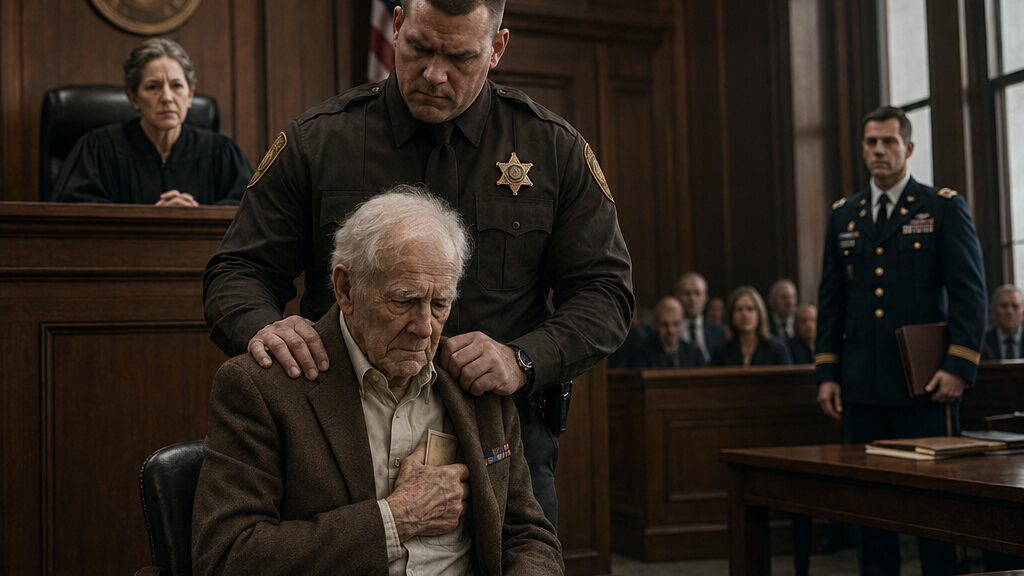
Frank felt one hand settle on his shoulder and another near his collar, not cruelly, not gently. The pressure was enough to remind him that age had made a map of weaknesses across his body and strangers could find them quickly. His breath caught. He kept his hand over the pocket.
“Please,” he said, barely above a whisper. “Don’t bend it.”
The courtroom went quiet, but not with understanding. It was the quiet before control.
Timothy leaned closer. “Mr. Bennett, I need you to let go.”
Frank looked at the flag beside the bench. The gold fringe trembled in the courthouse air. For one small, foolish second, he thought of his wife’s hands smoothing the paper on their kitchen table, telling him that if he waited until everything felt right, he would die waiting.
He closed his fingers over the fold.
Chapter 2: The Salute That Stopped The Courtroom
Timothy Reed did not yank the old man out of his chair. He would remember that later, when shame tried to make the moment worse than it had been, and mercy tried to make it better. He placed one hand on Frank Bennett’s shoulder and the other near the lapel of the brown blazer, intending only to steady him, to keep the hand from diving deeper into the jacket.
But the room saw the size of him behind the old man.
It saw Frank’s white hair, the thin neck above the collar, the small service ribbons pinned too low on a blazer that did not quite fit anymore. It saw the deputy’s hands and the old man’s hand over his heart, and whatever Timothy intended became less important than what the moment looked like.
“Mr. Bennett,” Judge Hayes said, “this is your final instruction. Release the item.”
Frank’s eyes lifted toward the bench.
“I can’t let him get lost twice,” he said.
Donald Harris looked toward the judge, impatient. “Your Honor—”
The rear courtroom door opened.
It was not loud. Just a soft wooden pull, a hinge, a brief spill of hallway light across the center aisle. Still, the interruption cut through the room because everyone was waiting for the next motion from Frank’s hand.
A man in dress uniform stepped inside.
He paused just long enough to remove his cap. He was younger than Frank by decades, but old enough to have earned the controlled face he wore. His uniform was dark and exact, the ribbons arranged with a precision that made the little crooked row on Frank’s blazer look suddenly tender. He carried a folder under one arm.
The clerk glanced up, startled. Judge Hayes frowned.
“Can I help you, Colonel?” she asked, though his exact rank was not announced in court and no one corrected her.
The officer did not answer immediately. His eyes had gone to Frank.
Not to the old man’s face first. To his hand. To the edge of the paper showing where the blazer had pulled open under Timothy’s grip. Only a corner was visible, yellowed and soft with age. There was a typed line near the fold, faint enough that most people would have seen nothing but old paper.
The officer saw it.
His expression changed so slightly that only the people nearest him could have noticed. His jaw set. His shoulders, already straight, became still in a different way.
“Your Honor,” he said, “I’m David Carter, military records liaison assigned through the regional veterans office. I was asked to verify a document connected to Mr. Bennett’s filing.”
Donald turned. “This is a municipal property matter. The veterans office has no standing here.”
David did not look at him. “I understand.”
Judge Hayes folded her hands. “Who asked you to come?”
From the clerk’s station, Sharon Cooper stood halfway. Her face had gone pale, but her voice held. “I did, Your Honor. Yesterday evening. After I found the duplicate request in archives.”
Donald’s mouth opened, then closed.
Judge Hayes looked from Sharon to David. “This court is in session. If you have relevant information, you may wait until called.”
David gave a small nod. “Yes, Your Honor.”
But he did not move to the benches. He remained in the aisle, looking at the old paper.
Timothy felt Frank tremble under his hand.
“Deputy,” David said quietly.
The single word was not an order, not exactly. It was spoken with the calm of a man who had learned not to raise his voice when a lower one would carry farther.
Timothy looked at him.
David’s eyes shifted to the deputy’s hands on Frank’s shoulders.
There was no accusation in the look. That made it worse.
Timothy removed his hands.
Frank did not slump. He did not turn to glare. He kept one palm against his pocket, breathing through his nose, eyes lowered as though the whole exchange had embarrassed him more than frightened him.
David came down the aisle.
Every step was measured. The gallery watched him pass. The court reporter stopped typing. Even Judge Hayes let the silence remain, perhaps because there was a kind of authority in the room now that did not compete with hers but asked to be recognized.
David stopped three feet from Frank.
“Mr. Bennett,” he said.
Frank did not answer.
“Sir,” David said, softer.
Frank’s eyes lifted.
David looked at the ribbons on the old blazer, then at the folded corner of paper, then back at Frank’s face. “May I ask if the document in your pocket bears the name Cooper Ward?”
Something passed over Frank’s face so quickly it might have been pain or relief or the sudden return of a voice long unused.
Kathleen made a small sound behind him.
Frank said, “It bears what’s left of him.”
David’s hand moved to his side. He stood fully straight.
Then he saluted.
It was not theatrical. He did not snap the room into patriotism. He did not turn his body toward the gallery or make a lesson of the gesture. He saluted one old man seated at a courtroom table, one old man whose hand still guarded a paper everyone else had wanted taken away.
The room changed.
Not loudly. No one applauded. No one cried out. But the air altered with the terrible quiet of people realizing they had been watching the wrong story.
Frank stared at the salute as though it had arrived from a country he had not visited in many years. His mouth tightened. For a moment his hand left his pocket, not to return the salute, but to press against the table and keep himself steady.
“Please don’t,” he whispered.
David held the salute one breath longer, then lowered his hand. “Permission to stand beside you, sir?”
Frank looked at Judge Hayes, as if even permission given to him still had to pass through the court.
The judge’s voice was different when she spoke. “Mr. Bennett may answer.”
Frank nodded once.
David stepped to his side, not behind him. That detail was small, but Timothy felt it like a rebuke. The officer did not touch Frank. He placed his folder on the table, carefully, and waited.
Donald cleared his throat. “Your Honor, I want to renew my objection to this interruption.”
Judge Hayes looked at him. “Noted.”
“With respect, a salute does not establish relevance.”
“No,” David said. “It establishes that I recognized a service designation on that document.”
Donald’s eyes narrowed. “From across the room?”
“From enough rooms,” David said.
Frank closed his eyes.
Judge Hayes leaned forward. “Mr. Carter, what designation?”
David glanced at Frank, asking without words. Frank’s fingers tightened around the folded paper. For a moment it seemed he would refuse.
Then he drew the paper out.
He did it with both hands, slowly, as though removing something living from a place of shelter. The paper was folded around a small cloudy photograph sleeve, its edges protected by a piece of old wax paper. The corner that had shown before carried a typed line, faded but still legible from the bench when Sharon brought it forward on the evidence tray.
David did not pick it up. He waited until Frank placed it down.
“Your Honor,” David said, “that line corresponds to a temporary casualty transfer record from an overseas evacuation route. Mr. Bennett’s name appears in a later inquiry connected to that file. So does the name Cooper Ward.”
Sharon’s hands were clasped at her waist.
Donald said, “Again, Your Honor, the county has no verified resident by that name on its memorial rolls.”
Frank opened his eyes.
“That’s why I came,” he said.
Judge Hayes looked at him for a long moment. “Mr. Bennett, whose name is Cooper Ward?”
Frank touched the edge of the photograph sleeve but did not open it.
“Not mine,” he said.
His voice had steadied, but the steadiness seemed to cost him.
“I came because I made a promise. And because this county keeps telling me the man I made it to was never here.”
Chapter 3: The Name The County Called Irrelevant
Judge Sandra Hayes called a recess because the courtroom had stopped behaving like a courtroom.
She did not say that. She struck the gavel once and announced fifteen minutes, but the reason sat plainly in front of everyone. The ordinary shape of the morning docket had broken. Traffic fines, property damage, restitution, old men who would not follow instructions—none of those labels fit neatly over what had happened when David Carter raised his hand to Frank Bennett.
Sandra remained on the bench while the gallery emptied in murmurs.
She watched Frank stay seated at the table, the folded document in front of him, both hands resting on either side of it as if the paper might be startled by sudden movement. Kathleen stood behind his chair. She did not touch him. Timothy Reed had retreated to the wall near the flag, his face stiff with the effort of appearing unchanged.
Donald Harris gathered his file with clipped motions. “Your Honor, I need to object to the direction this is taking.”
“We are in recess,” Sandra said.
“Then I need to preserve my objection for when we are not.”
She looked at him over her glasses. “You have preserved it with enthusiasm.”
Donald closed his mouth.
Sandra stepped down from the bench and motioned toward the side door. “Mr. Harris. Ms. Cooper. Mr. Carter. Chambers.”
Frank looked up.
Sandra paused. She had almost forgotten the old man was not an exhibit. That realization bothered her.
“Mr. Bennett,” she said, “your document will remain where it is unless you wish to put it away.”
Frank’s hand moved over it at once.
“I’ll hold it.”
Donald made the smallest sound.
Sandra turned her head. “Mr. Harris, chambers.”
The room behind the bench was narrow, lined with law books nobody had opened in years and county binders everyone opened too often. A framed photograph of Sandra’s predecessor hung beside a thermostat that always lied. Sharon Cooper entered last and closed the door gently.
For a moment no one spoke.
Then Donald said, “This cannot become a veterans memorial hearing.”
“No one said it was,” Sandra replied.
“With respect, that is exactly what it is becoming. Mr. Bennett damaged county property. He has been warned. He has repeatedly attempted to insert unauthorized material into a public memorial display. The fact that he served, however honorably, does not exempt him from basic procedure.”
David stood near the wall, cap tucked under his arm. “No one asked that it should.”
Donald turned on him. “Then why are you here?”
“Because Ms. Cooper found my office number on a records request and called.”
Sandra looked at Sharon. “Explain.”
Sharon’s fingers worried the edge of a folder. She had worked in the courthouse long enough to become part of its machinery: soft shoes, quiet voice, memory for file numbers, birthday cards passed around offices for people she barely knew. Sandra had rarely seen her nervous.
“Mr. Bennett submitted a correction request six months ago,” Sharon said. “Then again four months ago. Then three weeks before the glass broke. The request involved adding a name to the veterans wall.”
“Cooper Ward,” Sandra said.
Sharon nodded. “The veterans services assistant marked it incomplete because Mr. Bennett could not provide a county enlistment address. The archive search showed no Cooper Ward in our memorial roll, no property record, no school record, and no death record attached to this county.”
Donald spread one hand. “Which supports the county’s position.”
Sharon looked down. “It supported what we thought then.”
Sandra heard the change. “What did you find?”
Sharon opened the folder. “An intake log from 1965. Not the memorial roll. A courthouse relief office ledger. The name is not Cooper Ward exactly. It’s Ward, Cooper. Listed as dependent family contact for a woman who received county assistance for two months. The address was a boarding house on Ellis Street.”
Donald took the copy before Sandra could. “This is not proof of military residency.”
“No,” Sharon said. “But it means he existed here.”
David said, “And the temporary casualty transfer file means he existed in the service record Mr. Bennett has been asking someone to review.”
Donald looked at him. “Can you verify that from memory?”
“No. I can verify that the designation on Mr. Bennett’s paper matches the type of record my office handles. I can also verify that Mr. Bennett’s name has appeared in correspondence about an unresolved service identity inquiry.”
Sandra held out her hand for the ledger copy. Sharon gave it to her.
The page was faint, a reproduction of a reproduction. Names, dates, amounts. Ward, Cooper. Two lines only. Enough to disturb certainty, not enough to settle anything.
Sandra had built a career on the difference.
“What exactly is Mr. Bennett charged with?” she asked.
Donald stiffened. “Damage to county property and failure to comply with a lawful instruction.”
“And what exactly did he damage?”
“The display glass and the frame.”
“While doing what?”
Donald’s jaw worked. “Attempting to place his document inside the display.”
“Not stealing from it. Not defacing a name already there.”
“No, but—”
“But attempting to insert a name the county had refused to consider.”
Donald’s voice sharpened. “Your Honor, emotional motive is not permission.”
“I know that.”
The room went quiet again.
Sandra looked at David. “Mr. Carter, why did you salute him?”
Donald’s expression suggested this question was precisely the problem.
David did not answer quickly. “Because he did not identify himself by rank. He did not ask for recognition. He was being treated as a risk while trying to protect a fragile document. And I recognized enough to understand he had carried something longer than he should have had to carry it alone.”
“That is not a legal answer,” Donald said.
“No,” David replied. “It is the honest one.”
Sandra looked back at the copy in her hand. She thought of Frank seated in front of the bench, saying the promise instead of the paper. She thought of Timothy’s hands on the old man’s shoulders. She thought of how easily a court could mistake slowness for resistance and grief for disorder.
Still, Donald was not wrong. Glass had broken. Orders had been ignored. A courtroom could not function if every private sorrow became an exception.
“Ms. Cooper,” Sandra said, “what happened to Mr. Bennett’s earlier requests?”
Sharon swallowed. “They were returned as incomplete.”
“Did anyone call him?”
“I don’t know.”
“You don’t know, or no?”
Sharon’s eyes flicked to Donald, then back. “No.”
Sandra set the paper down.
In the silence, they could hear the muffled sounds of the courtroom beyond the door: benches creaking, low voices, someone coughing. Ordinary people waiting for ordinary rulings.
“Here is what we are not going to do,” Sandra said. “We are not going to decide a military records matter from a chambers conference. We are also not going to pretend Mr. Bennett’s document is trash because it was inconveniently presented.”
Donald inhaled. “Your Honor—”
“He will be allowed to submit it for limited review.”
Donald’s face tightened. “And the property damage?”
“Still before the court.”
David lowered his eyes slightly, not in victory, but in acknowledgment.
Sandra turned to Sharon. “Make a copy if Mr. Bennett permits it. Handle the original as he instructs. Do not flatten it if he objects.”
Sharon nodded.
Donald closed his file. “The county maintains that Cooper Ward was never officially assigned to this county’s memorial list.”
Sandra opened the chambers door.
In the courtroom, Frank looked up immediately. He had put the folded paper back into his inside pocket. His hand covered it again, but the gesture no longer looked like defiance to Sandra.
It looked like shelter.
Donald followed her gaze and spoke from behind her, quiet enough that only those near the door heard him.
“Even if the man existed, Your Honor, that doesn’t mean he belongs on that wall.”
Frank’s eyes moved to Donald.
The old man had heard.
Chapter 4: Kathleen Wanted Him To Let The Dead Rest
Kathleen found her father in the side hallway outside Courtroom Two, sitting on a wooden bench beneath a framed evacuation map that had hung there since before she was born.
The hallway was quieter than the courtroom, but not private. People passed with folders held to their chests. A deputy guided a man toward the stairwell. Someone laughed near the vending machines, then lowered their voice when they saw the old man in the brown blazer sitting stiffly with one hand inside his coat.
David Carter stood several feet away, giving Frank space. That, more than the salute, unsettled Kathleen. Respect had always seemed to her like something noisy people demanded or ceremonial people performed. This was different. David had positioned himself where Frank could see him but not feel watched, close enough to help, far enough not to claim him.
Kathleen sat beside her father.
“You scared me in there,” she said.
Frank looked at his shoes. They were polished, but badly. He had tried. One toe held a dull crescent of light from the hallway window.
“I scared myself some,” he said.
She let out a breath that almost became a laugh and almost became something else. “Then come home.”
His hand stayed over the paper.
“Dad.”
He turned his head a little.
“You heard the judge. They’re going to look at it. That’s more than they did before. Let them make a copy. Pay for the glass. Let me drive you home before this turns into more than your heart can take.”
“My heart is all right.”
“You know that isn’t what I mean.”
Frank gave a small nod. The old courthouse lights hummed above them. Kathleen had hated that sound as a child. On Saturdays when her mother brought her here to pick Frank up after overtime, she would sit on the lobby bench and wait while he finished some last repair nobody would notice unless he failed to do it. He would emerge smelling of dust, machine oil, and the peppermint candies he kept in his shirt pocket. Back then his hands had seemed large enough to fix the whole world.
Now one of those hands trembled against a piece of folded paper.
Kathleen lowered her voice. “This is hurting you.”
Frank said nothing.
“You think I don’t know what it is? I know where you kept it. Top drawer, left side, under the handkerchiefs Mom ironed even after nobody ironed handkerchiefs anymore.”
His face changed at the mention of her mother. Not much. Frank’s grief never made a scene. It moved behind his eyes like a curtain stirred by air.
“She knew,” Kathleen said. “I know she knew. I used to see the two of you at the kitchen table. Papers everywhere. Envelopes. That old photograph sleeve. Mom reading addresses out loud because you didn’t want to put on your glasses.”
Frank’s mouth softened. “She had better eyes.”
“She had more patience.”
“She had both.”
Kathleen watched a clerk pass them, then waited until the hallway cleared. “After she died, you got worse about it.”
He looked at her then.
The words had come out wrong, but she did not take them back. Too many years had made a fence around that drawer, that paper, that name he would not explain fully. She had walked around it for so long she had forgotten she was angry until the anger rose.
“You stopped letting me help,” she said. “You stopped going to church suppers. You stopped answering the phone unless I called twice. Every few months there was another letter, another trip to an office, another form somebody sent back. Then you broke the glass, Dad. You were down on your knees in the courthouse lobby with deputies around you.”
“I didn’t break it on purpose.”
“I know.” Her voice cracked. “But knowing doesn’t make me less afraid.”
Frank looked toward the far end of the hall where the veterans wall stood out of sight around the corner. His hand moved once over the pocket, checking the shape beneath the fabric.
Kathleen had spent half her life trying to understand that gesture. As a child, she thought he touched his chest because of pain. As a teenager, she thought he was checking for a pen. After her mother died, she began to think it was some private habit of grief, like the way he still put two plates down before remembering.
“What did you promise him?” she asked.
Frank’s eyes closed briefly.
“You don’t have to tell me everything,” she said. “But you have to tell me enough that I know why I’m watching my father put himself through court over a man the county says doesn’t belong here.”
“He belonged,” Frank said.
The firmness startled her.
“Then why won’t you let someone else prove it? Let Mr. Carter handle the military side. Let the clerk handle the county records. You don’t have to sit in there while that attorney talks about you like you’re a problem.”
Frank looked down at his lap. “Maybe I am a problem.”
“No.”
“I broke their glass.”
“Yes, and we can deal with that.”
“I ignored their letters.”
“Because they ignored yours.”
He shook his head. “Don’t make me better than I am.”
Kathleen went quiet.
Frank rubbed the edge of his thumb against the blazer seam. “I had chances before this. Your mother told me. Years ago, she told me to go stand in front of the county board and say his name into a microphone if that was what it took.”
“That sounds like Mom.”
“She said a quiet promise can turn into hiding if a man isn’t careful.”
The hallway seemed to narrow around them.
Kathleen whispered, “Why didn’t you?”
His shoulders rose with a careful breath.
“Because if I said it out loud and they still said no, I didn’t know where to put what was left of me.”
Kathleen looked away before he could see her face.
Across the hall, Timothy Reed stood near the courtroom door. He had removed one hand from his belt and let it hang at his side. He was not looking directly at Frank, but he was not pretending not to listen either. Kathleen wondered if he had a father. Most men like that did, though they sometimes behaved as if they had been carved from policy.
Frank saw him too.
“He was doing his job,” Frank said.
Kathleen turned back. “He put his hands on you.”
“I wouldn’t move mine.”
“That doesn’t make it all right.”
“No.” Frank’s voice stayed even. “But it makes it not simple.”
She hated how often he did that—took the sharp clean edge off her anger. She wanted someone to be clearly wrong. Donald Harris with his file and his polished impatience. Timothy with his hands. The judge with her tired voice. The county that sent letters back marked incomplete. Even the dead man whose name had pulled her father through years of worry.
But Frank kept making room for everyone to be human.
Kathleen leaned back against the bench. “Mom would be furious with you.”
That almost made him smile. “Yes.”
“She’d say you should have told me.”
“Yes.”
“She’d say you should have worn the blue tie instead of that old brown blazer.”
“She liked the blue tie.”
“She hated that blazer.”
“She said it made me look like a retired undertaker.”
Kathleen laughed once, and then the laugh broke. She covered her mouth. Frank moved his right hand from the pocket just long enough to pat her wrist. The gesture was awkward and brief, but it carried him from father to father, from the man who had fixed sinks in this courthouse to the man who used to lift her onto his shoulders during parades.
“Dad,” she said, “please tell me why today.”
Frank looked at the courtroom door.
“Because I’m tired,” he said.
She stiffened.
He shook his head. “Not like that. I’m tired of keeping him folded.”
Kathleen looked at the place under his hand.
“Cooper Ward,” she said.
Frank’s eyes moved to hers.
It was the first time she had said the name in his presence. She had read it on envelopes and half-filled forms, on the backs of photocopies, in her mother’s careful handwriting. But she had never spoken it aloud, not to him.
Frank swallowed.
“Your mother knew I was late by fifty-nine years,” he said.
Before Kathleen could answer, the courtroom door opened. Sharon Cooper stepped into the hall holding a folder against her chest.
“Mr. Bennett,” she said gently, “Judge Hayes is ready to continue. She said you may keep the original with you for now.”
Frank nodded and began to stand.
Kathleen reached for his elbow, then stopped.
He saw it and gave her the smallest nod of thanks.
Chapter 5: The Wall With One Empty Space
The veterans wall stood in the courthouse lobby where morning light could reach it but afternoon shadows always did.
Frank had never liked that. Years ago, when the county replaced the old display with a larger glass case and brass header, he had suggested shifting it to the opposite wall. The maintenance supervisor told him the wiring was already approved and the donor plaque had been ordered. Frank had tightened the screws, polished the brass, and said no more.
Now he stood before the wall as a defendant under court recess, with his daughter on one side and a military liaison on the other.
Judge Hayes had allowed the viewing because Sharon Cooper said the physical display mattered to understanding the damage. Donald Harris objected twice, then followed them into the lobby with his file tucked under one arm. Timothy Reed came too, not close behind Frank this time, but close enough to do his job.
The damaged glass had been removed, replaced temporarily by a clear acrylic sheet that did not sit flush in the frame. A thin crack remained in the lower wood trim where Frank had tried to lift the edge. The county had taped over it with a strip of blue painter’s tape, as if the wound might be less embarrassing in a brighter color.
Names filled the display in columns.
Some were etched on metal plates. Others were printed on archival cards behind the glass, sorted by conflict and service period. Frank knew the uneven history of it. The oldest names had come from family Bibles and newspaper clippings. The newer ones came from federal forms. Some had middle initials. Some did not. Some had ranks. Some had only branch and year. The wall pretended to be orderly, but Frank knew it had been assembled from grief, memory, pride, and whatever paperwork survived weather, moves, fires, and tired clerks.
He stopped before the lower right corner.
Kathleen saw the blank space at once. It was not officially blank. There was a small gap between two mounted cards where the spacing had been adjusted after a nameplate was corrected years earlier. Anyone else would have called it a layout flaw. Frank looked at it like a chair left empty at supper.
“That’s where you tried to put it,” Kathleen said.
Frank nodded.
Donald stepped forward. “For clarity, Mr. Bennett attempted to force private material beneath the protective sheet in this area.”
Frank did not answer.
David crouched, careful not to block Frank’s view. He looked at the frame, the blue tape, the slight lift in the acrylic. “You did this with your pocketknife?”
Frank’s face reddened.
Kathleen turned sharply. “Dad.”
“It was a small knife,” Frank said.
“That is not the part I’m worried about.”
He looked ashamed then, not of the act, but of being seen by his daughter in the foolish mechanics of it. An old man kneeling in a public lobby with a pocketknife, trying to do in secret what years of letters had not done in daylight.
“I thought if it was there,” he said, “someone would have to ask why.”
Donald’s voice was dry. “Or someone would remove it as unauthorized material, which is what happened.”
Sharon Cooper, who had been standing quietly with her folder, said, “It was not removed.”
Donald looked at her.
Sharon opened the folder and took out a plastic evidence sleeve. Inside was a photocopy, not the original. “The responding deputy photographed it before placing it in temporary evidence. The original was returned to Mr. Bennett after processing.”
Frank glanced at her with surprise.
She lowered her eyes. “I made sure it was returned. I should have called you then.”
The apology came softly, almost too softly for the lobby. But Frank heard it.
“You were busy,” he said.
Sharon shook her head. “That is not an answer I like today.”
Donald shifted. “Ms. Cooper, this is not the time for personal reflections.”
Judge Hayes, who had come down from the courtroom behind them, said, “It may be exactly the time, Mr. Harris.”
The small group fell silent.
People entering the courthouse slowed when they saw them gathered at the wall: the judge without her robe, the county attorney, the old man in the brown blazer, the uniformed military liaison, the deputy standing back. A few looked at Frank with curiosity. One elderly woman removed her hat before walking past the display.
Frank kept his hand at his pocket.
David stood. “Mr. Bennett, may I see where the paper would have gone?”
Frank did not move at first. Then he withdrew the folded paper and photograph sleeve. Kathleen noticed how everyone around him adjusted. Sharon held her folder out like a tray but did not touch the document. David stepped aside. Timothy’s hands remained visible and still. Even Donald stopped speaking.
Frank held the paper near the lower right corner, not touching the acrylic.
“There,” he said.
The folded paper was yellow against the clean display. Its edges were soft, darkened where fingers had held it too often. Through the cloudy sleeve, Kathleen could barely make out the ghost of a young face in uniform. Not enough to know him. Enough to understand he had once looked into a camera because someone wanted to remember him.
“Why here?” Kathleen asked.
Frank pointed with one bent finger to the name above the gap. “Served out of the same intake station.” He pointed below. “Same transfer group came through two weeks after.” His finger returned to the open space. “Cooper should have been between.”
Donald made a note. “That assumes facts not in evidence.”
Frank turned toward him. “Most names start that way.”
The county attorney blinked.
Frank seemed almost surprised at himself. He looked back to the wall. “Somebody says a name before a clerk writes it. Somebody spells it. Somebody remembers a date. A wall like this doesn’t begin with evidence, Mr. Harris. It begins with somebody refusing to let a person vanish.”
No one answered.
Sharon slowly opened her folder. “There’s something else.”
Judge Hayes looked at her. “From the archives?”
“Yes, Your Honor. I had the records room pull old relief office ledgers after the chambers discussion. The first copy was faint. The second book had a cross-reference.” She handed the page to the judge. “Cooper Ward’s mother was listed under temporary county assistance. Two months. Ellis Street boarding house. The note says, ‘son enlisted, forwarding address unknown.’”
Frank closed his eyes.
Kathleen looked at him. “You didn’t know that?”
“I knew she came through here,” he said. “I didn’t know they wrote her down.”
David read over the judge’s shoulder. “This could establish local connection for review.”
“Not automatic inclusion,” Donald said quickly.
“No,” David said. “Review.”
Frank still had his eyes closed. Kathleen wondered where he had gone. Not away from them exactly. Backward, maybe. To a room where a young man named Cooper had a mother in a boarding house and a forwarding address that never caught up.
Judge Hayes handed the copy back to Sharon. “File it with the temporary record.”
Donald frowned. “Your Honor, again, the matter before the court—”
“Is broader than you wanted it to be,” the judge said. “Not broader than it is.”
Frank opened his eyes.
The lobby had gone still in patches. People pretended not to watch. A child near the stairs whispered and was hushed. The acrylic over the veterans wall reflected Frank’s face faintly over the names, making him look half listed among them, half outside.
Kathleen looked from the reflection to the folded paper.
For years she had thought the paper was dragging him backward. Standing there, she understood it differently. He had been trying to bring someone forward with him, one refused form at a time.
“Dad,” she said quietly.
He did not look away from the wall.
“I thought you wanted them to see what you did.”
Frank shook his head. “I wanted them to see who I left.”
The words landed without force. That made them harder to bear.
Timothy Reed turned his face slightly toward the main doors. His jaw flexed once.
David said, “Mr. Bennett, tomorrow, if Judge Hayes permits, I can testify only to the process. Not to what you saw. Not to what you promised.”
“I know.”
“You’ll have to say it.”
Frank folded the paper again along its old crease. He slid the photograph sleeve behind it and placed both back inside his blazer.
Kathleen waited for him to cover the pocket. He did.
But this time his hand did not grip. It rested there, tired and open.
Judge Hayes looked at the damaged frame, then at Frank.
“Court resumes tomorrow morning at nine,” she said. “Mr. Bennett, be prepared to testify.”
Donald closed his file with a soft snap.
Frank kept his eyes on the empty space.
“I’ve been prepared a long time,” he said.
Chapter 6: Frank Bennett Finally Opened The Fold
The next morning, Frank wore the blue tie.
Kathleen had found it looped over the back of a kitchen chair when she arrived before sunrise, still bearing the soft crease of years spent in a drawer. She did not say that her mother would have approved. Frank already knew. He sat at the table while she tightened the knot because his fingers would not do it right, and neither of them spoke of how strange it felt for a daughter to dress the man who had once tied her shoes.
At the courthouse, people looked at him differently.
Not all of them. Some had no idea who he was. Others only noticed the uniformed officer walking near him, or the judge’s clerk holding doors with unusual care. But enough eyes lingered on the old man’s face that Frank felt the change like a draft. He did not enjoy it. Pity and respect could look alike from a distance.
In Courtroom Two, Timothy Reed stood by the front rail.
Frank approached slowly. Kathleen kept pace beside him. David Carter waited near the counsel table with a folder, but he did not reach for Frank’s chair. No one did.
Timothy stepped forward, then stopped far enough away to leave room.
“Mr. Bennett,” he said.
Frank looked at him.
The deputy’s face was tight, but not hard. “Before court starts, I need to say I should have asked before I put my hands on you yesterday.”
The room was not yet full, but several people heard. Timothy seemed aware of that and chose not to lower his voice.
Frank studied him. “I should have listened when you told me to move my hand.”
Timothy’s brow creased. “Maybe. But I still should’ve asked.”
Frank gave a small nod. “Then we’ll both do better today.”
The deputy swallowed. “Yes, sir.”
Sir. Not as habit. Not as crowd-pleasing. As correction.
Frank moved to the table.
When Judge Hayes entered, the courtroom rose. Frank rose with the others, slower but unaided. The folded paper rested inside his blazer, and for the first time since he had entered the building the day before, his hand was not on it. He could feel it anyway. Some burdens announced themselves without touch.
The judge took her seat. “We are back on the matter of County of Brookwell versus Frank Bennett. Mr. Harris, your position remains?”
Donald stood. “The county maintains the property damage charge and requests restitution. Regarding the additional material, we object to any final determination about memorial eligibility in this proceeding. However, the county does not object to limited testimony for the purpose of explaining motive and determining disposition of the document.”
Judge Hayes looked faintly surprised. “Thank you, Mr. Harris.”
Donald sat as if the words had cost him.
Frank understood then that nobody would hand him the whole thing. Not the county. Not the judge. Not David. They had opened a narrow place in the wall. He would have to pass the name through it himself.
Judge Hayes turned to him. “Mr. Bennett, you may testify from the table if standing is difficult.”
Frank looked at the witness stand. It sat to the right of the bench, boxed in by polished wood. He had repaired that step twice. Once after a winter leak swelled the board, once after a defendant kicked it loose leaving court. He knew the grain of the rail beneath the varnish.
“I’ll go there,” he said.
Kathleen’s hand moved, then stopped.
Frank walked to the stand. Timothy opened the small gate and stepped back. The court clerk administered the oath. Frank raised his right hand. His left hovered near his pocket but did not touch it.
“State your name,” Donald said when the judge allowed him to proceed.
“Frank Bennett.”
“Age?”
“Eighty-two.”
“You are the same Frank Bennett who damaged the county veterans display case on the morning of April third?”
“Yes.”
A faint movement passed through the gallery.
“Did anyone give you permission to alter that display?”
“No.”
“Did anyone from the county tell you not to insert your own documents into it?”
“Yes.”
Donald let that sit. “So you knowingly violated that instruction.”
Frank looked at the folded hands in his lap. “Yes.”
Kathleen closed her eyes.
Donald turned slightly toward the judge. “And you understand that your reason, however meaningful to you, does not make county property yours?”
“Yes.”
“Then why did you do it?”
The courtroom quieted.
Frank looked at the bench, then at the wall beyond Donald’s shoulder where the flag stood. His voice came slowly.
“Because I tried your way.”
Donald frowned. “My way?”
“The county’s way. Forms. Letters. Copies. Dates if I had them. Addresses if I could find them. I wrote what I knew. Your office sent back what it didn’t.”
Donald glanced down. “You were asked for required verification.”
“I know.”
“And you could not provide it.”
“Not all of it.”
“Because Cooper Ward was not in the county’s official military roll.”
Frank’s hand moved to his pocket. The judge watched but said nothing.
“He was not in your roll,” Frank said. “That is the trouble.”
Donald stepped closer. “Mr. Bennett, did you serve with Cooper Ward?”
“Yes.”
“What branch?”
“Army.”
“What conflict period?”
Frank hesitated. Not because he did not know. Because there were words that opened doors in the mind better left closed in public rooms.
“Vietnam era,” he said.
David’s eyes lowered.
Donald continued more softly than before, perhaps aware of the room. “And what exactly are you asking this court to believe?”
Frank looked at Judge Hayes. “May I open it?”
The judge nodded. “You may.”
He took out the folded paper.
The courtroom watched his hands. They were not steady, but they were careful. He removed the cloudy photograph sleeve first and placed it on the rail in front of him. Then he unfolded the paper along creases worn white as thread. Once. Twice. A third time.
The sound was small, dry, almost nothing.
To Frank it was louder than the gavel.
The paper lay open. Inside were typed lines, a faded duplicate transfer notation, handwritten corrections in two inks, and at the bottom, in Frank’s younger hand, a name printed carefully in block letters:
COOPER WARD.
Frank touched the name once.
“He gave me the picture first,” he said.
No one asked a question.
“He said his mother hated the picture because he wouldn’t smile right. Said she lived in boarding houses after his father died. Said the county office helped her once and she said it proved there were still decent people left.” Frank’s mouth tightened. “He talked when he was scared. Some men go quiet. Cooper talked.”
Kathleen covered her mouth.
Frank kept his eyes on the paper. “I was supposed to keep him awake. That was all I could do. Keep him talking until transport came. He asked if I knew Brookwell. I said I did. Not well then. Later I knew it better. He told me if anything happened, tell them back home he wasn’t just passing through.”
Donald did not interrupt.
“He said, ‘My mama paid taxes on three streets and rent on two others. That ought to count for belonging somewhere.’” Frank paused. “I told him I would tell somebody.”
His finger remained on the name.
“Did he survive transport?” Judge Hayes asked quietly.
Frank shook his head.
The answer did not need decoration.
For several seconds, only the court reporter’s keys moved.
Donald looked at his file, but the papers there seemed to offer him little. “Mr. Bennett, why wait so long?”
Frank accepted the question as he had accepted the oath.
“I came home with other names first,” he said. “Names with mothers standing in doorways. Names with flags already folded. Cooper had no one waiting where I knew to knock. Then life went on in the way it does when a man lets it. Work. Marriage. A child. Bills. Roof leaks. Knees. I kept thinking I would find the right proof before I said his name to anyone official.”
He looked at Kathleen.
“Your mother told me proof was not the same as truth. I didn’t listen fast enough.”
Kathleen cried silently, her hands folded hard in her lap.
David Carter stood at the rear of the counsel table, still as a guard post.
Frank turned back to the judge. “I’m not asking the court to pretend I didn’t break the glass. I did. I’ll pay for it as far as my pension lets me. But don’t throw the paper away. Don’t tell me incomplete means untrue. If the county has to say no after looking, then make them look with his name open.”
Judge Hayes removed her glasses and set them down.
Donald rose slowly. His face had changed, though not into softness. It had become careful.
“Your Honor,” he said, “the county does not concede eligibility for inclusion on the memorial wall today.”
“I understand.”
“But we will not object to a review of Mr. Bennett’s submission in light of the additional ledger entry and any military records Mr. Carter’s office can lawfully provide.”
Frank closed his eyes once.
Judge Hayes turned to him. “Mr. Bennett, do you understand? This does not guarantee the name will be added.”
Frank nodded. “Most decent things don’t come guaranteed.”
For the first time, Sandra Hayes almost smiled.
She looked toward Donald. “Does the county still object to opening a correction review?”
Donald stood with both hands on the back of his chair.
“No, Your Honor,” he said. “Not to a review.”
Chapter 7: Respect Was How They Handled The Paper Afterward
Judge Sandra Hayes did not rule at once.
She sat with Frank’s opened paper before her, not touching it, her glasses resting beside the blotter and her hands folded in a way that made the courtroom wait with her. The gallery had grown fuller than it had been the first morning. Word had moved through the courthouse in quiet, practical ways: through the clerk’s office, through the deputies’ station, through the veterans services desk, through people who said they were only checking on their own cases but stood at the back longer than necessary.
Frank noticed none of that at first.
He noticed the paper.
It lay on the evidence tray near the clerk, unfolded now, no longer shaped to his pocket. The photograph sleeve rested beside it. Cooper Ward’s face was still blurred by age and plastic, but after saying the name aloud, Frank found he could see the young man more clearly than he had in years. Not the photograph exactly. The tilt of his head. The nervous talking. The way he had laughed once at a joke neither of them had finished.
Frank sat at the table again. Kathleen sat behind him, close enough that he could hear her breathing. David Carter stood by the rail. Donald Harris remained at the county table with his file closed.
The judge looked toward Frank. “Mr. Bennett, before the court rules, I want to be clear about what this hearing can and cannot do.”
Frank nodded.
“This court cannot order a military record corrected today. It cannot order a name placed on the county memorial wall today. There are procedures for that, and some of them are outside this courtroom.”
“I understand,” Frank said.
“What this court can do is determine how the county handles the item you brought, whether the county will open a proper local review based on the material now presented, and what penalty is appropriate for the damage to the display case.”
Frank’s eyes moved to the damaged frame beyond the courtroom doors, though he could not see it from where he sat.
“I broke the glass,” he said.
“Yes,” Judge Hayes said. “You did.”
Kathleen’s hands tightened in her lap.
The judge turned to Donald. “Mr. Harris, does the county have a final restitution estimate?”
Donald stood. “The maintenance supervisor provided an estimate for replacement acrylic, frame repair, and labor. In light of the court’s direction, the county is willing to accept a reduced amount based on materials only, with payment over time.”
Frank looked at him.
Donald did not soften his expression. He did not become another man. But he looked directly at Frank when he spoke next.
“The county does not wish to punish Mr. Bennett beyond the damage actually caused.”
Frank gave him a small nod. “I’ll pay it.”
Kathleen leaned forward. “Dad—”
“I’ll pay it,” Frank said again, not sharply. “Glass broke. It shouldn’t have.”
Judge Hayes waited until Kathleen sat back. “The court will order restitution for materials only, payable in installments. Mr. Bennett is not to tamper with the display case again.”
“I won’t,” Frank said.
“However,” the judge continued, “the court will not order disposal of the document. The original will remain Mr. Bennett’s property. With his permission, copies will be entered into a temporary court file and forwarded to the county veterans review committee, along with the ledger entry located by Ms. Cooper and any eligible records Mr. Carter’s office can provide.”
The court reporter’s keys clicked steadily.
Judge Hayes looked at Sharon Cooper. “Ms. Cooper, you will mark the matter for administrative follow-up and ensure Mr. Bennett receives written confirmation of each step. Not a form letter. Confirmation.”
“Yes, Your Honor,” Sharon said.
The judge looked at Donald. “Mr. Harris, the county may argue eligibility when the committee meets. It may not call the request incomplete without addressing the newly located records.”
Donald nodded. “Understood.”
Then Sandra Hayes looked back at Frank. Her voice lowered, though it carried through the room.
“Mr. Bennett, you had lawful options you did not use. But the record also shows that you tried lawful options and were not meaningfully heard. The court cannot excuse what you broke. It can recognize why a man might break something after being told, repeatedly and incorrectly, that a name did not exist.”
Frank’s throat tightened.
The judge picked up her glasses but did not put them on. “You came here charged with damaging county property. You also came here carrying a name the county should have looked at more carefully. Both things are true.”
That, Frank thought, sounded like justice in the only form he trusted: not clean, not painless, but able to hold more than one truth at once.
Judge Hayes struck the gavel once. “Restitution ordered as stated. The stay-away order from the display case is denied, provided Mr. Bennett accesses it only through regular public areas and does not alter it. The document review is opened. Court is adjourned.”
No one applauded.
For that, Frank was grateful.
People stood slowly. The gallery murmured, then quieted, as if unsure what kind of sound belonged after such a ruling. David Carter stepped toward Frank, stopped, and waited until Frank looked at him.
“Mr. Bennett,” David said, “with your permission, I’ll coordinate the service records request.”
“With my permission,” Frank repeated.
“Yes, sir.”
Frank absorbed the words. Permission had become a strange and beautiful thing in that room.
“You have it,” he said.
Kathleen came around the rail and stood beside him. “Dad?”
“I’m all right.”
“You always say that.”
“Today I mean more of it.”
She gave a tired laugh, wiping carefully beneath one eye. She looked toward the evidence tray. “Do you want me to get it?”
Frank turned.
Timothy Reed was already near the clerk’s table. He had been speaking quietly with Sharon, but when Frank looked over, he stopped. Sharon slid the photograph sleeve and folded paper toward him, then paused and looked at Frank.
“May Deputy Reed bring it to you?” she asked.
The question itself struck Frank harder than the answer.
Yesterday, hands had come before permission. Today, permission came first.
Frank nodded.
Timothy picked up the photograph sleeve with both hands. He did not fold the paper quickly. He did not tuck it under his arm or pinch it between fingers while reaching for something else. He let Sharon show him the original crease, then followed it slowly, the way a person might close an old letter from someone still loved.
He walked to Frank and stopped an arm’s length away.
“Sir,” Timothy said, “may I hand this back?”
Frank held out both hands.
Timothy placed the folded paper and photograph sleeve into them. His fingers did not touch Frank’s skin.
“I’m sorry for how I handled you,” Timothy said.
Frank looked down at the paper. “You said that.”
“I know. I needed to say it when I wasn’t hoping court would start before you answered.”
Frank studied the deputy’s face. There was no performance in it, only discomfort that had decided not to run.
“I held on too hard,” Frank said.
Timothy shook his head. “So did I.”
Frank slipped the document into his inside pocket. His hand followed it out of habit, but instead of gripping the fabric closed, he rested his palm there lightly.
Timothy glanced toward the courtroom doors. “Would you like help standing?”
Kathleen shifted, ready to object on Frank’s behalf.
Frank looked at Timothy’s open hand, waiting at his side rather than reaching.
“Yes,” Frank said after a moment. “Under the elbow. Not the shoulder.”
“Yes, sir.”
Timothy supported him exactly where instructed. Frank stood. The help was real, but it did not take him over. When he was steady, Timothy let go.
In the lobby, the veterans wall waited under the afternoon light.
The blue tape still marked the cracked frame. The acrylic still sat unevenly. Cooper Ward’s name was not there. Nothing in the ruling had carved letters into metal or made the empty space whole.
But Sharon Cooper stood beside the display with a new folder marked for review. Donald Harris spoke with the maintenance supervisor in a low voice, pointing not at Frank but at the damaged trim. David Carter waited near the wall, cap under his arm. Kathleen stood close to her father, her shoulder almost touching his.
Frank approached the lower right corner of the display.
For years, he had stood before that space as if standing guard over a failure. Today the space remained empty, yet it no longer felt sealed. It had become a question the county had agreed to answer properly.
Kathleen looked at the wall. “What happens now?”
“Paperwork,” Frank said.
She smiled through what was left of her tears. “You hate paperwork.”
“I respect it when it behaves.”
David heard and almost smiled.
Frank took the photograph sleeve from his pocket one more time. He did not remove the picture. He held it against his palm and looked at the blank space through the glass.
“I said it,” he whispered.
Kathleen did not ask whether he meant the name, the promise, or the truth. Some sentences were allowed to carry more than they explained.
Judge Hayes passed through the lobby without her robe, on her way back to chambers. She paused near Frank.
“Mr. Bennett,” she said.
He turned.
“When the committee date is set, you’ll receive notice.”
“Yes, Your Honor.”
“And if transportation is an issue, inform the clerk.”
Frank nodded.
The judge glanced toward the wall. “The court should have listened sooner.”
It was not an apology dressed for display. It was smaller than that, and more useful.
Frank considered what to do with it. Then he said, “Courts are made of people. People run late.”
Sandra Hayes held his gaze. “Not fifty-nine years, if we can help it.”
After she walked away, Frank remained before the wall a while longer.
People moved around him. Doors opened and closed. The courthouse returned to itself—papers, footsteps, metal detectors, low voices, the ordinary machinery of public life. But something had shifted in how the people nearest him moved. Sharon did not rush the folder away. Timothy did not hover. David did not salute again. Kathleen did not ask him to let the dead rest.
At last Frank put the photograph sleeve back into his pocket.
His hand rose after it, then stopped.
For a moment, his palm hovered over his heart, the gesture worn into him by years of carrying. Then he lowered his hand to his side.
Kathleen saw.
She offered her arm, not as a command, not as rescue.
Frank looked at it, then took it.
Together they walked toward the courthouse doors. Behind them, the wall still held one empty space. Ahead of them, the afternoon had cleared, and the stone steps shone pale under the sun.
Frank did not leave celebrated.
He left lighter by one name.
The story has ended.