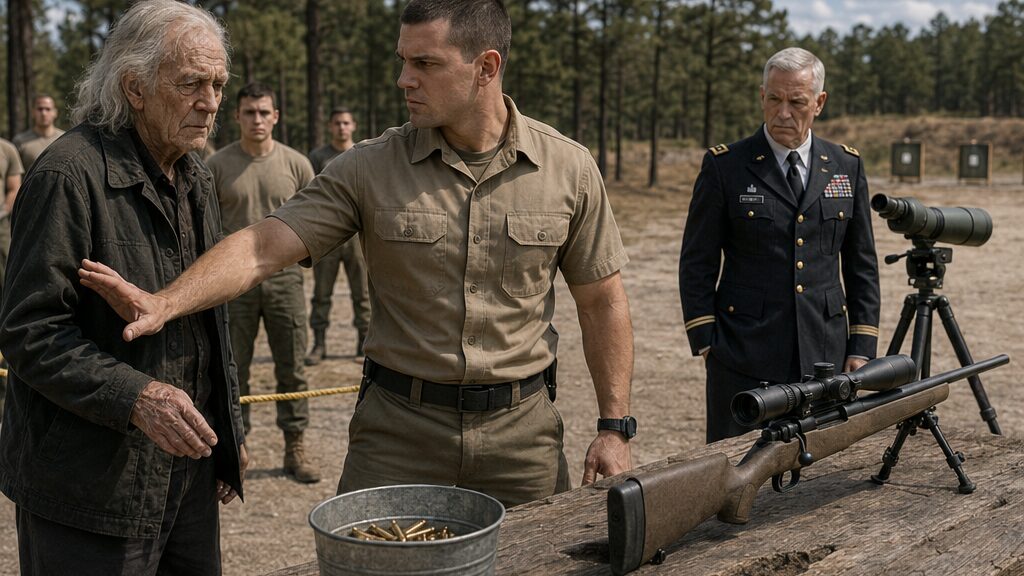
They Laughed At The Old Veteran’s Shaking Hand Until The Spotting Scope Went Silent
Chapter 1: The Old Hand Beside The Rifle Bench
Ronald Bennett arrived before the heat came up from the dirt.
The range road had not changed as much as he expected. It still ran straight through the pines, pale and powdery, with the low roofs of the ammunition shed and range office sitting beyond the last bend. The old watchtower stood farther out, sun-bleached and square against the trees, its ladder cage patched in two places. Someone had painted the tower since he had last seen it, but the paint had already started to peel where the afternoon wind carried grit across the boards.
He stopped at the chain gate and let the engine idle.
For a moment, he only watched.
Trainees moved along the firing line in pairs, rifles cased or shouldered, instructors checking clipboards, flags hanging limp in the dead morning air. A metal bucket sat beside one of the wooden benches, bright brass catching light inside it. Farther down, a spotting scope waited on a tripod like a narrow black eye aimed toward the targets.
Ronald rested both hands on the steering wheel. The knuckles had grown broad and pale over the years. The right thumb trembled when he held it too long in the air, so he pressed it lightly against the worn seam of the wheel until it settled.
The guard at the gate leaned from the booth. “Can I help you, sir?”
Ronald lowered the window.
“I’m here for Colonel Sullivan.”
The guard looked at the visitor list, then at Ronald’s face, then back at the list again. The second glance was the one Ronald had expected. People always tried to match the name on a form to the man sitting in front of them, and when the years did not line up kindly, their eyes did the adjusting.
“Retired personnel observation?” the guard asked.
“If that’s what it says.”
“It says you’re cleared for the qualification range.” The guard hesitated. “You need someone to drive you in?”
Ronald’s mouth moved, not quite a smile. “I found it.”
The guard opened the gate.
Ronald parked near the range office and took his time getting out. He had learned not to rush in front of younger men. Rushing made a tremor look like weakness. Moving slowly could mean many things. Age. Habit. Judgment. He let people choose what they wanted to see.
The morning smelled of dust, gun oil, canvas, and cut grass gone dry at the edges. That smell had lived somewhere in him for half a century, packed away with names he did not say often and places that appeared only in dreams when the weather changed.
A medic at the side table saw him first. She wore her aid bag across one shoulder and had a stack of water bottles under one arm. Her name tape read Harris.
“You looking for someone, sir?”
“Colonel Sullivan.”
“He’s down by Lane Four.” She shifted the bottles. “You want me to walk you over?”
Ronald looked toward the firing line. “No need.”
She did not insist. That was rare enough for him to notice.
The old wooden benches had been rebuilt, but not redesigned. Thick tops, scarred edges, front legs braced wide in the dirt. He passed Lane One, where a trainee was dry-firing under instruction. Lane Two had two rifles laid out, bolts open, instructors speaking in clipped morning voices. Lane Three was empty except for a cleaning rod and a sandbag.
Lane Four held the scoped rifle.
Ronald stopped ten feet from it.
It was a precision rifle set on a bipod, matte black and heavy through the barrel. The stock had been adjusted for someone tall. The scope sat high, the turrets capped, a bubble level fixed to the mount. Beside the rifle rested an ammunition case, a range card, and the metal bucket he had seen from the gate. Loose rounds lay inside it, some nose-down, some sideways, brass and copper flickering whenever a breeze touched the bucket.
A young instructor leaned over the bench, speaking to a trainee. He was square-shouldered, clean-shaven, with dark hair clipped close and a confidence that seemed to have been polished along with his boots.
Kevin Carter, according to the name tape.
“Your cheek weld is wandering,” Kevin said. “Don’t chase the scope. Build the position, breathe through it, squeeze straight back.”
The trainee nodded. He looked young enough to still believe that a mistake said something permanent about him.
Ronald stood behind the bench rail, silent.
The trainee fired.
A crack rolled downrange and disappeared into the trees.
The target pits were too far for bare eyes. Ronald watched the rifle instead. He watched the bipod feet jump. Watched the barrel settle. Watched the trainee’s shoulder tighten before the report had fully left the lane.
Kevin checked through the spotting scope. His jaw tightened.
“Low left again,” he said.
The trainee swallowed. “Same as before?”
“Same as before because you’re doing the same thing as before.”
Ronald’s gaze lowered to the bench.
One loose round had rolled out of the bucket and come to rest near the rifle case. He bent and picked it up.
The brass was warm from the sun. He turned it once between his thumb and forefinger, not lifting it high, not making a show of it. The bullet jacket held a faint mark near the seating line. Not damage exactly. Not enough for a careless eye. A thin crescent rubbed into the copper, consistent across more than one round if his suspicion was right.
He looked at the bucket.
Then at the scope mount.
Then at the bipod feet pressed against the grain of the old bench top.
The tremor in his thumb started again. He held the round gently until the shaking faded into a small, rhythmic movement no wider than the case rim.
Kevin looked over his shoulder and saw him.
“This is a controlled line, sir.”
Ronald set the round on the bench, parallel to the rifle, bullet pointing downrange.
“I know.”
Kevin straightened, assessing him in one sweep: old hair, weathered face, careful stance, plain jacket, hands that did not close fast anymore.
“Observers stay behind the yellow rope,” Kevin said.
Ronald glanced down. The yellow rope hung slack from two posts behind him. He had stopped just in front of it.
He stepped back until his shoes touched the dust behind the line.
The trainee looked embarrassed for him.
Ronald did not.
Kevin returned to the rifle. “Again. This time don’t anticipate.”
The trainee built his position again. He breathed too shallow. His elbow was not the main problem, though Kevin adjusted it twice. His cheek weld had changed, yes, but not enough to explain the repeated pattern. Ronald watched the instructor’s hands move quickly, efficiently, correcting the visible things.
The trainee fired.
Another crack. Another small jump of the bipod. Another long second before Kevin bent to the spotting scope.
Kevin exhaled hard. “Still low left.”
Ronald looked toward the flags. Nothing. No crosswind worth naming. Mirage faint over the dirt, but not enough.
Colonel Charles Sullivan came from the range office with a clipboard under one arm. He was older than the others but still carried himself with the unbent caution of a man used to being watched. His dress uniform looked too formal for the dust, ribbons squared above his pocket, silver hair trimmed close.
He saw Ronald and stopped.
The pause lasted just long enough for Ronald to know Charles recognized the name before he decided what to do with it.
“Mr. Bennett,” Charles said.
“Colonel.”
Kevin looked between them. “Sir, we’re working through a grouping issue.”
“So I see.”
Charles came to the bench but did not offer his hand. Ronald appreciated that. Some men shook too hard when they wanted to prove they did not notice weakness.
The trainee waited, rifle safe, eyes lowered.
Ronald’s attention returned to the loose round on the bench. It had rolled slightly, caught in a shallow groove worn into the wood by years of equipment and elbows. His thumb wanted to stop it. He let it move until it touched the rifle case.
“Not his shoulder,” Ronald said quietly.
Kevin turned. “Excuse me?”
Ronald looked at the trainee. “Not enough to put every shot there.”
Kevin’s face tightened with professional patience. “Sir, I understand it can look that way from back there.”
Ronald said nothing.
The old habit moved through him before thought did: gather the pattern, distrust the obvious, respect the smallest repeat. One shot was a mistake. Two shots might be a shooter. Three in the same wrong place meant the equipment had earned a look.
He nodded toward the round.
“Check the lot.”
Kevin stared as if Ronald had asked him to check the weather underground.
Charles Sullivan’s eyes shifted to the bench.
The line went briefly quiet between shots. Somewhere downrange, a target frame creaked in the faint wind.
Kevin picked up the loose round and dropped it back into the bucket with the others.
“We’re not chasing ammunition excuses,” he said. “Not on a fundamentals lane.”
Ronald watched the brass disappear.
The trainee’s face reddened.
Ronald felt the old pull in his chest, the place where silence and duty argued.
He had not come to teach. He had told himself that twice before leaving the house and once in the parking lot. He had come because Charles had asked him to observe the old lane before its certification review. He had come because a standard was not a monument. It had to be kept alive by people willing to notice when it was being shaved thin.
But the trainee was looking at the dirt now, believing the target told the whole truth about him.
Ronald moved his hand behind his back so no one would watch it tremble.
“That grouping is saying something,” he said.
Kevin’s voice cooled. “Yes, sir. It’s saying he needs more instruction.”
Charles did not speak.
That silence troubled Ronald more than Kevin’s answer.
He looked past them to the target line, to the shimmer above the dirt, to the dark circle of the spotting scope waiting on its tripod.
The old range was talking. Everyone heard the shots.
Almost no one was listening.
Chapter 2: The Instructor Who Mistook Silence For Confusion
Kevin Carter had been on his feet since 0500, and the day was already turning against him.
Lane Two had lost twenty minutes to a stuck case. Lane Five had a trainee who kept forgetting to breathe until the shot startled him. The certification review was supposed to be clean, efficient, proof that his instruction team could run precision qualification without older supervisors hovering over every bench.
Instead, Charles Sullivan had arrived in dress uniform, which meant someone higher up wanted a photograph or a report. Then Ronald Bennett had appeared behind Lane Four like an old memory nobody had briefed Kevin to handle.
Kevin did not dislike old veterans. He had grown up around them at ceremonies, diners, county fairs, men with ball caps and careful steps, men people thanked in grocery stores. But a live firing line was not a ceremony, and respect could not mean letting anyone wander into a bench because his name mattered to someone in the office.
He lifted the bucket from the bench and set it farther from Ronald’s reach.
“Andrew,” he said to the trainee, “reset. We’ll diagnose this properly.”
Andrew Miller nodded, though his shoulders had begun to fold inward.
Ronald remained behind the yellow rope, still as a fence post. The sun caught the lines in his face. His hair, gray-white and long at the back, moved slightly in the breeze. One hand rested against his side. The other hung loose, fingers curved as if still remembering the shape of the round.
Charles stood near the spotting scope, saying nothing.
That made it worse.
Kevin checked the rifle. Bolt open. Chamber clear. Scope caps secure. Mount screws visually fine. Bubble level centered when the rifle sat flat. Nothing obvious.
He gestured Andrew forward. “Position.”
Andrew lay in behind the rifle again.
Ronald’s voice came from behind the rope. “You moved the bucket.”
Kevin closed his eyes once. “Yes, sir.”
“Didn’t move the problem.”
Andrew froze.
Kevin straightened. “Mr. Bennett, with respect, this is an active qualification line.”
“With respect,” Ronald said, “that is why I mentioned it.”
A couple of trainees on the neighboring lane glanced over. The instructor there pretended not to listen.
Kevin felt heat rise under his collar. It was not only irritation. It was the sensation of being inspected in front of the men he was supposed to lead.
“Sir,” he said, carefully now, “we have established procedure. We don’t stop a qualification evolution because an observer has a feeling about loose ammunition.”
Ronald’s gaze did not sharpen. It simply stayed.
“Not a feeling.”
Kevin gave him room to explain, partly because Charles was watching, partly because refusing would make him look afraid of an old man’s comment.
Ronald stepped forward to the rope but not past it. “Third round from the top when you moved the bucket had the same crescent at the seating line as the one I set down.”
Kevin looked at the bucket despite himself.
“Could be feed wear,” Kevin said.
“Could be.”
“Could be nothing.”
“Could be.”
The agreement irritated Kevin more than argument would have.
Ronald nodded toward the rifle. “Scope is reading level on the bench. Not under load.”
Kevin’s jaw set. “The mount was checked before the line opened.”
“By eye?”
“By standard procedure.”
Ronald looked at the bipod feet. “Bench top’s crowned.”
The words were soft enough that the neighboring lane did not hear them, but Charles did. Kevin saw the colonel’s eyes drop to the old wooden surface.
Kevin almost laughed, not because it was funny, but because the claim sounded like something from another decade. A crowned bench top. A seating mark. A loose round. The kind of thing men said when they wanted mystery to replace fundamentals.
“This bench has passed inspection,” Kevin said.
Ronald nodded again. “I imagine it has.”
“You imagine?”
“I imagine it passed because nobody loaded the rifle the way that boy is loading it.”
Andrew’s ears went red.
Kevin took one step closer to the rope. “That boy has a name.”
“Andrew,” Ronald said at once.
Andrew looked up, surprised.
Ronald had heard it once and kept it. Kevin had not expected that.
“All right,” Kevin said. “Then tell me what Andrew is doing wrong that only you can see.”
Ronald’s eyes shifted to Andrew, and for the first time his expression changed. Not much. A small regret moved across his face.
“He trusts you.”
The words landed badly.
Kevin’s shoulders squared. “That’s enough.”
Nicole Harris, the medic, had come nearer with a water bottle in hand. She stopped a few steps from Charles, watching the space between Kevin and Ronald.
Kevin reached toward the rifle. “Sir, step away from the active bench area.”
Ronald was still behind the rope, but his hand had drifted toward the bench. Not reaching for the weapon. Reaching toward the groove where the round had rested, as if measuring something only his fingers could read.
Kevin caught the movement.
He moved quickly, blocking the hand with his forearm, not touching Ronald hard, but enough to stop him.
“Do not reach toward the weapon.”
The range fell quieter than it should have.
Ronald’s hand remained suspended in the air, weathered fingers half-curled. The tremor was visible now. Small, uncontrollable, humiliatingly clear in the bright morning.
Kevin saw it and wished at once that he had not.
Ronald lowered his hand.
No anger came. No wounded pride. No lecture about service, no demand for respect. He simply stepped back until the yellow rope brushed his jacket.
Charles’s face had gone still.
Kevin knew he had overcorrected. He also knew every person on the line had seen why: an elderly observer’s shaking hand near a rifle bench. Procedure was procedure. Anyone would understand.
Ronald looked at the bench, not at Kevin.
“Your right bipod foot is walking,” he said.
Kevin exhaled through his nose. “Because the shooter is loading unevenly.”
“Because the bench gives under pressure at that spot. Scope shows level empty. Under shoulder load, the rifle cant repeats. Same place every time.”
Kevin folded his arms. “And the ammunition?”
“Two problems can stand in the same room.”
A trainee down the line coughed once, then looked away.
Charles finally moved. He walked to the bench and placed two fingers on the wooden top. He did not press. He only felt along the grain, across the shallow groove, toward the right front area where the bipod foot had been braced.
Kevin watched his commanding officer do what Ronald had wanted to do.
That stung more than he expected.
Charles looked at Ronald. “You saw that from behind the rope?”
Ronald’s mouth tightened slightly. “I saw the rifle come back different than it went forward.”
Kevin shook his head. “Sir, with all due respect, if we chase every bench imperfection on qualification day, we’ll never certify anyone.”
Ronald looked at him then.
“Certification is not the same as truth.”
No one spoke.
The sentence did not sound rehearsed. It did not sound like a challenge either. It sounded like something Ronald had learned the costly way and did not care to explain.
Kevin reached into the bucket and pulled out a round. He held it up between two fingers. “This is standard match issue from the ammunition shed. Same lot used across three lanes.”
“Then you may have three lanes worth checking.”
Kevin let out a short breath. “Or we have one retired observer making a large claim from a small mark.”
Ronald accepted that with a slight nod.
“Small marks are where large claims begin.”
The old man’s calm was beginning to feel less like confusion and more like discipline. That annoyed Kevin because it made his own certainty feel loud.
Charles looked toward the target line, then back at Andrew.
“Cease Lane Four,” he said.
Kevin turned. “Sir?”
“Pause the lane.”
“Colonel, we’re already behind schedule.”
Charles did not raise his voice. “Then we’ll be behind schedule safely.”
Kevin looked at Ronald. Ronald did not look pleased. That, somehow, made the moment harder.
The colonel walked to the spotting scope and adjusted it toward Andrew’s last target. He looked for several seconds. Long enough that even the neighboring instructors stopped pretending not to watch.
Ronald stood behind the rope with both hands folded in front of him now. His right thumb moved against the side of his left hand, a small private motion.
Kevin lowered his voice. “Mr. Bennett, what exactly are you suggesting?”
Ronald’s eyes remained on the rifle. “Take one round from a different box. Set the rifle under load, not empty. Check the level then. And don’t use that groove in the bench.”
Kevin heard the old command shape beneath the quiet. Not volume. Sequence. Priority. A man arranging risk in order.
“Anything else?” Kevin asked.
Ronald looked toward Andrew. “Tell him the last three shots don’t belong to him yet.”
Andrew blinked.
Kevin did not say it.
Charles lifted his face from the spotting scope.
“Carter,” he said, “do what he asked.”
The instruction moved through the range like a change in weather.
Kevin felt every eye and hated that he cared. He took a fresh box from the case, set the bucket aside, and shifted the rifle an inch left so the bipod foot cleared the worn groove. He checked the bubble level empty. Centered.
Then he asked Andrew to settle in behind it.
Under shoulder pressure, the bubble slipped.
Not much.
Enough.
Kevin stared at it.
Ronald did not.
He had already known where to look.
Chapter 3: One Round To End The Argument
By noon, the range had grown hot enough for the air above the dirt to shimmer.
The pause at Lane Four had spread a quiet unease along the firing line. Nobody called it that. Instructors called it a procedural check. Trainees called it a delay. Charles Sullivan called it necessary. But Ronald could feel the other name beneath it.
Doubt.
It had moved from Andrew’s shoulders into Kevin’s jaw, from Kevin’s jaw into the men watching from the neighboring lanes. Doubt had weight. Ronald had carried it before, sometimes usefully, sometimes too late.
Kevin set a fresh round on the bench, separate from the bucket. He had found a box from a different lot after sending a runner to the ammunition shed. The new round looked clean at the seating line. No faint crescent. No rubbed copper. Nothing that would have caught an impatient eye.
Ronald stood behind the yellow rope and let the younger men work.
The rifle had been shifted left, away from the groove in the bench. Kevin had checked the level under load twice, once with Andrew behind the stock and once by pressing the rifle himself. The bubble moved differently now. Not perfect, but honest.
“Try it again,” Kevin told Andrew.
Andrew glanced once at Ronald, then settled behind the rifle.
Ronald did not nod. He did not want the boy looking to him instead of the instructor in charge. Chain of command mattered, even when pride had bent it out of shape.
Andrew fired.
The shot cracked clean and flat. The rifle came back straighter.
Kevin bent to the spotting scope.
His face did not change at first.
Then he looked again.
“Center right,” he said.
Andrew’s head lifted. “On paper?”
Kevin did not answer quickly enough.
Charles stepped closer. “Where?”
“Center right,” Kevin repeated. “Tighter.”
Ronald let his breath leave slowly.
One corrected shot did not prove everything. He knew better than that. Luck loved to disguise itself as confirmation. But a rifle that changed its story when the conditions changed was no longer accusing the shooter alone.
Kevin turned from the scope. “That doesn’t clear the shooter.”
“No,” Ronald said.
“And it doesn’t prove the ammunition was bad.”
“No.”
Kevin’s eyes narrowed. “You say no a lot for a man who stopped my lane.”
Ronald looked at the target line. “A man should say no when no is true.”
Nicole, standing near the medical table now, lowered her gaze as if hiding a smile.
Kevin heard it anyway, or felt it. His ears flushed.
Charles walked to the bench. “Bennett, would you take a look through the scope?”
Ronald did not move.
The old instinct in him recoiled from the invitation. Men had a way of turning useful things into displays. He could already feel the shape of it if he stepped forward: the old veteran behind the rifle, the young trainees watching, Kevin waiting for his hand to betray him, Charles measuring history against the present.
He had not come for that.
“I can see enough from here,” Ronald said.
Charles studied him. “I’m asking.”
That was different from ordering. It left Ronald the burden of choice.
Kevin folded his arms. “Sir, with respect, putting him behind that rifle now complicates the line even more.”
Charles’s voice stayed even. “The line is already complicated.”
Ronald’s right hand trembled against his trouser seam. He closed it loosely.
The tremor had started after the winter he turned seventy-two. First only when tired. Then with coffee. Then with nothing at all. Doctors had given it names and pamphlets and careful tones. He had learned to button shirts slower, write shorter notes, hold cups with two hands when no one was looking.
But shooting had never belonged only to stillness. Stillness was useful. It was not the whole craft. The craft was building support where the body failed, knowing what could be trusted, knowing when not to fire.
Andrew was watching him with something painful in his face. Hope, maybe. Or apology for needing proof.
Ronald stepped toward the rope.
Kevin lifted a hand immediately. “Sir—”
Ronald stopped.
He looked at Kevin’s raised hand until the young instructor lowered it.
“I won’t touch the rifle unless you clear me to,” Ronald said.
The words were not submissive. They were procedural.
Kevin swallowed. “Bolt is open. Chamber clear.”
“Then say it.”
Kevin’s face tightened.
Charles said nothing.
The range seemed to hold its breath.
Kevin turned toward the bench and spoke clearly. “Lane Four rifle is clear. Mr. Bennett is permitted forward under instructor supervision.”
Ronald stepped past the rope.
The few feet to the bench felt longer than he liked. He could feel Nicole watching his balance, could feel Kevin watching his hands, could feel Charles watching everything else. He placed his left palm lightly on the bench, not for drama, but because the world had begun to tilt at the edges in the noon heat.
Nicole moved half a step.
Ronald gave the smallest shake of his head.
She stopped.
He lowered himself onto the stool behind the rifle. The wood was too low. The stock too long. The scope set for younger eyes. He did not complain. He adjusted what could be adjusted and accepted what could not.
His right hand hovered near the grip.
The tremor showed.
Someone behind him whispered, then went quiet.
Ronald did not look back.
Kevin placed the fresh round on the bench. “One round?”
“One.”
“What are you trying to prove?”
Ronald looked through the scope, saw blur, then shadow, then the target swimming in the bright distance. He adjusted his cheek, blinked, waited for the black ring to settle.
“That the rifle tells the truth when we let it.”
Kevin said nothing.
Ronald did not load immediately. He checked the bipod pressure with his left hand. Not much. Just enough. He looked at the bubble level under his own shoulder load. Off by a hair. He shifted his body instead of correcting the rifle, because the rifle needed to reveal the bench, not obey him.
He picked up the round.
The brass slipped slightly against his fingers. He closed his hand, waited, then opened it again. The tremor remained, but smaller now that the motion had purpose.
He loaded.
Closed the bolt.
The sound moved through him like a door shutting in an old hallway.
For a moment, the range disappeared.
He was not young again. He disliked that lie. Memory did not return muscle, and age did not vanish because a rifle fit the shoulder. His back hurt. His right eye watered. His hands no longer belonged completely to him.
But the sequence remained.
Bone, not muscle.
Breath, not force.
Pressure, not snatch.
Wait for the body’s sway to become predictable.
The crosshair drifted. It always drifted. He let it.
Kevin stood close enough to intervene, far enough not to touch.
Charles watched from behind the spotting scope.
Ronald breathed in, let half of it go, and held not his breath but the moment after it.
The shot broke.
The rifle came back against him, heavy and familiar. Dust lifted from the bench where the bipod feet settled. The sound ran downrange, struck the trees, and faded.
Ronald opened the bolt and withdrew his hand from the rifle.
“Clear,” he said.
Kevin looked at the chamber, then at him. “Clear.”
Nobody moved toward the target at first.
Charles bent to the spotting scope.
Ronald remained seated. He did not trust himself to stand immediately. The shot had taken more from him than he would allow his face to show. His right hand shook freely now beside his knee, relieved of duty and therefore uncontrolled.
Nicole saw. She turned slightly, blocking the view from the neighboring lane with her body.
That kindness nearly undid him.
Kevin stared at Charles instead of the rifle.
The colonel stayed behind the spotting scope for a long time.
Too long for an ordinary hit.
Too long for a miss.
The old range sounds returned by inches: a flag snapping once, boots in dirt, a distant command from another lane cut short when no one answered.
Kevin’s voice came out lower than before.
“Sir?”
Charles did not lift his head.
Ronald looked at the loose bucket of rounds, now sitting several feet away in the dust, no longer allowed to pretend it was harmless.
Finally Charles straightened.
His expression had changed, but not into surprise. Something older moved through it. Recognition, perhaps. Or the grief of seeing a thing too late.
He looked first at Ronald, then at Kevin.
“Do not touch that target,” Charles said.
Kevin went still. “Colonel?”
Charles looked back through the spotting scope once more, as if giving silence a second chance to explain itself.
Then he said, “Bring me Andrew’s last target sheet. All of it.”
Chapter 4: The Target Nobody Wanted To Read Correctly
The target sheet came back in the hands of a tower observer who had started the morning looking bored and now looked as if he wished someone else had been sent.
He carried it flat against a clipboard, careful not to bend the corners. The paper had a row of neat pasters from earlier strings and a cluster of fresh holes low and left of center. Andrew’s name was written at the top in block letters. Lane Four. Qualification attempt. Time. Weather. Ammunition lot.
Ronald saw the lot number before anyone handed him the sheet.
He did not reach for it.
Charles took the clipboard and held it where the sunlight fell clean across the paper. Kevin stepped beside him, close enough to read, far enough to avoid appearing eager. Andrew stood several paces back with his cap in both hands. He had the look of a young man waiting for a verdict he had already accepted.
Charles looked first at Andrew’s group, then through the spotting scope again, then back at the target sheet.
“Carter,” he said, “read me the last three calls.”
Kevin took the clipboard. His eyes moved across the notation.
“Shot one, low left. Shot two, low left. Shot three, low left.” He swallowed. “All within a similar spread.”
“And Mr. Bennett’s shot?”
Kevin looked toward the target line, then toward the scope. “Center. Slight right.”
Charles waited.
Kevin’s jaw worked once. “Tight.”
Ronald looked down at his hands. His right one had not stopped shaking since he left the rifle. He folded both together and pressed the tremor into stillness.
“That doesn’t mean the shooter was clear,” Kevin said, too quickly.
“No,” Charles said.
The answer should have helped him. It did not.
Ronald could see Kevin trying to stand inside two truths at once: his instruction might still be sound, and his conclusion might still be wrong. Some men could not bear that combination. They needed one truth to kill the other.
Andrew stared at the holes in the paper. “So did I fail?”
Kevin turned toward him. “We’re not making that call yet.”
It was the first useful thing he had said since the target returned.
Ronald lifted his eyes to the spotting scope. The instrument stood black and patient on its tripod, the same as it had when Charles lowered his head to it and the range went silent. A scope did not care what a man wanted to be true. It showed what its glass could gather. The trouble was always the person behind it.
Charles handed the clipboard back to Kevin. “Show me the rifle under the original setup.”
Kevin hesitated.
“Sir?”
“The way Andrew fired the string. Same bench position. Same bipod placement. Same ammunition lot.”
Kevin looked toward the bucket, now sitting apart from the fresh box like something quarantined by embarrassment. “Do you want the line cold?”
“Yes.”
The command went down the firing line. Bolts opened. Rifles cleared. Voices passed the cease-fire from lane to lane. The sudden quiet made the range feel wider, the trees farther away.
Kevin reset the rifle where it had been before Ronald spoke. The right bipod foot settled into the worn groove on the wooden bench. He selected a round from the original bucket but did not chamber it. He placed it on the bench and bent to check the level.
“Empty, it reads center,” Kevin said.
“Under load,” Charles said.
Kevin’s mouth tightened, but he called Andrew forward. “Get behind it. No firing. Just position.”
Andrew settled into place, more carefully than before. He was trying to do everything right now, which made him too stiff. Ronald watched the shoulder pressure come into the stock.
The bubble slipped.
Not far. Enough.
Kevin stared at it as if the small green vial had personally betrayed him.
Charles lowered himself closer, eyes narrowed. “Again.”
Andrew lifted off the rifle and settled back in.
The bubble slipped again.
Ronald’s voice was quiet. “The bench gives more when the shooter builds position honestly.”
Kevin looked over. “Honestly?”
“Hard enough to repeat.”
The word hung there. Repeat. That was the part the morning had been shouting. Not a wild miss. Not a flinch that scattered across the paper. A repeat.
Charles pointed to the round Kevin had placed on the bench. “Let me see that.”
Kevin handed it to him.
Charles turned it in the sun. It took him longer than Ronald, but he found the crescent. His thumb paused over the faint rubbed mark near the seating line.
“Could be handling,” Kevin said.
Ronald heard the fatigue in it now. Not defiance only. A man fighting the shape of the day.
“Could be,” Ronald said.
Charles did not look away from the round. “And if it appears across the bucket?”
“Then it isn’t handling,” Ronald said. “It’s a pattern.”
Nicole came with a pair of nitrile gloves from the medical table, though no one had asked. She handed them to Charles. He took them with a nod, then began setting rounds from the bucket onto a clean cloth Kevin spread over the ammunition case.
One by one, the brass lined up in the sun.
Some were clean. Several were not.
The faint crescent appeared again. And again. Not always identical. Not dramatic. The kind of mark a hurried inspection would forgive, especially on a day crowded with schedules and rank.
Kevin said nothing.
Andrew stepped closer, drawn by dread and hope. “So those shots…”
Ronald looked at him. “They were still yours. But the rifle wasn’t telling you the whole truth.”
The answer seemed to matter to the boy. It did not absolve him. It did not condemn him. It gave him back a piece of himself without handing him an excuse.
Kevin heard it too. His face shifted, almost imperceptibly.
Charles turned toward the tower observer. “Pull Andrew’s earlier sheet from the morning string.”
The observer jogged off.
Kevin looked downrange. “Colonel, we can’t assume every low-left group is equipment.”
“No one is assuming,” Charles said. “We’re checking.”
Ronald’s left knee had begun to ache from standing. He shifted his weight and hoped it looked like impatience rather than pain.
Nicole noticed anyway. She brought over a folding chair and set it near the rope, not beside him, not under him, just near enough to be available. Then she walked away before gratitude could become awkward.
Ronald did not sit.
Not yet.
The second target sheet arrived with a paperclip holding the morning notes. Charles placed it beside the first. The holes told the same story in a looser hand: a young shooter correcting himself around a problem he had been told was entirely his own.
Kevin leaned closer.
Ronald watched him read the paper the way men read bad news from home, trying first to deny the handwriting.
Charles adjusted the spotting scope toward the earlier target still hanging on the frame. He looked, then motioned Kevin to look.
Kevin bent. Through the scope, he saw what the sheets had already said. The pattern was there, patient and accusing.
When he straightened, his face had lost color.
“I should have caught it,” he said.
Ronald looked toward Andrew before answering. “You caught what you expected to see.”
Kevin turned sharply, but the words had no insult in them. That made them harder to reject.
Andrew spoke from behind them. “What happens to my qualification?”
Charles answered before Kevin could. “It gets reviewed.”
“Do I shoot again?”
“Not on that setup.”
Andrew nodded, though his hands shook faintly now.
Ronald finally sat in the folding chair Nicole had left. His body took the relief too eagerly, and he disliked that everyone could see it. He kept his back straight and his hands folded.
Charles stood before him with the target sheets under one arm.
“When,” the colonel asked, “did you last stand on this range?”
The question drew the air out of the moment.
Kevin looked at Ronald. So did Andrew. Nicole, at the medical table, went still.
Ronald looked past them to the watchtower, to the patched ladder cage and the peeling paint. He could almost see it as it had been: bare wood, younger men, sharper voices, a different flag snapping above the same dirt.
“A long time ago,” he said.
Charles waited.
Ronald reached toward the bench, then stopped before his hand crossed the space. He looked at the old groove where the bipod foot had rested.
“Before that groove was there.”
Chapter 5: The Standard With Ronald’s Name Still On It
The range office was cooler by only a few degrees, but the shade made everyone speak softer.
A fan turned in the corner with a dry clicking sound. The walls held laminated safety diagrams, emergency numbers, faded unit photographs, and a framed range map with red grease-pencil marks along the lanes. A metal cabinet stood open near the back. Charles had sent the ammunition clerk searching through binders while Kevin stood by the table with the target sheets laid out before him.
Ronald sat near the doorway where he could see the firing line through the window.
He did not like being inside while the range waited.
Outside, trainees stood in loose clusters, rifles cleared and grounded. Some tried not to stare through the glass. Andrew sat alone on a bench under the awning, elbows on knees, turning his cap in his hands.
Nicole came in with a paper cup of water and placed it near Ronald.
“Drink before you decide whether you need it,” she said.
Ronald looked at the cup, then at her.
“That a medical order?”
“Logistical suggestion.”
He took the cup. His hand trembled enough to wrinkle the rim. She looked away as he drank, which was the second kindness she had given him that day.
At the table, Kevin tapped one finger beside the lot number on Andrew’s sheet.
“This shipment came in last week,” he said. “Seals were intact. Clerk logged it clean. We’ve used part of it already.”
“Across which lanes?” Charles asked.
“Two, Four, and Six for precision blocks. Five may have drawn from it for zero confirmation.”
The ammunition clerk, still half inside the cabinet, called back, “I’m checking now, sir.”
Charles placed the marked rounds into a small plastic evidence tray. “And the bench?”
Kevin looked through the window toward Lane Four. “It passed the quarterly inspection.”
Ronald set down his cup. “Quarterly inspection checks stability empty.”
Kevin turned.
Charles did too.
Ronald did not enjoy the attention. He had spent years giving instruction that kept men alive because it belonged to the work, not because people enjoyed the sound of his voice. Now every sentence he spoke seemed to arrive carrying history he had not unpacked.
“Empty bench. Empty rifle,” he said. “That’s what the sheet asks for.”
Kevin’s brows pulled together. “You know the sheet?”
“I know what it used to ask for.”
The ammunition clerk came back with a gray binder whose spine had cracked and been repaired with tape. “Sir, this one was in the old cabinet. Pre-digital range standards. I don’t know if it’s current.”
Charles took it.
Ronald looked away.
He knew the binder before it opened. Not the tape, not the dust, but the way the cover had been labeled by someone trying to make temporary handwriting last. Block capitals. Black marker. A diagonal crease at the lower corner.
Charles laid it on the table and turned pages carefully.
Kevin stood beside him, still tense, but no longer dismissive. That was something, though not yet enough.
The pages smelled faintly of old paper and oil. Ronald did not need to see them to remember the order: range opening checklist, ammunition control, bench inspection, optics verification, shooter position notes, weather recording, post-fire review. In those days, the forms had been shorter because men were expected to know what the lines meant. Later, as always, short forms became long forms, and long forms became boxes, and boxes taught people to obey without asking what the box protected.
Charles stopped.
His eyes moved down the page.
Kevin leaned closer. “What is it?”
Charles turned the binder so he could read.
At the bottom of the old optics verification page, beneath a paragraph about bench load and bipod placement, was an initial block and a printed name from another era.
R. Bennett.
Kevin looked at the page, then at Ronald.
No one spoke for several seconds.
Ronald hated the silence. He had not wanted his name found like a relic under dust, offered up as proof that he had once mattered. A name on a page was not the same as correctness. He had known decorated men who were wrong and unknown men who saved lives by noticing mud on a boot.
Charles tapped the paragraph lightly. “Read this.”
Kevin did.
His voice changed as he moved through the words.
“Optics verification must be performed under expected shooter load when bench-supported fire is used. Empty-level confirmation alone is insufficient where bench wear, bipod bite, or surface crown may alter cant under pressure.”
The fan clicked twice.
Kevin looked toward the window.
Ronald closed his eyes briefly.
He remembered the day that line had been added. Not in full, not willingly, but in fragments that came with heat: a young soldier insisting he had followed instruction, an instructor too tired to listen, a rifle that kept accusing the wrong man, a qualification failure that cost more than a score. No one had died. People liked to say that as if it made the harm small. Ronald had watched a good shooter lose trust in his own hands for six months because a bench had lied and men had believed the paper.
Charles turned another page. “Ammunition visual check. Seating marks. Lot separation.”
Kevin read silently now.
His throat moved.
Ronald opened his eyes. “Standards don’t remember themselves.”
Kevin looked at him.
There was no defense ready this time.
“I’ve never seen this version,” Kevin said.
“I believe you.”
“They gave us the updated digital checklist.”
“I believe that too.”
Charles’s face hardened, not at Kevin but at the paperwork spread across the table. “The updated checklist removed the under-load note.”
The ammunition clerk shifted uncomfortably. “Sir, the current system just says confirm bench and optic stability before firing.”
Kevin said, “Which we did.”
“Yes,” Ronald said.
The quiet answer was not absolution. It was a door.
Kevin stood on one side of it for a moment, then stepped through.
“But not enough,” he said.
Ronald picked up the cup again and held it in both hands. “Enough for the sheet. Not enough for the rifle.”
Nicole came to the table and examined the marked rounds without touching them. “Could that cause injury?”
Ronald looked at the tray. “Maybe not today. Maybe only bad groups. Maybe a shooter blamed for a rifle’s lie. Maybe a pressure issue if the mark means seating inconsistency. I wouldn’t guess with boys behind rifles.”
Kevin flinched at boys, though Ronald had not meant to diminish them. To Ronald, anyone young enough to believe a single failed sheet could define him was still a boy in the way that mattered.
Charles closed the binder halfway. “Why did you come today, Bennett?”
Ronald looked through the window at the watchtower.
“You asked.”
“I asked for an observation.”
“I observed.”
Charles’s gaze did not move. “You could have told me this standard was yours before you stepped on the range.”
Ronald’s mouth tightened. “Would it have made Kevin listen better?”
Kevin looked down.
Charles did not answer.
Ronald set the cup on the desk. “If a thing only becomes true after a name is attached to it, the name is doing too much work.”
The words left him more tired than he expected.
Nicole folded her arms gently. “Then why come at all?”
Ronald looked at her, and because she had not used him as evidence or obstacle, he answered more honestly.
“Because Charles said the old range was being certified for expanded training. Because Lane Four was built before most of you were born. Because every time someone simplifies a safety line, they think they’re saving time.” His hand trembled on his knee. He let it. “And because I signed the first standard after I learned what silence costs.”
The room remained still.
Kevin’s face changed at the edges. Not apology yet. Something less comfortable. Understanding.
The ammunition clerk returned to his screen near the wall. “Colonel.”
Charles looked over.
The clerk pointed at the inventory log. “Same lot was issued to Lane Six thirty minutes before the pause. They’re staged for the next relay.”
Kevin moved first.
He was halfway to the door before Charles spoke.
“Carter.”
Kevin stopped.
Charles looked at Ronald.
Ronald pushed himself up from the chair before anyone could offer an arm. His knee protested. His right hand shook. He stood anyway.
“Lane Six,” Ronald said.
Nicole reached for her aid bag. “I’m coming.”
Kevin looked at Ronald, and for the first time that day, his voice held no edge.
“How do you want it checked?”
Ronald took one breath, then another.
“Under load,” he said. “Before they fire.”
Chapter 6: The Lane That Could Not Wait
Lane Six was already calling shooters forward when Kevin reached the firing line.
The second relay had been waiting in the heat too long. Delay had made them restless. Restlessness made men careless, and carelessness loved a schedule. A tower observer had just raised his hand to confirm readiness when Kevin’s voice cut across the range.
“Hold Lane Six.”
The instructor there looked over, surprised. “We’re clear to begin.”
“Hold it.”
The words carried enough command to stop movement but not enough explanation to satisfy anyone. Trainees froze halfway into position. One had already settled behind a rifle and lifted his cheek from the stock, blinking against sweat.
Ronald came more slowly behind Kevin, with Nicole near enough to catch him if pride failed before balance did. Charles followed carrying the old binder and the evidence tray. The procession drew every eye on the range.
Kevin felt them watching. An hour ago, he would have hated Ronald for that. Now he hated the way he had almost missed what the old man saw.
The Lane Six instructor walked toward him. “What’s going on?”
“Possible ammunition and bench verification issue,” Kevin said.
“We checked equipment before opening.”
“I know.”
The instructor glanced at Ronald, then back at Kevin. “Is this from Lane Four?”
Kevin heard the doubt beneath the question. Not unreasonable doubt. The day had become strange: an old observer, a paused qualification, marked rounds on a cloth, Charles Sullivan himself crossing lanes with a binder older than half the staff.
Ronald stopped beside the bench and looked at the setup.
The rifle was not identical to Lane Four’s, but close enough in the ways that mattered. Same bipod style. Same type of bench, though this one had a darker patch along the front edge. Same ammunition bucket near the shooter’s right side. Same haste in the air.
Kevin waited for Ronald to speak.
Ronald did not.
He studied the bench from behind the rope, then the shooter, then the bucket. His eyes paused on the trainee’s left elbow placement, not judging the position, only noting where pressure would travel through the rifle and into the wood.
The Lane Six instructor’s patience thinned. “Sir, we have a relay ready.”
Ronald said, “I can see that.”
“Then what exactly are we stopping for?”
Kevin expected Ronald to answer as he had before, with quiet and maddening precision. Instead, Ronald looked at him.
The choice settled on Kevin like a hand on the shoulder.
This was not Ronald’s lane to command. He was not on the duty roster. He had no need to rescue Kevin from embarrassment. If Kevin believed him now, Kevin had to spend his own authority.
Kevin turned to the Lane Six instructor. “Same lot as Lane Four?”
The instructor glanced toward the bucket. “I’d have to check.”
“Check.”
A trainee kneeling behind the rifle muttered, “Does this mean we’re going to be here all day?”
Kevin looked at him. “It means we’re not going to waste your score on a bad setup.”
The trainee shut his mouth.
Ronald’s eyes flickered toward Kevin, then away. It was not praise. It was enough.
The ammunition label confirmed it. Same lot.
Kevin pulled a clean cloth from the case and began setting rounds out. Charles stood back, letting him work. Nicole kept watch over Ronald, though Ronald pretended not to know.
The first four rounds looked clean. The fifth carried the faint crescent.
The Lane Six instructor leaned closer. “That’s tiny.”
“Yes,” Kevin said.
“I’ve seen worse marks chamber fine.”
“So have I.”
“Then—”
“Under load,” Kevin said.
The instructor looked irritated, but he gestured the trainee back into position. Kevin checked the bubble level empty. Centered. Then he crouched beside the rifle while the trainee settled behind it.
The bubble moved.
Not as much as Lane Four.
Enough.
Kevin felt a coldness move through him that the heat could not touch.
“Again,” he said.
The trainee lifted and reset.
The bubble slipped the same direction.
The Lane Six instructor said nothing.
Ronald stepped closer to the rope. His breathing had grown shallow. Sweat had gathered at his temple, catching in the deep lines beside his eye.
Nicole murmured, “You need shade.”
“In a minute.”
“That’s what people say before they become my paperwork.”
He almost smiled. “Then stand close.”
She did.
Kevin pointed to the bench. “Front right support has give.”
The Lane Six instructor pressed on the wood with his palm. “Feels solid.”
“Empty,” Kevin said.
Ronald’s voice came low behind him. “Press where the bipod bites.”
Kevin moved his hand two inches and pressed down.
The wood gave with a faint, dry tick.
Everyone heard it because the lane had gone quiet.
The trainee behind the rifle lifted his head. “Was that supposed to happen?”
“No,” Kevin said.
The word left him before pride could soften it.
Charles stepped forward. “Clear the rifle.”
The Lane Six instructor cleared it. Kevin watched him do it twice.
Ronald’s face had gone pale. He was still upright, but only because he had decided to be. Nicole touched his elbow, and this time he did not move away at once.
“You saw the patch,” Kevin said.
Ronald looked at the darker strip along the front edge of the bench. “Paint hides repairs. Pressure finds them.”
Kevin crouched again and examined the underside. A maintenance plate had been screwed beneath the front support, painted over, probably logged as repair, probably passed because it held under hand pressure. He pictured a quarterly inspection: empty bench, quick push, tick mark on a sheet.
Enough for the sheet. Not enough for the rifle.
The words returned so sharply he looked back at Ronald.
The old man’s right hand shook against Nicole’s sleeve. Not violently. Just enough that nobody could pretend not to see. His eyes stayed on the bench, though, clear and fixed.
Charles opened the binder and placed it on the ammunition case. “Carter.”
Kevin came over.
Charles did not read aloud this time. He tapped the old paragraph.
Kevin nodded once.
Then he turned to the line.
“Lane Six remains cold,” he called. “No firing from this bench. We’re pulling the lot and checking every precision lane under shooter load.”
The announcement traveled with a ripple of frustration and relief. Some trainees groaned. Some looked at their rifles differently. Andrew, watching from Lane Four, stood.
The trainee on Lane Six rose from behind the rifle and looked at the bench as if it had insulted him personally. “So if I’d fired, where would it have gone?”
Ronald answered before anyone else.
“Maybe close enough to blame you.”
The young man stared at him.
Ronald held his gaze. “That is worse than a clean miss.”
No one laughed.
Kevin understood then that Ronald was not only protecting bodies. He was protecting trust—the thin, necessary thread between a shooter, an instructor, and the equipment both were supposed to respect. Cut that thread often enough, and a man could spend years doubting the wrong thing.
The Lane Six instructor looked at Kevin. “Who caught this?”
Kevin could have said the inspection caught it. He could have said the review caught it. He could have hidden behind “we.”
He looked toward Ronald.
“Mr. Bennett noticed the pattern.”
The instructor looked at the old man with new uncertainty, the kind that came when a person had to rebuild someone in his mind.
Ronald did not seem to enjoy it. He only lowered himself slowly onto the stool Nicole had pulled behind him.
“Noticed,” he said. “Kevin stopped the lane.”
Kevin looked down.
The correction was small. It gave him responsibility without removing Ronald’s part. It also gave him no place to hide.
Charles turned to the ammunition clerk, who had hurried up with a tablet. “Pull the lot from all active use. Document every marked round. Maintenance checks on Lanes Four and Six before close of day.”
“Yes, sir.”
“And print the current digital checklist.”
The clerk nodded and left.
Kevin remained beside the bench. He ran his thumb along the painted repair seam and felt the place where the wood dipped under pressure. He thought of his own certainty that morning, how clean it had felt, how efficient. He had mistaken smooth procedure for disciplined attention.
Ronald watched the trainees while he sat. He looked exhausted now. Not diminished, exactly. Used. As if the day had taken from a limited account.
Nicole offered him water.
This time he accepted without a joke.
Andrew came over from Lane Four, stopping a respectful distance away. “Mr. Bennett?”
Ronald looked up.
Andrew held his cap against his chest. “Thank you.”
Ronald studied him for a moment. “For what?”
“For saying it wasn’t all me.”
Ronald’s gaze softened. “I said it wasn’t all you yet.”
Andrew nodded, and a nervous smile flickered across his face. “Yes, sir.”
“Good. Don’t thank a man for giving you work back.”
Andrew’s smile faded into something sturdier.
Kevin heard the lesson and knew it had not been aimed only at the trainee.
Charles stood near the spotting scope at Lane Six now, though no shot had been fired. He looked through it toward the target line, then stepped back without comment. The scope pointed at nothing important, but its silence seemed to hold the day together.
The tower observer called down that all lanes were cold and awaiting instruction.
Kevin took the current checklist when the clerk returned with the printout. The page was crisp, official, and incomplete in ways he could no longer unsee. He placed it beside the old binder on the ammunition case.
Two versions of the range sat there: one efficient, one remembered.
Ronald leaned forward from the stool. “Neither one is enough alone.”
Kevin looked at him.
The old man nodded toward the pages. “Old paper can forget too.”
That surprised Kevin.
Ronald breathed carefully, as if each word had to be chosen from a smaller supply now. “Don’t worship the old sheet. Fix the new one.”
Kevin picked up a pen.
The first line he wrote in the margin was not elegant. His hand pressed too hard, denting the paper.
Verify optic level and bench stability under expected shooter load.
He paused and added:
Inspect ammunition lot for repeated seating marks before live fire.
Charles watched him write, then looked at Ronald.
Ronald closed his eyes for one brief second, not in triumph, but in relief.
From the far end of the line came another voice, hesitant but clear.
“Sergeant, Lane Two has the same lot.”
The range did not explode into panic. It became, instead, very still.
Kevin capped the pen and looked at Ronald.
Ronald opened his eyes.
“Then,” the old man said, “we have more listening to do.”
Chapter 7: When The Spotting Scope Went Silent
By evening, the range had lost its sharpness.
The heat lifted slowly off the dirt, and the light came sideways through the trees, turning the target frames into dark rectangles at the end of each lane. The trainees had been moved back under the awning while instructors inspected benches, checked ammunition, and wrote more notes than anyone had expected to write that morning. No one complained loudly now.
Ronald sat on a folding chair near Lane Four with his jacket open and a cup of water balanced carefully between both hands.
The cup had gone warm. He drank anyway.
His body felt hollowed out by the day. Not broken. Not finished. Just emptied of the reserve he had counted on without admitting how small it had grown. His right hand shook even when he rested it against his knee. The tremor no longer embarrassed him the way it had in the morning. It was still there. The men had seen it. The rifle had seen it. The target had seen it. None of them had been fooled into thinking it told the whole story.
Across the line, Kevin Carter stood at the ammunition table with the old binder open beside the current checklist. He had taken off his cap and set it near the evidence tray. Marked rounds lay in a row under the late sun, each one turned so the faint crescent could be seen. Small marks, Ronald thought. Small things men missed when they were busy defending large things.
Charles Sullivan stood near the spotting scope.
For most of the afternoon, he had used it without ceremony. He checked targets, confirmed pattern shifts, compared groups from before and after bench correction, then stepped aside so Kevin could look for himself. The scope had become less like an instrument of judgment and more like a witness nobody could flatter.
Lane Two had shown the same ammunition marks but no bench issue. Lane Six had shown both. Lane Four remained the clearest lesson because it had been the place where arrogance and error met in full view.
Andrew Miller had been allowed to shoot again from the corrected setup after the bad lot was pulled.
His group had not been perfect.
It had been honest.
Ronald had watched the boy walk back from the line holding the new target sheet, not smiling, not celebrating, just standing a little taller because the paper no longer accused him of something he had not done. That was enough.
The qualification schedule would have to be rewritten. Reports would have to be filed. Maintenance would tear into two benches before dark. Ammunition would be quarantined, inspected, maybe returned, maybe investigated. Someone somewhere would dislike the inconvenience. Someone would ask why it took a retired old man at a yellow rope to notice what a checklist had not required.
Ronald hoped they asked that question more than once.
Nicole came over and crouched beside him without making a scene of it.
“You’re done for the day,” she said.
“I didn’t know I was on your roster.”
“You are if you fall over on my range.”
He looked at the cup in his hands. “Fair.”
She studied his face, not intrusively, but with the plain attention of someone trained to notice what people tried to hide. “You need a ride to your car?”
“Eventually.”
“That’s not a no.”
“It’s an old man’s way of making peace with yes.”
Her smile was small and quick.
He handed her the empty cup, and she stood, leaving him the dignity of a moment before help became public.
Kevin approached after she stepped away.
He carried two sheets of paper. One was the current digital checklist, now marked in heavy pen. The other was a clean copy the clerk had printed after Kevin rewrote the relevant lines. Ronald could see the pressure of the writing from where he sat: dark, uneven strokes from a hand still angry with itself.
Kevin stopped in front of him.
“Mr. Bennett.”
Ronald looked up.
The young instructor stood differently now. Not smaller. That would have been no victory. He stood like a man feeling the weight of the authority he had spent the morning wearing too easily.
“I owe you an apology,” Kevin said.
Ronald did not answer at once.
He had received apologies before that were really requests. Forgive me quickly. Make me feel decent again. Say it didn’t matter. Say I meant well. The young often wanted absolution before they had finished understanding the damage.
Kevin did not rush to fill the silence.
That was something.
“For stopping your hand at the bench,” Kevin said. “For assuming. For making Andrew carry a problem I should have checked.” He glanced toward Lane Six, where the maintenance sergeant was kneeling with a flashlight under the bench. “For thinking procedure was the same thing as attention.”
Ronald watched the range instead of Kevin’s face.
The apology was better than most because it named things.
“You were protecting a live line,” Ronald said.
Kevin’s expression tightened. “That doesn’t clear all of it.”
“No.”
Kevin accepted the answer with a nod that cost him something.
Ronald looked at the papers in his hand. “What did you write?”
Kevin gave him the revised checklist.
Ronald took it slowly. The paper shifted under his unsteady fingers, but he held it.
Verify optic level and bench stability under expected shooter load.
Inspect ammunition by lot for repeated seating, jacket, or case irregularities before issue.
If repeated error pattern appears, pause shooter correction and inspect equipment before assigning fault.
Ronald read the last line twice.
Before assigning fault.
He looked at Kevin. “You wrote that?”
“Yes, sir.”
“Good.”
The word seemed to strike harder than praise should have.
Kevin looked away, toward Andrew under the awning. “I almost failed him for trusting me.”
Ronald let the paper rest against his knee. “You almost did. Then you didn’t.”
“Because you stopped me.”
“No.” Ronald’s voice was quiet but firm. “I warned you. You stopped Lane Six.”
Kevin’s eyes returned to him.
Ronald held out the checklist. “Don’t give away the part that belongs to you. That’s another way men avoid learning.”
Kevin took the paper back carefully.
Charles came over then, carrying the old binder under one arm. He had removed his uniform jacket and rolled his sleeves, which made him look less like a visiting authority and more like a tired officer at the end of a difficult day.
“Maintenance has confirmed the Lane Six repair failed under pressure,” he said. “Lane Four’s bench is worn past tolerance. Ammunition lot is pulled from use.”
Kevin nodded. “I’ll finish the incident report tonight.”
“You’ll start it,” Charles said. “You’ll finish it after sleeping enough to write like a man who wants the truth kept clean.”
Kevin almost argued. Then he did not.
Charles looked at Ronald. “The revised checklist goes into temporary effect now. Formal review starts tomorrow.”
Ronald handed him the old binder. “Then you don’t need me anymore.”
Charles did not take it immediately.
“Yes, we do.”
Ronald’s face hardened before he could stop it. “Careful, Colonel.”
Charles understood. To be needed could become another kind of use. Old men were often ignored until they were convenient, then praised until they were exhausted.
“I don’t mean as a symbol,” Charles said.
Ronald waited.
Charles took the binder and held it against his side. “Come back when you choose. Review the benches with the maintenance crew if you want. Sit in the office and mark the checklist if that suits you better. Or don’t. But the invitation is yours, not ours to spend.”
Ronald looked toward the firing line.
A few trainees were watching openly now. When they saw him look, some turned away. Andrew did not. He gave Ronald a small nod, the kind a young man could offer without making a ceremony of gratitude.
Ronald returned it.
The day had not made him young. It had not given him back steady hands or a painless knee or the careless strength to stand in the sun for hours. Nothing that mattered should depend on such lies.
But the range had listened.
That was rare enough.
Nicole returned with a small evidence envelope and a marker. “The clerk needs the last loose round from Lane Four logged separately.”
Kevin looked toward the table. “Which one?”
Ronald answered before anyone moved. “The one I set on the bench before you put it back.”
Kevin’s face shifted. “I don’t know which one that is now.”
“I do.”
Ronald pushed himself to his feet. The first attempt failed halfway. Kevin’s hand moved, then stopped, asking without touching.
Ronald glanced at him.
“Left elbow,” Ronald said.
Kevin offered his left arm, not his right hand, not a grip that would make a rescue out of it. Ronald took it lightly and stood.
Nicole watched with approval she was polite enough not to show fully.
They walked to the ammunition table. The marked rounds had been separated by lane, but the Lane Four bucket still held several unlogged examples. Ronald leaned over the cloth. The brass gleamed in the low light, each piece nearly identical to anyone who had not spent years learning how repetition hid inside sameness.
His hand trembled above them.
He did not rush. Rushing made the body loud.
There. A crescent mark, slightly longer than the others, and a tiny dark fleck near the case mouth where it had rested against the groove in the bench after he set it down.
He picked it up.
For one second, it lay in his palm exactly as it had that morning: small, ordinary, easy to ignore.
He placed it in Nicole’s envelope.
She sealed it and wrote the lane, time, and lot number. Then she paused. “Initials?”
Ronald looked at Kevin.
Kevin looked back, then took the marker.
K. Carter.
He handed it to Ronald.
Ronald hesitated.
His initials were already in an old binder. For years they had sat under dust, mistaken for a finished thing. He no longer wanted his name to close a matter that needed to remain alive.
Still, some records mattered.
He wrote slowly, the letters uneven but legible.
R. Bennett.
Nicole took the envelope and handed it to Charles.
The colonel turned toward the spotting scope. It still stood at Lane Four, aimed at the target that had changed the day. He walked to it, folded the tripod legs, and closed the lens cap. The small click carried in the cooling air.
No one clapped.
Ronald was grateful.
Applause would have made the moment too simple. It would have turned the range into a stage and the day into a trick. What mattered was quieter: Kevin rewriting a line, Andrew getting a fair target, Charles closing the scope after finally seeing enough, Nicole standing close without making weakness public.
Kevin rolled up the revised checklist and slipped it into the front of the old binder.
“Temporary copy goes on every bench tomorrow,” he said.
“Not tomorrow,” Charles said. “Tonight.”
Kevin nodded. “Tonight.”
Ronald looked down the firing line one last time.
The benches were scarred. The dirt was still uneven. The tower still needed paint. The men would make new mistakes, because men always did. A corrected checklist would not save them from carelessness unless someone read it with attention. An old rule would not protect a young shooter unless someone understood why it had been written.
But a line had been restored.
Not perfectly. Not permanently.
Enough for today.
Nicole brought Ronald’s jacket from the chair. He took it, then let her steady the sleeve while he found the armhole. It was a small surrender. It did not feel like defeat.
Kevin walked with him toward the parking area. They passed Andrew, who stood straighter as Ronald came near.
“Keep working,” Ronald told him.
“Yes, sir.”
“And don’t trust a good group too much either.”
Andrew blinked, then smiled. “No, sir.”
At the edge of the gravel, Kevin stopped.
“I thought you came here to prove something,” he said.
Ronald looked at his old car beyond the dust. “I did.”
Kevin waited.
Ronald’s right hand shook at his side. He did not hide it.
“I came to prove the range could still listen.”
The answer settled between them as the evening wind moved through the pines.
Kevin opened the car door, then stepped back without offering more help than was needed. Ronald lowered himself into the seat slowly. The day had taken all pride that depended on pretending, and left him with the kind that could accept an open door.
Charles stood near Lane Four, the old binder under one arm and the spotting scope folded beside him. Nicole carried the sealed envelope toward the office. The maintenance sergeant marked the bench with orange tape. Kevin returned to the firing line, where the new checklist waited to be copied.
Ronald started the engine.
Before he pulled away, he looked once more at the wooden bench where his hand had shaken beside the rifle and a loose round had told the truth before any man wanted to hear it.
Then he drove out through the gate without ceremony, leaving the range quieter than he had found it, and more honest.
The story has ended.