The HOA Tried To Remove The Old Bench Before Samuel Could Tell Them Who Built It
Chapter 1: The Man Who Looked Like He Came Through The Service Door
Samuel Bennett had learned, over seventy-eight years, that polished floors made people look down.
Not at the floor itself. At shoes.
His were brown work boots, the leather darkened at the toes from years of oil, rain, and red clay. He had wiped them twice on the mat outside the clubhouse, first out of habit and then because he had seen his reflection in the glass doors and understood, even before he entered, what he would look like inside.
Behind him, morning sun spread over the gated lanes of Willow Ridge Estates, catching sprinkler mist and the chrome trim of cars parked in perfect rows for the open house. Ahead of him, the clubhouse lobby shone like a hotel from a brochure: marble underfoot, high gold-trimmed columns, glass vases taller than children, and a chandelier that made the whole room sparkle as if no dust had ever settled there.
Samuel stood just inside the doors in his faded denim work shirt, his old cap pinched between two fingers, a white rag folded in his other hand.
The rag was cleaner than his shirt, though not by much. It had been washed so many times the cotton had thinned soft as breath. One corner was permanently stained with cedar oil.
A reception clerk looked up from behind the counter.
For half a second, her professional smile appeared. Then her eyes made the quick trip from his boots to his shirt, from his shirt to the cap in his hand, and the smile changed into something smaller.
“Can I help you?”
Samuel stepped toward the counter. “I need to speak with somebody from the board.”
“The board members are preparing for the resident preview,” she said. “Vendors check in at the side entrance.”
“I’m not a vendor.”
Her glance dropped again, this time to the rag.
Samuel closed his fingers around it before he could stop himself.
“I live here,” he said.
The clerk’s smile held, but it did not warm. “Of course. May I have your name?”
“Samuel Bennett. Briar Lane.”
She typed with careful little taps. Behind her, through a wide doorway, two women adjusted rows of brochures on a table covered in white linen. A man in a dark suit lifted a clipboard and nodded toward the front doors, as if giving instructions to the building itself. Everything was new or pretending to be new. Even the air smelled replaced: lemon polish, fresh paint, cut flowers.
Samuel had known this place when it smelled like sawdust.
Before the chandeliers. Before the fountain at the front roundabout. Before Willow Ridge had a sign carved out of limestone and a committee to decide which shade of beige counted as acceptable. The clubhouse had been a sales trailer then, with plywood steps and a coffee pot that burned everything left in it. He and Rebecca had come on a windy Saturday because she had seen a newspaper ad for “quiet lots, senior-friendly paths, and room to grow.”
The clerk looked at the screen.
“I’m not seeing you on the preview list, Mr. Bennett.”
“I didn’t come for a preview.”
A man’s voice came from Samuel’s right. “Is there a problem?”
The man with the clipboard had crossed the lobby without seeming to hurry. He wore a navy suit tight at the shoulders and a silver name badge that read Gary Reed, Property Manager. His shoes made no sound on the marble.
Samuel knew Gary by sight. Everyone at Willow Ridge knew Gary by email. Gary’s notices were always polite, always numbered, always signed with “community standards” somewhere in the last paragraph.
“I got your notice,” Samuel said.
Gary’s eyes moved to the rag, then the boots, then Samuel’s face. “Which notice?”
“The one taped to my door. About the bench.”
For the first time, Gary’s polite expression sharpened. “Ah. That.”
Samuel laid the folded notice on the counter. It had been printed on heavy paper and slipped into a plastic sleeve as if weather might ruin the authority of it. The top line read: Final Compliance Action: Common Area Object Removal.
“It isn’t a common area object,” Samuel said.
Gary picked up the notice with two fingers. “The bench is located adjacent to the clubhouse entrance, on association property.”
“It’s been there thirty years.”
“That doesn’t make it compliant.”
The clerk lowered her eyes to her keyboard, but Samuel felt her listening. He felt others listening too. The women with the brochures had gone still. A couple in golf clothes paused near the coffee urn.
Gary smiled the way people did when they wanted the room to know they were being reasonable. “Mr. Bennett, the board has renovated this clubhouse at considerable expense. The bench is deteriorated. It doesn’t match the updated exterior plan. We’ve sent several notices.”
“I answered two.”
“You wrote comments on them.”
“I wrote the truth.”
Gary slid the paper back across the counter. “The board president will be here shortly. You can submit a written appeal, but today is not the time for a scene.”
Samuel looked at him.
There were words Samuel could have said. He could have said he had fixed the old irrigation valve behind the clubhouse before Gary had ever learned the gate code. He could have said he had patched the first roof leak with a tarp and two borrowed ladders while Rebecca held the flashlight in the rain. He could have said that “updated exterior plan” sounded strange coming from people who had not known the place when it had no exterior worth planning.
But he had spent most of his life working in buildings where men who carried tools were expected to be useful, not loud.
So he took the rag and wiped at the corner of his mouth, though there was nothing there.
Gary noticed. So did the clerk. Samuel regretted the movement as soon as he made it. It looked nervous. It looked old.
“I only need ten minutes,” Samuel said.
Gary checked his watch. “The preview starts at ten.”
“It’s eight-thirty.”
“And contractors are already scheduled.”
Samuel’s hand tightened around the rag.
“What contractors?”
Gary’s eyes flicked toward the glass doors.
Samuel turned.
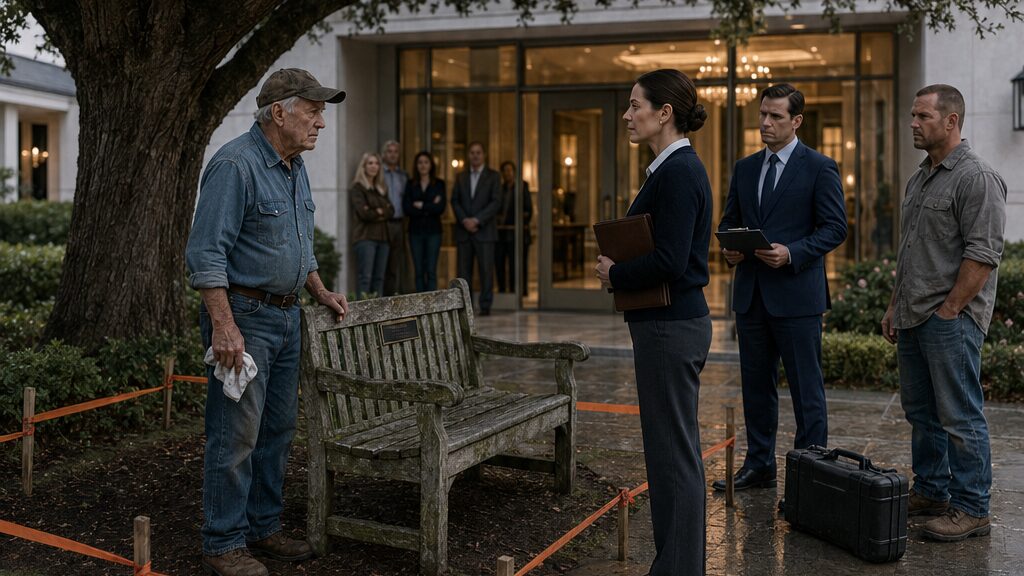
Beyond the lobby, past the spotless panes and the planters full of white flowers, the old cedar bench sat under the live oak near the front walkway. It looked smaller from inside. It always had. Outside, when a person sat on it, the curve of the path and the shade of the branches made a little pocket of quiet. From the lobby, it was just an object interrupting symmetry.
A strip of orange contractor tape had been looped around one armrest.
Another strip hung from the back slat, lifting in the morning breeze.
For a moment Samuel could not move.
The bench was not beautiful. He knew that better than anyone. The cedar had silvered with age. One arm dipped lower than the other because the root beneath the right leg had pushed up over time. The small brass plaque under the left arm had darkened until most people would not see it unless they knew where to look.
Samuel knew where to look.
His thumb found the stained corner of the rag.
Gary spoke behind him. “Removal is set for today. The notice was final.”
Samuel heard the lobby sounds return in pieces: the clerk’s keyboard, the clink of cups, the low voice of someone asking where the restrooms were.
He stared at the orange tape.
It was wrapped right over the place where Rebecca’s hand used to rest.
Chapter 2: Contractor Tape Around The Last Place She Sat
Samuel pushed through the glass doors before Gary could finish whatever he was saying.
The morning air hit him warm and damp. A landscaper’s blower whined somewhere beyond the parking lot, scattering leaves that had already been gathered once. Two residents walking in for the preview slowed when they saw him cross the entrance path toward the bench.
Raymond Miller stood beside it with a toolbox at his feet and a battery-powered saw still in its case. He was a broad man in a faded contractor shirt, his hair clipped close, his face set in the neutral expression of someone paid to do a job and avoid questions. A clipboard rested on the bench seat.
On the clipboard was another copy of the removal order.
Samuel picked it up.
Raymond lifted one hand. “Sir, I’m going to need that.”
“You’re cutting it?”
“I was told to remove and haul.” Raymond glanced toward the lobby doors. “That’s all I know.”
Samuel looked at the saw case. His stomach turned in a slow, physical way. Not anger first. Something lower. Something like being late to a room where a person had already stopped breathing.
Gary came out behind him. “Mr. Bennett, please step away from the work area.”
“It’s a bench.”
“It’s an active work area.”
“It’s a bench,” Samuel said again, quieter.
The clubhouse doors opened a second time. Amanda Carter stepped out.
Samuel had met her once, two summers earlier, when she was campaigning for HOA board president on a promise to “bring Willow Ridge into its best era.” She had shaken his hand without quite looking at the grease beneath his nails. Now she wore a cream blazer and carried a leather folder against her ribs. Her hair was smooth, her posture straight, her expression trained for meetings.
“Mr. Bennett,” she said. “I’m sorry this is happening during the preview.”
“Then stop it.”
A few people near the entrance turned their heads. The clerk had come to the inside of the glass and was watching through it. Two board members stood behind her, holding coffee cups.
Amanda’s voice lowered, which somehow made it carry more. “We’ve been patient. The bench is weathered, uneven, and inconsistent with the new entry design. We received complaints.”
“From who?”
“That’s not relevant.”
“It is to me.”
Gary stepped slightly between them, not fully blocking Samuel but enough to draw a line. “The board has authority over common area features.”
Samuel looked past him at the bench. Orange tape fluttered around the cedar arm. The tape was bright, almost cheerful. It made the bench look accused.
Amanda opened her folder. “This is not personal.”
Samuel laughed once. It came out dry and short, surprising him.
Amanda’s face tightened. “The community has standards. We can’t preserve every outdated item because someone has feelings attached to it.”
The words landed softly. That made them worse.
Someone behind Samuel murmured. Another resident, perhaps. A golf cart slowed near the curb.
Samuel rubbed the white rag over his fingers. His hands had begun to shake, just a little, and he hated that. He hated that the shaking might be read as frailty or confusion instead of the effort it took not to raise his voice.
Raymond looked down at the saw case.
“Mrs. Carter,” Samuel said, “do you know who put this bench here?”
Amanda’s eyes moved over the bench, then back to him. “That isn’t the issue.”
“It’s the first issue.”
“The first issue is safety and appearance.”
“Appearance,” Samuel repeated.
“Yes.”
“Because it doesn’t look like the new plan.”
“It doesn’t.”
Samuel nodded once, slowly. “Neither do I.”
Amanda inhaled as if she had been interrupted in a meeting rather than answered in a way she had not expected. “That is not what I said.”
Gary said, “Nobody is asking you to leave, Mr. Bennett. We’re asking you not to interfere.”
Samuel stared at him.
Behind Gary, through the shining glass, Samuel could see himself reflected in pieces: faded cap, denim shirt, bowed shoulders, white rag clutched in one hand. Beyond his reflection, the chandelier glowed over the counter where the clerk still stood.
He looked like a man who had wandered into the wrong life.
A drop of sweat or rainwater from the oak leaves slid down his cheek. He lifted the rag and wiped it away. The cotton smelled faintly of laundry soap and cedar, and for a second he was back in the old kitchen, Rebecca tying that rag around the handle of his lunch pail because he always forgot to bring one.
“Take one,” she had said. “A man who wipes his hands on his pants gets holes in everything.”
She had smiled when she said it. Back then there had been no cane by the door, no medicine bottles lined beside the sink, no folder in the top drawer marked in her careful handwriting.
Samuel folded the rag once. Then again.
He stepped to the counter-height stone ledge beside the entrance and placed the rag on it, flat, as if setting down something official.
Gary watched the movement. “Mr. Bennett—”
Samuel reached into his pocket.
Gary raised a hand. “Sir, don’t—”
Samuel stopped and looked at him.
The hand stayed in the air, palm outward. A stopping gesture. A warning built out of politeness.
Samuel drew out the black phone.
Several people had gathered now, the way people gathered whenever rules and embarrassment became public. No one stood close enough to be responsible. Amanda’s face had settled into calm resolve. Raymond had not opened the saw case, but he had not moved it away either.
Samuel pressed the screen. His thumb was not as steady as he wanted it to be, but it found Emily’s name.
The phone rang once.
Twice.
Amanda said, “If you need to call someone, we can continue this through the formal appeal process.”
Samuel held the phone to his ear and looked at the taped bench.
On the third ring, his daughter answered.
“Dad?”
“Emily,” he said.
His voice scraped on her name.
There was a pause. “What happened?”
“They’re taking the bench today.”
On the other end, he heard a chair move. Emily had always had her mother’s quick silence: not empty, but full of thought.
“Are you at the clubhouse?”
“Yes.”
“Dad, I told you I could come with you.”
“I need you now.”
Amanda glanced at Gary. Gary’s hand lowered.
Samuel looked at the orange tape again, then at the darkened place beneath the left arm of the bench where the small plaque hid from anyone who did not care to bend.
“Go to the top drawer in my bedroom,” he said. “Your mother’s side.”
Emily did not answer right away.
“Dad.”
“There’s a manila envelope in the back. She wrote on it.”
“What does it say?”
Samuel shut his eyes for a moment. In the dark behind them, he saw Rebecca’s handwriting, the slant of it changed by weakness but still hers.
For the bench, when Samuel gets too stubborn to explain.
He opened his eyes.
“Bring the envelope your mother marked for the bench.”
The line went quiet.
When Emily spoke again, her voice was softer and frightened in a way Samuel did not want to hear. “What’s in it?”
Samuel looked at Amanda, at Gary, at Raymond, at the clerk behind the glass and the residents pretending not to stare.
“I don’t know all of it,” he said.
That was not entirely true. He knew enough to be afraid of opening it.
He ended the call before Emily could ask more.
For several seconds, nobody spoke.
Then Amanda closed her folder. “Mr. Bennett, I am sorry for your loss. But personal history doesn’t automatically override association rules.”
Samuel picked up the rag from the ledge.
“No,” he said. “But it ought to slow down a saw.”
Chapter 3: The Envelope Nobody Was Supposed To Open In Public
Emily Parker had not opened the top drawer on her mother’s side of the dresser in nearly five years.
She had dusted around it. She had placed folded sheets on the bed beside it when she came to help Samuel change linens. Once, after a storm rattled the old windows hard enough to frighten him awake, she had sat on the floor near that dresser until two in the morning, listening to him breathe through grief he would not name.
But the drawer itself had remained closed.
Samuel kept the bedroom neat in a way that made Emily ache. Her mother’s hairbrush still lay in the shallow ceramic tray beside the lamp. A blue cardigan hung on the back of the chair, though Rebecca had last worn it in a November that now felt like it belonged to another country. The room did not smell like her anymore. That was one of the cruelties no one warned you about. People said grief lived in photographs and birthdays and songs. They did not mention the day the last trace of a person’s hand lotion vanished from the house.
Emily stood in the doorway with her phone still in her hand.
Her father had sounded old on the call. Not elderly, not tired, but old in the exposed way of someone who had been cornered in public.
She crossed the room and opened the drawer.
Inside were ordinary things: a scarf, a small box of safety pins, reading glasses in a floral case, a stack of cards tied with ribbon. In the back, exactly where Samuel said it would be, was a manila envelope with Rebecca’s handwriting across the front.
For the bench, when Samuel gets too stubborn to explain.
Emily sat on the edge of the bed.
“Oh, Mom,” she whispered.
The envelope was not sealed. Rebecca would have known better than to seal anything she expected Samuel to need. Emily slid out the contents carefully.
A photograph came first.
It showed Rebecca younger, maybe late forties, sitting on an unfinished cedar bench under a thin little oak that had not yet learned how wide it would become. She wore jeans and a sunhat, one hand resting on the bench arm. Beside her, Samuel stood in a white undershirt and work pants, his face turned away from the camera as he tightened something underneath the seat. Behind them was not the clubhouse Emily knew, but a beige sales trailer with temporary steps.
A hand-painted sign leaned against the trailer: Willow Ridge, A Place To Stay Awhile.
Emily pressed her thumb to the edge of the picture.
She had grown up in a different house across town. Willow Ridge had been her parents’ late-life dream, though neither of them would have used words that large. They had moved there after Samuel’s knees began to object to crawl spaces and ladders. Rebecca had said they needed a place where the sidewalks were smooth and the neighbors waved even when they did not know your name yet.
Emily had thought the bench was just one of her father’s projects. One of many.
There were other papers in the envelope: a yellowed newsletter from the early homeowners’ group, a rough sketch of the clubhouse walkway, receipts for cedar boards, a photograph of three neighbors sitting on the bench with paper cups of coffee. Beneath those lay a folded sheet of stationery.
Emily recognized her mother’s handwriting before she opened it.
Her first instinct was not to read it. A letter had a kind of temperature. Once opened, it warmed the room whether you were ready or not.
Her father had said to bring it. Not read it.
Still, the top lines showed when the paper unfolded.
Samuel,
If you are reading this because someone wants the bench gone, then I was right about two things. First, boards change. Second, you still think silence is the same as strength.
Emily stopped.
Her throat tightened.
A car passed outside, slow over the speed bump. Somewhere in the kitchen, the old refrigerator clicked on. The house carried on with its small mechanical life, indifferent to the way a few lines of ink could rearrange the morning.
Emily folded the letter again before she read more. She gathered the photographs and papers back into the envelope, then paused at the scarf in the drawer.
Under it was a white cotton rag.
For a moment she thought it was one of Samuel’s shop rags, misplaced. Then she saw the cedar stain at the corner.
There were many like it. Her father had always kept them in his truck, his garage, his pockets. But this one looked softer than the others, nearly worn through.
She remembered, suddenly, being twelve years old and watching her mother tie a rag around Samuel’s lunch pail handle while he pretended to object.
“You’ll lose it,” Rebecca had said.
“I won’t.”
“You’ll use your sleeve.”
“I won’t.”
“You will. Take the rag.”
He had taken it because Rebecca had smiled at him, and because even then Samuel Bennett had been helpless against being cared for in practical ways.
Emily placed the rag back, not wanting to disturb more than she had to.
Then she drove to the clubhouse.
By the time she arrived, the resident preview had started. Cars lined the curb. A banner hung near the entrance welcoming residents to the “New Willow Ridge Clubhouse Experience.” The words made Emily’s hands tighten on the steering wheel.
The old bench sat to the left of the walkway, surrounded by orange tape. Her father stood beside it with his cap back on, not wearing it properly, just holding it against his head as if the sun had become too much. Amanda Carter was near the doors with Gary Reed. The contractor stood beside his toolbox, arms crossed, looking less certain than a man with tools usually did.
Emily parked crookedly.
She got out with the envelope held flat against her chest.
Her father saw her and straightened.
That was what hurt most. Not his age, not his worn clothes, not the people watching. It was the way he tried to become taller when she arrived, as if daughterhood were one more thing he had to protect from embarrassment.
“Dad,” she said.
He looked at the envelope but did not take it.
“You found it?”
“Yes.”
“Did you read it?”
“Only the first lines.”
His mouth moved slightly. Not anger. Not relief. Something between shame and gratitude.
Amanda stepped closer, her expression careful. “You must be Mr. Bennett’s daughter.”
Emily did not answer at first. She had been raised to be polite. She had also been raised by Rebecca Bennett, who could make silence feel like a locked door.
“I’m Emily Parker,” she said finally.
Amanda nodded toward the envelope. “If that contains documentation relevant to the bench’s placement, we can review it through proper channels.”
Emily looked at the tape, then at the saw case.
“Proper channels were going to cut it up this morning.”
Gary said, “The removal can be paused briefly while we clarify—”
“Briefly,” Samuel said.
Everyone turned to him.
He was looking not at Gary, but at the bench.
Emily followed his gaze and noticed, for the first time, the small dark rectangle beneath the left armrest. She stepped closer and bent slightly. It was a plaque, almost black with age.
Only a few letters showed through the tarnish.
R B
Emily touched the envelope.
“Dad,” she said quietly, “what did Mom make you promise?”
Samuel’s face changed, and she knew he had heard the question beneath the question.
Not why did you keep the bench.
Why did you keep this from me.
He took the envelope then. His fingers brushed hers. They were cold despite the heat.
“I didn’t keep it from you,” he said.
Emily waited.
Samuel looked toward the clubhouse, where residents stood behind the glass pretending to admire the renovation while watching the old man outside.
“I kept it where I could still carry it.”
Chapter 4: The Board Called It An Eyesore Before They Saw The Photograph
The emergency meeting was held in the room that used to be the card room.
Samuel remembered when it had green felt tables, a soda machine that rattled after every third can, and a ceiling fan with one blade slightly lower than the others. Rebecca had once said the fan was proof the place had character. Now the room had recessed lights, pale walls, framed prints of abstract shorelines, and a long conference table polished so bright it reflected every face with a softer, less honest version beneath it.
Amanda Carter sat at the head of the table. Gary Reed stood beside a wall screen with his clipboard tucked against his chest. Two board members sat to Amanda’s right, both with tablets open. Raymond Miller had been asked to wait outside, though Samuel could see him through the glass partition near the hallway, drinking from a paper cup and pretending not to look in.
Emily sat beside Samuel with Rebecca’s envelope on her lap.
Samuel had not wanted to sit. Sitting made it feel like a hearing, and hearings had rules designed by the people who already owned the room. But Emily had touched his sleeve and nodded toward the chair. Not a command. A reminder that his knees had been unkind lately.
So he sat.
The old bench was visible through the meeting room windows, beyond the entrance path and the glass lobby doors. The orange tape still circled it. Every now and then, a resident passed by and slowed. Some looked at the bench. Some looked into the room. Some looked away.
Amanda opened the folder in front of her.
“Mr. Bennett, first I want to say we appreciate your history with Willow Ridge.”
Samuel kept his hands folded over the white rag in his lap.
Amanda continued, “But the board has to consider the whole community, not one resident’s attachment to an item in a shared area.”
“It is not an item,” Samuel said.
One of the board members shifted. Gary lowered his eyes to the clipboard.
Amanda’s expression did not change. “The bench is not part of the approved renovation plan. It is weathered. It sits at a visible entry point. There are concerns about stability, liability, and aesthetics.”
Emily lifted the photograph from the envelope and placed it on the table, sliding it toward Amanda.
Amanda looked down.
For the first time that morning, her face lost its prepared shape.
In the photograph, Rebecca sat on the unfinished cedar bench with the thin oak behind her and the sales trailer in the distance. Samuel, younger and darker-haired, crouched at the side with a wrench in his hand. The hand-painted sign leaning nearby read: Willow Ridge, A Place To Stay Awhile.
Amanda did not touch the photograph at first.
Gary leaned forward. “When is this from?”
“Nineteen ninety-four,” Samuel said.
“That was before the association had its current governing documents,” Gary said.
Samuel looked at him. “People lived here before your documents did.”
Silence spread across the table.
Emily’s hand moved slightly, close to Samuel’s sleeve, but she did not touch him. He appreciated that. It let him decide whether to stand inside his own words.
Amanda picked up the photograph carefully by its edges. “Mrs. Bennett?”
“Rebecca,” Samuel said.
“She helped build it?”
“She sanded it. Stained it. Complained about every bolt I put in crooked.”
A small sound escaped Emily, almost a laugh and almost not.
Amanda studied the photo another moment, then set it down. “I can see that it has history. That doesn’t address the current issue.”
“The current issue,” Emily said, “is that you sent a contractor to cut up something that belonged to the beginning of this place.”
Amanda turned toward her. “Ms. Parker, with respect, every older neighborhood has features that were meaningful once. That doesn’t mean all of them should remain in common areas indefinitely.”
“Meaningful once,” Emily repeated.
Samuel felt the words hit her. He could hear Rebecca in the room, not as a ghost, not as some soft imagined presence, but as an absence with weight. Rebecca would not have raised her voice. She would have looked at Amanda until Amanda either became honest or uncomfortable. Sometimes those were the same thing.
Gary cleared his throat. “There may be a practical solution. The association could remove the bench from the entrance and store it temporarily. If the family wants to reclaim it, we could coordinate pickup.”
Samuel’s fingers tightened around the rag.
“Pickup,” he said.
Gary nodded, encouraged by the calmness of the word. “Yes. You could place it on private property if it meets lot guidelines. Or keep it in a garage. That way the sentimental value is preserved without interfering with the clubhouse standard.”
Samuel looked past him, through the window, at the bench.
A garage.
He pictured the bench under a tarp beside paint cans, leaf bags, and the old snow shovel he had not used since moving south. He pictured the cedar legs off the ground, the seat turned toward a wall. Preserved. Protected. Useless.
Rebecca had not asked for a museum piece. She had never cared for things that could only be admired. “If a thing can’t hold a person, what good is it?” she had said once, arguing with a catalog chair too expensive to sit in comfortably.
Emily opened the envelope again and withdrew the yellowed newsletter. She placed it beside the photograph. The paper had browned along the folds. At the top was a grainy picture of three early residents sitting on the bench with coffee cups, their knees angled together in conversation.
Amanda read the heading aloud, softly despite herself. “Residents Complete First Community Rest Spot.”
Samuel remembered that day. Rebecca had made lemonade in a plastic pitcher and brought it down because the first summer heat had come early. He had worked on the bench with two neighbors now gone, both men insisting they knew a better way to set the legs. The bench had ended up slightly uneven because all three had been stubborn. Rebecca had said that made it perfect for people, since people were not level either.
“It was never decoration,” Samuel said.
Amanda looked up.
He had not meant to speak so soon. He had been holding the words back because each one seemed tied to something inside his chest. But the photograph was on the table now. The newsletter. Rebecca’s handwriting hidden in the envelope. The bench outside, taped like a thing marked for disposal.
“It was the first place anyone could sit that wasn’t inside a sales office,” he said. “Back then the sidewalks stopped halfway down Briar. There was mud where your fountain is. Rebecca said if they were going to sell this place as a community, they ought to give people somewhere to rest.”
Gary said, “That history is valuable. We can scan these for the clubhouse archive.”
Samuel turned to him.
“You keep trying to put it away.”
Gary opened his mouth, then closed it.
Amanda folded her hands. “Mr. Bennett, I am trying to balance emotion with responsibility. If someone trips, if the bench fails, if it looks neglected during a community event—”
“Then repair it.”
“It is not in the design.”
“Then change the design.”
One board member gave a quiet, uncomfortable laugh. Amanda shot him a look, and he lowered his eyes.
Emily slid the folded letter forward but kept her fingers on it. Samuel noticed. She had not opened it. She was leaving that to him.
Amanda’s attention moved to the letter. “Is that from your wife?”
Samuel did not answer.
The room waited.
Outside, a resident in a pale golf shirt stepped around the taped bench as if it might stain him. That should not have mattered. Samuel had seen worse than careless steps. But something in the way the man avoided it, not with anger or fear but with mild inconvenience, made Samuel feel suddenly exhausted.
He reached for the letter.
Emily’s fingers lifted from it.
The paper felt thin. It had been folded long enough to resist opening. When he spread it on the table, Rebecca’s handwriting looked smaller than he remembered from grocery lists and birthday cards. Illness had reduced the size of her script, but not the firmness of it.
He read the first line silently.
Samuel,
If you are reading this because someone wants the bench gone, then I was right about two things. First, boards change. Second, you still think silence is the same as strength.
He stopped there.
The room blurred slightly. He folded the paper once, not closed, just enough to cover the rest.
Amanda’s voice was careful. “You do not have to read it aloud.”
Samuel almost thanked her. Then he understood that if he accepted the mercy too quickly, the bench would still be moved gently, respectfully, irreversibly.
He slid the letter back toward himself.
“Not today,” he said.
Emily looked at him.
Amanda nodded, perhaps thinking he had agreed to privacy, perhaps thinking the hardest part had passed.
Samuel placed the photograph, the newsletter, and the letter together. The rag lay beside them on the table, white against dark wood.
Amanda said, “What I can offer is this. We pause removal for today. The bench can be moved into storage while the board reviews whether any portion of its history can be incorporated into the clubhouse display.”
Samuel looked at the old photograph of Rebecca sitting in sun beside the young oak. He heard the offer the way it had been meant: kind, procedural, clean.
He also heard what it would do.
A display on a wall. A scanned photograph. A paragraph under glass. The bench itself hidden somewhere, stripped of weather and footsteps and tired bodies.
He put his palm flat on Rebecca’s letter.
“No,” he said.
Amanda sat back.
Gary stiffened.
Emily whispered, “Dad.”
Samuel turned to her, and the fear in her face nearly broke his resolve. She was not afraid of Amanda. She was afraid of what the fight might cost him.
He softened his voice.
“Safe,” he said, looking back at Amanda, “is not the same as remembered.”
Through the window, the orange tape snapped in the breeze like a small warning flag.
Chapter 5: Rebecca’s Note Changed The Room Without Raising Its Voice
The room did not empty after Samuel refused.
That surprised him. He had expected annoyance to move people faster than grief. Instead, Amanda asked the clerk to bring water. Gary stepped into the hallway to make a call. One board member closed his tablet and looked out at the bench as if seeing it required effort. Emily sat very still, Rebecca’s envelope open between them.
Samuel did not drink the water when it came.
The glass sweated onto a paper coaster printed with the new Willow Ridge crest. He looked at the crest: two stylized trees, a roofline, a curved path. It was tasteful. It was also nothing like the place had been. The original sign in the photograph had been crooked, painted with blue letters, and left out in weather long enough to warp at the edges.
A Place To Stay Awhile.
Rebecca had liked that phrase. She had repeated it whenever Samuel complained about the slow construction.
“Stay awhile,” she would say. “That’s the whole point.”
Amanda returned from a brief conversation with Gary near the door. Her face had lost some of its polish, though not its control.
“Mr. Bennett,” she said, “we’ve paused work until tomorrow morning. That is the most I can do without a formal board vote.”
“Tomorrow,” Emily said.
Amanda looked at her. “The contractor schedule was already set. We can’t keep delaying without a clear path.”
Samuel rested both hands on the table. The rag was under his right palm, folded small.
“What path do you need?” he asked.
Amanda hesitated. “A reason that can be recognized by policy. Not only by sympathy.”
The sentence bothered him less than he expected. There was an honesty in it. Amanda was not asking what would make her feel better. She was asking what the rules could hold.
Samuel looked at Rebecca’s letter.
Emily saw and leaned closer. “Dad, you don’t have to.”
He almost smiled. “Your mother said I did.”
He unfolded the letter.
The paper made a faint sound in the quiet room. Everyone heard it. That was the strange thing about rooms built for meetings: they made human things seem louder than they were.
Samuel read from the top, his voice low.
“Samuel, if you are reading this because someone wants the bench gone, then I was right about two things. First, boards change. Second, you still think silence is the same as strength.”
Gary returned halfway through the sentence and stopped just inside the doorway.
Samuel kept his eyes on the page.
“I know you. You will stand there with your jaw set, letting people think you are being difficult because you would rather be misunderstood than explain pain to strangers.”
Emily turned her face away.
Samuel paused.
The words were not new in meaning. Rebecca had said versions of them across forty-six years. She had said them when he refused help after surgery. She had said them when his brother died and he went back to work the next morning. She had said them, smiling and scolding, when he fixed the neighbor’s porch light and pretended it had taken no effort.
But her handwriting saying it now, in front of people who had wrapped tape around the last place she rested, felt like being known too completely.
He continued.
“You built that bench because I asked for somewhere people could sit without buying anything, signing anything, or proving they belonged. That mattered to me then, and it matters more to me now.”
Amanda lowered her eyes.
Samuel did not look up.
“When the treatments made the walk from the parking lot to the door feel longer than it was, I sat there. When I could not make it through the clubhouse Christmas party, I sat there. When you thought I was inside talking to the women about recipes, I was sometimes on that bench catching my breath and watching you pretend not to worry.”
His voice roughened on the last words. He stopped and put the letter down.
No one moved.
Emily reached for him then, not his sleeve but his hand. He let her take it for one second. Only one. Then he needed the hand back because the letter had more weight than paper should.
Amanda spoke quietly. “I’m sorry. I didn’t know.”
Samuel almost said, You didn’t ask.
But that would have been too easy. And not fully true. No one had asked because he had trained the world not to. He had answered notices with short comments and old dates. He had written “installed before current board” and “community use feature” and “not abandoned.” He had not written Rebecca sat here when she was too weak to reach the door.
He had expected strangers to recognize a wound he had kept bandaged.
He read again, skipping a few lines he could not manage with an audience.
“If someone says it is ugly, tell them it has held tired people. If someone says it does not match, tell them neither did half of us when we first came here. If someone says it is old, ask them when age became a violation.”
One of the board members covered his mouth with his hand.
Gary stared at the table.
Amanda’s face had changed. Not softened exactly. More like something in her had been made less certain, and uncertainty looked uncomfortable on her.
Samuel folded the letter before the final paragraph.
Emily noticed. “There’s more.”
“Yes.”
“You’re not going to read it?”
“Not yet.”
Amanda’s eyes lifted. “Mr. Bennett, what you’ve shared helps. It truly does. But we still have structural and guideline concerns. The association can’t create an exception based only on one family’s loss. If we do, every resident with an old object will ask why theirs can’t remain.”
“There are not many objects people sat on while dying,” Emily said, sharper than Samuel expected.
Amanda absorbed it without flinching. “I understand why you’re angry.”
“No,” Emily said. “I don’t think you do.”
Samuel put a hand on Emily’s wrist. Not hard. Enough.
Emily stopped.
He looked at Amanda. “She’s right to be angry. But that won’t fix the bench.”
Amanda glanced at the window. Outside, two children had escaped whatever open house tour their parents were taking and had climbed onto the taped bench. A neighbor hurried over and motioned them off, pointing to the tape. One child dragged a finger along the cedar back before hopping down.
Samuel watched the small hand leave a clean line through dust.
“What would fix it?” Amanda asked.
“Repair what’s unsafe. Leave what matters.”
Gary said, “The bench doesn’t meet current design standards.”
“Then your standards are too small.”
The words came out before Samuel dressed them up. He did not apologize.
Amanda looked at him for a long moment. “Rules exist because communities need consistency.”
“Communities need memory too.”
Another silence.
This one was different. Not warm. Not solved. But no longer empty of listening.
Amanda opened her folder and removed a printed copy of the association’s exterior standards. She scanned a page with one finger. “There is no category for historic resident-built features.”
“Then make one,” Emily said.
“That requires board action, legal review, and defined limits.”
“Then start.”
Gary shifted. “Amanda, the contractor is booked for tomorrow morning. If we cancel after today, we may still owe the removal fee.”
Samuel looked at him. “You can pay a man to carry something away. You can pay him to fix it too.”
Raymond, still near the hallway, looked up at that.
Amanda followed Samuel’s gaze. “Mr. Miller was contracted for removal, not restoration.”
Raymond stepped closer to the open door. “Cedar can be repaired.”
Gary frowned. “Mr. Miller—”
“I’m just saying.” Raymond lifted both hands slightly. “Seat boards can be replaced. Legs can be leveled. If the frame’s decent, it doesn’t have to be hauled.”
Samuel looked at the contractor for the first time as something other than a threat.
Raymond’s face reddened a little. “I’d have to inspect it.”
Amanda closed her folder. “No work will be authorized today except securing the area.”
The sentence was meant to end the discussion. Samuel heard in it both a loss and a small opening.
“Tomorrow morning?” he asked.
Amanda’s jaw tightened. “The removal order remains active unless the board votes otherwise.”
“When?”
“We can call an emergency vote tonight, but I cannot promise the outcome.”
Gary said, “And if there is no action by seven tomorrow, the contractor proceeds.”
Emily inhaled sharply.
Samuel looked at the letter in his hand. The unread final paragraph seemed to press against his palm.
He could read it now. He could open the last door Rebecca had left him and lay it all out in the clean bright room where people took notes about acceptable porch lights.
But something in him resisted. Not pride this time. Protection.
The final lines were not for persuading Amanda. Not yet.
He folded the letter and slid it back into the envelope.
Amanda watched him. “Is there anything else the board should review before tonight?”
Samuel picked up the photograph of Rebecca on the unfinished bench, then the newsletter, then the rag. He held the rag last, smoothing it once with his thumb.
“Yes,” he said. “Look at it before you vote.”
“We have photographs.”
“No. Look at it.”
Amanda blinked.
Samuel stood slowly. His knees argued, but he stood.
“Sit on it,” he said. “Before you decide whether it belongs.”
No one answered.
He placed the newsletter on the table, the photograph on top of it, and Rebecca’s letter beside both. He kept the white rag.
At the door, he turned back.
“If the saw comes at sunrise,” he said, “I’ll be there before it.”
Chapter 6: Sunrise Came With A Saw And A Clipboard
Samuel arrived before the gate lights clicked off.
The sky over Willow Ridge was still gray, the kind of gray that made every roofline and clipped hedge look drawn in pencil. Dew silvered the clubhouse lawn. The fountain had not yet begun its programmed spill into the basin, so the entrance was quiet except for early birds and the distant hum of an irrigation pump.
The bench waited under the oak.
Someone had removed the orange contractor tape from the armrests during the night and wrapped it instead around two small stakes in the ground, making a square around the bench. It looked less accused that way, more like a patient in a curtained hospital bed.
Samuel stepped over the low tape.
He had dressed in the same denim work shirt, freshly washed but still permanently marked at the cuffs. His boots were cleaner. His cap sat low on his forehead. The white rag was folded in his shirt pocket, one corner showing.
He sat on the bench.
The right side dipped as it always had. The cedar was cool through his pants. He placed one hand on the left armrest, where Rebecca’s fingers had rested in the photograph, and let the morning settle around him.
He had not slept much.
Emily had stayed at the house until nearly midnight, making tea neither of them drank. She had read Rebecca’s letter through once, alone at the kitchen table, and cried silently with one hand over her mouth. Samuel had pretended not to see until she said, “You should have shown me years ago.”
He had answered, “I know.”
It was not enough, but it was true.
Now he took the letter from inside his jacket and unfolded it to the final paragraph.
The words were familiar from the night before, and still they struck him with the private force of Rebecca’s voice.
Most of all, Samuel, do not keep the bench only for me. If you do, grief will turn it into a stone. Keep it for the person who needs to sit down before going inside. Keep it so you remember to stay part of the living neighborhood after I am gone. And if the day comes when keeping it outside hurts more people than it helps, then you decide what love requires. Not them. You.
He read the last two words twice.
Not them. You.
A truck turned into the parking lot at six forty-two.
Raymond Miller got out first. He moved slowly when he saw Samuel on the bench. Two crew members stayed by the truck, looking uncertain. Raymond opened the back and removed the same saw case from the day before. Then he set it on the pavement but did not open it.
“Morning,” Raymond said.
Samuel folded the letter. “Morning.”
“You know why I’m here.”
“I do.”
“I haven’t heard different from the manager.”
“I figured.”
Raymond looked toward the clubhouse. “I can wait until seven.”
Samuel nodded.
Raymond remained where he was. “For what it’s worth, I checked the underside yesterday. It’s not as bad as they think. Needs two boards. New fasteners. Right leg reset. Sanding.”
“What would you charge?”
Raymond looked uncomfortable. “That’s between me and whoever authorizes it.”
“I didn’t ask for a bid. I asked what it needs.”
Raymond rubbed his jaw. “It needs someone to care whether it lives.”
Samuel looked at him then.
The contractor glanced away first.
At six fifty, Gary’s car pulled in. He emerged with a clipboard and a paper cup of coffee, dressed in the same navy suit as the day before. The suit looked different in the early light. Less like authority, more like a man who had not expected to be judged before breakfast.
Amanda arrived three minutes after him.
Emily’s car came in behind hers.
Samuel stood when his daughter stepped out. Emily carried Rebecca’s envelope, pressed flat against her coat. Her eyes went first to the saw case, then to him.
“Dad.”
“I’m all right.”
“That is not what I asked.”
He almost smiled. “You didn’t ask anything.”
“I know you.”
“Yes,” he said. “You do.”
Amanda walked to the taped square. She wore slacks and a dark sweater under her coat, not the cream blazer. Her hair was pulled back less perfectly than usual. She looked at the bench for a long moment before speaking.
“The emergency vote failed,” she said.
Emily’s shoulders tightened.
Gary looked down at the clipboard.
Samuel nodded once. He had expected it and still felt the impact.
Amanda continued, “Three to two. The board did not approve creating a new category without legal review.”
“So the saw comes out,” Samuel said.
Gary cleared his throat. “The existing removal order remains enforceable.”
Raymond did not move.
Samuel took the white rag from his pocket. He unfolded it and laid it over the left armrest, covering the darkened plaque.
Amanda noticed. “Mr. Bennett—”
“Give me a minute.”
Gary said, “We already delayed—”
“Give me a minute,” Samuel repeated.
His voice did not rise. That made Gary stop.
Samuel bent slowly. His knees resisted. Emily stepped forward, but he lifted one hand and she stopped too. He wiped the plaque with the rag, using small circles, thumb braced against the underside of the arm. Dirt lifted. Tarnish remained. He spat lightly on one corner of the cloth, as he had done with stubborn marks all his life, and rubbed again.
The letters emerged first.
Rebecca Bennett.
Beneath them, smaller words appeared, not bright, not new, but readable.
For anyone who needs to rest before going in.
Amanda drew in a breath.
Emily covered her mouth.
Gary stared as if the plaque had been placed there to embarrass him personally.
Samuel stayed bent a moment longer than he needed to. Not because of the plaque. Because standing up again meant speaking.
When he straightened, he had the rag in one hand and Rebecca’s letter in the other.
“I was going to keep this private,” he said.
No one interrupted.
“Rebecca wrote that if keeping the bench outside hurt more people than it helped, I should decide what love required.” He looked at Amanda. “Not you. Not the board. Me.”
Amanda’s face tightened, but she did not look away.
Samuel turned toward the clubhouse doors, where two early residents had stopped. A neighbor with a small dog stood on the walkway. One of Raymond’s crew leaned against the truck, listening.
Samuel did not want an audience. But the bench had always belonged to people passing by.
“I don’t want a shrine,” he said. “Rebecca would hate that. She’d say people don’t sit comfortably on guilt. I don’t want the board shamed into keeping rotten boards because an old man made everybody feel bad.”
Emily lowered her hand from her mouth.
Samuel looked down at the cedar seat.
“I want it repaired. I want it safe. I want the plaque cleaned, not polished so bright it looks new. And I want your rules to have room for things this place would be poorer without.”
Gary said, “That still requires—”
Amanda lifted a hand, not sharply, but enough to stop him.
Samuel looked at the raised hand. It was the same gesture Gary had made the day before at the counter. Stop. Don’t proceed. Don’t touch.
This time, it was not aimed at Samuel.
Amanda stepped over the tape and came closer to the bench. She bent—not much, but enough—to read the plaque herself.
“For anyone who needs to rest before going in,” she said.
Her voice made the sentence sound unfamiliar, as if the words had entered a room where they had not been invited and found it too cold.
Samuel folded the rag.
“I am asking you to amend the rule,” he said. “Not make an exception for me.”
Amanda looked up.
“That way,” Samuel said, “when I’m gone, nobody has to stand here with a dead woman’s letter to explain why something matters.”
Emily’s eyes filled again, but she stayed quiet.
Raymond shifted near the saw case. “I can secure it today,” he said. “No cutting. Temporary braces, caution sign. Full repair later if approved.”
Gary looked irritated. “That is not the work order.”
Amanda turned to him. “Issue a revised hold.”
“I don’t have authority to—”
“I do.”
The words were not loud. They did not need to be.
Gary’s mouth closed.
Amanda faced Samuel again. “I can’t amend the rule alone. But I can call a full board session with counsel and propose a legacy feature category. Documented history, community use, safety inspection, maintenance plan.”
Samuel listened. He did not thank her yet.
“And the bench?” Emily asked.
Amanda looked at Raymond. “Secure it. Inspect it. Give us a repair scope.”
Raymond nodded once and lifted the saw case back into his truck.
The sound of the case sliding into the truck bed was small. To Samuel, it seemed louder than the fountain when it suddenly began behind them, water spilling into the basin on its timer.
Amanda stepped out of the taped square.
“I should have looked at it before I voted,” she said.
Samuel watched her. There were apologies people offered to end discomfort, and apologies that left work behind them. He did not know yet which kind hers would be.
“Yes,” he said. “You should have.”
Amanda accepted that with a small nod.
Emily came to his side then. She did not ask this time before taking his arm. He let her.
Raymond brought out a different toolbox, not the saw. He knelt by the bench and ran his hand along the underside with the care of a man checking for damage he now understood had a witness.
Samuel placed the white rag over the back of the bench for a moment while he buttoned his jacket.
The rag stirred in the morning air, pale against the old cedar.
Then he picked it up, folded it carefully, and put it back in his pocket.
Chapter 7: The Bench Stayed, But Not Because They Felt Sorry
Two weeks later, the clubhouse lobby smelled of fresh flowers again.
Samuel stood just inside the glass doors with his cap in one hand and the white rag in the other, watching sunlight move across the marble floor. The chandelier was lit though it was only midmorning. Its reflection trembled faintly in the polished counter, the same counter where the clerk had once looked at his boots before she looked at his face.
Today she looked at his face first.
“Good morning, Mr. Bennett,” she said.
The greeting was simple. No ceremony. No grand correction. That made it easier to accept.
“Morning,” Samuel said.
He had worn his denim shirt again, though Emily had offered to iron a button-down for him. The shirt was clean, the cuffs still marked by years no washing could remove. His boots had been brushed. He had not tried to make himself look like someone else.
Outside, Raymond Miller knelt by the old cedar bench with a small socket wrench in his hand. The saw had never come back. Instead, Raymond had returned with clamps, sandpaper, replacement boards cut to match the old width, and the patience of a man repairing something under too many eyes.
The bench looked different now, though not new. That had been Samuel’s request and Raymond’s quiet agreement. The worst boards had been replaced, but Raymond had stained them lightly so they did not shout against the old cedar. The right leg had been leveled without erasing the slight dip in the seat. The plaque had been cleaned, not polished bright. It still carried age in its corners.
Rebecca Bennett.
For anyone who needs to rest before going in.
Beside that plaque, smaller and lower on the inside of the arm, a new brass plate had been added. Amanda had sent Samuel three wording options by email. All of them had sounded like a brochure. He had called her, not Emily, not Gary, but Amanda herself.
“I don’t want language people have to admire,” he had told her. “I want words someone tired can understand.”
There had been a pause on the line.
Then Amanda had said, “What would you write?”
He had written it on the back of an old envelope first, then copied it more neatly.
Built by neighbors. Kept for neighbors.
Amanda had approved it without changing a word.
Now she stood near the lobby doors holding a folder against her side, dressed in a navy sweater and slacks. Gary Reed was beside her, quieter than usual. A few board members lingered near the coffee table. Emily stood outside near the bench, her arms folded against the breeze, watching Raymond tighten the last fastener.
No banner had been hung. Samuel had insisted on that.
The board had wanted a small dedication. Amanda had called it “appropriate recognition.” Emily had looked at Samuel across the kitchen table and raised her eyebrows in a way that was entirely Rebecca.
Samuel had said no.
Not because he was angry. Not anymore. Anger had burned itself down into something duller but steadier. He simply could not bear the thought of the bench becoming an event. A ribbon. A photo. A thing people stood around before moving on.
The compromise had been a quiet morning after the rule amendment was entered into the association records.
Gary had sent the official notice the night before.
Legacy Feature Policy: Resident-built or historically significant exterior features may remain in common areas when documented, safe, useful to the community, and approved for ongoing maintenance by the association.
Samuel had read it twice. Then he had set it on the kitchen table beside Rebecca’s letter.
It was not poetry. It was not an apology. But it was room.
Amanda stepped closer. “Mr. Bennett.”
Samuel turned.
“The board minutes are filed,” she said. “The policy is active as of this morning.”
He nodded.
Gary cleared his throat. “Mr. Miller submitted a maintenance plan. We’ll inspect it yearly.”
Samuel looked through the glass at Raymond, who was now running one palm along the bench seat to check for roughness.
“Good,” Samuel said.
Gary shifted the clipboard from one hand to the other. He seemed to want to say something else and not know where to put it.
Finally he said, “I should have handled that morning differently.”
Samuel looked at him for a while.
The lobby did not go still this time. People moved around them. A resident came in carrying tennis shoes. The clerk answered a phone. Coffee dripped into a glass pot near the wall. Life refused to arrange itself around apology, and Samuel was glad.
“Yes,” he said.
Gary’s face tightened, but he accepted it. “I’m sorry.”
Samuel folded the rag once over his hand. “All right.”
It was not forgiveness exactly. Not the kind people asked for because they wanted to be released from the weight of what they had done. But it was not refusal either. Samuel had learned, slowly and unwillingly, that leaving a door open did not mean pretending no one had slammed it.
Amanda watched the exchange, then looked outside. “You were right about sitting on it.”
Samuel followed her gaze.
“You sat?”
“After the meeting,” she said. “Before the vote.”
He turned back to her.
Amanda’s eyes remained on the bench. “I came late in the evening. I didn’t want anyone to make a thing of it.”
Despite himself, Samuel almost smiled. “Neither did I.”
“I thought it would feel like old wood,” she said. “It did. But then a woman came out of the clubhouse after a water aerobics class and sat beside me because her knee was hurting. She didn’t know who I was. She just sat down and said, ‘I hope they don’t take this away.’”
Samuel let that settle.
Amanda looked at him then. “That changed more than the photograph did.”
“Good,” Samuel said. “Photographs can make people careful. Sitting makes them honest.”
For the first time since he had known her, Amanda Carter laughed softly without preparing it first.
Outside, Raymond stood and waved Samuel over.
Emily saw the wave and turned toward the doors. Samuel pushed them open before she could come get him. The morning air carried the smell of cut cedar and damp soil. The oak leaves shifted overhead, scattering light over the walkway.
The taped stakes were gone.
Raymond stepped back from the bench. “All set.”
Samuel approached slowly.
He did not sit right away. He bent, with some difficulty, and touched the old plaque. The letters were readable now but still dark in their grooves. Rebecca’s name had not been made new. It had been made visible.
He took the white rag and wiped a faint smear of dust from the new plate.
Built by neighbors. Kept for neighbors.
Emily came to his side.
“She would have edited it,” she said.
Samuel snorted. “Twice.”
“She would have said it needed a comma.”
“She always thought everything needed a comma.”
Emily smiled, but her eyes were wet.
Samuel folded the rag and put it back into his pocket. For once, he did not know what to do with his hands afterward.
Emily reached into the envelope she still carried and removed Rebecca’s letter. The paper had been placed in a clear sleeve now, not for display, but because Emily said skin oils and grief were both hard on old paper.
“You want this back at the house?” she asked.
Samuel looked at the letter.
For years, he had thought keeping Rebecca’s things near him was the same as keeping faith. Her cardigan. Her brush. Her notes in drawers. Her recipes he never cooked. Her side of the dresser untouched so completely it had become less a room than a held breath.
The bench had taught him otherwise, though he would never have admitted that to the board.
Some things stayed alive by being used.
“Keep it with you awhile,” he said.
Emily’s fingers tightened around the sleeve. “Are you sure?”
“No.” He looked at the bench. “But do it.”
She nodded.
A resident approached along the path from the parking lot, moving carefully with one hand on the strap of a canvas bag. She was older than Amanda, younger than Samuel, with the pinched look of someone determined not to admit pain in public. Halfway to the clubhouse doors, she slowed.
Her eyes moved to the bench.
Samuel stepped back.
The woman hesitated. “Is it all right to sit?”
Samuel glanced at Amanda, who had come outside and now stood a few feet away. Gary was behind her. Raymond was loading tools into his truck.
Amanda answered before Samuel could.
“That’s what it’s for.”
The woman lowered herself onto the bench with a breath she tried to hide. The repaired leg held firm. The seat gave its familiar slight dip, not unsafe, just human. She placed her canvas bag beside her and looked up through the oak branches.
“This is nice,” she said, mostly to herself.
Samuel felt Emily watching him.
He did not explain who had built it. He did not tell the woman about Rebecca’s treatments, or the first summer, or the sales trailer, or the morning with the saw. He did not tell her that she was sitting where a promise had almost been cut apart by people with a clipboard.
The bench did not need him to tell every story at once.
The woman rested there, breathing easier.
After a moment, Samuel walked to the clubhouse door and held it open, the way he had done for Rebecca when the walk from the parking lot became too long and pride made help a delicate thing.
The woman looked surprised, then grateful.
“Thank you,” she said.
Samuel nodded.
Behind him, the bench remained under the oak, old and repaired, visible from the lobby but no longer on trial. Through the glass, the chandelier still shone over the polished counter. The marble still reflected shoes. The clubhouse was still too bright in places and too carefully arranged.
But outside, in the small shade beside the entrance, there was a place to sit before going in.
The story has ended.