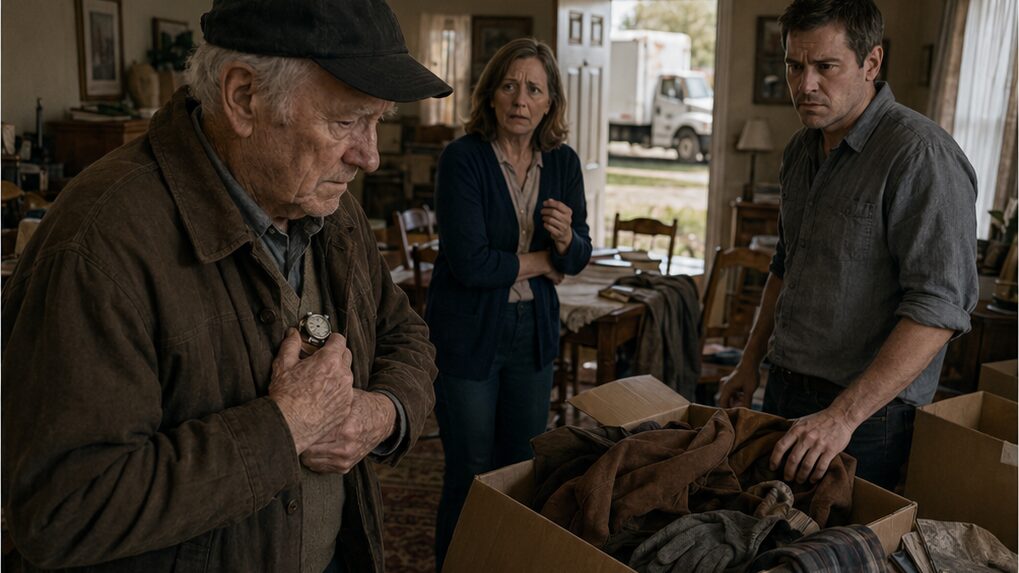
His Children Sold the Broken Watch Before He Could Tell Them Why It Still Ticked
Chapter 1: The Boxes Were Already Labeled When He Came In
Michael Bennett knew something was wrong before he opened the front door.
The house made different sounds when strangers were inside it. Not loud sounds. Not alarming ones. Just wrong ones. Cardboard scraping against the hallway wall. A drawer sliding open too far. Someone dragging a chair without lifting it first. The dull pull of tape off a roll.
He stood on the porch with one hand on the brass knob, his brown coat folded over his left arm because the morning had warmed faster than he expected. He had gone out for bread, milk, and the small tin of cinnamon tea Rebecca said was better for his stomach than coffee. Twenty-six minutes, maybe thirty. Long enough for his children to begin without him.
Through the front window, he saw a cardboard box pass by in Ryan’s arms.
Black marker letters faced the glass.
DONATE.
Michael did not move. The grocery bag sagged from his fingers until the loaf of bread pressed against his knee.
Inside, Rebecca’s voice carried through the door. “Not that one. Put that by the front steps. The organizer said anything with old fabric should go today.”
“Dad’s got four closets of old fabric,” Ryan answered.
“It’s not funny.”
“I’m not laughing.”
Michael turned the knob.
The living room looked as if a storm had come through and learned to sort.
Boxes stood in rows on the rug his wife had chosen thirty-three years earlier because, as she had said, a dark pattern forgave muddy shoes. KEEP. DONATE. SELL. TRASH. The words were written in Rebecca’s neat block letters, each label facing outward like an instruction to anyone who entered.
A woman Michael did not know stood beside the fireplace with a clipboard tucked under one arm. She wore soft shoes and a pleasant expression that made the room feel less like a home and more like a problem being handled. Near the hallway, Ryan had a box balanced against his hip. Rebecca stood at the dining table with both hands flat on the wood, as if bracing herself for something she had already decided was necessary.
Samantha was by the window, holding a stack of framed photographs. Michael’s granddaughter looked up first. Her face changed in the small, guilty way of a child caught using scissors where she should not.
“Grandpa,” she said.
Everyone stopped except the tape dispenser. It rocked once on the table and settled.
Michael shut the door carefully behind him. He set the grocery bag on the little entry bench. The milk inside gave a soft thud.
Rebecca came toward him with the careful smile she used when she was about to say something rehearsed. “Dad, we were going to tell you before you got back.”
“You were going to tell me before or after?” Michael asked.
Ryan shifted the box in his arms. “Come on, Dad.”
Michael looked around the room. The mantel had been cleared except for one clock and a small ceramic bird with a chipped beak. His wife’s gardening books were stacked on the floor. The basket beside her chair, the one that still held half-finished yarn she had not touched after her hands started shaking, sat open near a box marked DONATE.
He walked to the basket and put his fingers on the yarn.
Rebecca followed him. “We’re not throwing away anything important.”
Michael looked at the rows of boxes again. “That so?”
“We’re sorting,” she said. “That’s all. The realtor said the house will show better if—”
“The realtor,” Michael repeated.
Rebecca’s mouth tightened. “Only to understand options.”
“I didn’t ask for options this morning.”
“No, you never ask.” Ryan set his box down too hard. Something inside clinked. “That’s the problem.”
The organizer cleared her throat gently. “Maybe I should step outside for a minute.”
“No,” Rebecca said quickly, then softer, “No, it’s fine. We need help. Dad, this is not an attack.”
Michael glanced at the stranger’s clipboard. There were columns on the page. Room. Category. Action.
His house had actions now.
He moved through the living room slowly, not because he wanted them to think he was fragile but because he did not trust his legs to carry anger gracefully. The dining chairs had been moved against the wall. His wife’s sewing tin was on the table. The drawer of old batteries, screws, rubber bands, keys that fit locks nobody remembered, and folded receipts had been dumped into a plastic bin.
“You went in the bedroom?” he asked.
Rebecca folded her arms. “Dad, we had to start somewhere.”
The bedroom.
Michael turned toward the hallway. Ryan stepped in slightly, not blocking him, but close enough that the gesture showed. Michael saw it. Rebecca saw him see it.
“We didn’t touch anything private,” Rebecca said.
Michael almost smiled. Not from amusement. From the old tiredness of people believing privacy meant only what embarrassed them.
Samantha held the frames tighter. “Mom, maybe we should pause.”
“We have the truck only until two,” Ryan said.
“The truck?” Michael asked.
Rebecca rubbed her forehead. “Donation pickup. Ryan rented it. Just for the obvious things.”
“Obvious,” Michael said.
The word lay between them.
Rebecca’s face softened, then hardened again, as if compassion had become a door she could not afford to open too far. “Dad, last month you tripped over the box in the hallway.”
“I tripped because the lightbulb went out.”
“And you didn’t tell anyone.”
“I changed it.”
“Three days later.”
Michael looked at Samantha. She lowered her eyes.
Ryan came closer. “This place is too much. You’ve got stacks in the hall, stuff in closets, old coats, broken appliances, magazines from ten years ago. We’re trying to keep you safe.”
“By waiting until I left for milk.”
Ryan’s jaw worked. “Because if we asked, you would say no to everything.”
“I might have said no to strangers in my bedroom.”
The organizer made a small movement toward the door, but Rebecca raised one hand to stop her.
“Dad,” Rebecca said, “we are tired. I know that sounds awful. I know it does. But every time something happens, we come running, and then you say you’re fine, and nothing changes. We can’t keep pretending this house isn’t a hazard.”
Michael looked at the hallway, where a line of boxes leaned against the wall. His late wife’s blue scarf hung over the rim of one marked DONATE, one sleeve of an old dress folded beside it. He did not remember seeing those in years. He remembered her wearing the scarf at the lake when wind had kept pushing hair into her mouth and she had laughed until he laughed too.
He went to the box and lifted the scarf.
Rebecca exhaled. “That has moth holes.”
Michael ran his thumb over the soft edge. “I know.”
“You can’t keep everything because Mom touched it.”
There it was. Not shouted. Not cruel. Worse, maybe, because Rebecca sounded exhausted enough to believe she was being reasonable.
Michael folded the scarf once and set it on the table. “No,” he said. “I can’t.”
Ryan’s voice lowered. “Then let us help.”
Michael looked at the boxes again. KEEP. DONATE. SELL. TRASH.
“Help asks first,” he said.
Ryan laughed once, sharp and humorless. “That’s not fair.”
“No?”
“You think this is easy for us? You think we like going through Mom’s things? You think we want to spend a Saturday arguing about old coats and expired coupons?”
Michael looked at his son’s hands. They were big like his own had once been, but cleaner, less nicked. Ryan had never learned to repair a thing twice if replacing it was faster. Michael had not judged him for that. Not until this moment.
Rebecca stepped between them. “Nobody is trying to erase her.”
Michael looked at the mantel, at the empty space where her framed photo had been.
“Where is your mother’s picture?”
Samantha lifted the frame at the top of her stack. “I have it, Grandpa. I was dusting it.”
Dusting. Michael nodded once.
The stranger’s phone buzzed. She silenced it.
From the hallway, Ryan picked up another box. “We should keep moving. Dad can look through the KEEP pile later.”
Michael turned.
The box in Ryan’s arms was not large. It was the kind used for shoes or small appliances. On top of old winter gloves and a cracked flashlight lay the brown coat Michael had not worn since the funeral reception. It had been his good coat once. Heavy wool, worn at the cuffs, with a satin lining his wife had mended twice.
The coat shifted as Ryan moved. Something slid from the inner pocket and landed near the edge of the box.
A watch.
Old. Silver-toned. Small enough to have looked delicate on his wife’s wrist, though she had always insisted it was stronger than it seemed. The crystal was scratched. The band had been repaired with two mismatched links. The hands had stopped at 6:17.
Ryan looked down at it.
“Actually,” he said, reaching for the marker, “this might be worth something.”
Michael took one step forward.
Ryan dropped the watch into the box marked SELL.
“He won’t even remember this one,” Ryan said.
Chapter 2: He Took Back Only One Thing
For a moment, Michael could not hear the room.
He saw Ryan’s mouth move after the words, maybe continuing, maybe defending himself before anyone accused him. He saw Rebecca’s hand come up halfway, palm open. He saw Samantha’s eyes widen. He saw the organizer look down at her clipboard as if professionalism required sudden blindness.
But sound had narrowed to the dry tick that was not there.
The watch lay faceup on a pair of gloves, its stopped hands pointing to the same minute they had held for years. 6:17. Michael had never corrected it. He had never let anyone else correct it either.
He walked to the SELL box.
Ryan’s shoulders lifted. “Dad, I didn’t mean—”
Michael reached in and took the watch.
No one tried to stop him. That made it worse somehow. They watched him as if he had picked up something embarrassing.
He held it in his palm. The metal was cold at first, then warmed with a speed that made his throat close. His thumb found the scratch near the twelve, the one from the year Rebecca was ten and had dropped it on the kitchen tile while trying to “borrow” it for dress-up. His wife had pretended to be stern for all of eight seconds before laughing and telling her that every good watch needed one scar.
Rebecca came closer. “Dad.”
Michael slipped the watch into his vest pocket.
Ryan sighed. “Fine. Keep the watch. Nobody cares about the watch.”
Michael looked at him then.
The room stilled in a different way.
Ryan’s face colored. “I mean, nobody is trying to take it from you.”
“You put it in a box marked SELL.”
“I didn’t know it mattered.”
“You didn’t ask.”
Ryan threw up one hand. “We can’t ask about every single thing in this house.”
Michael’s fingers closed around the watch inside his pocket. “Then don’t touch every single thing.”
Rebecca’s voice sharpened. “That’s not realistic.”
“No,” Michael said quietly. “It isn’t. Not if you’ve already decided I don’t live here. Only my mess does.”
Rebecca flinched as if he had raised his voice. He had not. Michael wished he had. Raised voices gave people something to push back against. Quiet words made them hear themselves.
The organizer shifted toward the front door. “I can wait outside.”
Ryan snapped, “Please.”
Rebecca closed her eyes. “Ryan.”
The woman left with her clipboard pressed against her chest. The front door opened, letting in a blade of daylight and the faint sound of a truck idling by the curb. On its side, blue letters promised simple transitions.
Michael almost laughed at that.
Samantha put the framed photos on the couch. “Grandpa, I’m sorry. I thought we were only doing the hallway stuff.”
“This isn’t your doing,” Michael said.
Rebecca folded her arms tighter. “Please don’t do that.”
“Do what?”
“Act like Ryan and I are villains and Samantha is the only one who loves you.”
Michael looked at his daughter. He saw how tired she was. The shadows under her eyes. The gray at her temples she had stopped covering after her divorce. The way she stood like a woman holding up a ceiling.
“I don’t think you’re villains.”
“You sure sound like it.”
“No,” he said. “I think you’re afraid.”
Rebecca looked away first.
Ryan picked up the marker again, then set it down. “Afraid of what? That you’re going to break a hip in a hallway full of junk? Yeah. I am.”
Michael glanced at the DONATE box with his wife’s scarf folded on top. “You keep using that word.”
“What word?”
“Junk.”
Ryan’s mouth tightened. “What do you want me to call it?”
Michael walked to the dining table and placed the watch there. The small sound it made against the wood was almost formal.
“Call it something that belonged to people.”
Rebecca’s eyes moved to the watch. “Was it Mom’s?”
Michael did not answer quickly enough.
Ryan groaned. “Dad.”
Rebecca turned on him. “Stop.”
“No, I’m serious. If it was Mom’s, say that. Put it in KEEP. We’re not mind readers.”
Michael kept his gaze on the watch. “Your mother wore it when she worked double shifts at the clinic.”
Rebecca’s face changed.
Ryan looked toward the window, impatient but uneasy.
“She wore it when we signed the papers for this house,” Michael said. “She wore it when we drove you home from the hospital, Rebecca. She wore it when Ryan broke his arm falling out of the oak tree and kept telling the nurse he was fine because he didn’t want me to know he’d climbed higher than I allowed.”
Ryan’s eyes flicked back.
Michael stopped himself. The words were gathering too quickly now, and if he let them all come, they would not hear the ones that mattered.
Rebecca touched the back of a chair. “Dad, why didn’t you tell us?”
He looked at her. “When?”
She opened her mouth, then closed it.
“When you were labeling?” Michael asked. “When the truck was rented? When you went into my bedroom while I was buying milk?”
Ryan’s face hardened again because shame had nowhere else to go. “We’re doing what needs to be done.”
Michael nodded. “That’s what frightens me.”
The truck outside rumbled louder, then quieted.
Rebecca pulled out a chair and sat, though no one else did. “The house needs changes. We can’t keep doing this dance.”
“It’s my house.”
“And you’re our father.”
“I know.”
“Do you?” Her voice cracked on the second word. She pressed her lips together until she could continue. “Because sometimes it feels like you think love is waiting until there’s an emergency and then letting us panic.”
Michael looked down.
That landed. He had not called them when the basement step broke because he had already fixed it. He had not called when the doctor changed his blood pressure medication because he did not want a committee around his kitchen table. He had not told Rebecca about the dizzy spell in the grocery aisle because he had leaned on the cart, breathed through it, and finished shopping.
“I know you worry,” he said.
“No,” Rebecca said. “You know we say we worry. That’s not the same as understanding what it does to us.”
Samantha stood very still by the couch. Ryan rubbed his forehead and muttered something Michael did not catch.
Michael looked at the watch. “Then we have both been calling things by the wrong names.”
Rebecca did not answer.
He picked up the watch again and held it by the band. The old links caught the light from the window. It did not shine like the watches in jewelry-store windows. It looked small and tired and repaired too many times.
Ryan said, quieter now, “We thought we were helping.”
Michael nodded. “I believe you.”
The room seemed to loosen.
Then Michael added, “That does not give you the right to decide I’m already gone.”
Rebecca’s face folded for one second before she steadied it. Ryan stared at the floor.
Samantha whispered, “Grandpa.”
Michael turned the watch over. The back was scratched almost smooth, but the faint engraving remained if he tilted it.
M.B. to E.B.
Still time.
Rebecca leaned forward. “What does that mean?”
Michael closed his fist around the watch.
“Not today,” he said.
Ryan let out a frustrated breath. “That’s what I mean. You do this. You hold everything back, then punish us for not knowing.”
Michael slipped the watch into the inner pocket of the brown coat lying in the SELL box, then lifted the coat out too. “I’m not punishing you.”
“What would you call this?”
“Stopping you.”
He took the coat and the watch to the hall table. He laid them there carefully, away from every labeled box.
Rebecca stood. “We’ll pause for lunch.”
Michael looked at the boxes filling his living room. “You’ll pause for permission.”
Her eyes shone, but she nodded once.
Ryan said nothing.
The organizer came back in only after Rebecca opened the door and spoke to her in a low voice. Some boxes were moved back against the wall. Some were left where they were. The truck remained outside, patient and rented by the hour.
Michael watched his children carry two boxes from the hallway back into the bedroom. Not all. Just two.
It should have felt like a victory.
Instead, when he went to the kitchen for a glass of water, he had to grip the counter until his fingers stopped trembling.
By late afternoon, the house had quieted. The organizer left with nothing from the bedroom. Rebecca took Samantha home. Ryan stayed behind to “straighten up,” though mostly he stacked boxes and avoided Michael’s eyes.
Michael sat in his chair, the brown coat folded over the hall table behind him, the watch in its pocket.
At some point, he fell asleep.
When he woke, the sun had moved off the windows and the house was dim.
Ryan was gone.
The boxes were still there.
Michael pushed himself up and walked to the hall table.
The brown coat lay exactly where he had placed it.
The inner pocket was empty.
Chapter 3: The Store Put It Under Glass
Michael found the card on the floor the next morning.
It had slid beneath the hall table, half-hidden by the shadow of the lower shelf. He saw only the corner at first, a stiff white triangle against dust and old wood. He bent carefully, one hand on the table, and picked it up.
Carter & Reed Fine Timepieces
Buying • Selling • Restoration
On the back, in Ryan’s quick handwriting, was a number.
Michael stood in the hall with the card between his fingers until the name stopped blurring.
He did not call Rebecca. He did not call Ryan. Not yet.
He made tea, forgot to drink it, then found the phone book in the drawer beneath the microwave because he still trusted paper when his hands were unsteady. Carter & Reed was downtown, on a street where shops had polished brass handles and doorways that smelled like leather, perfume, and money. He had passed it once with his wife years ago. She had stopped outside the window and looked at a watch with a face the color of moonlight.
“Too fancy for me,” she had said.
“You like it?”
“I like looking,” she said, and pulled him along before he could do something foolish.
The bus ride downtown took forty minutes. Michael wore the brown coat though the day was mild. Its missing weight in the inner pocket seemed louder when he did not wear it.
Carter & Reed looked brighter than he remembered. The front windows held watches on small stands, each one tilted as if posing for a photograph. Inside, light poured down in clean white circles over glass counters. The floor shone so clearly Michael could see the dark shape of his shoes moving beneath him.
A young employee looked up from a tablet. “Good morning, sir.”
Michael nodded. His eyes were already searching.
There were watches with gold bands, black faces, leather straps, diamonds set around the dial. New watches. Proud watches. Watches that had never sat beside a hospital bed or been repaired with mismatched links because groceries mattered more that month.
Then he saw it.
Third case from the left. Middle shelf. On a gray velvet stand.
His wife’s watch looked smaller under glass.
A tag rested beside it. Vintage ladies’ manual watch. Restored condition pending.
The hands still pointed to 6:17.
Michael put both hands on the edge of the case.
“Sir?” the employee asked.
“That one,” Michael said.
She came around the counter. “Would you like to see it?”
“No,” he said. “I want it back.”
Her smile faltered. “I’m sorry?”
“That watch belongs to me.”
She looked at the watch, then at him, then back at the watch with the careful expression of someone trying not to offend while already deciding he was wrong.
“Do you have a receipt from our store?”
“No. It was sold to you yesterday.”
“By you?”
Michael swallowed. “By my son.”
Her face tightened professionally. “One moment, please.”
She walked toward the rear of the store. Michael kept his hands on the case. In the reflection, he saw himself among the lights and glass: white hair under his cap, brown coat too heavy for the room, shoulders that did not sit straight no matter how often he reminded them.
A man emerged from the back a minute later. Dark suit. Clean tie. Shined shoes. He carried authority the way some men carried umbrellas, ready to open it over themselves whenever weather changed.
“Sir,” he said, extending a hand Michael did not take. “Thomas Reed. I understand there’s a concern.”
Michael pointed through the glass. “That watch was taken from my home and sold without my permission.”
Thomas looked down. His face did not change. “The item was legally purchased from an adult seller with valid identification.”
“My son did not own it.”
“Do you have documentation proving the watch is yours?”
Michael felt the old anger rise and, beneath it, the embarrassment of being asked to prove what had slept in his wife’s drawer for decades. “It was my wife’s.”
“I understand.”
“You don’t.”
Thomas’s mouth tightened. The employee with the tablet looked away.
“Sir,” Thomas said, “family disputes over sold property are difficult. But once an item is sold to us in good faith, we have procedures.”
“Then follow one that gives it back.”
A couple near the front display glanced over. Michael saw their eyes move to his coat, his hands, his cap. He lowered his voice because he would not beg loudly.
“My son had no right.”
Thomas nodded as if Michael had given him a weather report. “You’ll need to resolve that with your son.”
“I am resolving it with the man who has my wife’s watch under glass.”
That reached him. Not enough to soften him. Enough to make him cautious.
Thomas stepped closer, blocking Michael’s view of the case. “Sir, I need you to step back from the display.”
Michael did not move.
“Please.”
Michael looked past him at the watch. “Open the case.”
“I can’t do that.”
“You can.”
“I won’t.”
The words settled sharply.
The employee whispered, “Mr. Reed…”
Thomas held up one hand.
Michael felt heat climb his neck. He thought of Rebecca writing KEEP and DONATE as if a marker could understand marriage. He thought of Ryan saying nobody cared about the watch. He thought of his wife’s wrist, thinner at the end, the watch sliding loose against bone until she asked him to take it home because the ticking bothered the night nurse.
He placed his palm flat on the glass.
Thomas reached for his arm. “Sir, don’t touch the case.”
Michael pulled back, not fast, but enough.
“I’m not stealing what is mine,” he said.
Two security officers near the door had begun watching. Michael had not noticed them when he came in. Now he saw them in the reflection: uniforms, belts, the stillness of men waiting for a signal.
Thomas’s voice became lower. “Nobody said you were stealing.”
“You’re thinking it.”
“Sir.”
Michael took one step sideways to see around him.
Thomas caught him by the upper arm.
The grip was not violent. That was almost worse. It was practiced, public, clean. A hold designed to look reasonable to everyone except the person being held.
Michael froze.
The store went quiet around the edges.
“Please don’t make this harder,” Thomas said.
Michael looked at the hand on his coat sleeve. The brown wool bunched beneath Thomas’s fingers. His wife had brushed lint from that sleeve the morning of Rebecca’s wedding. He remembered her standing on her toes to reach his shoulder, laughing because he had put on the wrong tie.
“Take your hand off me,” Michael said.
Thomas did not.
One of the officers came closer. “Everything all right here?”
Thomas kept his voice calm. “We’re handling it.”
Michael stared at the watch, small and unreachable under glass.
For one terrible second, he doubted himself. Not about ownership. About whether he looked like what they saw. Old man. Confused. Emotional. Making a scene over a broken ladies’ watch.
The doubt cut deeper than Thomas’s grip.
Then he remembered the card on the floor. Ryan’s handwriting. Proof, yes, but not the proof that mattered. The proof that his children had crossed a line and left him to explain the wound to strangers.
Michael reached slowly into his coat pocket.
Thomas’s grip tightened. “Sir, keep your hands visible.”
Michael paused. The officer shifted.
“I’m getting my phone,” Michael said.
Thomas glanced at the officer, then released just enough.
Michael took out the phone Samantha had made him promise to carry. The screen lit after two wrong touches. His fingers were clumsy. For a moment he could not find the name, and the heat of humiliation nearly blinded him.
Then there it was.
Samantha Carter.
He pressed call.
Thomas stood close enough that Michael could smell coffee on his breath.
The line rang once. Twice.
“Grandpa?” Samantha answered, bright and worried at the same time.
Michael kept his eyes on the watch under glass.
“Samantha,” he said, his voice rougher than he wanted. “I need you to listen carefully.”
Behind him, Thomas said to the officer, “He seems confused.”
Michael closed his eyes.
On the phone, Samantha went silent.
Chapter 4: He Called the Person Who Still Asked First
Samantha did not speak for three seconds.
Michael knew because he counted them.
One.
Thomas Reed still stood too close, one polished shoe angled between Michael and the display case.
Two.
The officer by the counter touched the radio at his shoulder but did not press it.
Three.
Then Samantha said, very quietly, “Grandpa, where are you?”
Michael kept his eyes on the watch. “Carter & Reed. Downtown. The store on Mercer.”
“What happened?”
Thomas glanced at the phone. “Sir, you need to end the call and step away from the case.”
Samantha heard him. Michael knew by the way her breathing changed.
“Who is that?” she asked.
“The manager.”
“Why is he talking to you like that?”
Michael looked at Thomas’s hand, still hovering near his sleeve as if ready to take hold again. “Because your uncle sold your grandmother’s watch here.”
On the other end, something thumped. A chair, maybe. Or Samantha’s hand hitting a table.
“What?”
“Ryan sold it.”
“No. No, he wouldn’t—”
“He did.”
The words came out flatter than Michael expected. He had imagined anger, but anger required surprise, and by then he had already crossed through that room. Surprise had been the card under the hall table. Grief had been the bus ride. This was the place after grief, the place where a man stood in a store under white lights and tried not to be treated like a problem.
Thomas said, “Sir, that has not been established.”
Michael turned his head slowly. “It has been established to me.”
The officer stepped closer. “Sir, let’s lower our voices.”
Michael almost smiled. His voice had not risen once.
Samantha said, “Stay there. I’m calling Mom.”
“No,” Michael said.
Thomas watched him with cautious impatience.
“Grandpa—”
“You listen first.”
That stopped her.
Michael shifted the phone to his other hand. His fingers ached. “I didn’t call you to fix it.”
“Then why?”
Because you still asked before moving the photographs, he thought. Because your face changed when you saw the boxes. Because if I called Rebecca first, she would arrive already defending herself, and if I called Ryan, I might say something I could not take back.
He did not say any of that.
“I called you because someone in the family should hear it while it is happening.”
Samantha’s breath shook once.
Thomas folded his arms. “Sir, I’m sympathetic to family matters, but this is a retail establishment. The item was sold to us properly.”
Michael looked at the officer. “Do I look improper?”
The officer did not answer.
The young employee with the tablet looked at the floor.
Thomas sighed. “That’s not what I said.”
“It’s what you meant when you put your hand on me.”
“I put my hand out because you were leaning over a secured case.”
“I leaned because my wife’s watch is inside it.”
Thomas’s expression tightened, but something flickered behind it now. Not belief. Unease.
Samantha’s voice came through sharper. “Did he touch you?”
Michael closed his eyes briefly. “He held my arm.”
“Grandpa.”
“Enough,” he said, but gently. “Call your mother. Tell her to come here. Tell Ryan too.”
“I’m coming.”
“You don’t have to.”
“I’m coming.”
The call ended before he could argue.
Thomas took a slow breath. “Sir, I regret if this has become upsetting.”
Michael looked at him.
Upsetting. Such a clean word. Like a paper towel over spilled medicine.
“I would like to sit,” Michael said.
The request seemed to rearrange the room. The officer stepped back. Thomas glanced toward the employee, who hurried to bring a chair from near a consultation desk. Michael lowered himself into it, more carefully than he wanted to. His knees had begun trembling, and he refused to let the store have that too.
The chair faced the display case.
Thomas stood beside the counter. “May I ask your name?”
“You may.”
Thomas waited.
Michael looked at the watch. “Michael Bennett.”
The young employee began tapping on her tablet.
“And your son’s name?” Thomas asked.
Michael did not answer.
Thomas’s voice softened by half an inch. “If the seller was your son, we can review the intake record once he arrives.”
“You reviewed enough when you bought it.”
“We purchase from adults every day, Mr. Bennett. We are not investigators.”
“No,” Michael said. “You are sellers. That part was clear.”
The officer shifted his weight. The couple by the front display had left. A new customer opened the door, sensed the tension, and retreated before the welcome bell stopped chiming.
Minutes stretched. Michael heard the low hum of the lights, the muted traffic beyond the window, the faint tap of the employee’s nails on glass as she pretended to rearrange a tray.
The watch sat under its small pool of light.
He remembered his wife winding it at the kitchen counter with her eyes half-closed, counting turns by feel. She used to hold it to her ear afterward and say, “There. Still arguing.” When it stopped the first time, after the clinic cut her hours, Michael had offered to buy a new one from a department store.
She had given him a look over her glasses. “And hurt its feelings?”
“It’s a watch.”
“It came through twenty-one years with us. It can come through one more bad spring.”
So he had taken it to a repair counter on the west side of town, where a younger woman with dark curls had told him the parts were worth less than the labor. He paid anyway. He did it again three years later. Again after the fall on the porch. Again when the crown loosened. Each time, his wife acted annoyed at the expense and wore it the next morning.
The front door opened hard enough to ring the bell twice.
Samantha came in first, hair pulled back badly, coat unbuttoned. Rebecca followed, face pale, phone still in hand. Ryan came behind them more slowly.
Michael saw the instant Ryan spotted the case.
His son’s face did something small and ugly and human. Not cruelty. Recognition.
Rebecca came straight to Michael. “Are you all right?”
He looked up at her. “Now you ask.”
The words hit her. Samantha turned away.
Ryan lifted both hands, already defensive. “Dad, I can explain.”
Michael remained seated. “Good.”
Thomas stepped forward. “You’re the seller?”
Ryan looked at him, then at the officer, then at the watch. “I brought in the watch, yes.”
Rebecca stared at Ryan. “You said you were taking boxes to storage.”
“I was.”
“Ryan.”
He rubbed his face. “I took one thing. One. I thought if we got it appraised, maybe Dad would see that half this stuff is just sitting there doing nothing.”
Michael watched him. “You thought selling my wife’s watch would teach me a lesson about clutter.”
Ryan’s voice rose, then faltered under Samantha’s stare. “I didn’t think they’d put it out that fast.”
Thomas said, “The item was not yet listed for final sale. It was placed for internal review.”
Michael looked at the display tag. “Under glass.”
Thomas did not answer.
Rebecca walked to the case. Her hands hovered above the glass, not touching. “That’s Mom’s watch.”
“Yes,” Michael said.
She turned to Ryan. “You knew.”
“I knew it was old. I knew it was hers, maybe. I didn’t know it was—”
“Don’t,” Samantha said.
Ryan looked at her, surprised.
She stood beside Michael’s chair now, close but not touching him. “Don’t finish that sentence.”
The store seemed smaller with all of them inside it.
Thomas cleared his throat. “If there is a dispute within the family, the store can hold the item while documentation is provided.”
Michael stood.
Samantha moved as if to help him, then stopped herself. He noticed. So did Rebecca.
“No,” Michael said. “We’re not making this a dispute.”
Ryan looked relieved too soon.
Michael turned toward him. “You took something from my house after I told you to stop.”
Ryan’s relief disappeared.
“You sold it,” Michael continued, “then left the card on my floor because you were ashamed enough to hide it, but not ashamed enough to undo it.”
Ryan’s mouth opened. Closed.
Rebecca whispered, “Dad.”
Michael looked at her next. “And you wrote the labels before I agreed to the boxes.”
Her eyes filled. She nodded once, not trusting herself to speak.
Then Michael faced Thomas. “You asked for documentation. My son can document that he did not own what he sold.”
Thomas’s jaw tightened. “The store will need to follow process.”
“Follow it,” Michael said. “But do it without putting your hand on me again.”
No one moved.
The officer looked at Thomas. Thomas looked at the watch. For the first time since Michael had entered, the manager seemed less certain which part of the room belonged to him.
Samantha’s hand brushed Michael’s sleeve, barely there. “Grandpa,” she said softly, “what do you want us to do?”
Michael looked at her.
There it was. The question. Small. Late. Necessary.
He looked back at the watch, at its frozen hands under the light.
“I want,” he said, “someone to stop calling this help until I say what I need.”
Chapter 5: The Receipt Was Not the Proof That Hurt
They moved to the store office because Thomas Reed did not want the conversation happening beside the cases anymore.
Michael understood that. A public scene was only useful to people who controlled the version being watched.
The office was narrow, with framed certificates on the wall and a desk too glossy to touch without leaving evidence. Thomas sat behind it. Rebecca took one of the guest chairs and then immediately stood again, as if sitting made her complicit in an arrangement she no longer trusted. Ryan remained near the door. Samantha stood beside Michael, not close enough to crowd him.
The officer stayed outside.
Thomas opened a file on his computer. “The watch was purchased yesterday afternoon from Ryan Bennett. Payment was issued by store check. Intake notes list the item as vintage, nonrunning, pending assessment.”
“Nonrunning,” Michael repeated.
Thomas glanced up. “That’s the condition noted.”
Michael looked at Ryan. “You told them it didn’t run?”
“It doesn’t.”
Michael did not answer.
Ryan swallowed. “Dad, I’m not saying that to be cruel. The hands don’t move.”
Rebecca spoke without looking at him. “Stop explaining it like that helps.”
Thomas printed a form. The machine behind him clicked and hummed. “Mr. Bennett, if your son acknowledges he sold an item that was not his to sell, we can begin reversing the purchase. It may require repayment of the amount issued.”
“I’ll pay it back,” Ryan said quickly.
Michael looked at him.
Ryan’s face reddened. “I will. I already told you.”
“No,” Michael said. “You told him.”
The quiet that followed had weight.
Thomas placed the printed intake form on the desk and turned it toward Michael. “Is this your signature anywhere?”
Michael did not move to look at it. “No.”
“Ryan, you signed as owner?”
Ryan nodded. “Yes.”
“Then the store can void the transaction once funds are returned and both parties sign acknowledgment.”
It was all neat suddenly. Forms. Signatures. Funds. A wrong folded into a process. Michael stared at the paper and felt no relief.
Rebecca touched the back of the chair. “So he can have it back today?”
“Not from the display directly,” Thomas said. “It will be removed from inventory, then released once the paperwork is complete.”
“Today?” Samantha asked.
Thomas hesitated. “Likely.”
Ryan reached into his jacket and pulled out his checkbook. “Just tell me the amount.”
Michael’s voice came low. “Do you think the amount is the part that hurt?”
Ryan froze.
He looked younger for a second, standing there with a pen in his hand. Younger and cornered and angry because he had finally run out of useful answers.
“No,” he said.
Michael waited.
Ryan lowered the pen. “No.”
Thomas looked between them, then down at his desk as if searching for a professional reason not to witness this.
A knock came at the office door. The young employee leaned in. “Mr. Reed? Cynthia Walker is here for the service pickups. She asked if you still needed her to look at the Bennett watch.”
Thomas frowned slightly. “Send her in.”
Michael turned at the name.
Cynthia Walker entered with a small canvas tool roll under one arm and reading glasses hanging from a chain. She was older than Thomas by decades and wore her gray hair in a short practical cut. Her eyes moved over the room, taking in the family, the tension, Michael’s coat, then stopping on his face.
“Mr. Bennett?” she said.
Michael looked at her more closely. The curls were gone, the face thinner, but the voice opened a drawer in his memory.
“You were on West Granby,” he said.
She smiled sadly. “Twenty years ago. Before the rent went foolish.”
Rebecca looked between them. “You know each other?”
“I know the watch,” Cynthia said.
Thomas straightened. “Cynthia does restoration consulting for us twice a month.”
Cynthia set her tool roll on the desk but did not open it. “I serviced that piece several times. Not because it was rare.” She glanced at Michael. “Because somebody loved it past reason.”
Michael looked down.
Ryan shifted by the door.
Thomas’s professional mask thinned. “You’re certain?”
Cynthia gave him a look over her glasses. “Thomas, I’ve been certain about watches longer than you’ve been wearing them.”
Samantha almost smiled and then did not.
Cynthia turned to Michael. “Still stopped at 6:17?”
He nodded.
Rebecca’s lips parted. “You knew that?”
“I replaced a cracked crystal once and cleaned the movement twice. Last time Mr. Bennett brought it in, he told me not to reset the hands.”
“When was that?” Rebecca asked.
Cynthia looked at Michael for permission. He gave a slight nod.
“About five years ago.”
Rebecca’s face changed. Five years ago was after her mother died.
Ryan stared at the floor.
Cynthia opened her tool roll and removed a small envelope. “I keep old service cards for pieces I recognize. Bad habit. Useful today.” She handed it to Thomas.
Thomas read it, then passed it to Michael.
The card was cream-colored and worn at the corners. Michael’s name was written in Cynthia’s old hand, along with the watch description, repair notes, dates, and one line at the bottom.
Customer requests hands remain fixed at 6:17.
Rebecca read over his shoulder. Her hand went to her mouth.
Ryan said, barely audible, “Why?”
Michael folded the card once, not sharply enough to crease it. “Because that was when she asked me to take it off.”
No one spoke.
He did not look at Rebecca. If he did, he might stop.
“The hospice nurse said jewelry could irritate her skin. Your mother had lost weight by then. The band kept sliding. She said it was making her feel like she was disappearing.” He held the service card with both hands. “I took it off. She asked the time. I told her. 6:17. She said, ‘Then let it rest there.’”
Rebecca sat down slowly.
Ryan pressed his fingers against his eyes.
Michael continued because the words had come this far and deserved to stand. “After she died, I put it in a drawer. Then I took it out. Then I put it away again. I brought it to Cynthia because I thought if it ran, maybe I would feel better. But when she asked whether to set it, I said no.”
Cynthia looked toward the window.
Samantha wiped her cheek with the heel of her hand.
Michael looked at Ryan. “So when you tell me it doesn’t run, I know.”
Ryan had no defense left. “Dad, I’m sorry.”
Michael nodded once. “I believe you are.”
The words were not forgiveness. Ryan heard that.
Rebecca leaned forward. “Why didn’t you tell us any of this?”
Michael looked at his daughter for a long time. “Because every time I start a story about your mother, somebody tells me what needs to be done next.”
Rebecca closed her eyes.
Thomas stood, perhaps because he needed to do something with his own discomfort. “I’ll remove the watch from the case.”
“No,” Michael said.
Thomas stopped.
Michael turned toward the office window that looked out over the showroom. From there he could see the case, the velvet stand, the watch still under glass.
“I want Ryan to ask for it.”
Ryan looked up.
Michael’s voice remained even. “Not buy it back. Not fix paperwork. Ask.”
Ryan’s face worked with shame. For a moment Michael thought he would refuse—not because he did not care, but because asking required more nakedness than paying.
Then Ryan nodded.
They returned to the showroom together. The officers had moved nearer the door. The young employee stood behind the counter. Afternoon light came through the front windows, turning dust in the air into fine gold lines.
Ryan walked to the display case.
Thomas unlocked it.
The click was small.
Ryan looked at Michael once, then at the watch.
“My father wants his wife’s watch back,” he said. His voice nearly broke on wife’s, but he kept going. “I sold it when I had no right to. I’m asking you to return it to him.”
Thomas lifted the watch carefully from the stand.
He did not hand it to Ryan.
He held it out to Michael.
Michael took it in both hands.
The metal was cold again, but this time he did not close his fist around it. He turned it over and looked at the back, at the worn engraving.
M.B. to E.B.
Still time.
Rebecca stood beside him, crying silently now.
Ryan whispered, “What does that mean?”
Michael ran his thumb over the letters.
“It means your mother once believed I could learn patience.”
Chapter 6: The House Was Quiet Enough to Hear the Clock
The next morning, the house held its breath.
Michael noticed it when he came into the kitchen before sunrise. No truck outside. No tape peeling. No stranger’s clipboard. No cardboard dragged across the rug. Just the refrigerator humming, the old floor settling under his slippers, and the brown coat hanging on the back of a chair where he had left it.
The watch lay on the kitchen table.
He had not put it away after bringing it home. He had set it beside the sugar bowl, still stopped at 6:17, and gone to bed without undressing properly. Sleep had come in shallow pieces. Each time he woke, he thought he heard the phone ring, or Rebecca crying, or Ryan saying he was sorry in that stunned, emptied voice.
Now morning found the watch exactly where he left it.
Michael filled the kettle. His hands were steadier than yesterday, which annoyed him. The body had its own opinions about when danger had passed.
While the water heated, he took out three empty boxes from the stack by the dining wall. Rebecca had turned all the labels toward the wall before leaving the night before. It was a small thing. It had taken him several minutes to notice. When he did, he had sat down hard in his chair.
He placed the boxes on the kitchen table, one by one.
Then he found the marker.
The cap came off with a dry pop.
On the first box, he wrote KEEP.
His letters were not as neat as Rebecca’s. The K leaned. The second E was larger than the first.
On the second box, he wrote READY.
He paused before the third.
The kettle began to whisper.
He wrote NOT YET.
The three boxes sat there like witnesses.
He made tea and forgot the sugar. Then he picked up the watch.
Cynthia had offered to clean it before he left the store. Michael had almost said yes. Then he had looked at Rebecca’s face and Ryan’s hands and Thomas pretending not to watch from behind the counter, and he had said, “Not today.”
At home, alone, he turned the crown gently.
Nothing.
He tried again, not forcing it.
A faint resistance answered him, then a small give. The sound that followed was not a tick yet. More like a breath behind a closed door.
Michael held it to his ear.
There.
One thin tick.
Then another.
Not steady. Not reliable. But present.
He sat down before his knees decided for him.
The sound was so small he had to close his eyes to hear it. Tick. Pause. Tick-tick. Pause. It did not erase the silence. It marked it.
He remembered the morning Elizabeth—he had not said her name aloud yesterday, not once—asked him to take the watch off. The room had smelled of lotion and raincoats and flowers Rebecca brought that were too bright for the windowsill. Elizabeth had looked down at her wrist as if the watch had become a loose bracelet from another woman’s life.
“Take it home,” she had said.
“You’ll want it back tomorrow.”
She had smiled with one side of her mouth. “Then bring it tomorrow.”
He had unclasped it badly because his fingers shook. She had watched him struggle, patient even then, and when it came free, she touched the pale mark it left on her skin.
“What time is it?” she asked.
“Six seventeen.”
“Then let it rest there.”
He had thought she meant the watch.
Only later did he wonder if she meant him.
The knock at the kitchen door came just after eight.
Michael did not move at first. The knock came again, softer.
“It’s me,” Rebecca called.
He opened the door.
She stood on the back step with a paper bag from the bakery near her apartment. Her eyes were swollen. She had not tried to hide it.
“I brought rolls,” she said.
Michael stepped aside.
She entered carefully, like someone visiting a house after breaking something in it. Her gaze went to the table, to the three boxes, then to the watch.
“Dad,” she said.
He took plates from the cabinet. “Tea?”
“Yes.”
She sat across from the boxes. Her fingers hovered over NOT YET but did not touch it.
Michael poured tea into his wife’s old floral cup and set it in front of her. Rebecca looked at the cup, then at him.
“I can use another one.”
“I know.”
She wrapped both hands around it.
For a while they ate without saying much. The rolls were too sweet. Michael ate one anyway.
Rebecca finally said, “Ryan wanted to come.”
Michael nodded.
“I told him not this morning.”
“Thank you.”
Her face tightened with fresh tears, but she kept them back. “He’s a wreck.”
“He should be uncomfortable.”
“I know.”
Michael looked at her. “So should you.”
She accepted that with a small nod.
“I keep thinking,” she said, “about yesterday morning. About writing those labels.” She looked at the boxes. “I thought if I made it organized, it would be less cruel.”
Michael drank his tea.
“But maybe organization was the cruel part,” she said. “Or not cruel. I don’t know. Easy. It made it easy to move things without asking what they were.”
“The boxes weren’t the problem,” Michael said.
Rebecca looked up.
He tapped the marker beside them. “The hand holding the marker was.”
Her mouth trembled once.
“I do need help,” Michael said.
She went very still.
He hated that stillness. Hated that he had made the words so rare she had to freeze around them.
“The basement stairs,” he continued. “The back gutter. The hall closet. Your mother’s sewing room. I know I can’t handle all of it the way I used to.”
Rebecca nodded slowly, afraid to interrupt.
“But I won’t have a committee deciding I’m done here.”
“No,” she said. “You won’t.”
“And I won’t have my things moved while I’m out buying milk.”
“No.”
“If I say not yet, it means not yet. It doesn’t mean convince me harder.”
Rebecca covered her mouth. This time she could not stop the tears.
Michael looked at the boxes until she found a napkin and wiped her face.
“I can’t keep everything because your mother touched it,” he said.
“I shouldn’t have said that.”
“You were tired.”
“That doesn’t excuse it.”
“No,” he said. “But it explains why it came out sharp.”
She looked toward the living room. “What do you want to do?”
Michael turned the watch in his hand. It gave one uncertain tick against his palm.
“Today?” he asked.
“Today.”
He looked at the boxes.
“Today we put back what came out of the bedroom without permission. Then we start with the hall closet. I choose. You carry.”
Rebecca laughed once through her tears. “That sounds fair.”
“It is fair.”
She reached across the table, then stopped halfway. “May I see it?”
The question entered the room differently from all the others.
Michael placed the watch in her open palm.
Rebecca held it as if it were both heavier and more fragile than she expected. “It’s still ticking.”
“Barely.”
“Did you wind it?”
“A little.”
She lifted it to her ear. Her eyes closed.
Michael watched his daughter listen to her mother’s watch and felt something inside him loosen, not enough to heal, but enough to move.
Later, after Rebecca carried the first box back to the bedroom, Michael stood alone at the kitchen table. Sunlight reached the three labels.
KEEP.
READY.
NOT YET.
He picked up the marker again and darkened the words until they were impossible to miss.
Chapter 7: He Chose What Left the House
Ryan came on Saturday with no boxes in his hands.
Michael saw him through the kitchen window, standing beside his car as if the driveway had become a place that required permission too. His son wore jeans and an old gray sweatshirt, not the work shirt he had worn the week before when he had carried things with the brisk impatience of a man trying to finish a job before it could hurt him.
The watch was on Michael’s wrist.
It did not fit well. It had been made for Elizabeth’s smaller bones, and he had added a temporary leather strip Cynthia found in a drawer at the shop so he could fasten it without stretching the old band. It looked wrong on him and right at the same time. Too delicate against his hand. Too stubborn to hide.
He opened the back door.
Ryan looked up. “Morning.”
“Morning.”
“I didn’t bring anything.”
“I can see that.”
Ryan gave a small nod, almost grateful for the plainness of the answer. He came up the steps slowly. At the top, he stopped. “May I come in?”
Michael held the door open.
Rebecca was already in the dining room, moving the three empty boxes from the kitchen table to the floor near the hallway. KEEP. READY. NOT YET. Samantha sat cross-legged by the bookcase with a dust cloth in her lap, waiting for direction instead of inventing it. When Ryan entered, she looked at him but did not smile.
No one mentioned the store.
That had been Michael’s request. Not because he wanted silence around it forever, but because the house had heard enough accusation. Today needed different sounds.
He stood at the head of the dining table where the marker lay uncapped beside a roll of tape.
“Before we start,” he said, “there are rules.”
Rebecca nodded immediately. Ryan put both hands in his pockets, then removed them, as if even that looked too defensive.
Michael pointed to the boxes. “Nothing leaves today unless I put it in READY.”
Rebecca looked at the middle box. “Ready means ready to leave?”
“Ready means I have decided.”
Samantha nodded.
“KEEP means it stays where I say it stays. NOT YET means nobody asks again today.”
Ryan swallowed. “Okay.”
“If you think something is unsafe, you can say so once. I will listen once. Then I decide what happens next.”
Rebecca’s eyes lowered. “That’s fair.”
Michael looked at Ryan.
Ryan met his gaze. “That’s fair.”
“And if I need help carrying something,” Michael said, “I will ask.”
Samantha stood. “What do you want to start with?”
Michael looked toward the hallway. For a week, the house had been half-returned and half-waiting. Boxes leaned against walls like guests who had overstayed but were too ashamed to leave. He had thought about beginning with Elizabeth’s sewing room, but even imagining the door open made his chest tighten. The basement could wait. The bedroom could wait.
“The hall closet,” he said.
Ryan moved first, then stopped himself.
Michael walked ahead.
The hall closet smelled of cedar blocks, dust, and winter. Coats crowded the rod. Scarves lay in a basket on the shelf. On the floor sat old boots, umbrellas, a broken vacuum attachment, and three folded paper grocery bags filled with other bags. Practical things. Useless things. Things that had gathered because life gathered.
Michael reached for a black raincoat. “This one can go.”
Rebecca came beside him. “Are you sure?”
He gave her a look.
She winced. “Sorry. I mean—” She corrected herself. “Where do you want it?”
“READY.”
Ryan took it only after Michael handed it to him.
That became the rhythm.
Michael chose. Rebecca folded. Ryan carried. Samantha wrote small notes on masking tape when Michael asked her to mark something by room. No one grabbed. No one guessed. The quiet was awkward at first, too careful to be natural, but after an hour it changed. The work began to sound like work again instead of invasion.
The broken vacuum piece went to READY.
Three umbrellas stayed because Michael insisted they all failed differently.
The grocery bags went, after he saved one because Elizabeth had written a pie recipe on the inside flap during a phone call with Cynthia years ago. Samantha copied the recipe onto an index card before he folded the bag and placed it in KEEP.
Ryan picked up a pair of old work gloves from the closet floor. “These?”
Michael looked at them. The leather palms were cracked, stiff with old paint and roof tar. He had patched the left thumb with duct tape the summer Ryan bought his first car and refused help replacing the starter until midnight, when he came inside with black grease on his face and said, “Maybe just tell me where to hit it.”
“KEEP,” Michael said.
Ryan held them for a second longer, then set them in the box.
By noon, the closet floor was visible.
Rebecca made sandwiches. Samantha swept. Ryan took the READY box to the porch but did not put it in his trunk. He returned to the kitchen and waited until Michael looked at him.
“Do you want me to load it?”
Michael took a bite of sandwich and chewed slowly.
“Yes,” he said.
Ryan nodded and went out.
Rebecca watched through the window. “He’s trying.”
“I know.”
“He doesn’t always know what to do with shame.”
Michael looked at her. “Most people don’t.”
She sat across from him. “I keep thinking I should have known better.”
“You should have asked better.”
Rebecca accepted the correction. “Yes.”
Michael looked at the watch. The hands still held at 6:17, but beneath the case, faint and uneven, it ticked.
After lunch, they went to the bedroom.
Michael opened the door himself. The room had been returned mostly to order, but not the same order. Elizabeth’s dresser stood against the wall with its small tray of pins and buttons on top. Her scarves were back in the drawer. The brown coat hung on a chair.
Rebecca stopped at the threshold. “We don’t have to do this today.”
Michael almost said, Not yet.
Then he looked at the watch on his wrist. He thought of how easy it would be to make NOT YET into another locked room. A boundary could protect him. It could also become a wall so thick no one knew where to knock.
“One drawer,” he said.
The top drawer held scarves, gloves, two old purses, and a folded hospital discharge instruction sheet Michael did not remember saving. He touched it once, then put it in READY without unfolding it.
Rebecca’s breath caught, but she said nothing.
The blue scarf with moth holes stayed in KEEP.
One purse went to READY after Michael checked each pocket. In the small brown one, he found a peppermint, a church bulletin, and a grocery list in Elizabeth’s handwriting.
Milk. Oats. Apples. Michael’s tea.
He sat on the bed.
Samantha, standing near the dresser, whispered, “Grandpa?”
“I’m all right.”
No one contradicted him.
He folded the list and placed it in NOT YET.
Ryan looked at the box, then at Michael’s wrist. “Dad.”
Michael waited.
“I thought if I could get you to let go of one thing, maybe everything else would get easier.” Ryan’s voice was rough but quiet. “I didn’t think about how I was making it harder.”
Michael looked at his son, at the man who had been a boy under the oak tree, pretending not to cry over a broken arm. “You wanted a shortcut.”
Ryan nodded.
“There isn’t one.”
“I know.”
“No,” Michael said. “You are starting to know.”
Ryan looked down. “That’s probably fair.”
Michael took the watch off his wrist. The leather strip resisted, then loosened. He held it out.
Ryan’s eyes lifted, startled.
“Hold it,” Michael said.
Ryan did not take it immediately. “Dad, I don’t—”
“Hold it.”
Ryan took the watch with both hands.
“It is not valuable because it belonged to your mother,” Michael said. “It is not valuable because I suffered. It is valuable because it was part of the life we were living while none of you were watching closely enough to know what things cost.”
Ryan’s face crumpled, but he did not look away.
“And someday,” Michael continued, “I may give it to one of you. Or to Samantha. Or I may leave it in a drawer with a note. But that is not a decision anyone gets to steal from me.”
Ryan nodded once, tears sliding silently now. “I understand.”
Michael took the watch back. “Not all the way.”
Ryan gave a broken little laugh. “No. Not all the way.”
“That’s honest enough for today.”
They finished the one drawer.
By late afternoon, there were two READY boxes on the porch, one KEEP box beside the bedroom door, and one NOT YET box on Michael’s dresser. The house was not transformed. It was not staged. It did not look ready for a realtor’s camera or a brochure about easier living.
It looked like a home after a hard conversation.
Rebecca taped the READY boxes closed only after Michael nodded. Ryan carried them to his car. Samantha stood beside Michael on the porch while the trunk opened.
“You sure?” she asked.
Michael looked at the boxes. Old raincoat. Broken vacuum piece. Worn purse. Papers he had chosen not to keep. Objects that had waited long enough and had been released by his own hand.
“Yes,” he said.
Ryan closed the trunk gently.
Before leaving, Rebecca came to Michael with a sheet of paper. At the top, she had written House Help Rules in her neat block letters. Below it were five lines, all unfinished.
“I thought,” she said, “we could write them together.”
Michael took the paper. The old part of him wanted to dismiss it as unnecessary. The tired part wanted to let her handle it. The wiser part, which sounded annoyingly like Elizabeth, told him to pick up the pen.
He wrote the first rule.
Ask before opening a closed door.
Rebecca read it and nodded.
Ryan wrote the second.
Nothing leaves without Dad choosing the box.
Samantha wrote the third.
Not yet means not today.
Michael looked at the page for a long time after that.
Then he folded it once and put it beneath the ceramic bird on the mantel, where Elizabeth’s photograph had been returned. In the picture, she was laughing at something outside the frame, wearing the watch loose on her wrist.
As evening settled, the cars pulled away one at a time. Rebecca hugged him carefully. Ryan asked before hugging him and held on longer than usual. Samantha kissed his cheek and whispered, “I’m glad you called me.”
Michael stood on the porch until their taillights disappeared.
Inside, the house was quiet.
He went to the mantel first and straightened Elizabeth’s photograph. Then he went to the kitchen, placed the watch on the table, and sat with the marker, the boxes, and the silence that no longer felt quite so crowded.
After a while, he picked up the watch and wound it.
One turn.
A pause.
Another.
The ticking came unevenly, stubbornly, alive enough to be heard.
Michael held it to his ear and closed his eyes.
He was not ready to let it go.
For the first time in a long while, that did not feel like failure.
The story has ended.