The Old Man At The Navy Gate Only Wanted One Last Look At His Ship
Chapter 1: The Card Held Too High At The Gate
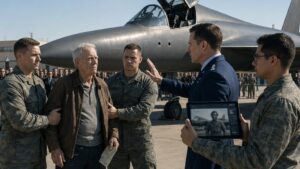
The pickup had not been washed in months, maybe longer. Salt had dried along the lower panels in gray-white streaks, and the tailgate wore a dent in the shape of an old mistake. When William Bennett eased it into the visitor lane at the Navy gate, the truck gave one low cough and settled beneath him like a tired dog.
Beyond the concrete barriers, the ship rose above the base like a piece of weathered steel pulled from memory.
William kept both hands on the wheel after he stopped. His left thumb rested over a split in the vinyl. His right hand stayed near the folded access card he had already taken from the cracked plastic sleeve in his shirt pocket. He had carried it there through three gas stations, one wrong turn, and forty-six miles of road he had once known without signs.
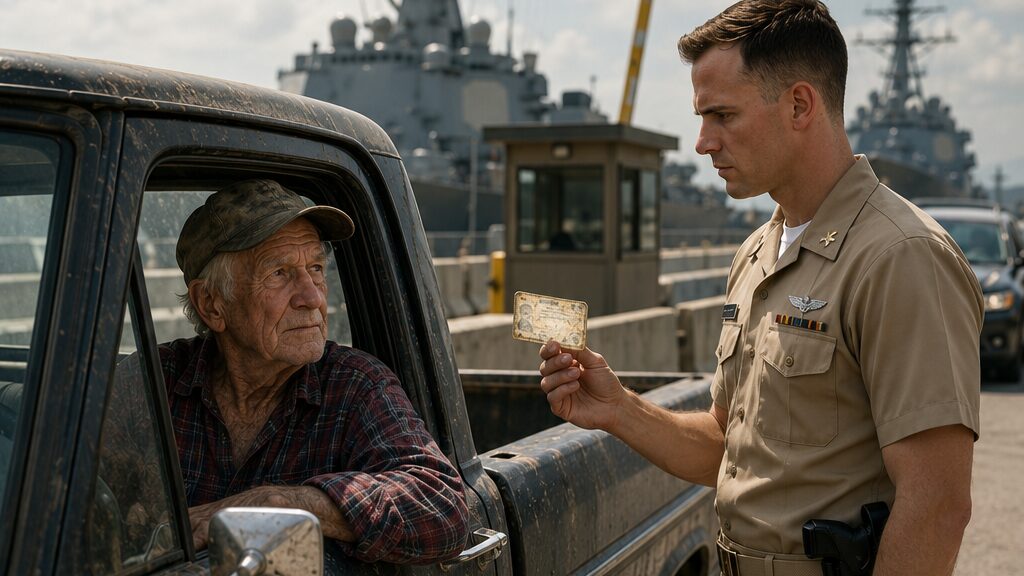
The young officer came out of the booth before William had lowered the window all the way.
Khaki uniform. Clean boots. Straight back. Close-cropped hair. A face still young enough to think tiredness was a choice.
“Morning, sir,” the officer said, but there was no morning in it. “Identification.”
William handed him the card.
The officer took it between two fingers, glanced at it once, then lifted it higher to catch the light. Not close to his own face. High enough that the guard in the other lane could see it. High enough that the driver behind William’s pickup leaned forward over his steering wheel.
The card looked worse in the officer’s hand than it had looked in William’s. The lamination was cloudy at the corners. The photograph had faded until William’s younger face seemed to be looking out through fog. The old dark-blue strip across the top had lost most of its color. His name remained visible, though. William Bennett. Beneath it, in smaller print, a designation that had once meant where he belonged.
The officer’s name tape read CARTER.
“Sir,” Carter said, “this is not scanning.”
“I expect it wouldn’t.”
“You expect it wouldn’t?”
William looked through the windshield at the ship. A gull crossed in front of her bow, small and bright against the gray hull.
“It’s old,” William said.
Carter’s mouth tightened. “Yes, sir, I can see that.”
Behind them, a car horn gave one short impatient tap. William did not turn around. He could feel the line forming in the side mirror—cars, delivery van, a white sedan with a base decal. Each engine waited with him.
Carter looked from the card to William’s truck. His eyes paused on the cracked dashboard, the plaid shirt, the thermos on the passenger seat, the old cap folded beside it.
“What is your business on base today?” he asked.
“I came to see the ship.”
“Which ship?”
William did not answer immediately. He had said her name aloud three times that morning before leaving home. Once in the kitchen. Once while locking the back door. Once at the gas pump, too softly for the clerk to hear. Still, at the gate, with the real hull visible beyond the barrier, the name caught behind his ribs.
“The Sullivan,” he said.
Carter’s expression did not change, but his attention sharpened. “The Sullivan is restricted today.”
“I know.”
“Decommissioning access is by appointment and current credential only.”
“I know that too.”
“Then you understand I can’t let you through with an unreadable card and no appointment showing in the system.”
William shifted his hand from the wheel to the open window frame. The morning air carried diesel, salt, and hot concrete. Somewhere farther in, a loudspeaker clicked and went silent.
“I was told the public gate wouldn’t help me,” William said. “So I came to the gate that had a view.”
Carter blinked once, as if the answer had not fit any space on his form. “Sir, I need you to pull out of the lane if you don’t have valid access.”
William looked at him then. Not hard. Not pleading. Just enough.
“I drove a long way.”
“I understand, but—”
“No,” William said quietly. “You don’t.”
The young officer’s jaw moved. For a moment, he looked less annoyed than uncertain. Then the horn sounded again, longer this time. Carter glanced back, and the uncertainty vanished beneath procedure.
“Sir, I’m going to ask you one more time to move the vehicle into the side inspection area.”
William’s gaze dropped to the card in Carter’s hand. The officer still held it too high, pinched at the corner as though it might leave dust on his fingers. William had seen men hold damaged things like that before. Wet letters. Burned photographs. Tags pulled from lockers.
He breathed through his nose.
“Turn it over before you throw it back at me.”
Carter looked down. “Excuse me?”
“Turn it over.”
The officer hesitated. The guard in the other lane watched. The driver behind William leaned out his window just enough to make impatience visible.
Carter turned the card over.
The back was worse than the front. Scratches ran across the surface. A strip of old adhesive clung where some barcode had peeled away years ago. But in the lower right corner, under yellowed lamination, was a handwritten notation in black ink, still legible because someone had pressed hard when writing it.
USS Sullivan. DC-2 Bennett. Emergency restoration crew.
Carter’s thumb stopped moving.
William watched the change before the young officer knew he was showing it. First the shoulders lowered, just slightly. Then the card came down from the air. Carter brought it closer, not to inspect it like evidence, but to read it like something that had begun speaking.
He looked beyond William, past the dirty windshield, toward the ship.
“You were assigned to the Sullivan?” Carter asked.
William rested his hand flat on the window frame. His knuckles had thickened with age. A faint tremor ran through the first two fingers, but he kept them still.
“A long time ago.”
Carter swallowed. “Sir, this card is expired.”
“Yes.”
“And this lane is for active access.”
“Yes.”
Another horn sounded. This time Carter did not look back.
“What was your rate?” he asked, voice lower now.
William looked at the card, then at the ship.
“Damage control.”
The phrase landed between them with more weight than the morning seemed ready to hold. Carter’s eyes flicked to the back of the card again. Emergency restoration crew. He was young, but he was Navy enough to understand that some words did not belong to clean days.
The officer in the next lane called, “Carter, you good?”
Carter did not answer right away.
William saw the battle in him: gate time, procedure, authority, the waiting line, the old man in the bad truck, the ship name on the card. The young man had not become kind all at once. He had only become careful. That was enough to change the shape of the morning.
Carter stepped closer to the window and lowered his voice.
“Mr. Bennett, do you have any current ID with you?”
William handed over his driver’s license. Carter took it differently from the card. Not by the corner now. Fully, with his palm beneath it.
“Please keep your vehicle here for a moment,” Carter said.
“I thought I was blocking the lane.”
“You are,” Carter said, then looked toward the line of cars. “But we can move them around you.”
The guard in the other lane stared at him.
Carter lifted one hand and signaled the waiting driver behind William to shift left. The driver threw both hands up, then pulled around with exaggerated irritation. Carter did not react.
William looked down at his empty fingers. Without the card, his shirt pocket felt strangely light.
Carter stood beside the truck, license in one hand, old access card in the other, no longer holding either one up for everyone to see.
“Sir,” he said, and this time the word had something inside it. “Were you assigned to the Sullivan?”
Chapter 2: The Ship Name Nobody Said Softly
Ryan Carter had been trained to keep the gate moving.
That was the first thing every new watch learned. Be polite, be firm, verify credentials, control the lane, do not let one confused person become twenty angry vehicles. The gate was not a place for stories. Stories slowed down judgment. Stories made you bend toward exceptions.
But the old card in Ryan’s hand did not feel like a story. It felt like something left in a drawer too long and then brought into the light on the last possible day.
He guided William Bennett into the side lane himself, walking beside the pickup until its front tires crossed the yellow inspection line. The truck idled roughly. The old man drove slowly, not because he was unsure, but because he seemed unwilling to jolt anything loose.
The guard booth held the smell of printer heat, coffee, and damp uniforms. Ryan stepped inside and placed the driver’s license on the desk first. Then, after a pause he did not understand until he had already done it, he laid the old Navy card beside it.
Not tossed. Not clipped under the scanner. Laid flat.
The scanner rejected it twice. The screen made a dull error sound each time, as if the machine were annoyed by memory.
“Old card?” the other guard asked.
“Very old.”
The guard leaned over. “That thing belong in a museum?”
Ryan gave him a look sharper than he meant to. “Run the license.”
Outside, William sat with the window still down, facing forward. He had not reached for his phone. He had not waved anyone over. He simply waited, one elbow on the window edge, eyes fixed through the gate where the Sullivan’s mast showed above the barriers.
The ship’s name had been posted in base notices all week. Final closure. Restricted access. Decommissioning support only. Ryan had passed her twice during night watch and barely looked up. Ships came and went. Names remained on signs after men stopped saying them.
Brandon Reed came from the security office with a tablet tucked under one arm and a frown already in place.
“What’s the hold?” Brandon asked.
“Old credential. Driver says he served on the Sullivan.”
Brandon looked through the glass at William’s truck. “Current access?”
“Not yet.”
“Appointment?”
“No.”
“Then you know the answer.”
Ryan picked up the card again. “There’s a notation on the back.”
Brandon did not reach for it. “Is there a current barcode on the front?”
“No.”
“Then there’s your notation.”
Ryan felt heat rise in his neck. He kept his voice level. “His name may be in the ship’s old records.”
“May be?”
“The card has a damage-control designation tied to the Sullivan.”
Brandon exhaled through his nose. “Carter, we are not running a history project at the gate.”
Outside, William turned his head slightly. Ryan could not tell whether the old man had heard, but he hated the possibility that he had.
“I’m not asking to wave him through,” Ryan said. “I’m asking to verify.”
“Verify fast. That lane is not a waiting room.”
Brandon stepped back toward the door, then paused. “And don’t let him turn this into a scene. Old guys come here on closure days. They get emotional. They think the base owes them one last look.”
Ryan glanced at William. The old man’s face had not changed. That made it worse.
“Yes, Chief,” Ryan said, though Brandon was not a chief and disliked being corrected more than he disliked delays.
Brandon left.
The license came back clean. William Bennett. Local address. No active warrants. No current base access. Age eighty-one.
Ryan opened the historical credential request line and typed the name. The system spun for several seconds, then returned nothing. He tried Bennett, William. Nothing. He entered the old designation from the card. The system corrected him twice and failed once.
The other guard watched over his shoulder. “You’re going to get Reed back in here.”
“I know.”
Ryan tried the ship name. USS Sullivan. A page opened with closure notices, access restrictions, pier operations, maintenance contractors. Nothing that touched the old man outside except the shape of the hull in the distance.
He looked through the glass again.
William had taken off his cap and set it on the passenger seat. His gray hair lay thin and flattened by the brim. Without the cap, he looked smaller. Not weaker exactly. Just less guarded from the sun.
Ryan stepped out of the booth.
“Mr. Bennett?”
William turned.
“We’re having trouble locating your record.”
“I thought you might.”
“Do you have any paperwork? Discharge papers, appointment confirmation, veteran ID?”
William’s mouth moved into something that was almost a smile and not close to one. “Son, I came with the card because the card was what I had when the ship still knew my name.”
Ryan had no answer for that.
A white sedan rolled past in the left lane. The driver looked at William, then at Ryan, then away. The base kept functioning around them. Badges scanned. Barriers lifted. Engines moved. One man remained still.
“What exactly are you trying to do today?” Ryan asked.
William looked past him. “See her before they close the gates.”
“That’s all?”
William’s fingers tightened once on the window frame. “That’s what I can say at the gate.”
The answer gave Ryan a faint chill. Not fear. Recognition of a locked door.
He nodded. “I’m going to call records.”
“Don’t get yourself in trouble.”
Ryan looked back at the booth where the old scanner still glowed red.
“I already started,” he said.
William’s eyes shifted to him. For the first time, Ryan saw something besides patience there. Not gratitude. Caution. The old man was measuring whether Ryan’s help would cost them both more than it gave.
Ryan returned inside and called the base records office. He expected another transfer, another refusal, another voice asking whether he had filled the proper form. Instead, a woman answered on the third ring.
“Records, Harris.”
“This is Carter at Gate Two. I need historical verification for a former sailor, possible Sullivan assignment. Name William Bennett.”
A pause.
“What year?”
Ryan looked at the card. The front did not give him enough. “Older. The credential is pre-digital.”
“That narrows it to half the ghosts in our basement.”
Ryan almost laughed, then didn’t. “There’s a handwritten note. USS Sullivan. DC-2 Bennett. Emergency restoration crew.”
The line went quiet.
“Harris?”
“Read that again.”
He did.
This time the silence felt different.
“I’m checking something,” Emily Harris said. Papers moved near the phone. A keyboard clicked quickly, stopped, then clicked again. “Do not send him away yet.”
Ryan straightened. “You found him?”
“I found a cross-reference. Not the full record. The ship has a restricted closure archive attached.”
“What does that mean?”
“It means someone forgot to digitize all of it, or someone didn’t want it easily opened.”
Ryan turned slightly so he could see William through the booth window.
Emily said, “The name William Bennett appears in an incident index tied to the Sullivan.”
“What kind of incident?”
“I don’t know yet.”
Brandon’s voice cut in from the doorway behind him. “Carter.”
Ryan closed his eyes briefly.
Brandon entered the booth, already irritated. “Why is that truck still there?”
Ryan kept the phone at his ear. “Records is checking.”
Brandon reached for the old card. Ryan moved it out of instinct, placing his hand flat beside it before Brandon’s fingers touched the lamination.
The room went still.
Brandon looked at him. “Careful.”
Ryan withdrew his hand, but he did not move the card closer.
On the phone, Emily Harris said, “Officer Carter?”
“Yes.”
“I need you to confirm something with Mr. Bennett.”
Ryan watched William through the glass. The old man had put his cap back on and was staring at the ship like the gate had disappeared.
Emily’s voice lowered.
“Ask him if the name Morgan means anything to him.”
Ryan did not repeat the name aloud at once. He felt, without reason, that it should not be thrown across the booth.
“What did you find?” he asked.
“Not enough. But there’s a note in the old index.”
“What note?”
Another pause. Then Emily said, “Morgan family letter — undelivered.”
Chapter 3: The Record That Would Not Load
Emily Harris had spent six years in base records learning that most urgent things were not urgent and most important things arrived mislabeled.
A contractor needed a pier access correction “immediately” because he had typed his own birthdate wrong. A department head wanted a file “today” that had sat unopened since the last inspection. Sailors called looking for forms they swore nobody had given them, which usually meant the forms were in their inbox under a subject line they had not read.
But old records were different.
Old records did not demand. They waited.
The Sullivan closure archive had been placed in a gray metal cabinet at the back of the records room, behind boxed maintenance logs and a retired printer nobody had approval to discard. Emily found the cabinet key on the third ring of a labeled chain and carried it back with the phone still pressed to her ear.
“Keep him there,” she told Carter.
“I’m trying,” he said.
“Try harder.”
She hung up before she could hear whether he took offense.
The cabinet drawer resisted. When it opened, the smell rose at once—paper, dust, old ink, and the faint stale trace of dampness. Emily slipped on gloves, not because the files were sacred but because the oldest paper sometimes came apart when handled like ordinary paperwork.
Sullivan, closure archive. Sullivan, maintenance transition. Sullivan, personnel cross-reference.
The folder she needed was thin.
That worried her.
Ships gathered paper the way hulls gathered barnacles. If a folder was too thin, it meant the rest had been moved, sealed, destroyed, or forgotten somewhere no one admitted existed.
She opened the cross-reference and found a printed index with names arranged under crew functions. Most were typed cleanly. A few had pencil marks beside them. Near the bottom of one page, under Damage Control / Emergency Restoration, she saw it.
Bennett, William — DC-2. See Incident Addendum 7C. Morgan family letter — undelivered.
Emily read it twice.
The words did not belong together in a personnel index. Not like that. Not without explanation.
She pulled the incident addendum folder and found a single placeholder sheet.
FILE RESTRICTED / PARTIAL TRANSFER ONLY
CONTACT BASE HISTORICAL OFFICE OR COMMAND AUTHORITY
The historical office had been reduced to a shared inbox three reorganizations ago. Command authority meant signatures, delays, and someone asking why a gate officer had started tugging at an old knot in the middle of a closure day.
Emily looked across the room at the wall clock. The Sullivan’s final restricted window began in less than four hours.
Her computer took longer than usual to open the archive search. She typed William Bennett’s name. The system returned a service number fragment, then froze. She typed Morgan. Too many results. She added Sullivan. The screen blinked and loaded a scanned page so slowly that the lines appeared in strips.
It was not the incident file. Only a maintenance summary.
Smoke damage. Electrical failure. Flooding controlled. Emergency restoration team commended.
No medals listed. No names highlighted. Just the cold language of damage and repair, stripped of shouting, heat, water, fear.
Then another page loaded beneath it.
Casualty notification cross-reference: Morgan, Edward.
Emily sat back.
She did not know Edward Morgan. She did not know William Bennett. She did not know what had happened aboard the Sullivan beyond the careful official verbs on the screen. But she knew enough to stop thinking of the old man at the gate as a credential problem.
Her desk phone rang before she could call Carter back.
“Harris,” she said.
“This is Reed at Gate Two.”
Of course it was.
“Yes?”
“I’m told you’re holding up traffic for an unverified visitor.”
“I’m verifying him.”
“You verified current access?”
“No.”
“Then he is unverified.”
Emily pinched the bridge of her nose with her gloved fingers, then pulled the glove away, annoyed with herself. “He appears in an old Sullivan index.”
“Appears?”
“His credential matches a handwritten designation in the archive.”
“Does that grant access?”
“Not by itself.”
“Then tell Carter to clear him.”
Emily looked at the scanned maintenance summary again. Emergency restoration team commended. Such a small phrase for whatever had earned it.
“There’s a family notation attached,” she said.
“What family notation?”
“Morgan family letter — undelivered.”
Reed was silent just long enough to reveal that he had heard the difference.
Then he said, “That sounds personal, not operational.”
“Sometimes records are both.”
“Harris.”
She knew that tone. It was the tone of a man turning a person back into a procedure.
“I am not authorizing access,” she said. “I’m saying do not send him away until I finish checking.”
“You have fifteen minutes.”
“That’s not enough.”
“That’s what you have.”
The line clicked dead.
Emily stared at the receiver before setting it down.
In the old archive box, beneath the personnel cross-reference, she found a smaller envelope labeled CONTACT ATTEMPTS. Most of the pages inside were copies of letters sent decades before, addresses blacked out in thick marker, replies marked returned, forwarded, incomplete.
Near the back was a photocopy of a handwritten note. The original was not there. The scan was faint, but she could make out a few words.
If Bennett comes asking after the family, do not make him say it in public.
No signature was visible. Only initials: E.M.
Emily’s throat tightened unexpectedly.
She picked up the phone and called Carter.
“Did you ask him about Morgan?” she said when he answered.
“Not yet. Reed is standing here.”
“Then don’t ask him in front of Reed.”
A pause. “Why?”
Emily looked at the note again.
“Because someone in the old file specifically didn’t want that.”
On the other end, Carter lowered his voice. “What is this?”
“I don’t know the full story.”
“What do you know?”
Emily opened another scan. This one showed a crew roster from the same period. William Bennett’s name appeared beside Edward Morgan’s, both assigned to the same emergency team. The scan cut off part of the page, leaving dates and signatures missing.
“I know William Bennett served on the Sullivan,” she said. “I know he was attached to damage control. I know an incident file connects him to a man named Edward Morgan. And I know there’s a letter that apparently never reached the Morgan family.”
Carter said nothing.
Emily continued, “There may be a next of kin contact in the old file, but I need to check whether it’s still valid.”
“Can you do that?”
“I can try.”
“Reed wants him gone.”
“Then Carter,” she said, and surprised herself with the firmness in her own voice, “you may need to stop treating gone as the cleanest answer.”
After she hung up, Emily searched the next of kin file. Some names were outdated, some addresses dead-ended, some numbers belonged to people who had no connection anymore. She worked through them carefully, knowing each search might open a door the old man had kept closed for years.
Morgan, Edward. Spouse deceased. One dependent listed in a later benefits correspondence. Name: Nicole Morgan.
Emily found a number attached to a veterans’ family contact update from two years earlier. She hesitated before dialing. It was one thing to find a note in a file. It was another to bring a living person into whatever had waited inside it.
When the call connected, a woman answered with guarded politeness.
“Nicole Morgan?”
“Yes.”
“My name is Emily Harris. I work with records at the Navy base. I’m calling about an old file connected to your father, Edward Morgan, and the USS Sullivan.”
The woman’s breathing changed.
Emily chose her words with care. “There is a man here today named William Bennett.”
The silence on the line became so complete that Emily heard the fluorescent light above her desk buzzing.
At last Nicole said, “Did he bring the letter?”
Chapter 4: The Letter Under The Seat
William knew the call had gone somewhere it should not have gone.
He could tell from the way Ryan Carter came back from the guard booth without the same stride he had used the first time. The young officer no longer moved like a man enforcing a line. He moved like a man carrying a glass too full to spill.
Brandon Reed followed him to the edge of the inspection lane, tablet under his arm, mouth set flat. The two men stopped a few feet from the pickup, not close enough to crowd the window, not far enough to pretend this was casual.
“Mr. Bennett,” Ryan said, “Records found a reference.”
William kept his eyes on the ship.
The Sullivan sat past the gate in the hard white morning, her gray sides marked by shadows from cranes and lines. From here, she looked both near and unreachable. A man could see the rail. A man could count the breaks in the deck fittings. A man could almost believe that if the barrier lifted, the years between would lift with it.
“What reference?” William asked.
Ryan’s answer came carefully. “A Morgan family letter.”
William’s hand closed around the window edge.
Not much. Just enough that the skin pulled tight across his knuckles. He loosened his grip when he noticed Ryan had seen it.
Brandon spoke before Ryan could. “Mr. Bennett, if you’re carrying personal property connected to an old service record, we need to understand what it is before we make any access decision.”
William looked at him then.
Brandon was not cruel. That was what made him harder to answer. Cruelty was simple. William had learned a long time ago that procedure could bruise without ever raising its voice.
“It’s not property,” William said.
Brandon waited.
William turned off the engine. The sudden quiet made the gate sounds sharper: tires over pavement, scanner beeps, distant metal striking metal from somewhere inside the base. He opened the door slowly. Ryan stepped back, giving him room. Brandon did not move until Ryan glanced at him.
William’s knees objected when his boots touched the pavement. He stood beside the pickup a moment before reaching back into the cab. The movement sent a line of pain through his hip, but he had no wish to make a performance of it.
On the passenger seat lay his old cap and a steel thermos. Beneath the seat was a narrow space that smelled of dust, oil, and sun-baked vinyl. His fingers searched past a rag, an old tire gauge, a folded map he no longer needed.
Then he found the envelope.
It had been wrapped in a plastic grocery bag, then in a second one when the first began to split. The paper inside was stiff but not brittle. William brought it out with both hands and held it against his chest before he could stop himself.
Ryan’s gaze dropped to it. He did not reach.
Brandon did. “I’ll need to see—”
“No,” William said.
The word came out quiet, but it stopped the man’s hand.
Brandon’s face tightened. “Sir, I’m responsible for—”
“I said no.”
For the first time since arriving, William heard his own voice carry something harder than fatigue. The old muscles beneath it surprised him. So did the silence that followed.
Ryan stepped in, not between them exactly, but at an angle that softened the line.
“Mr. Bennett,” he said, “no one is going to take it from you. We just need to know whether it affects why you’re here.”
William looked down at the envelope through the plastic. A faint line of handwriting showed through where the paper had darkened with age.
He had promised himself he would not take it out unless he reached the ship. Not the gate. Not the guard booth. Not in a parking lane with a supervisor watching the time.
But the ship was right there, and the name had already left the file.
He unwrapped the plastic slowly.
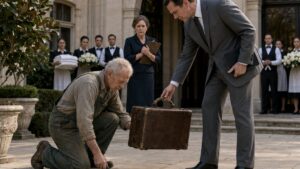
The envelope was cream-colored once, now browned at the edges. It had no stamp. No sealed flap anymore, only a careful fold tucked into itself. Across the front, in a hand William could still see gripping a pencil with burned fingers, were the words:
For my family, if I don’t get the chance.
Ryan read it and looked away first.
Brandon said nothing.
William held the letter against his palm. “Edward Morgan wrote it on a night when the lights kept going out. We thought we had time. Men always think that when the ship is still floating.”
The base seemed to continue around them without permission. A truck rumbled past in the far lane. A gull cried somewhere above the barrier.
“He asked me to hold it,” William said. “Said if he made it home, he’d tear it up himself. If he didn’t, I was to get it to them.”
Ryan’s voice came low. “His family?”
William nodded.
“Why didn’t you?”
The question had no accusation in it. That made it worse.
William folded the plastic once around the envelope, then stopped. His thumb rested along the top edge as if he might smooth away all the years by pressing hard enough.
“I tried once,” he said. “Address was wrong by then. Then I told myself I’d try again when I knew what to say with it.”
He almost laughed, but his throat would not allow it.
“Turns out a man can grow old waiting to know what to say.”
Brandon shifted his weight. “Mr. Bennett, I’m sorry for the history here, but unless this visit has been preauthorized—”
Ryan turned toward him. “Chief.”
Brandon’s eyes sharpened.
Ryan corrected himself without lowering his head. “Supervisor Reed. Records has verified a service connection. There’s an active family-contact question. The ship closes today. We can hold him in inspection until Records clears a controlled escort.”
“That is not your call.”
“No,” Ryan said. “But sending him away before Records finishes would be ours.”
William watched the young officer. He had expected impatience, maybe pity, maybe a salute too big for the moment. He had not expected this: a man choosing a small difficult thing while still afraid of doing it wrong.
The radio at Brandon’s shoulder crackled. He stepped aside to answer.
Ryan remained by the truck. “Mr. Bennett, Records contacted Nicole Morgan.”
William felt the envelope change weight in his hand.
For a second he was not at the gate. He was in a passageway gone black with smoke, one arm hooked under another man’s shoulder, Edward’s voice rough and close, saying, If you get above deck before I do—
William shut his eyes once.
“She’s alive?” he asked.
Ryan nodded. “She’s on her way.”
William looked at the ship. He had imagined the letter ending at an office, a mailbox, a clerk’s desk, maybe a family stone in a cemetery if he arrived too late. He had not imagined Edward’s daughter walking toward him with her father’s handwriting still sealed between his fingers.
“I should leave,” William said.
Ryan frowned. “Sir?”
“This was foolish.”
“No.”
William glanced at him.
Ryan seemed surprised by his own answer, but he held it. “You came all this way. Don’t leave because we made the gate harder than it had to be.”
William looked down at the letter again. It had survived lockers, drawers, glove compartments, storms, his wife’s death, his own anger, his own excuses. Now it rested in the open air with the ship watching.
In the distance, the Sullivan’s mast cut into the sky.
William whispered, “I was afraid if I came back, I’d hear the alarm again.”
Ryan did not ask what alarm.
That was the first wise thing anyone had done all morning.
Chapter 5: The Daughter Who Thought He Forgot
Nicole Morgan had not planned to come to the base angry.
She had planned to come controlled.
There was a difference, and she had practiced it all the way there, one hand on the wheel, the other opening and closing against her knee at red lights. Controlled meant she would ask direct questions. Controlled meant she would not cry in front of strangers in uniform. Controlled meant she would remember that whatever William Bennett had done or failed to do, he was an old man now.
Then she saw him through the glass of the small waiting room, seated with the letter on the table in front of him, and all the careful words she had arranged inside herself began to come apart.
He looked smaller than the man she had imagined.
For years, William Bennett had occupied a space in family silence. Not a face, not a voice, barely even a name. Her mother had said it once after too much quiet at the kitchen sink: There was a sailor who knew your father at the end. Bennett. If he ever comes, let him speak first.
He never came.
Nicole had built a man from that absence. Hard, maybe. Cowardly, maybe. Someone who chose his own peace over theirs. Someone who let a dead man’s family wait without knowing they were waiting.
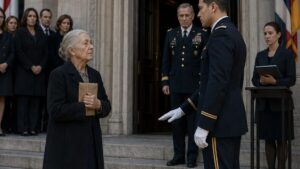
The man in the waiting room wore a faded plaid shirt and held himself upright as if sitting comfortably would be disrespectful. A young officer stood near the wall. A woman from records waited by the door with a folder against her chest. Another security man remained outside, visible through the blinds, talking into a radio.
Nicole entered without knocking.
William rose. Slowly, because his body required it. Not theatrically. Not to make her feel guilty. He placed one hand on the chair back and stood until he was as straight as he could manage.
“Ms. Morgan,” Emily Harris said softly, “this is William Bennett.”
Nicole ignored the introduction. Her eyes were on the envelope.
“Is that his?”
William looked at the table. “Yes.”
“Did you open it?”
“No.”
“Did you read it?”
“No.”
“Did you know my mother died without seeing it?”
The room became airless.
Ryan Carter lowered his eyes. Emily’s fingers tightened around the folder. William did not flinch, and that almost made Nicole angrier.
“I knew she might have,” he said.
“You knew?”
“I knew time had passed.”
“Time had passed,” Nicole repeated. “That’s what you call it?”
William’s hand remained on the chair. The knuckles were pale.
Nicole stepped closer to the table, but she did not touch the letter. She had wanted it for so long without knowing what it said that reaching for it felt dangerous.
“My mother used to keep a box,” she said. “Every letter he sent before the last deployment. Every photograph. Every card. She kept them in order. She told me she had all of him that paper could hold.”
William’s face changed then, but not enough to satisfy her. Pain passed through him like a shadow under water.
“She didn’t have this,” Nicole said.
“No.”
“Because you kept it.”
“Yes.”
The plainness of the answer struck harder than denial would have.
Ryan shifted as if he might speak, but Emily touched his sleeve once. He stopped.
Nicole stared at the old man. “Why today?”
William looked through the waiting-room window. From this angle, the Sullivan was partly hidden by concrete and fence, her upper deck visible above the barrier. “Because after today, I was told civilians won’t be allowed near her again.”
“So the ship mattered enough to bring it. We didn’t?”
The words were cruel the moment they left her, but she did not take them back.
William turned from the window.
“No,” he said. “The ship was where I could still hear him ask.”
Nicole’s throat tightened despite herself. “Don’t do that.”
“Do what?”
“Make it sound beautiful.”
He nodded once, accepting the rebuke.
“It wasn’t beautiful,” he said. “It was loud. Hot. Dark in places that should have had light. He gave me that letter because neither of us knew which one of us would see morning.”
Nicole looked at the envelope. Her father’s handwriting had always leaned slightly right, as if the words were hurrying ahead of him. She could see that same lean now.
William continued, “He said if he came home, he’d tear it up. If he didn’t, I was to bring it to your mother. Not mail it. Bring it.”
“And you didn’t.”
“No.”
“Why?”
He looked at her, and for the first time she saw not refusal but the shape of a man who had answered the question to himself so often it had worn grooves into him.
“Because I came home with his voice in my ears,” William said. “And every time I thought of standing in front of your mother, all I could think was that I would be carrying the letter because he couldn’t.”
Nicole’s anger shifted, not leaving, only losing its clean edge.
“That was not your choice to make,” she said.
“No.”
“My mother had a right to it.”
“Yes.”
“I had a right to it.”
William bowed his head. “Yes.”
There was no defense. No explanation offered as pardon. Somehow that made the room harder to stand in.
Nicole pulled out the chair across from him and sat. Her legs felt unsteady, though she would not have admitted it. “Tell me one thing.”
William remained standing.
“Did he suffer?”
Emily looked away. Ryan’s face tightened.
William sat back down with care. He placed both hands flat on the table, not touching the letter.
“Yes,” he said.
Nicole closed her eyes.
“But not alone,” William added.
She opened them.
“I don’t say that to soften it,” he said. “I say it because it’s true.”
Nicole’s mouth trembled once. She pressed her fingers against it until it stopped.
“What happened?”
William looked toward the ship again, though the wall was between them now. “There was flooding after the fire took the lower electrical room. Smoke moved faster than we did. We were trying to keep power to the pumps. Your father went back for a man who’d fallen near the hatch.”
“Did he save him?”
“Yes.”
The answer was immediate.
Nicole breathed in sharply.
William’s gaze dropped to the table. “Then the hatch warped. We got one man through. Not two.”
No one spoke.
The old building hummed around them. Air-conditioning clicked behind the wall. Outside, a truck backed up with three soft warning beeps, distant and ordinary.
Nicole looked at the letter again.
“Why didn’t the Navy send it?”
“Because he gave it to me,” William said. “And I lived.”
There it was. Not the whole truth, maybe, but the root of it. A sentence that had been holding the old man upright for decades and bending him at the same time.
Nicole reached toward the envelope, then stopped just short.
“Is it still mine?” she asked.
William’s eyes lifted.
“It was always yours.”
His voice nearly failed on the last word. He slid the envelope across the table with both hands, slowly, as though any sudden movement might damage what little was left intact.
Nicole touched the paper. Her father’s handwriting sat beneath her fingertips, no longer memory, no longer family rumor, no longer a story withheld by an old sailor too afraid to knock on a door.
She did not open it.
Not there. Not under fluorescent lights. Not with procedure waiting outside.
Instead she looked at William and said the question that had lived in her mother’s silence longer than anger had lived in hers.
“Why did he want you to bring it when the ship came home?”
William’s eyes moved once toward Ryan, then Emily, then back to Nicole.
“He didn’t say when the ship came home,” William said. “He said when I could stand to look at her again.”
Nicole’s fingers closed around the letter.
William’s face had gone the color of old paper.
“I was afraid if I came back,” he said, “I’d hear the alarm again.”
Chapter 6: Permission To Walk Past The Barrier
Ryan had expected Brandon Reed to refuse.
Not loudly. Not cruelly. Simply with the clean finality of a man who had policy on his side and a clock on the wall. That was why Ryan stood straighter before he entered the security office, William’s old access card in one hand and the temporary escort request in the other.
Brandon sat behind the desk, reading the form as if it had personally disappointed him.
“No,” he said.
Ryan had not even reached the second sentence.
“Records verified prior service,” Ryan said.
“Prior service is not current access.”
“Emily Harris confirmed a closure-related archive connection.”
“Archive connection is not access.”
“Nicole Morgan is present as a family contact.”
“Family contact is not access.”
Ryan looked at the blinds behind Brandon’s desk. Through the narrow gaps, he could see the inspection lane, William’s pickup, and beyond it the gray rise of the Sullivan. The ship seemed closer from inside the office, though Ryan knew that was only the angle.
“Then what is access?” he asked.
Brandon set the tablet down. “A current credential, preauthorization, or command approval. You know that.”
“The command desk is not answering fast enough.”
“That happens.”
“The ship closes today.”
“That also happens.”
Ryan heard the sharpness in his own breath and forced himself to slow it. He thought of his grandfather then, unexpectedly. Not because the situations were the same. They were not. His grandfather had served in the Army, not the Navy. He had worn baseball caps with unit patches and refused to talk about anything behind them. As a child, Ryan had once asked why he kept an old photograph facedown in a drawer. His grandfather had said, Some things don’t need your eyes on them yet.
Ryan had mistaken silence for emptiness then.
He had been making the same mistake all morning.
“Supervisor Reed,” Ryan said, choosing each word, “I am requesting a controlled escort to the pier access boundary. No ship entry unless approved. No restricted compartments. Records present by phone if needed. Family contact present. I’ll take responsibility for the movement.”
Brandon leaned back. “You’re very ready to put your name on something you don’t understand.”
“Yes,” Ryan said. “Because I understand enough.”
The room cooled.
Brandon studied him for a long moment. His expression was not warm, but it was no longer merely annoyed. “Do you?”
Ryan did not answer quickly.
Outside the office, William sat in the waiting area with Nicole Morgan a few chairs away. They were not talking. The envelope rested in Nicole’s lap, both of her hands over it. William’s cap sat on his knee. He looked toward the gate every few seconds, each glance shorter than the last, as though he were practicing disappointment.
“I understand that if we send him away,” Ryan said, “we will have followed procedure and still failed at our job.”
Brandon’s jaw tightened. “Our job is security.”
“Yes,” Ryan said. “And security includes knowing the difference between a threat and a man who kept a promise badly but came back to finish it.”
For a moment, Ryan thought he had gone too far.
Brandon looked down at the old card lying beside the request form. Ryan had placed it there carefully, faceup. The faded photograph showed William decades younger, eyes level with the camera, mouth set in the same restrained line he wore now.
“Controlled escort to the memorial boundary,” Brandon said at last. “Not beyond without additional clearance. You document every movement. Harris sends the archive confirmation before he crosses the second checkpoint. Morgan stays with the party. If he becomes distressed, you turn back.”
Ryan kept his relief out of his voice. “Yes, Supervisor.”
“And Carter.”
“Yes?”
Brandon tapped the old card once, not touching it hard. “Don’t make this into something it isn’t.”
Ryan picked up the card. “I’m trying to make sure we don’t make it smaller than it is.”
He left before Brandon could answer.
In the waiting area, Nicole looked up first. William did not. He seemed to have settled into the idea that the answer would be no, and Ryan disliked how familiar the old man looked with denial.
“Mr. Bennett,” Ryan said.
William’s eyes lifted.
“We can escort you to the pier access boundary. From there, we’ll see what Records can clear. No promises beyond that.”
William stared at him, not with joy, not even relief. With caution. “You shouldn’t risk your post over this.”
“I’m not risking it. I’m documenting it.”
Nicole stood, the letter still in her hand. “Can he see the ship?”
Ryan nodded. “Yes, ma’am. At least from the pier.”
William placed his cap on his head, then took it off again. He looked at the old Navy card in Ryan’s hand.
Ryan stepped closer and held it out with both hands.
The gesture felt awkward the moment he made it. Too formal for a plastic card. Not formal enough for whatever the card had carried. But William looked at Ryan’s hands, and something in his face eased by a fraction.
“May I return this to you, sir?” Ryan asked.
The title came naturally this time.
William accepted the card. His thumb brushed the cloudy photograph.
“You don’t have to call me that.”
“I know.”
William slid the card into his shirt pocket, but not all the way. A worn corner remained visible.
They moved out together.
The gate looked different from the walking side. Cars rolled past, scanners chirped, and the barrier arm rose and fell with indifferent rhythm. Ryan walked on William’s left, matching his pace without making it obvious. Nicole walked a step behind, close enough to help if needed, far enough not to crowd him. Emily’s voice came through Ryan’s radio once, confirming the archive note had been transmitted.
At the barrier, the guard from the second lane watched them approach. His eyes moved from Ryan to William, then to the old pickup still resting in inspection.
“This the Sullivan vet?” he asked.
Ryan stopped.
William’s shoulders tightened, almost invisibly.
Ryan turned to the guard. “This is Mr. Bennett,” he said. “He is here under escort.”
The guard’s face changed. “Right. Sorry.”
William said nothing, but Ryan felt the correction settle between them like a necessary plank in a weak bridge.
Brandon stood near the booth, arms folded. He gave one short nod. Not approval exactly. Permission.
Ryan swiped his badge. The barrier arm lifted.
William did not move.
For a second, Ryan thought the old man’s strength had failed. Then he saw William looking at the open road beyond the gate, at the strip of pavement leading toward the harbor, at the ship that had waited behind fences, files, and fear.
The old man’s right hand rose to his shirt pocket, covering the edge of the card.
“You all right?” Nicole asked quietly.
William looked at her. Then at Ryan.
“No,” he said.
No one moved.
Then William took one step past the barrier.
“But I’m going.”
Chapter 7: One Last Look Without An Audience
The harbor road ran between low buildings and fenced equipment yards, past stacked crates, parked service trucks, and coils of line thick as a man’s wrist. William walked it slowly, one step placed before the next with the care of someone crossing a deck in rough weather.
Ryan stayed to his left. Nicole walked on his right now, the letter held flat against her chest beneath both hands. No one had asked her to carry it that way. William noticed and said nothing.
The Sullivan grew larger with each step.
From the gate, the ship had looked like memory, distant enough to belong to another man. Up close, she became steel again. Weathered paint. Rust at seams where rain had found patient paths. Lines tied off cleanly. Temporary barriers set near the gangway. Signs posted in laminated sheets. Restricted. Authorized Personnel Only. Final Closure Operations.
The words were neat. The ship was not.
William stopped at the edge of the pier boundary.
Ryan stopped with him. “This is as far as we’re cleared without the harbor escort.”
William nodded.
A maintenance worker crossed the pier carrying a clipboard, glanced at the group, and slowed.
Ryan stepped forward before the question formed. “Escorted party for memorial access. Confirmed through Records and Supervisor Reed.”
The worker looked at William’s plaid shirt, Nicole’s white face, Ryan’s uniform. His eyes lingered on the old access card still showing at William’s pocket.
“Memorial access is through the side passage,” the worker said, softer than William expected. “Not aboard. Just the pier room.”
“That’s enough,” William said.
The worker nodded and opened a low gate.
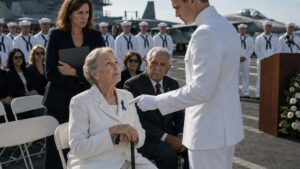
The memorial room was not grand. That helped. William had been afraid of polished floors, flags arranged for photographs, plaques with too many words written by men who had not smelled smoke. Instead it was a small shore-side room near the pier, used for closure materials, ship history, and the temporary remembrance wall before the final transfer. Folding chairs stood against one wall. A table held binders and cotton gloves. Photographs of the Sullivan over different years lined a display board.
One photograph showed her young and bright under a blue sky.
William did not look at it long.
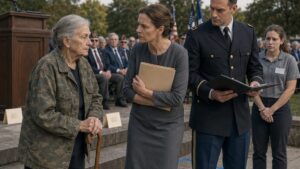
Nicole moved toward the remembrance wall. Names were arranged by year and incident, printed cleanly, each beneath a small ship emblem. She found her father before William did.
Edward Morgan.
She touched the name with two fingers, then took her hand away as if afraid she had done too much.
William remained near the doorway.
Ryan did not urge him forward. That mattered. All morning people had been asking him to move—pull over, wait here, step through, come inside. Now, at last, no one moved him.
Nicole turned. “Would you rather I read it alone?”
The letter trembled slightly in her hand.
William looked at the name on the wall. Edward Morgan. Printed in black. Held in place by two clear pins. Too small for the man who had laughed with a cigarette unlit between his lips because smoking was forbidden and he liked pretending to consider it anyway. Too tidy for the man who had shoved William toward a hatch and shouted over alarms until his voice broke.
“It’s yours,” William said. “You decide.”
Nicole looked down at the envelope. “He asked you to bring it.”
“Yes.”
“Then stay.”
William’s breath caught in a place too old to name.
She opened the envelope carefully, lifting the flap as though the paper could feel pain. The letter unfolded in two pages, the creases soft from age but unbroken. Nicole’s eyes moved over the first lines. Her mouth pressed tight. She did not read aloud at first.
Outside, metal rang against metal somewhere on the pier. William’s hand rose to his shirt pocket. Beneath his fingers, the old card sat against his heart, cloudy and useless to every machine on the base.
Nicole read quietly. Her father’s words changed her face by degrees. First sorrow, then recognition, then something almost like a child listening at a bedroom door for a voice that had gone missing.
Halfway down the page, she stopped.
“He wrote about you,” she said.
William looked away.
Nicole swallowed. “He called you Bill.”
“No one calls me that anymore.”
“He said if this letter reached home, it meant you kept your head when everyone else was losing theirs.”
William’s fingers curled against the card.
“He said,” Nicole continued, voice unsteady but clear enough, “tell Clara that Bennett got three men out before the smoke dropped. Tell her not to let him stand in the doorway like a guilty fool.”
William shut his eyes.
The alarm came then.
Not from the ship. Not from the base. From somewhere behind his ribs, where old sound did not age. The rising clang, the shouted orders, boots slipping on wet metal, air gone black, Edward’s hand slamming the letter into his chest.
If I don’t get the chance.
William opened his eyes to the small room, the folding chairs, Nicole, Ryan standing near the door with his hands clasped behind him and his gaze lowered.
“I didn’t get him out,” William said.
Nicole folded the letter slightly but did not put it away. “He knew that might happen.”
“No.”
The word was sharper than he meant. Nicole did not step back.
William looked at Edward’s name. “I had his sleeve. For a second I had him. The hatch shifted. I could feel him pulling his arm free, not because he was afraid, because he knew. He knew if I held on, we both stayed there.”
His hand dropped from his pocket.
“He made the choice. I’ve hated him for it some days. I’ve hated myself more.”
Nicole’s eyes filled, but her voice stayed steady. “The letter says he trusted you.”
William almost smiled. It hurt too much to become one. “Edward trusted everybody until they gave him reason not to.”
“He trusted you with us.”
The room went quiet.
William looked at the name again. For years, Edward had been the man he failed to save. In Nicole’s hands, in Edward’s own hurried words, he became something else too. A father. A husband. A sailor who had known the risk and still used his last clear thoughts to send love forward.
Nicole stepped closer and held out the second page.
William did not take it.
“Please,” she said.
He looked at Ryan. The young officer had turned his face slightly away, giving them privacy in the only way he could without leaving his post.
William accepted the page.
Edward’s handwriting blurred at first. William blinked until it steadied.
Bill, if you are the one carrying this, do not stand outside the door forever. Knock. Tell them I was scared and I did my job anyway. Tell them you did too.
The paper lowered in William’s hand.
No one spoke.
Outside, the harbor wind moved against the building. The Sullivan creaked softly at her lines, old steel answering water.
William stepped toward the remembrance wall. His knees hurt. His chest hurt worse. Still, he made the distance without help. At Edward’s name, he placed his palm against the wall, not over the letters, just beneath them.
“I came late,” he said.
Nicole stood beside him.
“But I came.”
She nodded once. “Yes.”
He returned the page to her. “Your mother should have had that.”
“Yes,” Nicole said.
The answer was honest. It did not pardon him cheaply. He was grateful for that.
“I’m sorry,” William said.
Nicole folded the letter with the same care she had used opening it. “I know.”
He heard what she did not say. That knowing was not the same as erasing. That apology did not restore years. That some doors, once left unopened, changed the rooms behind them.
She slipped the letter back into the envelope, then held it against Edward’s name for a moment. Not taping it there. Not surrendering it. Just letting paper meet the place where the Navy had written him down.
Ryan stepped forward only when Nicole turned. “Ma’am,” he said, “take all the time you need within the clearance window.”
Nicole looked at him, surprised.
Ryan’s ears reddened slightly. “I’ll handle the window.”
William looked over. The young officer stood straighter, not performing. No salute. No broad gesture. Just a man making space where the morning had nearly made none.
“Carter,” William said.
Ryan faced him. “Sir?”
William touched the old card in his pocket. “You did all right.”
The words were small. Ryan received them as if they were not.
A few minutes later, when they left the memorial room, William asked to stand by the rail once before returning to the gate. The harbor escort allowed it after Ryan checked the boundary twice. Nicole stayed back with the letter. Ryan stood farther off, close enough to be responsible, far enough to let the moment belong where it belonged.
William rested one hand on the cold metal rail.
The Sullivan filled his view. Not young. Not whole in the way memory kept trying to make her. But present. Scarred, repainted, stripped in places, still holding the shape of everything that had happened aboard her.
He waited for the alarm.
Only the wind came.
For the first time in years, that absence did not feel like betrayal.
When they walked back, William did not move faster, but he seemed less pulled downward. At the gate, Brandon Reed stood near the booth with a clipboard. He looked at William, then at Ryan.
“Escort completed?” Brandon asked.
Ryan kept his voice even. “Yes.”
Brandon marked the form. After a pause, he looked at William. “Mr. Bennett.”
William turned.
Brandon’s expression remained controlled, but his voice had changed by a small, important measure. “Your truck can exit through the service lane. No need to merge back through visitor traffic.”
William nodded. “Thank you.”
It was not warmth. It was not apology. But it was behavior, and William accepted it for what it was.
Ryan walked him to the pickup. The old truck sat where it had been left, dusty and patient. William opened the door, then stopped and took the access card from his pocket.
For one strange second, Ryan thought William was going to give it to him.
Instead William looked at the faded photograph and slid the card back into the plastic sleeve.
“Machines don’t care for old things,” William said.
“No, sir,” Ryan said. “But people can.”
William looked at him, and this time the smile reached his eyes only faintly, which made it real.
Nicole came to the passenger side before he climbed in. “Mr. Bennett?”
He waited.
“When I read the rest,” she said, “I may have questions.”
“I expect you will.”
“Will you answer?”
William looked through the gate toward the ship one last time. “What I can.”
Nicole nodded. That was not forgiveness either. It was a beginning shaped like one.
William got into the pickup. The engine resisted, caught, and settled into its rough idle.
Ryan stepped back and lifted the barrier for the service lane. He did not make a scene of it. He did not call other guards over. He did not salute for the benefit of drivers, cameras, or the open morning.
But when William’s truck rolled forward, Ryan stood a little straighter.
William saw it in the side mirror.
At the edge of the road, before turning out toward the city, he slowed the pickup and looked back once. The gate was open wider than when he had arrived. Beyond it, the ship stood in the afternoon light, no longer waiting for him to be brave enough to look.
Then William Bennett drove away with both hands steady on the wheel.
The story has ended.