The Little Girl Saw the Old Veteran’s Dog Before the Diner Saw His Sacrifice
Chapter 1: The Booth Beside the Window Went Quiet
Samuel Carter came through the glass door at seven minutes past six, the same as he did every Monday, Tuesday, Thursday, and Friday, unless rain was hard enough to turn the sidewalk silver.
The bell above the door gave its thin, tired ring.
Conversations did not stop. Not all at once. They never did for him. They only bent slightly, the way grass bent when something passed through it. A spoon paused above a bowl of oatmeal. A newspaper lowered two inches. Someone at the counter shifted a boot away from the aisle before the shepherd’s paws crossed the tile.
Samuel kept his eyes on the booth beside the window.
“Morning,” the waitress called from behind the coffee station.
Samuel gave her one nod. It was enough. It had been enough for years.
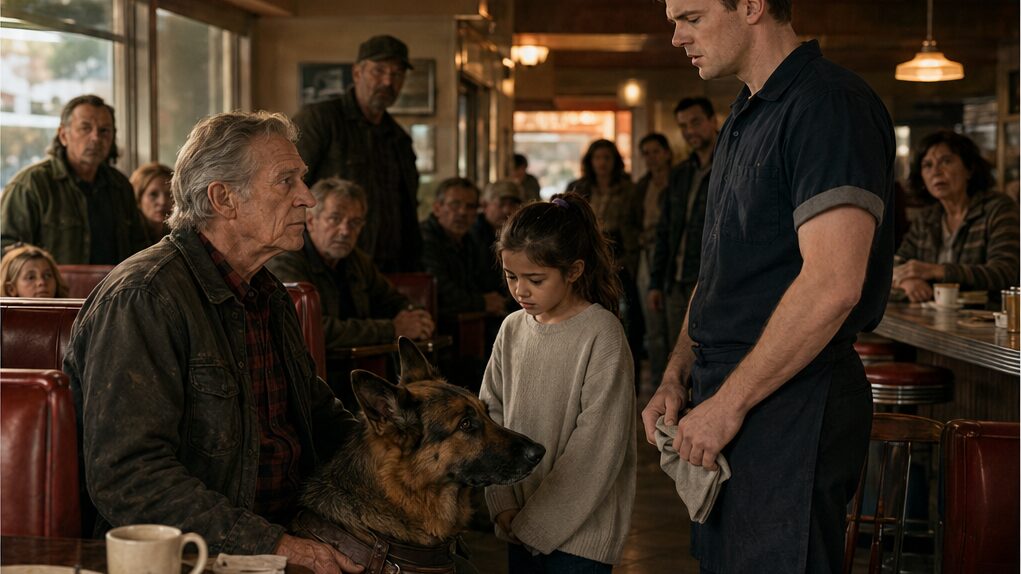
The German shepherd moved at his left knee, close enough that Samuel could feel the warmth of him through denim. The dog was large, black-backed, tan-legged, with a gray frosting around the muzzle that made him look older than his body allowed. He did not sniff the floor. He did not swing his head toward the grill or the dropped bacon near the counter stool. He watched the room once, calmly, then tucked himself into Samuel’s shadow.
“Close,” Samuel murmured.
The dog was already there.
Donna Walker’s diner had been built long before anyone worried about making places look old. The booths were real wood, rubbed smooth by elbows and winter coats. The pendant lamps over the counter glowed amber even in daylight. The air smelled of coffee, butter, hot metal, and the faint lemon cleaner Donna insisted on using before sunrise. A row of regulars sat along the counter like birds on a wire.
Samuel knew where the floor dipped near the third stool. He knew which booth had a loose spring. He knew the back corner smelled too strongly of mop water and that the booth beside the window let him see the door without turning his head.
That booth was empty.
It was almost always empty at seven minutes past six.
He reached it without hurrying. The shepherd turned with him, waited as Samuel lowered himself onto the worn red vinyl seat, then folded beneath the table with his body parallel to Samuel’s legs. Samuel’s left hand dropped, two fingers touching the leather harness strap before he reached for the laminated menu he did not need.
Coffee arrived before he opened it.
“Usual?” the waitress asked.
“Yes, ma’am.”
“Toast darker?”
“A shade.”
She smiled because that was the whole conversation and had been the whole conversation since late winter. “You got it.”
Samuel set the menu back behind the napkin holder. Through the window, morning traffic crawled past: delivery vans, pickups, a school bus with its yellow lights blinking at the corner. A man in a reflective jacket crossed against the light, carrying two paper cups stacked one above the other.
The shepherd’s ear flicked.
Samuel’s fingers returned to the harness strap.
“Easy.”
The dog settled, but Samuel felt the movement under the table, that small gathering of muscle that came before alertness became action. It was not fear. It was memory wearing a body.
Across the aisle, Paul Bennett sat in his regular seat with a plate of eggs cooling in front of him. He had a mechanic’s thick hands, though he had not owned the garage in years. He watched Samuel over the rim of his coffee cup, the way he often watched things he could not identify but did not intend to ask about.
At the counter, Ryan Miller moved too quickly for a room that had not fully woken up. He was young enough to believe speed solved most problems. He carried two plates in one hand, a coffeepot in the other, and a crease between his brows that deepened whenever the room filled.
Ryan’s eyes passed over the shepherd, stopped, then moved away.
Samuel saw it. He saw most things people hoped he did not see.
The young couple near the window booth leaned closer to each other. The woman whispered something. The man glanced down at the dog and gave a short laugh that did not make it all the way into sound.
The shepherd did not move.
Samuel unfolded his paper napkin and laid it across his knee. His hands were steady if he kept them doing something. Napkin. Spoon. Coffee cup. Sugar he would not use. Knife shifted one inch to the right. The small tasks gave the morning edges.
His breakfast came on an oval plate: two eggs, toast darkened a shade, hash browns crisp at the corners. The waitress placed a small bowl of water under the table without comment. Samuel looked up at her.
“Thank you.”
“Course.”
That was why he still came.
The dog drank only after Samuel tapped the edge of the bowl once.
The doorbell rang again. A gust of cool air entered with a delivery driver carrying boxes of paper cups. Behind him, half-hidden by the boxes, came Maria Walker.
She wore a pale sweater with sleeves too long for her hands and sneakers that made no sound on the tile. Her dark hair was pulled back with a purple elastic. She was young enough to stare openly and old enough to know she might be told not to.
“Stay by the counter,” Donna called from the register without looking up.
“I am,” Maria said, though she had already taken two steps away from it.
Donna Walker owned the diner in the way some people owned a house and some people owned a debt. She had inherited the place from her husband’s side, kept the old sign, replaced the grill twice, and refused to change the coffee brand even when the supplier raised the price. She could pour coffee, total a bill, correct a cook, and kiss the top of Maria’s head in one continuous motion.
Maria slipped onto a stool, but her eyes were on Samuel’s booth.
Samuel cut into his eggs.
The shepherd’s tail gave one slow movement beneath the table.
Maria saw it and brightened.
Children looked at the dog differently than adults did. Adults measured teeth, size, liability, inconvenience. Children saw a secret large enough to breathe.
Samuel kept his eyes on his plate.
“Grandma,” Maria whispered, much too loudly, “is that dog allowed to be in here?”
The room did not go silent then. It sharpened.
Donna glanced toward Samuel and then back at her granddaughter. “That dog is working.”
“What’s his job?”
“Maria.”
“I’m just asking.”
Samuel lifted his coffee cup and held it a moment before drinking. The coffee was too hot. He swallowed anyway.
The shepherd turned his head slightly, not toward Maria, but toward Samuel’s knee. Checking. Asking.
Samuel touched the harness strap.
“Fine,” he said under his breath.
Paul Bennett’s newspaper lowered another inch.
Ryan came from behind the counter with a wet cloth in his hand. “Maria, don’t bother customers.”
“I’m not bothering,” she said.
“You are when you ask questions across the room.”
Maria slid off the stool. Donna caught the movement too late.
“Maria,” Donna warned.
The girl stopped halfway between the counter and Samuel’s booth. She did not rush. That was the first thing Samuel noticed. She did not squeal, did not reach, did not make kissing noises the way grown women sometimes did before remembering themselves. She stood with her hands in the cuffs of her sweater and looked at the shepherd as if he were someone seated at the table.
“Can I ask him something?” she said.
A fork clicked against a plate somewhere behind Samuel.
He looked at her then.
Her face was open, but not careless. There was curiosity in it, and something gentler underneath. She had Donna’s eyes, dark and direct, but none of Donna’s practiced hurry.
Samuel set down his fork.
“You can ask me,” he said.
Maria’s gaze flicked from the dog to him. She took that correction seriously. “Is he still working if he’s under the table?”
Samuel’s hand rested on the harness, where the leather had softened and darkened from years of use. The metal tag lay flat against it, half-hidden by the dog’s fur. He felt the familiar notch along its edge.
“Yes,” he said. “Especially then.”
Maria leaned a little to see beneath the table, careful not to come closer.
The shepherd watched her. Calm. Waiting.
Ryan exhaled through his nose. “Maria, come on.”
But Maria did not move. She was looking at the tag now, at the worn metal catching the amber light from above the booth.
Samuel shifted his hand, almost covering it without meaning to.
Maria noticed that too.
“What does that say?” she asked.
Samuel looked down at the dog, at the gray around his muzzle, at the strap beneath his own hand.
The diner seemed to hold itself still.
On the tag, most of the lettering had been rubbed smooth by years of Samuel’s thumb. But two words remained clear enough for a child to read if she cared to try.
Maria bent her head.
“Stay close,” she sounded out.
Samuel closed his hand over the strap.
The shepherd’s ear flicked once.
Across the aisle, Paul Bennett put his newspaper down.
Chapter 2: The Child Asked Before the Adults Could Stop Her
Maria knew she was not supposed to stand in the aisle when breakfast plates were moving.
Her grandmother had rules for the diner the way other people had prayers. Do not block the counter. Do not touch the pie case. Do not bother customers who sit alone unless they speak first. Do not ask why someone uses a cane, why someone is crying, why someone has no hair, why someone talks to themselves, or why someone does not eat what they ordered.
But the dog had looked at her.
Not the way dogs in the park looked, all jumping hope and wet noses. This dog had looked once and then returned his attention to the old man as if Maria were a sound he had filed away for later.
That made him more interesting.
“Maria,” Ryan said again, sharper now.
She turned enough to see him standing beside the counter with the wet cloth twisted in one hand. His face had the look grown-ups wore when they were afraid of being embarrassed and wanted the nearest child to fix it.
“I’m not touching him,” she said.
“That is not the point.”
“What’s the point?”
A few people at the counter smiled into their coffee.
Ryan did not. “The point is, Mr. Carter is trying to eat breakfast.”
Maria looked back at the old man.
Mr. Carter. She had heard the name before, but only in pieces. Grandma said it softly to the waitress when he came in. Mr. Carter gets the window booth. Mr. Carter likes the toast darker. Don’t put the water bowl too close to the aisle for Mr. Carter’s dog.
The old man did not look like the kind of person anyone called Samuel. His face was lined deeply around the mouth and eyes, but not in a smiling way. His gray hair was combed back neatly, and he wore a red-and-black plaid shirt under a canvas jacket that had been mended at one cuff. His shoulders were still square, though his body had the carefulness of someone who measured each movement before spending it.
“I can go,” Maria said to him.
He looked at her for a moment.
The whole diner waited for his answer, even the people pretending not to.
“You already asked,” he said. His voice was low, roughened but not unkind. “Might as well finish.”
Maria took that as permission to stay exactly where she was.
Her grandmother made a small sound behind the counter, not quite relief, not quite warning.
Maria pointed to the tag, then remembered pointing was rude and lowered her hand. “Why does it say stay close?”
Mr. Carter’s fingers moved once over the leather strap. The dog’s eyes lifted toward him.
“It’s a command,” he said.
“For him?”
“For both of us, some days.”
Maria thought about that. Adults often said things that meant more than they were willing to explain. Grandma said we’ll manage when the freezer bill came. The cook said long night when his eyes were red. Ryan said all good when it was not.
“Did you teach him?”
Mr. Carter looked toward the window. Morning light had moved across the table and touched the edge of his plate. His eggs were getting cold.
“No.”
The answer was so small that Maria almost missed it.
The dog shifted under the table, his front paw moving over Mr. Carter’s boot.
Mr. Carter’s hand left the harness and touched the dog’s head once, not petting, not exactly. More like checking that something real was still there.
“Who did?” Maria asked.
“Maria,” Donna said, leaving the counter now.
But Mr. Carter lifted his eyes, not to Donna, but to Maria.
“A man who needed him to remember it,” he said.
No one moved for a second.
Maria felt the sentence enter the room differently from other sentences. It did not ask anyone to feel sorry. It did not explain enough to let them understand. It just sat there, heavy and plain.
“Was he your friend?” she asked.
Mr. Carter’s jaw tightened.
Ryan stepped forward. “Okay. That’s enough.”
Maria turned on him. “He said I could finish.”
Ryan glanced at Mr. Carter, then at the dog, then at the customers. “And now he needs to eat.”
“I’m not making him not eat.”
“You’re standing in the aisle.”
“So are you.”
Someone at the counter coughed into a napkin. Paul Bennett looked down at his plate, but Maria saw the corner of his mouth move.
Donna reached Maria and put both hands gently on her shoulders. “Honey, come help me count the jelly packets.”
Maria did not want to count jelly packets. She wanted to know why the old man’s hand looked almost afraid when it touched the dog’s harness. She wanted to know how a dog could be working while lying under a table. She wanted to know who had taught the command if Mr. Carter had not.
But Grandma’s hands tightened slightly, and Maria knew that meant later.
“I’m sorry if I bothered you,” Maria said.
Mr. Carter studied her face for a long moment. Adults often answered children too quickly, as if children were doors they wanted shut. Mr. Carter did not.
“You didn’t,” he said.
The dog’s tail moved once beneath the table.
Maria smiled before she could stop herself.
“Does he have a name?” she asked.
“Maria,” Ryan muttered.
Mr. Carter’s mouth changed. It was not a smile exactly. Something older, and sadder, and smaller.
“He knows who he is.”
Maria frowned, trying to decide whether that was an answer. “But what do you call him?”
Mr. Carter looked down.
“Close,” he said.
The dog lifted his head immediately.
Maria’s eyes widened. “That’s his name and his job?”
“Some names start that way.”
Donna turned Maria gently back toward the counter. “Come on now.”
Maria let herself be guided away, but she looked over her shoulder. Mr. Carter had picked up his fork again, but he was not eating. His other hand remained beneath the table, fingers curled around the harness strap.
At the counter, Donna gave Maria a basket of jelly packets and a look that said she had better count them in silence. Maria counted badly. Grape, strawberry, orange, grape, grape. Her eyes kept drifting back to the booth.
The diner’s noise returned slowly. Forks scraped. Coffee poured. The grill hissed as the cook pressed sausage patties flat. But something had changed, and Maria could feel it even if nobody said so. The room was now aware of Mr. Carter in a way it had not been before.
Not kindly, exactly.
Carefully.
That was different.
Ryan wiped the same clean patch of counter three times. Then he went to the register and spoke under his breath to Donna. Maria could hear only pieces.
“Complaints.”
“Health code.”
“Big dog.”
“Customers nervous.”
Donna’s voice stayed low. “He comes in every week.”
“That doesn’t mean—”
“He has never caused trouble.”
“I’m not saying he has.”
“You’re using the voice you use when you are.”
Ryan stopped wiping.
Maria sorted the jelly packets into crooked rows. She looked at the old sign taped near the front door. NO PETS ALLOWED. The letters were red and fading at the corners. She had seen the sign forever and never thought about it.
The dog was not a pet. Grandma had said so.
Maria turned a grape packet over between her fingers.
“What if people don’t know he’s working?” she asked.
Donna and Ryan both looked at her.
Donna softened first. “Then they should ask politely.”
Ryan’s face flushed. “Nobody’s being impolite.”
At the booth, Mr. Carter reached for his coffee. His hand trembled once before closing around the cup.
Maria saw it.
She also saw Ryan see it.
Ryan looked away too quickly.
A man near the door rose from his table and adjusted his coat, leaving half a pancake behind. As he passed the counter, he leaned toward Ryan and murmured, not softly enough, “You letting dogs in here now?”
Ryan’s shoulders stiffened.
Donna opened her mouth, but the man was already pushing through the door, making the bell ring hard.
The dog under Mr. Carter’s table lifted his head.
Mr. Carter’s hand dropped.
“Close,” he said, so quietly Maria felt more than heard it.
The dog settled.
Ryan stood very still. Then he took a breath, folded the wet cloth once, and walked toward the window booth.
Maria stopped counting.
Donna said, “Ryan.”
“I’m just going to talk to him.”
Maria watched Mr. Carter look up as Ryan approached. The old man’s face closed before Ryan even reached him, like a door shutting against weather.
Chapter 3: The Tag Ryan Almost Treated Like a Problem
Samuel knew the shape of a room before trouble entered it.
He knew by the soft collapse of conversation, by the way bodies leaned away from an aisle, by the air changing around men who thought themselves calm. He knew by the dog under the table, not moving but awake in every line.
Ryan Miller came toward the booth with empty hands.
That was something, at least. Men with empty hands sometimes wanted to be reasonable. Sometimes they only wanted both hands free for authority.
Samuel set his cup down carefully.
The coffee had cooled enough to taste bitter.
“Mr. Carter,” Ryan said.
Samuel waited.
Ryan glanced at the dog, then toward the counter, where Donna stood with one hand on Maria’s shoulder. The child watched with her mouth slightly open, one purple jelly packet still pinched between her fingers.
“I need to ask you something,” Ryan said.
“No,” Samuel said.
Ryan blinked. “Sir?”
“If you need to ask whether he bites, the answer is no. If you need to ask whether he belongs here, the answer is yes. If you need to ask whether I have papers, you’re asking the wrong way.”
A faint heat moved up Ryan’s neck. “That’s not—”
Samuel looked at him.
Ryan stopped, swallowed, started again.
“We’ve had a couple customers mention they’re uncomfortable.”
The dog breathed out beneath the table. Samuel felt it against his boot.
“Customers get uncomfortable,” Samuel said.
“Yes, sir, but with the breakfast rush, and the aisle being narrow—”
“This booth is where Donna seats me.”
“I understand.”
Samuel heard that phrase often from people who did not.
Ryan shifted his weight. “Maybe today, just today, we could move you to the back corner. There’s more room there, and the dog would be less…”
He did not finish.
Samuel did it for him. “Visible.”
Ryan’s eyes lowered. “Less in the way.”
The words landed cleanly. Not cruel. Worse, in a way. Ordinary. Practiced. The kind of words people used when they wanted an inconvenience to become smaller without having to name who had to shrink.
Samuel’s fingers found the harness strap.
The dog did not need the command. He stayed close.
Paul Bennett sat across the aisle, no longer pretending to read. Two men at the counter had turned their stools halfway. A young couple near the window watched openly now. Donna’s mouth was tight, but she did not interrupt. Samuel understood that too. Business made cowards of decent people in small, daily ways.
He slid his plate an inch away.
“I’ll go.”
Ryan looked startled. “That’s not what I said.”
“It’s what you meant.”
“No, Mr. Carter, I’m trying to find a compromise.”
Samuel took hold of the table edge. Standing from a booth required more planning than it once had. Knees first. Weight forward. Left hand steady. Do not grab for help. Do not let the room see the breath catch.
The dog rose with him in one smooth movement, shoulder brushing Samuel’s leg.
“Sir, you don’t have to leave.”
Samuel kept his eyes on the place where the window light struck the floor. “I know what I have to do.”
His hand closed on the harness strap as he stepped into the aisle.
Maria slipped from Donna’s hold.
“Wait,” she said.
Donna caught at her sleeve and missed.
“Maria, no.”
But the child was already in the aisle, not blocking Samuel exactly, but standing where he would have to see her.
“His tag is twisted,” she said.
Samuel’s grip tightened.
“It’s fine.”
“It’s caught under the strap.”
He looked down. She was right. When the dog rose, the old metal tag had flipped backward, its chain pulled half under the leather. It would rub if left that way.
“I can fix it,” Maria said.
“No.”
The word came harder than he intended.
The child froze.
The dog’s head turned toward Samuel’s hip.
Samuel closed his eyes once. Opened them. “No, thank you.”
Maria did not cry. That was something else he noticed. Her face changed, but she held herself still, as if she understood that the sharpness had not begun with her.
“Okay,” she said quietly. “I won’t touch it.”
Then, because she was a child and could not stop caring just because the room had become difficult, she leaned a little to read what the flipped tag showed.
“There are numbers on the back,” she said.
Samuel’s heart gave one hard beat.
Paul Bennett stood up.
It was a slow, uncertain movement, the way older men rose when their bodies objected and their consciences insisted. His chair scraped the tile.
“What numbers?” Paul asked.
Ryan turned. “Paul, please.”
But Paul’s eyes were on the tag. “Let me see.”
Samuel took one step back. The dog moved with him.
Paul lifted both hands slightly, palms out. “I’m not coming closer.”
For the first time that morning, Samuel looked directly at him.
Paul’s face had changed. The idle watchfulness was gone. In its place was something Samuel had not expected: recognition struggling through memory.
“Starts with MWD?” Paul asked.
The room lost its small sounds.
Samuel said nothing.
Maria looked from Paul to Samuel. “What does MWD mean?”
Paul lowered his hands. His voice came out rough. “Military working dog.”
Ryan’s face emptied.
Donna stopped moving behind Maria. The cook leaned into the pass-through window with a spatula in one hand.
Samuel felt the room tilt toward him. Not physically. Worse. With attention.
He had spent years avoiding that tilt.
The tag lay against the shepherd’s chest, dull metal, worn edges, old letters rubbed by Samuel’s thumb. MWD was still visible on the back if the light struck right. So were the first two digits of the service number. The rest had softened into scratches.
Maria whispered, “He was a soldier dog?”
Samuel looked down at her.
“No,” he said.
The disappointment on her face was immediate and innocent.
Samuel’s throat tightened. “He was never a soldier. He was a dog. Men gave him work. He did it better than most men would have.”
Paul bowed his head slightly.
It was not a salute. Not exactly. It was an old man correcting his posture before something deserved respect.
Ryan looked as if someone had taken the floor from under him. “Mr. Carter, I didn’t know.”
Samuel almost laughed. It would have come out badly.
“No,” he said. “You didn’t.”
Ryan’s mouth opened, closed. “I shouldn’t have—”
“No,” Samuel said again.
The single word held more than refusal. It held the edge of a boundary. Do not apologize loudly. Do not make this room watch you become better. Do not turn me into your lesson.
Ryan heard some part of it. His shoulders lowered.
“Yes, sir,” he said, but softly this time.
That word—sir—had been thrown at Samuel in many tones across his life. Mocking, automatic, fearful, respectful, careless. This one was uncertain. It was trying to become correct.
Samuel adjusted the tag himself. His fingers were clumsy for half a second, and he hated that the room could see it. The chain slipped, the tag turned, and the words STAY CLOSE faced outward again.
Maria read them silently.
The dog’s eyes stayed on Samuel.
Paul remained standing. No one at the counter spoke. Donna’s hands had folded together at her waist, the way they did when she wanted to fix something and knew a mop, a receipt, or a fresh pot of coffee would not do.
Samuel reached into his jacket pocket and took out a folded ten-dollar bill. He placed it under the edge of his plate, though he had barely touched the food.
Donna stepped forward. “Samuel, breakfast is on the house.”
That was worse than Ryan asking him to move.
Samuel looked at her. “I pay for what I order.”
Her face flushed, and he regretted the sharpness before it fully left his mouth. But he did not take it back. Pity was still a kind of handling.
Donna nodded once. “All right.”
He took one step toward the door.
The dog moved at his knee.
Maria’s voice followed him, small but steady. “Mr. Carter?”
He stopped.
She stood in the aisle with her hands at her sides now, no longer reaching for the dog, no longer reading the tag. Just standing there, asking permission with her stillness.
Samuel turned his head.
“If stay close was his job,” she said, “who stayed close to him?”
The question entered him before he could defend against it.
For a moment he was not in the diner. He was nowhere the room could follow. He heard wind against canvas, metal cooling after heat, a man’s voice turned thin by distance, and the hard breathing of a dog pressed against his side.
His hand dropped to the shepherd’s head.
The diner waited.
Samuel made himself breathe once. Then once more.
“He stayed closer than most people could,” he said.
No one answered.
That was good. If anyone had answered, he might not have made it to the door.
The bell rang when he pushed it open. Cool morning air touched his face. The shepherd stepped out with him, close as shadow.
Behind him, inside the amber-lit diner, Ryan Miller remained in the aisle, staring at the place where the worn tag had flashed in the light, as if a problem he had nearly solved had become a person he had not yet learned how to see.
Chapter 4: Donna Learned the Difference Between Quiet and Fine
Donna Walker waited until the door swung shut behind Samuel before she moved.
For a few seconds she stood in the aisle with one hand still half-raised, as if she could call him back by catching the air he had left behind. The bell above the door trembled once more and went still. Outside, Samuel’s shoulders passed the window, the shepherd close against his left side, both of them moving into the thin morning light.
No one in the diner spoke.
That was the worst part, Donna thought. Not Ryan’s mistake, not the customer’s complaint, not even the look on Samuel’s face when she had offered breakfast on the house. It was the silence afterward, the room pretending it had only watched something happen instead of helping it happen.
The cook was the first to break it. “Orders up,” he said, softer than usual.
Two plates slid into the pass-through and sat there steaming.
Donna turned back toward the counter. “Ryan.”
He looked at her like a man braced for something he deserved.
“In the office,” she said.
“I’ve got tables.”
“I’ve got tables. Office.”
Maria sat at the counter with the jelly packets lined in rows that made no sense. Her eyes followed Ryan as he passed. He did not look at her.
Donna picked up the two plates, delivered them, warmed coffee for three customers, and told the waitress to watch the register. Then she went into the back office, where Ryan stood beneath the old calendar with his arms folded tight across his chest.
The office was too small for anger. One metal desk, two filing cabinets, a shelf of receipt paper, a bulletin board crowded with schedules and supplier notices. Donna closed the door but did not slam it.
Ryan spoke first. “I was trying to handle a customer complaint.”
“You handled Samuel.”
His jaw flexed. “I didn’t know.”
“That he was military?”
“That the dog was—” He stopped. “Any of it.”
Donna leaned against the desk. The Formica edge pressed into her palm. “You didn’t need to know any of it to speak to him like a person.”
Ryan looked down.
She waited. Over the years, Donna had learned that people apologized too quickly when they wanted the apology to end the discomfort. She did not want his quick regret. She wanted him to stand inside the thing he had done long enough to recognize its shape.
“He scared people,” Ryan said finally, but the words had less force than before.
“Samuel?”
“The dog.”
“The dog was under the table.”
“People see a dog that size, they don’t think about training. They think about teeth.”
“And you saw an old man you could move.”
Ryan’s face reddened. “That’s not fair.”
“No,” Donna said. “It isn’t. But it might be true.”
He turned toward the bulletin board and stared at the staff schedule as if a better answer might be written there. “You know what happens when someone complains online. One picture, one caption, and suddenly we’re the place with dogs in the dining room.”
Donna laughed once, not because it was funny. “And what are we now?”
Ryan did not answer.
She opened the office door before she said anything else. “Go clear booth four. Then take ten minutes.”
“Donna—”
“Ten minutes. Not because I’m mad. Because you’re still trying to defend yourself.”
He moved past her without another word.
The diner had returned to sound, but not to normal. That difference mattered. The men at the counter were talking in lowered voices. Paul Bennett sat with his plate untouched, his newspaper folded square beside it. The young couple near the window had left cash on the table and gone. Samuel’s booth still held his plate, the eggs cold now, the toast darkened just as he liked it and barely bitten.
Donna went to clear it herself.
The ten-dollar bill was tucked under the plate’s edge. Exact enough to cover breakfast and coffee, with coins placed on top for tax. He had left no tip, then she found it beneath the napkin, folded once. Two dollars. Same as always.
That made her throat tighten more than if he had left nothing.
She lifted the plate. Beneath the table, on the booth’s wooden base, a thin pale scratch marked where the shepherd’s harness ring must have rested when he settled in. It was new, or else she had never noticed it before. A small mark. Nothing that mattered to business. A trace of him being there.
Donna touched it with her thumb.
For years Samuel had come in, sat at that booth, ordered the same breakfast, paid exact change, and left. She had thought of that as knowing him. She knew his toast. She knew he took coffee black. She knew he preferred the window and never complained when the room got loud. She knew the dog was trained because no animal that untrained could be so still.
But she had not known enough to protect him from her own staff. She had not known enough to protect him from her own hesitation.
At the counter, Maria had stopped pretending to count jelly.
“Grandma,” she said when Donna came near.
“Not now, honey.”
Maria’s small mouth pressed together, then opened anyway. “He looked scared.”
Donna almost corrected her. Samuel Carter had not looked scared. He had looked stern, guarded, offended, tired. Men like Samuel did not look scared in public because the world had taught them long ago what that cost.
But Maria went on before Donna could speak.
“Not when I asked him questions,” she said. “Not when Mr. Ryan told him to move. After everyone got quiet. After Mr. Paul said what the letters meant. That’s when he looked scared.”
Donna set the dirty plate in the bus tub.
Maria picked at the edge of a grape jelly packet. “Maybe he didn’t want everybody to know.”
The child had said it so plainly that Donna felt ashamed of every complicated adult reason she had been building around the moment.
“I think you may be right,” Donna said.
“Then why did everybody stare?”
Because people stared at pain when it arrived wearing a uniform they recognized. Because they thought respect meant attention. Because they did not know how to lower their eyes without turning away.
Donna did not say that.
“I don’t know,” she told Maria.
Paul rose from his booth and came to the register, bill in hand. He had his cap tucked beneath one arm.
Donna took the check. “You don’t have to say it.”
“Wasn’t going to.”
She looked up.
Paul placed cash on the counter. “I sat there every morning with that man across from me. Never asked his name beyond what you called him. Never asked about the dog. Never did much of anything except wonder why he looked like a locked door.”
Donna counted the bills because her hands needed something to do. “People have a right to be private.”
“They do.” Paul put his cap on. “But privacy ain’t the same thing as being invisible.”
He left before she could answer.
That sentence stayed with her through the lunch shift.
By noon, the diner was busy enough to force motion over thought. Donna refilled ketchup bottles, approved the delivery invoice, called the supplier about coffee filters, and corrected the cook when he tried to stretch yesterday’s soup one day too far. Ryan worked quietly, too quietly, taking orders with a politeness so stiff it made people glance at him twice.
He did not mention Samuel.
Neither did Donna.
At three, when the last lunch table had cleared and the waitress was wiping salt from the counter, Donna went to the front door and looked at the red-lettered sign taped inside the glass.
NO PETS ALLOWED.
It had been there for years. A simple thing. A necessary thing. Health rules, customer comfort, common sense. She had never thought about how harsh the red letters looked when someone entered with an animal that was not a pet.
Maria came to stand beside her.
“Are you taking it down?” she asked.
Donna touched the corner of the tape but did not pull it. “Not yet.”
“Why?”
“Because if I take it down before I know what to put up instead, I’m just trying to feel better.”
Maria considered that. “Can we put up one that says working dogs can come in?”
“Yes.”
“Can we put please?”
Donna smiled faintly. “We can put please.”
Maria leaned her shoulder against Donna’s side. “Will Mr. Carter come back?”
Through the glass, the street looked ordinary: cars at the light, a delivery truck idling, a woman crossing with a grocery bag hooked over her wrist. Samuel was nowhere in sight. Of course he wasn’t. Men like him knew how to disappear without making it look like leaving.
“I don’t know,” Donna said.
That evening, after the diner closed, she wiped Samuel’s booth herself. She cleaned the window ledge, refilled the sugar packets, and set the napkin holder straight. The pale scratch beneath the table remained. She could have polished it out if she wanted to. Instead she left it alone.
Some marks, she thought, were not damage.
Some were evidence that a place had failed to make room and had been given a chance to learn.
Chapter 5: Paul Remembered the Numbers Nobody Else Could Read
Paul Bennett had spent forty-three years listening to engines confess.
A loose belt had a whine. A bad bearing had a growl. A failing starter gave its warning in clicks before silence. Men lied about what they had ignored. Machines did not. Machines told you exactly how long you had pretended not to hear.
On Tuesday morning, the diner sounded wrong to him.
It was not the grill or the coffeepot or the doorbell. Those kept their usual rhythms. It was the empty booth beside the window. It sat there cleaned and ready, its red vinyl shining under the pendant light, and every time the door opened, Paul looked up before he could stop himself.
Samuel did not come.
Neither did the shepherd.
Donna moved like she had slept badly. Ryan kept his eyes on his order pad. Maria was not there before school, which Paul was grateful for. He did not feel prepared to be seen clearly by that child again.
He ordered eggs and did not eat them.
The letters kept returning to him.
MWD.
Not because he had served in a war. He had not. His older brother had, briefly, and came home with stories he never told cleanly. Paul himself had spent a few years repairing trucks under contract at a depot where old equipment came in with markings, stencils, numbers, tags. He had seen enough crates, harnesses, and transport forms to know a system when he saw one.
Military working dog. He had said it in the diner as if naming a fact were harmless.
Now he was not sure.
After breakfast, Paul drove to the garage he no longer owned and parked behind the building where the new owner let him keep a workbench. The sign out front still carried his surname beneath a newer logo. He rarely looked at it. Names on buildings had less meaning once other men held the keys.
Inside, the air smelled of oil, rubber, and cold coffee. A delivery driver argued with a mechanic over a brake job. Paul nodded to both and went to his bench.
He took a paper napkin from his coat pocket.
On it, written in pencil beside a smear of egg yolk, were the letters he had seen on Samuel’s tag and the first two digits he thought followed them. MWD-27, maybe. Or MWD-21. The rest had been rubbed almost smooth.
Paul stared at the marks.
He had not meant to memorize them. He had only seen them because Maria had turned the room toward the tag and because light from the window had caught the metal at the wrong or right angle. Once seen, they would not leave him alone.
He opened the old metal toolbox beneath his bench. Inside, under a tray of sockets, was a packet of things he should have thrown away years earlier: warranty cards, faded photographs, a broken watch, his brother’s last postcard from overseas, and a maintenance badge from a military vehicle depot with Paul’s younger face laminated behind cloudy plastic.
He took out the badge.
The numbering systems were not the same. He knew that. But the feeling of the tag had been the same: official once, personal now. Something designed for inventory that time had turned into memory.
By ten, he had called the county veterans’ services office and hung up before anyone answered.
By eleven, he called again and asked a clerk a careful question.
“I’m not looking for records,” he said. “Not private ones. Just trying to understand an old tag I saw. Started with MWD.”
The clerk told him, politely, that they could not confirm anything about anyone’s service animal, service record, or military history.
“I’m not asking you to.”
“That is what it sounds like you’re asking.”
Paul rubbed a hand over his face. “Fair enough.”
The clerk softened slightly. “Military working dog tags, old equipment tags, unit tags—there are a lot of possibilities. Some are official. Some are commemorative. Some people have replicas made.”
“This one wasn’t a replica.”
“You can’t know that.”
Paul looked at the napkin. “No. I guess I can’t.”
When he hung up, he sat at the bench for a long time.
The problem with regret was that it wanted action, and action often wanted to become interference. Paul had lived long enough to know the difference between helping and handling was not always clear from the helper’s side.
He drove back to the diner after lunch.
Donna was behind the counter, polishing the pie case with more force than glass required. Ryan was in the back. The old red sign still hung on the door, but one corner had been loosened from the tape.
Paul sat at the counter and placed the napkin in front of Donna.
She looked at it. “What’s this?”
“What I saw.”
Donna read the pencil marks. “You wrote it down?”
“After. From memory.” He tapped the napkin. “Might be wrong.”
“Paul.”
“I know.” He took off his cap. “I know it isn’t my business. But I said those letters out loud in a room full of people, and his face—” Paul stopped. He was not a man given to describing faces. “It cost him something.”
Donna folded her arms. “I was going to go by his house.”
Paul looked up sharply. “You know where he lives?”
“He pays by check on holidays when he buys pies. Address is in the receipt file.”
“Is that a good enough reason to use it?”
Donna’s expression tightened. For a second he thought she might tell him to mind his own business, which would have been fair.
Instead she looked toward the window booth. “No. But I’m going anyway.”
Paul nodded slowly. “Then go to apologize. Not to ask.”
“I know that.”
“Do you?”
She looked back at him.
Paul held her gaze. He had known Donna long enough to risk her anger. “Because I don’t think any of us knew the difference yesterday.”
Donna’s eyes shone briefly, then hardened back into usefulness. “Maria wants to come.”
“No.”
“She’s the only one he answered without looking like he wanted to leave the room.”
“That doesn’t mean she gets to carry grown people’s guilt.”
Donna looked toward the kitchen door. “She said he listened better when nobody pushed him.”
Paul had no answer for that.
The bell rang, and two customers came in. Donna served them coffee, took their orders, and moved through the small tasks that kept people from falling apart in public. Paul remained at the counter with his hat in his hands.
Ryan emerged from the back carrying a crate of clean mugs. When he saw Paul, he slowed.
“Morning,” Ryan said, though it was afternoon.
Paul nodded.
Ryan set the mugs down one by one. “He come in?”
“No.”
Ryan swallowed. “Right.”
Donna returned and picked up the napkin. “I’m going after closing.”
Paul reached for it, but she held it away.
“I don’t need that,” she said. “He’s not a puzzle.”
“Then why keep it?”
She looked at the penciled letters. Her thumb brushed the edge of the napkin, careful not to smear them. “Because it reminds me not to pretend I didn’t see what I saw.”
Ryan stood very still.
Paul put his cap on. “If you see him, tell him…” He stopped.
Donna waited.
Tell him what? That Paul was sorry he had made the room stare? That he recognized three letters but had failed to recognize the man across from him for years? That his brother used to wake up shouting and nobody in the family had known how to lower their voices then either?
“Tell him nothing from me,” Paul said at last. “Not yet.”
Donna nodded, understanding more than he had said.
That evening, Paul drove home by the long road. He passed the elementary school, the closed hardware store, the little war memorial near the courthouse with names etched into stone. He had walked past that memorial a thousand times and mostly thought about parking.
At a red light, he saw a man crossing with a cane, slow and stubborn against the countdown signal. The driver behind Paul honked when the light changed. Paul did not move until the man reached the curb.
The honking came again.
Paul looked in the rearview mirror and said, to no one who could hear him, “You can wait.”
At home, he placed his brother’s postcard on the kitchen table beside the napkin he no longer had. The postcard showed a desert sunrise faded to pale orange. On the back, in writing cramped by haste, his brother had written only three sentences. The last one had never made sense to Paul when he was young.
Some things follow you home because they did their job right.
Paul sat with that sentence until the room went dark.
Chapter 6: The Porch Where the Shepherd Did Not Bark
Samuel saw Donna Walker’s car before it turned into his driveway.
The shepherd saw it first, of course. His head lifted from the porch boards, ears angling toward the road. He did not bark. He rarely barked unless a sound cut wrong through the air or Samuel’s breathing changed too quickly.
Samuel sat in the old metal chair beside the front door, a cleaning cloth across one knee and the harness tag in his left hand. Without the tag, the leather strap looked unfinished, almost indecent. The dog lay close enough that one paw touched Samuel’s boot.
“Easy,” Samuel said.
The dog lowered his head but kept watching the car.
Donna parked near the mailbox. She did not get out right away. Through the windshield, Samuel saw her hands on the steering wheel, saw the shape of Maria in the passenger seat beside her.
He should have gone inside.
He did not.
There were reasons to avoid a conversation and reasons to sit still through one. At seventy-four, Samuel had learned that the body often knew which was which before pride did.
Donna stepped out first. She wore a cardigan over her diner shirt, and her hair was pulled back loosely, as if she had closed in a hurry. Maria came around the other side holding something in both hands. Not flowers. Thank God. Samuel did not know what he would have done with flowers.
They stopped at the bottom of the porch steps.
“Samuel,” Donna said.
He looked at her until she corrected herself.
“Mr. Carter.”
“That wasn’t the problem.”
Her face colored. “No. I suppose not.”
Maria looked at the dog, then at Samuel. “Hi.”
The shepherd’s tail brushed the porch once.
Samuel glanced down. “Traitor.”
Maria’s mouth twitched, but she did not laugh. That helped.
Donna clasped her hands in front of her. “I came to apologize.”
Samuel rubbed the cloth over the tag, though it was already clean. The metal was warm from his hand. “You could have done that at the diner if I’d come back.”
“You didn’t.”
“No.”
“I don’t blame you.”
“That makes one of us.”
Donna absorbed that without flinching. Maria looked between them, quiet now.
The evening had turned cool. Somewhere down the street a mower started, ran for five seconds, then died. Samuel could smell cut grass and the faint oil from the cloth. His porch needed paint. He had meant to do it in spring, then in summer, then not at all.
Donna took one step closer but did not climb the stairs. “Ryan was wrong.”
Samuel said nothing.
“I was wrong too,” she continued. “I let him speak because I was worried about complaints. I told myself I was being practical. But I was really hoping you would make the problem easier by accepting whatever we offered.”
“There it is,” Samuel said.
She nodded. “Yes.”
Maria held out what she had brought. It was a small paper bag from the diner, folded at the top.
Samuel did not reach for it.
“It’s not food,” Maria said quickly. “Grandma said not to bring food because you pay for what you order.”
Donna closed her eyes briefly.
Samuel looked at the child. “What is it, then?”
Maria opened the bag and took out a clean cloth napkin, the kind Donna used only for the holiday pie display. “For his water bowl. At the diner. If you come back.”
The simplicity of it unsettled him more than apology.
The dog lifted his head and sniffed once.
Samuel looked away toward the street. “You think a napkin fixes it?”
“No,” Maria said.
Donna’s hand moved toward her, but Maria kept going.
“I think maybe it means Grandma saved a place.”
Samuel looked at Donna.
She nodded once. “The booth is yours if you want it. Not in the back. Not hidden. Where you always sit.”
He turned the tag between his fingers. On one side, STAY CLOSE remained clear. On the other, MWD and the old number showed only when the metal caught light.
Maria noticed the tag in his hand.
“You took it off,” she said.
“To clean it.”
“Does he mind?”
Samuel looked down at the shepherd. The dog’s eyes were on him, patient and dark.
“He knows it comes back.”
Maria climbed one step, then stopped herself. “Can I ask something?”
Donna made a small warning sound.
Samuel almost smiled. “Seems to be your habit.”
Maria accepted that gravely. “Were you in the Army?”
The word moved through the evening without ceremony.
Samuel closed his fingers over the tag.
“Yes.”
Maria nodded as if he had confirmed something important but not surprising. “Was Close in the Army too?”
“No.”
She frowned. “But Mr. Paul said—”
“Paul said what he knew how to say.” Samuel leaned forward, elbows on knees. The dog shifted closer. “Close came from a military working-dog line. Before me, before this porch, before diners and water bowls. He was trained around men who thought dogs were equipment until the dogs proved otherwise.”
Donna stood very still at the bottom of the steps.
Samuel ran his thumb over the worn letters. “He wasn’t mine at first.”
“Whose was he?” Maria asked.
The mower down the street tried again, coughed, then caught.
Samuel watched a sparrow land on the mailbox and leave.
“A handler’s,” he said. “A younger man. Better with dogs than with people. He taught the command.”
“Stay close,” Maria whispered.
Samuel nodded.
There were stories people expected when they heard the word Army. Sharp uniforms. Flags. Clear courage. They did not expect mud in boot seams, paperwork that lost living things, quiet men sitting on cots trying not to shake, or a dog refusing to leave a place everyone else had been ordered to clear.
Donna’s voice was careful. “You don’t have to tell us.”
“I know.”
That was why he told only a little.
“The command was not for show. It meant stay within reach. Stay where a hand can find you if smoke gets thick. Stay where a man can remember which way is out.”
Maria’s face had gone solemn.
Samuel looked at her and softened his voice. “That is enough for tonight.”
She nodded quickly, as if afraid the wrong movement might close him completely.
Donna looked at the tag. “May I ask why you still use it?”
“You may ask.”
She waited.
He took his time answering. “Because some promises don’t end when the paperwork does.”
The dog pressed his paw more firmly against Samuel’s boot.
Donna’s eyes lowered to the movement. When she spoke again, her voice had changed. Not smaller. More careful.
“I’m sorry we made you feel you had to prove he belonged beside you.”
Samuel felt the old defensive answer rise: You didn’t make me feel anything. He could have said it. Once, he would have. But the dog’s paw was on his boot, the tag was in his hand, and Maria stood with the folded napkin like a child offering a flag no one had taught her how to fold.
“I’m tired,” he said instead.
Donna nodded. “We can go.”
“No.” Samuel looked at the tag. “I’m tired of proving it.”
The words left him quietly, but once spoken they seemed to use up all the air on the porch.
Maria’s eyes shone. She did not step closer. She had learned.
Samuel slipped the tag back onto the harness ring. His fingers fumbled with the small clasp. Age did that sometimes. Memory did it more. He hated both.
Maria looked at her shoes.
Donna looked toward the street.
Neither offered to help.
For that, Samuel was grateful.
When the clasp finally caught, the tag fell into place against the leather. STAY CLOSE faced outward.
The shepherd stood, shook once, and leaned against Samuel’s knee.
A figure appeared on the sidewalk beyond Donna’s car.
Ryan Miller stopped near the mailbox, breathing a little hard, as if he had walked fast and lost courage at the last yard. In one hand he held the red-lettered sign from the diner door.
NO PETS ALLOWED.
It was folded down the middle. The tape still clung to its corners.
Samuel’s face closed before he could stop it.
Ryan did not come closer.
“I’m not here to ask anything,” he said.
The shepherd watched him.
Samuel rested two fingers on the harness strap.
Ryan looked at the dog, then at the tag, then at the porch floor. When he spoke again, his voice was lower.
“I brought the wrong sign,” he said. “Thought you should know I finally figured that out.”
Chapter 7: The Sign Came Down Without a Speech
Ryan Miller had taken the sign down before dawn.
He had unlocked the diner while the streetlights were still on, before the cook arrived, before Donna’s car turned into the lot, before there was anyone around to tell him he was making too much of it or not enough. The glass door had looked different without the red letters.
NO PETS ALLOWED had left a rectangle of cleaner glass behind.
Ryan stood outside in the chill, staring at that ghost shape while traffic lights blinked over an empty intersection. In his left hand was the old sign, folded once down the center from where he had carried it to Samuel Carter’s porch and back again. In his right was the new one, printed at the copy shop before closing.
SERVICE ANIMALS WELCOME
PLEASE ASK STAFF IF YOU NEED ASSISTANCE
He had stared at the word welcome for a long time before paying. It was a simple word. The kind people put on mats, menus, church bulletins. It had never seemed difficult until he had to decide whether he meant it.
He taped the new sign to the glass, smoothing each corner carefully. Then he stepped back.
It did not fix anything.
That was the first useful thought he had all week.
The cook arrived at five-thirty and paused in the doorway. His eyes moved from the new sign to Ryan.
“You get permission?”
“From Donna, yes.”
The cook grunted. “From yourself?”
Ryan looked at him.
The cook pushed through with a crate of onions. “Never mind.”
By six, the coffee was brewed, the grill was warming, and the counter stools had been lowered off the tabletops. Ryan placed a clean water bowl behind the counter, not near the mop sink where the old chipped one had been, but on a shelf beneath the register. Beside it, folded neatly, was the cloth napkin Maria had brought back from Samuel’s porch after Donna had washed and pressed it.
He had nearly written Samuel’s name on a strip of tape and placed it on the bowl, then stopped himself. That would have been for Ryan, not for Samuel.
Donna arrived with Maria half-asleep beside her, her backpack dragging low from one shoulder.
The first thing Donna did was look at the door.
Ryan held still while she read the sign.
She said nothing for a moment. Then she nodded once. “Good.”
It should have relieved him. It did not.
Maria stepped closer to the glass and read it too. “You put please.”
“That was your idea,” Ryan said.
She looked at him with the unprotected directness of children who had not yet learned to make forgiveness comfortable. “Is Mr. Carter coming today?”
“I don’t know.”
“Did you ask him?”
“No.”
“Why not?”
Donna touched Maria’s shoulder. “Honey.”
Ryan shook his head. “No, it’s all right.” He took the old folded sign from beneath the counter and held it out. “I went to his house last night. I told him I brought the wrong sign.”
Maria considered him. “What did he say?”
“He didn’t say much.”
“That sounds like him.”
Ryan almost smiled and did not.
At six-forty, Paul Bennett came in. His eyes went to the new sign, then to the booth beside the window, then to Ryan.
“Morning,” Ryan said.
Paul took off his cap. “Morning.”
He sat at his usual booth across the aisle, ordered coffee, and unfolded his newspaper without reading it. Every time the bell rang, he looked up.
By seven, the diner was half-full. The breakfast rush had begun gathering its usual force: truckers with damp jackets, office workers watching phones, the young couple who had left early on Monday returning with cautious faces. Donna worked the register. Ryan moved between tables with a steadiness he did not feel.
At seven minutes past six, on other mornings, Samuel would already have been seated.
At seven-ten, the booth beside the window remained empty.
Ryan told himself not to watch the door. Then watched it anyway.
At seven-sixteen, the bell rang.
Samuel Carter stepped inside.
The room responded before Ryan did. Not loudly, not dramatically. But the shift moved through the diner like a hand smoothing a wrinkled cloth. Heads turned. Conversations thinned. Paul sat straighter. Donna looked up from the register and did not speak.
Samuel wore the same canvas jacket. His gray hair was combed back. The shepherd moved at his left knee, the worn harness fitted neatly, the tag resting against the leather.
Ryan’s mouth went dry.
He had imagined this moment too many times since Monday. In some versions he apologized. In others Samuel ignored him. In the worst one, the old man turned around and left before anyone could prove they had learned anything.
Samuel paused just inside the door.
His eyes moved to the new sign.
Ryan watched him read it.
No expression crossed the old man’s face, but his hand shifted slightly at his side, fingers brushing the dog’s harness as if marking the change without trusting it yet.
Donna spoke first, her voice even.
“Morning, Mr. Carter.”
Samuel looked at her. “Morning.”
Not warm. Not cold. Present.
The shepherd’s ears moved once.
Ryan stepped from behind the counter before he could rehearse another sentence badly. He stopped a few feet away, leaving the aisle clear.
“Mr. Carter,” he said.
Samuel’s eyes came to him.
Ryan kept his hands at his sides. No folded sign. No coffee pot. No prop for apology.
“Your booth is open if you want it,” he said. “There’s water behind the counter. I won’t bring it unless you ask.”
Donna glanced at him, and Ryan knew from her face that this was the first right thing he had said without being coached.
Samuel studied him.
The room waited.
Ryan felt the old urge to fill silence, to explain the sign, the bowl, the training sheet Donna had printed for staff, the way he had called the health department himself and asked what the correct wording should be. He wanted credit for effort. He wanted Samuel to know he had tried.
He kept his mouth shut.
At last Samuel gave one nod. “Coffee first.”
Ryan stepped back. “Yes, sir.”
The word came softly and did not ask to be noticed.
Samuel crossed to the booth. The shepherd followed, unhurried, passing the young couple near the window. The man shifted his chair back, then seemed to catch himself. Instead of pulling away, he tucked his feet under his own table and lowered his eyes to his plate.
It was a small thing.
Ryan saw Samuel see it.
At the booth, the old man lowered himself carefully. The dog turned once and folded beneath the table. The tag swung, catching the pendant light.
STAY CLOSE.
Maria had been watching from the end of the counter, her backpack forgotten beside her stool.
She whispered, “His tag is back.”
Ryan poured coffee into Samuel’s cup, leaving enough space at the top the way the waitress had shown him. He set it down without crowding the table.
“Toast darker?” he asked.
Samuel looked up.
Ryan held still.
“A shade,” Samuel said.
Ryan nodded. “A shade.”
He took the order to the kitchen and stood at the pass-through for a second longer than necessary.
“You breathing back there?” the cook asked.
“Trying.”
“Try while moving.”
Ryan moved.
The morning went on. Plates came out. Coffee cups emptied and filled. The doorbell rang and rang again. The new sign stayed on the glass, plain and unremarkable, doing its job without asking anyone to feel noble about it.
But not everyone read signs.
Near eight, a delivery driver came in with a stack of invoices and stopped short when he saw the shepherd.
“Thought you didn’t allow dogs,” he said.
The sentence was not loud, but it carried.
Ryan saw Samuel’s hand move toward the harness strap.
This time Ryan reached the driver first.
“He’s a service animal,” Ryan said.
The driver shrugged. “I was just saying.”
Ryan kept his voice low. “Then say it differently next time.”
The driver looked at him, surprised.
Ryan did not look toward Samuel to see if he had heard. That mattered. This was not a performance. It could not be.
The driver muttered something and went to the back.
Paul Bennett folded his newspaper and set it down.
Donna continued ringing up a customer, but the corner of her mouth changed.
Samuel did not turn around.
Beneath the table, the shepherd stayed close.
When Maria left for school, she passed Samuel’s booth with unusual care. She did not stop, though Ryan could tell she wanted to. At the door, she turned back.
“Bye, Mr. Carter,” she said.
Samuel lifted his coffee cup slightly. “Miss Walker.”
Maria smiled as if he had handed her something.
Then her eyes dropped to the dog’s harness, and her smile faded.
After the school bus carried her away, Donna found Ryan at the counter.
“Maria noticed something,” she said quietly.
“What?”
“The tag’s clasp is bent. She thinks it might come loose again.”
Ryan looked toward the booth. Samuel was cutting into his eggs. His left hand rested near the dog, not on the tag but close enough.
“Don’t say anything now,” Donna said.
“I wasn’t going to.”
She looked at him.
He gave a tired half-smile. “I’m learning.”
Still, for the rest of the morning, Ryan could not stop noticing the tag. The metal had been cleaned, but not polished. It carried its years honestly. The clasp did sit wrong, twisted where it joined the harness ring. One hard tug, one wrong catch on the booth edge, and it might fall.
At nine, Samuel stood to leave.
Ryan did not rush him. He did not offer to help. He only cleared the aisle by moving a chair that someone had left crooked.
Samuel noticed.
At the register, Donna rang him up. “Same as always.”
Samuel counted cash from his wallet. Exact bills. Coins. Then two dollars folded once.
Donna took it all without protest.
The shepherd waited at his knee.
As Samuel turned toward the door, Maria’s absence seemed suddenly visible, like the empty place where a question should have been. Ryan wondered if Samuel felt it too.
The old man stopped at the new sign before leaving. He looked at it again, longer this time.
Then he turned slightly toward Ryan.
“Better,” he said.
It was not forgiveness. It was not absolution. It was not enough to let Ryan stop thinking about Monday.
It was better than that.
It was a direction.
After Samuel left, Ryan went to the counter and picked up the folded old sign. He opened it once, looked at the red letters, then folded it smaller.
Donna watched him.
“What are you doing with it?” she asked.
Ryan slid it under the counter beside the staff training sheet and the clean cloth for the dog’s bowl.
“Keeping it,” he said. “So I remember what not to hang up again.”
Chapter 8: Stay Close Meant More Than Anyone Knew
By Friday morning, Samuel had decided twice not to go.
The first time was at five-thirty, when he woke before the alarm and lay still in the blue dark, listening to the shepherd breathe beside the bed. The house was quiet in the way old houses became quiet after years of holding one person’s routines. Refrigerator hum. Pipes ticking. A truck passing two streets over. Nothing urgent. Nothing requiring him to rise, shave, comb his hair, and walk back into a room that now knew one fact too many.
The second time was at six-fifteen, when he stood at the kitchen table with the harness in his hands and saw the bent clasp on the tag.
The tag had come loose in his palm.
Not fallen. Not lost. Just shifted free when he lifted the harness from its hook, as if the metal had grown tired of holding on.
The shepherd sat before him, watching.
Samuel turned the tag over.
STAY CLOSE.
The words were clearer after cleaning, but everything around them had thinned. The edge was worn smooth. The back side showed only MWD and the ghost of numbers. He could take it to the hardware store. He could buy a new ring, a new clasp, a new tag. He could have one engraved with cleaner letters.
He did none of that.
He put the old tag in his shirt pocket and clipped the harness without it.
The dog looked down, then back up.
“I know,” Samuel said.
The shepherd’s tail moved once.
At seven minutes past six, Samuel opened the diner door.
The bell rang.
This time the room did not go quiet all at once. It adjusted. That was the only word for it. A chair pulled in before the dog reached it. A man at the counter lowered his voice without looking around to see if anyone praised him for it. Ryan glanced up, nodded, and let Samuel cross the room before reaching for the coffee.
The booth beside the window was empty.
Samuel sat.
The dog folded beneath the table, but his chest looked bare without the tag. Samuel felt the absence as if something in the room were unbuttoned.
Donna came with coffee. “Morning.”
“Morning.”
Her eyes flicked once to the harness, then away. Good woman, Samuel thought. Learning.
“Usual?”
“Yes, ma’am.”
Ryan brought the water bowl, but stopped at the edge of the booth. “May I?”
Samuel looked at him. The young man held the bowl with both hands. Beneath it lay the clean cloth napkin folded into a square.
Samuel gave one nod.
Ryan set the cloth under the table first, then the bowl on top of it, far enough from the aisle that no one would kick it.
The dog waited.
Samuel tapped the bowl once.
Only then did the dog drink.
Ryan saw it and did not comment.
When he left, Samuel looked out the window. The morning traffic passed in pieces. A school bus sighed to a stop at the corner, its lights blinking red. Children climbed aboard with backpacks bouncing against their hips.
Maria would be here soon only if Donna had brought her early. Samuel found himself listening for her voice and was irritated by the fact.
His breakfast came. Toast darker by a shade. Eggs done right. Hash browns crisp at the edges.
Samuel ate half before the bell rang again and Maria Walker entered with Donna behind her.
Maria carried something in both hands.
Samuel saw it and set down his fork.
The shepherd lifted his head.
Maria did not come straight to the booth. She looked at Donna first. Donna looked at Samuel.
Samuel gave no permission. He gave no refusal.
Maria approached slowly.
“Good morning, Mr. Carter.”
“Miss Walker.”
She smiled at that, but only briefly. Her attention dropped to the dog’s harness.
“I noticed it was loose yesterday,” she said. “Grandma said I shouldn’t say anything in front of everybody.”
Samuel looked at Donna.
Donna held up both hands slightly from behind the counter, surrendering responsibility without quite denying it.
Maria opened her hands.
The tag lay on her palm.
For one disorienting moment, Samuel thought she had somehow taken the one from his pocket. His hand moved to his chest before he could stop it. He felt the metal there, still warm against him.
Then he saw.
This was not a new tag. It was his tag, but steadied. The bent clasp had been replaced with a small brass ring, dull rather than shiny. The metal had not been polished bright. The old scratches remained. The rubbed letters remained. Someone had cleaned only what needed cleaning and left the years alone.
Samuel’s throat closed.
Maria spoke quickly, perhaps mistaking his silence. “Mr. Paul knew a man at the hardware store who fixes watch chains. Grandma said not to make it look new. Mr. Ryan said not to ask unless you wanted it back. But I thought—” She stopped, took a breath. “I thought maybe Close should have his name and his job again.”
The diner had gone very still.
Not staring this time.
Listening.
Samuel looked at the tag in Maria’s palm. Then at Donna. Then at Ryan, who stood near the coffee station with his gaze lowered. Then at Paul Bennett across the aisle, hat on the table, hands folded around his cup.
“You all had a committee?” Samuel asked.
Maria’s face went pale with worry.
Then Samuel let the corner of his mouth move.
Paul gave a breath that might have been a laugh.
Donna covered her mouth and turned away, though not fast enough.
Maria’s shoulders loosened. “Kind of.”
Samuel held out his hand.
She placed the tag in it with great care.
The weight was nothing. Less than a key. Less than a coin. But it pulled through him all the same.
Samuel bent toward the dog. His fingers were not as steady as he wanted them to be. The new brass ring opened stiffly. He tried once and missed the harness loop.
No one moved.
He tried again.
Maria’s hands tightened against her sweater, but she did not offer.
Ryan looked at the floor.
Donna watched the coffee pot.
Paul stared out the window like a man guarding privacy by pretending not to see.
Samuel caught the ring through the leather loop at last. The tag dropped into place against the shepherd’s chest.
STAY CLOSE faced outward.
The dog stood, pressed his shoulder into Samuel’s knee, and held there.
Samuel rested his hand on the dog’s head.
The room remained quiet enough for the grill to sound loud.
Maria whispered, “Is that what the other man called him?”
Samuel looked at her.
There were many ways to refuse. He knew them all. A silence. A hard look. A change of subject. A small joke. He had used each one so often they were worn smoother than the tag.
But the child had returned the object without taking possession of the story. The room had made space without reaching for him. Ryan had corrected a stranger without making Samuel witness his improvement. Donna had let him pay. Paul had kept his questions folded behind his teeth.
Respect, Samuel thought, was not the same as being left alone.
Sometimes respect was room enough to choose what to say.
“No,” he said. “Close wasn’t his name then.”
Maria did not ask the next question. That was new.
Samuel ran his thumb over the tag. “The man who taught the command was a handler. Young. Too young to sound as tired as he did. He had a way of speaking to dogs like he was asking, not ordering.”
The shepherd leaned heavier against him.
“We were not friends at first,” Samuel said. “I was older. Set in my ways. He thought that was the same as wise. I thought his kindness made him careless.”
Paul’s eyes lowered to his cup.
Samuel did not look at anyone too long. If he did, the room might sharpen again.
“One night,” he continued, “things went wrong. Not in a way that makes a good story. Just wrong. Noise. Smoke. Men calling out and not hearing answers. The kind of dark where your own hands don’t seem attached to you.”
Maria’s face had become very still.
Donna’s hand rested against the register.
“The handler was hurt. The dog would not leave him. Orders came. Then other orders. Men shouted. The dog stayed. He kept pressing himself where a hand could find him.” Samuel swallowed once. “The handler kept saying the same thing. Stay close. Stay close. Not loud. Just enough for the dog. Maybe enough for himself.”
The tag warmed beneath Samuel’s thumb.
“I got to them because of the dog,” he said. “Not because I was brave. Because the dog knew how to stay where a man could still be found.”
No one spoke.
Samuel looked down at the shepherd. “The handler did not come home the way he left. The dog did not understand paperwork. He understood the last thing he was told.”
Maria’s eyes shone, but she did not wipe them.
“Is that why you kept him?” she asked.
Samuel breathed out slowly.
“That is why I made sure he was not treated like equipment when the paperwork was done.” He touched the dog’s ear. “And why, on bad mornings, he makes sure I am not treated like something left behind either.”
Ryan turned away slightly.
Donna did not.
Samuel looked at the young man. “You were wrong Monday.”
Ryan faced him. “Yes, sir.”
Samuel held his gaze. “You will be wrong again about somebody. Different way, maybe. Different person. Try to notice sooner.”
Ryan’s face tightened, not with shame this time, but with the weight of being trusted with a harder instruction than apology.
“I will,” he said.
Samuel believed he meant it. He also knew meaning it was only the first day of anything.
Maria stepped back from the booth. “Can I say hi to him now?”
Samuel looked down at the dog. The shepherd looked up at him, calm and patient.
“Ask him,” Samuel said.
Maria bent slightly, hands at her sides. “Close?”
The dog’s ears lifted.
She smiled. “Hi.”
The shepherd’s tail brushed the floor once.
That was all. No petting. No reaching. No scene made larger than it needed to be.
Across the aisle, Paul slid out of his booth. For a second Samuel thought he might come over, might say something about service or sacrifice or country, something too large for the space between tables.
Instead Paul picked up the chair nearest Samuel’s booth, the one customers always left crooked in the aisle, and tucked it properly under its table.
Then he sat back down.
Samuel looked at him.
Paul nodded once.
Samuel nodded back.
The diner began to breathe again. The cook called an order. Coffee poured. The young couple near the window argued quietly over who had stolen whose toast. The delivery driver came through the back and, seeing the shepherd, stopped himself before speaking. Ryan looked at him. The driver read the new sign, then kept walking.
Donna came to the booth with the check when Samuel had finished. She placed it facedown beside his cup.
“Same as always,” she said.
Samuel reached for his wallet.
Maria, from the counter, looked as if she wanted to object. Donna touched her shoulder before she could.
Samuel counted the bills, the coins, and the two-dollar tip. He placed them on the check.
Then he remained seated.
Outside, sunlight moved over the window glass. Beneath the table, the dog rested his head on Samuel’s boot. The repaired tag lay against the harness, old and steady.
Samuel looked around the room.
No one applauded. No one stood. No one saluted. No one tried to turn him into a lesson they could tell at dinner.
Donna wiped the counter near the register. Ryan refilled coffee without interrupting conversations. Paul read the same paragraph of his newspaper three times. Maria sorted jelly packets into careful rows.
The booth beside the window held him without asking him to explain why he deserved it.
Samuel set his hand near the tag, not covering it this time.
“Close,” he said quietly.
The dog did not need to move.
He was already there.
The story has ended.