They Laughed When The Old Navy Mechanic Touched The Pipe, Until The Whole Ship Went Quiet
Chapter 1: The Old Man In The Blue Work Jacket
Raymond Bennett had learned a long time ago that ships did not like to be rushed.
Men did. Officers did. Contractors did. Inspection teams did. A schedule printed on clean paper could pretend a vessel was made of checkboxes and signatures, but a ship had its own habits. It complained in small ways before it failed in large ones. It clicked. It sweated. It warmed in the wrong places. It gave a man one good warning, sometimes two, and then it made him pay for not listening.
The gangway trembled faintly beneath Raymond’s boots as he stepped aboard the training vessel just after 0700. The morning air off the pier carried diesel, salt, wet rope, and the sharp tang of fresh paint. Someone had touched up the rails recently. The gray looked too clean in the places hands did not usually rest.
Raymond noticed that first.
Then he noticed the young sailor at the quarterdeck glancing at his blue work jacket and not at his face.
“Civilian maintenance?” the sailor asked.
“Consultant,” Raymond said.
The sailor looked down at the clipboard. “Name?”
“Raymond Bennett.”
The pen moved. The sailor found the line, checked it, and passed him a temporary badge with a red plastic clip. “Engine spaces are two decks down. Lieutenant Carter is expecting you.”
Raymond took the badge. His fingers were thick at the knuckles, slow on cold mornings, but steady. “Much obliged.”
The sailor gave him the polite half-smile people used when they thought an older man was being formal because he did not know how to be casual. Raymond clipped the badge to his jacket and went below.
The ladderwell smelled more like a ship. Hot metal. Old insulation. Coffee carried in paper cups where coffee was not supposed to be. The hum strengthened as he descended, layer by layer, until it settled against his ribs. He paused at the landing to let a young mechanic hurry past with a tablet tucked under one arm.
“Sorry, sir,” the mechanic said, already gone.
Raymond did not correct the sir. He had been called worse by better men and better by worse men.
At the lower passageway, the overhead fluorescents flickered once. Not much. Just a brief flutter in the white light, like an eyelid fighting sleep. The ship’s ventilation pushed warm air across his cheek. He turned his head toward the sound beneath it: pump rhythm, fan noise, a far-off hydraulic whine, the layered song of a vessel pretending to be calm.
A woman’s voice cut through it.
“Mr. Bennett?”
She stood outside the engine-room access, dark navy uniform sharp enough to make the rest of the passageway look worn. Young, but not careless. Her hair was pinned tight, her eyes moving constantly, taking inventory even while she greeted him.
“Lieutenant Nicole Carter,” she said. “Thank you for coming aboard.”
Raymond shook her hand. Firm grip. Dry palm. In a hurry, but trying not to show it.
“You’ve got inspection today,” he said.
Her expression changed by almost nothing. “Readiness review. Initial walk-through starts at 1600.”
“Then nobody slept much.”
That earned the ghost of a smile. “Some of us tried.”
Behind her, a young man in a tan uniform stepped out of the engine room with a tablet in his hand. His sleeves were neatly rolled, his posture clipped, his eyes bright with the burden of having something to prove.
“Lieutenant, pump variance is back inside tolerance,” he said, then looked at Raymond. “This him?”
Nicole’s chin tightened slightly. “This is Mr. Bennett. He’s here for the legacy cooling assembly review.”
The young man shifted the tablet under his arm and offered a quick hand. “Ensign Ryan Miller. Engineering.”
Raymond shook it. Ryan’s grip was strong and brief, the kind that ended before respect had time to enter it.
“Raymond Bennett,” he said.
“We appreciate the help,” Ryan said, in a tone that made help sound like something harmless brought in after the real work was done.
Raymond looked past him into the engine room.
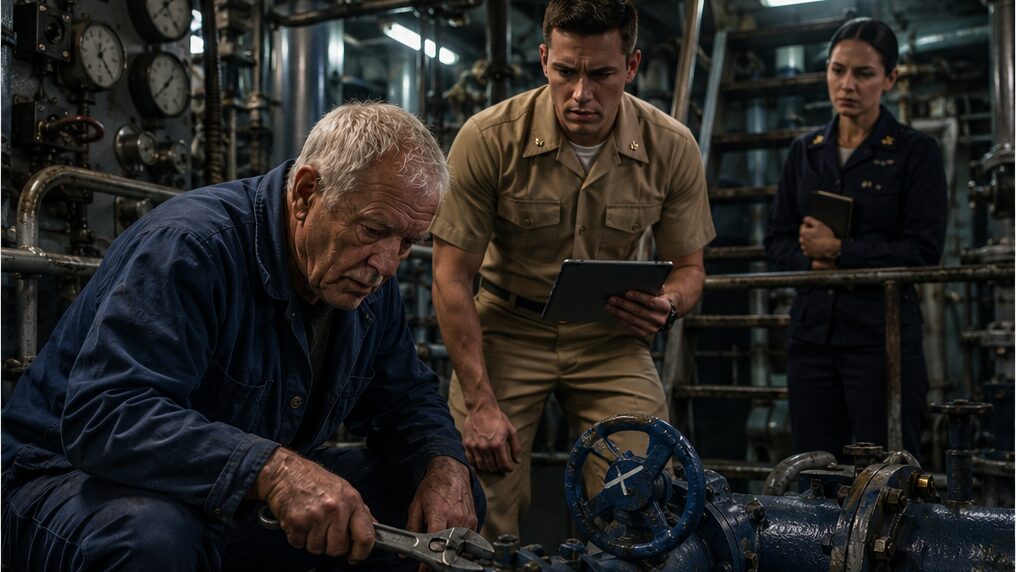
It was narrow and bright and crowded with the necessary ugliness of old systems kept alive by discipline. Pipes ran along the bulkhead in painted lines: red, blue, gray, yellow. Valve wheels sat at shoulder height and knee height, some polished by use, others dulled by time. Gauges trembled in their housings. A metal rail guarded a lower platform where the cooling bypass assembly cut across like a stubborn thought.
He felt his body remember before his mind named anything.
The angle of the line.
The old-style flange.
The little sweating ring around a downstream joint somebody had wiped but not dried.
Raymond took one step into the room and stopped.
Ryan continued, “We had a variance on the secondary pump earlier, but it’s been reset. Sensor drift, most likely. We’ve already logged it.”
“Logged it,” Raymond repeated softly.
Nicole heard the tone. Ryan did not.
“That assembly’s older than most of the crew,” Nicole said. “Shipyard still had your name on the consultant list for this class. Patricia Hayes said you’d worked around similar systems.”
“Patricia remembers too much,” Raymond said.
“She said you were the person to ask.”
Ryan glanced at the tablet. “Mostly we need sign-off that the legacy components don’t require inspection delay.”
There it was. Not what do you see, Mr. Bennett? Not what do you hear? Just sign the old thing and help us keep moving.
Raymond walked toward the cooling line. He did not go fast. His right knee disliked ladders now, especially in damp weather. He kept one hand near the rail, not quite touching it until he needed to. That was another thing young men noticed and misunderstood: the hand near the rail. They saw weakness. They did not see economy.
The pump housing carried a faint warmth. Normal. The gauge above it bounced within tolerance. Also normal, or willing to look normal. A newer diagnostic unit had been mounted beside an older pressure dial, and the two disagreed just enough to be interesting.
Raymond crouched.
The movement took him longer than it once had. He felt Ryan watching the stiffness of it. He felt Nicole watching Ryan watch. Raymond reached into his jacket pocket and closed his fingers around the old wrench he had carried from the tool locker on the pier. Not regulation for ship’s crew, not elegant, not digital. Just a fifteen-inch steel wrench with the handle worn smooth where his palm knew it.
He held it loosely and leaned toward the pipe.
The ship hummed around him.
He did not touch the line yet. He let his ear sort the layers. Air. Pump. Fan. Electrical buzz from the overheads. A low rattle from a loose bracket somewhere aft. Nothing urgent. Nothing dramatic.
Then, beneath the pump rhythm, something knocked once.
Not loud.
Not even enough for a young officer with a tablet to hear unless he was already listening for the kind of sound machines made when they were ashamed.
Raymond’s eyes moved downstream.
There.
Again.
A dry little tap inside the pipe, traveling the wrong direction.
Ryan said, “Mr. Bennett?”
Raymond lifted one hand slightly, asking for quiet without looking up.
The room did not go quiet, of course. Ships never did. But Nicole stopped shifting papers. Ryan stopped speaking.
The knock came a third time, faint and patient.
Raymond’s thumb moved along the wrench handle. The metal had warmed in his pocket. He could feel the old dent near the jaw, the one from a night forty years ago when he had dropped it into a bilge and cursed loud enough for a chief to threaten to wash his mouth out with hydraulic fluid.
“You hear that?” Raymond asked.
Ryan looked at the tablet, not the pipe. “The pump?”
Raymond did not answer right away.
He looked at the blue paint on the line. Fresh over old. He looked at the downstream valve wheel, where the paint had bubbled around the stem. He looked at the little wiped ring of moisture near the flange.
The fluorescent light flickered again.
Nicole said, “Hear what?”
Raymond shifted his weight and brought the wrench closer to the pipe, still not touching.
“Maybe nothing,” he said.
Ryan exhaled through his nose, quiet but not quiet enough. “We just cleared the variance.”
Raymond looked up at him then. The young man stood above him, tablet tucked against his side, shoulders squared, face controlled. Not a bad face. Not a stupid one. Just young enough to think clean information came from clean places.
Raymond lowered his gaze back to the pipe.
“Machines don’t care what we just cleared,” he said.
No one answered.
Somewhere above them, footsteps crossed the deck in a hurry. The ship kept humming. The old line knocked once more, and Raymond felt the sound more than heard it, a small wrongness traveling through metal.
He rested his hand on the rail.
The rail trembled under his palm.
Not from the pump.
Downstream.
Chapter 2: The Knock Was Not In The Pump
Ryan Miller opened the diagnostic panel with the confidence of a man who had been taught that every problem became manageable once it had a label.
“Secondary cooling pump,” he said, tapping the screen. “Intermittent variance at 0642, 0718, and 0736. All within recoverable range after reset. No sustained pressure drop. No thermal runaway. No alarm cascade.”
Raymond remained crouched near the line.
His right knee had begun to ache in a familiar, deep way. He ignored it. Pain was information too, but not the kind that mattered at the moment.
Nicole stood at the edge of the platform with her arms folded, though Raymond did not think she was trying to look severe. She was holding herself together around the schedule. The readiness review would have inspection officers in polished shoes walking through spaces where polished shoes had no business being. They would ask clean questions about dirty systems. They would want to hear certainty.
Ryan was offering it.
Raymond was not.
That was the trouble with old experience. It rarely arrived dressed as certainty. It came as doubt first. A prickle. A pause. A memory of a sound that did not belong.
Ryan turned the tablet so Nicole could see. “The software agrees. Pump response curve lagged, recovered after sensor reset. We can note it and move on.”
“Sensor reset doesn’t change a knock,” Raymond said.
Ryan lowered the tablet slowly. “Sir?”
Raymond disliked the sir more this time.
He shifted his grip on the wrench. “That knock isn’t in your pump.”
Ryan’s mouth tightened. “With respect, Mr. Bennett, we have a pressure trace and a pump variance. That’s the system talking.”
Raymond looked at the pipe. “It’s part of the system talking.”
One of the enlisted mechanics near the aft bulkhead glanced over, then quickly looked back at a panel that did not need his full attention. Raymond knew that look. Nobody wanted to be caught choosing between age and rank.
Nicole stepped down one rung onto the lower platform. “Where do you think it’s coming from?”
Ryan answered before Raymond could. “Lieutenant, we’re already inside the inspection window. If we open downstream checks now, we’ll need to log the delay.”
“I asked him,” Nicole said.
The correction was mild, but Ryan felt it. Color rose at the edge of his collar.
Raymond did not enjoy that. He had never liked watching young officers get dressed down in front of machinery. Machines remembered tension and punished distraction.
He lifted the wrench and placed the flat of it lightly against the pipe.
Ryan moved at once. “Please don’t strike the line.”
“I’m not striking it.”
“That assembly’s pressurized.”
“I know what pressurized means.”
The words came out flatter than Raymond intended. The room tightened around them. Nicole’s eyes moved from his face to the wrench, then to Ryan.
Raymond softened his hand. He set the wrench against the pipe not as a tool but as an extension of bone. Steel to steel. Handle to palm. He leaned close enough that the cold smell of paint and heat came up to meet him. He closed his eyes.
The pump ran. The line carried. The ship breathed.
There was the knock.
He did not chase the first sound. Young mechanics chased first sounds. First sounds lied. He waited for the second, then the third, measuring the space between them against the pulse in the line.
Tap.
Pause.
Tap-tap.
Not pump cavitation. Not bracket rattle. Not sensor chatter. A valve seat not fully returning. Downstream. A small obstruction, or a warped stem, or old scale breaking loose where the flow changed direction.
Raymond opened his eyes.
“That knock is downstream,” he said.
Ryan stared at him. “You can’t determine that from touching a pipe.”
Raymond almost smiled, but did not. “No?”
“No,” Ryan said, too quickly. “Not reliably.”
Raymond took the wrench away from the line. “Then don’t rely on me. Check the bypass valve.”
“We checked valve position during morning rounds.”
“You checked position?”
“Yes.”
“Not travel.”
Ryan’s jaw flexed.
Nicole looked toward the blue-painted line. “Explain.”
Raymond pushed himself up a few inches, then stopped, deciding it was better to stay where he was. The pipe ran just below eye level from his crouch. “A valve can show open and still not travel clean. If the stem sticks, you’ll get a delayed return under load. Small knock at first. Then heat. Then pressure hunts back through the line and makes your pump look guilty.”
Ryan held up the tablet. “The pump is the only component that logged variance.”
“The pump is the only component with a sensor that tattled.”
The enlisted mechanic at the bulkhead looked down to hide something like a smile.
Ryan caught it. “This isn’t about old-school versus new-school.”
“No,” Raymond said. “It’s about water going where metal lets it.”
For the first time, Nicole did not seem hurried. She looked at the valve wheel downstream, at the diagnostic unit, at the old pressure dial trembling in its casing. Her eyes paused on the place Raymond had noticed earlier, the wiped ring around the flange.
“Ensign,” she said, “when was the last full travel check?”
Ryan looked at the tablet, swiped once, then again. “Last documented check was during quarterly maintenance.”
“That wasn’t my question.”
He swallowed. “I don’t have a manual travel entry from today.”
Raymond stayed silent.
He had learned that silence could be a tool if a man did not use it to punish. He was not there to win. Winning against a young officer in front of his people was easy and usually useless. The ship did not care who won.
Nicole glanced at the bulkhead clock. “How long to check it?”
Ryan answered immediately. “If it’s just a visual confirmation—”
“Travel check,” Nicole said.
He hesitated. “Long enough to delay prep.”
There it was again. The schedule standing in the room like a fourth officer.
A call came over the engine-room speaker, clipped and slightly distorted. “Engineering, bridge. Confirm readiness status for 1600 inspection sequence.”
Nicole looked upward, though the speaker was behind her. “Engineering to bridge, still green. Minor review in progress.”
Ryan’s eyes flicked toward her.
Raymond heard what she had done. Not delayed. Not escalated. Green.
Nicole released the transmit button and looked at Raymond. For one breath, he thought she would ask him to show her. Not to prove himself, but to protect the ship.
Instead, she said, “Mr. Bennett, can this wait until after inspection?”
Raymond’s hand tightened around the wrench.
In another engine room, on another day, a question like that had come dressed differently. Can it wait until morning? Can it wait until we clear the exercise? Can it wait until the chief gets here? He had been younger then, strong enough to stand too fast and angry enough to think volume could carry truth where rank would not let it go.
He had learned otherwise.
“Everything can wait,” Raymond said, “until it can’t.”
Ryan looked away.
Nicole’s face remained controlled, but something in her eyes took the hit.
“I need a recommendation,” she said.
“My recommendation is to check downstream valve travel before you load the system.”
Ryan said, “That means we lose the window.”
Raymond looked at him. “Maybe.”
“Maybe?” Ryan repeated. “You want to delay a readiness review on maybe?”
Raymond used the rail to stand.
It took effort. He felt the knee catch, felt his back pull, felt the room watching the old body rise. Ryan saw it. The enlisted mechanics saw it. Nicole saw it. Raymond let them see. There was no dignity in pretending age had not taken what it had taken. The dignity was in knowing what remained.
He slipped the wrench back into his jacket pocket.
“No,” he said. “I want you to delay it because of the knock.”
Ryan’s face closed.
Nicole looked at the pipe one last time. Then she looked at the clock.
“Log pump/sensor variance,” she said finally. “Monitor during warm-up. No delay yet.”
Ryan nodded at once, relief disguised as professionalism. “Aye, Lieutenant.”
Raymond said nothing.
Nicole turned to him. “Stay aboard until the review?”
It was not quite a request. Not quite an apology.
Raymond looked at the downstream valve. The blue paint near its stem had bubbled in a crescent no wider than his thumb.
“I’ll be nearby,” he said.
Ryan entered the note into the tablet: pump/sensor variance.
Raymond watched the words appear. Clean letters. Wrong place.
Then he turned away from the panel and looked back at the valve, listening to the ship give its warning again, small and patient, as though it still believed someone might listen in time.
Chapter 3: The Inspection Clock Started Running
By 1130, Nicole Carter had three lists in front of her and none of them matched.
The official readiness checklist showed Engineering green except for two cosmetic paint discrepancies and one missing tag on a locker nobody would open during the walk-through. Ryan’s diagnostic summary showed a resolved pump variance with monitoring recommended. The handwritten notes in Nicole’s own small black notebook showed something less tidy.
Downstream knock?
No valve travel check this morning.
Bennett recommends check before load.
Inspection window risk.
She underlined risk once, then shut the notebook.
The engineering office was barely an office, more a metal closet with a desk bolted to the deck and two chairs that bruised whoever trusted them. A fan turned overhead with a faint wobble. Someone had taped a faded safety poster beside the door. The poster showed a smiling sailor pointing at a pressure gauge. Nicole had stopped seeing it months ago.
Ryan stood across from her with the tablet tucked under his arm again. He did that when he wanted to appear ready for anything.
“The variance hasn’t repeated since the reset,” he said. “Temperatures stable. Pressure stable. If we delay for a manual valve travel check, the captain will ask why we didn’t do it during morning rounds.”
“Because we didn’t think we needed it during morning rounds.”
Ryan’s eyes dropped. “I should’ve logged one.”
Nicole let that sit between them.
She did not want a confession. Confessions slowed things down and rarely repaired metal. But she needed him to hear the shape of the problem. The ship was old enough that small omissions collected weight. One skipped check was not a disaster. One skipped check covered by too much certainty could become one.
“Would you have checked it if Mr. Bennett hadn’t said anything?” she asked.
Ryan took half a second too long. “Not based on current readings.”
“That wasn’t my question.”
“No,” he said. “Probably not.”
Nicole nodded. It was the first useful answer he had given since the engine room.
A knock sounded at the open hatch. Patricia Hayes leaned in with a folder against her chest, civilian badge swinging from a lanyard. She wore shipyard boots and the expression of someone who had spent twenty years watching uniformed people discover that paperwork had edges.
“Bad time?” Patricia asked.
“Yes,” Nicole said. “Come in.”
Patricia stepped inside, glanced at Ryan, then at the tablet. “That kind of day.”
Ryan said nothing.
Nicole gestured to the folder. “Legacy cooling assembly?”
“And three signatures nobody wanted to admit they needed.” Patricia set the folder on the desk. “Raymond get below?”
“He did.”
Patricia waited.
Nicole opened the folder and scanned the top sheet. “You said he had experience with this class.”
“I said he knew the bones of it.”
Ryan shifted. “The system has been modified since his service period.”
Patricia looked at him long enough to make the room smaller. “So have I. Doesn’t mean I forgot how stairs work.”
Nicole almost smiled. Almost.
Ryan’s face reddened. Patricia did not press. She turned back to Nicole.
“I brought him because that cooling bypass was retrofitted from a design he worked on years ago. Not identical. Similar enough that when he frowns at a pipe, I usually make time.”
Nicole opened her notebook again despite herself. “He thinks the knock is downstream.”
“He heard a knock?”
Ryan said, “He felt a vibration through a wrench.”
Patricia’s gaze moved to him. “That’s how some people hear.”
The fan wobbled overhead.
Nicole looked down at the folder. Old diagrams, stamped revisions, faded signatures. There were notes in different hands, some neat, some hurried. The ship had lived through layers of decisions made by people who thought later crews would understand why. Later crews rarely did.
A call came through the desk speaker. “Lieutenant Carter, captain wants final status by 1300.”
Nicole pressed the button. “Acknowledged.”
The clock above the safety poster read 1138.
Patricia lowered her voice. “Do you need me to pull a shipyard mechanic for the travel check?”
Ryan answered, “We can handle our own system.”
Nicole looked up.
Ryan stiffened. “Lieutenant, I mean—”
“I know what you mean,” she said.
But she was not sure he did.
The ship had already failed one readiness review before Nicole took over the department. Not catastrophically. Not dramatically. Worse, in a way. It had failed through accumulation: missing tags, late logs, inconsistent pressure readings, junior crew who knew screens better than systems, senior crew who had transferred before teaching what the manuals did not say. Nicole had inherited the shadow of that failure. Every inspection since had felt like standing trial for someone else’s neglect.
She had promised herself this one would be clean.
Then an old man in a blue work jacket had crouched beside a pipe and made the ship feel complicated again.
“Where is Raymond now?” Nicole asked.
Patricia nodded toward the passageway. “Last I saw, lower platform. Cleaning that old wrench of his like it was silverware.”
Ryan’s mouth twitched, not quite a laugh.
Nicole saw it. “Ensign.”
He straightened. “Ma’am.”
“Go verify current temperatures manually at the downstream gauges. Not the panel. Gauges.”
Ryan hesitated only a fraction. “Aye.”
When he left, the office felt less crowded but not easier.
Patricia remained by the desk. “He rub you wrong?”
“Mr. Bennett?”
“Raymond.”
Nicole closed the folder. “No. That’s the problem.”
Patricia waited.
“If he were dramatic, I could dismiss it. If he were angry, I could call it pride. If he were confused, I could call it age.” Nicole looked toward the passageway. “He was none of those.”
“No,” Patricia said. “He usually saves anger for machines. People disappoint him too often to waste fuel.”
Nicole leaned back in the chair. The metal edge pressed into her shoulder blade. “Why isn’t he still teaching?”
Patricia’s answer came slowly. “Because institutions like old knowledge better after it’s written down by someone young.”
The words landed harder than Nicole wanted them to.
From below, through deck and bulkhead, came the steady hum of the cooling system. No alarm. No shout. No visible crisis. Just machinery doing what it had been told to do while an inspection clock ate the day in clean, official minutes.
The speaker cracked again.
“Engineering, bridge. We’re seeing a brief temperature flutter on secondary cooling. Confirm local?”
Nicole sat forward.
Patricia did not move.
The speaker hissed.
“Engineering, bridge. Did you copy?”
Nicole reached for the transmit button. Her eyes went to the notebook, to the underlined word she had tried to make smaller by shutting it away.
Risk.
She pressed the button. “Engineering copies. Local verification in progress.”
Her voice sounded calm.
Then she stood so quickly the chair struck the bulkhead behind her.
Chapter 4: The Valve Nobody Wanted To Check
Raymond found the downstream valve where the pipe bent under a nest of smaller lines and disappeared behind a panel that had been painted too many times.
He stood there alone for a while before anyone came looking for him.
The lower platform was warmer than it had been that morning. Not dangerous. Not yet. Just enough that the metal smelled different, as if old paint and insulation had begun to remember every hard run the vessel had ever made. Raymond rested his hand near the blue-painted line, not on it at first, letting the heat gather against his skin from a distance.
He had always trusted the space before the touch.
A ship told the truth in layers. The first layer was noise, the kind that made young sailors raise their voices. The next was rhythm. The deeper layer was what changed when no one admitted anything had changed.
He leaned closer.
The knock came again.
Tap.
Pause.
Tap-tap.
He closed his eyes, and for half a second the lower platform was gone.
He was twenty-six, sweat running down his spine, one hand braced on a bulkhead while a chief shouted over a pump that sounded wrong to everyone and meant wrong to nobody. Another ship. Another blue line. Another officer in a hurry. Raymond had been younger then, still carrying the hard belief that being right would matter as soon as he could prove it.
He had not proved it fast enough.
The memory did not arrive with faces anymore. That was mercy, maybe. It came with details instead: the black smear on a glove, a valve wheel that resisted by a quarter turn, the taste of metal dust when the ventilation hiccupped. It came with the quiet afterward, the awful quiet after men had stopped shouting because the machine had made the next decision for them.
Raymond opened his eyes.
The valve wheel in front of him looked innocent. Most dangerous things did, until they moved.
He took the wrench from his pocket and crouched. The knee complained sharply enough that he breathed through his nose and waited before settling his weight. The deck plate pressed its grid into the side of his boot. The overhead fluorescent flickered above him, bright-white, dim-white, bright again.
A younger mechanic appeared at the far end of the platform. “Mr. Bennett?”
Raymond glanced back.
“Lieutenant Carter wants local readings.”
“Tell her I’m at the downstream bypass.”
The mechanic hesitated. His eyes moved to the wrench. “Ensign Miller said not to disturb that assembly until he gets here.”
“I’m not disturbing it.”
The mechanic remained where he was, caught between order and instinct.
Raymond turned back to the valve. “You ever turn one of these under load?”
“No, sir.”
“Good. Don’t start today.”
The mechanic did not laugh. That was something.
Raymond set his fingertips against the valve stem housing. Warm. A little too warm. Not the angry heat of imminent failure, but the uneven warmth of friction hiding under flow. He moved his hand to the flange where he had seen the wiped ring earlier. Moisture had returned, thin as breath.
He rubbed it between thumb and forefinger.
Not clean condensation.
A trace of old residue.
He wiped his hand on a rag and studied the valve wheel. The paint around the stem had bubbled in a crescent. The kind of thing a man could explain away if he needed the day to go smoothly.
Footsteps came down the platform behind him, quick and controlled.
“Mr. Bennett.” Ryan’s voice. “Step back from the valve.”
Raymond did not move immediately. He placed the wrench flat on the deck beside his boot, not in surrender, not in challenge. Just so nobody could claim he had been careless with a pressurized line.
Then he stood, slowly.
Ryan arrived with the younger mechanic behind him and Nicole a few paces back. She was holding the black notebook now, not the tablet.
“Bridge saw a flutter,” Nicole said.
“I heard.”
Ryan crouched near the local gauge and checked it without touching the valve. “Temperature is within operating range. Pressure steady.”
“Gauge needle’s sticking,” Raymond said.
Ryan looked at him. “It’s vibrating.”
“No. It’s hesitating.”
Nicole stepped closer. “Difference?”
Raymond pointed, but did not touch the glass. “Vibration dances even. Hesitation catches before it moves. Watch the left edge.”
Ryan stared at the gauge. His impatience was visible in the set of his shoulders.
The needle quivered, rose a hair, paused, then settled.
“There,” Raymond said.
Ryan shook his head. “That could be normal line vibration.”
“It could.”
“You keep saying could.”
“Because I’m not guessing for sport.”
Ryan stood. “We have a readiness review in less than four hours. We cannot tear into a downstream valve because a retired consultant doesn’t like the way a needle moves.”
The platform went still.
The younger mechanic looked away.
Nicole said, “Ensign.”
But the word had already done what it came to do.
Raymond felt no surprise. That made it worse in a quiet way. At seventy-two, insults rarely arrived new. They just found old rooms inside a man and opened the door.
Retired consultant.
Not chief. Not machinist. Not sailor. Not even mechanic.
A retired consultant who didn’t like a needle.
He looked at Ryan for a long moment. The young man’s face showed anger, yes, but beneath it was fear. Raymond had seen that too. Fear wearing polish. Fear holding a tablet like a shield.
Raymond bent and picked up the wrench.
Ryan stiffened.
Raymond slipped it into his pocket.
“The valve’s not returning clean,” Raymond said. “You’ll see it under load.”
Nicole asked, “What happens if you’re right?”
“If it sticks halfway, your pump will hunt. Temperature will flutter. Then pressure starts chasing itself. Maybe you catch it. Maybe you damage the seat. Maybe you shut down and explain to the inspection team why green went yellow.”
“And if you’re wrong?” Ryan said.
Raymond turned to him. “Then you lose an hour checking a valve.”
Ryan’s mouth closed.
Nicole looked at the downstream assembly. Her notebook was open in her hand, but she had stopped writing.
Raymond saw the decision forming and failing inside her. He did not envy her. The machine was complicated, but command pressure was worse. A ship could forgive uncertainty if a person listened quickly enough. Careers often could not.
The speaker crackled above them. “Engineering, captain requests status update in ten minutes.”
Nicole reached for the wall handset. “Engineering copies.”
She hung it back in place and looked at Raymond. “How certain are you?”
Raymond disliked the question, though it was fair.
Certain had ruined many good sailors. Certain made men stand too close to spinning equipment, trust clean logs, ignore hot bearings, laugh at old warnings.
“I’m certain enough to check,” he said.
Ryan exhaled. “That’s not enough to delay.”
Nicole closed her notebook.
“We monitor through warm-up,” she said. “If the flutter repeats, we reassess.”
Raymond looked at the valve. Its wheel sat still, blue paint flaking at the rim.
“Warm-up may be when it tells you.”
Ryan answered, “Then we’ll be watching.”
Raymond nodded once.
There was nothing else to do without taking control that was not his to take. A civilian, a guest, an old man with a red badge clipped to his jacket. He could warn. He could not command.
Nicole started back up the platform. Ryan followed, already speaking into his radio about stable local readings.
The younger mechanic lingered.
Raymond looked at him. “You got a grease pencil?”
The mechanic blinked. “Yes, sir.”
“Mark the valve wheel at twelve o’clock. Small line. Nothing fancy.”
The mechanic hesitated, then pulled the pencil from his pocket and made a short white mark across the rim and housing.
“Why?” he asked quietly.
Raymond watched the mark settle into the blue paint like a secret.
“So if it moves,” he said, “somebody will know it moved.”
The mechanic swallowed and nodded.
A dry metallic pop came from inside the line.
It was small enough that Ryan, already halfway up the ladder, did not turn.
Raymond did.
Chapter 5: When The Ship Went Quiet
The live systems test began at 1450, ten minutes ahead of schedule, because the captain wanted inspection readiness confirmed before the inspection officer stepped aboard.
Raymond stood on the lower platform beside the downstream bypass and listened to the ship gather itself.
The old vessel did not roar. It tightened. That was the word Raymond would have used if anyone had asked him. The pump note deepened. The pipe tremor strengthened. Air pushed harder through the ventilation trunk overhead, carrying heat along the platform and making the fluorescent lights hum louder in their housings.
Nicole stood near the ladder with the handset in one hand and her notebook tucked under her arm. Ryan was at the diagnostic panel, his tablet connected by a short cable, watching clean lines crawl across the screen. Two enlisted mechanics waited by the pump housing with tools laid out too neatly on a rag.
Everyone had a place.
Raymond’s place, officially, was out of the way.
He did not mind out of the way. Some of his best work had been done there.
“Secondary cooling load increasing,” Ryan called. “Flow stable. Pressure stable.”
Nicole spoke into the handset. “Engineering to bridge. Secondary cooling stable at load step one.”
A pause. “Bridge copies. Continue to step two.”
Ryan glanced down at his tablet. “No variance.”
Raymond watched the white grease-pencil mark on the downstream valve wheel.
It had not moved.
Yet.
The pump tone rose another notch. The deck plates began a finer vibration through the soles of Raymond’s boots. He rested one hand on the rail. Not for balance this time. For information.
The line knocked.
Tap.
Pause.
Tap-tap.
The younger mechanic nearest Raymond heard it. Raymond saw his head turn slightly, then freeze.
Ryan did not look up.
“Temperature flutter,” Nicole said, eyes on the local gauge.
Ryan answered at once. “Within tolerance.”
“Bridge saw it too,” she said.
“Compensating.”
Raymond crouched before he decided to. His body chose the position because the pipe demanded attention. Pain flared through his knee; he set it aside. He took out the wrench and touched the handle to the line.
The knock sharpened through the steel.
Downstream, the grease-pencil mark trembled.
Then shifted.
Not much. Barely enough to catch. A lazy eighth of an inch, as if the valve wheel had taken a breath when no hand was on it.
Raymond looked at the young mechanic.
The mechanic had seen it too.
“Lieutenant,” Raymond said.
Ryan turned. “Mr. Bennett, not now.”
“The valve moved.”
Ryan’s eyes went to the wheel. “Vibration.”
“No.”
Nicole stepped off the ladder. “What moved?”
Raymond pointed to the white mark. “Your downstream valve is walking under load.”
The pump note dipped.
Not stopped. Dipped. Like a man missing a stair in the dark.
Then every gauge seemed to remember itself at once. The old pressure dial bounced. The digital panel chirped. A yellow warning flashed on Ryan’s tablet.
“Pump variance,” Ryan said, but the confidence had gone thin.
Raymond was already moving toward the valve.
Ryan blocked him with one arm. “Stand back.”
Raymond looked at the arm, then at Ryan’s face. “Move.”
The word was not loud. It did not need to be.
Nicole said, “Ryan.”
“He shouldn’t be working on a live pressurized assembly.”
“He told us where to look,” Nicole said.
The bridge called through the speaker, sharper now. “Engineering, we show secondary cooling instability. Confirm status.”
Ryan stared at the tablet. “Pressure hunting. Pump response lagging.”
Raymond said, “Because the pump is chasing a valve that can’t make up its mind.”
The lights flickered. This time everyone saw.
A hush fell in the space after the flicker, not silence exactly, but the kind of thinning sound that made every sailor look up. For one suspended second, the ship seemed to hold its breath.
Nicole lifted the handset. “Bridge, Engineering. Hold at current load. Do not advance.”
“Engineering, inspection team is at the pier.”
“Hold current load,” Nicole repeated.
Raymond watched her then. The decision cost her something. He respected that.
She turned to him. “Show me.”
The words changed the room.
Ryan looked at her. “Lieutenant—”
“Put the tablet down,” Nicole said. “I need eyes on the valve.”
Ryan obeyed slowly.
Raymond knelt at the downstream assembly. He did not grab the wheel. He held his palm close to the stem housing and felt heat rising unevenly. The old residue smell had strengthened, faint but sour. The valve was not fully seated, not fully free. Under load, it was chattering against its own resistance.
“Don’t force the wheel,” Raymond said.
One mechanic froze with his hand halfway toward it.
Raymond took the wrench and placed it not on the wheel, but on the packing nut below the stem. “She’s binding here. If you crank the wheel, you’ll scar the seat.”
Ryan crouched on the other side despite himself. “Then what?”
There was fear in the question now. Raymond preferred fear to pride. Fear could learn.
“Ease load ten percent,” Raymond said. “Not more. Let pressure settle. Then we take the play out of the stem, quarter turn only.”
Nicole repeated into the handset, “Bridge, reduce secondary load ten percent, slow.”
The pump note lowered.
Raymond waited. Not one second. Not two. He waited until the knock changed from sharp to dull.
“Now,” he said.
The younger mechanic held a light. Ryan held position at the gauge. Nicole stood over them, no longer pretending she was outside the repair.
Raymond set the wrench and turned.
The nut resisted.
For a moment his hand did not have the strength he expected. Age betrayed him in small public ways. His fingers stiffened. The wrench trembled.
Ryan saw.
Raymond hated that he saw.
Then Ryan reached out, not touching the wrench, just bracing the lower pipe with a gloved hand where Raymond could work without fighting the vibration.
Raymond gave him one glance.
Ryan looked away, but kept his hand there.
Raymond turned the wrench a quarter.
The knock changed again.
“Hold,” he said.
Nobody moved.
The gauge needle rose, hesitated, then steadied.
Nicole watched it as if she could keep it still by will alone. “Pressure stabilizing.”
Ryan’s tablet chirped, then went quiet.
The pump note smoothed.
Raymond kept his hand on the wrench. “Don’t celebrate. Cycle the valve travel slow. Half-inch movement only.”
Ryan repeated, “Half-inch movement only.”
Together, the mechanic eased the wheel. The white grease mark shifted and returned, this time cleanly.
Raymond listened through the wrench.
No tap.
No tap-tap.
Only flow.
The bridge speaker crackled. “Engineering, bridge. We show stable secondary cooling. Confirm.”
Nicole’s voice was controlled, but softer than before. “Bridge, Engineering confirms stable secondary cooling. Recommend pause before further load increase.”
“Inspection officer is requesting status.”
Nicole looked down at Raymond.
Raymond removed the wrench from the nut and sat back on one heel. Sweat had gathered along his collar. His knee throbbed. His hand ached from the turn.
He was not a young man. The ship had not made him one. It had only asked him to be what he still was.
Nicole pressed the handset button. “Tell the inspection officer Engineering is conducting a corrective check before proceeding.”
The captain’s voice came on this time. “Lieutenant, is this a delay?”
Nicole looked at Ryan.
Ryan looked at the valve.
Then he looked at Raymond.
“Yes, sir,” Nicole said. “A necessary one.”
The speaker hissed.
Raymond could hear the captain breathing through the line.
“Very well,” the captain said. “Make it count.”
Nicole hung up.
No one applauded. No one grinned. The room remained hot, cramped, and full of work. That was right. Raymond trusted that more than celebration.
Ryan picked up the tablet, then stopped.
“What next?” he asked.
Raymond looked at him.
The young officer’s face was still tight with embarrassment, but he had asked the question cleanly.
Raymond wiped the wrench on his rag. “Next, you stop fighting the diagnosis.”
Chapter 6: The Young Officer Put Down The Tablet
Ryan Miller set the tablet on the deck beside the rag of tools as if placing a weapon where everyone could see it.
Raymond noticed, but did not mention it.
Some lessons died when named too soon.
The lower platform had changed after the instability. Not physically. The same pipes crowded the bulkhead. The same warning tags fluttered in the ventilation. The same fluorescent tube buzzed overhead with a tired electrical complaint. But the people had shifted. The mechanics no longer looked only to Ryan. Ryan no longer looked only to the screen. Nicole had moved from the ladder to the valve assembly and stayed there, her notebook closed in one hand.
The ship ran at reduced load, steady for now.
That for now mattered.
Raymond sat on a low step with one leg extended slightly to ease the ache in his knee. He did not like sitting while others stood, but he liked falling even less. His breath had settled. His right hand still felt the quarter turn in the bones.
Ryan crouched across from him.
“Show me again,” Ryan said.
Raymond studied him. “Show you what?”
“How you knew it wasn’t the pump.”
The younger mechanic shifted nearby, pretending not to listen. Nicole did not pretend. She stood with her shoulder against the rail and watched them both.
Raymond took the wrench from his lap and held it out.
Ryan reached for it.
Raymond did not let go.
“Not with your hand first,” he said.
Ryan’s eyes flicked up.
“With your attention.”
Ryan’s fingers withdrew.
Raymond placed the wrench against the pipe, handle angled outward. “You don’t hunt for the sound you want. You wait for the sound that doesn’t fit.”
Ryan leaned closer. The posture cost him pride. Raymond saw that too. He made his voice level enough to leave the young man room.
“Pump gives you rhythm. Bracket gives you rattle. Air gives you chatter. A sticky valve gives you a knock with a little drag behind it, like somebody tapping after the music’s moved on.”
Ryan listened.
The pipe hummed.
Raymond let the seconds stretch.
“There’s no knock now,” Ryan said.
“No.”
“Because the load is reduced?”
“Because we took the bind out for now. Reduced load helped. Quarter turn helped. Neither fixed why it bound.”
Ryan absorbed that. “So we still have to inspect the stem and seat.”
“After isolation. Not live. Not rushed.”
Ryan nodded. The movement was small.
Nicole said, “Could we have caught it during morning rounds?”
Ryan’s face tightened again, expecting judgment.
Raymond answered before shame could fill the space. “If you knew what to ask it.”
The words settled better than blame would have.
The younger mechanic said, “Sir, can I feel it?”
Raymond looked at Ryan. It was his space, his crew.
Ryan noticed the choice being handed to him. “Go ahead.”
The mechanic stepped in, awkward with eagerness. Raymond guided the wrench lightly against the pipe and had him hold the handle.
“Don’t grip hard,” Raymond said. “Hard hands miss small things.”
The mechanic loosened his hold.
“There,” Raymond said. “Feel the steady tremor? That’s flow. Anything outside that, you ask why.”
The mechanic nodded, though Raymond knew he did not fully understand yet. That was fine. Understanding began as permission to notice.
Ryan watched the mechanic, then looked away toward the valve wheel.
“I shouldn’t have said retired consultant like that,” he said.
The platform went quiet enough that the overhead buzz sounded loud.
Raymond picked up the rag and wiped a smear from the wrench jaw. “No.”
Ryan swallowed. “No, I shouldn’t have?”
“No, you shouldn’t have.”
Nicole’s mouth moved slightly, not a smile, not quite.
Ryan took the correction without flinching. “I’m sorry.”
Raymond kept cleaning the wrench. “I know.”
That surprised Ryan more than anger would have.
Raymond looked up. “You were scared.”
Ryan’s face hardened by reflex.
“Not an insult,” Raymond said. “Scared men talk too fast. I’ve done it.”
Ryan looked at the tablet on the deck. Its screen had dimmed. “This is my first readiness review as engineering lead.”
“Figured.”
“If we failed because I delayed for something I couldn’t prove—”
“You thought that would be worse than failing because you ignored something you couldn’t prove.”
Ryan had no answer.
Nicole looked down at her notebook. The line struck her too; Raymond could tell. Officers carried invisible scales. Delay against risk. Confidence against doubt. Responsibility against career. The trick was learning which side had a life on it.
Patricia Hayes appeared at the top of the ladder with a folder tucked under her arm. “Permission to enter the land of hot metal and bad moods?”
Nicole glanced up. “Granted.”
Patricia climbed down carefully. Her eyes moved over the valve assembly, the tools, Ryan’s tablet on the deck, Raymond seated with his bad knee extended.
“Well,” she said. “Looks like somebody listened eventually.”
“Nobody’s finished listening,” Raymond said.
Patricia handed the folder to Nicole. “Pulled the older maintenance history. You’ll want page four.”
Nicole opened it.
Raymond did not need to see the page to feel the past step closer. Patricia would not have brought the file unless it had found his name somewhere in old ink.
Nicole scanned the document. Her eyes paused.
Ryan noticed. “What is it?”
Nicole turned the folder slightly so the page caught the light. “Original retrofit notes. Cooling bypass modification. Advisory team.”
Ryan leaned in.
Raymond looked at the pipe instead.
He had signed many things in those days. Work orders. Watch logs. Maintenance notes. Statements after the kind of incident nobody wanted described in plain language. He remembered some signatures and not others. He remembered the men more than the paperwork, and the machinery more than the commendations nobody had offered.
Nicole read quietly, “Bennett, Raymond. Machinist’s Mate Chief.”
Ryan’s eyes moved to Raymond.
There it was. The old rank entering the room after the work had already spoken.
Raymond disliked how badly people sometimes needed a title before they trusted a hand.
Patricia, to her credit, said nothing.
Ryan’s embarrassment changed shape. It became something heavier than being wrong.
“Chief,” he said softly.
Raymond folded the rag over once. “Raymond is fine.”
Nicole closed the folder halfway. “Why didn’t you say?”
He looked at her. “Would it have made the knock louder?”
No one answered.
The pump hummed steady beside them.
Raymond pushed himself up from the step. Ryan moved as if to help, then stopped just short of touching him without permission. Raymond saw that too.
This time, after a second, he took the rail and stood on his own.
Then he held the wrench out to Ryan.
“Again,” he said.
Ryan blinked. “What?”
“Pipe. Wrench. Listen.”
Ryan took the wrench carefully.
Not like a prop. Not like a relic.
Like a tool.
Raymond nodded toward the line. “And this time, don’t try to be right.”
Chapter 7: He Handed Her The Wrench
By the time the inspection officer left the pier, the ship had been given a delay instead of a failure.
Raymond heard the difference in the way the crew moved afterward. A failure made people loud. A delay made them careful. Boots crossed the deck above him with less hurry than before. Radios spoke in shorter bursts. The engine room, which had spent the day pretending to be under control, settled into an honest kind of work.
The cooling system had been isolated. The downstream valve sat tagged and safe, its wheel marked with the same short white line the young mechanic had drawn under Raymond’s instruction. With pressure off and heat bleeding away, the metal looked less threatening, almost ordinary.
That was another trick machinery played. Once it stopped trying to hurt you, everyone wondered why they had been afraid.
Raymond remained on the lower platform after most of the crew cleared out. He sat on the same low step, blue work jacket unzipped, wrench across his knees. His shirt clung at the collar. His knee had stiffened badly now that the crisis had passed. He knew the climb to the main deck would be ugly.
He did not start it yet.
Nicole stood near the valve with Patricia’s folder open in her hands. She had read the same page twice and said nothing.
Ryan was a few feet away, helping one of the mechanics secure the tool rag. The tablet was back in his hand, but he held it differently now, lower, as if it no longer deserved to stand between him and the ship.
The captain had come down once, looked over the tagged valve, asked Nicole three precise questions, and accepted three precise answers. His eyes had moved to Raymond only briefly.
“Mr. Bennett,” he had said.
“Captain,” Raymond had answered.
No ceremony. No speech. That suited Raymond.
After the captain left, Patricia had leaned close and murmured, “That’s about as much emotion as he shows without written authorization.”
Raymond had almost smiled.
Now the engine room was quiet enough for small sounds: the click of a cooling pipe contracting, paper shifting in Nicole’s folder, Ryan’s boot scraping once against the deck.
Nicole closed the folder. “Chief Bennett.”
Raymond looked up.
Her face changed as soon as she said it, as if she had heard his answer before he gave it.
“Raymond,” she corrected.
He nodded once.
She stepped down onto the platform. “The maintenance file says you were part of the advisory team after the original retrofit.”
“Long time ago.”
“It also says your team recommended adding a manual travel check before high-load tests.”
Raymond ran his thumb along the wrench handle. The old dent was still there, a shallow crescent in the steel.
“Recommendations don’t always survive budgets.”
Nicole looked back at the valve. “Why was it removed?”
“Probably because the system behaved for a while.” He shifted his leg carefully. “A thing behaves long enough, people start calling the warning unnecessary.”
Ryan’s shoulders tightened, but he did not defend himself.
Nicole heard the silence and let it stay. Then she looked at Raymond again. “Patricia said there was an incident.”
Patricia, standing near the ladder, went still.
Raymond did not look at her. He looked at the pipe.
The engine room held many ghosts, but they were not all his to introduce.
“There was,” he said.
Nicole waited.
Raymond could have stopped there. Once, he would have. He had spent years believing grief had to earn its place before it was spoken aloud. But Nicole had put the ship into delay when delay could cost her. Ryan had put down the tablet. The young mechanic had marked the valve wheel because an old man asked him to.
That was not nothing.
“We heard a knock,” Raymond said. “Different ship. Different line. Same kind of lie in the sound. I said it wasn’t the pump. Too late, too quiet, wrong audience. Take your pick.”
Ryan looked at him now.
Raymond kept his voice even. “We fixed the machine afterward. Machines are usually the easy part.”
No one asked who had been hurt. Raymond was grateful for that.
Nicole held the folder against her side. “I’m sorry.”
He looked at her, not sharply, but directly enough that she understood pity was not what he needed.
“So am I,” he said. “But sorry doesn’t turn a valve.”
A faint breath left Ryan, not quite a laugh, not quite pain.
Raymond braced one hand on the step and began to stand. His knee locked halfway. Before he could hide the wince, Ryan moved closer.
This time he did not grab Raymond’s arm. He offered a hand near the rail, palm open, waiting.
Raymond looked at it.
There had been a time he would have refused because refusing looked like strength. Age had corrected him there too. Pride could become another bad reading if a man stared at it too long.
He took Ryan’s hand.
The young officer helped only as much as Raymond allowed. That was the important part.
When Raymond was steady, Ryan let go first.
“Thank you,” Ryan said.
Raymond slipped the wrench into one hand and rested the other on the rail. “For what?”
Ryan glanced at the valve, then at the pipe, then back at him. “For not letting me make the lesson worse than it had to be.”
Raymond studied him. The young man looked tired now, less polished. Better for it.
“You’ll make other mistakes,” Raymond said.
Ryan nodded. “Yes, sir.”
“Try not to marry them.”
Nicole looked down quickly, hiding the small smile she could not stop.
Patricia did not bother hiding hers.
The ship creaked around them, cooling slowly. The overhead fluorescent flickered once, then steadied.
Nicole stepped toward the pipe. “Will you show me?”
Raymond knew what she meant.
Not the emergency turn. Not the correction already logged and reported. The part before proof. The part that had no screen capture, no clean chart, no line item unless someone respected it enough to make one.
He looked at the wrench in his hand.
For most of his life, he had thought of it as a tool. Then, for a while, after retirement, it had become evidence that he used to be someone. That was a dangerous thing to let an object become. Tools were meant to work, not sit in a drawer proving a man had once mattered.
He held it out to Nicole.
She did not take it immediately.
“It’s yours,” she said.
“It’s a wrench,” Raymond said. “It works better when somebody’s using it.”
Nicole accepted it with both hands, awkwardly at first. The weight surprised her. It surprised everyone the first time.
Raymond pointed toward the cooling line. “Flat of the jaw against the pipe. Not hard. Let the metal talk through it.”
Nicole crouched where Raymond had crouched that morning.
The image caught him unprepared.
A young officer in a dark navy uniform, one knee bent beside the blue-painted line, old wrench angled lightly against the pipe. The same place. The same overhead light. The same rail. But the room had turned around the moment. In the morning, people had watched an old man kneel and thought they were seeing weakness. Now Nicole knelt because she had decided there was something worth learning down there.
Ryan stood behind her, silent.
Patricia stayed by the ladder, one hand on the folder.
Raymond lowered himself carefully onto the step again. “What do you feel?”
Nicole listened through her hand. Her brow tightened.
“Flow,” she said.
“What else?”
She waited.
The pipe hummed, steady and low.
“Nothing out of time,” she said.
Raymond nodded. “Good.”
She looked up. “That’s good?”
“That’s very good.”
Nicole’s grip relaxed on the wrench. “How long does it take to learn?”
Raymond looked around the engine room: the pipes with paint over old scars, the gauges trembling inside their rings, the valve that had almost been believed too late, the young faces trying not to show how much they wanted a simple answer.
“Longer than a checklist,” he said. “Shorter than regret, if you start now.”
Nicole absorbed that without writing it down.
Ryan crouched beside her, leaving enough space. “Can I try after?”
She looked at Raymond first.
He gave the smallest nod.
The ship hummed around them, neither grateful nor offended, only steady. Raymond liked that about ships. They did not flatter a man after he was right. They simply kept asking him to pay attention.
Patricia came down from the ladder and stood near him.
“You ready to go home?” she asked quietly.
Raymond looked toward the pipe where Nicole held the wrench and Ryan watched the line instead of the tablet. The young mechanic hovered nearby, eyes on the grease-pencil mark as though it had become a secret worth guarding.
“In a minute,” Raymond said.
Patricia followed his gaze. “They’ll ask you back.”
“Maybe.”
“You’ll come?”
Raymond flexed his stiff fingers. His hand hurt. His knee hurt. His pride hurt less than it had that morning, which was not the same as healed but was still something.
“If they want a signature, no.”
“And if they want to learn?”
He watched Nicole close her eyes, listening for the small truth inside the metal.
“Then I’ll bring the wrench.”
Patricia nodded and said nothing else.
Raymond stood one final time. Ryan moved as if to help, caught himself, then simply shifted a toolbox out of the way. That was better. Nicole rose from the pipe and tried to hand the wrench back.
Raymond shook his head.
“Keep it until the valve’s fixed.”
Her eyes widened slightly. “I can’t take your tool.”
“You’re not taking it. You’re being responsible for it.”
That landed where he meant it to.
Nicole looked down at the wrench, then back at him. “I’ll return it.”
“I know.”
He climbed the ladder slowly, one hand on the rail, each step deliberate. No one rushed him. No one pretended not to notice. That was a kind of respect too, letting an old man move at the speed his body required without turning it into either shame or ceremony.
At the top platform, he paused and looked back.
Nicole was kneeling again, the wrench against the pipe. Ryan crouched beside her, tablet forgotten on the deck behind him. The young mechanic stood by the tagged valve, watching the white mark. Patricia held the old folder closed against her chest.
The fluorescent light hummed.
The ship breathed.
Raymond Bennett turned toward the passageway and walked out slowly, while behind him the younger crew listened to the metal as if it had been speaking all along.
The story has ended.