They Laughed At The Old Veteran’s Rifle Until He Refused To Pull The Trigger
Chapter 1: The Old Rifle At Lane Seven
William Bennett had not planned to sit where everyone could see him.
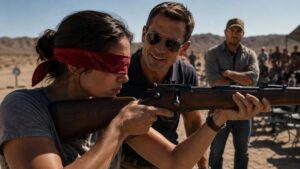
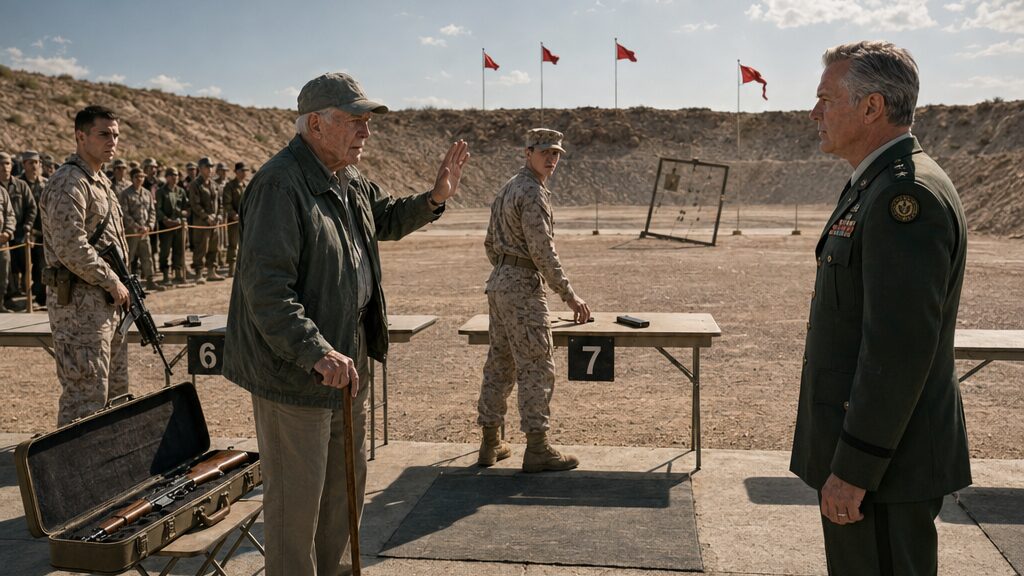
He had asked for a folding chair near the shade line, somewhere behind the staff table where the coffee had already gone burnt and the younger men could pass without having to decide whether to salute him, shake his hand, or pretend not to notice his cane. Instead, someone had brought out a low canvas stool and placed it just off the firing line at Lane Seven, close enough that the wind carried the powder smell straight into his face.
The stool sagged under him. His knees complained. His right hand rested on the smooth old stock of the rifle across his lap.
It was a plain thing compared with the rifles lined up on the mats ahead of him. No rails, no black finish, no shining attachments with little knobs and clipped-on lights. Walnut stock, worn dull where years of palms had polished it. A scope older than most of the soldiers on the line. A leather sling darkened by oil and weather. William kept his hand on it the way another man might keep a hand on a sleeping dog.
The range lay wide under a hard blue sky. Target boards stood in neat ranks downrange, white squares against the pale dirt berm. Red flags snapped from poles, then sagged, then snapped again. The firing mats were laid out in order, each lane marked with a number stenciled black on sun-faded signs. Behind the line, active-duty soldiers moved with quick efficiency, checking magazines, adjusting ear protection, calling short instructions over one another.
William watched the flags.
He did not watch the young soldier who kept glancing at him.
The young man stood near Lane Six, desert camouflage pressed sharp enough to cut paper. Tall, square-shouldered, clean-faced. His name tape read Reed. He had the look William remembered from a hundred ranges and a hundred first days: eager to be measured, annoyed to be delayed, trying not to show either.
A decorated officer in a green service uniform moved through the line with controlled authority. Scott Harris had more silver at the temples than William remembered, and more weight around the eyes. Still carried himself like a man who knew a dozen people were looking to him at any moment. When he saw William watching him, Scott gave a small nod.
William answered with one of his own.
That was enough.
He did not need the introduction Scott had given earlier, though Scott had insisted on it.
“Retired Gunnery Sergeant William Bennett,” Scott had said in front of the command staff and visitors. “Former Marine marksmanship instructor. We’re honored to have him with us today.”
There had been polite applause. Not much, but enough to make William feel his collar tighten. A few phones had lifted. Someone had said, “That’s incredible,” in the soft voice people used around old photographs and hospital beds.
William had looked at the rifle on his lap and waited for it to pass.
He was not ashamed of age. Age was just time staying honest. He was ashamed only of being placed like a prop beside a line he used to run.
“You all right, Mr. Bennett?”
Emily stood just behind his left shoulder, one hand half-raised as if she might steady him without permission. She wore sunglasses and a pale blouse that already had dust on the hem from the range parking lot. His daughter had not wanted him to come alone. She had not wanted him to come at all.
“I am sitting,” William said. “Hard to fall while sitting.”
“That isn’t funny.”
“It wasn’t much of a joke.”
Her mouth tightened, but she did not argue. Emily had learned, over the last two years, to save her strength for the things that mattered. So had he. The difference was that they did not always agree on what those things were.
Downrange, a flag at Lane Seven lifted, dropped, then kicked sideways.
William’s thumb stilled against the rifle stock.
The flags along the other lanes moved in a loose rhythm from left to right. Lane Seven’s flag did not. It snapped once toward the berm, then fluttered back as if caught in a small argument with itself. Wind could do strange things against uneven ground, especially near a cut berm, but William had spent too many years watching cloth, dust, grass, breath, barrel smoke. Wind told the truth if a man was patient enough to let it finish speaking.
He leaned forward a fraction.
His back gave him a warning. He ignored it.
On Lane Seven, the target board hung straight at first glance. White paper. Black scoring rings. Nothing remarkable. The frame, though, seemed to tremble after the gust died. Not much. A younger eye might call it heat shimmer, or the normal play of distance. William narrowed his gaze until the world reduced to board, line, flag, shadow.
The lower left corner of the target paper moved before the top did.
He breathed out slowly.
“Dad?” Emily asked.
“Who set Lane Seven?”
She followed his gaze but saw only what most people saw: boards, flags, numbers, soldiers, sun.
“I don’t know. Why?”
William did not answer. Scott was speaking with two command staff observers near the range table. Reed was fitting himself into his role for the day, laughing shortly with another soldier, then looking serious as soon as an officer turned.
William slid his hand from the rifle stock to the scope and checked, out of habit, that the caps were secure. He had cleaned the rifle the night before, though Emily had told him there was no need. He had laid each piece of the cleaning kit on a towel, not because the rifle needed to be fired, but because an old routine done properly could settle the mind.
“Dad,” Emily said softly, “please don’t start worrying about equipment. They know what they’re doing.”
William’s eyes stayed on the target. “Most times.”
She exhaled. “This is exactly what I meant.”
“What did you mean?”
“That you’d come here and feel responsible for everything. You’re a guest.”
The word sat badly between them.
Guest.
William had been called worse and better. Instructor. Gunny. Sir by mistake. Old timer by men who thought he could not hear. Guest was not an insult. Still, it had soft edges. It made a man harmless.
A range safety officer called for the first preparation cycle. The line shifted at once. Bodies lowered to mats. Rifles were settled. Bolts checked. Commands echoed through the warm air.
William watched Lane Seven.
No shooter lay behind it yet. Its mat was empty, reserved for the final demonstration, Scott had told him. Something for visitors. Something visual. A clean finish to a clean day.
The target board moved again.
Not enough for panic. Not even enough for a complaint, maybe. Just enough that William’s fingers pressed once into the rifle stock.
Scott crossed toward him between commands, careful not to step over equipment. “How are you holding up, Gunny?”
William glanced at the rank on Scott’s chest before he looked at his face. “Older than when you last asked.”
Scott smiled. “That was twenty minutes ago.”
“A lot can happen in twenty minutes.”
Scott’s smile faded a little, not from offense, but recognition. He had trained under men who spoke that way. Men who hid warnings inside dry remarks.
“You need anything?”
“Who inspected Lane Seven?”
Scott looked downrange. “All lanes were cleared this morning.”
“That’s not what I asked.”
Emily shifted behind him. William could feel her embarrassment before she spoke. “Dad—”
Scott raised one hand, not sharply. “It’s all right.” Then to William, quieter: “Target technician signed off. Range staff did visual checks. Why?”
William looked again at the flag. For a moment it hung limp, innocent.
“Something’s not moving with the rest.”
Scott followed his gaze for a long three seconds. Then the officer’s attention flicked back toward the line, where the preparation cycle was almost complete.
“I’ll have someone take a look before the final round,” Scott said.
It was a decent answer. Not a promise. Not a dismissal, either. The kind of answer busy officers gave when the day had a schedule and the schedule had people above it.
William nodded once.
Scott lingered. “You sure you’re not just reading ghosts out there?”
There was no cruelty in it. That almost made it worse.
William looked at the targets and thought of all the ghosts that had started as small movements nobody wanted to stop for.
“Could be,” he said.
Scott’s radio cracked at his shoulder. He stepped away.
The first shots began in controlled rhythm. Reports rolled across the range, sharp and flat. Brass clicked onto mats. Dust lifted in faint puffs near the berm. Emily flinched at the first volley, though she tried to hide it. William did not.
He had heard rifles in weather worse than this, in places where the air itself seemed to hold its breath. This was a safe range, a clean range, a stateside range with clipboards and water coolers and orange cones. That did not mean it could not hurt someone. Safe places were the ones most people stopped respecting.
Reed looked back at him after his own string, a quick glance over one shoulder. William saw curiosity there, and something else. Irritation, maybe. The young man had noticed Scott speaking with the old veteran. He had noticed the old rifle. He had noticed the attention shifting in ways a young man hungry for approval could feel before he understood.
William did not hold the glance.
Downrange, Lane Seven’s flag twitched against the wind again.
This time the target frame gave the smallest answering shiver.
William sat very still, the old rifle quiet across his knees, and listened as the range kept moving around him.
Chapter 2: The Young Soldier Smiled Before He Listened
Benjamin Reed had been told since boot camp that confidence was useful only if it could survive correction.
He believed that.
Mostly.
He believed it when the correction came from a range coach with a shot timer. He believed it when a sergeant adjusted his elbow with one boot and said, “Again.” He believed it when the paper showed what the shooter’s pride did not. The target never lied, and Benjamin liked that about shooting. A man could tell himself anything before the trigger broke. Afterward, there was a hole in paper and no place to hide.
What Benjamin had trouble accepting was correction from someone who looked like he needed help getting out of a chair.
He hated himself a little for thinking it. Not enough to stop thinking it.
The old man sat at Lane Seven as if someone had parked him there for atmosphere. Faded green field jacket. Brown-spotted hands. Cap pulled low against the sun. Rifle across his knees like a museum piece someone had forgotten to lock behind glass. The officers called him retired Gunnery Sergeant William Bennett, and that should have meant something. It did mean something, technically. Benjamin understood respect. He stood when introduced. He clapped when others clapped.
But the old man did not stand.
The old man did not even seem interested in the demonstration.
He watched flags.
Benjamin finished his string at Lane Six with a tight group just outside center. Not perfect. Good enough that the staff observer behind him made a note, and the soldier to his right gave him a low “nice.” Benjamin cleared his rifle, locked it open, and rose with controlled movements.
He glanced toward Scott Harris.
The officer was speaking to the old man again.
Benjamin wiped sweat from the bridge of his nose with the back of his wrist. The day was supposed to be clean. Public qualification, command staff present, civilian visitors behind the rope line, a final demonstration round after lunch. Benjamin had been selected for that final round because he could shoot under eyes. That was what the range sergeant had told him.
“You don’t rattle,” the sergeant had said.
Benjamin had carried those words all morning like a coin in his pocket.
Now the final lane had an old man beside it asking questions.
The soldier next to Benjamin leaned closer. “You know who that is?”
“Retired gunny,” Benjamin said.
“Yeah, but like who?”
Benjamin shrugged. “Some instructor from back when dirt was new.”
The other soldier laughed once, then looked away as Scott turned. Benjamin regretted it immediately, not because it felt untrue, but because it sounded smaller out loud than it had in his head.
The range moved into a pause. Targets were checked. Water bottles came out. Visitors murmured behind the safety line. A child pointed at the rifles until a civilian adult lowered the child’s hand.
Benjamin stepped away from his mat and rolled his shoulders. His father had once told him that every room had a man who needed to be impressed, and the trick was finding him before anyone else did. In the military, there was always more than one. Today Scott Harris mattered. The command staff mattered. The paper mattered. The final demonstration mattered most.
He was checking his sling when Scott called him over.
“Reed.”
Benjamin came at once. “Sir.”
Scott stood beside William Bennett. Up close, the old man looked smaller and sharper at the same time. His face had the creased dryness of desert maps. His eyes were pale, steady, and not particularly friendly. The rifle across his knees had a wood stock marked by long use, not neglect. Benjamin noticed that much despite himself.
“Mr. Bennett had a question about Lane Seven,” Scott said.
Benjamin kept his face neutral. “Yes, sir.”
The old man looked up at him. Not far up. The stool put him low, and Benjamin was aware of his own height in a way that made him uncomfortable.
“Who inspected the carrier?” William asked.
Benjamin blinked. “The carrier, sir?”
“Target carrier. Frame. Bracket. Fasteners.”
Benjamin glanced toward Lane Seven. “Range staff did, I believe.”
“You believe?”
A flush started under Benjamin’s collar. “I wasn’t assigned inspection, sir.”
“Mr. Bennett is fine,” William said.
Benjamin hesitated. “Mr. Bennett.”
Scott’s expression did not change, but Benjamin sensed he had missed something.
William pointed with two fingers, not quite lifting his hand from the rifle. “Flag’s not matching the next lane.”
Benjamin looked. Lane Seven’s small red flag hung halfway limp. Lane Six’s snapped right. Lane Eight’s fluttered right. Lane Seven shifted, then drooped.
“Wind pockets happen near berm cuts,” Benjamin said.
“They do.”
The old man said nothing else.
Benjamin waited, then added, “Sir—Mr. Bennett—I’m sure staff cleared it.”
“I’m sure they meant to.”
There it was. That old-man way of saying a thing without saying it, making everyone else guess around the edges. Benjamin had heard versions of it from older relatives, retired neighbors, men who stood in hardware stores and explained how tools used to be made. He did not want it here, on his range, before his demonstration.
“It’s a modern setup,” Benjamin said, keeping his tone respectful. “The carriers are checked on schedule.”
William’s eyes moved from the flag to Benjamin’s face. “Modern things still loosen.”
Benjamin smiled before he could stop himself. Not a full smile. Just a corner of the mouth, the small leak of impatience that betrayed more than open disrespect would have.
The old man saw it.
So did Emily Bennett. Benjamin had forgotten she was standing behind the stool until her sunglasses turned toward him.
Scott said, “Reed.”
Benjamin straightened. “No disrespect intended, sir.”
William touched the rifle stock with his thumb. “Wasn’t injured by it.”
That should have ended the exchange, but Benjamin felt the day slipping, attention moving away from the clean lines he understood. He looked at the old rifle and made the mistake of trying to lighten the air.
“That your rifle, Mr. Bennett?”
“It is.”
“Still shoots?”
Scott’s eyes flicked to him.
Benjamin heard the words after they were already gone. Still shoots. As if asking whether the old thing, or the old man, had any use left in it.
William looked down at the rifle. His hand moved along the stock, stopping near a faint scratch that ran beneath the scope mount.
“Only when I ask it to.”
The answer landed quietly. A few nearby soldiers had gone still enough to hear it.
Benjamin swallowed. “I just meant—”
“I know what you meant.”
There was no anger in William’s voice. That made Benjamin feel worse than if the man had snapped at him.
Scott let the silence hold for one measured beat, then said, “Reed will be firing the final public round from Lane Seven after the next rotation.”
William’s gaze returned downrange. “Then he should know what the lane is doing.”
Benjamin looked again. Target. Flag. Frame. Nothing worth stopping a schedule over.
“With respect,” he said, and hated the phrase even as he used it, “if there’s a wind shift, I’ll correct for it.”
William nodded. “That’s what worries me.”
Benjamin’s jaw tightened.
Scott turned slightly, warning in his posture. Emily stepped closer to her father’s shoulder, but William remained seated, the rifle unmoving across his knees.
“What does that mean?” Benjamin asked.
“It means a good shooter trusts his correction,” William said. “A better one asks why he needs it.”
The words were not loud. They were not dressed as a lesson. Still, Benjamin felt them in front of everyone. His face heated. He could hear the soft rustle of visitors, the scrape of boots, a distant metallic clank from the target area.
He wanted to say he had earned Lane Seven. He wanted to say the old man had no idea how many hours he had put into controlling breath, trigger, cheek weld, follow-through. He wanted to say that being old did not make every suspicion wisdom.
Instead, he said, “I’ll keep that in mind.”
William looked at him a second longer. “Do.”
Benjamin turned back toward his mat. The other soldiers suddenly found reasons to check equipment. He crouched beside his rifle and began wiping dust from the magazine well with more force than necessary.
From the stool, the old man’s voice came again, not raised.
“Who inspected the target carrier this morning?”
No one answered at first.
Benjamin closed his eyes for half a breath.
The question had become a splinter. Small, irritating, impossible to forget.
Chapter 3: The Shot He Refused To Take
By the time Lane Seven was called, William had counted three movements that did not belong.
First, the flag.
Second, the lower corner of the target paper.
Third, the frame settling backward after the previous lane’s impacts, though no round had touched it.
Three did not make certainty. Certainty was a luxury men invented after the fact. Three made a pattern, and a pattern deserved respect.
The final public round had drawn people closer to the rope line. Civilian visitors shaded their eyes. Command staff stood beneath the range canopy with clipboards lowered. Scott Harris had moved to the side of Lane Seven, where he could see both the shooter and the target. Benjamin Reed settled onto the mat with the deliberate calm of a young man determined not to appear irritated.
William remained on the stool.
His rifle lay across his lap, muzzle downrange, bolt open, chamber empty. A range medic stood twenty yards back, bored and sunburned. Emily hovered behind William, her worry now sharpened into something close to anger.
“You don’t have to sit through this,” she said under the range noise.
“I do.”
“No, Dad, you don’t. If they don’t want to listen—”
“They may yet.”
Benjamin heard some of it. William saw the young man’s cheek shift against the stock, though his eyes stayed forward. Good position. Good shoulder pressure. Not as relaxed as he wanted to look, but good. William had seen worse from men with more confidence and better reputations.
A range officer called the preparation command.
Benjamin loaded.
The visitors quieted. Even the flags seemed to pause.
William watched the target through his own eyes, not the scope. The temptation to raise the rifle and confirm what he suspected passed through his hands like an old itch. He did not move. The rifle was not there to make a point. Not yet. Maybe not at all.
Scott stepped closer. “Gunny,” he said quietly, using the old title where only William could hear. “You still concerned?”
“Yes.”
“Enough to stop the round?”
William did not answer quickly. The easy thing would be pride. The easy thing would be saying yes because he disliked being doubted. The harder thing was measuring the difference between discomfort and danger.
Benjamin adjusted his support hand under the fore-end. The muzzle settled. Downrange, Lane Seven’s flag lifted, but the target paper trembled inward, toward the board, instead of away.
William’s stomach tightened.
“Yes,” he said.
Scott looked at him.
The range officer had not yet called fire.
Scott’s jaw shifted once, but command staff were watching. The visitors were watching. Benjamin was watching through the discipline of his position, which meant he was pretending not to.
“What exactly are you seeing?” Scott asked.
“Carrier’s not square.”
“Technician cleared it.”
“Technician saw it still. I’m watching it move.”
Scott looked downrange. William knew what he saw: distance, heat, paper, flags, nothing obvious enough to embarrass a program over.
Benjamin lifted his head from the stock. “Sir, I can hold.”
Scott did not look at him. “Stand by.”
Benjamin’s mouth closed.
William felt the range’s attention gather around him. It was a familiar pressure and an unwelcome one. Men had looked to him once because that had been his job. Now they looked because he was interrupting something they trusted.
He could have let Benjamin fire. Let the shot print wrong. Let the target prove the first layer. Nobody would be hurt by a single bad scoring round, most likely. Pride would take a bruise, nothing more.
Most likely had buried better men than Benjamin Reed.
William reached slowly into the small box of cartridges Emily had placed beside his stool. They were his, brought for a ceremonial shot Scott had hinted at but never quite promised. William picked up one cartridge between thumb and forefinger. Brass caught sunlight. Simple, clean, obedient to physics.
He held it for a second, then set it on the mat beside the rifle.
The tiny sound seemed louder than it was.
Benjamin looked at the cartridge. So did half the line.
William lifted the rifle from his lap just enough to clear his knees. Emily inhaled sharply behind him, thinking he meant to stand, thinking he meant to prove something with a shaking body in front of young men who wanted a show.
Instead, William laid the rifle carefully on the mat, parallel to the firing line, still open, still empty.
“I won’t fire down that lane,” he said.
The words did not carry far, but silence carried them the rest of the way.
A command staff observer frowned. The range officer turned toward Scott. Benjamin pushed himself up on one elbow.
“With respect,” Benjamin said, unable to keep the edge out this time, “you’re not the one firing the lane.”
William looked at him. “No.”
“Then I don’t understand the problem.”
“You’re about to correct for something that isn’t you.”
Benjamin’s face hardened. “I know my corrections.”
“I believe you.”
That stopped him for half a second.
William pointed toward the target. “You’ll break clean and print high-left.”
Benjamin stared at him.
A murmur moved behind the rope line. Scott’s eyes narrowed, not in disbelief exactly, but in calculation. The range officer looked uncomfortable. Emily’s hand lowered from William’s shoulder.
Benjamin gave a short breath through his nose. “You’re calling my shot before I take it?”
“I’m calling the lane.”
“They cleared the lane.”
“So you keep saying.”
The young man’s pride rose visibly now. Not loud, not crude, but alive. William did not blame him. A shooter’s body was a private country. Being told from the outside that the error was waiting for him before he touched the trigger felt like insult.
Scott said, “Reed, settle.”
Benjamin held William’s gaze one second longer, then lowered himself back into position.
William did not like it. “Colonel.”
Scott did not turn. “One round,” he said quietly. “Then we inspect.”
It was not what William wanted. It was more than he expected.
The range officer looked to Scott, received the nod, and called the command.
Benjamin’s body became still.
William watched the target, not the shooter.
The shot cracked clean across the range.
A fraction later, the target frame trembled with that same wrong shiver.
Benjamin stayed in position through follow-through, disciplined despite his anger. Good, William thought. Angry, but good. That was something.
The line remained quiet as the target was called in.
Benjamin stood and cleared his rifle. He did not look at William. Not yet. The carrier motor hummed faintly, drawing the target forward. The white paper approached in stages, flat and ordinary until it was close enough for everyone to see the hole.
High-left.
Not wildly. Not embarrassingly. Just enough.
A clean shot in the wrong place.
The soldier beside Benjamin leaned forward. Someone behind the rope whispered. The command staff observer stopped frowning and began studying the paper as if it had become a document in another language.
Benjamin’s face went blank.
Scott stepped to the target and looked at the hole, then back downrange toward the empty carrier path.
William remained seated. His hands rested on his knees now, away from the rifle, away from the cartridge shining beside it.
He felt no pleasure. The first proof was always the loneliest proof. It showed a man the door, not the room beyond it.
Benjamin turned slowly.
For the first time all morning, he looked at William without the smile.
“How did you know?” he asked.
William looked past him to Lane Seven, where the flag snapped wrong again.
“I don’t know enough yet,” he said. “That’s the problem.”
Chapter 4: High Left On A Perfect Aim
Scott Harris had spent most of his career learning how to keep his face still.
It was useful when superiors asked questions with obvious answers, when young officers made old mistakes, when the press visited a training site, when a weapon jammed in front of visitors, when a mother looked at him after a ceremony and expected him to have words large enough for grief. Stillness did not mean calm. It meant other people could borrow calm from him until there was enough to go around.
He needed it now.
The target from Lane Seven hung clipped to the carrier, close enough that nobody could pretend not to see the hole. High-left. Clean, round, unmistakable.
Benjamin Reed stood beside his rifle with his jaw set and his ears red beneath the band of his hearing protection. He had cleared the weapon properly. He had stepped back properly. He had done everything properly after the shot except look at William Bennett for more than a second.
Scott looked at the paper, then downrange.
A high-left miss could come from a dozen human things. Trigger pressure. Shoulder tension. Anticipation. Eye strain. A shooter trying too hard in front of an audience. Benjamin was good, but good shooters could still betray themselves by wanting too much from a clean shot.
The problem was that William had called it first.
A command staff observer came up on Scott’s right. “Colonel?”
Scott kept his eyes on the paper. “One round is not a pattern.”
“No, sir.”
“But it is enough to inspect.”
The observer nodded, relieved to have something official to do with the tension.
Behind them, the visitors murmured with the excited discomfort of people who had almost seen something and were not sure whether they had permission to talk about it. One of the younger recruits leaned close to another and whispered until the range sergeant cut a look at him. The whisper stopped.
William had not moved from the stool. That bothered Scott more than if the old man had stood and demanded attention. A man who wanted to be proved right usually showed some sign of pleasure. William Bennett looked only tired.
Scott walked to him.
“Gunny,” he said quietly.
William’s eyes remained downrange. “Colonel.”
“I said we’d inspect after one round.”
“You did.”
“You want the carrier pulled?”
“I want it looked at by someone who expects to find something.”
Scott almost smiled. Almost. That was William exactly. Not rude. Not gentle. Precise enough to cut.
“The technician cleared it this morning.”
William glanced at him then. “Then send him first.”
Scott signaled toward the range staff. The target technician, a compact man with sun-reddened forearms and a tool pouch at his hip, came over with the wary look of someone being summoned into blame before blame had been assigned.
“Lane Seven carrier,” Scott said. “Bring the target forward. Check frame alignment, bracket tension, fasteners, motor track.”
“Yes, sir.”
The technician looked once at the paper, then once at William, and something crossed his face. Not disrespect exactly. Defense. Men who worked with their hands did not enjoy being questioned by people seated in chairs.
Scott understood that, too.
The technician unclipped the target and laid it flat on the inspection table. Benjamin stood three feet away, eyes fixed on the hole as if it might move if he watched hard enough.
Scott said, “Reed.”
Benjamin straightened. “Sir.”
“Walk me through the shot.”
“Natural point of aim was centered. Wind call was mild right-to-left, nothing significant. Breathing felt steady. Trigger broke clean.”
“You felt yourself pull?”
“No, sir.”
“Anticipate?”
“No, sir.” A beat. “I don’t think so, sir.”
Scott heard the crack in the answer. Not uncertainty about the shot. Uncertainty about whether he was allowed to trust himself now.
William heard it, too. Scott saw his eyes shift briefly to Benjamin, and there was no triumph there. Only recognition. The old instructor in him was awake despite everything.
The technician bent over the target. “Paper tore a little on the lower edge,” he said.
Scott stepped closer. “From the carrier?”
“Could be from handling.”
William’s voice came from the stool. “Diagonal?”
The technician paused.
Scott looked down. Along the lower left edge of the paper was a faint angled tear, no longer than a thumb joint. Easy to miss. Easy to dismiss. It ran up toward the scoring ring, just slightly, as if the paper had been tugged from one corner before being struck or retrieved.
The technician touched it. “That can happen if the clip bites.”
“Did it?” Scott asked.
The technician did not answer quickly enough.
Benjamin folded his arms, then unfolded them when he noticed Scott notice. “Sir, with permission, I can fire another. Same hold. We’ll know.”
“No,” William said.
One word. No volume. Still, it crossed the space like a command.
Benjamin’s mouth tightened. “I was speaking to the colonel.”
“And I was speaking to the lane.”
Scott turned his head toward William. “Explain.”
William’s fingers rested on his knees. They were not steady, not entirely. Age had put a tremor in them when they were empty. It disappeared when they touched the rifle.
“Paper’s not hanging square. Maybe because the frame isn’t square. Maybe because the bracket’s loose. Maybe because the carrier track has play. If he fires again, he will correct for his last hole. If the lane is lying, he’ll teach his body the wrong answer.”
The target technician’s shoulders stiffened. “Sir, the frame passed.”
William nodded. “I heard.”
The technician looked to Scott. “I can run it back and forth.”
“Do it,” Scott said.
The carrier hummed back downrange with the target removed. Everyone watched the empty frame travel as if it were a ceremony of its own. Halfway out, it shuddered once. Not much. Scott saw it because he was looking for it. Before William’s warning, he might not have.
The technician frowned.
“Stop it there,” William said.
Scott did not repeat the command. The technician stopped it.
William leaned forward. Emily stepped instinctively closer, but he lifted one hand, asking her not to help yet. He studied the distance, the frame, the flag. The sun put a hard white line along his cheek. For a moment Scott saw him not as the elderly man on the stool, but as he had been in stories passed along by older Marines: patient, unforgiving, able to make a recruit feel that the wind itself had regulations.
Scott had met William only twice before this year, once long ago when Scott had been a junior officer visiting a training range, and once after William’s wife passed, when the veterans’ association had asked Scott to say a few words. But men like William did not disappear from an institution. They stayed in the way other men held rifles, in phrases repeated without knowing who first said them, in old corrections that became doctrine.
Scott had invited him today because the range was being rededicated. Because the old training block had been rebuilt. Because someone on staff had suggested a “heritage moment,” and Scott had hated the phrase but agreed to the idea. He had told himself William would be honored.
Now he wondered when honoring a man had begun to look so much like displaying him.
“Bring it in,” Scott said.
The frame returned. The technician crouched at the carrier head and worked his fingers along the bracket. “It’s tight.”
William said nothing.
The technician tugged the lower left corner. It moved a fraction.
He stopped.
Benjamin saw it. Scott saw Benjamin see it.
“That’s within tolerance,” the technician said too quickly.
“For a clean lane?” Scott asked.
The technician swallowed. “It should be.”
William lifted his eyes to Scott. “Should be is not a measurement.”
Scott felt the command staff observer watching him now. He felt the schedule pressing at his back, the visitors waiting, the day beginning to tilt toward embarrassment. He had a choice: protect the program or protect the truth of what stood in front of him.
The trouble was, at that exact moment, the truth was still small.
A twitch. A tear. A hole high-left. A fraction of movement under a technician’s hand.
Enough for inspection. Not enough for the kind of full stop William’s eyes were asking for.
Scott turned to the technician. “Pull the assembly after the demonstration. Full check.”
William’s gaze sharpened.
“After?” Emily said before she could stop herself.
Scott looked at her, then at William. “We’ll move final demonstration to Lane Six.”
The decision settled some of the air. Not all of it.
Benjamin stared at Lane Seven. “Sir, I can still—”
“You’ll fire Lane Six,” Scott said.
“Yes, sir.”
The answer came clean, but disappointment moved under it. Not just disappointment. Shame. The kind that could harden in a young man if no one gave it a better shape.
William seemed to see that, too. “Your shot broke clean,” he said.
Benjamin looked at him, caught off guard.
“You held well,” William added. “Don’t fix what wasn’t broken.”
The words were not warm. They were not apology. But they were the first thing William had given Benjamin that sounded like instruction instead of warning.
Benjamin’s throat moved. “Yes, sir.”
“Mr. Bennett,” William corrected, but softer than before.
The technician unclipped the target paper fully and set it aside. As he did, the lower diagonal tear widened with a dry whisper.
Scott heard it.
So did William.
Their eyes met across the lane.
For the first time that morning, Scott did not ask if William was reading ghosts. He looked down at the torn paper and wondered what else had been trying to speak before any of them listened.
Chapter 5: Emily Wanted To Take Him Home
Emily Bennett had learned to hate public chairs.
Hospital chairs, office chairs, waiting-room chairs, folding chairs at ceremonies where someone handed her father a plaque and then talked around him like he was furniture. Chairs with arms too narrow for an old man’s shoulders. Chairs without arms that made standing a negotiation. Chairs placed in front rows, side aisles, corners, beside podiums, beneath flags.
Now this canvas stool at the range joined the list.
It was too low. Too soft. Too visible.
Her father sat on it as if it had been assigned by someone who still believed he could spring up on command. Emily watched the tendons in his hand flex when he shifted his weight, watched the controlled pause before he changed position, watched him hide pain from people who were not paying enough attention to deserve the performance.
The range had paused, but not fully. That was what angered her most. Everyone had seen the shot land where her father said it would. Everyone had watched the target paper tear wrong. Everyone had heard enough to know the day was not as clean as the schedule said.
And still the event rearranged itself instead of stopping.
Lane Six was being prepared now for the final demonstration. A staff member moved chairs under the canopy. The command observers spoke in low voices. The target technician kept glancing at Lane Seven as if it had insulted him personally. Benjamin Reed stood near his rifle with the rigid posture of someone trying to put shame into a box small enough to carry.
Emily stepped beside her father. “We should go.”
William looked downrange. “Not yet.”
“You said what you needed to say.”
“No.”
“They half-listened, which is apparently the best anyone here knows how to do.”
His mouth twitched, not quite amusement. “You used to be more polite.”
“You used to let me carry grocery bags without making it a moral issue.”
“That was different.”
“No, it wasn’t.”
A nearby recruit looked over. Emily lowered her voice.
Her father’s rifle lay in its open case now beside the stool, the old wood catching sunlight along the worn ridge of the stock. The cartridge he had set on the mat had been returned to the box, but Emily still saw it there in her mind. That small brass line he had drawn in the day. I will not.
When she was little, the rifle had lived in the locked cabinet in the den. She knew it mostly by absence: the key her mother kept separate, the smell of oil when her father cleaned it, the quiet in the house afterward. He had never treated it like a toy or a trophy. He had treated it like a responsibility that happened to be made of wood and metal.
After her mother died, he cleaned it more often.
Emily had not asked why. She was afraid the answer would open something neither of them could close.
“Dad,” she said, “please. You’re exhausted.”
“I am sitting.”
“You keep saying that like it proves something.”
“It proves I’m not lying down.”
She closed her eyes. The sun pressed through her lids, red and hot. “They’re using you.”
That made him look at her.
The words had come out harder than she meant, but not less true. At least not to her.
“They brought you here because it looks good,” she said. “Old instructor, old rifle, new generation. Everyone gets to feel patriotic for ten seconds, then they go back to not listening. I can’t stand watching it.”
William’s hand moved toward the rifle case, then stopped before touching it. “Scott didn’t mean it that way.”
“Maybe that makes it worse.”
He looked toward the canopy where Scott Harris stood in conversation with the range officer. “Maybe.”
The admission softened her anger for half a breath. Her father did not give ground easily. Not out loud.
Emily crouched carefully beside the rifle case, ignoring the dust on her knees. “Let me put this away.”
William did not answer.
She reached for the case lid.
“Leave it.”
His voice was not sharp, but it stopped her.
“It’s just sitting here,” she said.
“So am I.”
She turned toward him. His face was pale beneath the cap, the lines around his mouth deeper than they had been that morning. He looked very old suddenly, and that frightened her more than the rifles, more than the noise, more than the stubbornness.
“I don’t want them laughing at you,” she said.
“They aren’t.”
“You know what I mean.”
He looked away.
For a while, the range noise filled the space between them: the click of equipment, the call of staff, the distant hum of a carrier motor being tested somewhere down the line. A red flag snapped once and went slack.
William said, “Do you remember Camp Lejeune?”
Emily frowned. “Barely.”
“You were five. Maybe six. Your mother brought you out for family day.”
“I remember heat. And you telling me not to touch anything.”
“That sounds like me.”
“You bought me lemonade from a machine.”
“That sounds like your mother.”
A faint smile touched him and vanished.
Emily waited.
“There was a young corporal,” William said. “Not much older than Reed. Good shooter. Better than good. Fast learner. Trusted fast things too much.” His eyes remained on the range, but Emily could tell he was not seeing it now. “During a training block, I saw something off with the old steel setup. Not enough to shut it down, I told myself. Not enough to make a fuss in front of command.”
Emily’s hand tightened on the edge of the rifle case.
“What happened?”
He took a slow breath. “A fragment came back.”
She did not ask where it struck. His silence put the answer somewhere worse than a scratch and short of the stories movies liked to tell. Real harm lived in narrower spaces.
“He lived,” William said. “But he never shot the same. And I never liked the sound of myself saying, ‘I thought something was wrong.’”
Emily looked at the range differently then. Not as a place embarrassing her father. Not as a stage. As a field of small chances, most harmless, one or two waiting for pride.
“Why didn’t you ever tell me?”
“You were five.”
“I’m not five now.”
“No,” he said. “Now you think I don’t know when I’m tired.”
Her anger had nowhere clean to go. It drained instead into something heavier.
“I know you know,” she said. “I just don’t know when to stop being scared.”
He looked at her then, really looked, and the old instructor’s hardness left his face. What remained was her father, the man who had once waited outside her middle school in a truck with no air-conditioning because she had cried that morning before class. The man who could sew a button, clean a rifle, burn toast, and sit beside a hospital bed for eighteen hours without complaint.
“I need you to understand something,” he said. “If I leave because they embarrassed me, I can live with that. If I leave because you are embarrassed for me, I can live with that too, though I won’t enjoy it.”
She almost smiled.
“But if I leave while that lane is still active,” he said, “and something happens that I might have stopped, then I have to carry it. Not them. Me.”
Emily looked at Lane Seven. The target frame sat downrange, empty now, its white board removed. From this distance it seemed harmless, almost ridiculous. A square of metal and wood in bright sun.
“What if you’re wrong?” she asked.
“I hope I am.”
That answer settled deeper than certainty would have.
The range officer called for staff to prepare the final public round on Lane Six. People began moving again. The event found its rhythm, a little bruised but not broken. Benjamin Reed was being directed toward Lane Six, but another recruit stood near Lane Seven with a clipboard, speaking to the target technician.
Emily noticed her father watching.
“What is it?”
His eyes narrowed. “They’re not done with Seven.”
“I thought they moved the demonstration.”
“They did.”
The recruit at Lane Seven lifted a rifle from the rack, not Benjamin’s. The target technician gestured toward the empty frame as if explaining that no live fire would happen there, then glanced toward the range officer. The range officer looked busy with Lane Six and waved him off.
William’s hand found the edge of the stool.
Emily stood at once. “Dad.”
He did not rise. Not yet. But his body had changed. The tiredness was still there, the pain too, but beneath it something had locked into place.
At Lane Seven, the recruit began setting up for what looked like a routine function check.
William reached for the rifle case, not to close it, but to steady himself beside it.
“Help me up,” he said.
Chapter 6: The Range Went Quiet Too Late
William did not like needing a hand to stand.
He liked less the fact that Emily knew exactly how to give it: not pulling, not fussing, not making a show of strength for either of them. She offered her forearm. He took it. His knees registered their objections one at a time. His back added its own. For a second the range tilted slightly, bright sky and pale dirt and dark rifle shapes flattening into glare.
Then he was upright.
The old rifle remained in its case.
He left it there.
That mattered to him, though he could not have said why in the moment. Maybe because this was not about proving he could still hold it. Maybe because the rifle had already done its part by staying silent.
Lane Seven was not supposed to be active. That was what Scott had decided. That was what the range officer had repeated. That was what the staff seemed to understand in theory. But events had a way of splitting attention. Lane Six drew command eyes. Visitors wanted a final clean demonstration. The schedule wanted to heal itself. Meanwhile, a recruit at Lane Seven had been told to perform a dry function check and verify the carrier response before post-event inspection.
Dry checks were safe until somebody misunderstood the word dry.
William watched the recruit receive instruction from the target technician, then watched the technician step away to answer a question from the range officer. The recruit looked young enough to still feel honored by being useful. He handled the rifle carefully, but his attention kept flicking toward Lane Six where Benjamin Reed was preparing to fire before the command staff.
Two places at once. That was how mistakes liked to enter.
William began walking.
Emily stayed beside him, one hand hovering but not touching unless needed. Dust shifted under his shoes. The twenty yards to Scott felt longer than it should have.
Scott saw him coming and broke off from the range officer. “Gunny?”
“Lane Seven is not cold.”
Scott turned.
At first, nothing appeared wrong. The recruit was still behind the line. The rifle was pointed safely downrange. The target frame sat out near the berm, empty and sunlit. The red flag fluttered in its strange private rhythm.
Then the recruit reached for a magazine on the table.
Scott said, “Range officer.”
The range officer looked up, irritated at the interruption, then followed Scott’s gaze. “That’s for Lane Six.”
The recruit had the magazine in his hand now. He looked uncertainly between the table cards. Someone had moved equipment during the lane switch. Lane Seven’s mat still had a rifle on it. Lane Six’s ammunition tray had been set too close. No single thing was disastrous. Each small thing waited politely for the next.
William felt time narrow.
The range officer called, “Hold Lane Seven.”
His voice was firm, but not sharp enough.
The recruit froze halfway, then looked toward Lane Six just as the public demonstration command began. Around him, bodies settled, hearing protection pressed tighter, visitors leaned forward. The range absorbed the softer command and prepared for the louder one.
William saw the recruit’s finger outside the trigger guard. Good. He saw the magazine angled wrong for the rifle. Better than loaded. He saw the muzzle drift a fraction while the recruit turned his head toward Lane Six.
Not dangerous yet.
Enough.
William drew breath from low in his chest.
“Cease fire!”
His voice was not young anymore, but it had once crossed ranges in rain and heat and fear, and some part of it remembered the distance. It cracked over the line harder than anyone expected.
The range stopped.
Not gradually. Not politely.
Stopped.
Benjamin lifted his head from Lane Six. Scott’s hand went up. The range officer repeated the command at full volume, and then others echoed it. “Cease fire. Cease fire. Cease fire.”
Bolts opened. Rifles cleared. Bodies rose away from stocks. The visitors behind the rope went utterly silent.
The recruit at Lane Seven stood pale, magazine still in hand.
For two seconds, nobody moved.
Then Scott crossed to Lane Seven with the range officer beside him. William followed more slowly. Emily stayed close enough that he could feel her worry, but she did not stop him.
The range officer took the magazine from the recruit. “Who told you to handle ammunition on this lane?”
The recruit swallowed. “I thought it was the function check mag.”
“Function check was dry.”
“Yes, Sergeant.”
“This is live.”
The words changed the air.
The recruit looked sick.
Scott picked up the table card and turned it over. Lane Six. It had slid or been set at an angle near the wrong mat. A simple mistake. Ugly because it was simple.
William looked downrange.
The carrier frame at Lane Seven hung slightly cocked, empty bracket exposed. In the silence, without shots, without commands, without visitors murmuring, the thing finally made its own small sound.
Tick.
Metal settling.
Scott heard it. So did the range officer.
The target technician had come back and now stood very still.
William pointed. “There.”
The range officer took binoculars from a staff member and raised them. Scott waited. No one spoke.
“Bracket’s not seated,” the range officer said.
The technician shook his head. “It was seated.”
“Not now.”
“It must have shifted when we ran it.”
William said, “It shifted before.”
The technician looked at him, but the defense had gone out of his face.
Scott took the binoculars next. His expression did not change, but his shoulders did. The command calm remained; beneath it, William saw the weight land.
“If a round went through that frame angle?” Scott asked.
The range officer hesitated. “Depends where it struck.”
“Answer.”
“Potential deflection risk off hardware if the bracket is exposed wrong. Low probability.”
William’s mouth tightened.
Low probability. Another phrase men used when they wanted luck to sound professional.
Benjamin came up slowly behind them, his rifle cleared and slung. He did not speak. His eyes moved from the live magazine in the range officer’s hand to the distant bracket, then to William.
The recruit whispered, “I’m sorry.”
The apology was not aimed at anyone specific. It was too frightened to know where to land.
William looked at him. “Did you load?”
“No, sir.”
“Finger stayed clear?”
“Yes, sir.”
“Then breathe.”
The recruit did, shakily.
The range officer looked at William with surprise, as if he had expected anger. William had no use for anger at a young man who had stopped in time. Anger belonged elsewhere, if anywhere: in the gap between seeing and acting, in the comfortable hum of almost safe.
Scott turned to the range officer. “Lane Seven is closed. Full line remains cold until inspection confirms all lane assignments and ammunition tables. Visitors stay behind rope. No exceptions.”
“Yes, sir.”
The order moved outward. Staff began clearing tables, checking cards, separating live ammunition, walking the line with renewed seriousness. The public demonstration was dead for the moment, and nobody dared mourn it aloud.
William felt his legs weakening now that the decision had passed through him. Emily’s hand touched his elbow. This time he let it stay.
Scott stepped closer. His voice lowered. “You called ceasefire before I did.”
“Yes.”
“You were right to.”
William looked at Lane Seven. The red flag snapped once, then hung tired in the sun. “I was late.”
Scott’s brows drew together. “No one was hurt.”
“That’s not the same thing.”
The old words rose in him before he could stop them. Not the same thing. Not the same thing at all. He saw, for half a breath, another range, another day, a young corporal blinking in disbelief at what pain had done to his future. He had learned then that being almost early enough could haunt a man longer than being wrong.
Emily’s hand tightened on his arm. She had heard the difference now.
Benjamin stood in front of William, no longer stiff with offense. Something had been stripped from him, and not all of it was pride. He looked younger than he had that morning.
“Mr. Bennett,” he said.
William waited.
“I thought you were trying to show me up.”
“No.”
“I know that now.”
William nodded once. That was all he had strength for.
Benjamin looked toward Lane Seven, then back. “How did you see all that?”
William almost said experience. It was the easy answer, the one people liked because it asked nothing of them except admiration. Instead, he looked at the old rifle lying in its open case beside the empty stool, too far away to touch, and then at the red flag that had been speaking all morning.
“I didn’t see all of it,” he said. “I saw enough not to trust the rest.”
The range remained silent around him, not with ceremony now, but attention. Real attention.
William let Emily help him back toward the stool before his knees made the decision without him.
Chapter 7: The Scrape Mark Behind The Target
Benjamin Reed had been wrong before.
He had missed shots. He had misread wind. He had trusted bad advice because it came from someone louder than him. He had packed gear in the wrong order, called cadence off-beat, overcleaned a rifle until a sergeant asked if he planned to shoot it or marry it.
Those mistakes had weight, but they were ordinary. A man could carry them because everyone carried some version of them.
This one sat differently.
He followed the inspection team downrange with the other soldiers held behind the line. Scott Harris walked ahead with the range officer and the target technician. William Bennett came slower, leaning on Emily’s arm, refusing the golf cart someone had offered. That refusal irritated Benjamin for half a second, until he understood it was not pride for show. William wanted his own eyes on the thing he had stopped the range for.
The berm looked larger up close. The target frames stood rougher than they had from the line, their clean squares revealing screws, brackets, patched wood, dust gathered in corners. Lane Seven’s carrier assembly sat exposed without the paper target, and in the bright sun Benjamin could see what distance had hidden.
The lower left bracket was not seated flush.
It was not hanging loose like a broken gate. It was subtler than that, a small twist in metal that changed the face of the frame by a few degrees. One bolt held. Another had worn an oval groove around itself, allowing the corner to shift under movement. Fresh silver showed where the bracket had scraped against the mount.
The scrape mark was small.
That was the worst part.
Benjamin had expected, almost hoped, for something dramatic when they arrived. A cracked bar. A bent plate. A dangerous failure obvious enough that any fool would have stopped it. Instead, the problem was the size of a thumbnail and the color of a rubbed coin.
William had seen it breathing from seventy yards away.
The target technician crouched with his tool pouch open and said nothing for a long time. When he finally touched the bracket, it shifted with a faint metallic tick.
Benjamin felt the sound in his teeth.
The range officer stood behind him, arms crossed. “How did this pass inspection?”
The technician swallowed. “It was tight this morning.”
“That is not an answer.”
“No, Sergeant.”
Scott crouched beside the frame, careful not to block William’s view. “Show me.”
The technician put two fingers on the lower corner, pushed it inward, then released. The bracket settled back with that same tick. “Motor vibration may have walked it. Bolt’s worn. The mount hole has play.”
“Enough to affect paper?”
“Yes, sir.”
“Enough to expose hardware at a bad angle?”
The technician hesitated.
The range officer answered first. “If a round struck low at the wrong moment, maybe.”
“Maybe,” Scott repeated.
The word had changed since earlier. It no longer sounded like an excuse. It sounded like a door opening onto everything they had almost ignored.
Benjamin looked at William.
The old man stood a few steps back from the frame, one hand on Emily’s arm, the other resting lightly against his own thigh. He was breathing harder from the walk. Sweat had gathered along the edge of his cap. He did not look victorious. He looked like someone who had arrived at a place he had hoped not to find.
Benjamin wanted to say something. An apology. A question. A clean sentence that would put the morning into order.
Nothing clean came.
The range officer turned to William. “How did you see the bracket from the line?”
“I didn’t.”
The technician looked up.
William nodded toward the frame. “I saw what it did to everything else.”
Benjamin followed his gaze. The bracket itself had been almost invisible. But the paper had pulled at an angle. The carrier had shivered after stopping. The flag had disagreed with the frame. The shot had landed where a shooter would blame himself first.
William stepped closer, and Emily moved with him. He did not touch the damaged bracket. Instead, he looked at the target mount, the worn bolt, the scraped metal, then at the track beneath.
“Carrier stops,” he said. “Loose corner settles late. Shooter sees a clean sight picture. Frame moves after he breaks. Not much. Enough.”
The technician rubbed a hand over his mouth. “I checked the face. I didn’t torque every bracket.”
“No one torques every bracket on a demonstration day unless the checklist says so,” William said.
The technician blinked, surprised not to be attacked.
William looked at Scott. “Put it on the checklist.”
Scott nodded once. “It will be.”
Benjamin listened to the exchange with a slow, sinking shame. All morning he had thought William’s oldness was the reason he saw problems where there were none. Now it seemed his own youngness had made him see order where there was only habit.
He stepped toward the frame.
“May I?” he asked the technician.
The technician moved aside.
Benjamin crouched and looked along the bracket line. From that angle, he could see the tilt clearly. He imagined himself firing again, correcting for the high-left shot, forcing his body to obey a lie. He imagined the recruit at Lane Seven, attention divided, live magazine in hand, a loose bracket downrange, everyone trusting the word cleared because the day needed to continue.
He touched the scrape mark with one finger.
Fresh metal dust came away on his glove.
He looked back at William. “You saw the flag first.”
William nodded. “Flag was the first thing that didn’t belong.”
“But wind pockets happen near berm cuts.”
“They do.”
“I said that.”
“You did.”
Benjamin waited for more. A correction. A rebuke. Something he could absorb and be done with.
William gave him nothing.
That made Benjamin speak the harder sentence himself. “I said it like that ended the question.”
William’s face did not soften, exactly. But his eyes changed.
“A lot of mistakes begin as true statements,” he said.
The range officer made a quiet sound, not quite agreement but close. Scott looked down at the ground. Even the technician seemed to hold still around the words.
Benjamin stood.
The sun was high now, flattening every shadow beneath the target frames. From here, the firing line looked farther away than he expected. The visitors were small figures behind the rope. Soldiers waited near their mats. The old canvas stool sat empty beside the open rifle case.
Benjamin saw the morning tableau in reverse: the young men standing, the old man seated, the rifle across his lap. He had mistaken posture for usefulness. He had thought the person sitting down was outside the action.
He turned back to William. “Why didn’t you tell us who you were?”
Scott’s head lifted slightly, but he did not interrupt.
William looked at the bracket, then toward the empty line. “You were told.”
“I mean—” Benjamin stopped. He had almost said, why didn’t you prove it? The words tasted wrong before they left his mouth.
William seemed to hear them anyway.
“If a man only listens after he sees a resume,” William said, “he is not listening to the thing in front of him.”
Benjamin stared at the scrape mark.
It was not a dramatic answer. It did not let him salute and be forgiven. It put the burden where it belonged.
Scott stepped closer. “Reed.”
Benjamin straightened automatically.
Scott nodded toward William. “Mr. Bennett trained instructors who trained some of the people who trained you. That is true. But that is not why you should have listened.”
Benjamin’s throat tightened.
“No, sir.”
William glanced at Scott, and something passed between the two men: gratitude perhaps, or correction accepted too late.
The technician removed the worn bolt and dropped it into his palm. It was smaller than Benjamin expected. Small enough to disappear in dust. Small enough to be overlooked by anyone in a hurry. The oval wear around the hole showed in full now, ugly and obvious once someone had taken the time to look.
Benjamin thought of the old cartridge William had set beside the rifle.
I will not fire.
He understood now that it had not been a gesture of fear, or stubbornness, or theater. It had been a line drawn before proof arrived. A man deciding that the absence of certainty was not permission.
The range officer ordered the lane closed until repair and full inspection. The technician began tagging parts. Scott spoke briefly into his radio. Work resumed around them, quieter than before, each person careful in a way that would not last forever unless someone made it last.
Benjamin remained near William.
“I owe you an apology,” he said.
William looked at him. “For what?”
The question unsettled him. “For assuming.”
“That covers a lot of ground.”
“Yes, sir.”
“Mr. Bennett.”
Benjamin nodded. “Mr. Bennett.”
William studied him for a moment. Up close, Benjamin could see the age in him more clearly: the tiredness, the tremor at rest, the way Emily stood ready without taking over. He could also see the attention still working behind the pale eyes, measuring not the bracket now, but Benjamin.
“Apologies are easy on safe days,” William said.
Benjamin accepted that because it was true.
“What do I do with it, then?”
William glanced toward the firing line, where the soldiers waited for the range to reopen on reduced lanes. “Remember what it felt like when you wanted the old man to be wrong.”
The words went into Benjamin quietly and stayed there.
He looked again at the scrape mark behind the target. It seemed impossible now that he had not seen it.
Chapter 8: The First Lesson Was Not To Fire
By late afternoon, the range had emptied of ceremony.
The command staff left first, after Scott Harris gave them a short explanation that contained no excuses. The civilian visitors followed, quieter on the way out than they had been on arrival. The range staff remained longest, tagging Lane Seven, photographing the bracket, revising paperwork on clipboards that had suddenly become important in ways clipboards rarely felt.
The final public demonstration never happened.
Nobody announced that as a failure. Nobody called it success either.
William preferred the honesty of that.
He sat once more on the low canvas stool, not because anyone had placed him there this time, but because his legs had begun to shake after the walk back from the targets. Emily had brought him water. He drank half and held the bottle between both hands, feeling the cold steady his fingers.
His old rifle lay across the open case at his feet. Dust had settled on the leather sling. He brushed it off with the corner of a cloth from his cleaning kit.
“You don’t have to clean it here,” Emily said.
“I know.”
She sat on an overturned crate beside him. “That has never stopped you before.”
“No.”
The range was different without the crowd. Sound traveled farther. A truck door closed near the parking lot. Somewhere behind the equipment shed, a staff member laughed once, then lowered his voice. The flags still moved, but they had lost their audience.
Scott approached from the range office with his service jacket folded over one arm. Without the jacket, he looked less like a ceremony and more like a tired man trying to finish the day correctly.
“Lane Seven is closed until replacement parts come in,” he said.
William ran the cloth once along the rifle stock. “Good.”
“Full inspection on all carrier assemblies tomorrow morning.”
“Better.”
Scott took the answer as it was meant. He stood beside the stool for a moment, looking out at the targets.
“I owe you more than an apology,” he said.
“No.”
Scott looked at him.
“You owe the range a better checklist,” William said. “Start there.”
A small, rueful smile touched Scott’s mouth. “Already drafted.”
“Then you owe me nothing.”
Emily’s eyes moved between them, sharp with things she chose not to say.
Scott was quiet for a while. “I thought bringing you here would honor you.”
William kept cleaning the rifle.
“I thought,” Scott continued, “that if some of the younger soldiers saw you, heard your name, understood the history, it might do them good.”
“It might.”
“But I put you on display.”
William looked up then.
The officer did not look away. That counted for something.
“Yes,” William said.
Scott accepted it with a nod. The word did not break him. It settled on him, heavy and deserved.
“I’m sorry,” Scott said.
William returned to the rifle. “Don’t make a habit of using old men as decorations.”
Emily breathed out softly beside him, almost a laugh, almost a sob.
Scott’s smile came and went. “No, Gunny.”
William glanced at him.
“Mr. Bennett,” Scott corrected.
“William is fine when nobody’s performing.”
Scott nodded. “William.”
That, more than the apology, eased something. Not fully. Enough.
Benjamin Reed stood near Lane Six, waiting with his cap in one hand. He had been there for several minutes, pretending to study the empty firing mats. William had known he was there. Scott did too.
“Reed,” Scott called.
Benjamin approached, controlled but not stiff. He stopped a respectful distance away.
“Sir. Mr. Bennett. Ma’am.”
Emily nodded.
William kept his hands on the rifle cloth. “You waiting for permission to speak?”
Benjamin’s mouth moved as if it almost smiled but thought better of it. “Trying to decide if I earned it.”
“Speaking doesn’t take much earning.”
“No, sir. Listening does.”
Scott looked down at the dirt, hiding whatever expression crossed his face.
William leaned back slightly. His spine protested. He let it. “What do you want?”
Benjamin looked at the rifle, not with the careless curiosity of the morning, but with attention. “I want to learn what I missed.”
“You saw the bracket.”
“I saw it after everyone walked me to it.”
“Most people do.”
Benjamin took that without flinching. “I don’t mean just the bracket.”
William waited.
“The flag. The paper. The way you didn’t trust one clean answer. The way you stopped before you could prove anything.” Benjamin swallowed. “I want to learn that.”
Emily looked at her father, and for once her worry had no argument attached to it.
William folded the cloth over his knee. “You have instructors.”
“Yes, sir.”
“Good ones?”
“Yes.”
“Then learn from them.”
Benjamin’s face fell a little before he could hide it.
William let the silence sit long enough to be useful, not cruel.
“Then,” he said, “when they are done teaching you how to fire, come find me if you still want to learn when not to.”
Benjamin looked up.
Scott said nothing. Emily said nothing. The wind moved over the firing line and lifted the corner of the cloth on William’s knee.
Benjamin nodded slowly. “I would like that.”
William studied him. Pride was still there. It should be. A young soldier without pride was either broken or lying. But the shape of it had changed. It no longer filled the room before he entered. It had made space for something else.
“First lesson,” William said.
Benjamin straightened slightly.
William reached for the rifle. Emily shifted as if to help, then stopped herself. He appreciated that more than he could say.
He lifted the rifle from the case and checked it with the same slow sequence he had used all his life. Muzzle safe. Bolt open. Chamber empty. Magazine empty. He turned it just enough for Benjamin to see, not enough to make a show.
“Tell me what you see.”
Benjamin looked at the rifle. “Clear chamber. Bolt open. Old scope. Leather sling. Worn stock.”
“Everyone sees the worn stock.”
Benjamin looked again.
The late sun lay along the walnut, revealing scratches and darker places where hands had gone again and again. Near the trigger guard, a small patch of finish had been rubbed nearly smooth. Along the sling, one buckle had a straight, hard edge polished bright.
Benjamin frowned. “The sling buckle is worn flat on one side.”
William nodded. “Used it as a straight edge today.”
“At the bracket.”
“Yes.”
“I didn’t notice.”
“You weren’t looking for what it could do. You were looking at what it was.”
Benjamin absorbed that.
William held the rifle out.
For a second, Emily’s hand twitched toward him. The rifle was not heavy by a young man’s standards, but it was heavy enough after a day like this. Benjamin stepped forward quickly, then stopped, asking without words.
William gave the smallest nod.
Benjamin took the rifle with both hands.
The handoff was awkward for a heartbeat. Young strength meeting old release. Walnut passing from one set of palms to another. Benjamin held it carefully, almost too carefully, as if age had made the object fragile. Then he adjusted, found balance, kept the muzzle safe without being told.
Good, William thought.
“Do not shoulder it,” William said.
Benjamin froze. “No, sir.”
“Do not sight downrange.”
“No, sir.”
“Do not admire it.”
Benjamin glanced at him.
William’s mouth twitched. “Not yet.”
Emily finally smiled.
William pointed toward the empty mat at Lane Seven. “Stand there with it.”
Benjamin obeyed. He moved to the mat where the morning had gone wrong and stood with the empty rifle held low, the bolt open to the air.
“What now?” he asked.
“Now you do nothing.”
Benjamin blinked. “Nothing?”
“That is often the hardest part.”
Scott leaned against the range table behind them, arms folded, watching like a man smart enough not to interrupt a lesson he had not paid for.
William gestured toward the target line. “Look.”
Benjamin looked.
“Not at one thing. At all of it.”
The young soldier’s eyes moved from flag to berm to target frame to ground, from Lane Seven to Lane Six, from paper scraps to the shadow cast by the carrier rail.
“What are you looking for?” William asked.
“What doesn’t belong.”
“That is an answer. Not a method.”
Benjamin took a breath. His shoulders lowered. This time he did not rush.
“The flags don’t all move the same,” he said. “But that alone doesn’t mean anything.”
“Good.”
“The paper edges matter if they move different from the wind.”
“Good.”
“The equipment can pass inspection and still change under use.”
“Better.”
Benjamin looked back at him. “And if I don’t know enough?”
William rested both hands on his knees. They trembled now, openly. He was too tired to hide it. For once, he did not try.
“If you don’t know enough,” he said, “you don’t add a bullet to the question.”
The range went quiet around the sentence.
Benjamin looked down at the empty rifle in his hands.
William saw him understand, not fully, but truly enough for one day. A lesson did not need to become a man’s whole soul at once. It only needed a place to begin.
Emily moved closer to her father and gave him the water bottle again. He took it without pretending he did not need it. That too was a kind of lesson, though not one he enjoyed teaching.
Benjamin returned with the rifle. He did not hand it back like an artifact. He handed it back like responsibility.
William accepted it and set it in the case.
“Thank you,” Benjamin said.
William closed the rifle case but did not latch it yet. “For what?”
“For calling ceasefire.”
William looked toward Lane Seven. The bracket had been removed. The empty mount caught the last of the sun.
“I should have called it sooner.”
Benjamin shook his head. “You called it.”
William turned back to him.
There were things an old man could carry forever if nobody interrupted him. Maybe the young had uses beyond speed after all.
Scott stepped forward. “I’m updating tomorrow’s training block. If you’re willing, I’d like Reed assigned to assist you with the inspection walkthrough.”
Emily’s head turned sharply. “Tomorrow?”
William almost laughed at the alarm in her voice. Almost.
He looked at his daughter. “I have a doctor’s appointment at ten.”
“You remembered?”
“I remember many things.”
Benjamin wisely looked at the ground.
Scott said, “Afternoon, then. Only if you’re up to it.”
William considered the range, the rifle case, the young soldier waiting without pushing, and Emily trying very hard not to decide for him.
“I’ll come,” he said. “But I’m not sitting on that stool again.”
Scott nodded solemnly. “Chair with arms.”
“And shade.”
“And shade.”
Emily folded her arms. “And lunch.”
William gave her a look.
She gave it back.
Scott said, “Lunch too.”
The matter settled there, not with applause, not with anyone announcing what had been learned, but with the practical terms of tomorrow. Chair. Shade. Lunch. Inspection. A young soldier who would listen because he had once failed to. An old veteran who would teach because leaving would have been easier.
William latched the rifle case.
The sound was small and final.
As Emily helped him toward the parking lot, Benjamin remained by Lane Seven, looking downrange without a rifle in his hands. He stood there for a long time, doing nothing.
William saw him from the corner of his eye.
For now, that was enough.
The story has ended.