The Weight He Carried
The Weight He Carried
Part I — The Wrong Kind of Man
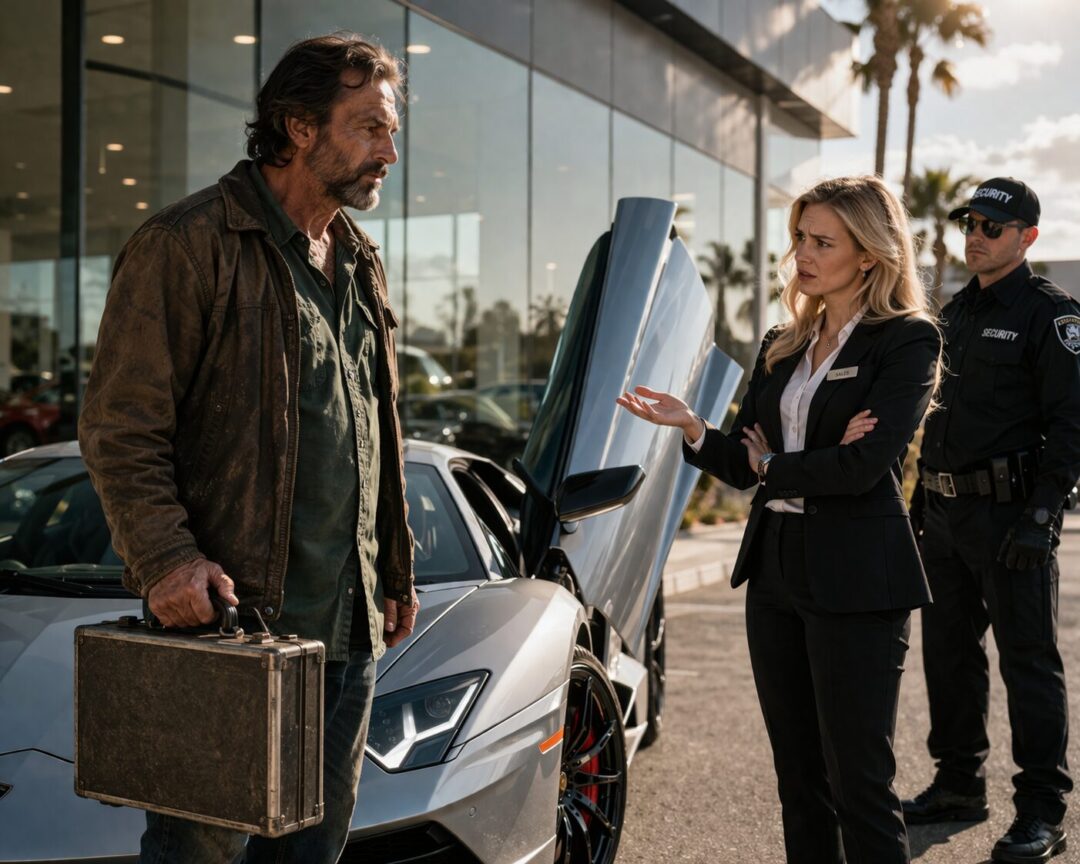
By the time the woman in the black blazer stepped in front of him, the whole polished world of the dealership had already decided what Elias Mercer was.
Not a buyer.
Not a man who belonged near a silver Lamborghini that gleamed like liquid metal in the late morning sun.
Certainly not someone who could afford to touch it.
“Sir, this isn’t for photos.”
The words came clean and clipped, delivered with the kind of smile that had never once been meant as kindness. Elias stopped with one hand resting near the raised door, his other hand still wrapped around the worn handle of the old metal briefcase he had carried for so many years that the edges had gone dull and the corners had peeled into soft scars.
He looked at the car instead of at her.
It made her more uncomfortable than anger would have.
The dealership lot behind them was all glass, chrome, and carefully arranged perfection. Every line was meant to signal wealth. The marble steps, the immaculate windows, the distant row of exotic cars angled like jewelry under the sky. Even the air smelled expensive—wax, leather, citrus cleaner, cold conditioned air spilling out every time the front doors opened.
And then there was Elias, standing in work boots darkened by old oil, a faded green work shirt under a brown utility jacket, shoulders a little worn from years of labor, face lean and quiet, eyes older than the rest of him.
He had known this moment was coming.
Not the exact words. Not this particular woman with the bright blonde hair and dealership badge pinned neatly at her lapel. But the look—he had known the look. He had seen it at banks. At restaurants. In stores where everything cost too much and men like him were expected to apologize for entering.
It was never just suspicion.
It was dismissal dressed up as policy.
Elias tightened his grip on the briefcase and let his gaze drift over the silver hood. “It was my son’s dream car,” he said softly.
For the first time, the woman hesitated.
Not because she believed him. People like her did not believe men like him easily. But grief had a sound when it was real. It thinned the voice. It hollowed it out in a way performance never could.
Still, uncertainty lasted only a second.
Professional caution returned to her face. “I understand,” she said, though she plainly did not. “But I need you to step away from the vehicle.”
Elias finally turned toward her.
She was younger than he had expected, maybe thirty, maybe a little older. Perfect hair, clean white blouse, a watch that probably cost more than his first truck. But he could see something else now too—a tension beneath the polish. She wasn’t simply cruel. She was scared of being wrong in the direction that her world punished. Better to insult the mechanic than disappoint the rich customer. Better to be cold than to risk letting the wrong person near the wrong machine.
He might have felt sorry for her if he had come for any ordinary reason.
Instead, he only felt tired.
Inside the showroom, someone must have noticed the pause at the front lot, because a security guard stepped through the door and began walking toward them with the brisk posture of a man who had been summoned many times before.
The woman did not turn to look at him. She did not need to.
Elias did.
The guard was broad-shouldered, square-faced, dressed in black with an earpiece tucked against one ear. He approached with professional calm, the sort that announced trouble before a single threat had been spoken.
“Sir,” he said when he reached them, “step back now.”
The three of them stood there for a beat in the sun: the salesman’s world, the guard’s authority, and one tired man holding a battered case.
Elias thought of turning around.
Not because he was ashamed. He had lived too much life for that. But because shame was exhausting, and grief was heavier than pride, and there were days—especially lately—when he did not know how much more weight one heart could take without cracking.
Then he looked at the Lamborghini again.
And in the curved shine of the door, he almost saw Noah’s reflection there instead of his own.
Seventeen years old. Laughing. Thin in the shoulders, quick in the grin, impossible not to love.
One summer night three years earlier, they had stood outside Elias’s garage with the bay door open and a fan rattling in the heat. Noah had been wiping grease from his hands, talking too fast as usual, showing his father a video on his phone of some silver Lamborghini screaming down an open road in Italy.
“One day,” Noah had said, grinning. “You and me. We don’t need ten of them. Just one. One stupid, irresponsible, beautiful car.”
Elias had laughed then, because it was easier than telling his son how impossible that sounded.
But Noah had only shrugged. “You save. I save. Twenty bucks, fifty bucks, whatever we can. It’ll take forever, but who cares? We’ll do it before you get old.”
Before you get old.
That had become a joke between them after that. A coffee can in the garage at first. Then envelopes. Then a lockbox. Then, when the savings began to grow into something real, the old metal briefcase Elias had rescued from a junk pile years before and cleaned with his own hands.
The dream had been absurd.
That was part of why Noah loved it.
Noah had died two winters later when a drunk driver crossed a median at midnight and shattered four families in under five seconds.
After that, every coin, every overtime shift, every skipped meal from the shop office vending machine, every weekend repair Elias took instead of rest—none of it was really about the car anymore.
It was about keeping a promise to someone who was no longer alive to remind him.
So when the security guard said again, “Sir,” more firmly this time, Elias set the briefcase down on the edge of the hood stand beside the Lamborghini and unlatched it.
Part II — What the Case Held
Neither of them expected him to move with such calm.
The woman in the blazer reached out, perhaps to stop him, perhaps just out of instinct, but Elias was already opening the lid. The old hinges gave a dry metallic sigh.
Inside, the cash sat in dense, orderly stacks.
For a moment, no one spoke.
Even the guard’s posture changed first in stillness, not action. The certainty drained out of him so quickly it was almost visible. Beside him, the woman stared as though the contents might rearrange themselves into something more reasonable if she blinked hard enough.
They did not.
The money remained where it was—years compressed into paper. Overtime in paper. Burned summers in paper. Frozen mornings under a truck lift in paper. Every holiday shift he had taken because somebody else wanted the day off. Every after-hours brake job. Every transmission rebuilt by hand when his shoulders already ached. Every extra dollar Noah had slipped into the jar from his weekend work, proud as if he were financing a moon landing.
Elias looked at the woman.
“Then count it.”
His voice was quiet enough that it made her flush harder. If he had shouted, she might have defended herself. Anger gave people cover. Calm took it away.
Her lips parted.
No sound came at first.
Then, in a voice so much smaller than the one she had used at the start, she said, “I… didn’t know.”
No, Elias thought. You didn’t.
He didn’t say it aloud.
He had not come there to humiliate anyone, though humiliation was often the only language the proud understood. He had come because the car had arrived last week. Because he had stared at the listing online until his eyes hurt. Because silver had always been Noah’s favorite. Because after three years of postponing the final step—three years of telling himself maybe next season, maybe when it hurts less, maybe when buying it stops feeling so much like crossing into a world that had never made room for men like him—he had finally understood something terrible and simple.
It would never hurt less.
Waiting would not make the promise easier to keep.
Around them, the polished quiet of the dealership seemed suddenly fragile. The distant sounds of traffic, the faint whisper of conditioned air from the open glass doors, the click of a heel somewhere inside—it all felt too soft for what had just broken open.
The woman swallowed. “Sir, I—”
Elias lifted one hand, not rudely, but enough to stop her. The gesture was gentle. That was what made it impossible to mistake for permission.
For the first time, the guard stepped back instead of forward.
The woman looked at the case again, then at Elias, and something changed in her face. Not redemption. Not yet. But the first real sight of another human being where before she had only seen a category.
“What… what is this for?” she asked.
He rested his fingers lightly on the roofline of the silver car.
A memory moved through him so vividly it nearly buckled his knees: Noah in the garage again, talking about engine notes and body lines, the way boys talked when they still believed the world was waiting to be persuaded rather than survived. Noah insisting silver looked fastest even when the car was standing still. Noah laughing at his father for pretending not to care.
Elias had not driven anything glamorous in his life. His truck coughed in winter and the shop had three loaner cars that all smelled faintly of antifreeze. But Noah had once spent forty straight minutes explaining why this exact shape mattered. Why the doors looked like wings. Why some machines weren’t practical at all and were still worth loving because beauty had its own logic.
Now Elias stood in that logic.
“He saved with me for years,” he said.
The woman’s eyes filled before she could hide it.
Behind her shoulder, through the reflections on the glass, Elias saw movement inside the showroom. A couple of people had noticed by now. They hovered at a distance, careful not to come too close, the way people often did when grief entered a luxury space. As if sorrow itself might stain the floors.
The woman lowered her gaze. Her shoulders, once held with the straight confidence of training and hierarchy, had softened into something rawer.
“I’m sorry,” she said.
This time it sounded real.
Elias believed she meant it. That was the strange thing. She was not evil. The guard was not cruel. They were simply fluent in a world that taught them to sort human beings quickly and incorrectly.
That did not excuse them.
But it did make the moment sadder than triumph would have.
He looked at the car again, the silver lines bright under the sun, the door lifting upward in a shape Noah would have loved. A dream had weight, he realized. He had been carrying it so long that he had forgotten some promises could grow heavier after the person who inspired them was gone.
The woman wiped quickly beneath one eye, embarrassed by herself now.
“I can get the paperwork started,” she said.
Elias almost laughed at the word. Paperwork. Such a small, neat term for the end of years.
Instead, he nodded once.
But before she could move, before the guard could disappear back inside and pretend he had not come ready to remove a grieving father from his own promise, Elias spoke again.
“Show respect before the money.”
No one answered.
There was nothing to say.
Part III — The Boy in the Passenger Seat
If the story ended there, most people would have been satisfied.
A humble man proved everyone wrong. The rich learned a lesson. The car became his. The world corrected itself for a moment.
But life was not a short video built around the clean pleasure of reversal. It was messier than that. Tenderer too.
The woman’s name, he later learned, was Maren. She handled the rest of the transaction with hands that trembled only once, when she passed him the final folder. The guard—Darius—never tried to explain himself. For that, Elias respected him a little more. Sometimes apology was cleaner without speeches attached.
They asked if he wanted someone to walk him through the controls.
He said no.
They asked if he wanted a commemorative photo beside the car.
He said no to that too.
What he wanted could not be provided by any dealership in the world.
By the time the paperwork was complete, the afternoon had shifted golden at the edges. Elias drove the Lamborghini out himself, too carefully at first, every movement deliberate, as though beauty might break more easily than ordinary machinery.
The engine was a revelation and an accusation all at once.
Noah should have heard this.
Noah should have been in the passenger seat with one sneaker up on the dash, talking too much, laughing too loudly, making Elias nervous on purpose. Noah should have reached out and slapped the roof once before they pulled away, the way he used to do with repaired cars at the shop, like blessing them into motion.
Instead, the passenger seat remained empty.
Elias drove past the edge of the city and followed the old highway north, where the road opened into long clean stretches bordered by trees just beginning to turn. He did not push the car hard. That was not the point. He simply drove. Let the machine breathe. Let the sound fill the cabin. Let the ache come when it came.
Near sunset, he pulled into the overlook Noah had always liked—a place above the river where they used to park the truck and eat bad gas station sandwiches after late jobs at the garage. Back then they had watched expensive cars on the distant highway and invented entire lives for the people driving them.
Maybe the guy in the red one was secretly miserable.
Maybe the woman in the convertible had robbed a bank.
Maybe, Noah had once said, the man in the silver supercar worked forty years in a factory and finally got one stupid dream.
Elias sat behind the wheel until the sky went soft and blue at the edges.
Then he laughed once, a broken sound, and covered his eyes with one hand.
“You were right,” he said into the empty car. “Silver does look fastest standing still.”
The river below held the last of the light.
For the first time in months, maybe years, Elias let himself cry without trying to stop. Not the tight hidden grief that pressed into a man’s chest while he kept working. Not the practical grief that paid bills and answered condolence calls and nodded through anniversaries.
This was older than pride.
He cried for Noah at seventeen. For Noah at ten, asleep in the back room of the garage while Elias finished late work. For Noah at fifteen, too tall suddenly, pretending not to enjoy being taught how to rebuild a carburetor. For the absurd coffee can full of early savings. For all the conversations they would never finish.
When the tears were done, dusk had deepened around him.
He got out of the car, came around to the passenger side, and opened the door.
For a while he simply stood there.
Then he set the old metal briefcase on the seat.
Not because it belonged there forever. Not because the money was still in it—it wasn’t. The case was empty now, transformed into something lighter and somehow more sacred. He set it there because the shape of it belonged to the story. Because for years it had carried a promise. Because some objects absorbed memory until they became witnesses.
The next morning, Elias drove the Lamborghini to the garage.
His crew came outside one by one, then all at once, wiping their hands on rags, staring openly. Someone let out a low whistle. Someone else laughed in disbelief.
Elias let them circle the car.
He let them ask questions.
When one of the younger mechanics finally said, “How in the hell—”
Elias smiled for the first time in a way that reached his eyes.
“Long story,” he said.
But it wasn’t, really.
Not anymore.
Before lunch, he took a small silver marker from the office supply drawer and wrote two words on a piece of masking tape. He pressed it gently to the inside of the passenger-side sun visor where no one would see it unless they were meant to.
For Noah.
That weekend, he drove to the cemetery.
He had avoided bringing the car there in his mind. It had seemed theatrical, maybe even wrong. But when he parked beside the narrow path and stood under the clean autumn light, he understood the difference between spectacle and witness.
He knelt beside the stone.
“I did it,” he said.
The wind moved lightly through the grass.
No miracle followed. No cinematic sign. Just the ordinary ache of being alive after someone you love is gone.
And yet the silence did not feel empty.
He stayed a long time. Told Noah about the dealership. About the blonde woman who had looked at him and seen the wrong kind of man. About the guard who almost pushed him away. About the moment the briefcase opened. About the way the engine sounded once it was finally out on the highway.
He even admitted, with a faint smile, that Noah had been right about the color.
When he rose to leave, the sorrow in him was still there. It would always be there.
But it no longer felt like only sorrow.
Some promises, he realized, did not end when they were fulfilled.
They changed shape.
The car would never replace Noah. Nothing could. It would never make the loss noble. It would never redeem the cruelty of a road accident or the stupid randomness of midnight violence. What it could do—what it had already done—was refuse to let Noah’s dream die where his life had.
On the drive home, people stared at the silver Lamborghini the way people always did. Some with envy. Some with admiration. Some with that instant arithmetic humans performed when they tried to decide who deserved what.
Elias no longer cared.
At a red light, a teenager in the next lane rolled down his window and gaped openly at the car, grinning with the helpless wonder of someone seeing beauty up close.
Elias looked over.
The boy lifted a thumb in approval.
Elias smiled and lifted his hand back.
The light changed.
He drove on.
And for one fleeting second, with sunlight spilling across the passenger seat and the empty briefcase resting there like an old companion finally allowed to retire, it felt almost as if the road beside him were no longer empty at all.