The Old Man Left a Rifle on the Courtyard Bench, and the Young Soldier Finally Understood Why
Chapter 1: The Rifle on the Stone Bench
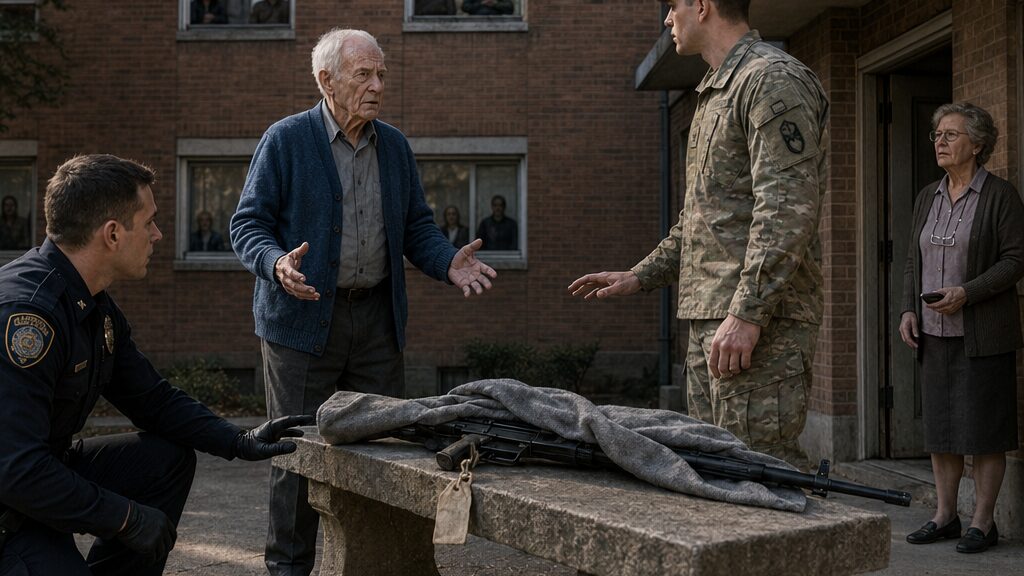
George Bennett had wrapped the rifle in a gray towel before sunrise, though by noon the towel had slipped loose at one end and showed the black barrel beneath it.
He had not meant for anyone to see it that way.
He had meant to carry it straight through the courtyard, past the stone bench, past the brick housing office, past the loading zone where the county shuttle stopped on Tuesdays. He had meant to sit on the shuttle with the rifle across his knees, quiet as luggage, and ride three towns over to the old base museum before his strength left him.
But the shuttle had already gone.
George stood under the pale afternoon light, breathing through the thin whistle in his chest, one hand around the towel-wrapped stock and the other braced against the bench. The courtyard was empty except for two pigeons pecking near the drain and the hum of an air conditioner mounted in the brick wall above the housing office door.
He lowered the rifle carefully onto the stone bench.
Not dropped. Not set down like trash. Lowered.
The bench was cold even through his palm. It had been donated by somebody’s family, a brass plaque darkened by rain at the base: For those who served and those who waited. George had passed it every morning for six years without sitting on it. Today he leaned over it as if it were the only solid thing left in the world.
The rifle lay sideways across the stone. The towel had opened enough to show the metal, dark and long against the pale bench. Near the trigger guard, a strip of faded cloth hung from a small loop. The letters on it were nearly gone, but George could still read them because he had read them a thousand times.
He touched the cloth with two fingers.
“I was told to bring it back clean,” he said.
His voice barely crossed the courtyard.
A window slid open above him.
George did not look up. His right hand had started to tremble, and he wanted it to stop before he tried lifting the rifle again. He flexed his fingers once, closed them, opened them. The tremor did not care what he wanted.
The door to the housing office opened behind him.
“Mr. Bennett?”
Kathleen Miller stood halfway out of the office with a file folder pressed to her chest. She was a brisk woman in her fifties who wore reading glasses on a chain and kept the courtyard notices taped in perfect rows behind the glass. George liked that about her. The notices did not sag when Kathleen put them up.
Her eyes dropped to the bench.
The folder slipped a little in her hand.
“George,” she said more quietly. “What is that?”
He kept his palm on the stone. “It’s not loaded.”
“That is not what I asked.”
“I know what you asked.”
Kathleen stepped fully outside, letting the door close behind her. “You can’t bring that out here.”
“I’m not leaving it here.”
“Then why is it on the bench?”
George looked toward the street. No shuttle. No bus. Just a gray sedan moving past the complex and the flag rope tapping softly against the pole.
“I had to stop,” he said.
Kathleen’s mouth tightened. She glanced up at the windows. George followed her gaze and saw curtains shifting. A face disappeared from the second floor. Someone else stayed where they were, only the shape of their head visible behind the screen.
“It’s disabled,” George said.
Kathleen did not come closer. “Step away from it, please.”
That hurt more than it should have.
Not because she was wrong to be careful. George knew careful. He had lived long enough to respect careful. But there were different kinds of distance in a voice, and Kathleen’s had become the kind people used when they were speaking to something unstable.
He straightened slowly.
His back objected. His left knee gave a small warning. He ignored both.
“I have paperwork,” he said.
“Do you have a case for it?”
“No.”
“Then you need to go back inside.”
“I can’t.”
“Mr. Bennett.”
“I can’t,” he repeated, sharper than he meant to.
The courtyard went still around the words. The air conditioner hummed. From somewhere above, a television laughed through a wall.
Kathleen took another step back toward the office door.
George saw the movement and understood. His hand rose, palm open, before she could say anything.
“I’m not threatening anybody.”
“I didn’t say you were.”
“You’re thinking about calling someone.”
Her face changed in a way that told him he was right.
A neighbor’s voice came from above. “Is that a gun?”
George closed his eyes.
“Please go back inside,” Kathleen called upward, then looked at him again. “George, listen to me. I know you probably have a reason, but I have residents here. I have children visiting. I have rules.”
“I have rules too.”
Kathleen blinked. “What?”
He looked down at the rifle. The towel had fallen open a little more. The barrel showed too plainly now. The thing looked harder than it was, colder than it had ever felt in his hands.
“I was told to bring it back clean,” he said.
Kathleen’s expression shifted from alarm to worry, and somehow the worry was worse.
“Who told you that?”
George pressed his lips together.
He had known this would happen if he said too much. People asked questions, then they leaned over the answer with soft eyes and careful hands. They took objects away. They said later. They said not today. They said it was too much for him.
It had been too much for him for fifty-two years.
That was not the same as being unable to do it.
“I need the shuttle,” he said.
“The shuttle left at eleven.”
“I know.”
“Then we’ll figure something out.”
“No.” He shook his head once. “Not we.”
Kathleen drew herself up, office manager returning to her shoulders. “Mr. Bennett, I cannot have a firearm sitting in the courtyard.”
“It isn’t a firearm anymore.”
“It looks like one.”
That was true. He had no answer for that.
The face in the second-floor window returned. Another curtain moved. The courtyard that had felt empty when George arrived now felt full of unseen breathing.
The rifle lay on the bench between him and the building like a question nobody wanted to ask properly.
Kathleen took out her phone.
George watched her thumb move. His first thought was not fear. It was irritation, small and useless, at the fact that the screen was bright enough to reflect in her glasses. His second thought was of Benjamin Harris laughing in rain, saying a man should always clean what he was trusted with, even if the world was ending.
“I can carry it inside,” George said.
“No,” Kathleen said quickly. “Do not touch it.”
Again, that tone.
George’s fingers curled at his side.
A screen door slapped somewhere to the left. A man at the edge of the courtyard stopped when he saw the rifle. He backed away, whispering into his own phone.
Kathleen turned from George and spoke into hers. “This is Kathleen Miller at the veterans’ housing courtyard on Mason Street. We have a resident outside with what appears to be a rifle.”
George looked at the flagpole, not at her.
“No, he isn’t pointing it,” Kathleen said. “It’s on a bench. He says it isn’t loaded.”
George lifted his eyes to the flag. It moved only a little. Not enough wind to raise it, just enough to worry the fabric.
“I understand,” Kathleen said. “Yes. He’s elderly. He’s standing near it.”
Elderly.
The word entered him like cold water finding a crack in stone.
He did not object. There was no point objecting to the truth. He was elderly. He had pill bottles lined on his kitchen counter and a daughter who checked his refrigerator for expired milk. He kept a chair near the shower because sometimes standing too long was a negotiation. He forgot the names of new residents and remembered the serial number on a rifle that had not been fired in half a century.
But elderly was not the whole truth.
Kathleen ended the call and kept the phone in her hand. “They’re sending an officer.”
George nodded once.
“You need to step over here with me.”
“I’ll stand where I am.”
“George.”
“I said I’ll stand where I am.”
His voice did not rise. That was what made Kathleen stop.
He placed both hands where she could see them, away from the rifle, palms forward. His right hand trembled. He let it. There was no hiding it now.
More faces appeared in the windows.
George could feel their fear before he could hear it. Fear had a pressure of its own. It pressed on old skin, old bones, old promises. It made a man into a headline before he had moved.
From the street came the first thin sound of a siren.
George turned toward it slowly.
The rifle remained on the stone bench, the faded cloth tag stirring in the faint breeze. He wanted to fix the towel around it. He wanted to cover it properly. He wanted to say that nobody had anything to fear from a promise kept too late.
Instead, he stood still, hands open, as the siren grew louder.
Chapter 2: Officer Carter Tells Him to Step Back
Patrick Carter saw the rifle before he saw the old man.
That was how training worked. Hands first, weapon second, faces last if there was time. He turned the cruiser into the loading zone outside the brick building, killed the siren, and let the flashing lights continue their silent red-blue wash over the courtyard. A few residents pulled back from the windows. One stayed watching with a hand pressed to the glass.
The rifle lay across the bench in plain view.
An elderly man stood eight or nine feet from it with both hands raised, not high, not dramatic, just visible. His white hair moved in the light breeze. His blue cardigan hung unevenly, one side bunched at the shoulder as if he had dressed in a hurry or with stiff fingers.
Patrick opened the door carefully.
“Mr. Bennett?” he called.
The old man looked at him. “Yes.”
“I’m Officer Carter. I need you to keep your hands where I can see them.”
“They are.”
“I see that. Thank you.”
Patrick kept his voice even. He had answered domestic calls, traffic accidents, store disputes, one school lockdown that turned out to be a balloon popping in a hallway. He had not answered a call like this: elderly resident, possible rifle, public courtyard, no active threat, unclear mental state.
Unclear was where mistakes lived.
Kathleen Miller stood near the office door, pale but composed. She pointed at the bench though nobody needed help seeing it.
Patrick moved slowly toward George, angling himself so he could see the old man and the rifle at once. “Is anyone else with you?”
“No.”
“Is that rifle yours?”
George did not answer immediately.
Patrick stopped.
George’s jaw shifted as though he were chewing on the question. “It’s in my keeping.”
That was not a useful answer.
“Is it loaded?”
“No.”
“When was the last time it was fired?”
“Before you were born.”
Patrick took that in without reacting. “I still need you to step farther back.”
“I’m far enough.”
“Sir, I need you to step back toward Ms. Miller.”
George’s eyes moved to Kathleen, then back to Patrick. Something in his face closed.
“Don’t call me confused,” George said.
Patrick blinked. “I didn’t.”
“You were about to.”
“No, sir. I’m trying to make the scene safe.”
“I’m not a scene.”
Patrick felt the words land somewhere he did not have room to examine yet.
Behind him, another cruiser pulled up but stayed at the curb. Good. Backup without crowding. Patrick lifted one hand, signaling the other officer to hold position.
“Mr. Bennett,” he said, “I’m going to secure the rifle. I’m not going to do anything sudden. You keep your hands visible.”
George nodded.
Patrick approached the bench.
The closer he got, the older the rifle looked beneath the black finish. It was not a sleek modern thing. The towel around it was soft from washing, frayed at the edges. A faint smell rose from it—oil, dust, old cloth. The rifle’s bolt area had been altered. Patrick could not yet tell how, but something about it did not match the panic in the dispatcher’s voice.
Still, he crouched first, then lowered one knee to the courtyard stones, keeping his body between the weapon and the nearest doorway.
“Do not reach for it,” he said.
George’s voice came quietly behind him. “I wasn’t going to.”
Patrick put on gloves.
The action seemed to affect the old man. Patrick saw it from the corner of his eye: a small tightening around the mouth, a shift of weight, the right hand closing and opening once.
“I’m checking that it’s safe,” Patrick said.
“You’ll scratch it if you turn it that way.”
Patrick paused.
The words had not been angry. They had been precise.
“How should I turn it?”
Kathleen made a soft impatient sound by the door. “Officer, please don’t let him direct you.”
Patrick kept his eyes on George.
George lowered his chin slightly toward the bench. “Lift from the stock and under the barrel. Don’t pull the cloth tag.”
Patrick looked down and saw the faded strip tied near the trigger guard.
He lifted the rifle the way George had said.
It was lighter than he expected. The chamber was empty. The firing mechanism had been disabled in a way that looked old but deliberate. The magazine well was blocked. It was, as George had said, not a functioning weapon. But to anyone at a window, to a passerby, to a frightened manager calling dispatch, it looked like one.
Patrick set it back down carefully.
“Disabled,” he said, partly to himself.
George’s shoulders lowered one fraction.
“But I still have to handle this by procedure,” Patrick continued.
George looked toward the towel. “Procedure won’t know where it belongs.”
“What does that mean?”
“It means it isn’t lost property.”
“I didn’t say it was.”
“You’re thinking about taking it.”
“I may have to.”
“No.”
The word came out low, not loud, but Patrick heard the old command shape in it. Not a plea. Not defiance for its own sake. A line.
Kathleen stepped closer. “George, you cannot refuse. This has gone far enough.”
George did not look at her. “It went far enough before you were born.”
Patrick stood slowly. “Sir, I need you to help me understand why you brought a disabled rifle into the courtyard.”
“I was on my way.”
“To where?”
“The museum.”
“What museum?”
George hesitated. “Base museum.”
“Do you have an appointment?”
“No.”
“Do they know you’re coming?”
“No.”
“Do you have documentation that they’re expecting this rifle?”
George’s eyes flicked to the towel. “I have a paper.”
“Where?”
“In my pocket.”
Patrick’s hand lifted slightly. “Do not reach for it yet.”
George froze.
There it was again, that flash in the old man’s face. Patrick had seen anger, panic, guilt, fear. This was none of them exactly. It was humiliation cut so fine it barely showed.
Patrick lowered his voice. “I’m going to ask you to tell me which pocket.”
“Inside left.”
“Can you keep your right hand visible and use your left slowly?”
George looked at him for a long second. Then he reached inside the cardigan with two careful fingers.
Kathleen inhaled sharply.
Patrick kept his stance ready, though he hated himself for it.
George withdrew a folded envelope, yellowed at the corners, soft from being handled. He held it out.
Patrick stepped forward and took it.
The paper inside was not a formal transfer form. It was an old handwritten note, flattened and re-folded until the creases had become permanent. Some of the ink had faded. At the top was a name Patrick could not make out. At the bottom was a line that seemed clearer than the rest.
Bring it back clean.
Patrick looked from the note to the rifle.
“Who wrote this?”
George’s mouth moved once before sound came. “A friend.”
“What friend?”
George looked away.
Kathleen crossed her arms. “Officer, I should tell you this isn’t the first time Mr. Bennett has had trouble with routines. Last month he missed rent office hours and insisted the calendar was wrong. He’s been getting worse.”
George’s face did not change, but Patrick saw the fingers of his right hand curl.
“Ms. Miller,” Patrick said, “please give us a minute.”
“With respect, this is my courtyard.”
“With respect,” Patrick said, still watching George, “I’m handling a police call.”
Kathleen stopped.
Patrick folded the note gently and put it back in the envelope. “Mr. Bennett, I believe you that it’s disabled. But from a public safety standpoint, I can’t allow you to walk around with it uncovered.”
“I had it covered.”
“It came uncovered.”
“I know.”
“Do you have someone who can drive you?”
George’s eyes changed again, this time with something like defeat.
“No,” he said.
“What about family?”
“My daughter would say no.”
“To driving you?”
“To the whole thing.”
Patrick glanced at the second cruiser. The other officer waited near the curb. A few residents had moved outside now, staying near the building edges, pretending not to stare.
The old man had become a public problem. Patrick could see the shape of it forming. A report. An evidence tag. A welfare concern. A call to adult services if somebody thought to make one. All the machinery that began moving once a person looked unable to manage himself.
Patrick had no authority to rewrite that machinery.
He also had no desire to crush a man under it without knowing why.
“I need to hold on to the rifle for now,” he said.
George’s eyes sharpened.
“No.”
“Mr. Bennett—”
“No.”
Patrick kept his voice calm. “If I leave it here and something happens, that’s on me.”
“If you take it and write the wrong thing on a form, that’s on me.”
Patrick had no quick answer.
A low rumble came from the street. A green National Guard utility vehicle slowed near the curb. Patrick glanced over, annoyed at first. He had not asked for Guard support. Then he remembered: the old armory two blocks away had weekend drill traffic, and someone had probably heard the call over a scanner or from a neighbor.
A young soldier stepped out, uniform neat, cap tucked under his arm. He scanned the courtyard, the officer, the rifle, the old man.
Kathleen moved toward him as if another uniform meant relief. “Thank goodness. Maybe you can help explain to Mr. Bennett that—”
The soldier raised one hand slightly, not rudely, just enough to pause her.
Patrick watched him approach.
George watched the rifle.
The soldier’s eyes dropped to the cloth tag near the trigger guard. Something in his stride changed. It was not dramatic. He simply slowed, as if the air had thickened.
Patrick felt the courtyard notice before he knew what it meant.
The soldier bent toward the bench.
George’s voice cut across the space, quiet and firm.
“Don’t pull the tag.”
The soldier stopped with his hand above it.
Then he looked at George differently.
Chapter 3: The Tag Brian Sullivan Recognized
Brian Sullivan had come because the call sounded wrong.
Not false. Wrong.
He had been returning from the armory with a box of training folders on the passenger seat when the radio chatter from the police channel filtered through the small speaker clipped near the dash. Elderly male. Rifle. Veterans’ housing courtyard. No shots. No threats. Subject refusing to leave weapon.
The words had placed a cold weight behind his ribs.
By the time he reached the courtyard, Officer Carter had one knee near the stone bench and one hand close to the rifle. The housing manager stood rigid by the office door. Residents watched from behind glass. An old man in a blue cardigan stood apart from everyone, hands visible, face drawn into the particular stillness Brian had seen in men who were trying not to be handled.
Brian first saw the rifle as a problem.
Then he saw the tag.
A faded strip of cloth, tied near the trigger guard, fluttered once in the weak breeze. Most people would have missed it. Brian almost did. But the shape of the lettering caught him before the words did. Three worn marks. An old unit abbreviation, stitched in dark thread that had bled into the fabric with age.
He stepped closer.
“Don’t pull the tag,” the old man said.
Brian stopped.
There was no fear in the warning. Only care.
Officer Carter looked from Brian to the old man. “You recognize something?”
Brian did not answer at once. He leaned nearer without touching the rifle.
The cloth was nearly the color of dirty bone. At one end, under a frayed knot, were the letters GHB. At the other was a partial name written in ink that had gone brown with time.
HARR—
Brian swallowed.
His grandfather had kept a shoebox full of old armory newsletters, reunion programs, memorial clippings. Brian had read them as a boy because boys read what is left on basement shelves when rain cancels baseball. One story had appeared again and again in those papers: the men of the old Harris-Bennett platoon, though the articles never officially called them that. Benjamin Harris. George Bennett. A rifle brought home disabled for training display, then lost from the inventory after a flood, disputed in records for decades.
And a phrase.
Brian had thought it was only family lore.
He looked up at the old man.
“What’s your name, sir?”
“George Bennett.”
Officer Carter turned slightly, as if hearing it fresh.
Brian straightened.
The courtyard seemed too small for the silence that followed.
Kathleen Miller frowned. “He already told us that.”
Brian ignored her without meaning to. He kept his eyes on George.
“George H. Bennett?”
George’s face tightened.
Nobody had used the middle initial in years except the Veterans Affairs clinic and the bank. He looked at the young soldier’s uniform, then at his face, searching for a memory that was not there.
“Yes,” he said.
Brian took one small step back from the bench.
His boots came together.
He raised his right hand and saluted.
It was not sharp enough for parade ground inspection. It was not big enough for spectacle. It was a restrained, careful salute in a courtyard where a frightened manager still clutched a phone and a police officer still had a report to write. But it changed the air.
Patrick rose from his kneel more slowly than he had intended.
Kathleen’s mouth parted, then closed.
George did not move.
For one second, Brian wondered whether he had made a mistake. The old man’s face did not soften. His eyes did not fill. He did not straighten into some restored version of himself. He only stood there, hands still visible, blue cardigan hanging crookedly, looking at a young soldier who knew too little and had saluted too much.
Then George’s right hand lifted.
The tremor was worse now. He fought it, failed, and completed the motion anyway. His fingers touched his brow.
He held the return salute for less than a breath.
“At ease,” George said.
The words came dry, almost worn out.
Brian lowered his hand. “Yes, sir.”
“Don’t call me sir unless you mean it after you hear the rest.”
Brian felt heat climb his neck. “I mean it now.”
“You don’t know enough.”
“No,” Brian said. “I don’t.”
That answer seemed to settle something.
Patrick looked at Brian. “You know him?”
“I know of him.”
Kathleen let out a small exhale. “What does that mean?”
Brian nodded toward the rifle. “That tag belongs to an old unit record. Or it matches one I’ve seen. I need to be careful how I say this because I don’t know the whole story.”
George looked at the bench. “Nobody does anymore.”
Patrick picked up on that. “Mr. Bennett, this rifle—”
“Was never mine,” George said.
The sentence fell harder than anything else he had said.
Brian looked down at the tag again. The partial name seemed clearer now that he knew what he was looking for.
HARRIS.
Patrick saw Brian read it. “Who is Harris?”
George’s lips pressed into a line.
A resident near the office doorway whispered something to another. Kathleen turned and told them to go inside. They did not.
George lowered his hand to his side. His tremor had become visible to everyone, and he hated that. He hated the way people’s eyes softened when the body betrayed what the voice could still hold.
“He told me to bring it back clean,” George said.
Brian felt the phrase pass through him like a remembered hymn.
Patrick’s brow furrowed. “Your note said that.”
Brian turned to him. “It’s more than a note.”
Kathleen’s patience snapped. “Then perhaps someone can finally explain why there is a rifle in my courtyard.”
George looked at her then. Not angrily. That might have been easier for her. He looked at her the way an old man looks at a closed door he no longer has the strength to push.
“I was on my way to return it,” he said.
“To whom?” Patrick asked.
“To where it should have gone before I got old.”
Brian lowered his voice. “The base museum?”
George’s eyes flicked to him.
That was answer enough.
Patrick looked between them. “Okay. Then we can call the museum. We can verify—”
“No,” George said.
Patrick stopped.
George reached for nothing, but his whole body leaned toward the bench. “You call them, and they’ll send somebody. They’ll take it. They’ll put it on a shelf under the wrong name. They’ll say thank you for your service and write a label that forgets him.”
“Benjamin Harris,” Brian said quietly.
George looked at him.
For the first time, the old man’s face changed completely.
It was not surprise. Not exactly. It was the pain of hearing a name return from a place where he had thought it would stay buried.
Kathleen’s expression shifted in spite of herself. “Who is Benjamin Harris?”
George did not answer her.
Brian wished he had not spoken the name in front of everyone. He had meant to help. Instead he had opened something without permission.
“I’m sorry,” he said.
George looked back at the rifle. “He was the man who owned it before ownership stopped mattering.”
Patrick’s radio crackled softly. He turned it down.
The courtyard, a few minutes ago crowded with assumption, now felt suspended. The same rifle lay on the same stone bench. The same old man stood beside it. The same officer stood near enough to stop him. Yet nothing in the scene meant what it had meant before.
Patrick removed his gloves.
George noticed.
That small action mattered more than Patrick expected it to.
“I still have to secure it,” Patrick said, but his voice had changed.
George nodded once. “Then ask before you touch it.”
Patrick took that in. Then he turned toward the bench.
“Mr. Bennett,” he said, “may I move the rifle back into the towel?”
George closed his eyes briefly.
“Yes.”
Patrick wrapped the towel around the rifle with slow hands. He avoided the tag. Brian watched the way the officer changed the angle of his fingers, no longer handling evidence only, but something entrusted.
Kathleen stepped closer, quieter now. “George, is there someone we should call?”
“My daughter,” George said.
“Nicole?”
He nodded.
Kathleen’s face tightened with worry again, but the sharpness had gone out of it. She lowered her phone and did not dial immediately.
Brian remained standing near the bench. He wanted to ask about the tag. He wanted to ask how the rifle had stayed with George all these years, why today, why alone, why the shuttle, why the note in the envelope. But questions could be another kind of grabbing.
So he waited.
George looked at him, then at the uniform.
“You with the armory?”
“Yes, sir.”
“You know the records office there?”
“Some. Not all.”
“Records lie when men are in a hurry.”
Brian nodded. “Then we should slow down.”
George studied him for a long moment.
Patrick finished wrapping the rifle. “I can’t let you carry it out of here alone.”
“I know.”
“I’m not saying you can’t finish what you came to do.”
Kathleen looked at Patrick in surprise.
George heard the difference too, but did not trust it yet.
From above, a window slid shut. Another remained open. The courtyard had witnessed enough to become a story by evening, and George knew stories changed in other people’s mouths.
Brian kept his hands at his sides.
“Mr. Bennett,” he said, “if you’ll allow it, I can help find the right record.”
George looked down at the covered rifle.
The cloth tag still showed beneath the towel, faded and stubborn.
“You found the name,” George said.
“Part of it.”
“That’s the easy part.”
Brian waited.
George lifted his eyes to him again. There was no gratitude in them yet. Only warning, and something more tired than warning.
“The hard part,” George said, “is telling why the rifle came home and he didn’t.”
Chapter 4: The Promise That Outlived the War
Nicole Bennett arrived with her hair still clipped back from work and her purse hanging open from one shoulder, as if she had left wherever she was without finishing the motion of leaving.
George saw her before she saw him.
She crossed the courtyard fast, then slowed when she noticed the police cruiser, the residents pretending not to watch, and the rifle wrapped in the gray towel on the bench. Her face changed in the same sequence it always did now: worry first, then calculation, then the controlled calm she used with doctors and pharmacists and the woman at the insurance office who spoke too quickly.
“Dad,” she said.
George did not like that word in this place. It made him smaller in front of people who already thought he needed managing.
“I’m all right,” he said.
Nicole looked at Patrick. “What happened?”
Patrick stood near the bench, one hand resting lightly on his belt, not on the rifle. He had put the gloves away. Brian remained a few feet back, quiet, his cap tucked under his arm. Kathleen stood by the office door with her file folder clutched so tightly the edges had bent.
“Your father brought a disabled rifle into the courtyard,” Patrick said. “We’re trying to determine the safest way to handle it.”
Nicole closed her eyes for half a second.
George watched that small movement and felt the old heat of embarrassment rise in him. She had been doing that since her mother died. Closing her eyes before answering him, as if he were a stove she had to touch carefully.
“Dad,” she said again, softer. “Why didn’t you call me?”
“You would have said no.”
“I would have driven you.”
“No. You would have said no first.”
She opened her mouth, then shut it because they both knew he was right.
Patrick looked from one to the other and said nothing.
Kathleen cleared her throat. “Nicole, I’m sorry we had to call you, but this frightened people.”
Nicole nodded automatically. “Of course. I understand.”
George looked down at the towel.
That was the part that tired him. Everyone understood everyone except him.
Nicole stepped closer but stopped before touching his arm. She had learned that much. “Can we go upstairs?”
“The rifle can’t.”
“We’ll let Officer Carter take care of it.”
“No.”
“Dad—”
“No.”
The word came out with too much force. A woman near the building entrance flinched. George saw it and hated himself for giving fear another reason to live in the courtyard.
He lowered his voice. “It doesn’t belong in a property room.”
Nicole looked at the bench, then at him. “Then where does it belong?”
George drew in a breath that caught halfway. For a moment he was not in the courtyard. He was in his apartment before sunrise, standing at the kitchen table under the weak yellow bulb, wiping the rifle with oil he had bought twenty years earlier and almost never used. He had moved slowly because his fingers would not hurry and because the rifle deserved better than hurry.
He had cleaned it because Benjamin had said clean.
He had wrapped it because carrying it bare would have been wrong.
He had left before calling Nicole because daughters knew how to turn a promise into an appointment.
“The base museum,” he said.
Nicole’s face went still. “You were going to take that on the shuttle?”
“Yes.”
“Dad, you can’t carry a rifle onto a public shuttle.”
“I know that now.”
“You knew that before.”
George looked away.
There were things a man knew in one part of his mind and things he refused to know in the part that still held a task. He had pictured the shuttle nearly empty. He had pictured the towel staying closed. He had pictured the driver remembering him from grocery Tuesdays and saying nothing. He had pictured arriving before his hands gave out.
He had not pictured windows full of frightened faces.
“Let’s go upstairs,” Nicole said. “Please.”
George heard the plea beneath the instruction and wished it did not work on him.
Patrick wrapped the rifle more securely and carried it only after asking George with his eyes. George nodded once. Brian walked beside him but did not touch it. Kathleen unlocked the side office instead of making them pass through the lobby.
Inside, the housing office smelled of copier paper and lemon cleaner. Kathleen cleared a conference table that was too small for the rifle and then seemed to realize it before George had to say anything.
“Not there,” he said.
Kathleen paused.
“Please,” George added.
Patrick looked around, then chose a long wooden side table beneath a row of resident notices. “Here?”
George studied it. No food, no clutter, no metal edges. “Yes.”
Patrick laid the wrapped rifle down.
Nicole stood with her arms crossed, not angry now, only frightened in the way grown children become frightened when their parents reveal a private life they had not been allowed to organize.
George lowered himself into a chair. He hated that too, but his knees were no longer negotiating.
Brian remained standing near the door. “Mr. Bennett, you said the rifle was never yours.”
George looked at him. “It was issued to Benjamin Harris.”
Nicole turned. “Who is Benjamin Harris?”
The name filled the room more completely than any answer could.
George reached into his cardigan and took out the envelope again. Patrick moved slightly, then stopped himself. That small restraint did not escape George.
He opened the envelope and withdrew the note.
His daughter had seen many of his old papers after her mother died. Insurance policies, service records, discharge forms, photographs of men whose names she knew only because George had written them on the backs. She had not seen this note.
George laid it flat with his fingertips.
The paper had softened almost to cloth. The words at the center were faded, but the last line remained clear.
Bring it back clean.
Nicole leaned in. “He wrote that?”
“On a night we thought we had two hours to sleep,” George said. “He was always cleaning something. Boots, rifle, canteen, a spoon if he had nothing else. Said a man shouldn’t return anything dirty if he had the chance to return it at all.”
Brian listened without moving.
George kept his eyes on the note, not on them. “The rifle came back with me because the record was wrong. The crate was marked damaged training equipment after the flood at the temporary depot. Nobody wanted it, and I knew whose it was.”
“You took it?” Nicole asked.
George looked at her.
Not sharply. Just enough.
“I kept it from being thrown away.”
Her face colored. “I didn’t mean—”
“I know what you meant.”
Kathleen shifted her weight. “George, why now?”
Because the clinic had called about another scan. Because he had stood in his kitchen three weeks ago and forgotten why he was holding a glass. Because Nicole had started labeling his pill organizer in bigger letters. Because there were mornings when the old names came faster than new ones, and that frightened him more than death ever had.
But he would not give all that to the room.
“I waited too long,” he said.
Nicole sat across from him. “You should have told me.”
“I should have done a lot of things.”
“That isn’t an answer.”
“It’s the one I have.”
Patrick glanced at the rifle. “Mr. Bennett, if the museum is the destination, we can contact them and arrange a proper transfer.”
George shook his head. “Not unless the record says his name.”
“Benjamin Harris?”
“Yes.”
“And yours?”
George’s fingers flattened the edge of the note. “Mine only if they need someone living to sign.”
Nicole’s voice lowered. “Dad, what happened to him?”
George looked at the cloth tag peeking from the towel. He could still see Benjamin’s hand tying it there, joking that nobody ever returned the right rifle after cleaning day. He could still hear him saying, Bennett, if I don’t get back, don’t let some lazy clerk mark my gear lost.
That had been before they knew who would and would not get back.
George folded the note along its old creases.
“He made me promise,” he said.
Nicole waited.
He put the note back in the envelope. “That is enough for today.”
For a moment she looked ready to argue. Then her eyes moved to his hands. The tremor was no longer small. It shook the envelope before he could return it to his pocket.
Nicole reached across the table, then stopped.
George saw the effort it cost her not to take over.
“Okay,” she said. “Not everything today.”
Patrick looked at Brian. “Can you check the armory records?”
“I can start,” Brian said. “The old unit files aren’t all digitized.”
“Then start with what you know.”
Brian nodded.
Kathleen looked at George, her file folder still bent in her hands. “I’m sorry people were frightened.”
George looked at her for a while.
“That isn’t the same as being sorry you frightened me,” he said.
Kathleen’s face tightened. Not with anger. With the sting of being correctly named.
Nicole whispered, “Dad.”
“No,” Kathleen said, surprising them both. She looked at George. “He’s right.”
The room went quiet.
George stood with effort. Nicole rose instinctively but did not touch him.
“I need to go upstairs,” he said.
Patrick glanced at the wrapped rifle. “We’ll keep it secured here until we have transport.”
George stopped at the door.
“No property tag,” he said.
Patrick met his eyes. “Not yet.”
“Not abandoned.”
“No.”
George nodded.
Nicole walked beside him into the hall. They moved slowly, not because she made him, but because his body required the truth.
At the elevator, she pressed the button and kept her finger there longer than necessary.
“You scared me,” she said.
“I know.”
“You do that more than you think.”
George looked at the closed elevator doors. In the reflection, he saw an old man with white hair and a blue cardigan standing beside a daughter who had learned to worry for both of them.
“I was trying to finish before I couldn’t,” he said.
Nicole turned to him.
The elevator opened before she could answer.
Behind them, in the office, the rifle waited on the side table, wrapped carefully, the faded tag still visible like a question nobody was done asking.
Chapter 5: Evidence, Property, or Promise
Patrick Carter wrote the word rifle on the form and then stared at it until it looked insufficient.
The property room at the station had no patience for meaning. It had shelves, lockers, numbered bags, red tags, yellow tags, zip ties, receipt slips, and a buzzing fluorescent light that made every object look guilty. A bicycle with a bent wheel leaned beside two toolboxes. A row of phones sat in plastic bags. A wedding ring in an envelope waited for someone to prove it was theirs.
The wrapped rifle lay on the counter between Patrick and the property clerk.
“Need a case number,” the clerk said.
Patrick looked at the form. “It isn’t exactly evidence.”
“Then property.”
“It isn’t abandoned property.”
“Safekeeping?”
Patrick hesitated.
The clerk tapped a pen against the counter. “Carter.”
“Safekeeping,” Patrick said at last.
The clerk pulled out the correct tag. “Owner?”
Patrick thought of George’s face when he said, It was never mine.
“Custodian,” Patrick said.
The clerk stared at him. “That is not a box.”
“Then leave owner blank.”
“Can’t.”
Patrick rubbed the bridge of his nose. He had slept badly. Every time he closed his eyes, he saw George standing in the courtyard with both hands visible, not afraid exactly, but forced into the shape of someone who had to prove he was safe.
“Put George Bennett as reporting party,” Patrick said. “Do not mark him as owner.”
The clerk gave him a flat look but wrote it.
“And don’t cut the cloth tag.”
“I wasn’t going to cut anything.”
“Don’t zip-tie through it either.”
The clerk stopped writing. “You want to do my job?”
“No.”
“Then let me tag the item.”
Patrick exhaled slowly. “Sorry.”
The clerk looked at him for another second, then reached for soft ties instead of plastic ones.
That should have been enough.
It was not.
The form still asked for disposition. Evidence. Destroy. Return. Auction. Transfer. The ordinary fates of ordinary things. None of them fit a rifle that an old man had carried for half a century because another man had not come home.
Patrick signed the temporary safekeeping line and carried his copy into the hallway.
His phone buzzed before he reached his desk.
Kathleen Miller.
He almost let it go to voicemail. Then he thought of George’s words in the office and answered.
“Officer Carter.”
“Nicole is with him,” Kathleen said without greeting. “He’s resting.”
“Good.”
“I wanted to ask what happens now.”
“We’re checking records. I’ll contact the museum.”
A pause. Papers rustled faintly on her end. “I also wanted to say I reviewed our resident policy.”
Patrick looked down the hallway toward the property room. “Okay.”
“There’s nothing about antique firearms or military donations.”
“I wouldn’t expect there to be.”
“No. I mean, I don’t know what I should have done.”
Patrick leaned against the wall. “You called because you were worried.”
“I called because I saw a gun.”
“Yes.”
“And because he’s been late with things. Forgetful. Different.” Her voice tightened. “I let that become the whole explanation.”
Patrick had no easy comfort to offer. He had done the same thing, only with a badge.
“People were scared,” he said. “That part was real.”
“So was he.”
Patrick closed his eyes briefly.
Kathleen continued, quieter. “If you need the office for paperwork or transport, use it. I’ll make sure nobody bothers him.”
“Thank you.”
After the call, Patrick returned to his desk and searched for the base museum number. The first call went to a recording. The second reached a clerk who sounded young and overworked.
“We can accept historic donations by appointment,” the clerk said. “We’ll need provenance documentation, condition notes, and a transfer form.”
“I have a disabled rifle connected to an old unit record. Elderly veteran attempted to bring it in personally.”
“Do you have proof of connection?”
“A handwritten note, cloth tag, possible unit abbreviation, and a living veteran’s statement.”
“That may not be enough for cataloging.”
Patrick looked through the glass toward the property room door. “What would be enough?”
“Service records. Issue records if available. A signed provenance statement. Any confirming documentation from the armory archive.”
“And if we can’t get all that?”
“Then it could be accepted as general military material if approved.”
General military material.
Patrick imagined telling George that.
“No,” he said.
The clerk paused. “Excuse me?”
“Nothing. I’ll call back.”
He hung up before politeness made him say something unhelpful.
By noon, Brian Sullivan arrived at the station carrying a thin folder and looking as if he had been given a job larger than his rank. Patrick met him in the lobby.
“I got into the old index,” Brian said. “Not the full archive. The records assistant at the armory let me look at scanned summaries.”
“And?”
Brian opened the folder. Inside were photocopies of faded rosters, old inventory sheets, and a grainy black-and-white photograph of a line of young men standing with rifles outside a low building.
Patrick saw George before Brian pointed him out.
Not the old man from the courtyard. A narrow-faced young soldier with dark hair, shoulders squared, mouth set too seriously for his age. Beside him stood another young man with a grin wide enough to survive bad photocopying.
Brian tapped the smiling one. “Benjamin Harris.”
Patrick studied the picture.
There was no dramatic revelation in it. Just two young men who did not know they would become evidence of anything.
“The tag abbreviation matches their training platoon,” Brian said. “The rifle serial range matches equipment assigned to that depot. I don’t have the individual issue card yet.”
“Can we get it?”
“Maybe. The records assistant said some cards were water damaged. Some were transferred to the museum years ago. Some are just gone.”
Patrick looked at the folder. “George said records lie when men are in a hurry.”
Brian gave a small, humorless smile. “He may be right.”
They drove together to the housing office. The rifle remained locked in Patrick’s cruiser trunk, still wrapped, still not tagged as evidence. He had signed it out under safekeeping with more explanation than the form wanted.
George was waiting in Kathleen’s office when they arrived.
Nicole sat beside him, a paper cup of water untouched near her hand. She looked tired. George looked smaller than he had in the courtyard, but not weaker. There was a difference Patrick was only beginning to understand.
Kathleen had cleared the side table again.
Patrick did not bring the rifle in yet.
“I spoke with the museum,” he said. “They need a provenance statement.”
George nodded. “I can make a statement.”
“They also need documentation.”
Brian placed the folder on the table. “I found partial records.”
George did not reach for them. “Partial records make partial truths.”
Nicole looked at him. “Dad, it’s a start.”
“It’s a start for them. Not for Benjamin.”
Patrick sat across from him. “Mr. Bennett, there’s a form at the station that would let us release the rifle for transfer, but it needs your signature.”
George looked at him. “What does the form call it?”
Patrick hesitated.
George’s face hardened. “Say it.”
“Safekeeping property.”
“No.”
Nicole sighed softly. “Dad.”
“No,” he repeated. “Property is what a man owns. Evidence is what a man is accused by. That rifle is neither.”
Patrick laid the blank copy on the table anyway. “The system may not have better language.”
“Then the system can wait.”
Kathleen stood near the window, listening.
Patrick felt irritation rise, then caught it. He had spent the morning trying to bend procedure around one old man’s meaning. He was tired. The form was the form. A signature would get the rifle moving. Refusal would trap it.
But George’s refusal was not stubbornness for its own sake.
It was the only piece of control he had left.
“What word would you use?” Patrick asked.
George looked at the table for a long time.
“Promise,” he said.
No one spoke.
Patrick glanced at Brian, then back at the form. There was no box for promise. No code. No dropdown.
He picked up his pen and wrote in the margin: Held for transfer pending provenance statement from George Bennett regarding Benjamin Harris.
The clerk would hate it. The report system might hate it more.
Patrick slid the form back.
“I can’t change the boxes,” he said. “But I can add the note.”
George read the sentence twice.
Nicole leaned closer. “Dad?”
George touched the margin where Patrick had written Benjamin’s name.
“You spelled it right,” he said.
Patrick nodded.
George signed.
His hand shook badly enough that the signature came out jagged, but it was his.
Brian opened the folder and pushed the old photograph toward him. “Is this him?”
George looked.
The room seemed to pull away from him. The walls, Kathleen’s desk, Patrick’s uniform, Nicole’s anxious breathing—all of it thinned behind the image of Benjamin Harris grinning at a camera as if the world had no right to become terrible.
George placed one finger near the photograph but did not touch Benjamin’s face.
“Yes,” he said.
Brian lowered his voice. “And this is you?”
George looked at the serious young man beside Benjamin.
“That boy thought he had time,” he said.
Nicole covered her mouth with one hand.
Patrick did not ask another question.
Outside, a child laughed somewhere in the courtyard, then was hushed by an adult. Life continuing with poor timing.
Brian removed another page from the folder. “The records assistant found something else. It’s not the issue card, but it lists two service numbers beside a damaged equipment transfer. Harris and Bennett. Same line.”
George’s eyes lifted.
Patrick saw it happen: not relief, not yet, but the first crack in the wall of being the only living witness.
Brian tapped the page. “It may be enough to get the museum to pull the deeper archive.”
George looked at the copied line where two names sat beside each other in faded type.
For a moment, he seemed to forget the room was watching.
“There he is,” George whispered.
Nicole’s eyes filled, but she did not interrupt.
Patrick folded his copy of the signed form and placed it in his pocket.
He had come that morning wanting to solve a procedural problem. He left the office understanding that procedure had become the least important thing in the room, and also the thing that could still ruin everything if handled carelessly.
At the door, Brian’s phone buzzed. He looked at the screen, then at Patrick.
“The records assistant found another box,” he said. “She says George Bennett’s service number is written next to Benjamin Harris’s on the original transfer sheet.”
George closed his eyes.
The chair creaked under him.
Nicole reached toward his arm and stopped again.
This time, George placed his trembling hand over hers.
Chapter 6: The Name Written Beside His
The base museum records office was smaller than George remembered, though he had never actually been inside it.
He had passed the building years ago, back when his knees still trusted him and Nicole’s mother was alive. They had driven by after an appointment at the clinic, and she had pointed to the low brick structure beyond the fence.
“You should donate some of your things there,” she had said.
“I used most of them up,” George had answered.
She had smiled because she thought he was joking. He had let her.
Now he stood just inside the records office with Nicole at his left, Patrick at the door, and Brian speaking quietly with the clerk behind a counter. The rifle, secured in a plain case Patrick had borrowed from the department, rested on a clean table covered in dark cloth. George noticed that first. Not the flags folded in display cases, not the photographs on the walls, not the old helmets behind glass.
The rifle was not on stone now.
It lay level and supported, no longer exposed to courtyard eyes.
The clerk came around the counter with a folder. “Mr. Bennett?”
George looked at her.
“If you’re ready, I can take your statement.”
Nicole’s hand twitched at her side. George saw it and knew she wanted to ask whether he needed to sit, whether he needed water, whether they could do this another day. She did not ask. That restraint was new enough to feel like a gift with sharp edges.
“I’ll sit,” George said, before anyone could suggest it.
Patrick pulled out a chair but did not touch George’s elbow. Brian stood back from the table, cap under his arm again.
The clerk placed a recorder near the folder. “This is only for transcription. We can stop anytime.”
“No,” George said. “If I stop, I might not start right again.”
Nicole looked down.
The clerk nodded and turned on the recorder.
George stated his name. Full name. George Harris Bennett. The middle name made Nicole glance up; he had rarely used it. Patrick noticed too, but did not ask.
“Were you related to Benjamin Harris?” the clerk asked.
“No.”
Then, after a pause, “Not by blood.”
The clerk waited.
George looked at the rifle case. “He was better at making people less afraid. Some men are born with that. We were young. Younger than we knew. He cleaned everything when he was nervous. Said dirt was one enemy you could beat if you had a rag and time.”
Brian’s eyes lowered to the cloth tag.
“He tied that strip on the rifle because equipment got mixed up. He wrote his name because he didn’t trust the quartermaster. Then he put my initials on the other end because I borrowed it during training and he said if I dented it, he’d know who to blame.”
The clerk’s pen moved softly.
George’s breathing grew shallow. Nicole shifted but held her place.
“There was rain,” George said. “Too much rain. The depot flooded later, and that’s why the records got ruined, but that wasn’t the rain I remember first.”
No one interrupted him.
“We were pinned down near a washout. Not the kind of story men tell cleanly. Noise, mud, bad orders, worse luck. I had taken a piece of metal in my leg and thought it was less than it was. Benjamin knew better. He dragged me where the ground dipped. I told him to leave the rifle. He said if he left it, some fool would say he lost government property.”
The corner of George’s mouth moved, but not into a smile.
“He put it across me while he worked the strap around my leg. Told me to keep pressure. Told me, ‘Bennett, if I don’t get back, bring it back clean.’ I told him he was an idiot.”
The recorder’s red light glowed.
“He went back for the other man.”
Nicole closed her eyes.
George’s hands rested flat on the table now. The tremor was still there but spread through the wood, softened by contact.
“He got the other man out,” George said. “Then the hill came apart.”
The clerk stopped writing for a moment.
Patrick looked at the floor.
Brian stood straighter, not for show, but because his body seemed to need discipline around the story.
“When they moved us, the rifle came with my kit. Maybe because it was across me. Maybe because someone was tired. Maybe because records lie when men are in a hurry. Later, after hospitals and transfers and forms, I saw it in a crate marked damaged training equipment. Harris wasn’t on the tag anymore. Bennett was. I could have corrected it then.”
He swallowed.
“I didn’t.”
Nicole looked at him. “Dad.”
George shook his head once, not harshly. “Let me say it.”
She fell silent.
“I told myself I was keeping it safe until the paperwork caught up. Then I told myself I was waiting until I knew what to say to his family. Then his parents died, and I told myself there was nobody left to tell. Then I had a wife, a child, a job, bills. Years make cowards look patient.”
His voice cracked on the last word. He waited until it steadied.
“I cleaned it every year. Not because it needed cleaning. Because he had asked. That was the easy part of the promise. The hard part was bringing it back.”
The clerk wiped beneath one eye quickly, as if hoping no one noticed.
George noticed and did not mind.
She opened the folder. “The original transfer sheet lists Benjamin Harris and George Bennett on the same damaged equipment line. It doesn’t identify the rifle by full serial number, but the range matches. Your statement and the cloth tag may be enough to catalog it with both names.”
“No,” George said.
The clerk froze.
Nicole leaned forward. “Dad?”
George looked at the rifle case. “Not both the same.”
The clerk waited.
“Benjamin Harris first. Issued to him. Kept by me. Returned by me. But not mine.”
The clerk wrote that down.
Patrick’s eyes moved to George’s face. Something in the officer’s expression had changed since the courtyard. He no longer looked like a man trying to decide what risk George represented. He looked like someone trying to learn the right shape of help.
“We can word the donor line carefully,” the clerk said. “There is also a question of legal ownership.”
George gave a dry breath. “There always is.”
“We’re not trying to take the story from you.”
“I know.”
Nicole looked at the clerk. “Can the display say why he kept it?”
George turned to her.
She held his gaze, uncertain but steady. “Not all of it if you don’t want. But enough that people don’t just see a rifle.”
George looked back at the case.
For most of his life, he had not wanted people to see anything. Not the rifle. Not the promise. Not the selfish relief of surviving. Not the shame of waiting until age forced honesty upon him.
But the courtyard had shown him what silence could become in other people’s minds. A weapon. Confusion. Danger. Decline.
Maybe meaning left unattended became its own kind of lie.
“Enough,” he said.
The clerk nodded.
Brian stepped forward only after George looked at him.
“Mr. Bennett,” Brian said, “the records assistant found an old memorial program. Benjamin Harris’s name is listed with two others from that action. There’s no detail, just names.”
George absorbed that.
“Does it say he went back?”
“No.”
“Then put it in mine.”
Nicole’s breath caught.
George touched the table once, near the rifle case. “Not to make him a hero. He was one before that. Put it because he should not disappear under damaged equipment.”
Patrick said, quietly, “He won’t.”
George looked at him.
It was a promise Patrick had no full power to make. Both men knew it. Still, it was not empty.
The clerk turned the folder so George could see the draft line she had written.
Benjamin Harris, service rifle, later disabled; kept and returned by George Harris Bennett in fulfillment of a personal promise.
George read it slowly.
His lips moved around Benjamin’s name without sound.
Nicole placed her hand on the table near his, not touching.
This time, he moved his fingers until they rested against hers.
The clerk slid another form forward. “I’ll need to ask what name should appear as the donor of record.”
The question seemed simple. It was printed on a form with a blank line, waiting for ink.
George looked at the rifle case, the folder, the young soldier, the officer, his daughter.
For fifty-two years, he had carried a thing under the wrong name because the right one hurt to say.
Now the blank line waited, and everyone in the room waited with it.
Chapter 7: He Asked Permission Before He Touched It
George did not answer the clerk right away.
The blank line waited beneath the printed words Donor of Record, clean and indifferent. It would accept whatever hand filled it. It would not know the difference between truth and convenience unless someone made it know.
For most of his adult life, George had allowed forms to do what forms did. They shortened. They sorted. They placed men in boxes narrow enough for file cabinets. He had told himself a form could not harm the dead if the living remembered correctly.
Then years passed, and living memory became an old man alone at a kitchen table, cleaning a disabled rifle under a yellow bulb while the rest of the world slept.
Nicole sat beside him without speaking. Her hand still rested near his, close enough that he could feel the warmth of her but not the pressure. She had been a child when he first locked the rifle behind the panel in the hall closet. He remembered her running past that closet in socks, dragging a stuffed rabbit by one ear, never knowing what slept behind the wood. Later, when she was older and asked why the closet stuck, he told her the building had settled.
A house could settle around a lie. So could a life.
George picked up the pen.
His fingers trembled. The pen tip hovered over the line, making a dot of ink before he had written anything.
“Take your time,” the clerk said.
George almost laughed. Not because it was funny, but because time was exactly what he had mishandled.
He wrote slowly.
Returned by George Bennett, kept for Benjamin Harris.
The line was not long enough. The words crowded at the end, the last letters shrinking to fit. It looked untidy. It looked human.
The clerk read it, then looked up. “We can enter it that way.”
“Don’t fix it,” George said.
“I won’t.”
“Not donated by George Bennett.”
“No.”
“Returned.”
“Yes.”
He set the pen down.
Nicole looked at the words and pressed her lips together. She did not cry. George was grateful for that. He had no strength left for comforting her, and he suspected she knew it.
The clerk turned the page gently. “There’s one more signature needed to complete the transfer. It confirms that you are releasing the item to the museum for preservation.”
George nodded.
Patrick stepped forward. “Before that, Mr. Bennett, the rifle has to be moved from the case to the intake table for the condition photographs.”
The case sat between them, plain and black, borrowed from the police department. It had looked wrong from the beginning, but it had protected the rifle, and George had learned over the years not to reject useful things because they were imperfect.
Patrick placed one hand near the latch, then stopped.
In the courtyard, he had knelt beside the rifle as if the whole world depended on his control of it. He had worn gloves. He had spoken in commands. George had understood why, even when it stung.
Now Patrick looked directly at him.
“Mr. Bennett,” he said, “may I open the case?”
George’s chest tightened.
A small question. A simple one. The sort of question no form required and no policy would remember. Yet it changed the room more than the salute had. The salute had recognized what George had been. This question recognized that he was still there.
“Yes,” George said.
Patrick opened the case.
The towel lay folded around the rifle, the faded cloth tag visible near the trigger guard. Patrick did not reach in immediately. He waited again.
George nodded.
Only then did Patrick lift the rifle, supporting the stock and barrel the way George had told him in the courtyard. He avoided the tag. He avoided scraping the metal against the case. He moved slowly, not ceremonially, not theatrically, just carefully.
Brian stood at attention without making a show of it.
The clerk had prepared a clean table with a dark cloth. Patrick laid the rifle there. The old object seemed different under museum light. Smaller. Less capable of frightening anyone. More capable of breaking a heart.
George leaned forward.
The cloth tag had twisted slightly. He reached toward it, then paused when his hand shook.
Nicole saw.
“Do you want me to—” she began.
George shook his head.
He took the tag between two fingers and turned it gently until the letters faced upward.
HARRIS.
The word was not complete anymore. Time had eaten part of it. But enough remained.
“Benjamin Harris,” George said.
The clerk wrote it down.
“Service rifle, later disabled,” she said softly, confirming the intake line.
“Kept clean,” George added.
The clerk looked at him.
“Put that somewhere,” he said. “Not on the big label if it doesn’t fit. Somewhere.”
“I will.”
Brian cleared his throat. “Mr. Bennett, the records assistant sent the memorial program over. It lists Benjamin Harris under his full name. No family contact current, but the museum can flag the record if any relative ever asks.”
George absorbed that slowly.
For years, one of his excuses had been that there was nobody left. Parents gone, letters unanswered, old addresses dead ends. He had let the absence become permission to delay. Now, even the possibility of someone asking one day felt like a door he had almost failed to leave unlocked.
“If they ask,” George said, “tell them he went back.”
The clerk nodded. “We’ll include your statement.”
“Not all of it.”
“Only what you approved.”
George looked at Nicole.
She understood the question before he asked it. “I’ll help review it,” she said. “Only if you want.”
“I want.”
Her face softened in a way that made her look briefly like the girl with the stuffed rabbit, standing in a hallway outside a closet she did not know mattered.
George signed the final release.
His signature was worse this time, the B in Bennett nearly collapsing into the line. The clerk did not ask him to redo it.
When the paperwork was finished, no one applauded. No one suggested a photograph. No one asked George to stand beside the rifle and smile. The clerk simply placed the forms in a folder, labeled it with Benjamin’s name first, and carried it to a cabinet behind the desk.
Patrick closed the empty case.
George watched the rifle remain on the museum cloth.
For fifty-two years, he had thought returning it would feel like setting down weight. Instead it felt like removing his hand from a railing before he was sure he could stand.
Nicole touched his sleeve. “Dad?”
He nodded, though she had not asked anything.
Brian stepped forward. “Mr. Bennett.”
George looked up.
Brian raised his hand in another salute. This one was quieter than the first because there was no crowd to misunderstand it and no danger to interrupt it. It belonged only to the room.
George returned it more slowly.
His hand shook all the way up and all the way down.
“Take care of the records,” George said.
“Yes, sir.”
This time, George did not correct him.
Patrick drove them back in the late afternoon. Nicole sat beside George in the rear seat, not because he needed watching but because she wanted to sit there. The borrowed rifle case was no longer in the trunk. Its absence seemed to fill the car.
The courtyard was calm when they returned. The stone bench sat under the same pale light, empty now except for a dry leaf caught against the plaque.
For those who served and those who waited.
Kathleen Miller came out of the office as soon as she saw the cruiser. She did not hurry the way she had during the call. She walked steadily, hands empty. No phone, no file folder.
“Mr. Bennett,” she said.
George noticed the name. Not George. Not Dad through someone else’s mouth. Not elderly resident. Mr. Bennett.
“Kathleen.”
She glanced at the bench. “I spoke with the residents this afternoon. Not about your private business. Just about what happened here. I told them the courtyard is safe, and I told them assumptions made it worse.”
George looked toward the windows. A curtain moved on the second floor. This time, it did not feel like a witness hiding.
Kathleen swallowed. “I’m reviewing how we handle resident belongings. Old records, military items, family things. Staff will ask before deciding something is junk or a problem.”
George studied her.
“That policy have a box for promise?” he asked.
A small, surprised breath left her. “Not yet.”
“Make one.”
“I will.”
Nicole looked down, almost smiling.
Patrick had