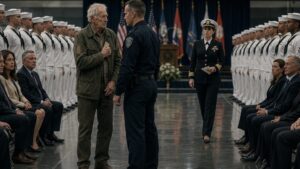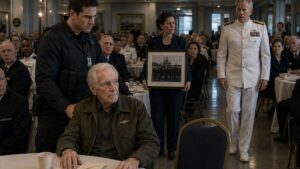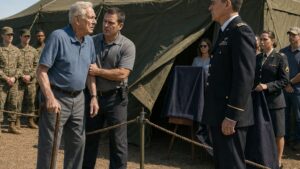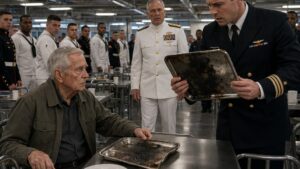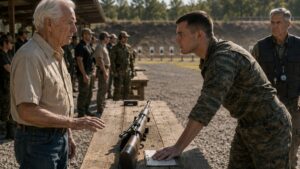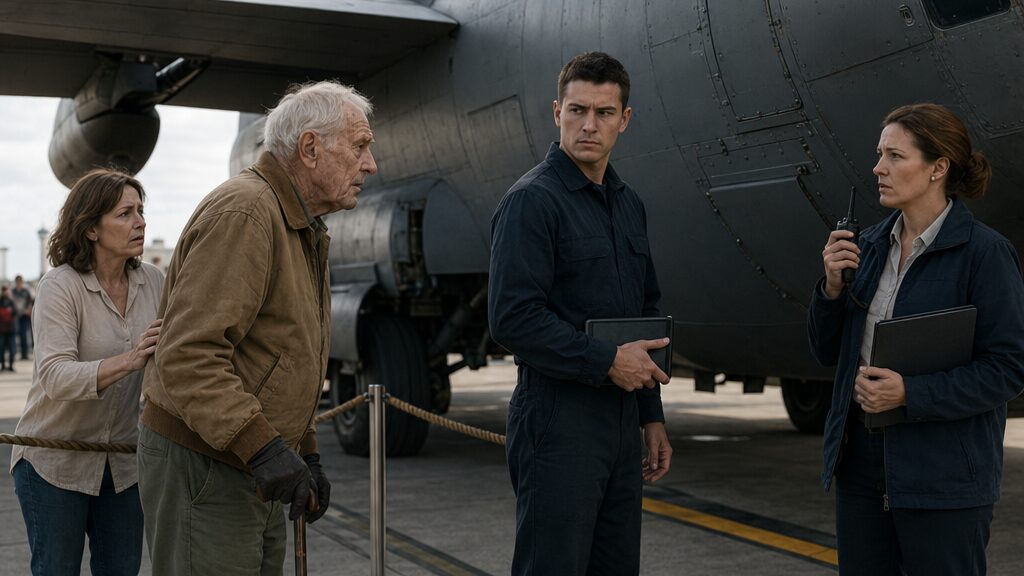
The Old Veteran Pointed at One Loose Panel Before the Young Technician Finally Listened
Chapter 1: The Old Man Under the Wing
Alexander Bennett arrived before the crowd gates opened.
He came in Sarah’s car, sitting in the passenger seat with both hands folded over the head of his cane, watching the base road curve past low hangars and trimmed grass that had not been there when he was young. The morning was still gray at the edges. Sunlight caught the tops of antennas, the tower windows, the tail fins of aircraft parked beyond the security fence. Everything looked cleaner than memory. Brighter. More measured. Less oil under the fingernails.
Sarah slowed at the checkpoint. A security guard leaned toward her window, checked the printed visitor pass, then glanced at Alexander.
“Memorial event?” the guard asked.
Sarah smiled politely. “Yes, sir.”
Alexander did not correct the “sir.” He had spent too many years answering to it, giving it, hearing it shouted through wind and engine noise. Now it floated around him loosely, a coat that no longer fit quite right.
The guard waved them through.
“You okay?” Sarah asked after the gate lifted.
Alexander looked at the flight line instead of her. “I’m not made of glass.”
“I didn’t say you were.”
“You were warming up.”
She tightened both hands on the steering wheel, then let one loosen. “Dad.”
He turned his head enough to see the worry she was trying to hide. At fifty, Sarah Morgan had inherited her mother’s careful mouth, the one that held back the first thing it wanted to say and softened the second. She had taken the morning off work, printed the map, packed water, packed his medication in a small zippered pouch, and reminded him twice to wear the tan jacket even though he had already laid it across the back of the kitchen chair before dawn.
“I’m fine,” he said.
Sarah did not believe him, but she let him have it.
The parking area for guests sat beyond a row of temporary barricades. Volunteers in orange vests directed traffic. Farther out, flags moved in the warm wind. Families were already walking toward the seating tents with folding chairs, sunscreen, small children wearing oversized ear protection. A memorial airshow, the flyers had called it. Static displays. Flyover. Speeches. Veterans’ recognition tent. Educational demonstrations. Community appreciation.
Alexander had not planned to come.
The invitation had arrived three weeks earlier, printed on glossy card stock with a photograph of the aircraft on the front. Not the exact one he had served beside, but close enough to make his right thumb press the image until Sarah noticed and said, “We don’t have to go.”
He had put the card under a magnet on the refrigerator.
For twenty days he walked past it without comment.
On the twenty-first, he asked if her car had enough gas.
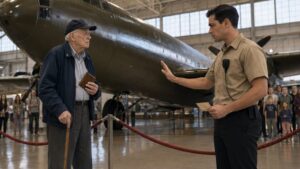
Now the real machine sat across the apron under the wide lifting morning, gray and heavy, its wings long enough to hold their own weather. Maintenance stands sat near one side. A tow vehicle waited near the nose. Under the left wing, a service panel stood open like a small square wound.
Alexander stopped walking.
Sarah went two steps farther before she realized he was no longer beside her. “Dad?”
He was looking past the visitor rope.
The aircraft was not beautiful in the way civilians meant beautiful. It was not sleek like the demonstration jets children pointed at. It was broad-shouldered, practical, built around load and distance and punishment. It carried the dull patience of work. He knew the type, knew the way its skin held heat, the way panels expanded in summer, the way fasteners lied when crews were tired.
He shifted his cane to his left hand and felt the old pull in his back.
“You want to go closer?” Sarah asked.
“Just to the rope.”
She glanced at the schedule map. “The veterans’ tent opens in ten minutes.”
“The tent will wait.”
He moved slowly, not because he wanted to, but because his knees had begun making private decisions sometime after seventy. Sarah stayed close without touching his elbow. He appreciated that. He also noticed the exact distance she kept, ready to catch but trying not to insult him with readiness.
The maintenance apron was separated from the public path by waist-high barriers and a yellow line. A few uniformed crew members moved around the aircraft. One young airman carried orange cones. Another checked a cart loaded with tools. Beneath the wing, near the open panel, a young technician stood with a tablet balanced in his left hand, tapping with his right thumb.
Alexander stopped at the rope.
The smell reached him first.
Not the whole smell. Bases had changed, fuels had changed, cleaning agents had changed. But beneath the morning heat and fresh paint there was still that thin metal breath of aircraft standing awake. Oil. Rubber. Dust lifting off concrete. The faint electrical note of powered systems waiting to be asked for more.
His fingers curled inside his gloves.
Sarah noticed. “Does it look familiar?”
Alexander did not answer at once. He was watching the open service panel.
The panel’s inner edge sat clean. Too clean, almost. A row of quarter-turn fasteners caught the light. Most were aligned as they should have been, slots lying neat and obedient. One near the lower edge sat just off true. Not open. Not loose enough for any checklist to flag at a glance. It only leaned a little against the pattern, like a man in formation favoring one leg.
The young technician with the tablet bent toward the panel, looked inside, tapped something, and stepped back.
Alexander listened.
The auxiliary power unit hummed alive from somewhere deeper in the aircraft, a low, steady vibration passing through the skin and ribs. Around him, civilians kept moving. A child laughed. A loudspeaker popped once and then went silent. A maintenance cart beeped as it backed away.
The fastener trembled.
Not much.
Only enough for Alexander’s eyes to narrow.
He took one step closer to the rope.
“Dad,” Sarah said quietly.
He raised a hand, not to silence her, only to ask for one moment. The hum held steady. The panel answered with a faint second tick half a breath after the first vibration passed through it.
Alexander felt the sound more than heard it.
His mouth went dry.
It had been years since a machine had spoken to him in that old stubborn language. Most people thought aircraft made noise. They did. But they also replied. A panel seated right answered when the frame answered. A bracket carrying stress answered late. A fastener that had been tightened around a tired corner gave a second word after the first. A small, delayed word. Easy to miss if your hand was not on the skin, if your mind was on a screen, if your day was running behind.
The technician looked satisfied. He tapped the tablet and turned away.
Alexander looked toward the barrier, then at Sarah.
“Stay here,” he said.
Her face changed. “No.”
He was already moving.
The yellow line was painted bright on the concrete. A volunteer near the barrier looked at him, uncertain whether to call out. Alexander stepped around the end of the rope where a maintenance cart had left a gap. His cane clicked once on the apron.
“Sir?” the volunteer said.
Alexander kept his eyes on the panel.
He had not come to interfere. He had not come to be the old man who wandered where he did not belong and made everyone speak gently. He had come to stand at a distance and remember. But memory was not the same as the thing that now sat open under the wing, humming a fraction out of time.
The young technician heard the cane and turned.
He was younger than Alexander had first guessed, maybe late twenties, square-shouldered in a dark maintenance uniform, hair trimmed close, tablet held against his ribs. His name tape read Carter. He looked surprised first, then annoyed in the guarded way of someone trained not to show annoyance in front of civilians.
“Sir, this is a restricted area,” he said.
Alexander stopped three feet from the panel. “That lower fastener.”
The technician blinked. “Excuse me?”
Alexander pointed with two gloved fingers. The gesture was small, steady, almost polite. “It is not answering with the frame.”
The young man looked at the panel, then back at Alexander. Behind the rope, Sarah had gone still.
“I need you to step back behind the barrier,” the technician said.
Alexander looked at the fastener again. The hum had settled. The panel was quiet now, innocent as a closed mouth.
He could have said more. He could have asked for a hand on the panel, one power cycle, one listen. He could have said that the machine had answered late and that late answers had a way of becoming final ones.
Instead he took a breath and lowered his hand.
The young technician’s tablet chimed softly.
Alexander heard the sound and felt a thin, old unease move through him.
Chapter 2: The Checklist Said It Was Clear
Ryan Carter had been awake since 0430, and every hour since had brought another person who wanted something done faster without being the one to sign for it.
The memorial airshow was supposed to be simple from the maintenance side. Static display. Systems demonstration. No flight from the old heavy aircraft, just a controlled power-up for the crowd, a ramp talk, and a short taxi reposition after the event window. Simple, except civilians would be close, command would be watching, and the base safety inspector had already reminded everyone that “ceremonial” did not mean “casual.”
Ryan’s name was on the readiness tablet for the left-side exterior panel inspection.
He had checked the access panel, verified latch alignment, photographed the interior harness, confirmed no visible chafing, no fluid trace, no unsecured line, no obvious deformation. The tablet checklist had accepted every entry. His supervisor had initialed the earlier inspection. The aircraft was not going airborne. The schedule mattered because the crowd flow mattered, the ceremony mattered, and Laura Reed from event coordination had already walked over twice with that smooth civilian smile that meant command was asking through her mouth.
Then an old man crossed the barrier.
Ryan saw the cane first. Then the tan jacket, the green pants, the gloves, the white hair flattened by the light wind. For half a second, the sight confused him. The man looked like he belonged to an older photograph of the same base, one of those framed hallway pictures near the heritage room: men standing beside aircraft with sleeves rolled, cigarettes tucked away before the camera came out, faces half sunburned and half shadow.
But this was not a photograph. This was an active apron.
“Sir, this is a restricted area,” Ryan said.
The old man stopped as if he understood exactly where he was. Not lost. Not wandering. That made it worse.
“That lower fastener,” the man said.
Ryan glanced at the panel. All fasteners appeared secured. One lower quarter-turn slot was a few degrees off line, but within tolerance. He had seen worse on aircraft cleared for actual operations.
“Excuse me?”
“It is not answering with the frame.”
Ryan stared at him.
Old mechanics had sayings. Ryan knew that. He had grown up around men who gave engines moods and weather intentions. His own grandfather had once told him a pickup “coughed like it knew winter was coming.” Ryan respected experience. He did. But respect did not allow an unidentified visitor to touch an inspected panel on an active aircraft during a public event.
“I need you to step back behind the barrier,” Ryan said.
The old man looked at the fastener again, then lowered his hand. His face did not flare with anger. That unsettled Ryan more than an argument would have.
Behind him, a voice called, “Everything all right here?”
Laura Reed approached from the visitor side with a radio clipped to her belt and a folder pressed to her chest. She wore a base event badge and the expression of someone measuring a problem by how many minutes it might cost. Her eyes flicked from Ryan to the old man, then to the open panel.
Ryan kept his tone controlled. “Visitor crossed the line. I’ve got it.”
Laura smiled at Alexander, but the smile had edges. “Sir, we need all guests behind the marked area for safety.”
The old man nodded once. “Yes, ma’am.”
He did not move immediately.
Ryan felt the eyes gathering. A volunteer. Two crew members near the tow cart. A boy behind the rope pointing before his mother pulled his hand down. Public embarrassment could spread faster than a fuel leak.
“What’s your name, sir?” Ryan asked, softer this time.
“Alexander Bennett.”
The name stirred nothing in Ryan. He wished it had. If the man had been on some VIP list, Laura would know. Laura’s expression did not change.
“Mr. Bennett,” Ryan said, “this aircraft has been inspected. That panel is secure.”
Alexander’s gaze came back to him. Pale eyes, tired but not cloudy. “Cycle the unit once more and put your hand below the fastener.”
“We already completed that step.”
“You completed a visual.”
Ryan felt heat rise under his collar. “I completed the assigned inspection.”
Alexander accepted the correction with a small dip of his chin, which somehow made Ryan feel more defensive.
Laura stepped closer. “We have a veterans’ seating area right this way. I can have someone escort you.”
Sarah appeared beyond the barrier, face tight. “Dad, please.”
For the first time, Alexander looked away from the aircraft. Ryan saw something pass across his face then—not embarrassment exactly, not fear of being caught. More like the old man had heard a sound no one else could hear and was trying to decide whether he had the right to name it.
The tablet in Ryan’s hand chimed with a schedule reminder. Demonstration prep meeting in ten minutes.
Laura heard it too. “We cannot delay the demo over a panel that already cleared.”
Alexander’s gloved fingers curled, then opened.
“Put your hand there when the power drops,” he said quietly.
Ryan exhaled through his nose. “Sir—”
“It answers late.”
The phrase landed strangely. Not technical enough to be useful, not vague enough to dismiss completely. Ryan hated that. A proper discrepancy had terms, measurements, visual evidence, location codes. It did not arrive as a sentence from an old man under a wing.
Laura lowered her voice. “Ryan.”
That single word carried the schedule, the spectators, the commander’s expectations, and the fact that Ryan was standing in front of an open panel with a civilian on the wrong side of the rope.
Ryan turned the tablet so its screen faced Alexander. “Panel inspection is green. Harness check is green. Latch engagement is green. There is no active fault.”
Alexander did not look at the tablet. He looked at Ryan’s hand around it.
“Green is good,” Alexander said.
Ryan waited.
“Until it teaches you not to listen.”
The nearest crew member looked down at his boots.
Ryan closed the cover over the panel with more care than he felt. He checked each fastener again, including the lower one, and seated it with the tool from his belt. It turned, resisted, and stopped. Secure. The slot now lined closer to the others.
“There,” Ryan said, keeping his voice even. “Panel secured.”
Alexander watched him step back. “You tightened the word. You didn’t change the answer.”
Ryan’s patience thinned. “Mr. Bennett, step behind the barrier now.”
Sarah slipped under the rope with permission from the volunteer and took her father gently by the elbow. Alexander did not pull away from her. That, too, stayed with Ryan: the way the old man surrendered to his daughter’s touch without surrendering his attention to the aircraft.
“I’m sorry,” Sarah said to Ryan. “He worked around planes a long time ago.”
“A lot of people did,” Ryan said before he could stop himself.
Alexander heard it. His face did not change.
Sarah did. “Come on, Dad.”
Alexander let her guide him back. At the rope, he turned once more. Not dramatically. Not like a man cursing fools. Just one glance at the closed panel.
Ryan looked away first.
Laura waited until Alexander and Sarah were out of earshot. “We good?”
Ryan checked the tablet again. Every line showed green.
“Yeah,” he said. “We’re good.”
But after Laura left and the crew resumed motion around him, Ryan stood under the wing for another few seconds. The aircraft hummed around him, massive and ordinary. The lower fastener sat aligned now, exactly as it should.
He put his palm under it.
Nothing.
He almost laughed at himself. Then the auxiliary power unit cycled down, and beneath his fingers, after the first vibration faded, something gave the faintest second tick.
Ryan pulled his hand away.
The tablet chimed again.
This time, he cleared the alert without looking at the screen.
Chapter 3: Sarah Takes Him Away
Sarah did not speak until they reached the shade of the visitor tent.
She kept one hand near her father’s elbow, not holding it now, just hovering close enough that he could pretend she was not ready to catch him. The tent was filling with older men in ball caps and women with folded programs. A volunteer offered them bottled water from a cooler. Sarah took one for Alexander, opened it, and passed it to him.
He held it but did not drink.
“Dad,” she said.
He looked toward the aircraft through the tent opening.
“Dad.”
“I heard you.”
“That’s the problem. You hear me and then you keep doing whatever scares me.”
He turned the bottle in his hands. The plastic crackled softly under his gloves. “Crossing a yellow line is not combat.”
“No, it’s a restricted military apron with equipment and people working and a daughter who doesn’t want security walking you out in front of everyone.”
A few heads turned near the folding chairs. Sarah lowered her voice at once. She hated that she had sounded sharp. She hated more that she was not wrong.
Alexander sat slowly in one of the metal chairs. It gave a small complaint under his weight. He set his cane between his knees and rested both gloved hands on top of it.
Sarah sat beside him. “I know you miss it.”
His jaw shifted.
“I know you do,” she said more gently. “But they have crews. They have procedures. That young man was doing his job.”
“He was.”
“You scared him.”
“No.” Alexander finally looked at her. “I inconvenienced him.”
The answer was so dry, so much like him, that Sarah almost smiled. It vanished before it formed.
Across the tent, an announcer tested the sound system. A burst of static rolled out, then a cheerful voice welcomed guests to the memorial airshow and reminded everyone that the aircraft demonstration would begin later in the afternoon. People clapped lightly. A child dropped a bag of chips. Somewhere outside, an engine coughed and settled.
Sarah watched her father’s face when the engine sound came. Not the way visitors watched aircraft, with excitement. He listened with his whole body, his shoulders still, his eyes not narrowed but drawn inward. It was the same look he got at home when the refrigerator made a new buzz, or when the neighbor’s old truck started rough, or when Sarah’s washing machine thumped off balance and he insisted it was not the load but the rear foot.
“You’re doing it again,” she said.
“What?”
“Leaving.”
He frowned. “I’m sitting right here.”
“You know what I mean.”
He looked down at the cane. His right thumb rubbed a worn spot in the handle. The gesture had become more common since winter, since the morning Sarah found him gripping the kitchen counter with the kettle whistling itself empty beside him. He had called it a dizzy spell. She had called the doctor. Neither of them had forgiven the other completely.
“I didn’t bring you here so you could get hurt,” she said.
“You didn’t bring me. You drove.”
“Don’t do that.”
“Do what?”
“Make jokes when I’m trying not to cry in public.”
That silenced him.
Sarah regretted the words as soon as they left her. Her father had never known what to do with tears. Her mother used to say he treated sorrow like a live wire: carefully, respectfully, and from too far away.
Alexander removed one glove finger by finger. His hands looked older without them, the skin thin and browned, veins raised like blue cords. The right hand trembled slightly when he reached for the water. He saw her see it.
“I can still hold a bottle,” he said.
“I didn’t say you couldn’t.”
“You were warming up.”
She closed her eyes for a moment. “I worry because I love you.”
“I know.”
“I worry because you don’t tell me things until they become emergencies.”
He opened the water, took a careful sip, and capped it again.
A pair of veterans near the entrance laughed at something in the printed program. One wore a cap stitched with the name of a ship. Another had a walker with tennis balls on the back legs. Sarah saw her father notice them and look away before his face could reveal anything.
“You don’t have to prove you belong here,” she said.
His answer came quietly. “That isn’t what I was doing.”
“Then what were you doing?”
Alexander looked out toward the aircraft again. The wing cut a hard gray line against the blue-white sky. From this distance, the service panel was hidden by bodies moving around it. The young technician was only a dark shape among other dark shapes.
“There was a delay in the answer,” he said.
Sarah pressed her fingers against her temple. “Dad, I don’t know what that means.”
“It means something moved after the load moved.”
“Is that bad?”
“It can be nothing.”
“And?”
His mouth tightened. “And it can be the first polite thing a machine says before it gets impolite.”
She stared at him, wanting to be angry and unable to find the right place for the anger to land. “Why didn’t you just say that to him?”
“I did.”
“No, you said something about answering late. That doesn’t help people who don’t live inside your head.”
For a moment he looked almost amused. Then the amusement left.
“You’re right.”
Sarah had expected resistance. The admission made her uneasy.
He leaned forward with both hands around the water bottle, gaze lowered. “There was a crew chief I knew. Long time ago. Harris was his name. Not family to anyone here, just a name.” He paused, and Sarah realized he had not spoken this name to her before. “He heard a panel once. Said it ticked after shutdown. We were behind, hot, tired, and a captain wanted the bird turned. I told him we’d look after the next cycle.”
The tent noise seemed to thin.
Sarah said nothing.
Alexander kept his eyes on the bottle. “There wasn’t a next cycle for that panel. Bracket cracked under vibration. Took a piece of housing with it. Nobody died.”
The last sentence came too quickly, as if he had said it many times to himself.
“But someone was hurt,” Sarah said.
His thumb pressed into the bottle until the plastic dented.
“He lived,” Alexander said.
That was not an answer.
Outside, the announcer began listing the day’s events. Static displays. Junior cadet presentation. Memorial remarks. Aircraft systems demonstration at fifteen hundred hours. Sarah heard the crowd respond, but her attention stayed on her father’s bent head.
“So when you saw that panel…” she said.
“I heard it.”
“You think it’s the same thing?”
“No.” He shook his head once. “That’s the trouble. It never comes back as the same thing. If it did, even fools would learn.”
She looked toward the apron. The aircraft stood bright and harmless in the sun. People posed for pictures with it in the background.
Sarah wanted to say they knew what they were doing. She wanted to say this was not his responsibility anymore. She wanted to say he had earned the right to sit in a chair under a tent and be thanked without having to listen for every loose piece of the world.
Instead she heard herself ask, “What happens if you’re wrong?”
Alexander looked at her then.
“Then an old man bothered a young one on a busy day,” he said. “That’s survivable.”
“And if you’re right?”
He did not answer.
A shadow fell across the tent opening. A young airman stood there, cap in hand, scanning the rows until he found Alexander. He looked nervous enough that Sarah straightened before he spoke.
“Mr. Bennett?” the airman asked.
Alexander lifted his head.
The young man swallowed. “I’m Airman Harris. Justin Harris.” His eyes flicked toward Sarah, then back. “Sir, what did you mean when you said the panel was answering late?”
Chapter 4: The Sound From Another Year
Alexander did not answer Justin Harris right away.
The young airman stood at the tent entrance with his cap held in both hands, as if he had interrupted a funeral instead of a conversation. Sunlight rimmed his shoulders. Behind him, people moved along the public walkway, carrying paper cups and folded programs, but Justin kept his eyes on Alexander with the strained focus of someone who had already decided he might be wrong and needed to know how wrong.
Sarah looked from the young man to her father. “Are you with the maintenance crew?”
“Yes, ma’am.” Justin swallowed. “I assist Sergeant Carter.”
Alexander rested his bare right hand over the glove in his lap. “Did he send you?”
“No, sir.”
That answer mattered. Alexander heard it.
Justin shifted his weight. “I was by the tow cart when you pointed at the panel. I didn’t hear anything then. But after Sergeant Carter closed it, when the unit cycled down…” He stopped, embarrassed by his own uncertainty. “There was a tick.”
Sarah’s face tightened.
Alexander looked toward the museum hangar beyond the visitor tent. Its doors stood open, showing the polished nose of an older aircraft inside, safe now behind ropes and placards. A quiet place. Quieter than here.
“Walk with me,” Alexander said.
Sarah reached for the cane before he did. He let her hand get there first, then took it from her without comment. Justin stepped back to make room.
They crossed the path slowly, keeping to the public side of the barriers. Sarah stayed on Alexander’s left. Justin walked on his right but half a pace behind, uncertain whether he had permission to walk beside him. Alexander did not invite him forward. He needed a minute to gather the old sound in his head without letting it gather everything else.
The museum hangar smelled of waxed concrete and old canvas. A volunteer near the entrance looked ready to greet them, then saw Justin’s uniform and nodded them through. Inside, the noise of the airshow softened. The aircraft on display wore its age more honestly than the one outside. Its paint had been polished, but time still showed around the seams. Under one wing, a drip pan had been placed though nothing dripped.
Alexander stopped near a bench facing a wall of framed photographs.
There were men in those pictures who had once thought themselves permanent. Men leaning against tires, crouched under open panels, squinting into sun. Some were younger than Ryan. Some had gone home to children who were now old. Some had not gone home at all.
Justin waited.
Sarah, to her credit, did not fill the silence.
Alexander sat on the bench. The movement cost him more than he wanted the young airman to see. His knee caught halfway down; his hand tightened on the cane; his breath came out through his nose. When he was settled, he looked at Justin.
“You ever put your hand on a sleeping dog and feel it dream?”
Justin blinked. “Sir?”
“Muscle jumps after the dog stops moving. Little answer after the big one. Aircraft do that too. Not because they’re alive. Because metal remembers load for a second after the load moves on.”
Justin nodded slowly, trying to translate.
Alexander held up one finger. “When the power unit comes up, the frame takes vibration. A seated panel answers with it. You hear one sound. Feel one pulse. When something under that panel is carrying stress it shouldn’t, you get a second answer. Late. Sometimes it’s nothing but a tired fastener. Sometimes it’s a bracket speaking through the skin.”
Sarah stood beside an old propeller display, arms folded.
Justin looked toward the hangar doors. “The checklist has a visual step and a latch engagement step.”
“It should.”
“It doesn’t say anything about a second answer.”
“No.”
“Why not?”
Alexander’s eyes moved to the photographs.
Because not everything true had made it into a box someone could tap green. Because manuals were written in blood and still had margins. Because young men wanted the world to tell them danger in approved language, and danger often whispered first in shop talk nobody wanted to defend in a meeting.
He said only, “Some things are learned before they’re named.”
Justin’s ears reddened. “Sergeant Carter says if it’s not documented, we can’t chase every noise.”
“Sergeant Carter is not wrong.”
That surprised him. “Sir?”
“You can’t ground a machine because an old man dislikes a sound.”
Sarah’s gaze sharpened at him, as if that was what she had been trying to say all morning.
Alexander rubbed his thumb along the cane handle. “But you can listen twice when a sound dislikes you back.”
Justin gave a small, nervous laugh that died quickly.
On the wall, a photograph showed a crew gathered around the open side of an aircraft older than the one outside. Alexander knew the picture though he was not in it. He knew the era, the posture, the way the men held tools as if tools were extensions of their wrists. He saw, without wanting to, another apron under another sun. Heat thick enough to chew. Shirts stuck to backs. A captain walking fast with a clipboard. A young crew chief named Harris crouched by a panel, frowning.
Not this Harris. Another. No relation except the coincidence of a name, which was sometimes enough for memory to play cruel games.
Alexander had been thirty-one then, already old in the eyes of nineteen-year-olds, young in the eyes of the men who had seen worse. They were behind schedule. Everyone was behind schedule. The panel had ticked once after shutdown. Harris had said, “Bennett, she answered late.”
Alexander had believed him.
He had also believed there would be time after the next cycle.
There had been noise then, and shouting, and a piece of housing that tore loose in a way no one expected because the crack had hidden behind a bracket that looked serviceable from the outside. Nobody died. He held to that still. Nobody died. But Harris’s forearm had never straightened fully again, and for months afterward Alexander woke hearing the small late tick before the violent sound that followed it.
“Sir?” Justin said.
Alexander realized he had closed his eyes.
Sarah had moved closer. “Dad.”
He opened them. The museum hangar returned: polished floor, framed photographs, a child whispering near a display case.
“What happened?” Justin asked, then immediately looked ashamed. “I’m sorry. You don’t have to—”
“A man got hurt,” Alexander said.
Justin lowered his cap.
“I was his lead. He heard what I should have stopped for. I told him we would check it after the next cycle.”
Sarah’s face softened in pain. She had heard a piece of this outside, but not this. Not the shape of it.
“You were young,” she said.
Alexander did not look at her. “So was he.”
Justin was very still.
“That does not make today the same day,” Alexander continued. “It may be nothing. A fastener worn at the head. A panel seated a hair off because somebody hurried. But if that second tick is coming from behind the lower edge, and not the fastener itself, then you need eyes inside the frame, not just on the latch.”
Justin nodded once, hard, as if committing the words.
“You don’t take my word,” Alexander said. “You test it.”
“How?”
“Cycle it cold if you can. Hand below the fastener, not on top. Feel the first vibration. Wait after it stops. If it answers late again, remove the panel and check the bracket behind the lower housing. Not just the harness. Look for rub dust. Gray line where there shouldn’t be one. Bright edge at a screw head. Anything polished by movement.”
Justin’s breathing changed. He was no longer only listening to an old man’s story. He was building a sequence in his mind.
“Sergeant Carter won’t like me asking,” he said.
“No,” Alexander said.
“Laura Reed really won’t like it.”
“No.”
Sarah looked between them. “And if they say no?”
Alexander put his glove back on slowly, one finger at a time. The tremor in his right hand made the last finger difficult. Sarah saw Justin notice, and for a moment she braced for the young man’s face to shift into pity.
It did not. He waited.
That, more than anything, seemed to steady Alexander.
“If they say no,” he said, “you decide what kind of silence you can live with.”
Justin’s throat moved. He put his cap back on.
From outside came the announcer’s bright voice, carried through the hangar doors. The aircraft systems demonstration would begin in less than two hours. Families were invited to move toward the viewing area. The words sounded harmless, practiced, smooth.
Justin looked toward the sunlight.
“I should get back,” he said.
“Yes,” Alexander said.
The young airman took two steps, then turned. “Mr. Bennett?”
Alexander lifted his eyes.
“What was the other Harris’s first name?”
Alexander’s hand stilled on the cane.
For a moment he looked past Justin, past the hangar, past the day. Then he shook his head once, not because he had forgotten, but because the name did not belong to this young man and this new chance.
“Today,” Alexander said, “Harris is you.”
Chapter 5: One Airman Listens
Justin Harris returned to the aircraft with the feeling that his uniform had grown heavier while he was gone.
The apron was busier now. Spectator traffic had thickened along the rope line. Crew members moved with that clipped, tense efficiency that came before a scheduled demonstration. A maintenance cart sat under the left wing. A portable speaker near the visitor area played patriotic music too softly to drown out the mechanical sounds around the aircraft.
Ryan Carter stood by the open equipment case, speaking with Laura Reed. He held the tablet against his forearm, scrolling with quick, irritated movements. Laura’s folder was tucked under one arm; her radio crackled every few seconds with questions about seating, timing, and where to place a group of visiting veterans for the ceremony.
Justin slowed before he reached them.
Ryan looked up. “Where were you?”
“Visitor tent, then museum hangar.”
Ryan’s eyes narrowed. “With Mr. Bennett?”
Justin felt the answer catch in his throat. “Yes, Sergeant.”
Laura’s attention sharpened. “Is he still upset?”
“No, ma’am.”
Ryan’s mouth tightened. “What did he want?”
Justin glanced at the closed service panel. The lower fastener sat aligned now. Perfect. If he had not seen Alexander point, if he had not felt that question lodge under his ribs, it would have looked like the most ordinary piece of secured aircraft skin in the world.
“He said we should cycle the unit again and feel below the lower fastener during shutdown.”
Ryan stared at him.
Laura made a small sound, not quite a laugh. “We are not restarting an inspection loop because a guest used colorful language.”
“He wasn’t trying to delay us,” Justin said.
“No,” Ryan replied. “He crossed a restricted line and touched an inspected aircraft.”
Justin kept his voice level. “He said to test it, not take his word.”
Ryan looked past him toward the public tent, then back. “And you think that changes the situation?”
“I heard it too.”
That landed.
Ryan stopped scrolling. “You heard what?”
“The second tick. After you closed the panel.”
Laura’s radio crackled. She turned it down without taking her eyes off them.
Ryan stepped closer. “You’re sure?”
Justin wanted to say yes. He wanted certainty because certainty made courage cheaper. But Alexander’s voice stayed with him: You don’t take my word. You test it.
“I’m sure I heard something,” Justin said. “Not sure what it means.”
Ryan’s jaw worked once. The honest answer irritated him less than a confident one might have.
Laura checked her watch. “The demonstration team needs green status in thirty-five minutes.”
Ryan looked at the aircraft. “We already have green.”
“Then keep it,” Laura said, with practiced calm. “Unless you have an actual discrepancy.”
Justin felt his window closing.
“Sergeant,” he said, “permission to perform one additional power cycle and tactile check on the panel?”
Ryan gave him a look that said he had chosen the most formal possible sentence to make refusal harder.
“Denied,” Ryan said.
Justin swallowed. “Yes, Sergeant.”
He turned away because staying would look like argument. He had taken only three steps when Ryan called after him.
“Harris.”
Justin stopped.
Ryan was looking at the panel again. The tablet screen had gone dark from inactivity. He woke it with his thumb, then seemed annoyed by the bright neat boxes waiting there.
“One cycle,” Ryan said. “No panel removal. No delay beyond five minutes. And if there’s nothing, it ends.”
Laura opened her mouth.
Ryan did not look at her. “I’ll own the five minutes.”
Laura’s face cooled. “Five minutes.”
Justin nodded once. “Yes, Sergeant.”
They set it up without drama. That was how Ryan wanted it: no gathering crew, no drawing spectator attention, no turning the old man’s warning into a scene. Justin stood at the panel. Ryan coordinated the auxiliary power cycle with the cockpit support tech through the headset. Laura remained ten feet away, watching the time.
“Ready?” Ryan asked.
Justin put his right palm below the lower fastener, exactly where Alexander had described. Not on the head. Below it, near the panel edge. The aircraft skin was warm from the sun.
“Ready.”
The auxiliary power unit came alive. Vibration filled the metal, not violent, just a steady low tremor that moved through Justin’s hand and wrist. The panel answered with it. One sound. One pulse. He nearly sagged with disappointment.
Then Ryan said into the headset, “Cycle down.”
The hum began to fade.
Justin held his breath.
The first vibration died under his palm. For a fraction of a second there was nothing but the crowd noise and the faint whine of systems settling.
Then: tick.
Not loud. Not dramatic. A small delayed click from behind the lower panel edge, like a fingernail tapping from inside.
Justin’s eyes flew to Ryan.
Ryan had his hand on the panel too. His face had changed.
Laura looked between them. “What?”
Ryan did not answer. He pressed his palm more firmly under the fastener. “Again.”
Laura’s shoulders stiffened. “Ryan.”
“Again,” he repeated into the headset.
The second cycle produced the same result. Power up, unified vibration. Power down, pause, late tick.
Justin felt his mouth go dry.
Ryan stepped back, stared at the panel, then opened the checklist notes. His thumb hovered over the screen. “Could be fastener wear.”
“That’s what Mr. Bennett said,” Justin replied.
Ryan shot him a look.
Justin added quickly, “He said it could be nothing.”
Ryan exhaled. “But?”
“He said if it’s behind the lower edge, check the bracket behind the housing. Rub dust. Bright edge. Gray line.”
Laura’s voice was controlled but sharper now. “Can that wait until after the demonstration?”
Ryan did not respond immediately. Justin watched the fight move through him. It was visible in small places: the tightened grip on the tablet, the glance toward the spectator area, the straightening of his shoulders as if rank could make uncertainty less heavy.
The demonstration was not a flight. That mattered. It was a power-up, ramp talk, then taxi reposition. The aircraft would not be loaded or pushed hard. But machinery did not care how ceremonies were described on a schedule. A failed bracket during a public demonstration could still throw debris, damage systems, injure crew near the wing, or simply become the report everyone had to explain afterward.
Ryan opened his tool pouch.
Laura saw it. “Sergeant Carter.”
“I’m removing the panel.”
“You said one cycle.”
“I said if there’s nothing, it ends.” Ryan looked at her now. “There’s something.”
The crewman nearest the tow cart had stopped pretending not to listen.
Laura lowered her radio, expression tight. “How long?”
“Longer than five minutes.”
“That is not an answer I can take to command.”
Ryan’s face hardened, then softened almost immediately into something more tired than angry. “Tell command we have an unverified panel vibration and we are inspecting.”
Laura held his gaze for a long second. Then she turned away and spoke into her radio with a voice that made delay sound like procedure rather than trouble.
Justin brought the tool kit. Ryan loosened the fasteners one by one. When he reached the lower quarter-turn, it resisted, then gave with a dry little snap. Not broken. Not fine either.
They lifted the panel carefully and set it on a padded stand.
The inside looked clean at first glance. Harness secure. No fluid. No obvious crack. Justin felt his hope and dread twist together. If there was nothing, Ryan would be exposed for delaying over an old man’s phrase and Justin’s uncertain ear.
Ryan leaned closer with a flashlight. “Lower housing.”
Justin crouched, shoulder nearly touching Ryan’s. Behind the lower interior edge, near a bracket partly hidden by bundled wiring, a faint gray smear marked the metal. Not much. A line of dust where dust should not have gathered. Beside it, one screw head had a bright crescent polished into its edge.
Justin pointed without touching. “There.”
Ryan’s flashlight froze.
For several seconds neither of them spoke.
The defect was small. So small it seemed almost insulting after the weight it had gathered. A slight bracket shift. A wear mark. A hint that vibration had been moving something in a place the visual latch check would not catch.
Ryan leaned back on his heels.
Justin looked toward the visitor tent, but Alexander was not visible from here.
“What now?” Justin asked.
Ryan’s answer was quiet. “Now we find out how deep it goes.”
Chapter 6: Ground the Aircraft
By the time Alexander returned to the apron, the afternoon light had turned hard and white against the concrete.
Justin had found him at the edge of the museum hangar, where Sarah was trying to persuade him to eat half a sandwich he did not want. The young airman did not shout. He did not say emergency. He simply removed his cap, looked at Alexander with a face that had lost its earlier hesitation, and said, “Sir, Sergeant Carter is asking if you would come back to the aircraft.”
Sarah stood at once. “Why?”
Justin looked at Alexander.
“They found something,” Alexander said.
Justin nodded.
Sarah’s hand closed around the sandwich until the bread folded. “Is it dangerous?”
“Nobody knows yet,” Justin said carefully.
Alexander reached for his cane.
“No,” Sarah said, then heard herself and lowered her voice. “Wait. Please. Just tell me what they need from you.”
He looked up at her. The tiredness in his face was real. So was the steadiness under it.
“They need to know whether the sound has a memory,” he said.
She almost argued. Then she stepped aside.
The restricted line opened for him this time. That was the first difference. A crew member moved the barrier without being asked. Laura Reed stood near the wing with her radio in one hand and her folder in the other, her expression arranged for control but not comfort. Ryan Carter was crouched by the open panel. When he saw Alexander, he stood.
The tablet was still in his hand.
For a moment neither man spoke.
The open panel revealed more than Alexander had seen from outside. A lower bracket sat partly behind the housing, its edge marked by a fine gray dusting. A screw head bore a polished crescent. The fastener Ryan had tightened earlier lay on a clean cloth beside two others.
Ryan held himself very straight. “Mr. Bennett.”
“Sergeant.”
Ryan looked down at the panel, then back at him. “We reproduced the delayed tick twice. Removed the panel. Found rub dust and movement at the lower bracket. I requested additional inspection.”
Alexander nodded.
Laura stepped closer. “We need to understand whether this grounds the demonstration or whether it can be documented for later maintenance.”
Alexander looked at her. “Ma’am, that decision does not belong to me.”
“I understand,” Laura said, though her tone suggested she wished someone would give her a cleaner sentence. “But your observation started this.”
“No,” Alexander said. “The panel did.”
Ryan’s eyes moved briefly to him.
A safety inspector arrived with a flashlight and mirror tool. The base commander followed a minute later, expression unreadable under his cap. The air around the wing tightened with rank, radios, and the knowledge that hundreds of spectators were waiting for a show whose schedule was now bleeding.
Ryan summarized the findings. His voice was crisp until he reached the first warning.
“Initial concern was raised by Mr. Bennett,” he said. “He identified a delayed vibration response at the lower service panel.”
The base commander looked at Alexander. “You’re prior service?”
“Yes, sir.”
“Maintenance?”
“Crew chief. Long time ago.”
“How long?”
Alexander almost smiled. “Long enough that some of my tools are in museums now.”
The commander did not smile, but his eyes changed a little.
The safety inspector bent into the open panel, mirror angled behind the bracket. “I see contact wear. Need better light.”
Justin held the flashlight. Ryan crouched beside him. Alexander remained standing because if he crouched, getting up again would become an event, and he refused to make his knees part of the inspection.
Sarah waited behind the reopened barrier, arms folded tight, watching not the aircraft but the men watching her father.
“Mr. Bennett,” Ryan said, “can you explain what you meant by answering late?”
Everyone looked at Alexander then.
He disliked that. Machines were easier when they were the ones listening.
He took one step closer, slow and careful. Ryan moved as if to offer an arm, then stopped himself. Alexander appreciated the stop more than the offer.
“Put power into the frame,” Alexander said. “A seated panel carries the first vibration with the structure. All one piece. When you power down, it quiets with the structure. But if a bracket or backing plate has play, it moves after the main vibration drops. Small delayed contact. That tick is not the panel talking. It’s something behind it catching up.”
The safety inspector glanced at Ryan. “That’s consistent with the mark.”
Laura checked her watch, then seemed ashamed of the motion and lowered her arm.
The commander asked, “Could this fail during a static demonstration?”
The safety inspector did not answer quickly. Good, Alexander thought. Quick answers were often dressed-up wishes.
“Unknown without removing more,” the inspector said. “If the bracket is cracked or the mounting point is elongated, vibration could worsen during power cycling or taxi.”
“The aircraft is not flying,” Laura said.
“No,” the inspector replied. “But personnel and spectators will be nearby.”
The commander’s face settled.
Ryan looked at the tablet. The green checklist still existed there, neat and official. Alexander could see its glow reflected faintly in Ryan’s eyes.
“Sergeant Carter,” the commander said, “recommendation?”
Ryan did not answer at once.
This was where pride had a sound too. Alexander heard it in the silence. The young man had cleared the panel. He had dismissed a warning in front of witnesses. He had five different reasons to call this minor, document it, and move the day forward. None of those reasons made him a bad man. They only made him human under pressure.
Ryan lowered the tablet.
“I recommend grounding the demonstration until the bracket and surrounding mount are fully inspected,” he said.
Laura closed her eyes for half a second.
The commander nodded once. “Do it.”
The words were plain. No drumroll. No gasp from the crowd. Just one decision settling over the concrete.
Laura stepped away to speak into her radio. Her voice stayed even, but the message spread quickly. The aircraft systems demonstration would be delayed. Then revised. Then, after the safety inspector removed a second access piece and found the bracket’s hairline crack extending behind the mount, cancelled.
The spectators groaned when the announcer told them. Children complained. A few adults clapped politely at the safety explanation they were given. Most never knew how close a small sound had come to being ignored completely.
Under the wing, Ryan set the cracked bracket on a cloth beside the fasteners. It was not dramatic to look at. A piece of metal with a thin dark line running where strength should have been. The crack had hidden itself well. It had needed vibration to confess.
Justin stared at it as if it were bigger than it was.
Alexander looked once, then away.
Ryan picked up the lower fastener between two fingers. Its worn head caught the light. He turned it slowly, seeing now what he had not seen before. Then he looked at Alexander.
“I tightened this,” he said.
“Yes.”
“I thought that fixed what you saw.”
“You fixed what I pointed at.”
Ryan absorbed that. “Not what you heard.”
“No.”
The safety inspector began dictating notes. Laura came back with a thinner face but no argument left in it.
“The commander needs a name for the initial discrepancy note,” she said to Ryan. “Who caught the fault?”
Ryan looked down at the tablet, then at the fastener on the cloth, then at Alexander’s gloved hands resting on the cane.
The old man was tired. It showed now. His shoulders had lowered; the lines around his mouth had deepened. He did not look victorious. He looked like someone who had been returned briefly to a room he knew and charged the full price of admission.
Ryan turned toward the commander.
“Mr. Bennett raised the concern,” he said. “Airman Harris reproduced it. I dismissed it first.”
Laura’s eyes flicked to him.
Ryan kept going. “That should be in the report.”
Alexander looked at him then, sharply enough that Ryan felt it.
The commander studied the three men beneath the wing: the old veteran, the young sergeant, the junior airman still holding the flashlight.
“Put it in,” he said.
Ryan entered the note. His thumb moved slower than it had all morning.
When he finished, he held the tablet at his side instead of against his chest.
“Mr. Bennett,” he said, “I owe you an apology.”
Alexander looked toward the closed-off crowd, toward Sarah waiting beyond the barrier, then back to the cracked bracket on the cloth.
“No,” he said.
Ryan frowned. “Sir?”
“You owe the aircraft a better listen next time.”
Ryan stood still.
Alexander’s right hand trembled once against the cane. He covered it with his left.
“And maybe,” Alexander added, softer, “you owe yourself one too.”
Chapter 7: The Report Did Not Call Him Lucky
The maintenance office smelled of coffee that had been burned twice and paper warmed by machines.
Alexander sat in a chair near the wall because Ryan had asked him to wait there, not because he had been told to stay out of the way. That small difference mattered more than he expected. Sarah sat beside him, her purse in her lap, both hands wrapped around it as if she had not yet decided whether the day was over.
Through the open office door, the aircraft was visible in pieces: gray wing, maintenance stand, crew moving beneath it with the slow seriousness that came after a near miss. The crowd noise had thinned. Families were leaving with programs folded under their arms. The loudspeaker had shifted from ceremony voice to practical voice, thanking guests for their patience and reminding them where to exit.
Nobody outside would know the size of the crack. Nobody would tell them about the late tick under Justin’s palm or Ryan lowering the tablet as if it had suddenly become heavier. They would go home saying the demonstration had been cancelled for safety reasons. Some would be disappointed. Some would call it overcautious. Some would forget before dinner.
Alexander did not need them to know.
On the desk across the room, the cracked bracket rested in a clear evidence pouch beside the worn quarter-turn fastener. The fastener looked harmless now, smaller than the trouble it had carried. A little metal head. A slot. A rubbed edge catching fluorescent light.
Ryan stood with the safety inspector near a computer, entering the report. Justin hovered nearby, still holding the flashlight even though there was nothing left to illuminate. Laura Reed came in and out with her radio, no longer trying to save the schedule, only trying to land the day cleanly.
The base commander had gone to brief someone higher.
Sarah leaned close. “Are you all right?”
Alexander looked at his hands. He had taken off the gloves. They lay folded on his knee, creased and darkened at the fingertips.
“I am tired,” he said.
It was the plain truth, and saying it cost him less than he expected.
Sarah nodded as if she had been given something fragile. “We can leave whenever you want.”
“Not yet.”
She followed his gaze to Ryan.
The young sergeant’s shoulders had changed since morning. Not lowered exactly, but unbraced. He typed, paused, deleted something, typed again. The safety inspector said a few quiet words. Ryan shook his head once and pointed to the screen.
Justin looked toward Alexander and gave a small nod. Alexander returned it.
After a minute, Ryan printed a page and carried it over. He did not bring the tablet first. He brought the paper.
“Mr. Bennett,” he said.
Alexander looked up.
Ryan held the report in both hands. “I wanted you to see the wording before I submit the final.”
Sarah straightened in her chair.
Alexander accepted the paper. The text blurred for a second until he adjusted the distance. The language was official, dry, careful: delayed vibration response noted at lower left service panel during auxiliary power shutdown; discrepancy initially identified by visiting retired Air Force crew chief Alexander Bennett; reproduced by Airman Justin Harris; confirmed by Sergeant Ryan Carter; panel removed; evidence of bracket movement and hairline fracture discovered; aircraft demonstration cancelled pending full maintenance inspection.
He read the sentence twice.
Not lucky.
Not assisted.
Not civilian report.
Identified.
He handed the paper back. “That is more name than it needs.”
Ryan almost smiled, then did not. “No, sir. It is exactly as much name as it needs.”
Alexander looked away first.
Sarah’s hand found his sleeve. She did not grab. She rested her fingers there, light enough that he could pretend not to notice and firm enough that he could not miss it.
Laura stepped into the doorway with her folder against her chest. For the first time all day, she looked less polished than human.
“Mr. Bennett,” she said, “I owe you courtesy I did not give you earlier.”
Alexander shook his head. “You had a schedule.”
“I did.” Her eyes moved to the evidence pouch. “I also had a warning standing in front of me, and I treated it like an inconvenience.”
He had no use for making her smaller. “The schedule was loud.”
Laura accepted that with a quiet nod. “It usually is.”
She left before the moment could become a speech.
Justin set the flashlight on the desk at last. “Sir,” he said to Alexander, “can I ask something?”
“You have been doing that all afternoon.”
This time Justin did laugh, softly.
“When you said today Harris is me…” He glanced at the floor. “Was that because you thought I would catch it?”
Alexander rubbed the seam of one glove between his fingers. “No.”
Justin waited.
“It was because you asked.”
The answer settled over the young airman. He nodded as if it had given him both less and more than he hoped.
Ryan folded the report and placed it on the desk, then picked up the tablet. Its screen glowed awake, still full of boxes, entries, green confirmations, new red hold notes. He looked at it for a long moment.
“I added a note to the inspection file,” he said. “Not as a replacement for procedure. As an additional caution for this airframe type during shutdown response.”
Alexander raised an eyebrow. “What did you call it?”
Ryan turned the tablet so he could see.
In the notes field, beneath the formal language, was a short line: Listen for late panel response after power-down.
Alexander looked at the phrase.
Ryan cleared his throat. “I wasn’t sure ‘answering late’ would survive review.”
“No,” Alexander said. “Probably not.”
“But I kept it in the technician comments.”
He touched the screen and opened another line. There it was, in quotation marks, smaller and less official but present: “answering late.”
Alexander felt something in his chest loosen, not enough to hurt, just enough to remind him it had been tight all day.
Sarah stood. “Dad?”
He looked up at her.
Her eyes were wet, but she was not crying. “I’m sorry I thought keeping you safe meant keeping you quiet.”
He wanted to joke. He almost did. Then he saw the strain around her mouth and chose better.
“I have made that mistake too,” he said.
“With me?”
“With myself.”
She looked down, breathing carefully. “You scared me today.”
“I scared me too.”
That surprised a small laugh out of her, and the sound carried just enough warmth to change the room.
Ryan stepped aside as Alexander pushed himself up from the chair. It took longer than it should have. His knee objected, his back joined in, and for one undignified second he had to press hard into the cane and the chair arm at the same time. Nobody reached too soon. Sarah waited until he looked at her. Then he took her arm.
Not because he had failed.
Because she was there.
Outside, the sun was dropping behind the hangars. The aircraft sat quiet beneath the wing lights, no longer a display piece, no longer a memory pretending to be harmless. Crew members had tagged the open panel with red streamers. The evidence pouch had been carried away. The lower edge of the aircraft looked unfinished without its panel, but honest.
At the parking lot, Ryan caught up with them.
“Mr. Bennett.”
Alexander turned.
Ryan held his cap in one hand, tablet tucked under the other arm. Justin stood a few paces behind him, trying not to look like he was listening.
Ryan hesitated. The younger man from the morning might have filled the pause with rank, procedure, or apology. This one stood inside it.
“Would you come back next week?” he asked.
Sarah looked at Alexander.
Ryan continued, “Not for a ceremony. For the crew. I’d like you to show us the tactile inspection method. What to listen for. What not to overclaim. How to test it properly.”
Alexander looked past him to the aircraft. In the evening light, the open panel was only a dark square under the wing.
“I am not on your payroll,” he said.
“No, sir.”
“I am slow.”
“Yes, sir.”
“I forget names.”
Ryan’s face softened. “We can write them down.”
Alexander considered him. Then Justin, who was failing to hide a hopeful expression. Then Sarah, who looked worried and proud and ready to drive him home the moment he said the word.
“You keep the tablet,” Alexander said.
Ryan looked uncertain. “Sir?”
“Tools matter. New ones too. Don’t let an old man make you ashamed of a good tool.”
Ryan nodded slowly.
“But when the tool says green,” Alexander continued, “and your hand says wait, you wait long enough to learn which one is lying.”
The wind moved across the parking lot, carrying the last faint smell of fuel and sun-warmed concrete. For a moment Alexander could almost hear another apron, another voice, another Harris warning him that a machine had answered late.
This time, someone had listened.
Ryan held out his hand.
Alexander looked at it, then took it. The grip was careful, respectful, not weak.
“I’ll be here,” Alexander said.
Sarah helped him into the passenger seat a few minutes later. She shut the door gently, walked around the car, and sat behind the wheel without starting the engine.
“Dad,” she said.
He leaned his head back, suddenly too tired to pretend otherwise. “Yes.”
“Next week, I’m driving.”
He closed his eyes.
“That was assumed,” he said.
She laughed then, really laughed, and the sound stayed with him as they pulled away from the base, past the flags, past the guarded gate, past the road where the aircraft disappeared behind hangars and evening light.
In his lap, his gloves rested palm up.
The story has ended.