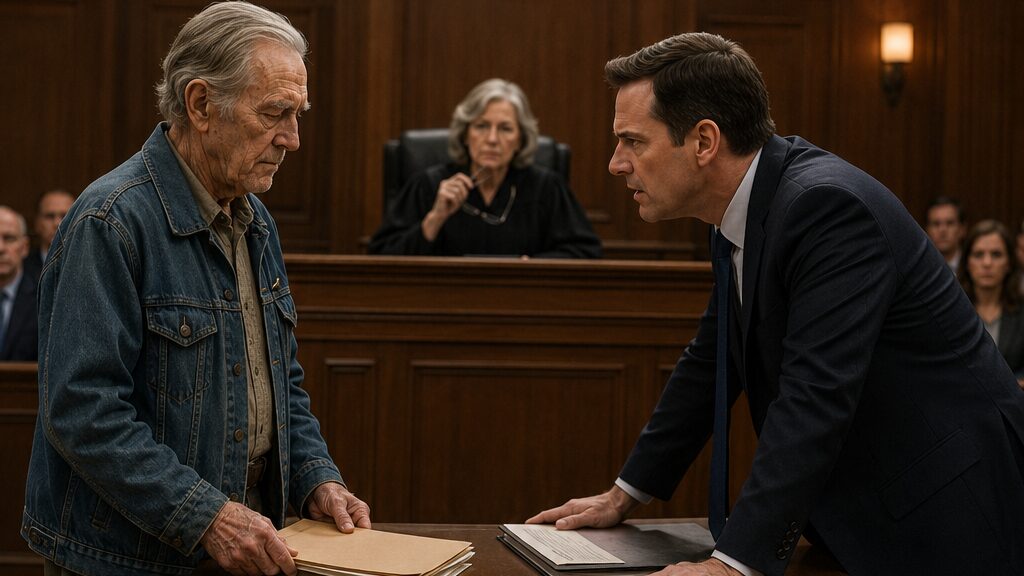
The Judge Called Him A Nuisance Until His Worn Denim Jacket Explained The Silence
Chapter 1: The Old Man In The Denim Jacket
Raymond Bennett arrived at the courthouse before the doors opened.
He had not meant to be early. He had woken at four because sleep had gone thin in the years after Nancy died, and because the notice from the city had been folded and unfolded so many times it no longer lay flat on the kitchen table. At five, he had boiled water for instant coffee and forgotten to drink it. At six, he had stood in front of the hallway mirror and buttoned the same clean shirt twice, first wrong, then right.
The denim jacket came last.
It was faded nearly white at the shoulders, darker at the elbows where years of his hands had bent it into shape. The left cuff had been mended with thread that did not match. On the chest pocket sat a small bent pin, dull brass, no bigger than a dime. It was not polished. It did not announce anything. Raymond touched it with two fingers before leaving the house, the way another man might touch the knob of a locked door.
Outside, the morning had the flat gray light of rain that had not yet decided. His old truck needed a second turn of the key. The wipers dragged once across the glass and left a crescent of dust. Raymond sat a moment before backing out, looking at the porch boards he still had not replaced.
“I understand,” he said quietly.
There was no one there to hear him.
By the time he reached the municipal courthouse, the parking lot had begun to fill with people who knew where they were going. Young men in work boots moved toward the side entrance. A woman in a blazer spoke into a phone as she crossed the painted lines without looking up. Raymond parked near the far curb because the nearer spaces were marked with signs he did not trust himself to read quickly enough.
He carried a manila folder under one arm. Inside were city notices, photographs of his porch after he had swept it, a receipt for lumber he had not yet used, and two stamped forms that he had been told, on two different days, belonged in two different offices. The folder had softened at the corners from his grip.
At the courthouse doors, a security guard pointed toward the bins.
“Pockets empty.”
Raymond nodded and took out his keys, his wallet, and a small folding ruler he had forgotten was there.
“No knives, sir?”
“No.”
The guard looked at the ruler. “What’s that for?”
“Measuring.”
The guard waited, as if there should be more.
Raymond placed it in the tray. “For the porch.”
Behind him, someone sighed.
The metal detector gave a tired beep when Raymond stepped through. The guard asked him to step back and try again. Raymond did. It beeped again. He patted his pockets, slow and careful. The line behind him shifted. Someone muttered something about old people needing their own hour.
The guard waved the wand near Raymond’s chest. It chirped at the pin.
“This,” Raymond said, touching it.
“You need that?”
The question was not cruel. It was impatient. Still, Raymond felt heat move under his collar.
“Yes,” he said.
The guard stared at him for half a second, then shrugged. “Go ahead.”
Raymond gathered his things. He did not look back at the line.
The hallway smelled of floor wax, damp coats, and paper. Outside Courtroom B, people were already crowded along the benches. Some held traffic tickets. Some held envelopes with windows. A young mother bounced a child on her knee. A man in a paint-splattered sweatshirt whispered angrily into his phone. On the wall, a monitor listed case numbers in blue letters that refreshed too quickly for Raymond to follow.
He found his number on the notice.
CE-4179.
He looked at the screen.
CE-4176. CE-4177. CE-4181.
Raymond waited for the letters to change. They did not.
A clerk hurried past carrying a stack of folders against her chest.
“Ma’am,” Raymond said.
She stopped without fully stopping. “Yes?”
“I’m looking for where I’m supposed to stand.”
“What’s the matter?”
“Code enforcement hearing.”
“Courtroom B.”
“I’m at B.”
“Then inside, sir.”
“I don’t see my number.”
She glanced at his paper. “They’ll call you.”
“Will they call by number or name?”
“Both, usually.”
He nodded. “Thank you.”
She was already moving.
Inside, the courtroom was smaller than Raymond had expected and more polished. Wooden benches filled the back half. A long table stood before the judge’s bench. To one side sat a city attorney in a dark suit, reviewing files with the neat irritation of a man who had more names than morning. His hair was trimmed close around the ears. His tie was dark blue. His pen moved quickly.
Raymond took a seat in the second row.
He did not remove his jacket. It gave him a shape he understood.
A bailiff came through a side door and told everyone to rise. Judge Katherine Harris entered without drama, black robe moving softly around her as she sat. She had silver at both temples and reading glasses on a chain. Her face looked neither kind nor unkind. It looked scheduled.
Cases moved quickly.
A landlord agreed to clear debris from a back lot. A restaurant owner argued about a grease trap and lost. A young man said he never got the notice, and the judge asked if his address on file was correct. He said it was. She gave him thirty days.
Raymond listened to the rhythm. Complaint. Response. Fine. Date. Next.
He tried to match his breathing to it.
Complaint. Response. Fine. Date. Next.
When the city attorney stood, his voice filled the room without needing to be loud.
“Your Honor, before the next matter, the city requests that CE-4179 be heard out of sequence. We have had repeated noncompliance and multiple failures to properly respond.”
Raymond looked down at his paper.
CE-4179.
Judge Harris checked her screen. “Raymond Bennett?”
Raymond rose too quickly. His knee caught the bench, and the folder slipped from under his arm. Papers slid across the floor in a pale fan. A few people turned. The man behind him lifted his feet so a notice would not touch his shoes.
Raymond bent to gather everything, but the stiffness in his back slowed him. He picked up one page, then another. A photograph of his porch landed near the aisle.
A woman’s hand reached down and gave it to him. She was seated near the end of the row, wearing a courthouse badge that read Melissa Carter.
“Thank you,” Raymond said.
She nodded, her eyes resting briefly on his face as if she had seen him before.
“Mr. Bennett,” the judge said, not harshly, but not gently either. “Please come forward.”
Raymond walked to the table. The city attorney did not sit. He looked at Raymond’s jacket, the folder, the bent pin, then back at his file.
“Good morning, Mr. Bennett,” Judge Harris said. “You understand why you’re here?”
Raymond placed both hands on the folder to keep them still.
“I understand there’s a problem with my house.”
Christopher Reed, the city attorney, exhaled through his nose. “Your Honor, respectfully, there has been more than a problem.”
Raymond turned his head slightly toward him.
Christopher leaned one hand against the table.
“The city is tired of games.”
The courtroom, which had been restless, quieted in that small way rooms do when people sense that something has shifted from procedure into personal judgment.
Raymond lowered his eyes to the folder.
His fingers found the bent pin through the denim.
Chapter 2: When Silence Was Treated As Guilt
Christopher Reed had learned to dislike silence in court.
Silence meant delay. Silence meant someone had come unprepared and hoped confusion would do the work money or responsibility would not. Silence meant missing forms, bad addresses, excuses about mail, complaints about city workers, stories that began with weather and ended nowhere near the law.
So when Raymond Bennett stood at the table without opening his folder, Christopher read him the way his job had trained him to read people.
Old denim jacket. Papers out of order. No attorney. No clear answer.
Another morning swallowed by someone who had ignored every chance to fix a simple problem.
“Mr. Bennett has received five notices,” Christopher said, turning toward Judge Harris. “Two certified letters, three posted warnings, one administrative extension, and a final compliance deadline. The property remains in violation.”
Raymond looked at him, then at the judge.
“Your Honor,” he said, “I came down here before.”
Christopher glanced at the file. “There is no record of a proper response.”
“I brought papers.”
“Not properly filed.”
“I was told to go downstairs.”
Christopher straightened. “By whom?”
Raymond opened his mouth, then closed it.
The room waited.
He could see faces in the benches beyond Christopher’s shoulder. The man in the paint-splattered sweatshirt had stopped whispering into his phone. The young mother bounced her child more slowly now. The bailiff watched from near the wall. Melissa Carter sat at the clerk’s station, her fingers hovering near a keyboard.
“Mr. Bennett,” Judge Harris said, “if you are saying a court employee gave you instructions, I need more than that.”
Raymond looked toward the clerk’s desk. Melissa’s gaze met his, then flicked down.
“I don’t know her name,” Raymond said.
Christopher gave a small, humorless laugh.
Raymond heard it. He had heard laughs like that before, from younger men who thought age had made him harmless. He had heard worse in motor pools, hospitals, waiting rooms, hardware stores, and once in his own front yard when a city worker told him that maybe it was time to “let somebody competent handle the place.”
Judge Harris looked at Christopher. “Mr. Reed.”
Christopher adjusted his tie, but the impatience remained on his face.
“Your Honor, this is exactly the difficulty. The city has been more than patient. Every hearing produces another vague explanation. Another unnamed person. Another missing document. Meanwhile the property remains unsafe.”
Raymond kept his hands flat on the folder.
“The porch rail is loose,” he said. “The back step sank after the storm. I know that.”
“And the side yard?”
“I cleared it.”
“After citation.”
“Yes.”
“And the broken window?”
“It’s boarded.”
“It was boarded after the inspection.”
Raymond nodded. “Yes.”
Christopher leaned forward, both palms now on the table. The movement brought him closer, his suit sleeve brushing the edge of Raymond’s folder.
“Mr. Bennett, this court is not here to listen to another old war story or a tour through every reason you didn’t do what every other homeowner in this city is required to do.”
The words landed, and the room changed again.
Not loudly. No one gasped. No one stood. But a stillness pressed against the wood-paneled walls.
Raymond’s face did not move.
Inside his chest, something old and quick struck against the cage he had built around it.
Old war story.
He looked down at his jacket.
The bent brass pin caught a stripe of overhead light and gave it back weakly.
Raymond pressed two fingers against it.
Not proof. Not rank. Not memory for strangers.
Just a reminder.
A barracks room in winter. A younger man with blood under his fingernails and rage in his throat. An older sergeant gripping his wrist hard enough to hurt and saying, Put your hand there before anger answers for you.
Raymond breathed in.
The judge’s voice cut through the silence. “Mr. Reed, keep your argument to the violations.”
Christopher’s jaw tightened. “Yes, Your Honor.”
But the damage had already made its shape in the room. Raymond could feel people looking at the pin now, at his jacket, at his white hair, at the way his hand had gone to his chest. He had not meant to invite that. He had not meant to make himself into a question.
Judge Harris turned toward him. “Mr. Bennett, does that pin have something to do with this case?”
Raymond’s hand remained there a moment longer.
“No, ma’am.”
“Then why did you reach for it?”
He could have said nothing. He had spent years perfecting nothing. Nothing let the day continue. Nothing kept rooms from breaking open. Nothing held old promises in place.
But the judge had asked directly.
Raymond lowered his hand.
“It reminds me not to answer angry.”
A pen clicked somewhere behind him.
Christopher looked briefly at the pin, then away.
Judge Harris studied Raymond over her glasses. Her face had changed by less than an inch, but Raymond saw it. The schedule had been interrupted by a person.
“Are you angry, Mr. Bennett?”
He considered lying. He considered saying no because anger in an old man made people nervous or dismissive, depending on whether they thought he could still hurt anything.
“Yes, ma’am,” he said. “But I can wait.”
The young mother in the back stopped bouncing her child.
Christopher cleared his throat. “Your Honor, the city is requesting a finding of contempt for failure to comply and failure to respond. We are also requesting authority to pursue further enforcement if the property is not brought into compliance within ten days.”
Raymond’s fingers pressed into the folder.
“Ten days?” Judge Harris asked.
“The city has already granted multiple extensions.”
Raymond looked up. “I didn’t know about today until last week.”
“The notice was mailed.”
“To where?”
Christopher looked down at his file. “The address on record.”
“My house?”
“Yes.”
Raymond opened the folder with careful hands. The papers were not in the order he wanted anymore. He found the one with the red stamp, then the one with the typed address, then another that had been returned with a yellow sticker.
“This one went to Carter Street,” he said.
Judge Harris leaned forward slightly. “Your address is Cooper Street.”
“Yes, ma’am.”
Christopher took the paper when Raymond offered it. His eyes moved over it, and a crease appeared between his brows.
“This appears to be a copy of a returned notice.”
“It was in my door,” Raymond said. “Not mailed. Somebody stuck it there after.”
Christopher’s tone sharpened again, though not as confidently. “Mr. Bennett, even if one notice had an addressing issue, that does not explain the entire history of noncompliance.”
“No.”
The single word seemed to irritate Christopher more than an argument would have.
“No?” he repeated.
“No. It doesn’t explain everything.”
Judge Harris waited.
Raymond looked at her. “I’m not saying the porch is good. I’m saying I came here twice, and I was told my case wasn’t on the docket. I brought these. I asked where to put them.”
Melissa Carter’s fingers lowered onto her keyboard.
Judge Harris turned toward her. “Ms. Carter?”
Melissa looked startled, as if the room had pulled her by name from a place she had been hiding.
“Yes, Judge?”
“Can you check whether Mr. Bennett appeared on any prior walk-in dates?”
Christopher shifted. “Your Honor, if I may, the city’s records—”
“I asked Ms. Carter to check the court’s records.”
Melissa typed. Raymond watched her face, not the screen. He saw the moment she found something because her lips parted slightly.
“There is a Raymond Bennett entry at the public counter three weeks ago,” she said. “No filing attached.”
Christopher frowned. “That could be any inquiry.”
Melissa typed again. “And another entry the week before that. Same name. It was logged under CE-4176.”
Raymond heard the number.
CE-4176.
That had been on the screen.
Judge Harris removed her glasses. “CE-4176 is not this case.”
“No, Judge,” Melissa said quietly.
Christopher said nothing.
Raymond looked down at his folder. The anger that had risen in him did not disappear; it changed weight. It was no longer a flame. It became something heavier, something he could carry if he had to.
Judge Harris looked at Raymond for a long moment.
“Mr. Bennett, I am continuing this hearing for one week. Ms. Carter, I want the counter logs and any related filing records pulled before then. Mr. Reed, I expect the city to review its notice history.”
Christopher nodded once. “Yes, Your Honor.”
“And Mr. Bennett,” the judge said.
Raymond raised his eyes.
“You will need to bring whatever documents you have. All of them. If there are property violations, they still have to be addressed.”
“I understand.”
The words came out softer than before.
Judge Harris watched him. “Court is adjourned on this matter until next Wednesday.”
Raymond gathered his papers slowly. He could feel the room return to motion behind him, but different now, threaded with whispers. He did not look at Christopher. He did not look at Melissa. He placed each page back into the folder, even the ones that had slid out of order.
As he turned to leave, Christopher spoke from behind him.
“Mr. Bennett.”
Raymond stopped.
For a moment, it seemed Christopher might say something else. Something smaller than an apology but less sharp than before.
Instead, the attorney looked at the folder in Raymond’s hands.
“Make sure you bring the originals.”
Raymond nodded.
In the aisle, Melissa Carter watched him pass. Her eyes went again to the bent pin on his chest, then to his face.
This time, she did not look away.
Chapter 3: The Notices Nobody Followed Back
Melissa Carter knew the courthouse by sound.
The front doors sighed open at eight. The security trays clattered in uneven bursts. Attorneys walked differently from defendants; their shoes struck the tile with ownership. The elevator made a soft metallic complaint before opening on the basement level. The old copy machine near the records room clicked twice before it jammed, always as if surprised by its own failure.
That afternoon, after the courtroom emptied and Judge Harris took the bench in traffic cases, Melissa heard Raymond Bennett’s voice in her head more clearly than any of it.
It reminds me not to answer angry.
She sat at the public counter with his case number on her screen and the city’s file beside her. CE-4179. Code enforcement. Repeated noncompliance. Failure to appear. Failure to respond. Recommended contempt.
It looked simple if she read only the top page.
Most things did.
Melissa had been at the counter three weeks earlier when an old man in a denim jacket had asked where to file photographs. She remembered the jacket before she remembered his face. She remembered the little bent pin because he had touched it when the man ahead of him cursed at a parking clerk. He had waited until the clerk finished with everyone else, then said, “I don’t want to put this in the wrong place.”
She had been covering two windows that day. The phones were ringing. A printer had gone down upstairs. Someone from the judge’s chambers needed a warrant packet copied immediately.
She had looked at his paper, seen CE-4176 near the top of the screen, and told him basement records.
Had she checked the name?
She pressed the heel of her hand lightly against her forehead.
Across the counter, a woman argued about a late fee. Melissa answered, stamped, directed, smiled when needed, and returned to Raymond’s file between interruptions.
By three o’clock, she requested the basement box.
The records room was colder than the rest of the building. Shelves stood in long rows, gray and beige, with banker’s boxes labeled in black marker. A fluorescent light buzzed overhead. The clerk assigned to records rolled a cart toward her and pointed.
“Code enforcement overflow. That’s your pile.”
“Thank you.”
“Looking for something ugly?”
“Something missing.”
“That’s usually uglier.”
Melissa opened the first box and found CE-4176. Carter Street. A vacant lot with illegal dumping. Owner: Raymond Bennett Holdings LLC.
She paused.
Raymond Bennett Holdings LLC was not Raymond Bennett of Cooper Street. Different mailing address. Different property. Same first and last name.
She took out the folder and checked the walk-in log attached to the back. There, in her own handwriting, was a note: “Elderly male, docs/photos, sent to basement records.”
No middle initial. No address confirmed.
Melissa felt a flush rise up her neck.
She opened CE-4179 next. Raymond Bennett, Cooper Street. Owner-occupied. Porch rail, back step, side debris, broken window. Notices attached. The first was correctly addressed. The second had a handwritten correction. The third had been mailed to Carter Street.
Someone had crossed out Carter and written Cooper above it, but the envelope copy still showed the wrong street.
She found a loose yellow slip folded behind an inspection photo.
RETURNED — NO SUCH RESIDENT AT THIS ADDRESS.
It had been scanned into the file but not flagged.
Melissa sat back on her heels beside the open box.
The city had mailed at least one notice to the wrong address. The court had logged at least one walk-in under the wrong case. None of that fixed Raymond’s porch. None of it made his house safe. But it changed the meaning of his silence in the courtroom.
He had not simply failed to answer.
Parts of his answer had been misplaced.
She carried both folders upstairs, holding them tighter than necessary.
At the public counter, Raymond Bennett was standing alone.
For one unsettling second, Melissa thought she had imagined him into existence. His denim jacket was damp at the shoulders from rain. His hair was combed back but had loosened at the crown. The manila folder rested against his stomach. The bent pin on his chest had caught a thread from the jacket pocket.
He looked as if he had been waiting for permission to occupy the space.
“Mr. Bennett,” Melissa said.
He turned. “Ma’am.”
“I was just looking at your file.”
“I don’t want to bother you.”
“You’re not bothering me.”
He absorbed that without reacting.
A line formed behind him. Melissa glanced at the other clerk, who nodded and took the next person.
“Do you have a few minutes?” Melissa asked.
Raymond looked toward the benches. “Yes.”
She led him to the small side table near the wall, not behind a closed door, but away from the counter noise. She placed the two files down and opened them side by side.
“There is another case with your name,” she said. “Different property. Different address. I think some of your visits may have been logged under that case.”
Raymond looked at the folders. His face did not show surprise. That troubled her more than if he had become angry.
“I told them Cooper Street,” he said.
“I believe you did.”
He looked at her then.
Melissa had said many things at the counter over the years. I can’t give legal advice. You need that notarized. Court costs are due by four. Window two.
She could not remember the last time three words had made her feel so exposed.
“I found a returned notice too,” she continued. “It went to Carter Street.”
“Not mine.”
“No.”
Rain tapped softly against the high windows.
Raymond opened his folder and removed a creased receipt. “A young man downstairs stamped this when I brought photographs.”
Melissa took it carefully. The date matched the first walk-in. The stamp was real. It bore the court’s seal, faint on one side where the ink had thinned.
“May I copy this?”
“Yes.”
“You should bring the original next week.”
“That’s what Mr. Reed said.”
Melissa looked up at the name. Raymond’s voice had remained level, but something had passed under it.
“He was hard on you,” she said.
Raymond’s fingers moved once toward the pin, then stopped before touching it.
“He has a job.”
“That doesn’t mean he was right.”
“No.”
The word had no bitterness in it. That made it worse.
Melissa carried the receipt to the copier. The machine clicked twice and jammed. She opened the side panel, pulled out a wrinkled sheet, and tried again. Raymond waited by the table, his hands folded over the folder.
When she returned, he was looking at the two case files.
“You can fix it?” he asked.
“I can make sure Judge Harris sees it.”
“That’s not what I asked.”
Melissa stood still.
The hallway noise seemed to move around them.
“I can’t erase what already happened,” she said. “But I can put the documents where they should have been.”
Raymond nodded slowly.
“That’s fixing enough for today.”
She gave him back the original receipt. Their fingers did not touch. He slid it into his folder with more care than the paper deserved.
“Mr. Bennett,” Melissa said, “can I ask you something?”
He waited.
“The pin. You said it reminds you not to answer angry.”
His eyes lowered, not in shame, but in boundary.
“Yes.”
“Is it military?”
He gave a small breath that almost became a laugh.
“Not the way people mean when they ask that.”
Melissa understood she had reached the edge of what he would give.
“I’m sorry,” she said.
Raymond buttoned the folder closed.
“Most people are asking about something else when they ask.”
“What are they asking?”
He looked toward the courtroom doors, closed now, the wood polished by years of hands pushing in and out.
“They’re asking whether they’re supposed to respect me.”
Melissa had no answer ready.
Raymond adjusted the folder under his arm. The denim at his shoulder was dark with rainwater.
“I’ll come back Wednesday,” he said.
“I’ll have the files ready.”
He gave one nod and walked toward the exit, moving slowly but not uncertainly.
Melissa watched him pass through security in reverse, collecting his keys and wallet from the tray. The guard said something she could not hear. Raymond touched the pin with two fingers and answered with a nod.
When he was gone, Melissa returned to the counter.
The next person in line stepped forward, irritated and already talking.
Melissa opened Raymond’s file again before she helped him. She took out a fresh note sheet and wrote carefully across the top:
Possible misfiled walk-in response. Similar name. Address discrepancy. Returned notice. Bring to Judge Harris before continued hearing.
Then she paused, added the date, and signed her full name beneath it.
For the first time that day, the record followed him back.
Chapter 4: The House They Called A Nuisance
The rain had stopped by the time Raymond pulled into his driveway, but the house still looked wet.
Water clung to the porch rail and darkened the places where the paint had peeled. The back corner of the roofline dripped into a coffee can he had placed under the leak months ago and forgotten until it overflowed. The grass along the side yard lay flattened in muddy strips where he had dragged branches after the last storm. A blue tarp covered the broken window in the spare room, pulled tight and nailed at the corners.
From the street, Raymond could see what other people saw.
An old house giving up.
He sat in the truck with both hands on the wheel and tried to see it the way he had seen it when he and Nancy first bought it. Pale yellow siding. White trim. A porch swing she said was too noisy and then used every evening in June. Two tomato plants by the steps. A wind chime shaped like spoons.
Now the swing was gone. The tomatoes were gone. The wind chime hung rusted from a hook, making no sound.
A city truck stopped at the curb behind him.
Raymond watched in the mirror as Joshua Miller stepped out with a clipboard tucked under one arm. Joshua was younger than Christopher Reed, but he carried the same city pace in his shoulders, the same belief that paper made things clear. He wore a dark jacket with the code-enforcement badge sewn over the pocket. His boots were clean enough that Raymond noticed.
Raymond got out slowly.
“Mr. Bennett?”
“Yes.”
“Joshua Miller. Code enforcement.”
“We met.”
Joshua glanced at him. “Briefly.”
“You came in March.”
“I’ve been here more than once.”
“Yes.”
Raymond did not say that on the second visit Joshua had stood at the sidewalk and taken photographs without knocking. He had seen him through the front curtains and had meant to open the door, but he had been in Nancy’s room with a box of her winter sweaters on the bed, and by the time he got himself turned toward the hallway, the city truck was leaving.
Joshua checked his clipboard. “Judge Harris requested an updated inspection before the continued hearing. I’m here to document the current condition.”
Raymond nodded. “All right.”
“I’ll need access to the exterior. I won’t enter the house unless invited.”
“You can walk around.”
Joshua looked at the porch rail first. He put one hand on it and moved it gently. The whole rail shifted.
“That’s unsafe,” he said.
“Yes.”
“When did it loosen?”
“Storm in February made it worse.”
“Was it loose before that?”
Raymond looked at the rail. “Some.”
Joshua wrote something down.
The pencil moved too easily. Some. Unsafe. Delayed. Raymond could almost hear the words turning into a report.
“I bought lumber,” Raymond said.
“Do you have a contractor?”
“No.”
“Someone helping you?”
“No.”
Joshua’s eyes flicked over him. Not cruelly. Measuring.
“Mr. Bennett, with respect, this is not a small repair.”
“I know what a rail is.”
“I didn’t say you didn’t.”
Raymond looked at him until Joshua lowered his eyes back to the clipboard.
They walked along the side of the house. Raymond’s boots sank lightly into the wet ground. Joshua photographed the boarded window, the stack of old boards near the fence, the spot where the back step had settled three inches below the threshold. A vine had worked its way through the lattice. The air smelled of damp wood and leaves.
“This debris needs to be removed,” Joshua said.
“It’s not debris.”
Joshua looked at the boards. “What is it?”
“Old porch plank. Some of it’s still good.”
“It’s stacked directly against the fence line. That draws complaints.”
“From who?”
“I’m not required to identify complainants.”
Raymond nodded once.
He knew anyway. The neighbor had stopped waving after Nancy died and the side yard began to grow wild. A woman who measured respectability by curb edges and trash bins aligned on the proper morning. She had not been wrong about the yard. That was the part that made it harder to resent her.
Joshua crouched near the back step. “This needs immediate attention.”
“I have blocks.”
“Temporary blocks are not a repair.”
“They keep it from dropping.”
“For now.”
Raymond heard the same tone he had heard in the courtroom. The city’s tone. Not rage. Not hatred. Something colder because it did not have to be personal.
Joshua stood and wiped mud from his fingertips with a paper towel.
“Mr. Bennett, I’m going to be honest with you. The city is considering recommending removal if compliance isn’t demonstrated.”
Raymond turned toward him. “Removal of what?”
“Unsafe structures, if they’re determined to pose a risk.”
“The porch?”
“Possibly more, depending on inspection.”
Raymond looked at the back door. The paint near the handle had worn away where Nancy’s hand used to push it open with her hip when she carried laundry. Inside that door was the kitchen floor she had made him promise not to replace because the scratches showed where their life had passed through.
“You mean the house.”
“I mean the city has tools available if a property remains unsafe.”
Raymond breathed through his nose.
Joshua’s expression shifted. “I’m not saying that’s what I want.”
“But it’s what the paper can say.”
“It can, yes.”
They stood in the backyard with the broken step between them.
Raymond could feel the missing weight on his chest before he remembered. He looked down. The pin was not on his jacket. He had taken the jacket off after court and hung it by the kitchen door to dry. He was wearing only his blue work shirt, buttoned wrong at one cuff.
Without the pin, his hand moved to an empty spot.
Joshua noticed.
“Are you all right?”
Raymond lowered his hand. “Yes.”
The lie tasted familiar.
Joshua softened his voice. “Do you have family nearby?”
“No.”
“No one who can help?”
“No one who should have to.”
“That’s not the same answer.”
Raymond looked toward the back window, the one with the tarp. Behind it was Nancy’s sewing room. He had not opened the curtains since the week after the funeral. He had boarded the window from the outside because a branch broke it during a storm, but he had not gone in to clean the glass from the floor. He told himself he was waiting until he had time. Then he told himself he was waiting until he had a box. Then he stopped telling himself anything.
“My wife kept this house better than me,” he said.
Joshua waited.
Raymond did not continue.
The young officer wrote nothing for once.
At the porch, Joshua reviewed his list. “You need the rail stabilized, the back step repaired, the boards moved away from the fence, and the window properly secured. I can note partial progress if I see it before the hearing.”
“I can move the boards today.”
“The rail?”
“I can start.”
Joshua looked at Raymond’s hands. They were broad, veined, and stiff at the knuckles. Not useless. Not young.
“I don’t want you falling off your own porch trying to fix a violation.”
“That would make the paperwork interesting.”
Joshua blinked, then almost smiled. It disappeared quickly.
“Do you want me to leave a list?”
“I have one.”
“I mean a clean copy.”
Raymond thought of his folder, the papers out of order, the courthouse screen with the wrong number.
“Yes,” he said. “A clean copy would help.”
Joshua tore a sheet from his pad and wrote the items in block letters. He handed it over.
Raymond took it and folded it once.
At his truck, Joshua paused. “Mr. Bennett?”
Raymond looked up from the porch rail.
“I can’t make the hearing go away.”
“I didn’t ask you to.”
“No. But if you bring proof of what you’ve done, and if the court accepts there was a notice issue, you may have room.”
“Room for what?”
“To fix what’s fixable.”
Raymond held the folded list in his palm.
After Joshua drove away, Raymond went inside and stood at the kitchen door. The denim jacket hung from the hook. The pin sat dull against the faded fabric.
He touched it once.
Then he took the jacket down, put it on, and carried the first stack of boards away from the fence.
Chapter 5: The Man Who Would Not Humiliate Back
Christopher Reed did not think of himself as unkind.
He thought of himself as efficient, which was what people called a man when they needed his sharp edges but did not want to admit they benefited from them. The city hired him to keep cases moving. Unsafe porches did not become safer because everyone sat in a circle and discussed hardship. Abandoned properties did not clean themselves because owners had sad histories. Children walked past leaning rails. Neighbors lived beside broken glass. Someone had to be the person in the room who said enough.
Still, the phrase followed him from court to his office and from his office into the evening.
Another old war story.
He had said worse in frustration, though rarely on record and rarely with a judge watching. But this one had remained in the air after he said it. It had attached itself to the old man’s hand moving to that bent pin, to the strange calm sentence that followed.
It reminds me not to answer angry.
Christopher told himself the line was manipulative. People learned quickly what moved a courtroom. A veteran-coded pin, a quiet voice, a little tremor in the hand. He had seen sympathy derail enforcement before.
Then Melissa Carter emailed the file note.
He read it twice.
Similar name. Address discrepancy. Returned notice. Walk-in response possibly misfiled.
He leaned back in his chair and stared at the screen.
His office overlooked the employee parking lot, not the street. A narrow view of bumpers, rain puddles, and the dumpster behind the courthouse. On his desk sat three stacks of files: urgent, almost urgent, and overdue enough to become urgent if ignored until Friday. Raymond Bennett’s file had started in the third stack. It now sat alone in the center.
Christopher opened the city records portal.
CE-4179. Raymond Bennett. Cooper Street.
He clicked the notice history.
The first notice was clean. The second had a scanned photograph of orange paper taped to Raymond’s front door. The third had the Carter Street error. The fourth had been certified but signed by a mark that looked nothing like Raymond Bennett. The fifth was listed as posted.
Enough to proceed, maybe.
Enough to feel clean?
He closed the portal.
At four-thirty, he walked down to the clerk’s office. Melissa was sorting files at the counter.
“Do you have a minute?”
She looked up. Her expression was careful. “For the Bennett matter?”
“Yes.”
She lifted the file from beneath the counter as if she had expected him.
Christopher did not like that.
They used the small conference room beside Courtroom B. It had a round table, four chairs, and a wall clock that ticked too loudly. Melissa set the court file down. Christopher set the city file beside it.
“I reviewed your note,” he said.
“And?”
“And there are issues. But the property violations remain real.”
“I didn’t say they weren’t.”
“The city can’t withdraw enforcement every time there’s a clerical imperfection.”
“This wasn’t one imperfection.”
Christopher folded his hands on the table. “Melissa.”
She looked at him until he stopped using her first name as a way to soften the warning.
“Mr. Reed,” she said, “he came here twice.”
“Possibly.”
“I wrote one of the counter notes myself.”
“You logged him under the wrong case.”
Her face tightened. “Yes.”
The simple admission took some of the force from his next sentence.
He looked down at the two folders. “I’m not trying to bury that.”
“Then don’t.”
The clock ticked.
Christopher exhaled and leaned back. “If Judge Harris sees this as a notice problem, she may continue it again. Fine. But I’m not withdrawing the request for a compliance order. The porch is unsafe. Miller inspected it.”
“Mr. Bennett knows that.”
“Knowing doesn’t repair it.”
“No,” Melissa said. “But being called defiant when you tried to answer doesn’t repair it either.”
Christopher’s jaw worked once.
He wanted to say the courtroom was not built for feelings. But that was a lie. The courtroom ran on feelings restrained into forms: fear translated into petitions, anger into complaints, loss into probate, desperation into payment plans. The forms did not remove the feeling. They just made it legible to people paid not to flinch.
“Has Bennett been contacted about a resolution?” Melissa asked.
“I was about to do that.”
“Before or after the contempt request?”
He stood. “I’ll handle it.”
Raymond Bennett was already in the hallway when Christopher opened the door.
He sat on the bench across from Courtroom B with the manila folder on his knees. His denim jacket was dry now, the bent pin set slightly crooked on the chest pocket. He looked at Christopher and rose, because some instinct in him still answered authority with courtesy.
Christopher disliked that too, though he could not have said why.
“Mr. Bennett,” he said. “I was going to call you.”
“I don’t hear well on the phone.”
“You came here?”
“Yes.”
“Why?”
Raymond looked toward the courtroom doors. “I wanted to ask where to bring the repair proof. Before I bring it wrong.”
Melissa, still in the conference room doorway, lowered her eyes.
Christopher gestured toward the room. “Step in for a moment.”
Raymond entered but did not sit until Christopher did. Melissa remained by the door.
Christopher opened the city file.
“I’ll be direct. The city has documentation of violations. Your porch rail, back step, window, and yard materials. Those issues need correction.”
“Yes.”
“There also appear to be notice and filing problems.”
Raymond waited.
Christopher found himself irritated by the lack of reaction. “That matters.”
“Yes.”
“I can propose a resolution. The city withdraws the contempt language for now. You agree to a written repair schedule. You waive any challenge to prior notice defects, and we move forward.”
Raymond’s fingers rested on the folder.
“What does waive mean?”
“It means we don’t spend time arguing over whether every notice was perfect. We focus on fixing the property.”
“And the record?”
“The record would show agreement.”
“That I failed to answer?”
Christopher hesitated. “It would show the case resolved by agreement.”
Raymond looked at Melissa. Not for help. For witness.
Then he looked back at Christopher. “No.”
Christopher’s eyebrows rose. “No?”
“I’ll fix what’s mine. I won’t sign that I ignored what I tried to answer.”
“That’s not what I said.”
“It’s what the paper will carry after I leave.”
Christopher’s hand closed around his pen. “Mr. Bennett, court records are not personal biographies.”
Raymond touched the pin with two fingers, then removed his hand.
“No. But people read them like they’re truth.”
Melissa remained very still.
Christopher leaned forward, caught himself, and leaned back. “What exactly do you want?”
Raymond looked tired. Not weak. Tired in the way a post holds after too many seasons of weather.
“I want the mistake said where the accusation was said.”
Christopher stared at him.
“In open court?”
“Yes.”
“You want me embarrassed.”
Raymond shook his head once. “No.”
“That is what you’re asking.”
“No. If I wanted you embarrassed, I’d ask different.”
Christopher felt heat touch the back of his neck.
“What would you ask?”
Raymond’s voice did not change. “I’d ask why a man who knows his words carry weight used them like they didn’t.”
The room held the sentence.
Christopher looked down at the file because looking at Raymond had become difficult.
Melissa took one quiet step back from the doorway.
Raymond continued, softer. “I don’t need you made small, Mr. Reed. I need the record made straight.”
Christopher had spent years in rooms where people demanded apology, money, delay, dismissal, punishment, exceptions, mercy they did not name mercy. He was used to bargaining against anger. He was less practiced against restraint.
“And if Judge Harris still orders compliance?” he asked.
“I’ll comply.”
“If she imposes deadlines?”
“I’ll meet what I can and ask plain for what I can’t.”
“Why didn’t you say all this last week?”
Raymond looked at the conference room wall. A framed notice about court conduct hung crooked near the door.
“Because I was angry.”
Christopher waited for more.
Raymond gave it after a long breath. “And because you made me want to answer like a younger man.”
The words landed without accusation, which made them heavier.
Christopher closed the file.
“I’ll review the matter before the continued hearing.”
Raymond nodded.
“That’s all I can promise.”
“I understand.”
There it was again. The same phrase, but now it did not sound like surrender. It sounded like a door left open only because Raymond chose not to close it.
He stood, gathered his folder, and stepped into the hallway.
Melissa followed him with her eyes. Christopher did not.
When Raymond was gone, she said, “He could have made that worse for you.”
Christopher put the cap back on his pen.
“Yes,” he said.
The admission surprised them both.
Chapter 6: The Pin Was Not Proof
On the morning of the continued hearing, Raymond left the house with the porch rail braced but not finished.
Two new posts stood at either end, pale against the old wood. The back step had temporary blocks under it, squared and measured. The boards along the fence had been moved into the shed. The blue tarp still covered the sewing room window, but beneath it Raymond had replaced the broken glass with a sheet of plywood cut clean at the edges. It was not pretty. It was not enough. It was evidence that his hands had not quit.
He placed photographs in the folder in the order he wanted: porch, step, side yard, window. Behind them he placed lumber receipts, the stamped court receipt, and Melissa’s copied note. Last, in the back pocket where it could not fall out, he placed the handwritten list Joshua Miller had given him.
Before leaving, he stood in the kitchen and looked at the denim jacket hanging by the door.
The bent pin leaned slightly to one side.
Raymond fixed it with his thumb.
For years, people had mistaken the pin for something it was not. A medal. A campaign marker. Some military decoration too worn to name. He rarely corrected them unless they asked directly, and most people did not. They only glanced at it and adjusted their voice, either toward respect or away from discomfort.
The pin had come from a veterans’ coffee group at a church basement twenty-six years earlier. Not official. Not important in the way strangers meant important. A cheap brass circle with the edge bent when the man who gave it to him dropped it in the parking lot and stepped on it.
Raymond had kept it because of what came with it.
Put your hand there before anger answers for you.
He had needed that instruction more than any ribbon he had ever placed in a drawer.
Courtroom B was nearly full when he arrived. The same polished wood. The same benches. The same faint smell of damp coats and old paper. Melissa Carter was at the clerk’s station with two files stacked beside her. Christopher Reed stood at the city’s table, his suit as neat as before, though his face looked less certain in repose.
Joshua Miller sat behind him with a report folder.
Raymond took his place at the table when called.
Judge Katherine Harris looked over her glasses. “Mr. Bennett. Mr. Reed. We are here on the continued matter in CE-4179. I have reviewed the clerk’s memorandum regarding possible filing and notice issues. Mr. Reed?”
Christopher stood.
Raymond waited for the lean.
It did not come.
Christopher remained behind his table, hands at his sides.
“Your Honor, the city maintains that the property had and continues to have code violations requiring correction. However, after reviewing the court records and city notice history, the city acknowledges that at least one notice was mailed to an incorrect address, and that Mr. Bennett’s prior walk-in attempt appears to have been associated with another matter involving a similar name.”
A small sound moved through the benches.
Raymond looked down at his folder.
Judge Harris said, “Does the city maintain its contempt request?”
Christopher glanced at Raymond, then back to the judge. “Not at this time, Your Honor.”
The words should have brought relief. Instead, Raymond felt only the weight of what had not yet been said.
Judge Harris turned to him. “Mr. Bennett, do you wish to respond?”
He placed both hands on the folder. He had practiced nothing. Practicing made words too large.
“Yes, ma’am.”
“Go ahead.”
Raymond opened the folder and removed the photographs. His fingers shook once on the corner of the first page. He laid them out slowly.
“This is the porch rail as of yesterday. It’s braced. Not finished. This is the back step. Temporary blocks. I know temporary isn’t repair.” He moved to the next page. “This is the side yard cleared. This is the window boarded proper until I can replace the frame.”
Judge Harris looked at each photograph. Christopher did too. Joshua leaned slightly forward.
“I’m not asking the court to say the house was fine,” Raymond said. “It wasn’t.”
The honesty made the room quieter than denial would have.
“I let some things go after my wife died. That’s mine. I don’t put that on the city.”
He heard his own voice thinning at the mention of Nancy and stopped before it could break into something he had not come to show.
Judge Harris gave him time.
Raymond touched the edge of the folder, not the pin.
“But I did come here. Twice. I asked where to put papers. I was sent wrong, maybe by mistake. A notice went to a street I never lived on. Then last week, in this room, it was said like I had played games.”
Christopher’s gaze lowered.
Raymond felt the old heat rise, familiar and fast. His hand began to move toward the pin. He stopped it halfway.
Not yet.
He looked at Christopher, then at the judge.
“I’ve seen men use anger because it was the only tool they had left. I’ve done it. A long time ago.”
The bailiff shifted near the wall.
Raymond did not look at the benches. If he looked at faces, he might begin to perform for them, and he had not come to perform.
“This pin,” he said, touching it now, “isn’t proof of service. It isn’t a medal. It won’t tell you I’m right.”
Judge Harris watched him carefully.
“It was given to me by a man who knew I had trouble coming home. He told me to put my hand here before I let anger answer for me. So I do.”
The courtroom did not move.
Raymond took his hand away from the pin.
“Last week I was angry. I still am. But anger doesn’t fix a rail. It doesn’t fix a court record either.”
Christopher’s jaw tightened, but he did not interrupt.
“I’m asking for time to finish the repairs. I’m asking that the record show I did not ignore this court. And I’m asking that when an old person comes here with papers in the wrong order, somebody checks the address before calling him defiant.”
Melissa looked down at her keyboard.
Judge Harris let the silence sit until it belonged to the room instead of Raymond alone.
“Mr. Reed,” she said. “Does the city oppose a compliance schedule without contempt?”
Christopher stood again.
“No, Your Honor.”
“Does the city oppose correcting the docket to reflect the notice and filing irregularities?”
A pause.
“No, Your Honor.”
“Does the city wish to be heard further?”
Christopher looked at Raymond.
For the first time, Raymond saw not shame exactly, and not apology. Something less useful to a courtroom but more human: the recognition that a man could be right in the part that hurt and still not want to make anyone bleed for it.
“Yes, Your Honor,” Christopher said.
Raymond braced.
Christopher placed both hands lightly on the table but did not lean.
“The city was right to pursue correction of unsafe conditions. But the contempt request overstated the record. Mr. Bennett did make efforts to respond, and those efforts were not properly reflected. The city withdraws any characterization of deliberate defiance.”
The words were formal, but they were public.
Raymond lowered his eyes.
Judge Harris made a note. “Mr. Miller?”
Joshua stood behind Christopher. “Yes, Judge.”
“You inspected the property?”
“Yes. There has been partial progress. The rail is braced, side yard cleared, window temporarily secured. Back step remains an issue. Permanent repairs are still needed.”
“Can the city work with a thirty-day schedule?”
Joshua looked at Christopher, then at Raymond. “Yes, Judge. With a follow-up inspection at two weeks.”
“Mr. Bennett, can you comply with that?”
Raymond wanted to say yes because yes was clean.
Instead he looked at the photograph of the back step.
“I can comply with the first two weeks. I may need help with the full step.”
“What kind of help?”
“Names of someone who won’t take money and disappear.”
A few people in the benches gave quiet, knowing breaths. Not laughter. Recognition.
Judge Harris nodded. “Mr. Miller, can your office provide a list of licensed low-cost repair resources?”
“Yes, Judge.”
“And note that Mr. Bennett is not being ordered to perform unsafe repairs personally.”
“Yes, Judge.”
Christopher wrote that down.
Judge Harris looked back at Raymond. “The court will continue this matter for thirty days. Contempt request withdrawn. Docket to reflect notice irregularities, misfiled walk-in response, and current compliance schedule. Mr. Bennett, you are still responsible for the property.”
“Yes, ma’am.”
“But the record will not state that you deliberately ignored this court.”
Raymond swallowed once.
“Thank you.”
The judge’s expression softened, but only slightly. “Thank Ms. Carter for finding the record.”
Raymond turned toward Melissa.
“Thank you,” he said.
Melissa nodded, eyes bright but steady.
Judge Harris looked at Christopher. “Mr. Reed, before this afternoon’s docket, I want your office and the clerk’s office to discuss a procedure for similar-name code cases and elderly walk-in respondents. I do not want this repeated.”
Christopher’s face changed at the word elderly. Not offended. Marked.
“Yes, Your Honor.”
The gavel did not fall. Judge Harris simply moved the file aside.
“Next matter.”
Just like that, the room began to breathe again.
Raymond gathered his photographs. His hands were steadier now, but not because he had won. Winning was not the word. The porch still needed work. The city would still return. Nancy’s sewing room still waited behind plywood and tarp.
At the aisle, Christopher stepped toward him.
“Mr. Bennett.”
Raymond stopped.
Christopher held out the handwritten repair schedule, signed at the bottom. “You’ll need this copy.”
Raymond took it.
Their hands nearly touched.
Christopher said, low enough that the benches could not hear, “I should have said it differently.”
Raymond looked at him for a long moment.
“Yes,” he said.
Christopher accepted it like a sentence.
Raymond placed the schedule in his folder and walked out under the same courtroom lights that had made his pin look dull the week before.
This time, he did not touch it until he reached the hallway.
Chapter 7: What The Courtroom Remembered After He Left
Raymond did not leave the courthouse quickly.
He stood for a moment beyond the security checkpoint with his folder under one arm and the repair schedule folded inside it, listening to the sounds of the building continue without him. Doors opened. Names were called. Someone laughed too loudly near the elevators. A child cried once and stopped. The place had already moved on to other troubles.
That was right, he thought.
A courthouse could not stop every time one man hurt.
He stepped outside into a pale afternoon. The rain had cleared, and the courthouse steps were drying in uneven patches. At the curb, cars came and went. People walked past him without noticing the old man in the faded denim jacket, and for once that felt less like erasure than mercy.
Raymond sat on the low stone wall beside the steps and opened the folder.
The new order was on top.
Thirty days. Follow-up inspection at two weeks. Contempt withdrawn. Notice irregularities acknowledged. Prior walk-in response to be attached.
The words were plain. That mattered.
He ran his thumb along the edge of the paper, then placed it back carefully. He was still sitting there when Christopher Reed came out through the revolving door, carrying his briefcase and looking as if he had meant to walk straight to the parking lot.
He saw Raymond and stopped.
For a moment neither man moved.
Christopher came down two steps and stood beside the stone wall, leaving enough distance that Raymond did not have to look up too sharply.
“Mr. Bennett,” he said.
Raymond nodded.
“I owe you more than what I said in there.”
Raymond looked across the street at a row of wet maples.
Christopher shifted the briefcase from one hand to the other. “I should not have spoken to you that way last week.”
“No.”
The word was not offered to comfort him.
Christopher accepted it with a small nod.
“I thought I was reading the case correctly,” he said. “I was not reading you correctly.”
Raymond looked at him then.
Christopher’s suit was still neat, but some of the certainty had gone out of the shoulders. He looked younger outside the courtroom. Not young, exactly. Just less like a wall.
“You read what was handed to you,” Raymond said.
“That is not an excuse.”
“No.”
Christopher looked down at the courthouse steps. “Judge Harris asked my office to review our process for elderly respondents in code cases. I’m going to do it.”
“That good?”
“It is if we actually change it.”
Raymond folded his hands over the folder.
Christopher hesitated. “Would you be willing to tell us what would have helped?”
Raymond almost smiled, but the expression stayed faint.
“Bigger letters.”
Christopher blinked.
“On the notices,” Raymond said. “And one phone number that reaches a person. Not a machine that tells you four other numbers.”
Christopher took that in.
“And if a man comes to the window with papers,” Raymond added, “check his address before you send him downstairs.”
“I can write that down.”
“You should remember it.”
Christopher gave a quiet breath through his nose. Not laughter. Something nearer to being corrected and letting it stand.
“I will.”
Raymond rose slowly. Christopher moved as if to help, then caught himself. Raymond noticed and appreciated that he stopped.
At the bottom of the steps, Christopher said, “For what it’s worth, I don’t think your house is a nuisance.”
Raymond looked toward the street.
“It is one if I let it fall on somebody.”
Christopher had no answer to that.
“Good afternoon, Mr. Reed.”
“Good afternoon, Mr. Bennett.”
Raymond walked to his truck without turning back.
The repair work began before sunset.
He changed into an old work shirt but kept the denim jacket hanging on the porch rail, close enough to see. The air smelled clean after rain. He swept mud from the back step, measured the sag again, and wrote the numbers on Joshua’s clean list. His handwriting had grown less steady over the years, but the figures were clear.
The next morning, Joshua Miller returned with a packet of contractor names and a city form for repair assistance. He stood at the edge of the porch this time instead of calling from the sidewalk.
“I brought the list Judge Harris mentioned,” Joshua said.
Raymond wiped his hands on a rag. “Any of them honest?”
“I can’t guarantee that.”
“Then what good are you?”
Joshua’s face changed before he realized Raymond was teasing him. A quick grin appeared, then softened into something respectful.
“I marked the ones the city has used before,” Joshua said. “And this form can reduce permit fees if approved.”
Raymond took the papers.
“Thank you.”
Joshua looked at the new braces under the rail. “You did this?”
“Yes.”
“It’s straight.”
“I know.”
This time Joshua let himself smile.
They walked the property together, not as accuser and accused, but not as friends either. That would have been too easy. Joshua still wrote down what needed repair. Raymond still listened with the guarded patience of a man who knew paper could turn against him. But when Joshua pointed to the back step, he crouched beside it instead of standing over it.
“You’ll want someone with a jack for this,” Joshua said. “Not blocks.”
“I know.”
“I can call one of the numbers while I’m here, if you want.”
Raymond considered saying no. The old habit rose in him, quick and stubborn. A man handled his own house. A man did not ask the city worker who cited him to help him find help.
Then he looked through the kitchen window at the closed door to Nancy’s sewing room.
“Yes,” he said. “Call.”
Two weeks later, the back step had been replaced. The rail was firm. The side yard was clear. The window frame still needed paint, but the glass was new. Raymond kept every receipt in the folder, each page arranged in the order Melissa had shown him.
At the final review, Judge Harris did not make the matter grand.
“Mr. Bennett,” she said, “the city reports substantial compliance and recommends the matter remain open only for routine follow-up on paint and final trim.”
Raymond stood at the table in his denim jacket.
“Yes, ma’am.”
“Mr. Reed?”
Christopher rose. He did not lean. He did not speak over the room as if volume could turn into truth.
“The city agrees, Your Honor. We also filed the corrected docket memorandum this morning.”
Judge Harris looked at Melissa.
“Confirmed, Judge.”
Raymond glanced toward the clerk’s station. Melissa gave him the smallest nod.
Judge Harris signed the order. “Then that is how the record will stand.”
No one applauded. No one rose. No one made Raymond into a symbol large enough to hide the man himself.
The next case was called.
Raymond gathered his folder and left the table.
In the hallway, Melissa stepped from behind the counter.
“Mr. Bennett.”
He stopped.
“I checked the docket after the order posted,” she said. “It reads correctly.”
He gave one slow nod. “That’s good.”
“I also spoke with the counter staff. Similar-name cases get address confirmation now before routing.”
Raymond looked at the line of people waiting with envelopes, tickets, photographs, and folded notices.
“That’s better.”
Melissa’s eyes went briefly to the pin. “May I ask one thing?”
Raymond waited.
“Did the man who gave you that pin know how long you’d keep it?”
Raymond looked down at the bent brass circle. For a second, the courthouse hallway thinned around him, and he was back in a church basement with burnt coffee, metal folding chairs, and men who sat with their backs to the wall without ever discussing why.
“No,” he said. “He just knew I needed it that day.”
Melissa accepted the answer.
On his way out, Raymond passed Courtroom B. The door stood partly open. Inside, Christopher Reed was at the city’s table for the next docket. An elderly woman stood before him, holding a notice in both hands.
Christopher began to speak, then stopped.
He pulled out the chair beside the table.
“Ma’am,” he said, his voice carrying into the hallway, “let’s start with your address and make sure we’re looking at the same paper.”
The woman sat.
Christopher sat too.
Raymond stood outside the doorway long enough to see it, no longer.
Then he walked out of the courthouse.
At home, the afternoon sun had reached the porch. The new rail cast a clean shadow across the boards. Raymond hung his denim jacket on the hook by the door and stood a moment in front of Nancy’s sewing room.
The new glass reflected his face back at him, older than he felt on some days, younger than he feared on others. He opened the door.
Dust waited inside. So did the sewing machine, the boxes, the winter sweaters, the curtains he had not touched. Sunlight crossed the floor and found a few bright pieces of broken glass he had missed.
Raymond fetched a broom.
He swept slowly, not because the city had ordered him to, not because a judge might ask, but because the room had waited long enough.
When he finished, he returned to the porch. The denim jacket hung where he had left it, the bent pin catching a small, ordinary light.
Raymond fixed it straight with his thumb.
Then he sat on the repaired step, rested both hands on his knees, and listened as the wind finally moved the old spoon-shaped chime enough to make a sound.
The story has ended.