The Old Man in the Blue Shirt Saw the Range Mistake Everyone Else Ignored
Chapter 1: The Blue Shirt at the Desert Range
The desert had a way of making every sound honest.
Boots on gravel. Canvas snapping in the wind. The metallic click of a rifle bolt being checked twice by hands that either knew what they were doing or wanted everyone nearby to believe they did. Even voices carried differently out there, stripped thin by the dry air before they reached the low brown mountains beyond the range.
Stephen Bennett stood just outside the painted safety line and let the morning heat settle on his shoulders.
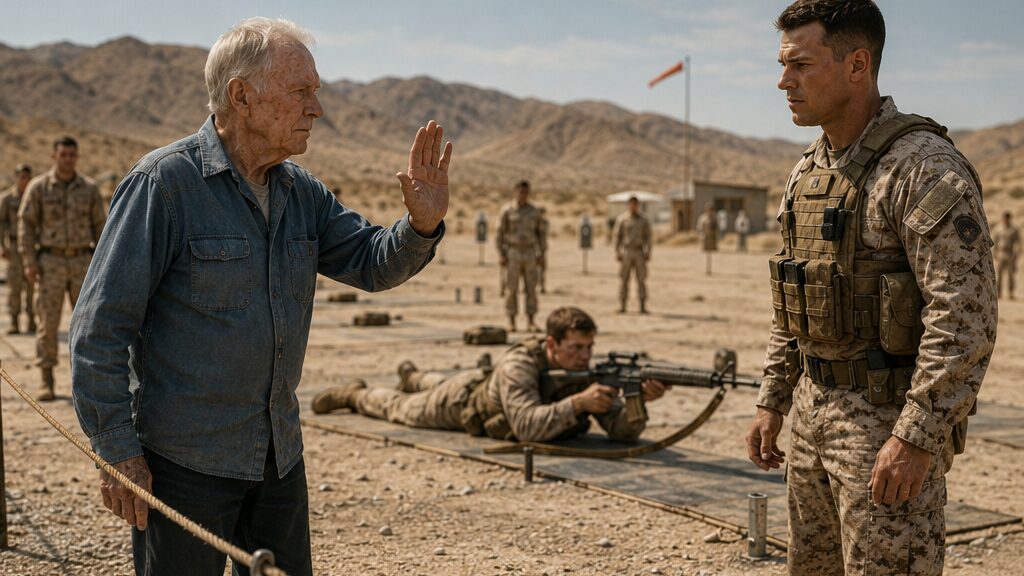
He had dressed wrong for the place, at least by the standards of the younger men moving around him. They wore camouflage, plate carriers, sunglasses, gloves clipped to belts, sleeves rolled with sharp purpose. Stephen wore a loose blue work shirt, dark trousers, and boots old enough that the leather had softened around his feet. His white hair lifted whenever the wind moved over the open flats. He kept one hand resting against his side, not because he needed to, but because the other hand held the rifle.
It lay diagonally across his chest, muzzle low, action open, stock resting lightly against his palm. Not carried like a trophy. Not carried like a threat. Carried like something that had weight beyond steel and wood.
A range clerk had signed him in twenty minutes ago after squinting at a clipboard and saying, “You’re the guest observer?”
Stephen had nodded.
“You can wait by the shade tent until Sergeant Carter gets a minute.”
Stephen had nodded again.
He had not said that he had been on ranges before the clerk’s father was old enough to drive. He had not said that he still heard cadence in the spacing between commands, or that his left thumb knew the shape of sling tension better than his tongue remembered certain names. He had not said he almost turned around twice on the road in, when the first target frames came into view.
The rifle belonged to the range, not to him. An old training rifle pulled from the rack for demonstration, cleared and flagged, handed over by the clerk with the casual warning people gave to age.
“Careful with that, sir. It’s heavier than it looks.”
Stephen had taken it without answering.
Now the long line of firing points stretched in front of him, marked in dust and faded paint. Targets stood downrange against the berms, white faces catching the morning glare. Red flags hung from poles. A wind flag near lane four snapped once, then sagged, then snapped again late, as if it had heard the wind after the dust already knew.
Stephen watched the dust instead.
It moved low, sliding from right to left near the berm before the flag stirred. A small thing. Barely worth naming unless somebody had been trained to distrust the obvious signal and look for the quieter one.
Behind him, trainees gathered in uneven clusters, joking too loudly. One of them, a lean young man with a narrow face and nervous hands, kept adjusting his sling as if it were a strap on a backpack. He laughed when another trainee bumped his shoulder, but the laugh ended too quickly.
Stephen noticed the way the young man’s fingers went back to the sling.
He looked away.
Not your line, he told himself.
The base had changed. The old wooden benches were gone, replaced by metal tables and plastic ammunition trays. The tower had a new radio mast. The pits had fresh signs with block lettering. Even the range commands had been laminated and clipped to a board as if the words worked better under plastic.
But the desert did not change much. It still smelled of dust, oil, sun-baked rubber, and old cordite hiding in the boards. It still waited. A range was never empty, even before the first shot.
Stephen shifted the rifle slightly across his blue shirt. The fabric tugged under the sling swivel. His fingers settled at the balance point automatically, two inches forward of where a new shooter would grip.
He felt someone watching him.
A young soldier in desert camouflage was walking toward him from the firing line. He moved with the clipped energy of a man who had too many things to control and too little time to control them. His face was clean-shaven, tight at the jaw, and his clipboard rode under one arm like a second weapon.
“Sir,” the soldier called, not loudly, but with enough edge for nearby heads to turn. “You can’t stand there with that.”
Stephen looked at him.
The name tape read Carter.
The rank told Stephen enough. Noncommissioned officer. Responsible for the line. Young enough to believe command presence could cover every uncertainty if he kept his voice firm.
Stephen lowered the rifle a fraction, though it was already safe. “It’s clear.”
“I didn’t ask if it was clear.” Sergeant Joshua Carter stopped close, closer than he needed to. “I said you can’t stand there with it.”
Two trainees behind him went quiet. Another looked over from a table where ammunition boxes sat unopened.
Stephen could feel the old arrangement forming around him. One man speaking. Others watching. A mistake becoming public before anyone knew whether it was a mistake.
He glanced toward the shade tent. The clerk was talking into a radio and pretending not to watch.
“I was told to wait here,” Stephen said.
Joshua’s eyes flicked over him: the white hair, the blue shirt, the rifle, the ordinary boots. Not unkindly at first. More like a quick safety assessment made under pressure.
“This is an active evaluation range today,” Joshua said. “We have inspectors coming through, trainees cycling in, and live-fire blocks starting in less than an hour. Visitors stay behind the rope.”
Stephen looked at the rope. It was six feet behind him, sagging between two posts.
He could have stepped back. He almost did. There was no shame in stepping back from a line that was not yours.
But the wind flag snapped again, late.
Downrange, dust moved before cloth.
The nervous trainee in lane four tugged at his sling once more, then tucked the rifle against his chest with the casual awkwardness of someone trying to look confident. The sling was twisted near the forward mount. Not enough to stop him from firing. Enough to pull wrong when his body dropped prone and tension came on.
Stephen’s fingers tightened once around the stock he held.
Joshua noticed the movement.
“Sir,” he said, softer but sharper, “I’m going to take that from you.”
Stephen’s eyes returned to him. “You’ve got a left pull on lane four.”
Joshua blinked. “What?”
“The sling,” Stephen said. “On the rifle your trainee keeps adjusting. It’s mounted with a half twist. He drops prone with that, it’ll pull him left before he knows he’s fighting it.”
The two trainees behind Joshua traded a glance.
Joshua did not turn around. That was the first thing Stephen noticed. The young man heard a statement about his line, but he kept his eyes fixed on the old man as if looking away would surrender authority.
“Sir, I appreciate the concern,” Joshua said, in the tone people used when they did not appreciate anything. “But I need you behind the rope.”
Stephen nodded once.
He had warned. That was all.
He shifted the rifle again, careful and slow, bringing the muzzle farther down. The diagonal line of it crossed the blue of his shirt like an old scar.
A white pickup rolled past the range road toward the office, lifting dust. Stephen watched it through the heat shimmer. On its door was a temporary placard with the inspection unit’s seal.
Joshua glanced at the truck, then back at Stephen.
“You’re Mr. Bennett?” he asked, as if the name had arrived late.
“Stephen Bennett.”
Joshua’s mouth tightened. “Right. The guest observer.”
He said the words politely, but his eyes had already placed Stephen in a category: honored old visitor, potential distraction, possible liability.
“I was told you might want to see the dedication marker later,” Joshua said. “That’s fine. We’ll make time. But you cannot be near the active line holding a rifle.”
The dedication marker.
Stephen looked past him toward the far end of the range, where a tarp covered something mounted low near the flagpole. He had not let himself look directly at it since arriving.
The wind moved. The tarp lifted at one corner, then fell.
A name waited under there. A name Stephen had not spoken aloud in years.
His throat tightened, but his face did not change.
“I’ll stand behind the rope,” he said.
Joshua reached for the rifle.
Stephen allowed the younger man to take it, but he turned it first, presenting the open action, chamber flag visible, muzzle safe. The movement was so practiced that Joshua’s hand paused in spite of himself.
Only a second.
Then he took the rifle.
“Thank you,” Joshua said.
Stephen stepped back over the rope.
Behind him, one of the trainees whispered something Stephen did not catch. Another gave a short laugh, embarrassed or relieved. The clerk looked away too quickly.
Stephen stood in the place assigned to visitors, hands empty now, blue shirt shifting in the warm wind. The range spread out before him in clean lines of command and compliance.
Joshua carried the rifle toward the rack.
The young trainee in lane four tugged at his sling again.
Stephen watched the dust crawl left along the berm.
Chapter 2: The Warning Nobody Wanted From Him
By midmorning the range had arranged itself into ritual.
The trainees lined up behind their firing points. Ammunition was counted and recounted. The inspection captain had not yet stepped onto the line, but everyone behaved as if his shadow were already there. Clipboards moved from hand to hand. Radios crackled. A medic checked a bag beneath the shade tent and zipped it closed with unnecessary force.
Stephen remained behind the rope.
No one had told him he could not watch.
That was the small mercy.
He stood near a post where the rope had frayed at the knot. From there he could see lane four without turning his head too obviously. The trainee with the nervous hands had a name strip on his uniform: Reed. Young James Reed, all elbows and tightened shoulders, trying to breathe in a way that looked natural.
Joshua Carter moved down the line with his clipboard tucked beneath his arm. He checked chambers. He corrected stances. He made the trainees repeat commands back to him. He was not careless. That mattered to Stephen.
Careless men were easy to resent. Joshua was harder. He cared about safety. He cared about standards. He simply cared in the way young leaders often did, by tightening his grip on every visible thing and missing the invisible ones.
“Lane four,” Joshua said. “Adjust your sling before live block.”
James Reed flushed. “Yes, Sergeant.”
He pulled the sling, but not the twist.
Stephen watched the strap flatten under the young man’s hand, then roll again at the front mount. A half twist remained hidden where the sling met steel. The kind of thing that could look corrected from five feet away.
Stephen moved before he had decided to.
One step toward the rope. Then another. Not across it. Just close enough for Joshua to see him.
Joshua saw.
His jaw changed first.
“Mr. Bennett,” he said.
The trainees went still in the way young men went still when they sensed someone else was about to be corrected.
Stephen kept his voice low. “Sergeant Carter.”
“You need something?”
“Lane four still has the twist.”
Joshua looked at James this time, but only briefly. “I checked it.”
“You checked the flat. Not the mount.”
A small smile appeared on one trainee’s face and vanished when Joshua’s eyes cut sideways.
“Sir,” Joshua said, walking toward Stephen, “I understand you may have experience with older rifles. But these are current range procedures. My line is under control.”
The words were not cruel. That almost made them worse. They were clean, professional, and final.
Stephen looked at the rifle in James Reed’s hands.
It was not the same one Stephen had held earlier, but its geometry was familiar. A training rifle, modernized in parts, old in spirit. Sling tension did not care what year it was. Bodies under stress did not either.
James shifted his weight.
The dust near the berm slid left.
The wind flag hung limp.
Stephen nodded toward it. “Your flag is lying to you too.”
Now Joshua’s expression hardened. “The flag?”
“Dust’s moving before the cloth. It’s lower wind off the berm. Lane four will read calm and hold wrong.”
A few heads turned downrange.
The flag snapped then, as if late to defend itself.
The moment might have passed if Stephen had stopped there. But James Reed, trying to fix what he thought was the problem, raised his rifle slightly and ran his hand down the sling. The strap tightened against the twist, pulling the stock a fraction across his chest.
Stephen saw the motion and lifted two fingers.
Not a point. Not an accusation. Just two fingers placed in the air, then lowered toward the forward sling mount on the rifle Joshua had set in the rack beside him.
“That,” Stephen said. “Right there.”
Joshua followed the gesture despite himself.
Stephen reached for the rack rifle only after making sure Joshua saw his hand. He did not pick it up. He did not shoulder it. He simply touched the sling near the mount with two fingers and rolled the strap back half an inch.
The twist revealed itself and flattened.
Quiet fell, not dramatic, not complete, but enough.
Stephen looked at Joshua. “When he drops prone, the sling will tighten across his support arm. He’ll fight the rifle and think it’s nerves. If he hurries, he’ll correct the wrong thing.”
For the first time, James Reed looked directly at Stephen.
There was fear in his face, quickly hidden. Not fear of the rifle. Fear of being seen.
Joshua noticed that too. Stephen could tell by the way his eyes flicked, then came back harder.
“Mr. Bennett,” Joshua said, “do not touch range equipment without permission.”
Stephen removed his hand from the sling.
“Yes, Sergeant.”
The answer, calm and immediate, seemed to irritate Joshua more than argument would have.
“You were told to remain behind the rope.”
“I am behind it.”
“You’re interfering with my line.”
Stephen looked at the rope between them. Then at James. Then at the flag.
“I’m trying not to.”
One of the background trainees shifted, boots scraping gravel.
Joshua stepped closer. He lowered his voice, but the range carried everything.
“Sir, this is not a place for old habits.”
The words landed.
Stephen felt them, not as insult alone, but as proof of a wall he knew too well. Old habits. Old rifles. Old men. Old warnings. Things useful only in stories until the day somebody needed them and realized too late they had thrown them away.
His face remained still.
The younger man seemed to expect a defense. Maybe a claim of past service. Maybe an offended speech. Maybe the brittle pride of an old visitor who wanted to be treated as important.
Stephen gave him none of it.
Instead he looked once more at the sling, then at the trainee.
“Reed,” he said.
James straightened before remembering he did not owe the old man a response.
“Yes, sir?”
“When you go down, don’t chase the sight. If it pulls, stop and breathe. Make them fix the strap.”
Joshua’s hand came up. “That’s enough.”
Stephen lowered his gaze.
He stepped back from the rope.
The watching trainees looked away one by one, as if embarrassed for him, or for themselves, or simply eager for the discomfort to move elsewhere.
Joshua turned to James. “Lane four, you take instruction from range staff only.”
“Yes, Sergeant.”
But James’s eyes slipped once toward the sling mount.
Stephen saw that. It was not victory. It was not enough. But it was something.
At the far end of the range, Eric Miller came out of the office with a radio clipped high on his vest. He had the broad, sunburned face of a man who had learned to turn concern into irritation because irritation was easier to manage. His eyes moved from Joshua to Stephen to the line.
He started walking.
Joshua muttered something under his breath and went to meet him halfway.
Stephen could not hear the first exchange over the wind, but he saw Eric’s posture sharpen. He saw Joshua shake his head once. He saw both men look toward him.
Then Eric came the rest of the way.
“Mr. Bennett,” he said, stopping on the firing-line side of the rope. “I’m Eric Miller, senior range officer.”
Stephen nodded. “Mr. Miller.”
“Sergeant Carter tells me you have concerns about our equipment.”
“One sling. One lane. Wind low off the berm.”
Eric gave the faintest smile. It did not reach his eyes. “We appreciate extra eyes. But today is a formal evaluation. Too many voices on a range make accidents, even when those voices mean well.”
Stephen accepted that. It was true as far as it went.
“I understand,” he said.
“Good.” Eric looked relieved to have found compliance. “We’ll have you wait by the office until the dedication portion.”
Stephen looked at James Reed. The young man was pretending to inspect his magazine. The sling still had the twist.
“Check lane four before live fire,” Stephen said.
Joshua exhaled through his nose.
Eric’s smile disappeared. “We have qualified personnel for that.”
Stephen held his eyes for one second, maybe two. Long enough to decide whether pride was involved. Long enough to know it was, but not only pride. Schedule. Inspection. A public line. A visiting old man creating uncertainty.
He stepped back.
The rope brushed his blue shirt.
“Yes,” Stephen said. “You do.”
Eric turned to Joshua without lowering his voice enough. “Get him off the line before the inspectors see this.”
The words moved across the gravel and reached everyone who was trying not to listen.
Stephen felt heat rise in his face, but he did not give it shape.
Joshua looked, for one brief second, as if he regretted that the sentence had been said aloud. Then he straightened.
“Mr. Bennett,” he said, “this way.”
Stephen followed.
Behind him, the range resumed its ritual. Commands were called. Bolts were checked. Trainees answered in chorus.
The wind flag snapped late again.
This time James Reed looked down at his sling and did not laugh when the man beside him whispered.
Chapter 3: Old Habits and New Orders
The shade beside the range office was thin and grudging.
Stephen sat on a metal bench that had been painted green too many times. Each layer had chipped at the edges, showing older greens beneath it, then primer, then the dull silver of use. A paper cup of water sweated in his hand. He had not asked for it. The clerk had brought it with the solemn kindness people offered when they thought age itself was an injury.
“Just wait here, sir,” the clerk had said. “They’ll come get you for the ceremony.”
Stephen thanked him.
The office door opened and shut behind him as people moved in and out. Radios spoke in clipped bursts. Somewhere inside, a printer coughed paper. Outside, the range carried on.
He could hear Joshua’s voice even when he could not make out every word.
“Shooters, stand by.”
A pause.
“Check your lane.”
A longer pause.
“On command only.”
Stephen closed his eyes.
The words stacked inside him with older words. Different men. Different range. Different heat. Same waiting. He had spent years teaching young soldiers that the rifle was not the first danger. Haste was. Shame was. A man trying to hide fear could become more dangerous than a man who admitted it.
His own instructors had taught him that by making him repeat small things until they became part of his bones. Thumb. Breath. Slack. Flag. Backstop. The order changed with the weapon and the place, but the lesson never did: nothing bad started large. It started small, then gathered help.
A bootstep stopped near the bench.
Stephen opened his eyes.
Joshua Carter stood there, clipboard at his side. Without the trainees watching, he looked younger. Not boyish, exactly. But less armored.
“You all right here?” Joshua asked.
Stephen looked at the cup in his hand. “I am.”
Joshua nodded. He seemed ready to leave, then didn’t.
“Mr. Miller doesn’t like disruptions during evaluation days.”
“Most people don’t.”
“That’s not what I meant.”
“I know.”
Joshua’s mouth tightened. “Then you know why I had to move you.”
Stephen turned the cup slightly. The water inside trembled from the vibration of distant commands.
“You had authority,” Stephen said. “You used it.”
Joshua looked away toward the range. “It wasn’t personal.”
“Most things aren’t when you’re the one saying them.”
The young man’s eyes came back.
For a moment Stephen thought Joshua might answer sharply. Instead he glanced at the rifle rack visible through the office window.
“Were you military?” he asked.
Stephen let the question sit.
There had been a time when answering was simple. Unit, years, role. The kind of answer that made men stand differently, or ask different questions, or offer him a coffee he did not want. But the older he got, the less he trusted what people did with service once they knew about it. Some turned it into a pedestal. Some turned it into a story they wanted him to perform. Some used it to decide he must be fine.
“I was,” Stephen said.
Joshua waited for more.
Stephen gave him none.
The range radio cracked: “Inspection team five minutes out.”
Joshua checked his watch.
“Then you understand chain of command,” he said.
“Yes.”
“And range control.”
“Yes.”
“And why extra instruction from outside personnel creates confusion.”
Stephen looked at him. “It can.”
Joshua caught the missing certainty. “Can?”
Stephen took a sip of water. It tasted like plastic and heat.
“A voice can confuse a line,” he said. “Silence can too.”
Joshua stared at him for a beat. Then the radio on his vest sounded, and whatever answer he had was pulled away.
“Carter, back to line.”
He pressed the radio. “On my way.”
Before he turned, Stephen said, “He flinches early.”
Joshua stopped.
“Reed,” Stephen said. “Lane four. He tightens before the command finishes.”
Joshua’s shoulders rose with an inhale. “I know he’s nervous.”
“It is not the nerves that worry me.”
“Then what?”
“What he does to hide them.”
Joshua studied him then, not with respect, not yet, but with irritation complicated by uncertainty.
“I’ll handle my trainee,” he said.
Stephen nodded. “I hope so.”
Joshua walked away.
Stephen watched him go, and for a moment the young man’s back became another back, narrower, nineteen years old, trying too hard not to shake. Stephen shut the memory down before it could finish forming. There was no use letting ghosts instruct men who had not asked for them.
He set the cup beside him and rubbed his thumb against the tips of two fingers. The feel of that sling twist seemed to remain there, a small wrongness under skin.
Inside the office, Eric Miller was speaking to someone.
“No, he’s fine,” Eric said. “Just an invited guest. We’ve got him staged away from the line.”
Stephen looked down at his boots.
Staged.
He almost smiled. Not because it was funny, but because the word belonged to equipment. Chairs were staged. Barriers were staged. Water coolers were staged.
Old men, too, apparently.
His phone buzzed in his pocket.
He pulled it out carefully. Amy.
For a second he considered letting it ring. Then he answered.
“Hi, honey.”
“Dad?” Amy’s voice was tight enough that he knew the clerk had called, or someone from the office had decided family was safer than judgment. “Are you at the range already?”
“I told you I was going.”
“You said you were going to watch a dedication. You didn’t say anything about being near the firing line.”
Stephen looked toward the line. “I’m not near it now.”
“That is not comforting.”
He closed his eyes again. Amy had her mother’s way of pressing fear into plain sentences. No decoration. No room to dodge.
“I’m sitting in the shade,” he said.
“Did something happen?”
“No.”
A pause.
“Dad.”
He looked at his hand. The fingers were still rubbing together, thumb over forefinger, forefinger over middle, searching for a twist that was no longer there.
“Nothing happened to me,” he said.
“That’s not what I asked.”
Downrange, a command rang out. Not live fire yet. Dry sequence. Practice cadence. Still, Stephen’s body listened.
“I noticed something,” he said.
Amy sighed. “You always notice something.”
The words were tired, not cruel. That made them harder to answer.
“Sometimes something needs noticing.”
“And sometimes you need to let other people do their jobs.”
He turned toward the mountains. Their ridges were brown and still, hard against the white sky.
“I know.”
“Do you?”
Stephen did not answer.
Amy softened. “I’m not trying to make you feel useless.”
“I didn’t say you were.”
“You don’t have to.”
The line went quiet for several seconds. He could hear, behind her, traffic or maybe the hum of the hospital parking lot where she worked. Her life had schedules, patients, forms, bills, her own grown children calling at inconvenient times. He had no right to make himself another worry.
“I’ll leave after the dedication,” he said.
“Promise?”
He looked at the covered marker by the flagpole.
The tarp lifted again.
“I promise I won’t stay longer than I should.”
“That is not the same thing.”
“No,” he said. “It isn’t.”
She knew better than to argue with that. “Call me when you’re done.”
“I will.”
After he hung up, Stephen kept the phone in his hand until the screen went dark.
On the range, Joshua’s voice rose.
“Dry run complete. Prepare for first live block.”
Stephen stood.
Not quickly. His knees did not like quick anymore. His back gave him its usual warning. The heat pressed down through the thin shade and settled at the base of his neck.
He moved to the corner of the office where he could see past the parked pickup and down the line.
James Reed was in lane four.
The sling still held its half twist.
Joshua walked behind him, checking each shooter in order. When he reached James, he bent, said something, and tugged once at the strap. From that distance, it looked corrected.
Stephen’s fingers stopped moving.
James lowered into position for the dry prone sequence, and the sling tightened across his arm. His left shoulder pulled in a fraction. The muzzle shifted, not much, but enough for Stephen to see the young man correct with muscle instead of position.
Stephen whispered, “Don’t chase it.”
No one heard him.
The first live round cracked across the desert from another lane.
Then another.
James flinched before his command.
When his shot came, the sound was wrong.
Not wild, not catastrophic, not enough to stop the line. Just a sharp, ugly strike with a higher note under it, metal touched where dirt should have swallowed the round.
Stephen’s eyes went to the target frame.
He could not see the impact from there.
But he had heard it.
Joshua’s voice carried down the line. “Lane four, reset.”
James lifted his head, embarrassed, and nodded too fast.
Stephen stepped out from the shade.
Chapter 4: The Sound Before the Miss
Stephen did not cross the rope.
That was the first thing he made himself remember.
He stepped out of the office shade and stopped where the gravel changed color under the sun, his boots just short of the sagging boundary. The live block had settled into rhythm now. Commands, shots, calls, reset. The trainees were firing in controlled sequence, not all at once, which made each report distinct enough for an old ear to separate.
Lane one cracked clean.
Lane two hit dirt behind paper.
Lane three struck somewhere low and soft.
Lane four had made that hard little sound, the one that did not belong.
Stephen watched the target frame. Heat shimmer bent the distance. He could not see a hole, only the white square wavering above the berm, but sound had already drawn its own map inside him.
Metal bracket. Right side of frame. High enough to mean the muzzle had come across the line of correction, then snapped back.
James Reed was still prone. Joshua had crouched beside him, one hand hovering near the rifle but not touching. From that distance Stephen could see the young trainee’s shoulders moving too fast.
“Lane four,” Joshua called. “Reset your breathing.”
James nodded and lowered his cheek again.
Stephen lifted one hand but let it fall.
Eric Miller came out of the office behind him. “Mr. Bennett.”
Stephen did not turn. “That round hit frame metal.”
Eric stopped beside him. “The pit crew will score after the block.”
“Not score. Inspect.”
Eric looked down the line, then back at Stephen. “You cannot diagnose impact from here.”
Stephen kept his eyes on lane four. “I can hear the difference between dirt and bracket.”
The senior range officer gave a short breath, almost a laugh. “Sir, I am trying very hard to be respectful.”
“I know.”
“Then let me be clear. You are no longer permitted to advise shooters, call corrections, or interfere with live fire. If there is a safety issue, my staff will identify it.”
Stephen looked at him then. Eric’s face was red from sun and pressure, sweat darkening his collar. This was not a man who wanted anyone hurt. He was fighting the day, the clock, the inspection, the embarrassment of an old guest becoming a visible problem.
Stephen understood him. That did not make him right.
“The staff missed it once,” Stephen said.
Eric’s expression closed. “We have not missed a safety issue.”
“Not yet.”
That landed poorly.
Eric stepped closer. “Mr. Bennett, I will not have you undermining command confidence on my firing line.”
A second shot from lane four cracked across the range.
Stephen turned before the echo faded.
This one struck paper, but wide. Not dangerously wide. Not enough to halt. It pulled left, exactly as the sling had promised it would. James jerked his head up, then looked toward Joshua as if expecting anger.
Joshua was patient. Stephen saw that too. The young sergeant leaned down and spoke calmly. James nodded too fast again.
“See?” Eric said. “Correctable training issue.”
Stephen did not answer.
The wind flag snapped late. Again. The dust had already moved.
A civilian maintenance contractor in a faded cap drove a small utility cart along the side road toward the target pits. He slowed near the berm access and waited for clearance. The cart carried replacement target boards, orange cones, and a bundle of fresh stakes.
Stephen watched the stakes bounce with the engine’s vibration.
“Why is he moving now?” Stephen asked.
Eric followed his line of sight. “Maintenance is staging for the next block. They’re outside the active sector.”
“Is the pit access gate latched?”
Eric’s jaw worked. “Yes.”
Stephen looked at the gate. At the angle of dust. At the utility cart waiting where the side road dipped. At lane four’s target frame, where the first ugly sound had come from.
“Check it.”
“Mr. Bennett.”
“Check the gate.”
Eric turned fully toward him now. “You are guessing.”
Stephen felt the old irritation rise, sharp and useless. Not at Eric alone. At time. At age. At the fact that an old man saying the right thing too early sounded exactly like an old man fussing.
He swallowed it.
“No,” he said. “I’m remembering.”
Eric seemed ready to answer, but Joshua’s voice cut across the range.
“Cease fire, lane four. Keep the muzzle downrange.”
Stephen’s whole body stilled.
James had pushed up from prone. The sling had tightened across his arm, and in trying to free himself he had shifted his elbow too sharply. The muzzle stayed downrange, but the movement had been wrong enough for Joshua to catch it.
Good, Stephen thought. Good.
Joshua stepped in, controlled the rifle, and had James sit back. No panic. No shouting. The line remained safe.
Eric glanced at Stephen, but only for half a second.
“Minor correction,” he said, more to himself than to Stephen.
Stephen saw Joshua reach for the sling. This time he inspected the mount. His thumb found the twist. His shoulders paused.
There.
Not victory. Not even relief. Just the first small crack in certainty.
Joshua flattened the sling and said something to James. The young trainee stared down at the strap as if it had betrayed him.
Stephen looked toward the target pits again. The maintenance cart had begun rolling forward.
The pit gate moved in the wind.
Not open. Not closed. Moving.
A gust slid dust along the berm. The flag above the line hung still for one breath too many.
Stephen stepped to the office doorway. “Radio the pits.”
Eric’s patience broke. “Enough.”
“Radio them now.”
The word now came out harder than Stephen intended. It cut through nearby conversation. The clerk inside looked up. So did the medic under the shade tent.
Eric’s face darkened. “You do not give commands here.”
Stephen lowered his voice. “Then give one yourself.”
They stood in the dry heat, two men separated by authority, age, and a problem only one of them believed was becoming visible.
Joshua looked back from lane four, still crouched beside James. He saw Stephen, saw Eric, saw the direction of Stephen’s gaze. This time he followed it downrange.
The maintenance cart had stopped near the berm access. The driver leaned out, one hand on the gate.
Joshua lifted his radio.
Stephen heard only pieces.
“Range control, confirm pit gate status.”
A burst of static.
Eric turned toward Joshua. “Carter, who told you to call that?”
Joshua did not answer him at first. He listened, eyes narrowed against the glare.
Then the radio answered clearly enough for those nearby to hear.
“Pit gate latch is loose. Holding outside until secured.”
The range seemed to take one breath and hold it.
Eric stared downrange.
Stephen stood very still.
The finding was not dramatic enough to frighten everyone. No one had stepped into fire. No shot had crossed into a forbidden place. No disaster had arrived. That was the strange mercy of prevention: when it worked, it looked almost like overreaction.
Eric looked back at Stephen with something guarded in his face.
“You saw the gate from here?”
“I saw it move when nothing else did.”
“And you connected that to lane four?”
“No,” Stephen said. “I connected it to the wind. Lane four just made me keep looking.”
Joshua came up from the line, leaving another instructor to hold the block. He stopped near Eric but looked at Stephen.
“You were right about the sling,” Joshua said.
The admission was quiet. It cost him something.
Stephen nodded once. “You found it.”
Joshua’s eyes flicked toward James. “Why didn’t it show when I checked it?”
“Because he flattened the strap where you could see it. The twist was under tension at the mount.”
Joshua absorbed that, irritated all over again, but this time at the object, not the old man.
Eric clipped his radio back on. “We’re pausing for pit gate maintenance. Five minutes.”
The command spread along the line. Rifles were cleared. Shooters sat back. The inspection captain, newly arrived near the office, looked from face to face, reading the pause before anyone explained it to him.
Stephen had created the one thing Eric wanted least: uncertainty in front of an evaluator.
Eric leaned close enough that only Stephen and Joshua could hear.
“I don’t know what you think you’re doing,” he said, “but you are making this range look disorganized.”
Stephen looked at the young trainees sitting in the dust, rifles open, waiting. James Reed had both hands on his knees and his head bowed.
“I thought I was trying to keep it that way,” Stephen said.
Eric’s eyes hardened. “This is not your line.”
Stephen felt the words settle. They were true. That had been the rule he had repeated to himself since morning.
Not your line.
Not your men.
Not your grief.
Then James Reed looked up from lane four. For a second his face was the face of every young man who had ever pretended not to be afraid because older men were watching.
Stephen turned back to Eric.
“No,” he said. “It isn’t.”
He stepped back before he could say more.
A car door shut in the parking area behind the office. Fast footsteps crossed gravel.
Stephen knew them before he saw her.
Amy Harris came around the corner in her work blouse and flats unsuited for range dust, eyes scanning until she found him. Her face held relief for one second, then anger built over it because relief needed somewhere to go.
“Dad,” she said.
Joshua took a small step back. Eric looked relieved to have family arrive, as if Stephen might now become someone else’s jurisdiction.
Amy stopped in front of her father. “What happened?”
Stephen looked toward the paused line, the loose gate, the young trainee, the flag that had finally begun to move on time.
“Nothing,” he said.
Amy’s eyes filled with a frustration old enough to know his evasions by shape.
“Then why did they call me?”
Behind Stephen, Eric said carefully, “Ma’am, your father has been involved in a few range disruptions.”
Amy looked past Stephen at the soldiers, the rifles, the open desert.
Then Joshua, still holding the corrected sling in one hand, said nothing at all.
Chapter 5: What His Daughter Thought He Was Chasing
Amy took Stephen by the elbow, not roughly, but firmly enough to tell him she had already made decisions on the drive over.
He let her guide him toward the parking area.
The gravel shifted under her flats. She looked out of place among the dust and uniforms, and Stephen hated that he had brought her into it. She had spent enough of her life entering places after calls: hospitals, pharmacies, administrative offices, his house after he left a burner on, the urgent care clinic after he tried to fix a gutter alone. Now a military range.
He could feel the story forming in her mind.
Dad went back to the past. Dad got too close. Dad scared people. Dad would not listen.
They stopped beside her car, a compact sedan with a hospital parking sticker on the windshield. The desert sun flashed across the glass. Amy folded her arms and looked at him the way she had looked at her own children when they were teenagers pretending not to know better.
“Tell me the truth,” she said.
“I noticed a safety issue.”
“No. That’s the first sentence you use when you don’t want to tell me the rest.”
Stephen looked toward the firing line. From here the trainees were shapes through shimmer. The pause continued. Men moved near the pit gate, one kneeling to work the latch.
Amy followed his gaze. “They said you were interfering with live fire.”
“I stayed behind the rope.”
“Dad.”
“I did.”
“That is not the same as staying out of it.”
He almost smiled, not happily. She had always been precise when frightened.
A radio crackled near the office. The inspection captain spoke with Eric Miller under the shade, both men gesturing toward the gate. Joshua stood apart from them, looking down at the sling in his hands as if a strip of nylon had become an accusation.
Amy lowered her voice. “Why are you doing this?”
Stephen turned back to her. “Doing what?”
“Coming here. Picking up rifles. Correcting soldiers. Making everyone look at you like—”
She stopped.
“Like what?” he asked.
Her mouth tightened. “Like they don’t know whether to respect you or remove you.”
The words hurt because they were careful.
Stephen looked down at his blue shirt. Dust had settled across the front where the rope had brushed him. Without the rifle against it, the shirt looked plain, too large at the shoulders. An old man’s shirt.
“I didn’t come to be looked at,” he said.
“Then why?”
He looked toward the covered marker by the flagpole. Amy followed his gaze, and her expression changed a little.
“The dedication,” she said.
Stephen nodded.
“You never said who it was for.”
“No.”
“Was it someone you knew?”
He pressed his thumb against his first two fingers. The ghost of the sling twist was still there.
“I trained him,” Stephen said.
Amy waited.
Stephen had not planned to tell this in a parking lot with rifles cracking in the distance and an inspection team watching a broken latch. He had not planned to tell it at all.
“He was young,” Stephen said. “Most of them were. Thought fear was something you could outrun if you moved fast enough.”
Amy’s face softened, but she did not step closer. She knew there were some doors he would close if she moved too quickly toward them.
“I corrected his sling one morning,” Stephen said. “Not like today. Different range. Different year. Same kind of small wrong thing. He laughed. Not mean. Just embarrassed. Everybody was watching, and I let him have his pride because I didn’t want to shame him over a strap.”
The range seemed to fade in pieces. The mountains stayed. The heat stayed. But Stephen saw, for a moment, another line, another shoulder, another young man grinning too hard.
“Later,” he said, “there was a hurry. Weather turning. Orders changing. He made a correction he shouldn’t have made. Not because of the sling alone. Nothing is ever one thing. But I remembered seeing it. I remembered deciding not to press.”
Amy’s arms lowered slowly.
“Did he die?” she asked.
Stephen kept his eyes on the covered marker.
“Not that day.”
It was all he could give her. It was enough.
Amy looked down at the gravel. “Dad, you can’t carry every young man you trained.”
“No.”
“But you do.”
He did not answer.
The wind moved between them. A loose corner of the tarp near the flagpole lifted, showing a strip of bronze beneath. Stephen looked away before he could read anything.
Amy stepped closer now. “I thought you came because you missed being who you were.”
Stephen breathed out through his nose. “I do miss parts of it.”
“I thought you were trying to prove you could still do it.”
“So did they.”
“Were you?”
He considered lying kindly. It would have been easy. A little pride, a little nostalgia, a harmless old man wanting to feel useful. People understood that. They could forgive it.
But Amy deserved the harder truth.
“When I held that rifle this morning,” he said, “I wanted to know if my hands remembered without my asking.”
“And did they?”
“Yes.”
The answer frightened her. He saw it.
“Dad—”
“That isn’t why I spoke.”
“Then why?”
He looked at lane four.
“Because Reed is hiding fear. Carter is hiding pressure. Miller is hiding embarrassment. Everybody is hiding something, and the range doesn’t care why.”
Amy swallowed.
The medic walked past them carrying a water cooler toward the shade tent. He glanced once at Stephen, then away.
Amy said, “You sound like you’re back there.”
Stephen nodded. “A little.”
“That scares me.”
“It scares me too.”
The admission surprised them both.
For years he had let her believe his silence was strength, or stubbornness, or both. He had let her argue with the surface because the depths were unfair to hand to a daughter who had already buried her mother and balanced his pill organizers and pretended not to notice when he forgot the same question twice.
“I’m not trying to be young,” he said. “I know what I am when I get out of a chair. I know what stairs cost. I know what people see.”
Amy’s eyes glistened, but she did not cry.
“What do they see?” she asked.
He looked toward Joshua, who was now speaking with James Reed at lane four. The young sergeant’s posture had changed. Less command, more attention.
“They see someone who has already had his turn.”
Amy took that in as if it had weight.
“And what do you want them to see?”
Stephen thought of the rifle crossing his chest, the quick judgment in Joshua’s eyes, Eric’s polished concern, James’s hidden flinch.
“Not me,” he said. “The thing in front of them.”
From the office, Eric Miller’s voice rose.
“Gate is secured. We’re resuming in ten.”
Joshua turned sharply toward him. “Sir, I’d like to recheck lane four’s setup before continuing.”
Eric replied, “You already did.”
“I want another minute.”
“We don’t have another minute.”
The inspection captain stood close enough to hear. His face gave nothing away.
Amy looked at Stephen. “Is that the boy you were worried about?”
Stephen nodded.
On the line, James Reed tried to adjust the sling himself. Now that he knew it was wrong, his hands seemed less certain than before. He pulled too much slack. Then too little. His embarrassment was becoming visible.
Joshua reached to help him, then stopped as Eric called him over.
Stephen watched the young sergeant hesitate between the trainee and the superior. Chain of command tightened around him like a sling under tension.
Amy saw her father’s body change.
Not much. A straightening that cost him. A stillness that belonged to another decade.
“No,” she said softly.
Stephen did not move.
“Dad.”
“I hear you.”
“You promised you wouldn’t stay longer than you should.”
He looked at her then, and the sadness in his face was old but not distant.
“I know.”
Eric’s voice carried again. “Run the block.”
Joshua turned back toward lane four, jaw set.
James lowered toward prone, rushing now because everyone was waiting.
Stephen closed his eyes for one breath.
When he opened them, the wind flag hung still, the dust moved left, and James Reed’s sling tightened across his support arm.
Stephen stepped away from Amy’s car.
Chapter 6: When the Line Went Quiet
Stephen did not hurry.
Hurry was what had broken the moment.
He crossed the gravel at the pace his knees allowed, each step deliberate enough that no one could mistake him for panicked and no one could pretend he was wandering. Amy called his name once behind him. He heard fear in it, and love, and anger waiting its turn.
He kept moving.
At the firing line, Joshua Carter stood behind lane four with his hand raised to give the next command. Eric Miller watched from near the office, inspection captain beside him. The pit gate had been latched. The maintenance cart was clear. On paper, the range had corrected itself.
But James Reed had dropped prone too fast.
Stephen saw the strap bite into the young man’s support arm. Saw his left shoulder pull. Saw the rifle’s line shift. Saw James try to muscle it back because he had been told he was nervous, because men were watching, because the worst thing a frightened young trainee could imagine was being the reason the line stopped.
“Shooters,” Joshua called, “stand by.”
Stephen reached the rope.
He could have shouted from there.
He did not.
He lifted the rope with one hand, ducked beneath it, and stepped onto the firing-line side.
The world changed instantly.
A trainee in lane two saw him and froze. The medic stood. Eric’s voice cut out mid-sentence. Joshua turned, anger flashing across his face before surprise took its place.
“Mr. Bennett!”
Stephen raised his right hand, palm flat, fingers together.
Not reaching for a rifle. Not pointing. Not commanding with volume.
Just the old signal, clear as a closed gate.
“Stop the line.”
The words were quiet.
Joshua heard them anyway.
“Cease fire!” Joshua shouted, the command leaving him before pride could stop it. “Cease fire, cease fire. Fingers straight. Safeties on. Muzzles downrange.”
The line obeyed in a clatter of movement and held breath.
Stephen stopped three feet behind James Reed.
He did not touch the young man. He did not touch the rifle. His palm remained open where everyone could see it.
Eric was already coming toward him. “Get him off the line.”
Joshua’s hand rose, not to Eric, not fully, but enough to ask for one second.
Stephen looked down at James. “Reed.”
The young trainee’s face was pale under the brim of his cap. “Sir?”
“Do not correct the sight.”
James swallowed. “I wasn’t—”
“You were about to. Because the rifle is pulling left and your pride is pulling harder.”
The words were plain. Not mocking. Somehow that made them harder to hide from.
Joshua crouched on the other side of James now. “Keep the muzzle downrange.”
“Yes, Sergeant.”
Stephen lowered himself slowly to one knee. Pain moved through his leg, sharp and private. He let it pass across his face without drama. The gravel pressed through the fabric at his knee.
“Sergeant Carter,” he said, “look at his support arm.”
Joshua looked.
“Not the sling. The arm.”
Joshua’s eyes narrowed. The strap had tightened across the outside of James’s arm at an angle, dragging the stock inward. James’s hand was fighting the pull, fingers tense, forearm rigid.
Stephen said, “Now look at his shoulder.”
Joshua followed. The left shoulder had crept high. A young body trying to solve equipment with muscle.
“Now his cheek.”
James’s cheek weld had shifted just enough that his eye line was searching for the sight instead of settling behind it.
Joshua’s anger had gone still. His training was working now. Not against Stephen. With him.
Eric reached them. “This is over. Clear him from the line.”
The inspection captain stood behind him, silent.
Stephen did not look up. “Captain, may I speak for thirty seconds?”
Eric snapped, “You may not.”
The captain said, “Let him.”
Eric turned.
The captain’s face remained unreadable. “Thirty seconds.”
Stephen nodded once, still kneeling.
He pointed not at James, but at the ground beside him. “Dust is moving left along the berm. The flag above you is late because it’s catching higher air. Lane four reads calm if you trust the cloth. It is not calm where the round travels.”
Joshua glanced downrange.
Stephen continued. “The sling was twisted at the mount. It looked flat until tension came on. When Reed dropped prone, the strap pulled his support arm. He corrected with shoulder and cheek. His first round touched frame metal. His second went wide left. Now he is embarrassed and hurrying.”
James shut his eyes.
Stephen’s voice softened. “That is the dangerous part.”
No one spoke.
The range, which had been full of command and recoil minutes earlier, had gone so quiet Stephen could hear the wind move paper on the target board.
Joshua looked at James. “Is that what happened?”
James’s mouth opened, closed, then opened again. “I didn’t want to hold everyone up.”
Joshua looked down.
There it was. Not disobedience. Shame.
Stephen shifted his weight to stand, but his knee refused him for one humiliating second. Amy moved forward from behind the rope, but stopped herself. Joshua saw the struggle and offered a hand.
Stephen looked at it.
The old pride in him flared. The reflex to refuse help, to rise alone even if it cost him. He had taught too many young men never to let pain make decisions, but age had a way of turning every offered hand into a question.
Then he took Joshua’s hand.
The younger man pulled carefully, not too hard, and Stephen came to his feet.
That changed something more than the warning had.
Eric looked away first.
The captain stepped closer to lane four. “Fix the sling.”
Joshua did it himself. This time slowly. He loosened the strap, rolled the twist out at the mount, set the tension, then had James settle into prone again without ammunition.
Stephen watched but did not speak.
Joshua adjusted once, then looked at Stephen despite himself.
Stephen shook his head.
Joshua paused. Rechecked the support arm. Found the angle still tight. Changed it.
Stephen nodded.
James breathed out, and for the first time all morning his shoulders dropped.
“Sight picture?” Joshua asked.
“Steady,” James said, surprise in the word.
The captain walked to the edge of the line and looked toward the berm. “Target frame inspection?”
A pit voice answered over the radio. “Lane four bracket shows fresh strike.”
Eric’s face went slack for half a second before control returned.
The captain turned to Stephen. “Who taught you to read a line like that?”
The question moved through the men around them. It was the question Joshua had almost asked earlier, the one Eric had avoided, the one Amy feared and needed both.
Stephen looked at the target, not the captain.
“Men who didn’t get second chances,” he said.
No one knew what to do with that.
The radio crackled. The wind flag snapped, late again, and this time every man on the line looked at the dust first.
Chapter 7: No Applause, Just Listening
The inspection captain did not ask the question again.
He only watched Stephen after asking it, as if he understood that some answers did not come faster because a uniform expected them. The men on the line remained still. Joshua stood beside lane four with the corrected sling in his hand. James Reed stayed prone, cheek lifted from the stock now, breathing as though he had only just discovered he had been holding his breath all morning.
Stephen looked at the dust first.
It had always been easier to look at what moved.
“Clear lane four,” Joshua said quietly.
James eased back from the rifle. Joshua took control of it, checked the chamber, and made the weapon safe with careful hands. There was no show in the movement now. No performance for the inspection captain. He did each step as if each step deserved its full second.
Stephen noticed that and said nothing.
Eric Miller spoke into his radio. His voice had lost some of its heat. “Range remains cold. Pit crew, confirm lane four frame and bracket condition. Maintenance, stand by at gate.”
The reply came back broken by static, but clear enough.
“Fresh strike on right bracket. No personnel in pit access. Gate secured.”
The inspection captain looked toward Eric. “Good halt.”
Eric’s face tightened. “Yes, sir.”
The captain’s eyes shifted to Joshua. “Good command.”
Joshua did not look pleased. “I should have checked the mount twice.”
The captain did not rescue him from the sentence. “Yes.”
That was all. No lecture. No public stripping down. Just a small word placed where it belonged.
Stephen liked him for that.
Amy had come only as far as the rope. She stood with one hand gripping the post, her work blouse moving in the desert wind. Her face held too many emotions to sort from where Stephen stood. Fear, still. Anger, not gone. But something else now, something quieter and more difficult for both of them.
He stepped back from the firing line.
This time no one told him to.
His knee hurt from kneeling on gravel. His back had begun its slow complaint. He felt suddenly as old as everyone had thought he was that morning, and older than he had wanted to admit to himself. The heat pressed under his collar. His hands shook once, not badly, but enough that he closed them.
Joshua saw. He did not speak of it.
Instead he carried the cleared rifle to the rack and laid it down with the muzzle aligned, chamber visible. Then he returned to Stephen.
“Mr. Bennett,” he said.
Stephen waited.
Joshua swallowed. Behind him, the trainees watched with a different kind of attention now. Not reverence. That would have embarrassed everyone. More like caution after realizing the ground was not as flat as it had looked.
“I owe you an apology,” Joshua said.
Stephen looked at the young sergeant’s face. The words were hard for him. Not because he was insincere, but because he had to say them where his men could hear.
“You owe Reed a better lane check,” Stephen said.
Joshua’s mouth opened slightly, then closed. He nodded. “Yes, sir.”
“And yourself a little mercy,” Stephen added.
That caught him off guard.
Joshua looked down at the dust between them.
Eric came over with the inspection captain beside him. For a moment Stephen expected a formal thank-you, or worse, a public explanation that would turn him into a symbol while he was still trying to get his breath back.
But Eric only removed his cap and rubbed a hand over his short hair.
“Mr. Bennett,” he said, “I handled that poorly.”
Stephen did not make him say more.
“Evaluation days make men tight,” he said.
Eric looked at him. “That an excuse?”
“No.”
A brief silence passed between them, dry and honest.
The inspection captain turned toward the covered marker near the flagpole. “You came for the dedication.”
Stephen’s eyes followed, though he tried not to let them.
The tarp had been loosened by the wind throughout the day. One corner had folded back enough to show the edge of bronze. Someone had brushed dust from the base earlier. A small row of folding chairs sat nearby, empty and bright in the sun.
“I came to stand at the back,” Stephen said.
The captain studied him for a second. “That may be harder now.”
Stephen almost smiled. “Most things are.”
Amy ducked under the rope then. No one stopped her. She walked straight to her father and stood close enough that if he swayed, she could catch him, but not so close that she did it before he needed her.
“You okay?” she asked.
“Yes.”
“You always say that.”
“I’m mostly okay.”
Her mouth softened despite herself. “That sounds closer.”
Joshua turned to James Reed, who had remained near lane four with his cap in both hands.
“Reed,” Joshua said, “come here.”
James came over with the stiff walk of a young man certain he was about to be embarrassed again.
Joshua held out the rifle sling. “Show me the mount.”
James looked confused. “Sergeant?”
“Show me where the twist hid.”
James glanced once at Stephen.
Stephen looked at the ground, giving him the privacy of not being watched too hard.
The trainee bent over the rifle and traced the strap to the forward mount. His fingers found the place where the nylon could flatten and still lie wrong underneath.
“There,” James said.
Joshua nodded. “Good. Now show the next man.”
The young trainee looked up.
Joshua’s voice remained steady. “You saw it now. That makes it yours to pass on.”
James’s face changed a little. The shame did not disappear, but it was given work to do. He nodded once and went back toward the line.
Stephen watched him go.
That was how lessons survived. Not in speeches. Not in signs laminated to boards. One person saw the small thing and taught the next person to see it before pride got involved.
The dedication happened forty minutes later.
No one restarted live fire before it. The inspection captain asked to review the line procedures first, and Eric did not argue. Joshua gathered the trainees by lane four and walked them through sling tension, support-arm pressure, wind at flag height versus wind at berm height, and the difference between correcting a shooter and understanding what the shooter was fighting.
He did not make Stephen speak.
Stephen was grateful.
When the small group moved to the flagpole, the sun had begun to lower behind a pale veil of dust. The mountains were no longer flat brown shapes but ridges with shadow in their folds. Folding chairs scraped gravel. The clerk handed out bottles of water. The medic stood at the back, arms folded. The maintenance contractor leaned against his cart, cap in his hands.
Stephen tried to remain behind the last row.
Amy stood beside him.
“You can sit,” she said.
“I can stand.”
“I know you can.”
He looked at her.
She lifted one eyebrow in a way her mother used to.
Stephen sat.
Amy sat next to him, close but not fussing. That was a kindness he had not taught her. She had learned it by surviving him.
Eric stepped in front of the covered marker with a folded paper in his hand. The inspection captain stood to one side. Joshua stood with the trainees, James Reed among them. The rifles were racked far away, bolts open, flags inserted, harmless under the empty sky.
Eric cleared his throat.
“This range,” he began, then stopped.
He looked at Stephen.
For the first time all day, Eric seemed unsure of the correct procedure. The paper in his hand suddenly looked too official for the thing it had to carry.
He folded it once and put it in his pocket.
“We’re here,” Eric said, “to dedicate this training line in memory of a soldier who learned here, trained here, and later served with steadiness that reflected the men who taught him.”
Stephen’s hands closed around each other.
Amy’s shoulder touched his lightly.
Eric continued, “He was known for checking on the man beside him. For slowing down when others rushed. For taking small corrections seriously.”
Stephen looked at the tarp, not at Eric.
“He once wrote,” Eric said, and his voice shifted, “that the best instructor he ever had never yelled when a quiet correction would do.”
The desert blurred.
Stephen lowered his head.
Amy’s hand found his forearm, not gripping, only there.
The tarp came off with a soft snap in the wind.
The bronze marker underneath was simple. A name. Dates. A short line about service and instruction. Stephen read the name once, then could not read it again.
For years he had kept memory in fragments because fragments were easier to carry. A laugh. A badly tied sling. A young man pretending not to be scared. The news delivered later by a voice that became too gentle halfway through the sentence. Now the name stood in the sun, fixed to metal, no longer asking Stephen to hold it alone.
No one clapped.
Stephen was grateful for that too.
After a minute, the group began to loosen. Quiet conversations formed. The trainees drifted away in pairs. Eric spoke with the inspection captain. The clerk collected empty bottles from chairs no one had used.
Joshua came over carrying the rifle Stephen had held that morning. Cleared, chamber flagged, muzzle down. He stopped at a respectful distance.
“Sir,” he said.
Stephen looked at the rifle, then at Joshua.
“I wanted to return this to the rack,” Joshua said. “But I thought I should ask first.”
“Ask what?”
“If you wanted to carry it back.”
Amy’s hand tightened once on Stephen’s arm, then relaxed. She was letting it be his answer.
Stephen stood slowly. Joshua did not offer help this time. He waited, ready if needed, but not ahead of need.
Stephen appreciated the difference.
He took the rifle.
It settled diagonally across his blue shirt, just as it had that morning. Same weight. Same line. Same old steel and wood under his hand. But no one stepped forward to take it from him. No one told him where to stand.
He carried it to the rack with Joshua walking beside him.
At the rack, Stephen paused and looked down at the sling. He rolled the strap flat, checked the mount, and set it right before laying the rifle in place.
Joshua watched every movement.
“Start with the sling,” Stephen said.
Joshua nodded.
“They’ll listen if you make it plain.”
“I will.”
Stephen looked toward lane four, where James Reed was showing another trainee how the twist hid under tension. The young man’s movements were awkward but careful.
“That one will be all right,” Stephen said.
Joshua followed his gaze. “Because of you.”
Stephen shook his head. “Because he was willing to be corrected after all.”
Joshua absorbed that. “I was too late.”
“You were in time.”
The younger man looked at him then, and whatever answer he had found did not need words.
Amy waited near the parking area as the sun lowered. Stephen walked toward her, slower now, the pain in his knee no longer willing to be ignored. When he reached her, she did not ask if he was okay.
She simply offered her arm.
He looked at it.
Then he took it.
Together they crossed the gravel toward her car. Behind them, the range settled into evening quiet. The wind flag moved once, then stopped. Dust slid low along the berm, honest as ever.
At the car, Amy opened the passenger door and waited while he lowered himself into the seat. Before she closed the door, she leaned one arm on the roof and looked in at him.
“You still should have told me who the dedication was for,” she said.
“Yes.”
“You still scared me.”
“I know.”
“And I still think you need to stop carrying things by yourself.”
Stephen looked past her to the flagpole, where the bronze marker held the last light.
“I’m learning,” he said.
Amy studied him, deciding whether to believe that.
Then she smiled a little. “At your pace, I assume.”
“At my pace.”
She closed the door gently.
As she walked around to the driver’s side, Stephen looked once more toward the firing line. Joshua Carter stood with James Reed and two other trainees near lane four. He was not lecturing them. He was listening while James pointed to the sling mount.
Stephen watched until Amy started the engine.
The range grew smaller through the windshield as they drove away, the mountains darkening behind it. His blue shirt was dusty. His knee ached. His hands lay open in his lap, empty now.
For the first time all day, empty did not feel useless.
The story has ended.