They Laughed at Her Old Hand Signal Until the Dogs Went Silent
Chapter 1: The Old Woman Who Told Him To Loosen The Leash
Jonathan Clark laughed loud enough for the parents behind the barricade to hear.
“Ma’am,” he said, one hand locked around the leash of the German Shepherd straining at his side, “this isn’t an old kennel yard. Please step back before you get hurt.”
A few people in the crowd turned their phones toward Deborah Mitchell.
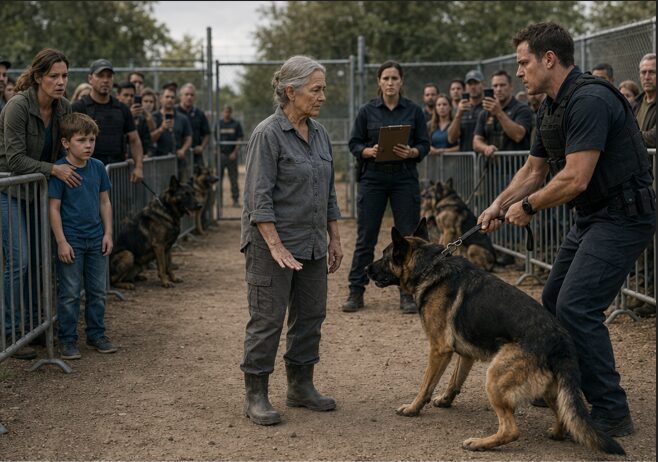
She stood just inside the rope line in gray work pants, a faded shirt, and rubber boots that still had kennel straw in the grooves. Her right hand hung beside her thigh, palm hovering low and flat, the way it had learned to rest after years of not startling dogs, horses, frightened soldiers, and men who mistook volume for command.
The Shepherd’s name was printed in black on a yellow tag clipped to Jonathan’s vest: K9 UNIT DEMO — DO NOT TOUCH. The dog did not care about the tag. His mouth was open, tongue high, breath chopping too fast. His ears flicked forward, then pinned half-back. His eyes were not on the decoy sleeve waiting at the far end of the lane. They were on the crowd.
“He’s stacking,” Deborah said.
Jonathan glanced at her like she had dropped a spoon in a quiet church.
“He’s what?”
“Stacking fear. You’re feeding it through the leash.”
The Shepherd lunged once, more sound than movement. Parents flinched against the metal barricades. Children squealed, some delighted, some not. The county open house had been advertised as family-friendly: meet the handlers, watch a safe demonstration, take pictures with the patrol vehicles. A banner zip-tied to the fence snapped in the morning breeze.
Jonathan gave the leash a sharp correction. “He’s fine.”
The dog’s jaws closed.
Deborah saw it before anyone else did.
Not a bite. Not yet. The closed mouth came first. The quiet before the wrong decision. The Shepherd’s ribs drew tight. His front paws dug into the packed dirt. His head dipped half an inch, no more, but Deborah’s eyes had been trained by years of dogs saying everything before people heard anything.
She looked toward Catherine Johnson.
Catherine stood near the gate with a clipboard pressed to her ribs, dark uniform neat, sunglasses tucked into her collar. Her face did not change, but her pen stopped moving.
“Catherine,” Deborah said quietly.
Jonathan heard the name and turned sharper than the dog did. “You know her?”
Catherine crossed the lane in three quick steps, keeping herself out of the leash line. “Deborah, what are you seeing?”
The question cut through the laughter just enough for some of the handlers to look over.
Deborah did not take satisfaction from it. She watched the Shepherd’s weight, the crowd, the narrowness of the lane between the barricades, the other dogs waiting their turn. Too many bodies. Too much metal noise. Too much show.
“His target shifted,” Deborah said. “He’s not reading the sleeve anymore. He’s reading pressure.”
Jonathan snorted. “He’s reading my command.”
“He’s reading your hand.”
His fingers tightened around the leash as if to prove her wrong.
The Shepherd’s shoulders rose.
Deborah’s palm lowered another inch, still beside her thigh. She had not meant to do it. Muscle memory, older than most of the men in the yard. Low hand. Soft line. No challenge in the eyes. Give fear a place to land.
Jonathan saw the movement and smiled without warmth.
“There it is,” he said, turning halfway to the crowd. “The old magic hand. Everybody relax. We’ve got a dog whisperer.”
A few people laughed because laughing was easier than understanding tension. One of the younger handlers grinned and looked away. A parent near the front whispered something Deborah could not hear, but she caught the shape of it: old lady.
Deborah felt the words without showing that she had.
She had been called worse by men who were afraid and younger men trying not to be. Age had a strange way of making people speak to you as if the room had already decided your use was over. If she had worn a uniform, maybe they would have stood straighter. If she had brought framed certificates, maybe Catherine would have introduced her properly. But Deborah had come in rubber boots because Catherine had said the unit needed “another set of eyes,” and dogs did not care for decorations.
The Shepherd lunged again, harder.
This time Jonathan had to brace.
The crowd made a single startled sound. The metal barricade rattled as someone backed into it. Catherine raised a hand to settle the front row while keeping her eyes on Jonathan.
“Continue to the bite demonstration,” called the county board observer from the shade tent, voice clipped and impatient. “We’re already behind.”
Catherine’s mouth tightened.
Deborah saw the choice travel through her: stop the demonstration and explain why in front of donors, parents, and officials, or trust the handler to hold the dog together for three more minutes.
“Jonathan,” Catherine said, “shorten the sequence.”
Deborah’s stomach went cold.
Shorten meant skip the reset.
The old routine had always needed space between pressure points. Let the dog breathe. Let the handler breathe. Let the lane become a lane again, not a tunnel. But the county crowd wanted movement. Demonstrations did not like quiet. Quiet looked like nothing was happening.
Jonathan nodded, relieved to be chosen over the old woman.
“You heard her,” he said. “Step back.”
Deborah did not move.
His face hardened. “Ma’am.”
The Shepherd’s mouth closed again.
At the end of the barricade, a boy in a blue T-shirt leaned over the rail. He had dropped something—small, plastic, bright red. It bounced once on the dirt and rolled under the bottom bar toward the training lane.
Deborah saw his mother reach for him and miss his sleeve.
The boy ducked.
“Jacob!” the woman shouted.
The boy’s shoulders slipped under the barricade, one knee already in the dirt, one small hand reaching for the red toy as the Shepherd’s head snapped toward the movement.
Deborah’s palm opened beside her leg.
And for the first time that morning, she knew politeness had waited too long.
Chapter 2: One Palm Down Between The Barking Dogs
The Shepherd hit the end of the leash so hard Jonathan stumbled one full step toward the boy.
Jacob froze on his knees in the dirt.
His red toy lay inches from his fingertips, forgotten now. His eyes were not on his mother or the handlers or the phones rising behind the barricades. They were on the dog’s teeth.
“Back!” Jonathan shouted, though no one knew whether he meant the boy, the dog, or Deborah.
The Shepherd barked again, deep and breaking. The other dogs along the lane answered. Leashes snapped tight. Boots shifted. Metal links rang against collars. The careful demonstration line turned in one breath into a corridor of noise and fear.
Deborah stepped forward.
“Do not pull against him,” she said.
Jonathan’s arm trembled with the effort of holding the dog back. “Get out of the lane!”
Deborah did not look at him. Looking at him would pull more pride into the moment, and pride already had its hands around the leash.
She kept her eyes soft and low, watching the Shepherd’s shoulders, the line of his spine, the shape of his breath. The dog’s name was called twice by another handler, both times too loud. His ears flicked, then vanished into the storm of sound.
“Everyone quiet,” Deborah said.
No one obeyed.
Karen Brown screamed her son’s name from behind the rail. Catherine was moving toward the gate, clipboard jammed under one arm, her other hand lifted to the handlers. A phone clattered onto the ground. One of the waiting dogs threw himself sideways, and the handler jerked him back with both hands.
“Quiet,” Deborah said again.
This time she did not raise her voice. She lowered it.
The Shepherd heard the change before the people did.
Deborah took another step. Slow. Heel first. Rubber boot pressing dust flat. Her right hand floated out from her side, palm down, fingers together, wrist loose. Not a command. Not a threat. A ceiling lowered over panic.
The nearest dog on the left stopped barking for half a second.
It was so brief that most of the crowd missed it. Deborah did not.
His eyes tracked her hand.
“That’s it,” she murmured. “There you are.”
Jonathan stared at her. “What are you doing?”
“Giving him less to fight.”
“He’s trained for noise.”
“He’s drowning in it.”
The Shepherd lunged again, but smaller this time, confused by the absence of challenge in front of him. Deborah did not step back. She angled her body, making herself narrower, making the lane wider by the simple refusal to fill it with fear.
Jacob began to cry without sound. His mouth opened, but nothing came out.
Deborah lowered her palm until it hovered at the height of the dog’s chest.
“Jacob,” she said, still watching the dog, “do not run.”
The boy’s little fingers curled into the dirt.
“Look at my boots.”
His eyes shifted, just barely.
“Good. Hands on the ground. Slow.”
Jonathan’s face flashed with anger. “Don’t talk to him. I’ve got the dog.”
The Shepherd surged at the hard edge in his voice.
Deborah’s hand did not move.
“No,” she said, and there was nothing loud in it. “He has you.”
The words struck Jonathan harder than any shout might have. His jaw tightened. For a moment she thought he would yank again, prove her wrong, prove something to the crowd, prove something to Catherine, to the county observer, to himself.
Then the Shepherd’s front paws scratched trenches in the dirt, and Jonathan’s grip slipped a fraction.
Deborah moved into the lane.
Gasps rose behind the barricades. Catherine said her name once, sharp with fear. Another handler cursed under his breath. The dogs on both sides barked and strained, the sound ricocheting against metal and concrete walls, but Deborah had stood in louder places with less room for error.
Her palm moved slowly through the air, not toward the Shepherd’s face but across his field of attention, drawing a line down and away from the boy.
The dog’s eyes followed.
His bark broke into a rough whine.
“Good,” Deborah breathed. “You’re still in there.”
She could feel the old rhythm in her bones: read the body, lower the world, open the exit. It was never magic. It was respect precise enough to look like it.
“Jonathan,” she said, “loosen your last two fingers.”
“No.”
“Just the last two.”
“If he breaks—”
“He is breaking because you keep telling him there is something to break against.”
Jonathan’s face had gone pale. Sweat stood along his temple. The anger in him was still there, but underneath it she saw the smaller thing. Fear. Not of the dog, not exactly. Fear of being seen failing.
“Last two fingers,” Deborah said.
Catherine had reached the side of the lane. “Jonathan.”
That did it. Not the command, but the sound of his supervisor saying his name with doubt in it.
His ring finger loosened. Then his smallest finger.
The leash changed.
The Shepherd felt it. His body still quivered forward, but the fight in the line softened. Deborah’s palm lowered another inch. The dog’s head dipped with it, almost against his will.
Jacob moved one knee backward.
The dog’s ears twitched.
“Slow,” Deborah said.
Karen sobbed behind the barricade. “Baby, come back.”
“Not yet,” Deborah said, and Karen went silent, furious and terrified enough to obey.
The waiting dogs were still barking, but unevenly now. One stopped. Another picked up, then faltered. The lane no longer sounded like one animal. It sounded like several frightened animals realizing nothing was chasing them.
Deborah took one side step, placing herself between the Shepherd’s sightline and Jacob without blocking Jonathan’s view. Her hand stayed low, a small roof over the moment.
“Jacob,” she said, “crawl back the way you came.”
He moved one palm. Then the other. Dirt stuck to his knees. His red toy remained in the lane.
“Leave it,” Deborah said gently.
He left it.
When Karen’s hands finally caught his shoulders and pulled him back under the barricade, the crowd exhaled so hard it seemed to move the banner on the fence.
Jonathan still held the leash. The Shepherd still stood ready, muscles shaking, but he had stopped barking.
Deborah looked at Jonathan then.
Not long. Not triumphantly. Just enough.
His eyes were fixed on her hand.
He looked as if he had seen an old door open in a wall he thought he knew.
Catherine stepped into the lane with her clipboard crushed against her hip. “Deborah—”
Before she could finish, a phone near the front lifted higher than the rest.
A teenage voice said, “It’s live.”
On the screen, Deborah saw herself from a cruel angle: small, gray-haired, walking into a lane of barking dogs while Jonathan pointed and shouted. The caption already sat across the bottom in bold white letters:
Old lady walks into K9 lane after handler laughs at her.
Chapter 3: The Clipboard Said Interference, The Video Said Otherwise
The incident report gave Catherine Johnson two boxes that looked clean until she had to choose one.
Handler error.
Civilian interference.
She held the clipboard on the metal desk in the K9 office and stared at the empty squares while the sound from the yard still rang in her ears. Outside the cinderblock wall, dogs barked in their kennels one at a time, answering each other across the row. The open house had ended early. Parents had been escorted out through the side gate. The county board observer had left without shaking anyone’s hand.
Catherine’s pen hovered over the second box.
Civilian interference would be easier.
It would satisfy the safety officer. It would explain why an elderly woman in rubber boots had stepped into a restricted lane. It would keep the report narrow, manageable, procedural. It would make the public video look reckless instead of damning.
Across the room, Jonathan stood with his arms folded, vest still on, leash burn red across one palm.
“She crossed the barrier,” he said. “That’s the report.”
Deborah sat on the wooden bench near the kennel hallway, hands folded loosely in her lap. She had washed the dirt from her palms but not from the knees of her work pants. No one had asked her to sit there. No one had asked her to leave.
Catherine looked at her. “Deborah?”
Deborah lifted her eyes. “Write what happened.”
Jonathan let out a short laugh. “That’s what I’m asking her to do.”
“No,” Deborah said. “You’re asking her to write what protects you.”
His face flushed. “You don’t know anything about what protects this unit.”
Deborah’s right hand shifted on her lap, palm turning down without fully opening. Catherine noticed it. So did Jonathan. He looked away first.
The office door swung open hard enough to strike the rubber stopper.
Karen Brown came in with Jacob pressed against her side. The boy had a paper cup of water in both hands. His face was washed, but pale. Karen’s eyes went straight to Catherine.
“Which one of you decided a child could be ten feet from a dog that wasn’t under control?”
The room changed around her anger. Jonathan straightened. Catherine set the clipboard down. Deborah rose slowly from the bench, not to defend herself, but because Jacob had glanced at her and then at the floor.
“Mrs. Brown,” Catherine said, “your son should never have been able to get under that barricade.”
“That is not an answer.”
“No, ma’am. It isn’t.”
Jonathan stepped forward. “I had the dog secured. The problem started when—”
Karen turned on him. “When my son dropped a toy? Or when you kept showing off after that woman told you something was wrong?”
Jonathan stopped.
Catherine saw Deborah close her eyes for one second, as if the support hurt in a place blame had not.
“She warned you?” Karen asked Catherine.
The clipboard felt heavier under Catherine’s hand.
“Yes,” Catherine said.
Jonathan stared at her.
Karen’s voice dropped. “Before he lunged?”
Catherine looked down at the two boxes. “Before.”
The word sat there, small and terrible.
Jacob shifted against his mother. He had not said anything since the lane. His fingers tightened around the paper cup until the rim bent.
Deborah stepped closer, but not too close. “Jacob.”
He peeked up.
“You did well leaving the toy.”
His eyes filled again. “I wanted it back.”
“I know.”
“My dad gave it to me.”
Karen’s anger flickered. Not gone, but pierced.
Deborah nodded once. “Then it mattered. That is why you went after it. That does not make you bad.”
The boy swallowed. “The dogs were loud.”
“Yes,” Deborah said. “The adults were louder.”
No one in the room answered.
Jonathan looked down at his burned palm. Catherine watched him, waiting for the sharp reply. It did not come.
Then the safety officer appeared in the doorway, tablet in hand. “The video is already over forty thousand views.”
Catherine’s stomach sank.
He turned the screen toward her. The frozen frame showed Deborah in the lane, hand lowered, Jonathan’s mouth open mid-shout. The comments were climbing too fast to read.
Old woman knew before he did.
Why did they laugh at her?
That handler needs retraining.
Someone get that kid out of there.
Catherine pushed the tablet gently away. “Not now.”
“It is now,” the safety officer said. “County wants a preliminary finding by five.”
Jonathan stepped toward Catherine’s desk. “If this comes down as handler error, they’ll pull him.”
Everyone knew who he meant.
The Shepherd.
Not “the dog.” Not “the animal.” Him.
For the first time all afternoon, Jonathan’s voice lost its edge. “They already think he’s unstable. You put this on me and they’ll wash him out to make the public feel better.”
Deborah watched him then, really watched him. The proud set of his shoulders remained, but fear had opened through it like a crack in concrete.
Catherine saw it too.
“You should have stopped when she warned you,” Catherine said.
“I know the dog.”
“You knew your plan.”
Jonathan’s mouth tightened.
Deborah moved back toward the bench. “The dog was not the only one under pressure.”
Jonathan looked at her sharply, but her face gave him nothing to attack.
Catherine turned to the filing cabinet behind her desk. The old protocol binder was supposed to be in the bottom drawer with expired certifications and retired forms. She had asked Deborah to come because three dogs had shown strange agitation in the last month and no modern checklist had explained it. She had not told Jonathan that. She had not introduced Deborah because she had wanted an old expert’s eyes without the politics of an old expert’s authority.
That cowardice now stood in the room with her.
She pulled the binder free and set it on the desk. Its plastic cover had yellowed at the edges. County K9 Reset Procedures — Field Adapted. She flipped past pages stamped with revision dates, past diagrams of lane spacing, handler posture, crowd control.
Halfway through, a copied sheet slid loose.
At the top, in faded type, was a note: adapted from Army field K9 calming sequence, submitted by trainer D. Mitchell.
Catherine’s thumb stopped on the name.
Jonathan saw it.
Deborah saw it too, but her face did not change.
Catherine read the line twice, though it did not become less clear the second time. Then she looked at Deborah, sitting quietly in dirty work pants while her name waited in a protocol no one had bothered to teach.
“What else,” Catherine asked softly, “did we stop using?”
Chapter 4: The Missing Pause In The Demonstration Plan
The gate latch clanged again, and Deborah’s right hand flattened before she could stop it.
She stood alone in the training lane with the old protocol sheet folded in her back pocket and the morning yard empty except for kennel noise behind the cinderblock wall. No crowd. No phones. No county banner. Just metal, dirt, chain-link, and the same sharp sound that had snapped the Shepherd’s attention toward Jacob the day before.
Clang.
One latch. One hard correction on a leash. One boy slipping under a rail.
People liked to say dogs reacted without reason. Deborah had never found that to be true.
She stood where Jonathan had stood and looked down the lane. Narrower than it should have been by nearly two boot lengths. Barricades pressed close on the public side. The demo markers had been set for visibility, not space. A dog moving through it would feel walls. A handler holding him through it would feel eyes. Neither would feel air.
Deborah took three slow steps backward, heel to toe, counting distance the way she used to count it when there was no measuring tape and no time to ask permission. Her rubber boot scuffed a groove through yesterday’s dust. She stopped at the spot where Jacob had frozen.
The red toy was gone. Someone had picked it up after everyone left. Still, Deborah could see it there—bright, small, foolishly precious.
Behind her, a kennel door opened.
“You measuring the crime scene now?”
Jonathan’s voice carried the edge he used when other handlers could hear him, though no one else was in the lane. He came through the gate in a black unit T-shirt instead of uniform, leash burn bandaged across his palm. The Shepherd was not with him.
Deborah did not turn immediately. She placed her boot beside the barricade foot and marked the distance with her eyes.
“You were six inches too close before you gave the second command,” she said.
Jonathan laughed once, flatly. “That’s your answer? Six inches?”
“No.”
“Then what? My grip? My voice? My breathing? You going to write all of that in Catherine’s report?”
Deborah faced him. “I’m not writing her report.”
“You don’t have to. That video is doing it for you.”
His mouth twisted around the words, but the fear under them showed. Deborah heard it more clearly this morning because the yard was quieter.
“You think I wanted that child in the lane?” he demanded.
“No.”
“You think I wanted him scared like that?”
“No.”
“You think I’m some idiot who just yanks on dogs for fun?”
Deborah looked at his bandaged hand. “I think you were afraid of being seen losing control.”
That struck him cleanly enough that he did not answer.
One of the dogs barked from the kennel row. Another answered. The sound rose, then fell when no one fed it.
Jonathan walked past her and kicked lightly at the dirt near the center of the lane. “Everybody online thinks they know exactly what happened. Old woman hero. Young handler clown. That easy.”
“It wasn’t easy.”
“Looked easy when you did it.”
Deborah’s palm turned down against her thigh, not as a signal this time but as a restraint on herself. There were things she could have said. That easy was what people called work they had not watched being learned. That quiet hands came from years of mistakes. That the first time she had failed to speak loudly enough, a handler younger than Jonathan had gone home without the partner who trusted him.
She said none of that.
Instead, she stepped to the far end of the lane and touched the top rail of the barricade.
“Tell me the sequence.”
Jonathan’s expression narrowed. “What?”
“Yesterday. From the start.”
“You were there.”
“Tell me what you did.”
He looked toward the office, as if Catherine might appear and save him from answering. She did not.
Jonathan exhaled. “Intro pass. Crowd exposure. Sleeve presentation. Hold. Release demonstration. Reset. Bite sequence.”
Deborah waited.
His jaw worked.
“Except we shortened.”
“Where?”
“After crowd exposure.”
“You removed the reset.”
“We didn’t remove it. We compressed it.”
“That means removed.”
His eyes flashed. “We were behind schedule.”
“The dog was ahead of you.”
He stared at her.
Deborah tapped the rail once. The sound was dull, but the Shepherd in the kennel row barked anyway.
“There,” she said.
Jonathan looked toward the kennel. “There what?”
“That dog braced before your command yesterday. Not after. Before.”
“He knows the sequence.”
“He knew the pressure.”
She walked the lane again, slower this time, pointing without drama. “Crowd noise here. Banner snap behind him. Narrow rail here. Your hand shortening the leash here. Gate latch behind his right ear. No pause after crowd exposure. Then you turned him toward the sleeve, but his body was still reading the people. His mouth closed before you spoke.”
Jonathan’s face changed at that.
Just slightly.
He had seen it too. Not understood it, maybe. Not named it. But remembered.
“The closed mouth,” Deborah said. “That was the detail.”
Jonathan looked down the lane as if yesterday had left a trace visible to him now. “He always does that when he’s focused.”
“Sometimes.”
“He does.”
“Sometimes,” she repeated, not harder. “Focus points forward. Fear hardens everywhere.”
His bandaged hand flexed.
A door opened at the office. Catherine came out with the old protocol binder under one arm and her phone pressed to her ear. She was not wearing sunglasses today. She looked tired enough to be honest, which did not mean she would be.
“Yes, sir,” Catherine said into the phone. “I understand the optics. We’re reviewing. No, the dog has not been released from the unit. No, I would not recommend that before—”
She stopped when she saw Deborah and Jonathan in the lane.
“County safety wants a clean re-certification demonstration,” she said after ending the call. “Forty-eight hours.”
Jonathan’s head snapped toward her. “Forty-eight?”
“If we pass, the unit stays operational while the formal review continues. If we don’t, the board can suspend public K9 work pending evaluation.”
Deborah let the words settle into the dirt between them.
A deadline had weight. Dogs felt it through handlers before handlers admitted they were carrying it.
Catherine opened the binder. “Deborah, I need you to look at the old reset sequence. Tell me what we can safely reintroduce without rebuilding the entire demo.”
“Safely?” Deborah asked.
Catherine’s mouth tightened. “Practically.”
“Those are not the same word.”
Jonathan looked away.
Catherine lowered her voice. “I have one day to keep this from becoming a funding disaster.”
“And a child?”
The clipboard was not in Catherine’s hands this morning, but Deborah still saw it: that habit of making clean lines where life had blurred.
Catherine met her eyes. “And a child.”
For a moment, Deborah believed her.
Then Catherine added, “But if we cancel the public lane entirely, the board will say we admitted the dog is unsafe.”
Jonathan stepped closer. “He isn’t unsafe.”
“No,” Deborah said. “The setup is.”
Catherine opened the binder to the copied protocol page. Deborah’s own name waited there in faded print, ugly in its quietness. D. Mitchell. A younger woman’s hand had submitted that note. A woman who still believed that if a warning was written clearly enough, someone would keep it alive.
Catherine held out a pen. “Then sign a statement saying the dog responded to environmental stacking, not handler error. It gives us room.”
Jonathan looked at Deborah quickly, hope and resentment crossing his face together.
Deborah took the paper but not the pen.
The statement was already typed. It mentioned noise. It mentioned crowd proximity. It mentioned unexpected civilian movement. It did not mention that Jonathan had been warned. It did not mention that Catherine had shortened the plan. It did not mention the missing pause.
Her palm pressed flat over the bottom of the page.
“No,” she said.
Jonathan’s face closed. “So you are trying to ruin me.”
“I’m trying not to lie for you.”
Catherine stepped forward. “Deborah—”
“No.”
The word surprised even Deborah. It was quiet, but not private. It stood up in the lane.
Catherine looked back toward the office, toward phones, county officials, funding, reports, the machinery of blame already warming itself.
Jonathan swallowed hard. “I skipped the reset because she told me the demo had to keep moving.”
Catherine went still.
He did not look at her. He kept his eyes on the dirt where Jacob had frozen.
“You wanted the crowd held,” he said. “You said if we paused too long, they’d drift before the donor walk-through. So I cut it. I thought I could handle him.”
Deborah watched Catherine absorb the truth she had already known and hoped no one would say out loud.
The kennel row quieted strangely, as if even the dogs were waiting.
Chapter 5: The Dog Was Not The Only One Afraid
Jonathan found Deborah sitting on an overturned feed bucket outside the Shepherd’s kennel, listening through the door as if the dog had something to confess.
It was nearly dark. The long fluorescent lights in the kennel row buzzed overhead, turning every chain-link shadow hard-edged and thin. The other handlers had gone home. Catherine’s office light still burned at the far end of the building, but the hallway between them felt abandoned, washed in the smell of disinfectant, kibble, wet concrete, and dog breath.
Jonathan stopped with one hand on the gate.
“You’re not supposed to be back here alone.”
Deborah did not look up. “Neither are you.”
“I work here.”
“So does he.”
Inside the kennel, the Shepherd shifted. His nails clicked once against the sealed floor. Not pacing. Not lunging. Just moving his weight from one foot to another.
Jonathan heard it because Deborah was still.
He hated that.
He hated that she seemed to make a room quieter by taking less from it. He hated that the video had shown him with his mouth open and her hand low. He hated the comments, the calls, the careful tone Catherine had used since the old protocol page turned up. Most of all, he hated the small private fact that when the dog had stopped barking yesterday, Jonathan had been relieved before he had been embarrassed.
“He eat?” he asked.
“Half.”
“He always eats all of it.”
“Not when his stomach is still carrying the yard.”
Jonathan opened the gate to the kennel corridor but did not unlatch the dog’s run. The Shepherd came to the chain-link, head level, eyes alert. His tail moved once and stopped.
“Hey,” Jonathan said softly.
The dog looked at his bandaged hand.
Deborah noticed. So did Jonathan.
“He doesn’t trust the hand yet,” she said.
Jonathan bristled. “He trusts me.”
“He wants to.”
That was worse.
He turned on her. “Do you know what happens if they pull him from active training?”
“No.”
“They put him into evaluation. If he fails that, he’s reassigned if he’s lucky. Retired out if he’s not. And everyone looks at me like I broke him.”
The dog’s ears flicked at the rise in his voice.
Deborah lowered her palm near her knee. Not toward the kennel. Just down.
Jonathan saw it and forced his voice lower. “He isn’t broken.”
“No,” she said. “But he is reading a man who thinks he might be.”
Jonathan laughed under his breath. It sounded almost like pain. “You always talk like that?”
“Only when people give dogs human problems and then punish them for understanding.”
He looked through the chain-link. The Shepherd’s eyes were on him, steady and uncertain.
“What do you want me to do?” Jonathan asked.
Deborah stood slowly. Her knees objected, but she did not let her face show it. Pride was not only for young men. Sometimes it wore gray hair and called itself composure.
“Open the run.”
Jonathan hesitated.
“You asked.”
He unlatched the door.
The Shepherd stepped forward too quickly. Jonathan’s hand rose out of habit, palm hard, fingers ready to grip the collar.
The dog stopped. His mouth closed.
Deborah said, “There.”
Jonathan froze. “What?”
“You just told him a fight was coming.”
“I didn’t touch him.”
“You prepared to.”
Jonathan’s lips pressed together.
Deborah stood beside him, angled away from the dog. “Put your hand down.”
He dropped it too fast.
The Shepherd blinked, head still high.
“Not like surrender,” Deborah said. “Like you have time.”
“I don’t know what that means.”
“Yes, you do. You just don’t like it.”
He shot her a look, but it lacked force.
Deborah lifted her own hand and set it palm-down in the air between herself and the floor. Low. Loose. Not floating like a trick. Resting on invisible water.
“Your wrist is shouting,” she said when Jonathan copied her.
He stared at his hand. “My wrist?”
“Locked. High. Commanding. You’re still trying to be obeyed.”
“That is literally the job.”
“No. The job is to be understood when fear makes obedience thin.”
The Shepherd took one careful step out of the run.
Jonathan’s fingers twitched.
“Last two fingers,” Deborah said.
He looked at her. “I’m not holding a leash.”
“You’re holding him anyway.”
Something in his face shifted then. Not understanding. Not yet. But the beginning of hearing.
He breathed out and loosened his hand one finger at a time. Thumb. Forefinger. Middle. Ring. Small. Deborah watched the change travel from his hand to his elbow, shoulder, jaw.
The Shepherd lowered his head and sniffed the concrete between them.
Jonathan’s eyes widened.
“He’s not defying you,” Deborah said. “He’s reading you.”
The dog came closer, not touching, then sat.
Jonathan stared down at him with an expression Deborah recognized from young handlers in every uniform she had ever known: shame arriving late and finding nowhere to stand.
“I thought if I gave him less room,” he said, “he’d have fewer choices.”
“And?”
“He had fewer exits.”
Deborah nodded once.
The kennel row hummed around them. A dog at the far end lapped water from a metal bowl. Catherine’s office phone rang and stopped.
Jonathan lowered himself into a crouch. The Shepherd leaned forward enough to touch his nose to the edge of Jonathan’s bandage. Jonathan did not reach. Deborah could see the effort it cost him.
“My first dog washed out,” he said suddenly. “Not here. Before. I overhandled him in tracking. They said I was too tense. I said the dog didn’t have drive.” His throat moved. “I was wrong then too.”
Deborah had not expected the admission. It made him younger than he had looked in the yard.
“Fear wears different uniforms,” she said.
He looked at her hand, still low. “Is that what this is? Some Army thing?”
“Partly.”
“You wrote that protocol.”
“I contributed.”
“That all you’re going to say?”
She should have left it there.
She had practiced leaving it there for years.
But the Shepherd was sitting between them now, calm because both humans had stopped needing to win. The old silence in Deborah’s chest loosened where she had kept it tied.
“There was a handler overseas,” she said. “Young. Good instincts. Bad officer above him. The dog started showing what yours showed yesterday. Closed mouth. Hard brace. Searching for the wrong target.”
Jonathan did not move.
“I saw it,” Deborah said. “I told the officer quietly. He dismissed it loudly. I let the chain of command hold my tongue.”
The Shepherd’s ears flicked at her voice.
“What happened?” Jonathan asked.
Deborah looked at the dog instead of him. “Enough that I learned quiet is not always restraint.”
The office door opened at the end of the hallway.
Catherine came in with a folder pressed under her arm and a face already arranged for business. “I have the revised plan for re-certification.”
Jonathan stood. The Shepherd stood with him, but did not startle.
Catherine glanced at that, then at Deborah’s low hand. For one second, hope touched her expression.
Then she opened the folder.
“We keep the public lane,” she said. “The board wants the same layout so the retest proves yesterday was an anomaly.”
Deborah’s hand went still.
Jonathan looked down the hallway toward the dark yard beyond the double doors. “Same barricades?”
“Adjusted slightly.”
“How slightly?” Deborah asked.
Catherine did not answer quickly enough.
Then she said, “Jacob and his mother agreed to attend, provided we increase the handler buffer.”
The Shepherd stepped back into the shadow of the kennel.
Deborah looked at Catherine, and the old habit of silence rose in her like a hand over her own mouth.
This time, she did not let it close.
Chapter 6: The Same Lane, The Same Mistake, The Different Choice
Jacob Miller stood behind the same section of barricade, holding nothing in his hands.
That was the first thing Deborah saw when she stepped into the K9 yard on re-certification morning. Not the county board observer in the shade tent. Not Catherine with her clipboard. Not Jonathan at the gate with the Shepherd sitting alert beside his left leg. Not the parents gathered in a careful half-circle, quieter now because everyone knew they were watching something that might become another video.
Jacob’s hands were empty.
Karen Brown stood behind him with both palms on his shoulders, as if she could hold him in the world by grip alone. The boy’s eyes followed every dog. He did not cry. He did not smile. He had come because adults had told him it would be safe this time, and children had to trust adults until adults taught them otherwise.
Deborah stopped near the lane entrance.
Catherine came to her immediately. “We widened the left side by eighteen inches.”
“Right side?”
“The right side has the shade tent supports.”
“Move the tent.”
“The observer requested visibility.”
Deborah looked at her.
Catherine lowered her voice. “We have thirty minutes. If we fail this, the board suspends public K9 operations. That means funding review. Training freeze. Possible reassignment.”
“Then do not fail safely,” Deborah said.
Catherine’s jaw tightened. “That is not a sentence that works in a county meeting.”
“It works in a yard.”
Jonathan watched them from the gate. The Shepherd sat beside him, but the dog’s head was not loose. His eyes moved from crowd to lane to tent to Jonathan’s hand. He knew enough to wait. Waiting was not the same as ease.
Deborah walked to Jonathan. He did not straighten defensively this time. That mattered. Not enough, but it mattered.
“How did he eat?” she asked.
“All of it.”
“Water?”
“Normal.”
“Stool?”
Jonathan blinked, then answered because dogs did not permit dignity around practical truths. “Normal.”
“Good.” She looked at his leash hand. “And you?”
He gave a humorless half-smile. “Not normal.”
“That is honest.”
“Does honest pass certification?”
“No. But it may keep him alive long enough to learn.”
His face tightened, but he nodded.
The loudspeaker cracked from the shade tent. A county official asked families to remain behind the barricades and reminded them that all demonstrations were supervised by certified personnel. The word certified moved through the yard like a shield held too high.
Catherine checked the first box on her clipboard.
Deborah watched the pen move.
Paper had always impressed people. It made uncertainty look handled.
The first pass began cleanly. Jonathan walked the Shepherd down the lane on a loose leash. The dog’s ears tracked the crowd, but his mouth stayed open. A child whispered. A phone lifted. Jonathan’s bandaged hand remained low.
Deborah let herself breathe.
At the far end, the gate latch clanged.
Not loud to most people. Loud enough to the dog.
His mouth closed.
Deborah saw Jonathan feel it. His shoulders almost rose, then stopped. He looked across the lane at her.
That small look was the first real proof of the morning.
Not that he knew what to do. That he no longer needed to pretend he did.
“Pause,” Deborah said.
Catherine’s pen stopped.
The county observer called from the tent, “Proceed with the sequence.”
Catherine glanced toward him, then back at the lane. The old fear crossed her face: funding, headlines, officials, the machinery waiting to punish any visible hesitation.
“Continue,” she said.
Jonathan’s fingers tightened.
The Shepherd braced.
Deborah felt the past come up through the soles of her boots. Another yard. Another officer. Another dog’s closed mouth. Her own voice, careful and private, placed where it could be ignored without consequence. She had called that discipline for years because guilt needed a respectable name.
Jacob shifted behind the barricade.
Karen’s hands tightened on his shoulders.
The Shepherd’s eyes flicked to the movement. His head lowered half an inch.
“No,” Deborah said.
The word did not carry far enough.
Catherine started to mark the next box.
Deborah stepped forward.
“Stop the sequence.”
Now the yard heard her.
The county observer stood. “Who is directing this demonstration?”
No one answered.
Jonathan’s leash hand trembled. The Shepherd’s body leaned into the line, not lunging yet, but gathering. Other dogs along the waiting row felt the charge and began to bark. One handler hushed his dog too sharply. Metal rattled. A phone rose in the front row.
Catherine’s face paled. “Deborah, not in front of—”
“In front of them is where it is happening.”
That silenced Catherine more completely than anger could have.
Deborah walked into the lane.
The Shepherd’s eyes snapped toward her. Jonathan did not order her back this time. He looked at her hand.
She kept it by her side for one breath. Not yet. The hand was not a performance. It was not proof. It could not become another trick for people to record without learning what it meant.
“Jonathan,” she said, “tell me what you see.”
His throat moved. The crowd waited. Catherine waited. The observer waited with a frown that belonged to meetings, not dogs.
“Closed mouth,” Jonathan said.
“More.”
“Weight forward. Ears split. He’s tracking the crowd.”
“More.”
Jonathan looked down at his own hand.
“My leash is telling him I’m scared.”
The words came out rough, but they came out.
The Shepherd whined once.
Deborah nodded. “Now give him somewhere else to put it.”
The county observer snapped, “This is not the approved sequence.”
Deborah did not look away from Jonathan. “Neither was yesterday.”
A stir moved through the crowd. Karen’s face changed, not softened exactly, but sharpened toward truth.
Catherine lifted her clipboard, then lowered it.
“Continue under Deborah’s direction,” she said.
The observer turned toward her. “Supervisor Johnson—”
Catherine looked at the board tent, then at Jacob, then at the dog. “Under Deborah’s direction.”
Jonathan’s eyes flicked to Catherine, then back to Deborah. His pride was still there; she could see it fighting for a place to stand. But fear was there too, and this time he did not hand it to the dog.
“Loosen your last two fingers,” Deborah said.
He did.
The Shepherd’s head dipped a fraction.
Deborah raised her right hand, but only low, palm down, fingers together. The barking along the row jumped, then faltered, as if the lane itself were trying to decide which command mattered.
She took one step into the center.
Catherine whispered, “Careful.”
Deborah heard it, and heard behind it the apology Catherine had not yet found room to make.
The Shepherd’s shoulders remained tight. Jacob watched from behind the barricade, still as a post. Phones were recording. The county observer was angry. Jonathan was pale. Catherine’s clipboard hung useless at her side.
All the pieces of yesterday had returned.
Only Deborah had changed.
She stepped fully into the lane and said, loud enough for the whole yard, “Do not pull against fear.”
Chapter 7: When Jonathan Lowered His Hand Too
For one breath, no one moved except the barking dogs.
Deborah stood in the center of the lane with her palm low and steady, and the whole yard seemed to balance on the narrow space between Jonathan’s fingers and the leash. The Shepherd leaned forward, not yet lunging, not yet settling, caught in the place where fear waited for a human to decide what shape it would take.
The county observer opened his mouth.
Catherine turned on him before he spoke. “Quiet.”
The word came out sharper than she meant it to, but it worked. Not because of rank. Because for once she had used her authority to protect the moment instead of the schedule.
The observer’s face tightened. Phones remained raised behind the barricades. Karen’s hands stayed locked on Jacob’s shoulders. The boy stared at Deborah’s palm as if it were the only still thing in the world.
Jonathan swallowed.
Deborah did not look at him like a teacher waiting for obedience. She looked at the dog. That was the mercy in it. He could fail without the whole yard seeing her eyes on him.
“Last two fingers,” she said.
Jonathan’s hand shook. His grip had gone white around the leash, bandage creasing across his palm. The Shepherd felt it and braced harder. Every muscle along his back carried Jonathan’s fear forward.
“Not all at once,” Deborah said. “Do not drop him. Do not dare him. Just stop arguing through the line.”
Jonathan’s ring finger loosened.
The dog’s ears flicked.
Jonathan’s smallest finger opened.
The leash softened a fraction, almost nothing, the sort of change no camera could catch unless someone knew what they were seeing. Deborah saw it. More importantly, the Shepherd did.
His bark broke into a low, uncertain sound.
“Good,” Deborah said, and the word was for both of them.
Jonathan’s shoulders lowered half an inch. He lifted his free hand, then stopped with it too high, palm stiff like a command in court.
Deborah did not correct him with words. She lowered her own hand another inch, soft at the wrist, fingers together, palm facing the ground as if calming water.
Jonathan watched.
Then, slowly, he lowered his hand too.
The lane changed.
Not all at once. Not like a trick. The dogs did not become statues. The crowd did not gasp into silence. The Shepherd still trembled. The waiting dogs still strained against their handlers. But a single thread of pressure went slack, and the animals felt what the humans had missed: no one was pushing fear back into them.
The Shepherd’s head dipped.
Jonathan’s eyes widened, but this time he did not seize the moment and make it his. He breathed out through his nose, slow, and kept his hand low beside Deborah’s.
The dog sat.
A ripple moved down the row. One dog stopped barking to watch. Another handler, older than Jonathan but younger than Deborah, looked at his own leash hand as if it had betrayed him. He lowered his grip. His dog’s bark faltered.
“Loosen,” Deborah said, not loudly.
The word passed from handler to handler without anyone announcing it. Grip by grip, the lane released its argument. The barking did not disappear. It thinned. The Shepherd’s mouth opened. His tongue appeared, then withdrew. His eyes moved from Jacob to Jonathan’s lowered hand.
Jacob whispered something Deborah could not hear.
Karen bent close. “What, baby?”
“He stopped being big,” Jacob said.
Karen’s face folded around that sentence.
Jonathan heard it too. His jaw tightened, and for a moment Deborah thought shame might pull him under. Instead he kept his hand low.
“Walk him back,” Deborah said.
Jonathan nodded.
Not to Catherine. Not to the observer. To Deborah.
He took one step backward, giving the dog room to come with him rather than forcing him to retreat. The Shepherd followed, still alert, but no longer fighting the leash. At the gate, Jonathan paused, looked down, and touched two fingers lightly to the dog’s shoulder. Not a reward show. Not a claim. A thank-you so small most people missed it.
Deborah did not.
The crowd began to murmur. A few people clapped, uncertainly, as if noise might be the proper shape for relief. Deborah lifted her left hand slightly, not palm-down this time, just enough to stop it.
The clapping died before it could become something false.
Karen stepped away from the barricade with Jacob beside her. Catherine moved as if to block them, then stopped herself.
Karen did not look at Catherine first. She looked at Deborah.
“I want someone to say, in front of everybody, why my son was put there again.”
The yard held still in a different way.
Catherine’s clipboard hung at her side. The top page was marked with neat boxes and spaces for official language. Clean words waiting to make messy truth acceptable.
Jonathan turned from the gate. His face was pale, but set.
“It was not the dog,” he said.
The county observer shifted. “Handler Clark—”
Jonathan kept going. “It was the setup. And me. I tightened when I should have paused.”
The words cost him. Deborah could see each one leave a mark.
Karen’s eyes flashed. “So yesterday you blamed an old woman instead?”
Jonathan looked at Deborah, then back at Karen. “Yes.”
The answer landed harder because it was not decorated.
Catherine stepped forward then. “And I allowed the demonstration to continue after Deborah warned us. I shortened a safety reset for timing. That goes in the report.”
The observer’s face darkened. “This is not the place for—”
“This is exactly the place,” Catherine said.
Deborah looked at her. Catherine’s hand trembled around the clipboard, but she did not hide it. She clicked her pen and drew one firm line through the typed word on the preliminary page.
Interference.
She wrote above it, slowly enough that those nearest could see:
Prevented escalation.
Then she added another line beneath it.
Reset protocol suspended pending retraining.
The yard made no grand sound. No cheer. No swell of forgiveness. Just the scrape of a pen and the soft panting of a dog at the gate.
That was enough.
Jacob tugged free of his mother and walked two steps toward Deborah before Karen caught his shoulder again.
Deborah crouched carefully, one knee protesting. “You do not have to come closer.”
He nodded, but he did anyway, stopping an arm’s length away.
“I’m sorry I went under,” he said.
“You were trying to save something that mattered.”
“It was just a toy.”
“No,” Deborah said. “It was yours.”
He studied her hand. “Were you scared?”
The question reached places adults had stepped around all day.
Deborah looked at the lane, at the handlers, at Jonathan standing beside the Shepherd, at Catherine holding the changed report.
“Yes,” she said.
Jacob seemed relieved. “You didn’t look scared.”
“I had work to do.”
He nodded as if that made perfect sense.
Karen’s voice came softer than before. “He said your hand made him stop being scared.”
Deborah looked down at her palm. Lines crossed it, old scars mixed with age, the skin looser than it had been when she first learned to quiet a frightened dog. For years she had thought the hand meant control. Then correction. Then memory. Today, watching Jonathan hold his own hand low beside hers, she understood it differently.
It was a promise not to make fear defend itself.
Jonathan approached slowly, the Shepherd at heel. He stopped far enough away that Deborah could choose the distance.
“I’m sorry,” he said.
She rose with more effort than she wanted anyone to see. Jonathan saw it anyway and almost reached to help, then stopped. That restraint mattered too.
“For laughing?” she asked.
“For laughing. For pulling. For making him carry what I wouldn’t admit.” He glanced toward the dog, then back. “For calling it control.”
Deborah nodded.
He waited for more. Punishment, maybe. Forgiveness. A speech he could survive because it would make the moment formal.
She gave him neither.
“Feed him early tonight,” she said. “Half portion. Walk him after the yard empties. No lane work tomorrow.”
Jonathan blinked.
Then he nodded once. “Yes, ma’am.”
Catherine came over with the clipboard held against her chest, no longer like armor. “Deborah.”
Deborah turned.
“I’m asking officially,” Catherine said. “One month. Retrain the unit on the reset sequence. Full authority over demonstration layout while you’re here.”
The county observer made a sound behind her, but Catherine did not look back.
Deborah considered the yard. The barricades still stood too close. The gate latch still clanged too sharply. The handlers still had pride to unlearn. She was tired in the deep way old work returned to the body before the mind agreed to it.
But Jacob was watching. Jonathan was watching. Catherine was not hiding behind the clipboard.
Deborah lowered her right hand, palm down, not to silence a dog this time but to steady herself.
“One month,” she said. “And the first lesson is no audience.”
Catherine wrote it down.
The Shepherd sat at Jonathan’s side, mouth open, breathing easy.
The story has ended.