The Old Man in the Blue Jumpsuit Touched One Yellow Folder and Made Two Officers Stand Still
Chapter 1: The Man Who Straightened Names Before Sunrise
Thomas Bennett arrived before the lights knew what to do with the building.
At 5:42 each morning, the veterans’ records annex still belonged to the humming machines, the old floor wax, and the soft complaint of pipes behind painted cinder block. The front doors would not unlock for another eighteen minutes. The civilian clerks would not come in for nearly an hour. The officers, when they came, would walk fast and carry coffee and speak as if the building had been waiting for them.
Thomas came in through the service entrance with a ring of keys, a blue work jumpsuit, and a thermos he rarely finished.
He moved slowly but not uncertainly. The stoop in his shoulders was not surrender. It was age making a quiet claim on him inch by inch. He paused inside the door, as he always did, until the lock settled behind him. Then he stood still long enough to hear the annex breathe.
The place had been built with no beauty in mind. Long hallways. Fluorescent lights. Metal carts. File rooms with gray cabinets. A small waiting area with chairs that made grief sit upright. On the walls hung framed photographs of units, commanders, dedication ceremonies, men in uniforms smiling at days they could not know would become history.
Thomas did not look at the photographs first.
He looked at the names.
The brass directory beside the main hallway had been crooked for three weeks. Someone had bumped it with a cart, maybe. Or maybe the wall itself was settling. Thomas set his thermos on the floor, took a small screwdriver from his chest pocket, and tightened the bottom screw. The plate shifted a hair to the left. He adjusted it again.
There.
He ran one knuckle under the word RECORDS, wiping away dust that had gathered in the groove.
“Morning, boys,” he said, not loud enough for anyone living to answer.
His first hour belonged to small corrections. Empty trash. Replace towels. Check the water stains above Room 114. Push the mop bucket past the conference room. Pick up the paper clips that younger backs never bent for. He knew which doors stuck in winter, which light flickered before failing, which file cabinet drawer would not close unless lifted from underneath.
He knew the building’s complaints because the building did not mind telling him.
The annex was closing in twelve days.
Not the whole department, not the service itself, not the people behind the glass counters who still spoke gently to widows and sons. But this old annex, with its basement stacks and handwritten transfer logs and records that had survived three systems of modernization, was being folded into a newer facility across town. Boxes had begun appearing in corridors. Red tags meant disposal review. Blue tags meant digitization. White tags meant uncertain.
Thomas disliked the white tags most.
Uncertain was where names went when people were tired.
He pushed his cart toward the east file room. A young records assistant had left the door slightly open the night before. Thomas noticed such things. He noticed everything that touched the records, though he had no official reason to.
Inside, the room smelled of paper, toner, and dust warmed by old vents. File cabinets lined the walls. In the center, two metal carts stood beneath a printed sign: FINAL REVIEW — LEGACY CASUALTY FILES.
Thomas stopped.
The sign had not been there yesterday.
On the first cart were brown archive boxes. On the second, folders stacked by color. Green for medical follow-up. Gray for personnel reconciliation. Yellow for casualty correction.
A yellow folder sat near the edge, half under a red disposal-review sheet.
Thomas’s hand stayed on the mop handle.
For several seconds he did nothing.
The fluorescent light above him clicked and brightened. Somewhere in the building, heat moved through the ducts with a low metallic sigh. Thomas looked toward the open doorway. No footsteps. No voices. Only the annex before office hours, still innocent of hurry.
He stepped closer.
The folder was bright enough to look new, but its corners were soft. A crease ran down the left side where someone had held it too tightly. A white label had been printed and stuck over an older one. The new label read: MILLER, BENJAMIN H. — CASUALTY RECORD CORRECTION REVIEW.
Thomas did not touch it at first.
He read the name once. Then again.
His breathing changed so little that no one would have seen it unless they had known him before age taught him stillness. His jaw tightened. The fingers of his left hand curled at his side, then opened.
He reached for the folder.
The paper was cool. His thumb rested on the label, not covering the name. He lifted the red disposal-review sheet away from it and looked at the handwritten routing note clipped to the front.
Duplicate witness reference. Incomplete chain. Close if no living verifier.
No living verifier.
Thomas stared at the phrase until the letters stopped being letters.
The maintenance badge clipped to his jumpsuit swung forward when he leaned. Behind it, tucked against his undershirt, an old chain shifted and gave the faintest metallic sound. He pressed the badge flat with one hand. Then he turned the folder just enough to see the old label beneath the new one.
MILLER, BENJAMIN H.
But below it, in fading ink from another era, another name had once been written in pencil.
Bennett, T. — witness addendum.
Thomas closed his eyes.
He was not in the file room then. He was in a place where paper did not survive unless somebody wrapped it in plastic and prayed. He was twenty-three and mud was pulling at his boots and a man with a cracked voice was laughing because he had found half a pack of cigarettes dry in his shirt pocket. Then there was smoke, and rain, and a name shouted into noise too loud to hold it.
Thomas opened his eyes.
The room returned. Cabinets. Carts. Sign. Folder.
He did not open the file. That mattered. He had rules for himself, and one of them was that he did not read what did not belong to him, even when the past tried to pull his hand through paper.
But he did move it.
Not far. Not enough to hide. He removed the red disposal-review sheet, set it under the gray stack, and placed the yellow folder on the blue-tagged digitization pile where it should have been from the beginning. Then he straightened it until its edge aligned with the folders beneath.
He stood there a moment longer, his palm resting near the label.
“Not yet,” he whispered.
A sound came from the doorway.
Thomas turned.
The security clerk stood just outside the file room with a paper cup of coffee in one hand and a key card in the other. He was young enough to wear impatience like part of his uniform. His eyes moved from Thomas’s face to the cart, then to the yellow folder.
“This room isn’t cleared for maintenance before seven,” the clerk said.
Thomas took his hand away from the folder.
“I saw the door open.”
“You’re not supposed to handle anything on that cart.”
“I wasn’t handling. It was misfiled.”
The clerk stepped into the room. “You moved it?”
Thomas looked at the folder, then at the clerk. He could have said many things. That he had worked in this building longer than the clerk had been alive. That the folder was not trash. That some names had already been moved once by men in a hurry and did not deserve it a second time.
Instead he said, “You should call Mrs. Ward.”
“Nancy’s not in yet.” The clerk lifted his radio. “Stay here.”
Thomas did not move.
The clerk spoke into the radio using words Thomas had heard in sharper places: unauthorized access, restricted review, possible breach. They sounded too large for the quiet room. They filled the space where the dead had been sleeping in paper.
Thomas looked down at his hands.
There was dust on the side of his thumb from the yellow folder.
He rubbed it once against the seam of his blue jumpsuit, then stopped because he did not want to wipe it away.
By seven-thirty, the annex had awakened around him. Footsteps passed the file room. Voices lowered when people looked in. A civilian supervisor arrived, then left. Nancy Ward came in with her coat still on and her face already troubled. She tried to speak to Thomas, but the clerk kept saying they had to wait.
Wait for whom, Thomas did not ask.
He knew the answer when two uniformed officers came down the hall.
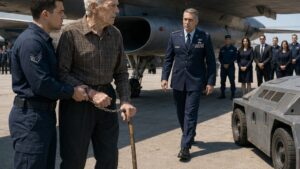
The first was older than the other, broad-shouldered, decorated, face held in the careful neutrality of command. The second stood behind him, taller, watchful, carrying a tablet and a leather folder under one arm. Their shoes sounded polished against the tile.
The yellow folder was no longer on the cart.
It was in the older officer’s hand.
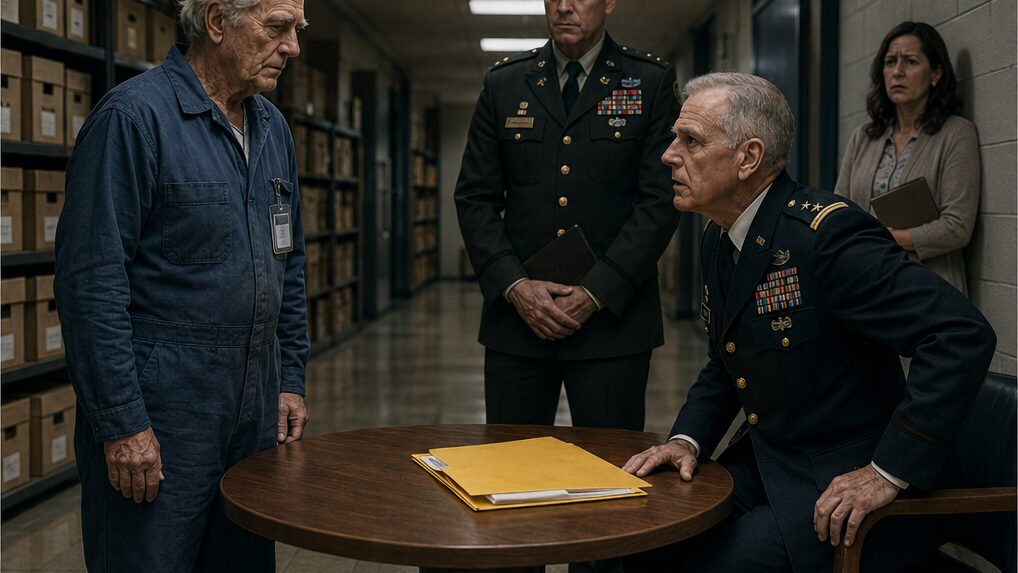
Thomas watched him set it on a round wooden table someone had pulled into the hallway from the break room. Three chairs had been placed around it, but no one told Thomas to sit.
The officer lowered himself into the chair facing him.
The standing officer took his place just behind the table, eyes moving from Thomas’s badge to the folder to Thomas’s face.
The hallway seemed longer than it had before.
“Mr. Bennett,” the seated officer said, reading from a note instead of looking at him. “I’m Colonel Stephen Carter. We need to ask you about why your hands were on a restricted casualty-correction file.”
Thomas stood in his blue jumpsuit, shoulders aching, the old chain cool against his chest.
He looked at the yellow folder.
Then he looked at the man who had not yet learned how to say his name.
Chapter 2: The Yellow Folder on the Round Table
Colonel Stephen Carter had not intended to conduct an inquiry in a hallway.
He disliked hallways for official matters. They made everything look temporary, and temporary things invited mistakes. But the conference rooms were full of labeled boxes, the secure review room had no chairs, and the building supervisor had offered the round break-room table with the apologetic shrug of a man who knew the annex was being dismantled faster than dignity allowed.
So Stephen sat beneath a humming light, with the yellow folder before him and Thomas Bennett standing across the table like a man waiting for bad weather to pass.
Major Gregory Reed remained standing.
That, too, had not been planned. There were three chairs. But Gregory had taken one look at the old maintenance worker, one look at the folder, and decided to stay on his feet. He told himself it was because he could watch the hallway better from there. He told himself procedure required it.
Thomas Bennett looked smaller standing.
His blue jumpsuit had been washed so often it had softened at the elbows. His white-gray hair was combed back with water, not vanity. His badge said MAINTENANCE SUPPORT in black letters under a photograph that had been taken badly. A ring of keys hung at his belt. His boots were clean but old.
Gregory had seen dozens like him in government buildings: quiet men who fixed what others broke, who became furniture in the minds of people with rank.
Stephen opened his notebook.
“Mr. Bennett,” he said, “you understand that this annex is under restricted transfer protocol?”
Thomas’s eyes stayed on the folder. “I understand people are moving fast.”
“That was not my question.”
“No, sir.”
The sir landed softly, without sarcasm. It bothered Gregory more than if the old man had been defensive.
Stephen folded his hands. “Do you understand that certain files may not be moved, altered, opened, removed, or reclassified except by authorized records personnel?”
“Yes.”
“Are you authorized records personnel?”
“No.”
“Then why did you move this folder?”
Thomas lifted his gaze. “It was in the wrong stack.”
Nancy Ward stood ten feet away near the wall, her arms crossed over a cardigan buttoned wrong in her hurry. “Colonel, he knows the building. Sometimes staff leave carts where—”
Stephen raised a hand without looking at her. Nancy stopped, lips pressed tight.
Gregory watched Thomas’s face.
Nothing flared there. No anger at being interrupted. No plea. No performance of wounded pride. Only a slow settling, as if the old man had learned long ago that being misunderstood was not an emergency.
Stephen tapped the folder once with two fingers. “This is not a janitorial matter.”
Thomas’s eyes moved to the tapping fingers.
For the first time, Gregory saw something change in him.
Not much. The old man’s shoulders did not straighten. His voice did not rise. But his right hand closed gently at his side, thumb pressing into the crease of his palm. The motion was controlled, deliberate, almost invisible.
“It isn’t janitorial,” Thomas said.
“Then explain your interest.”
The hallway had begun to gather people the way hallways do when discipline and curiosity compete. A clerk slowed near the copier. Two young soldiers paused by the exit doors. The security clerk stood too close, eager to be useful.
Stephen noticed them and frowned. “Clear the hallway.”
Gregory turned his head. “You heard the colonel.”
The two soldiers moved on. The clerk retreated. Nancy remained.
Stephen looked back at Thomas. “You were seen touching this file before business hours. You removed a disposal-review sheet. You changed its placement. That looks like interference.”
“It was not ready for disposal review.”
“You don’t determine that.”
“No.”
“Then who does?”
Thomas breathed in through his nose. “Someone who reads all the names.”
Stephen leaned back slightly. “Meaning?”
Thomas did not answer.
The fluorescent light buzzed overhead. A printer spat one page somewhere behind a closed door. Gregory shifted his weight, impatient now despite himself. He had been brought in because the transfer audit had already been messy. Legacy casualty files were sensitive. Families were waiting on corrections. Any mishandling could become a complaint, an investigation, a headline if grief found the right person to blame.
“Mr. Bennett,” Gregory said, stepping closer to the table, “this is simple. Did you open the folder?”
Thomas turned to him.
“No.”
“Did you read the contents?”
“No.”
“Then how did you know it was in the wrong stack?”
Thomas looked at the yellow folder, then at Gregory’s tablet, then at the wall where an old framed unit photo hung crooked. His eyes lingered on the photo for a second longer than anyone else’s would have.
“The label,” he said.
“The label says Miller, Benjamin H.,” Gregory replied. “That doesn’t answer the question.”
Thomas was silent.
Stephen exhaled through his nose. “Mr. Bennett, silence is not helping you.”
The old man gave the smallest nod, as if he agreed with that but had no intention of correcting it.
Gregory reached for the folder. “Colonel, may I?”
Stephen slid it toward him.
Gregory opened the cover. The first page was a routing sheet, the second a digitization printout, the third a scan of an older casualty correction request. He skimmed quickly. Nothing obvious. No reason for a maintenance worker to know anything. A handwritten note appeared halfway down the fourth page, reproduced from an older form.
Witness addendum incomplete. B-17 ref. Chain unresolved.
B-17.
Gregory frowned. He turned another page. There were initials next to the witness line.
T.B.
He looked up.
Thomas was not watching Gregory’s face. He was watching the folder, but not hungrily. Fearfully, maybe. No, Gregory corrected himself. Not fearfully.
Carefully.
“Mr. Bennett,” Gregory said, “have you ever seen this file before today?”
Thomas’s answer came too slowly. “I’ve seen that name.”
“Miller?”
“Yes.”
“Where?”
Thomas’s hand rose, not toward the folder but toward his chest, then stopped. His fingers brushed his maintenance badge. The plastic badge shifted, and something behind it caught the hallway light.
A thin metal chain.
Not a necklace. Not jewelry.
Gregory’s eyes narrowed.
“Your badge is caught,” he said.
Thomas looked down. “It does that.”
The old man tucked the chain back with two fingers.
But Gregory had already seen the edge of the tag.
Not enough to read all of it. Enough to know the shape. Enough to feel, with sudden discomfort, that the room had been arranged wrong from the beginning.
“May I see that?” Gregory asked.
Thomas became very still.
Stephen looked between them. “Major?”
Gregory lowered his voice. “Sir, I’d like to see what’s behind his badge.”
The words changed the hallway.
Nancy uncrossed her arms. The security clerk looked confused. Stephen’s expression tightened, not in anger now but attention.
Thomas did not move for three heartbeats. Then he unclipped the plastic maintenance badge from his jumpsuit and let it hang forward. Behind it, on a worn chain darkened by years against skin, rested an old dog tag. Its edges were dulled. The stamped letters had softened, but they were readable.
BENNETT THOMAS A.
Gregory looked down at the page in the yellow folder.
B-17 ref. T. Bennett. Witness addendum incomplete.
He felt heat rise at the back of his neck.
The old man reached to cover the tag again, but Gregory spoke before he could.
“Wait.”
Thomas’s hand stopped.
Gregory turned the folder slightly, bringing the witness notation closer to the light. His voice, when it came, was no longer the voice he had used to question a maintenance worker.
“Colonel,” he said, “the witness line isn’t a records code.”
Stephen leaned forward.
Gregory kept his eyes on the paper. “It’s him.”
No one spoke.
The hallway seemed to lose its ordinary noises. Even the buzzing light felt distant.
Stephen reached for the page and read the notation. His eyes moved from the initials to the dog tag to Thomas Bennett’s face. The formal mask he had worn since arriving did not fall away all at once. It changed by fractions. The set of his jaw loosened. His shoulders drew back. The fingers that had tapped the yellow folder pulled away from it as if he had touched something too casually.
Gregory stepped back from the table.
Then he stood straighter.
Not for spectacle. Not for the clerk or Nancy or anyone who might be watching. It was a correction in his own body before he trusted his voice.
“Mr. Bennett,” Gregory said, and then stopped because the title felt wrong.
Thomas lowered his eyes.
Gregory tried again.
“Sir.”
The word entered the hallway quietly.
Thomas’s face did not change, but his fingers closed around the maintenance badge.
Stephen rose from his chair.
The movement was not dramatic, but it was enough. The seated officer no longer sat while Thomas stood alone. He came to his feet slowly, as if standing had become part of the answer.
“Mr. Bennett,” Stephen said, voice lower, “were you the Thomas Bennett attached to this witness addendum?”
Thomas looked at the yellow folder.
“I was attached to a lot of things once.”
“That’s not an answer.”
“No, Colonel.”
But Stephen did not correct him this time.
Gregory noticed the security clerk still hovering near the doorway. “Give us the hallway,” he said.
The clerk blinked.
“Now.”
The clerk left.
Nancy stayed, but no one told her to go.
Stephen looked at the chairs around the table. For the first time, he seemed to see that Thomas had been left standing. The colonel reached for the nearest chair and pulled it back.
“Please sit down.”
Thomas looked at the chair as if it were another question.
“I’m all right.”
“I’m asking,” Stephen said, then caught himself. His voice changed again. “No. I’m offering.”
Thomas did not sit.
The refusal was not pride. Gregory understood that now. The old man did not know yet what kind of room this had become. He was waiting to see whether respect was only another way to corner him.
Stephen closed the folder gently.
“Major,” he said.
Gregory understood. He picked up the yellow folder with both hands and placed it back on the table, squarely, carefully, as if its corners mattered.
Thomas watched the motion.
Something passed through his eyes. Not relief. Not forgiveness. A recognition of care, maybe. Or the pain of seeing it arrive late.
Stephen said, “Mr. Bennett, I need to ask you again. Why did you move this folder?”
Thomas kept one hand on his badge and the other at his side.
After a long silence, he said, “Because Benjamin Miller was already put in the wrong place once.”
Nancy made a small sound behind him.
Stephen’s face tightened.
Gregory looked down at the folder and felt the first real weight of it.
“What happened to him?” Gregory asked.
Thomas did not answer.
He looked past them toward the end of the hallway, where the morning light had begun to brighten the glass doors. For one moment, Gregory thought the old man might simply walk away.
Then Thomas said, “That isn’t something to say standing in a hallway.”
Chapter 3: A Name Written in the Wrong Place
Stephen Carter had spent thirty-two years learning how to keep rooms under control.
Rooms where young officers mistook volume for confidence. Rooms where families waited for news that could not be made gentle. Rooms where old decisions returned wearing new paperwork. He knew how to sit, how to stand, how to let silence work for him. He knew when to soften his voice without weakening the order behind it.
But when Thomas Bennett said Benjamin Miller had already been put in the wrong place once, Stephen felt control shift to the yellow folder.
They moved to the small conference room because Thomas would not speak in the hallway and because Stephen, to his own discomfort, understood the refusal. The conference room had a rectangular table, six mismatched chairs, and stacks of transfer boxes against the wall. Someone had taped a schedule to the whiteboard: FINAL LEGACY LOCK — MIDNIGHT FRIDAY.
Stephen took the seat at the head of the table out of habit, then paused.
Thomas stood near the doorway, one hand resting on the back of a chair. Gregory entered behind him with the yellow folder. Nancy Ward followed, quiet and pale, carrying a pad of notes though no one had asked her to.
“Mr. Bennett,” Stephen said, “please.”
He pushed the chair beside him out slightly.
Thomas looked at it. Then at Stephen. Then he sat across from him instead, leaving the offered chair empty.
Stephen accepted the correction without comment.
Gregory placed the yellow folder in the center of the table. He did not open it immediately. Stephen noticed that. He also noticed the way Thomas’s eyes tracked the folder until it stopped moving.
The old man’s maintenance badge lay flat against his chest again, hiding the dog tag. But Stephen could not unsee it now. The plastic badge seemed absurdly small over what it concealed.
Nancy sat near the wall. “Thomas,” she said softly, “I’m sorry.”
He gave her a tired look that was almost kind. “You didn’t put the red sheet on it.”
“No, but I should have caught it.”
“There’s a lot to catch.”
Stephen opened the folder.
This time, he did not tap it.
The top sheets were familiar: inventory transfer log, chain-of-custody note, digitization priority rating, casualty correction request. Beneath them lay copies of documents from decades earlier, some clear, some poorly scanned. Dates. Unit references. Location markers partly redacted by age and process more than secrecy. Names.
MILLER, BENJAMIN H.
Stephen had seen thousands of names in files. He had learned not to let his eyes drag every one into his chest. If he did, he would have been no use to anyone.
But this name now had a man sitting across from it.
“You said he was put in the wrong place once,” Stephen said. “Explain what you meant.”
Thomas looked at the file but did not touch it. “His statement got split.”
“His statement?”
“Mine. About him.”
Gregory sat straighter. “You gave a witness statement?”
“A long time ago.”
“There’s no complete statement here,” Stephen said. “Only a reference to an addendum.”
“I know.”
“How do you know?”
Thomas’s mouth tightened. “Because the part that mattered never came back.”
Stephen held his pen over his notebook. “Mr. Bennett, I need plain answers.”
Thomas lifted his eyes. They were not hard, exactly. They were old in a way Stephen was not, despite all his years. Old past rank. Old past rooms. Old past the usefulness of being pressed.
“I gave plain answers then,” Thomas said. “They made them short.”
Nancy lowered her gaze.
Stephen turned a page. “The file indicates Benjamin H. Miller was listed in a casualty correction request due to conflicting unit location reports and an incomplete witness chain. His daughter requested review. There’s a note that no living verifier was confirmed.”
Thomas’s hand moved on the table. His fingers flattened slowly against the surface.
“No living verifier,” Stephen repeated.
“I saw that.”
“That is why you moved the folder?”
“Yes.”
“Because you are a living verifier?”
Thomas looked at the wall behind Stephen. There was no photograph there, only a clock with a second hand that hesitated before each tick.
“I was there,” Thomas said.
The words were not dramatic. They did not ask to be believed. They sat on the table beside the folder and changed the air around it.
Gregory turned a page carefully. “Why aren’t you already attached in the current system?”
“I don’t know your current system.”
Stephen heard the rebuke and deserved it.
He leaned back. “Fair enough.”
Thomas’s expression flickered. It might have been surprise.
Stephen continued, “What I mean is, if you were the witness, why did this record not identify you when Mrs. Miller requested review?”
Thomas looked down. “Because the Army knew Thomas A. Bennett. This building knows Tom Bennett with a mop bucket. Computers don’t always introduce people properly.”
Nancy made a note, then stopped as if writing it down made it worse.
Gregory rubbed a hand over his jaw. “The witness notation says B-17 reference. Is that you?”
Thomas nodded once.
“What does B-17 mean?”
Thomas’s eyes went to the folder again. “A field code. Not important now.”
“It may be important,” Stephen said.
“It was important then.”
The answer closed more than it opened.
Stephen forced himself not to push too hard. The morning had already given him one correction. He could accept another.
He turned to Nancy. “Who placed the red disposal-review sheet on this folder?”
Nancy swallowed. “The transfer team sorted anything with unresolved witness chains into the review stack. It doesn’t mean disposal exactly. It means possible closure if verification can’t be—”
“Who?”
“A records assistant, probably. Under my supervision.”
Thomas looked at her. “Nancy.”
She blinked quickly.
He said, “Don’t carry what a bad label did.”
Stephen watched him. A man accused minutes earlier was comforting the clerk whose process had nearly erased his reason for being there.
That unsettled him more than anger would have.
Gregory leaned forward. “Mr. Bennett, Mrs. Miller is scheduled to come next week?”
Nancy checked her pad. “Laura Miller. She was scheduled for Friday. I left a message asking to reschedule because of the transfer delay.”
A phone rang outside the conference room. No one moved.
Then the door opened, and a young records assistant looked in, flushed with nerves. “Mrs. Ward?”
Nancy turned. “What is it?”
“There’s a woman at the front desk. Laura Miller. She says she got your message and drove in early because she didn’t want the file moved again.”
The room went quiet.
Thomas’s face changed.
It was the first change Stephen had seen that the old man could not fully contain. Not fear. Not exactly. A tightening around the eyes, a retreat inward, as if a door had opened somewhere he had kept locked from both sides.
Nancy rose halfway. “I’ll speak with her.”
“No,” Stephen said.
Everyone looked at him.
He had spoken too sharply. He moderated his tone. “Not yet. If this file contains unresolved witness information, we need to understand what we can properly tell her.”
Thomas pushed his chair back.
The sound of its legs against the floor was soft but final.
Gregory turned. “Mr. Bennett?”
Thomas stood, slower than before. “She didn’t come for procedure.”
Stephen stood too. “I can’t allow an unverified statement to be given to a family member without—”
“You can allow a daughter not to be lied to twice.”
The words struck the room cleanly.
No one spoke.
Thomas seemed to regret the sharpness, not because it was untrue, but because it had escaped him. He lowered his eyes.
Stephen felt heat rise in his face. He had been careful all morning. Careful with rules. Careful with language. Careful with the file once he understood it had weight. Yet he was still standing between a daughter and something the man across from him had carried for half a lifetime.
He looked down at the folder.
Yellow. Bright. Almost ordinary.
“Mr. Bennett,” he said, quieter now, “what does Laura Miller believe happened to her father?”
Thomas’s throat moved.
“She believes he was missing in the confusion.”
“And what do you know?”
Thomas looked toward the closed door, toward the waiting area beyond it, toward a woman he had never met and had known for decades.
“I know he knew exactly where he was,” Thomas said. “And I know why he stayed.”
Chapter 4: The Daughter Who Brought the Last Letter
Laura Miller had learned that government buildings used chairs to tell people how much they mattered.
In some offices the chairs were padded, placed beside small tables with tissues and water bottles. In others they were plastic, lined against walls beneath posters about service, sacrifice, and patience. The veterans’ records annex had given her a hard blue chair with one cracked arm, facing a glass window that had a bell taped to the counter with a label asking visitors to ring once.
She had not rung.
A young records assistant had seen her standing there with a folder of her own pressed against her chest and had gone pale in the particular way people did when they realized grief had arrived early.
Now Laura sat with her coat still buttoned, her purse strap wrapped twice around her hand. On her lap lay a brown envelope softened by years of being opened and closed. Her mother’s handwriting marked the front: Ben’s last letter. Do not lose.
Laura had been nine when her father’s name became something adults lowered their voices around. At first they said missing. Then they said presumed. Then they said confirmed, but the confirmation never held still. One letter said his unit had been overtaken during movement. Another said he was separated during evacuation. A third, years later, said a witness had reported an act of assistance to others but the record was incomplete.
Her mother had read every sentence until the paper nearly tore at the folds.
“He didn’t wander off,” her mother used to say when someone tried to comfort her with words like confusion or chaos. “Ben knew what he was doing. Somebody knows that.”
Somebody knows that.
Laura had carried that sentence longer than she had carried most memories of her father’s voice.
The annex waiting room smelled of floor cleaner and old paper. Boxes lined the far wall. A sign near the hallway apologized for delays during transfer operations. Laura disliked the word transfer. It made her father sound as if he were being moved from one shelf to another.
Behind the glass, the young records assistant kept glancing at her, then toward the hallway.
Laura checked her watch. She had driven three hours after receiving Nancy Ward’s message. Nancy had said there might be a delay because of the annex closure. She had been kind, careful, apologetic in the way good clerks learned to be when they could not promise anything.
Laura had heard only one thing: delay.
Her family had been delayed for fifty years.
She had not called back. She had put the brown envelope in her purse and driven before daylight, stopping once for gas and once because her hands were shaking too badly to hold the steering wheel. By the time she reached the annex, she had rehearsed what she would say.
Please don’t transfer the file until I see it.
Please don’t close the correction.
Please don’t let my father become a mistake that is easier to store than fix.
But now that she was there, the sentences had gone thin.
A door opened down the hall. Voices came out in pieces. A man’s voice, controlled. Another lower, older. A woman’s voice that might have been Nancy’s. Laura sat straighter.
The young assistant came around the counter. “Mrs. Miller?”
Laura rose too fast, gripping the envelope. “Yes.”
“They’re still reviewing the file.”
“Who is they?”
“The transfer officer and records liaison.”
“I was told Mrs. Ward was handling it.”
“She is. It’s just—there was a question.”
Laura felt the old heat rise under her ribs. “There has always been a question.”
The assistant looked as if he wanted to step backward but had been trained not to. “Yes, ma’am.”
“I don’t mean to be rude,” Laura said, though she knew her voice had sharpened. “But every time someone says there’s a question, my father disappears a little more.”
The assistant’s face changed. Not enough to help, but enough to show he had heard her.
Before he could answer, Nancy Ward came through the hallway door.
Her cardigan was still buttoned wrong. Laura noticed because grief made strange details bright. Nancy’s eyes moved to the envelope in Laura’s hands, then to Laura’s face.
“Mrs. Miller,” Nancy said gently. “I’m sorry you had to wait.”
“I was told to reschedule.”
“I know.”
“I couldn’t.”
Nancy nodded. “I understand.”
Laura almost laughed. It came out as a breath. “People say that a lot in buildings like this.”
Nancy accepted that without defense. “You’re right.”
That stopped Laura more effectively than an apology would have.
Nancy stepped closer. “Your father’s file is here. It has not been transferred. It has not been closed.”
Laura closed her fingers around the envelope. “But?”
Nancy glanced toward the hallway. “There is someone we may need you to meet.”
Laura’s body stiffened. “Someone from the Army?”
“Yes. And no.”
“I don’t understand.”
Nancy lowered her voice. “A man who works in this building may have been connected to your father’s original witness record.”
The waiting room seemed to tilt slightly.
Laura stared at her. “Works here?”
“Yes.”
“What do you mean, connected?”
Nancy hesitated.
That hesitation, small as it was, angered Laura more than any refusal could have. She had spent a lifetime watching institutions hesitate before saying less than they knew.
“Mrs. Ward,” she said, “I drove three hours with my father’s last letter in my lap. If there is someone in this building who knows something, I need a better answer than connected.”
Nancy looked down at the envelope again. “His name is Thomas Bennett.”
Laura heard the name as if from another room.
Bennett.
Not common enough to pass through her without catching.
Her mother’s voice rose from years ago, thin with age and certainty: If you ever find the Bennett name, you ask. Your father wrote it once. I don’t know why.
Laura opened the brown envelope with fingers that had gone clumsy. Inside was the letter her father had sent two weeks before the date on the first telegram. She did not need to search long. She had read it too many times.
Tell Laura I owe a man named Bennett half my cigarettes and probably my hide. Don’t worry, he’s the careful sort. Keeps lining things up like the world will behave if the edges match.
Laura pressed her thumb under the line.
Nancy watched her.
“He wrote that,” Laura said.
“Your father?”
Laura nodded. She could not look up yet. The ink was faded but still there, a younger hand speaking from before everything broke.
“Bennett,” she whispered. “My mother thought it might be important, but no one ever knew what it meant.”
Nancy’s expression shifted, grief and recognition meeting in the middle. “Thomas straightens everything in this building.”
Laura looked up.
“What?”
“Nameplates. File labels. Chairs. If a folder edge is crooked, he fixes it. We all thought it was just his way.”
Laura folded the letter carefully along its old lines. “Where is he?”
Nancy did not answer at once.
“Where is he?” Laura repeated.
“In the conference room.”
“With my father’s file?”
“Yes.”
Laura moved toward the hallway.
Nancy stepped with her, not blocking, only slowing. “Mrs. Miller, I need to say this before you go in. Whatever Mr. Bennett knows, it may not be easy for him to say.”
Laura stopped.
Anger had carried her into the building, but it could not carry her past that sentence. She looked through the hallway door’s narrow glass window. Far down the corridor, she could see part of a conference room through open blinds. A uniformed officer stood inside. Another sat. A man in a blue jumpsuit stood near the table, turned partly away.
He looked old.
Not powerful. Not like someone who had held an answer for half a century. Just an old man in work clothes, one hand resting on the back of a chair as though he needed its steadiness but did not want anyone to notice.
Laura felt something inside her tighten and soften at the same time.
“That’s him?” she asked.
Nancy nodded.
Laura looked again.
The man in the blue jumpsuit lowered his head while the officers spoke. He did not look like a secret. He looked like a person who had spent years making himself useful enough not to be questioned.
Laura’s mother had died without meeting him.
That thought struck cleanly and left no room for anger for several seconds.
She held the brown envelope against her chest. “Did he know my father?”
Nancy’s eyes moistened. “I think he did.”
Laura looked down at the old letter in her hands.
Tell Laura I owe a man named Bennett half my cigarettes and probably my hide.
The hallway door opened before Nancy touched it.
Inside the conference room, the older officer turned first. Then the standing officer. Last of all, Thomas Bennett looked toward her.
His face emptied of whatever he had been preparing to say.
Laura saw his eyes go to the envelope.
He knew it.
Not the words, perhaps. Not the paper. But the shape of a last thing carried too long.
She stepped into the room.
No one introduced her at first.
The yellow folder lay on the table between the officers and the old man. Beside it, Laura placed the brown envelope with her father’s letter.
Thomas Bennett stared at the two objects side by side.
When he finally spoke, his voice was low.
“Your mother kept it.”
Laura swallowed. “She kept everything.”
He closed his eyes once.
When he opened them, he was looking not at her, but at the name printed on the yellow folder.
“Then we’d better not get this wrong again,” he said.
Chapter 5: What Thomas Refused to Say Out Loud
The first thing Thomas remembered about Benjamin Miller was not his courage.
It was the way he talked too much when he was afraid.
Some men went quiet. Some got mean. Some made jokes that came out wrong. Benjamin talked. He talked about his wife’s biscuits, his baby girl’s crooked smile, the truck he planned to buy when he got home, the neighbor who borrowed tools and returned them cleaner than he found them. He talked until Thomas once told him that if the enemy ever found them, they would only need to follow the sound of Benjamin describing breakfast.
Benjamin had laughed and offered him a cigarette.
Thomas had taken it, though he did not smoke much then.
Now, in the small records interview room, Thomas sat with his hands folded and wished he remembered less.
The room had been chosen because it had a door that closed and blinds that worked. Stephen Carter sat across from him with a recorder placed between them, not yet turned on. Gregory Reed stood near the wall at first, then seemed to think better of it and took a chair. Nancy had brought water none of them drank. Laura Miller sat at the end of the table, her father’s letter lying before her in its brown envelope.
The yellow folder rested beside it.
Thomas had asked that Laura hear him before anything official was recorded. Stephen had not liked the order of that. Thomas saw the objection form and fade behind the colonel’s eyes. In the end Stephen only nodded and said they would begin when Thomas was ready.
Ready was a word for younger men.
Thomas looked at Laura. She had her father’s eyes. Not exactly the color. The attention. Benjamin had looked at people as if conversation were a rope he could throw between them. Laura looked as if she had been holding one end of that rope all her life.
“I don’t know how much you want,” Thomas said.
Laura’s voice was steady, but her hands were not. “The truth. As much as you can give me.”
Thomas nodded.
He looked at the yellow folder.
“Your father wasn’t missing because he got lost.”
Laura did not move.
“The first reports made it sound that way because the unit was split, and the map references were bad, and some men writing reports had not been where the shooting happened. They used words that fit paperwork. Separated. Unaccounted. Last seen during movement.” He paused. “Those words were not lies exactly. But they weren’t the truth either.”
Stephen made no note. Gregory watched the recorder as if waiting for permission from it.
Thomas rubbed his thumb along the side of his finger. He could feel dust that was not there.
“We were moving under rain,” he said. “Hard rain. The kind that turns every path into the same path. Benjamin had been carrying extra radio batteries because the boy assigned to them had fever and wouldn’t admit it. He complained the whole time. Said when he got home, he was never carrying anything heavier than his daughter.”
Laura pressed her lips together.
Thomas gave her a moment, then continued.
“We came under fire near a low crossing. It was confusion at first. Then it was not. The radio went bad. Men were pinned on both sides of the trail. There was a casualty forward of us. A young soldier. I don’t know if you need his name.”
Laura shook her head quickly, then changed it to a nod, then stopped. “Not yet.”
“All right.”
Thomas accepted that. There were too many names in him already.
“Benjamin was ordered back with three others. He didn’t go.”
Laura’s eyes lifted.
“He saw the radio operator was down and the batteries were with him. Without the radio, the men forward could not call their position. Artillery was adjusting blind. If they stayed blind, they would hit our own.” Thomas’s voice thinned but did not break. “Benjamin went for the radio.”
Laura’s hand closed around the edge of the envelope.
Stephen’s face had gone still. Gregory looked down once, then back up.
Thomas continued because stopping would make starting again impossible.
“I went after him. Not because I was brave. Because I was close and stupid enough to think two men could fix what one man had already decided to do.”
A sound came from Laura, almost a laugh and almost pain.
“Your father reached the radio first. Got the handset working enough to pass coordinates. He was good with numbers when fear didn’t make him talk.” Thomas looked at her. “He stayed calm then. Very calm.”
Laura wiped under one eye with the side of her hand.
“The last correction he gave saved men on the forward side. I know because I heard the adjustment come back. I heard the fire lift. I heard men moving who would not have moved otherwise.”
Stephen leaned forward slightly. “Was that in your original statement?”
“Yes.”
“It is not in the file.”
“I know.”
The room absorbed that.
Thomas looked at the yellow folder with something close to exhaustion. “What made it into the first summary was that Miller was last observed near radio equipment during hostile contact. Later someone attached a line saying he may have assisted with communications. May have.” The old bitterness tasted like metal. “I wrote more than may have.”
Laura’s voice was small. “What happened after he gave the coordinates?”
Thomas’s fingers stopped moving.
This was the place he had stepped around for fifty years. In sleep, in church basements, in grocery store aisles when a shelf label was crooked and his chest tightened for no reason. It was not the dying alone. It was what the living made of it after.
“He told me to take the handset,” Thomas said.
Laura stared at him.
“He had been hit by then. He knew. I knew. He told me to take the handset and repeat the correction. I said I could drag him.”
“Could you?”
Thomas looked at her because she deserved the cruelty of an honest answer.
“No.”
Laura closed her eyes.
“I tried anyway,” he said. “That part I left out when I wrote the statement. I was ashamed of how long I tried. Men were still forward. He knew it. He kept telling me to take the handset. Then he said your name.”
Laura’s shoulders shook once.
“He said, ‘Tell Laura I stood where I meant to.’”
The sentence entered the room and changed every face in it.
Laura covered her mouth. The brown envelope bent under her other hand.
Thomas looked away. He could not watch her receive what he had failed to deliver before her mother died.
“I did not get to tell you,” he said.
“You were young,” Laura whispered.
“That’s not an answer.”
“It’s part of one.”
Thomas shook his head. “I gave the statement after. I wrote the sentence. I wrote the coordinates. I wrote what he did. A captain told me later the report had been shortened because casualty summaries had formats. He said the important part was that the family knew he died in service.”
Laura looked up sharply. “They didn’t.”
Thomas nodded once. “I know.”
Stephen’s hand closed around his pen.
Thomas turned to him. “That is why I moved the folder. Because that red sheet said no living verifier. And because I had been walking past the file room for years thinking someone with the right title would ask the right question.”
Nancy’s eyes filled. “Thomas, why didn’t you tell me?”
He gave her a tired half-smile. “You asked me about light bulbs, Nancy.”
She laughed once through tears and looked down.
Gregory cleared his throat. “Mr. Bennett, we can record the full statement now. Attach it. Cross-reference the original witness notation. If Colonel Carter approves, we can stop closure.”
Stephen looked at him. “We can do more than stop closure.”
Thomas did not respond.
Laura had taken the letter from the envelope. She smoothed it with both hands, then turned it so Thomas could see the line her father had written about him.
Tell Laura I owe a man named Bennett half my cigarettes and probably my hide.
Thomas read it.
For a moment, the old interview room disappeared around him. Benjamin was young again, grinning in rain, tapping a cigarette against a damp helmet, telling Thomas he lined things up like the world might behave.
Thomas touched the edge of the letter with one finger, then withdrew his hand before he could mark it.
“He never owed me anything,” he said.
Laura’s voice steadied in a way that hurt to hear. “Maybe he wanted me to know there was someone with him.”
Thomas looked at her.
The truth of that had stood outside him for fifty years, waiting for him to open the door.
Stephen reached toward the recorder, then stopped. “Mr. Bennett,” he said, “I would like to record your statement properly. But only if you are willing.”
Thomas heard the difference.
Not ordered. Not pressed. Not cornered.
Asked.
He looked at the yellow folder, then at Laura’s letter. Wrong paper and right paper. Official line and living hand. A name printed cleanly and a promise written before a young man knew it would become a last message.
Thomas sat back.
“I’ll do it,” he said. “But not for my record.”
Stephen nodded. “For Benjamin Miller’s.”
Thomas looked at Laura.
“For his daughter first,” he said.
Chapter 6: The Record Could Not Carry His Voice
When Thomas began again, the recorder’s red light looked too small for what it was being asked to hold.
Stephen Carter stated the date, the annex location, the file reference, and the names of those present. His voice was formal but quieter than before. Each word seemed placed down rather than issued. Gregory Reed sat beside him with the yellow folder open, a clean statement form ready, and a pen uncapped. Nancy Ward watched from near the end of the table, hands folded so tightly her knuckles had lost color.
Laura Miller sat across from Thomas.
Her father’s letter lay between them.
Thomas looked at the recorder, then past it. “My name is Thomas Arthur Bennett,” he said. “I served in the United States Army. I was present when Specialist Benjamin H. Miller made the final radio correction that prevented friendly casualties during hostile contact.”
Stephen wrote nothing during the first sentence. He let the recorder take it. Then he began to make notes, careful, sparse.
Thomas spoke without flourish. Dates where he remembered them. Weather. Terrain. Unit movement. The damaged radio. The batteries Benjamin had carried. The downed operator. The coordinates that had been wrong, then corrected. He did not describe more than the record needed, and when memory offered him sounds and smells, he kept them behind his teeth unless they mattered.
Laura listened without interrupting.
Once, when Thomas paused too long, she slid a cup of water closer. He nodded but did not drink.
“The previous summary,” Stephen said when Thomas reached the point of the original report, “states that Specialist Miller was last seen assisting communications under fire.”
Thomas’s eyes moved to him. “That is a sentence made by someone who had a desk between himself and the mud.”
Gregory looked down.
Stephen accepted it. “What should it say?”
Thomas looked at Laura. “It should say he knowingly remained in an exposed position to restore radio contact and pass corrected coordinates after being ordered back.”
Stephen wrote the sentence slowly.
Thomas continued, “It should say his action allowed men forward of our position to withdraw. It should say he gave the handset to me when he could not continue. It should say he spoke of his daughter.”
Laura’s hand pressed flat over the old letter.
Stephen’s pen stopped. “Do you want that final part in the official statement?”
Thomas’s face tightened.
Laura answered before he could. “Yes.”
Then she looked at Thomas. “Unless you don’t.”
Thomas considered that. For decades he had guarded the sentence as punishment. He had believed that if he kept it whole inside himself, the failure to deliver it would remain his and no one else’s. But the words had not belonged to him. They had only passed through him because Benjamin could not carry them farther.
“They’re hers,” Thomas said.
Stephen nodded and wrote.
Gregory’s phone vibrated once on the table. He glanced at it, and the room felt the change in him.
“What is it?” Stephen asked.
Gregory hesitated. “System notice. Legacy lock begins tonight for transfer batch verification. Midnight cutoff. Anything not entered and approved before then moves to pending archive review at the new facility.”
Nancy looked stricken. “That could add months.”
“Or bury it in reconciliation,” Gregory said.
Laura’s expression sharpened. “After all this, it can still disappear?”
“Not disappear,” Stephen said, then stopped because every person in the room knew that bureaucratic delay could be its own form of disappearance.
Thomas looked at the yellow folder.
Its label seemed too clean for the years under it.
“What needs doing?” he asked.
Stephen shifted immediately into procedure, but the tone had changed. “Recorded witness statement. Written transcription. Cross-reference with original addendum. Chain-of-custody correction explaining why the folder was moved. Officer certification. Records clerk validation. Family notification packet.”
Nancy was already standing. “I can prepare the validation and locate the original scan batch.”
Gregory closed the folder, then reopened it as if unwilling to waste even that motion. “I can handle the cross-reference and chain note.”
Laura lifted the old letter. “Can this be included?”
Stephen looked to Thomas first, not because Thomas had authority over Laura’s property, but because the letter had become part of the bridge between them.
Thomas said, “A copy. Not the original.”
Laura nodded. “A copy.”
Stephen rose. “Then we move.”
The room became active without becoming loud. Nancy went to the copier with Laura’s letter held in both hands. Gregory carried the folder to a workstation outside the conference room, walking as if the hallway had narrowed around what he carried. Stephen stayed with Thomas long enough to stop the recorder and label the file.
Thomas remained seated.
For the first time all day, no one asked him why.
Through the glass wall, he watched the annex work around the yellow folder. Nancy at the scanner, waiting for each page to feed. Gregory at a terminal, shoulders squared, entering references with the care of a man who now knew a typo could become a wound. Stephen on the phone, using rank not to command a person but to remove obstacles from a process that had hidden behind them.
Laura sat beside Thomas, the original letter back in its envelope on her lap.
“He was funny in the letter,” she said after a while.
Thomas looked at her.
“My father. My mother always cried when she read the serious parts, but I liked the funny parts. He wrote that the food was terrible but he was developing the moral strength to complain about it.”
Thomas’s mouth moved, almost a smile. “That sounds like him.”
“You really remember?”
“Yes.”
“I used to be afraid no one did.”
Thomas looked through the glass at the folder. “Men get remembered in pieces. A date here. A line there. A photograph if someone saved it. Your father deserved more than pieces.”
Laura turned the envelope over in her hands. “So did you.”
He shook his head.
“I mean it,” she said.
“That’s kind. But today isn’t about me.”
“My mother waited for someone to tell her my father chose what he did. She died still waiting.” Laura’s voice trembled but held. “I’m angry about that. I don’t know where to put it.”
Thomas did not answer quickly.
After a moment, he said, “Don’t put it down just because people are uncomfortable seeing you carry it.”
She looked at him, surprised.
He kept his eyes on the hallway. “Just don’t let it be the only thing your hands know how to hold.”
Laura looked at the envelope.
Beyond the glass, Gregory approached Stephen with a printed sheet. Stephen read it, then pointed to a line. Gregory corrected it immediately. Nancy returned with copies and a digital receipt. The young records assistant who had first met Laura at the window hovered nearby, quiet now, watching Nancy place the copied letter into a protective sleeve.
Laura stood.
Thomas started to rise too, but she touched the table lightly. “Please don’t.”
He remained seated, though it clearly cost him effort to receive the consideration.
She walked to the workstation where Stephen and Gregory stood with the yellow folder.
“May I see it?” she asked.
Stephen did not answer by opening it. He moved the folder closer to her and waited.
Laura opened the cover herself.
Inside, the old forms remained. The shortened sentence still existed. The incomplete witness reference had not vanished. But behind them now lay Thomas’s recorded statement receipt, the new transcription, the copied letter, and a correction page with Benjamin Miller’s name typed without abbreviation.
Laura touched the page.
“This is more paper,” she said.
Stephen stood very still.
She looked at him, not accusing, not forgiving. “I know paper can’t carry his voice.”
“No,” Stephen said. “It can’t.”
Thomas watched from the interview room doorway. He had risen after all, quietly, one hand braced against the chair before he crossed to them.
Laura looked back at him.
“But it can stop losing him,” she said.
Thomas nodded.
Gregory closed the folder when she was done. He did it gently, aligning the edges before fastening the clip. The small motion caught Thomas unprepared. For years he had been the one straightening what others left crooked. Now another man’s hands were learning care in front of him.
Stephen’s phone rang.
He answered, listened, and his expression hardened into focus.
When he hung up, he looked at Gregory, then Nancy, then Thomas.
“The records system locks at midnight,” he said. “If this correction is not fully entered, certified, and uploaded before then, the file moves to the new facility under unresolved status.”
Nancy glanced at the clock. “That gives us less than seven hours.”
Laura held the envelope tighter.
Thomas looked at the yellow folder, bright against the gray desk.
“Then we should stop talking like it’s already saved,” he said.
Chapter 7: When Respect Finally Became Procedure
By evening, the annex had stopped pretending it was an office and had become a place holding its breath.
Most of the civilian staff had gone home. The front counter lights were off. Chairs in the waiting room sat in their neat rows beneath posters no one was left to read. At the far end of the hall, the glass doors reflected the interior back at itself: boxes, carts, old photographs, and a few people moving under fluorescent light as if they had been forgotten inside the building after closing.
Thomas Bennett stayed in his blue jumpsuit.
Nancy had offered him coffee, then tea, then a ride home, and he had refused all three with the same small shake of his head. Laura had tried once to tell him he did not have to remain, and he had looked at the yellow folder on Gregory Reed’s desk until she understood he was not remaining for himself.
The folder had moved through the annex like a patient through emergency care.
First to the scanner. Then to the records terminal. Then to Stephen Carter’s review. Then back to Nancy for validation. Then to Gregory for cross-reference. Each time it changed hands, the person carrying it used both hands. No one said why. No one made a ceremony of it.
Thomas noticed anyway.
He sat in the hallway outside the file room because the chairs in the conference room felt too far from the work. His hands rested on his knees. His maintenance badge hung from his chest, plastic and ordinary, the old dog tag chain hidden behind it again.
Inside the records office, Gregory spoke in a low voice to a support clerk over the phone. “No, the original witness addendum was not absent. It was misindexed. Yes, we have a living witness. No, do not close the unresolved chain. I’m looking at the statement now.”
Stephen stood behind him, arms folded, reading the screen over his shoulder. He looked tired in the way officers looked tired when rank could still open doors but could not make the doors closer together.
Nancy came out of the copier room with a sealed document sleeve. She saw Thomas watching and held it up.
“Original letter copy is certified,” she said.
Thomas nodded. “Good.”
Laura sat two chairs away from him, the brown envelope in her lap. She had taken off her coat at some point. Without it, she looked less like a visitor and more like someone who had been waiting in this hallway for years.
“Did he ever talk about home?” she asked.
Thomas turned his head.
“My father,” she said. “In the time you knew him.”
Thomas looked down the hallway. The floor shone where he had buffed it two nights earlier. A strip of light ran along the tiles, broken by the wheels of carts and the legs of chairs.
“All the time,” he said.
Laura’s mouth trembled, but she smiled. “That sounds like the letters.”
“He said your mother made biscuits that could make a chaplain forget discipline.”
Laura laughed softly, a sound that surprised them both.
Thomas let it settle before adding, “He said you had a crooked smile.”
“I still do when I’m tired.”
“He was proud of it.”
She looked at the envelope. “I wish she could have heard that.”
Thomas did not offer comfort quickly. He had learned that quick comfort often served the person giving it.
After a while, he said, “So do I.”
At the records desk, Gregory printed a page and carried it to Stephen. Stephen read the first line, then the last, then signed. He did not sign with a flourish. He signed slowly, as if attaching himself to the correction instead of merely approving it.
Then he brought the page to Thomas.
“Mr. Bennett,” he said, “this is the final witness certification. Your statement has been entered, but I need your signature on the typed transcript. You can read it first.”
Thomas took the pages.
His eyes moved down the first sheet. The words looked cleaner than memory. Too clean in places. But the facts were there. Benjamin Miller’s action was no longer a may have. His position was no longer confusion. His choice had not been reduced to a line that could be filed without touching anyone.
Thomas reached the sentence Laura had asked to include.
He spoke of his daughter.
The words blurred. He blinked until they steadied.
Stephen offered him a pen.
Thomas signed Thomas A. Bennett, the name the Army had known, not Tom from maintenance. His hand shook only on the final letter.
Stephen took the signed page with both hands.
“Thank you,” he said.
Thomas looked at him. “Don’t thank me yet.”
Stephen understood. “Not until it’s filed.”
Gregory returned to the terminal. Nancy stood beside him with the sealed sleeve. Laura came to stand behind Thomas, close enough that he knew she was there but not so close that he felt held in place.
The wall clock read 11:36.
The system did not make the process dramatic. It asked for fields. File number. Correction category. Witness verification. Officer certification. Family notification. Supplemental documentary attachment. Each box accepted what had taken decades to gather as if it were no different from an address change.
At 11:48, an error message appeared.
Gregory went still.
Nancy leaned over the screen. “What happened?”
“Original addendum reference format rejected,” Gregory said.
Stephen stepped forward. “Why?”
“It wants the legacy code in the new format.”
Nancy’s face tightened. “The conversion table is in the east file room.”
“I’ll get it,” Gregory said.
Thomas was already standing.
Everyone looked at him.
He did not explain. He turned down the hall toward the file room, moving faster than he had all day. His knee protested by the third step. He ignored it.
“Mr. Bennett,” Gregory called, following.
Thomas reached the file room first. He knew exactly which cabinet held the old conversion binders because he had dusted around them for years while others walked past. Third cabinet. Bottom drawer. Sticking track. Lift before pulling. He opened it, removed the blue binder, and set it on the nearest cart.
Gregory arrived beside him, breathing harder than Thomas.
“You knew where it was,” Gregory said.
Thomas opened the binder to a tab marked FIELD REFERENCES. “I know where things get left.”
Gregory did not answer.
Thomas found B-17 in the left column and ran his finger across to the modern code. The paper crackled under his touch.
Gregory copied it into his notebook. Then he hesitated.
“Sir,” he said quietly, “may I carry that?”
Thomas looked at the binder, then at Gregory.
The major was not asking because Thomas was weak. He was asking because the binder mattered now.
Thomas handed it to him.
They walked back together. Not fast enough for fear, but fast enough for purpose. At the records desk, Gregory entered the converted code. The error vanished.
The clock read 11:55.
Stephen stood behind Nancy as she reviewed the final packet. “Witness statement attached,” she said. “Letter copy attached. Officer certification attached. Family notification pending release. Chain-of-custody correction attached.”
Gregory’s finger hovered above the final submission key.
He looked at Stephen.
Stephen looked at Laura.
Laura looked at Thomas.
Thomas looked at the yellow folder.
For most of the day, it had looked too bright for what it carried. Now, under the weak desk lamp, it looked worn, creased, and stubborn. Like something that had survived being mishandled because someone still knew its name.
“Submit it,” Thomas said.
Gregory pressed the key.
The screen loaded.
No one breathed loudly.
Then a confirmation appeared.
CORRECTION ACCEPTED — OFFICIAL RECORD UPDATED.
Nancy covered her mouth. Laura closed her eyes. Stephen looked down as if a weight had been set on the floor between them.
Thomas did not move.
He was listening for something that did not come. No voice from the past. No absolution. No young man laughing about cigarettes. Only the hum of the annex and the quiet around a name finally placed where it belonged.
Stephen took the printed confirmation from the machine and inserted it into the yellow folder. He fastened the clip. Then he did something that made Thomas’s throat tighten more than any salute could have.
He placed the folder in Gregory’s hands, and Gregory turned to Thomas.
“Mr. Bennett,” Gregory said, “would you walk it with us?”
Thomas looked toward the file room.
His first instinct was to step back. Officers filed records. Clerks certified them. Maintenance men fixed lights and doors and crooked plates.
But the old false order of things had already cost enough.
He nodded.
They moved down the hallway together: Gregory with the folder, Stephen beside him, Nancy carrying the binder, Laura holding the brown envelope, and Thomas in his blue jumpsuit walking at the center of them without being pushed forward.
At the legacy cabinet, Gregory paused.
He turned and offered the yellow folder to Thomas with both hands.
Thomas did not take it at first.
Gregory waited.
Finally Thomas accepted it. The folder was light. That seemed wrong, but paper had always been lighter than memory.
He slid it into the corrected file slot beneath MILLER, BENJAMIN H. His fingers remained on the tab a moment longer. Then he straightened the label until its edge matched the others.
“There,” Nancy whispered.
Thomas stepped back.
Stephen stood beside the cabinet. Slowly, he brought his hand up in a restrained salute. Gregory followed, not sharply, not for display, but with quiet precision. It lasted only a moment.
Thomas did not return it.
He looked at the two officers, then at Laura, then at the cabinet.
“Save that for him,” he said.
Stephen lowered his hand first. “Yes, sir.”
The words did not make Thomas taller. They did not make him younger. They did not take the ache from his knee or the years from his hands. But they changed the hallway around him.
Laura stepped forward and placed her palm lightly against the cabinet drawer. “Good night, Dad,” she said.
Thomas looked away.
When the annex finally closed, Stephen walked with him to the service entrance. Gregory held the door, then stepped aside. Neither man rushed him. Neither man spoke over the quiet.
Thomas paused at the threshold and looked back down the hallway.
The round table had been returned to the break room. The chairs were stacked. The floor still needed mopping near the copier. The brass directory near the entrance was straight.
Tomorrow, other boxes would need moving. Other labels would need checking. Other names might still be waiting inside folders no one had opened carefully enough.
Stephen seemed to understand where his eyes had gone.
“We’ll review the remaining unresolved files before transfer,” he said. “Not by shortcut. Not by disposal stack.”
Thomas looked at him.
Stephen added, “Nancy will lead it. Major Reed and I will certify the process.”
That was when respect became heavier than words.
Thomas nodded once. “Good.”
Laura waited near the glass doors with her envelope held close. She did not ask for more from him. That, too, was a kindness.
Gregory opened the service door.
Outside, the night air was cool. Thomas stepped into it in his blue jumpsuit, carrying no certificate, no applause, no proof anyone would recognize if they passed him on the street.
Behind him, the officers remained inside the doorway.
They did not call after him. They did not make a show of standing there.
They simply gave him room.
Thomas walked to his old truck beneath the parking lot light. Before opening the door, he touched the maintenance badge on his chest. Behind it, the dog tag rested against his heart, quiet and worn.
For the first time in years, he did not tuck it farther out of sight.
The story has ended.