They Grabbed the Old Veteran at the Bar Before Learning Why He Never Removed That Sleeve Patch
Chapter 1: The Hand on the Old Man’s Shoulder
Robert Bennett had been sitting on the third stool from the end for forty minutes before anyone touched him.
He had ordered the same drink he ordered every Thursday night—a small glass of ginger ale with a thin slice of lime—and left it mostly alone. The bubbles had gone flat. The lime had sunk halfway down the side. His right hand rested around the glass without gripping it, more for something to do than because he wanted it.
The bar was darker than it used to be.
Mary Sullivan had kept the lights low, but warm. Maria Morgan, the new owner, had changed the bulbs over the back shelves to a colder blue-white, the kind that made bottles shine and faces look tired. The old red vinyl booths still lined the wall. The brass foot rail still ran below the counter. The ceiling fan over the jukebox still clicked once every full turn.
But Mary was gone, and with her had gone the little things nobody could put in an inventory. The bowl of peppermints by the register. The pencil tucked above the cash drawer. The way she used to tap twice on the bar before locking the front door, as if the building itself deserved good night.
Robert heard the door open behind him.
He did not turn.
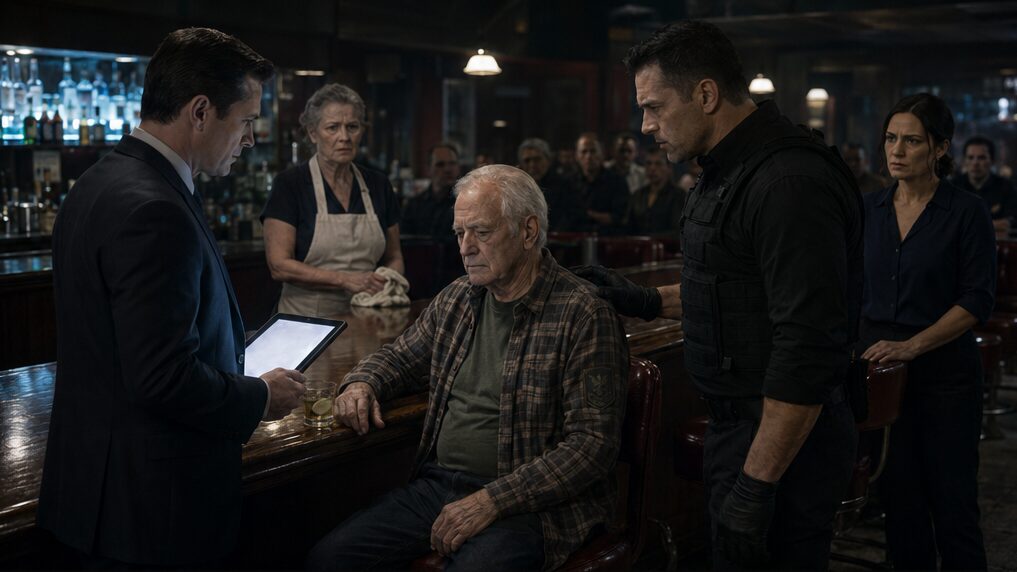
The mirror behind the liquor shelves gave him enough. Two men entered first. One wore a dark suit and carried a tablet that glowed red against his palm. The other had on black tactical gear, the sort of vest and gloves that made a man look prepared for trouble before he found any. Behind them, near the host stand, Maria Morgan stood with her arms folded tightly across her navy blouse.
Brenda Hayes, who had worked the lunch shift for nearly twenty years and now stayed late because the new schedule made no sense, looked from Maria to Robert and then down at the rag in her hands.
Robert took in all of that without moving more than his eyes.
The man in the suit came to his left side. The tactical man came to his right.
“Mr. Bennett?” the suited man asked.
Robert looked at his glass. “That depends on who’s asking.”
“James Reed.” The man angled the tablet so Robert could see it. “I’m conducting a review for the current ownership.”
Robert saw his own face on the screen, caught by a security camera from a high corner. Grainy. White hair, plaid overshirt, shoulders slightly bent. Beneath the photo was a list of dates and dollar amounts. Some were small. Eight dollars. Twelve fifty. Twenty-three. Some were larger. One hundred. Two hundred and forty. One line was circled in red.
Robert read enough and stopped.
The man in black shifted closer. Robert could smell rain on his jacket though the night outside had cleared an hour ago.
“You’ve been asked not to go behind the bar,” James said.
“I haven’t been behind the bar tonight.”
“That isn’t what I said.”
Robert’s thumb moved once along the glass, leaving a crescent in the damp.
Maria stepped forward, then stopped herself. “Robert, this would be easier if you just answered the questions.”
He did turn then, only enough to see her past James’s shoulder. She looked younger than Mary had looked the day Robert first came in, but older than she probably was. Tired eyes, careful hair, a woman who had inherited a business and found debts tucked in places where receipts should have been.
“Mrs. Morgan,” he said.
“It’s Maria.”
“I know.”
Her mouth tightened at that. She did not like being reminded he had known the bar before she had the keys.
James tapped the tablet. “Your name appears in connection with repeated cash withdrawals from a fund labeled V.M. It was not part of the official books. You were recorded on several nights entering after posted closing hours.”
Robert said nothing.
“That fund was supposed to be for veterans,” Maria said, and there was pain under the accusation. “At least that’s what the old notes suggest. So if there’s an explanation, I’d like to hear it.”
The word veterans made Brenda stop wiping the counter.
Robert felt the old patch beneath his plaid sleeve before he looked at it. Muted green fabric. Frayed edge. Faded stitching almost the color of dust. It had been sewn onto the sleeve of his old field shirt long after the shirt should have been thrown away. Mary had done it herself, sitting right where Brenda now stood, cursing because the needle was too dull.
Keep it where they can see it, Robbie, she had told him.
He had told her not to call him Robbie.
She had called him that until the winter she died.
James moved the tablet closer. “Do you deny making these withdrawals?”
Robert looked at the glowing red circle. The line inside it showed a date from three months before Mary’s funeral.
“I don’t deny being here,” Robert said.
“That’s not an answer.”
“It’s the one I’m giving you.”
The tactical man put a gloved hand on Robert’s shoulder.
It was not a shove. Not hard enough to bruise. Not yet. But the weight of it pressed through the plaid, through the green shirt beneath, through skin and old muscle and bone. It told the room where power was supposed to sit.
The two off-duty officers in the back booth looked over. The bartender paused with a bottle in his hand. A man near the jukebox lowered his voice in the middle of a story. The whole bar seemed to lean toward the third stool from the end.
Robert looked down at the glove.
His left hand, the one near his lap, closed slowly. He opened it again.
“Don’t,” Brenda said softly.
Mark Carter, the man in tactical gear, did not look at her. “Sir, we need you to stay seated.”
Robert almost smiled, not because it was funny, but because there were sentences a man heard in his life that arrived wearing new clothes but carrying the same old body.
Stay down.
Wait here.
Don’t move.
Let them through first.
He looked up at Mark. The younger man had a square face, trimmed beard, and eyes that had learned to scan a room for exits before faces. Not cruel. That was the problem with most harm. It so rarely arrived wearing horns.
“Take your hand off,” Robert said quietly, “before you make this harder on yourself.”
Mark’s fingers stiffened.
James lifted one finger, sharp and impatient. “Mr. Bennett, I would be careful with how you phrase things right now.”
Robert turned his eyes to James. He saw a man who believed the screen because the screen had organized the world for him. Dates. Amounts. Images. A story shaped into columns.
“I have been careful,” Robert said.
The room went still enough for the fan click to count seconds.
James studied him, then glanced at the sleeve where the plaid overshirt had slipped back. A strip of the green shirt showed, and on it the patch, worn nearly smooth at the corners. James’s eyes passed over it without stopping.
Brenda’s did not.
Neither did the older man at the end booth, who sat up a little straighter and took off his cap.
Maria noticed them noticing. “What is it?”
No one answered.
Robert eased his shoulder back, not hard, just enough to make Mark decide whether he was holding a person or handling a problem. After a second, Mark removed his hand.
Robert took his glass, lifted it, and set it down without drinking.
James exhaled through his nose. “There are fourteen entries tied to you. Missing cash, undocumented access, and no explanation from the prior owner because she’s no longer here to give one.”
At Mary’s mention, Robert’s jaw moved once.
Maria’s voice dropped. “Robert, if she made a mistake, say that. If someone used your name, say that. But don’t sit there like this is beneath you.”
That landed harder than Mark’s hand.
Robert looked at Maria fully now. “It isn’t beneath me.”
“Then why won’t you help?”
Because help was sometimes another kind of exposure. Because names written in Mary’s slanted hand belonged to men who still came in through back doors and women who waited in cars with the engine running. Because pride could be the last coat a person owned. Because Mary had trusted him not to turn mercy into a display.
He said none of that.
James tapped the tablet again and turned it so others could see. “This is from last Thursday. You entered through the side door at 11:47 p.m. The register was opened three minutes later. Forty dollars was removed.”
Brenda closed her eyes.
Robert looked at the image. The camera had caught his back, plaid shoulders, green sleeve, white hair bright under the exit sign. He remembered the night. Remembered the folded note under the sugar jar. Remembered the young woman in the parking lot who would not come inside because her husband’s friends were drinking at the far table.
Forty dollars for gas to get to the VA hospital before dawn.
James’s voice sharpened. “Where did the money go?”
Robert looked at the tablet, then at Maria, then at Mark, whose hand now hung stiffly at his side.
“Not in my pocket,” he said.
“That isn’t enough.”
“No,” Robert said. “I suppose it isn’t.”
Maria’s face changed, just a little. Not softness. Frustration trying not to become fear.
James lowered the tablet. “Until this is resolved, you are not permitted behind the bar, in the office, or on the premises after closing. If you refuse to cooperate, we’ll treat this as theft.”
The word crossed the counter and found every ear.
The old man at the end booth whispered something that sounded like shame on you, but Robert could not tell who it was meant for.
Robert slid two bills beneath his untouched drink. Exact amount. Always exact. Mary had once teased him for that too.
He stood slowly, because his knees required negotiation. Mark stepped back. James watched him as if any slowness might be strategy.
The plaid overshirt shifted again, and the sleeve patch showed more clearly under the light. Faded green. Old stitching. A shape few people would know unless they had needed to know it.
Brenda’s hand went to her mouth.
Robert did not look at her. If he did, she might speak, and if she spoke, others might ask why.
He picked up his cap from the bar.
Maria said, “Robert.”
He paused.
“If there’s something I should know,” she said, quieter, “you need to tell me.”
Robert looked at the empty place behind the bar where Mary used to keep the peppermints.
“I did tell someone,” he said. “She listened.”
He walked toward the door with every eye in the room following him.
Behind him, James Reed looked down at the tablet one more time, then froze.
A new file had loaded from the scan of Mary’s ledger. On the first page, in blue ink faded by years, were two words beside Robert’s name.
Ask him.
Chapter 2: The Ledger Mary Never Explained
James Reed did not like handwritten records.
They left too much room for sentiment. They invited excuses. A clean set of books either balanced or did not. A timestamp either matched or did not. A camera recorded a man entering through a side door, opening a register, and removing cash. That was not a poem. That was evidence.
Still, at 12:38 a.m., after the bar had emptied and Maria had locked the front door, James sat in the back office with Mary Sullivan’s ledger open beneath the desk lamp and felt the clean lines of the case begin to bend.
The office smelled of old paper, coffee grounds, and floor cleaner. Mary had labeled everything in block letters on masking tape. TAXES. VENDORS. REPAIRS. JUKEBOX. A shoebox on the top shelf had been marked BROKEN CHRISTMAS LIGHTS, though it contained no lights at all, only receipts bundled with rubber bands.
Maria stood by the file cabinet, arms folded the same way she had folded them in the bar. “So?”
James did not answer immediately.
The ledger was not a proper account book. It was a black composition notebook with softened corners, the kind sold in school-supply aisles. The first pages listed names, dates, small amounts, and initials. Some lines had a checkmark. Others had a short note.
Bus.
Boots.
Motel one night.
Prescription.
No questions.
That last note appeared more than once.
Maria leaned over the desk. “Is that her handwriting?”
“Yes.”
“How do you know?”
“You gave me her vendor logs.” James turned one page back. “Same slant on the capital M. Same way she crosses the t.”
Maria looked away. “She never told us about this.”
“Who is us?”
“My cousins. The bank. The attorney. Anyone trying to keep this place open.”
James nodded but kept reading.
Robert Bennett’s initials appeared in the margin on fourteen pages. R.B. Sometimes beside a dollar amount. Sometimes beside a time. Once beside a note that read green sleeve, Thursday.
James tapped that line with his pen.
Maria frowned. “What does that mean?”
“I don’t know.”
“You saw the patch. Maybe it’s some military thing.”
“Maybe.”
“You think that matters?”
James looked up at her. “Right now, I think everything matters until it doesn’t.”
She did not like that answer, but she accepted it because she had hired him for answers she could dislike.
Mark Carter stood near the door, vest unzipped now, gloves tucked into his back pocket. Without the hand on Robert’s shoulder, without the watchful posture, he looked less like authority and more like a man who had stayed too late and knew it.
“He warned me,” Mark said.
James turned a page. “Who?”
“The old man.”
“He told you to take your hand off.”
“Not like a threat.”
Maria rubbed her forehead. “Can we not turn this into folklore? I need to know whether money is missing.”
James looked down again. “Money is missing from the official account.”
“There.”
“But the unofficial ledger accounts for much of it.”
Maria went still.
James continued before she could interrupt. “Not legally. Not cleanly. Not in a way the bank will enjoy. But Mary wrote where it went.”
“To whom?”
“That’s the problem.” He turned the notebook toward her. “Some names are first names only. Some are initials. Some are descriptions.”
Maria read one upside down. “Tall man, Navy cap.”
“Another says nurse’s son. Another says woman from the shelter, blue van.”
“That’s not accounting.”
“No. It isn’t.”
Mark shifted by the door. “Sounds like helping.”
James gave him a flat look. “Helping can still become fraud if it uses the wrong money.”
“But you don’t think he stole it.”
James closed his pen. “I think Mr. Bennett knows exactly what happened. I also think he let us accuse him rather than explain.”
Maria sank into Mary’s old chair. The vinyl gave a tired sigh beneath her. “Why would he do that?”
No one answered.
James pulled the tablet closer and opened the camera archive again. The screen lit his face in red and gray. He searched the date from the ledger line that had bothered him most.
Green sleeve, Thursday.
The footage opened to an empty bar after closing. Mary Sullivan appeared first, alive in grainy silence. She was smaller than he expected, with gray hair pinned badly and a sweater hanging off one shoulder. She moved behind the bar with the practiced irritation of someone who knew every floorboard by sound. A minute later, Robert Bennett entered through the side door.
Not sneaking. Let in.
Mary waved him toward the third stool from the end. He sat. She placed a glass in front of him. Ginger ale, probably. Then she took a cigar box from beneath the register.
Maria’s breath caught.
James slowed the footage. Mary and Robert bent over the box. Mary wrote in the ledger. Robert counted bills, then pushed some back toward her. She pushed them back again. They argued in the silent way of old friends. Small gestures. Hands held up. A head shake. A tired smile Mary seemed to lose before it reached her eyes.
Then she reached across the bar and touched Robert’s sleeve.
James zoomed in.
The patch blurred, then sharpened poorly. Still, even in the security footage, he could see Mary’s finger tap it twice.
Maria whispered, “What was she doing?”
James did not answer. The screen kept playing.
Mary took an envelope from the cigar box and wrote something across the front. Robert tucked it inside his plaid overshirt. Before he left, Mary pointed at him, stern even in silence. Robert pointed back at the glass, as if accusing her of forgetting something. She laughed. The footage had no sound, but the laugh was visible in her shoulders.
Maria covered her mouth and looked away.
For the first time that night, James felt the case become less convenient.
He had investigated employees who padded hours, managers who skimmed cash, relatives who bled small businesses dry while calling it family. He knew the shapes of theft. He also knew theft often wore a wounded face when caught.
But Robert Bennett had not looked caught.
He had looked burdened.
James opened the ledger to the first page again. The inside cover had a pocket made from taped brown paper. He had missed it because the tape had yellowed into the cover. He slid his finger under the flap and pulled out a folded note.
Maria stood.
The note was addressed in Mary Sullivan’s handwriting.
Robert, if I’m gone before the mess is sorted, don’t let them turn kindness into a courtroom. Tell them enough. Not everything. Some people still need their names kept out of mouths.
James read it twice.
Mark stepped closer. “What does that mean?”
Maria’s eyes shone, but her voice came out sharp. “It means she left a mess and expected him to clean it up.”
James folded the note carefully. “It means she expected him to know the difference between truth and exposure.”
“That sounds poetic. I need practical.”
“Practical is this.” James held up the ledger. “We cannot call it theft until we understand the entries. And we cannot understand the entries unless Robert talks.”
“He won’t,” Mark said.
James looked at him.
Mark shrugged, uncomfortable. “You saw him.”
James had.
He saw again the old man’s left hand closing and opening when Mark touched him. Saw the way he had looked at the glove, not with fear exactly, but with the weary recognition of someone who had been handled before by men who thought they were allowed. Saw the sleeve patch that had meant something to Brenda and the old customer at the end booth.
He opened a new folder on the tablet and took photographs of the note, the ledger, the inside cover.
“Tomorrow,” Maria said, “we ask him again.”
James shook his head. “No.”
Maria’s expression hardened. “I’m paying you.”
“Yes. And I’m telling you not to corner him again in public.”
Mark looked down.
Maria noticed. “You both are acting like I did something wrong.”
James capped his pen. “You inherited a problem. That’s not wrong.”
“But?”
“But you let us treat a seventy-something-year-old man like a thief in front of half the room before we understood what Mary had built around him.”
Maria’s face flushed. “I was trying to protect this place.”
“I know.”
“My aunt left debts. She left bad books. She left employees I can barely pay and regulars who think they own the stools. Every time I open a drawer, something else falls out. So forgive me if I don’t have patience for secret envelopes.”
James did not soften his voice. “Patience may be the only thing that gets us the truth.”
The office fell quiet.
From the bar, the ceiling fan clicked through the wall.
Maria wiped under one eye quickly, angry at the evidence of it. “Fine. Find out what the entries mean.”
“I will.”
“And Robert?”
James looked at the note again.
Ask him only if I’m gone.
“He already knows we’re coming,” James said. “The question is whether he’ll believe we came to listen.”
At the door, Mark reached for his gloves, then stopped as if they had become heavier in his pocket.
James gathered the ledger, the tablet, and Mary’s folded note. Before he shut off the desk lamp, he saw one more mark written at the bottom of the inside cover. It was half hidden under the taped pocket, pressed so lightly he nearly missed it.
R.B. keeps the Thursday seat.
Not owns. Not reserves.
Keeps.
Chapter 3: The Seat Nobody Was Supposed to Move
By noon on Saturday, Maria Morgan had decided the third stool from the end was bad for business.
She did not say it that way. She said the traffic pattern behind the bar was inefficient, that customers bunched near the register, that the lunch rush needed cleaner sight lines from the grill window to the counter. She said the stool wobbled, which was true. She said all the old furniture needed review, which was also true.
But Brenda Hayes had worked at Mary Sullivan’s long enough to hear the sentence underneath.
The old man’s seat bothered Maria.
So Brenda watched the young bartender carry it to the storage hall with its chrome legs sticking out in front of him like something wounded.
“Careful,” Brenda said.
“It’s a stool,” he answered.
“Then be careful with the stool.”
He gave her the look young people gave when they thought age had made a person sentimental over objects. Brenda let him keep it. Some lessons came late or not at all.
The lunch crowd filled slowly. A mother with two children took the booth near the window. The off-duty officers claimed their usual back table. Two road workers came in wearing reflective vests and ordered meatloaf before they sat down. The jukebox was silent. Maria had unplugged it until the electrician checked the wiring.
Everything looked cleaner than it had under Mary. That was the strange part. The menus were laminated. The counter had been polished. The cracked mirror behind the whiskey bottles had been replaced with one so bright Brenda could see the lines beside her mouth from twenty feet away.
Still, the room felt less ready to forgive.
James Reed arrived just before one with Mary’s ledger under his arm and his tablet tucked flat against his side. He wore no tie today. Brenda noticed that. Maybe it meant something. Maybe it meant laundry.
“Coffee?” she asked.
“Please.”
“You here to accuse anybody before or after dessert?”
He accepted that without flinching. “After, if possible.”
Brenda poured coffee into a white mug and set it in front of him. “He won’t come at lunch.”
“Robert?”
She wiped the counter near him though it was already clean. “He doesn’t like a crowd.”
“But he came Thursday night.”
“Thursday night isn’t a crowd. Thursday night is people pretending they aren’t lonely.”
James looked at the empty space where the third stool had been. “What happened there?”
“Efficiency.”
He glanced at her.
“Don’t look at me,” Brenda said. “I’m not management.”
Maria came from the back carrying a clipboard and stopped when she saw James. “I didn’t know you were coming.”
“I wanted to ask Brenda a few questions.”
Brenda kept wiping. “Brenda is standing right here.”
Maria’s mouth tightened. “I meant officially.”
James sat at the counter, choosing the stool beside the empty space without seeming to mean to. “Unofficially may work better.”
That was the first thing he had said that Brenda liked.
The door opened at 1:17.
Robert Bennett stepped in wearing the same plaid overshirt, the same muted green shirt beneath it, the same cap held low enough to shade his eyes. Saturday light came in behind him, soft and gray. He paused, not because the room looked at him—though it did—but because the third stool from the end was gone.
Brenda felt something twist behind her ribs.
Robert’s eyes moved to the gap. No anger crossed his face. No demand. He simply took in the absence the way a man might take in a grave marker he had known was coming.
Maria saw it too. To her credit, she looked down first.
“Robert,” Brenda said, too warmly, which ruined the attempt to sound normal. “I can get you a table.”
“I’m all right.”
His voice carried just far enough for the nearest customers to hear.
James stood. “Mr. Bennett.”
Robert looked at him, then at the ledger under his arm. “You brought Mary with you.”
Maria flinched at the name.
James lowered his eyes briefly. “In a manner of speaking.”
Robert walked to the counter. Without his stool there, he had nowhere natural to stop. He rested one hand on the polished edge, the old patch visible where his plaid sleeve had slid back. A child in the window booth stared at it until her mother whispered something and turned her attention back to the menu.
“Would you like your ginger ale?” Brenda asked.
Robert looked at the empty space again. “No, thank you.”
That hurt worse than if he had shouted.
Maria cleared her throat. “We had to move some things around.”
Robert nodded. “You own the floor.”
Nobody spoke for a beat.
James said, “I’d like to understand the ledger.”
“I imagine you would.”
“Mary left a note.”
Robert’s face did not change, but his hand on the counter flattened. “Mary left too many notes.”
“She wrote that we should ask you.”
“Then ask.”
James glanced at the customers, then at Maria. “Not here.”
Robert’s eyes flicked to the missing stool. “You had no trouble starting here.”
Brenda looked away. Maria looked as if the words had struck her in the throat.
Mark Carter entered then, out of uniform, wearing jeans and a dark jacket. He stopped just inside when he saw Robert. The room seemed to remember his gloved hand even without the glove.
Robert did not turn.
Mark came forward slowly. “Mr. Bennett.”
“Mr. Carter.”
“I wanted to say—”
“Not here,” Robert said.
The same words James had used, but cleaner. Final.
Mark closed his mouth.
Brenda felt the lunch crowd pretending not to listen. Forks slowed. The road workers lowered their voices. One of the off-duty officers stared into his coffee.
Maria set her clipboard down. “Robert, I’m trying to keep this place open.”
“I know.”
“Then you know I can’t have undocumented funds and people entering after hours.”
“I know that too.”
“Then help me.”
He looked at her then, really looked, and Brenda saw Maria shrink from the exhaustion in his face. Not because it accused her. Because it did not.
“Your aunt helped people who would not survive being made into paperwork,” Robert said.
James went still.
Maria whispered, “What does that mean?”
“It means she knew the difference between a receipt and a person.”
Brenda’s eyes burned. She turned toward the coffee machine and found nothing to do there.
James opened the ledger. “These names. Are they veterans?”
Robert looked at the open pages but did not step closer. “Some.”
“Families of veterans?”
“Some.”
“People Mary knew?”
“Some.”
“People you knew?”
Robert gave him the faintest look. “Mr. Reed, you keep asking questions that make boxes. Mary didn’t work in boxes.”
Maria’s patience cracked. “That is not enough. This is my bar now. My loan. My name on the notices. If she was handing out cash from the register, I need to know why.”
Robert’s gaze drifted to the storage hallway where the stool had disappeared.
“When your aunt bought this place,” he said, “she couldn’t afford the sign out front. Did you know that?”
Maria blinked. “What?”
“The old neon one. Sullivan’s. Red letters. Half dead when she got it. She wanted it fixed before opening night. Said a place without a working sign looked ashamed of itself.”
Brenda remembered the sign. Remembered Mary standing below it in the rain, cursing at the repairman.
Robert continued, “A man from the reserve center fixed it for free. Wouldn’t take money. Mary fed him every Thursday for six months without ever saying the meals were payment.”
Maria looked uncertain. “What does that have to do with the ledger?”
“Everything.”
James watched him carefully. “Was the fund repayment?”
Robert shook his head. “No.”
“Charity?”
“No.”
“Then what was it?”
Robert’s fingers touched the edge of his sleeve patch once, so briefly Brenda might have missed it if she had not already been watching.
“It was a way to let people come in without having to beg,” he said.
The room’s silence changed. It lost its appetite for scandal.
Maria’s voice lowered. “And your part?”
Robert looked at the empty space beside James. “I kept the seat.”
Before anyone could ask what that meant, the young bartender returned from the storage hall carrying a plastic tub of clean glasses. He glanced at the gap and said, too casually, “You want me to bring the old stool back, or are we tossing it?”
Nobody moved.
Robert’s face went still in a way Brenda had seen only once before, the night Mary’s ambulance left without its siren.
Maria turned toward the bartender. “Put it in the office.”
The bartender looked confused. “The office?”
“Now.”
He left quickly.
Robert picked up his cap from the counter though he had never set it down.
James closed the ledger. “Mr. Bennett, please. One conversation.”
Robert looked at him. “You’ll get it.”
“When?”
“When you can ask without an audience.”
He turned toward the door.
Maria stepped after him. “Robert, if that seat means something—”
He paused with his hand on the doorframe.
“It meant someone could sit beside me without telling the whole room they needed help,” he said.
Then he went out into the gray afternoon, leaving the polished bar brighter, cleaner, and emptier than before.
Chapter 4: The Names Behind the Numbers
James Reed found the first person from Mary’s ledger by accident.
He had gone to the county veterans’ services office expecting forms, not faces. The building sat between a tax preparer and a closed nail salon, its brick front faded by sun and its flagpole rope tapping lightly in the wind. Inside, the waiting room smelled like paper dust, burnt coffee, and wet coats even though the morning was clear.
A clerk behind the glass listened while James explained that he was reviewing old records connected to Mary Sullivan’s bar.
At Mary’s name, the clerk’s expression changed.
“She passed?”
“Last winter.”
The clerk lowered her eyes. “I’m sorry to hear that.”
“You knew her?”
“Everybody knew her a little.”
That was how the morning went. Not answers. Pieces. A man in the waiting room heard Mary’s name and looked up from a folded benefits form. A woman with a cane asked whether James meant the Mary from Sullivan’s. A volunteer in a faded polo said, “She fed half the people who came through here at one time or another,” and then stopped speaking when he realized he might have said too much.
James showed no one the ledger itself. He had copied selected pages and covered names with paper slips where he could. Still, the notes spoke in ways numbers did not.
Bus.
Boots.
Motel one night.
Prescription.
No questions.
He had thought the phrase sentimental when he first read it. By noon, he understood it was instruction.
The clerk would not release records, which James had expected. But she did confirm that Mary Sullivan had attended two community resource meetings years earlier. She also remembered Robert Bennett.
“He didn’t come for himself,” she said.
James looked up from his tablet. “What did he come for?”
The clerk glanced toward the waiting area. “Usually to ask what could be done without making someone fill out six pages in front of strangers.”
“Was he a volunteer?”
“No badge, if that’s what you mean.”
“What did he do?”
She considered him a long time. “He listened before people had to explain.”
That answer followed James out to his car.
He sat with the engine off and opened Mary’s ledger again. The pages looked different in daylight. Less like a scheme. More like a map drawn by someone who knew official roads did not reach every door.
One entry from three years before caught his eye because Mary had written more than usual.
M.C. father, winter coat, no mention to son.
James stared at it.
M.C.
He did not like coincidence. He liked it less when it sat beside a man who had put his hand on Robert Bennett’s shoulder.
He photographed the line and sent nothing. Not yet.
Robert’s apartment was across town in a low building with brown railings and window air conditioners that rattled even when off. James did not knock at first. He sat in the parking lot and watched an upstairs curtain move. He had no warrant, no police authority, no right to demand anything beyond a conversation. The tablet on the passenger seat looked suddenly theatrical.
When he finally went up, Robert opened the door before James knocked twice.
“You walk heavy on stairs,” Robert said.
James lowered his hand. “May I speak with you?”
“No.”
The door began to close.
“Mary’s note said to ask you.”
The door stopped with two inches left.
Robert’s face filled the narrow space. Without the bar’s shadows, he looked older and less breakable at the same time. The lines in his face were not soft. They were cut by weather, sleeplessness, and decisions that had not expired.
“You read it?” Robert asked.
“Yes.”
“Then you read the part about not turning kindness into a courtroom.”
“I’m not here to do that.”
“You brought a tablet?”
James looked down at the device tucked under his arm and almost apologized to it. “Habit.”
Robert opened the door wider but did not invite him in. Behind him, the apartment was neat and spare. A small table with two chairs. A stack of folded dish towels. A row of pill bottles lined up by size. On the back of one chair hung the muted green shirt with the sleeve patch facing outward.
James’s eyes went to it before he could stop himself.
Robert noticed.
“People keep looking at that now,” he said. “They didn’t before.”
“What is it?”
“A piece of cloth.”
“That isn’t an answer.”
Robert’s mouth shifted slightly. “It’s the one I’m giving you.”
James accepted the echo.
He opened his folder, not the tablet, and removed one copied page from the ledger. He had covered the last names and left only Mary’s note visible.
M.C. father, winter coat, no mention to son.
“Do you know what this refers to?”
Robert looked at the page. His expression did not change, but his right hand moved toward the doorframe and held it.
“Yes.”
“Is M.C. Mark Carter?”
Robert’s eyes lifted to James’s.
“I’m trying to understand the money,” James said.
“You’re trying to understand the people. Money is easier.”
“Did Mary give Mark Carter’s father help?”
Robert looked past him to the parking lot. A delivery truck backed into the building next door, its warning beep thin in the afternoon air.
“His father came in twice,” Robert said at last. “First time, he ordered coffee and counted change under the table. Mary pretended not to see. Second time, he asked if she knew where a man could get a coat that didn’t smell like mildew.”
“Was he a veteran?”
Robert’s eyes hardened just enough. “He was cold.”
James felt the correction and took it.
“Did Mark know?”
“No.”
“Why not?”
Robert stepped back, but not enough to let him enter. “Because his father still had a son to look tall in front of.”
James looked at the copied ledger page. The words no mention to son seemed heavier now.
“There are fourteen entries tied directly to you,” he said. “Maria believes the bar could be liable if this was mishandled.”
“It was mishandled the minute your friend put his hand on me.”
James did not defend Mark.
Robert turned then, as if conversation had reached its useful end. The door remained open. James could see the green shirt more clearly now. The patch was not a unit insignia he recognized. It was a simple shape, faded, with stitching around the border and a small line of thread across the center where something had been repaired.
“Why keep wearing it?” James asked.
Robert stopped.
“Mary wrote ‘green sleeve, Thursday.’ She tapped it in the footage. Brenda recognized it. So did someone else at the bar. What did it tell people?”
Robert took the shirt from the chair and folded it once, hiding the patch.
“It told them not to ask Mary,” he said.
James waited.
Robert laid the shirt down on the table, his palm resting on the fold. “Some folks can walk into an office and say what they need. Some can’t. Some would rather sleep in a truck than tell a clerk they lost the room. Some would rather skip pills than let their daughter know. Mary understood that. Too well, maybe.”
“So they came to you.”
“Sometimes.”
“And you came to Mary.”
“Sometimes.”
“Where did the money come from?”
Robert gave a tired exhale. “Everywhere. Nowhere. A jar on the back counter. Tips Mary pretended were too large. Cash I left and she pretended not to notice. Meals she marked as waste. A man fixes a sign and never takes payment, so she feeds the next man who needs feeding. People think money moves in straight lines. It doesn’t. Not when it’s trying not to embarrass anybody.”
James wrote nothing. For once, he understood writing would be rude.
“Why not tell Maria?”
Robert’s hand tightened over the folded shirt. “Mary’s family thought she was careless. Maybe she was. Thought she was too soft. Maybe she was that too. Maria came in with bankers and clipboards and eyes full of numbers. I didn’t know what she’d do with names.”
“She might have protected the fund.”
“She might have posted a sign.”
James imagined it: VETERANS EAT FREE, painted bright, shared online, a line of strangers staring at whoever used it.
Robert seemed to see the same thing.
“Mary never wanted pity sold with coffee,” he said.
The hallway outside smelled faintly of someone frying onions. A child laughed behind a closed door, then was shushed.
James looked at the apartment again. No pictures on the walls except one small frame turned inward on a shelf. No medals. No flags. No certificate demanding attention. Only the shirt, folded now like a secret tired of being watched.
“Mr. Bennett,” he said, “Maria needs enough truth to keep the bar open.”
Robert’s face changed then. Not fear. Something nearer to grief.
“Is it that bad?”
“Yes.”
He looked toward the window. “Mary always said the place was one bad freezer away from closing.”
“There are notices. Back taxes. Vendor debts. If the ledger looks like theft, Maria may lose more than the bar.”
Robert nodded once, slowly, as if some part of him had expected this and hated being right.
“I can protect names,” James said. “But I need to know categories. Patterns. Anything that separates help from fraud.”
Robert gave him a look. “You can protect them?”
“I can try.”
“Trying is not the same as keeping a promise.”
“No,” James said. “It isn’t.”
For the first time, Robert looked as if he respected the answer.
He went to the table, opened a drawer, and removed a small stack of envelopes bound with twine. He did not give them to James. He held them against his chest.
“These don’t leave with you.”
“All right.”
“You don’t photograph names.”
“All right.”
“You don’t call people unless I say.”
James nodded.
Robert untied the twine. His fingers were careful, but not steady. Age had taken some obedience from them. The first envelope was blank except for a date. Inside were receipts: a pharmacy slip, a bus ticket, a handwritten IOU crossed out by Mary’s thick blue pen.
“Mary kept the ledger,” Robert said. “I kept what she was afraid someone would throw away.”
“Why you?”
A shadow of a smile crossed Robert’s face and left. “Because I was already good at carrying things I couldn’t fix.”
The sentence sat between them.
James did not ask about combat. He did not ask about medals. He did not ask because he understood, finally, that the story was not waiting in those places.
Robert opened another envelope.
This one held a photograph. Mary behind the bar, younger, laughing with one hand raised to block the camera. Beside her sat Robert on the third stool from the end, his green sleeve turned outward. The patch was brighter then. On the back, Mary had written, Thursday seat.
James looked at it and thought of the missing stool in the storage hall.
Robert slid the photo back into the envelope.
“Tell Maria,” he said, “she can ask me. Not the room. Not the tablet. Not the man with gloves.”
“I will.”
James gathered his folder, leaving the copies on the table because they felt less like evidence now and more like things he had not earned the right to carry.
At the door, Robert stopped him.
“Mr. Reed.”
James turned.
“If that line is about Mark Carter’s father, you leave the son out of it unless there’s no other way.”
James glanced toward the stairwell. “Even after what he did?”
Robert looked at the folded green shirt.
“Especially after what he did,” he said.
Chapter 5: The Man Mark Did Not Recognize
Mark Carter kept his father’s things in a cardboard box under the workbench, and for six years he had told himself that was better than throwing them away.
The box had sagged at the corners. Dust clung to the tape. On top lay a fishing reel, a cracked leather wallet, two utility bills, and a photograph of his father beside an old pickup with one hand lifted against the sun. Beneath those were papers Mark never read all the way through because they made him angry in directions that had nowhere useful to go.
He opened the box at 7:12 that evening because James Reed had sent him a text with no explanation beyond, Call me when you are alone.
Mark had called from his truck first. James had not told him everything. James rarely did. But he had said enough.
There is an entry in Mary’s ledger that may involve your father.
Mark had driven home without remembering half the streets.
Now he stood in his garage with the overhead light buzzing and the smell of oil and damp concrete rising around him. His father’s name appeared on nothing in the ledger, James had said. Only initials. Only a note.
Winter coat. No mention to son.
Mark moved the fishing reel aside.
His father had died with three jackets in the front closet. Two light, one heavy. Mark remembered that because he had donated them after the funeral and felt virtuous for fifteen minutes before the house became unbearably empty. He did not remember buying the heavy one. He did not remember his father buying it either.
He found it in a photograph near the bottom of the box.
His father stood outside Sullivan’s, thinner than Mark remembered, shoulders bent in a dark wool coat too good for him at the time. Beside him was Mary Sullivan, pointing at the camera with a cigarette between her fingers. At the edge of the photo, half cut off, sat an old man at the bar window, visible through the glass.
White hair. Plaid shirt. Green sleeve.
Mark sat down on an overturned bucket.
The garage seemed to lose air.
He had seen that man three nights ago under his own gloved hand.
Not recognized. Not even wondered.
His father had been proud in ways that made help difficult and closeness worse. After Mark’s mother left, the two of them had lived in a house where apologies were repaired through chores. His father never said he was short on money. He let lights go unpaid and called it teaching a lesson about candles. He watered soup. He patched boots with glue. He told Mark everything was fine with the force of a man daring the world to contradict him.
Mark remembered one winter in particular. He had come home from a security training course to find his father wearing a coat he had never seen before.
“Where’d you get that?” Mark had asked.
“Man owed me,” his father said.
“What man?”
“A man.”
Mark had laughed then, irritated. “That’s not an answer.”
His father had smiled without showing teeth. “It’s the one I’m giving you.”
The memory struck so hard Mark stood up.
Robert Bennett had said nearly the same thing to James.
Mark picked up the photograph again. On the back, in handwriting he did not know, were four words.
He wouldn’t take cash.
Mark turned it over, then back again.
He had spent years believing his father had kept dignity by refusing help. Now he had to make room for a harder truth: maybe dignity had survived because someone helped him quietly enough that his son never saw him bend.
Mark drove to Robert’s apartment after dark.
The building’s exterior lights had not come on, so the stairwell was dim. He climbed slower than usual, not because he feared the old man, but because every step felt like approaching a version of himself he did not want to meet.
He knocked.
No answer.
He knocked again, softer.
A neighbor opened a door down the hall and looked at him through the chain. “You looking for Mr. Bennett?”
“Yes, ma’am.”
“He went out.”
“Do you know where?”
She looked him up and down. Mark was not in uniform. Still, something about him must have carried the shape of Thursday night.
“You a friend?”
The question did not allow easy lying.
“No,” he said. “Not yet.”
The chain stayed on. “He took the bus.”
“The bus where?”
The neighbor hesitated. “He goes by the old bar sometimes. Even when he doesn’t go in.”
Mark thanked her and left.
Sullivan’s was closed when he arrived, its front windows dark except for the glow of the beer signs Maria had not yet taken down. The old neon sign above the door buzzed faintly, red letters blinking unevenly. It had been repaired more than once. Mark knew that now without knowing the names of the men who had done it.
Robert stood beneath the awning, facing the window.
His cap was pulled low. The plaid shirt hung open over the green one, and the patch on his sleeve caught the faint red light from the sign. He looked smaller outside, without the bar around him. Or maybe the street made everyone look temporary.
Mark stopped several feet away.
“Mr. Bennett.”
Robert did not turn. “Mr. Carter.”
“I went to your apartment.”
“So I heard.”
The old man’s voice was calm, but Mark heard the wall in it.
“I found a photo,” Mark said.
Robert remained still.
“My father. In a coat.”
The neon sign hummed.
Robert said, “Good coat.”
Mark swallowed. “Did you buy it?”
“No.”
“Did Mary?”
“No.”
“Then who?”
Robert finally turned. “Does it matter?”
“Yes.”
“Why?”
Because I touched you like you were a problem. Because I thought my father had never needed anybody. Because I built a life around not needing anybody either.
Mark said none of that well enough.
“I need to know,” he said.
Robert studied him. “Your father fixed Mary’s back door one summer. Wouldn’t take payment. Said a hinge was not worth a bill. That winter, Mary noticed him rubbing his hands under the counter and wearing a jacket thin enough to read through. She put out word that a coat had been left by mistake. He came by after closing to identify it.”
“That’s a lie.”
“Yes.”
Mark looked at the sidewalk.
Robert’s voice did not soften, which somehow made it kinder. “He knew it was a lie. Mary knew he knew. They both respected it.”
“And you?”
“I sat in the seat.”
“Why?”
“So nobody else did.”
Mark stared at him.
Robert looked through the window at the dark counter. “A man can accept help if the room is arranged right.”
The words moved through Mark slowly.
He had trained himself to arrange rooms for control. Stand here. Block that exit. Keep hands visible. Close distance before trouble grows. He had never thought of arranging a room for mercy.
“I owe you an apology,” Mark said.
“Yes.”
The answer was immediate. No false modesty. No rescue.
Mark nodded because he deserved that.
“I’m sorry,” he said. “For putting my hand on you. For doing it in front of people. For thinking I knew what I was looking at.”
Robert looked at the sleeve patch, then at Mark. “You thought you were doing your job.”
“That doesn’t excuse it.”
“No.”
Mark let that settle. “I don’t know how to fix it.”
“You don’t start by fixing. You start by remembering not to do it again.”
A car passed, headlights sliding across the glass.
Mark looked at the locked door. “James says the bar may be in trouble.”
“It is.”
“Maria doesn’t know what she inherited.”
“Most people don’t.”
“Will you tell her?”
Robert turned back toward the window. Inside, the empty space where his stool had been was visible even in the dark.
“I haven’t decided.”
Mark stepped closer, then stopped himself before he entered Robert’s space. The restraint felt awkward, like learning to hold a tool with the wrong hand.
“My father never told me,” he said.
“He wasn’t required to.”
“I would have helped him.”
Robert’s face changed, just a little. “Maybe that was what he was afraid of.”
Mark almost argued. Then he remembered the cardboard box under the workbench, the bills folded beneath photographs, the way grief had made him generous only after generosity was no longer useful.
“He must have been ashamed,” Mark said.
“Proud,” Robert corrected. “Ashamed is what other people call pride when it inconveniences them.”
Mark looked at him then, really looked.
The old man was not gentle in the way Mark had expected old men to be gentle. He had hard edges. He could withhold. He could wound with precision when truth required it. But he had protected Mark’s father from the son who might have loved him badly.
“I’m still sorry,” Mark said.
Robert nodded once. “Hold onto that. Don’t polish it too clean.”
The front door opened behind them.
Maria stood there with her coat over one arm and keys in her hand. She looked from Mark to Robert, then to the patch on Robert’s sleeve.
“I thought I heard voices,” she said.
Robert did not move toward the entrance.
Maria glanced at Mark. “Are you working tonight?”
“No.”
“Then why are you here?”
Mark looked at Robert. Robert gave him nothing.
“I came to apologize,” Mark said.
Maria’s expression faltered.
“For Thursday,” he added. “For touching him.”
The keys in Maria’s hand lowered.
Robert turned to leave.
“Robert,” she said.
He stopped but did not face her.
Maria’s voice was smaller than it had been in daylight. “James found something in my aunt’s papers. He says I should ask you, not corner you.”
Robert looked at the red neon sign. One letter flickered out, then came back.
“He’s learning,” Robert said.
“Will you come in?”
He looked through the window again, toward the missing stool.
“No,” he said.
Maria’s eyes followed his.
The embarrassment reached her slowly. Mark saw it when it landed.
“I can have the stool brought back,” she said.
“That won’t bring back why it was there.”
She had no answer.
Robert adjusted his cap and stepped away from the awning. Mark almost offered to walk him home, but stopped before the words left his mouth. Robert did not need to be escorted like damage.
At the corner, Robert paused.
“Mr. Carter,” he said without turning.
“Yes, sir?”
“Your father liked the coat. Pretended he didn’t.”
Then Robert crossed the street under the uneven red light, leaving Mark with the apology he had made and the larger one he had not yet earned.
Chapter 6: The Patch Mary Asked Him to Keep
Robert waited until the bar was empty before he came back with Mary’s final envelope.
Brenda had wiped the counter twice after closing and then stopped pretending. Maria sat at a table near the window with the day’s receipts spread in front of her, though she had not added a column in twenty minutes. James stood by the jukebox with Mary’s ledger under one arm. Mark waited near the door, not guarding it, just standing where he would not block anyone’s way.
The third stool from the end had been returned.
It looked wrong at first. Too deliberate. Like flowers brought after a careless word at a funeral. Someone had tightened the wobbling screws and polished the chrome legs. The vinyl seat still had a small crack along one edge, the same crack Robert’s thumb had traced on nights when Mary talked too much and he listened badly.
Robert carried the envelope inside his jacket.
No one spoke when he entered. That was better than the other night, but not yet good. Silence could be respect. It could also be fear of making the next mistake.
He went to the stool and placed one hand on the back of it.
Maria stood. “Robert—”
“Not yet.”
She sat.
He lowered himself onto the stool. His knees complained. His back took a moment to settle. Brenda moved as if to make him a ginger ale, then stopped and looked at him for permission. He gave a small nod.
That nearly undid him.
Not the drink. The asking.
Brenda poured slowly. Ice, ginger ale, lime. She set it down without a coaster because Mary had never used one for him.
Robert looked at the glass until the bubbles rose and broke.
“My wife used to say Mary Sullivan could turn a nickel into an argument,” he said.
No one moved.
“She was not a careful woman in the way banks prefer. She gave credit to men who had no reason to deserve it except that they were hungry. She forgot invoices. She hid cash in coffee cans, cigar boxes, hymnals, one time in a broken Christmas angel nobody would throw away because it looked too sad.”
Brenda smiled with wet eyes.
Maria looked down at her hands.
Robert touched the envelope inside his jacket but did not remove it yet. “That doesn’t mean she stole.”
“I know,” Maria said quietly.
“No. You suspect. Knowing costs more.”
The words were hard, but he had not come to be cruel. He had come because Mary had left him a responsibility heavier than the envelope.
James stepped forward. “We don’t need names, Mr. Bennett. Not tonight.”
Robert looked at him. “You will need some. Eventually.”
“Yes.”
“And you’ll ask me first.”
“Yes.”
Robert nodded.
Then he drew the envelope out.
It was yellowed, thick, and soft at the folds. Mary had written his name across the front in blue ink.
Robert.
Not Robbie. That was how he knew she had meant it seriously.
He laid it on the bar but kept two fingers on it.
“Mary gave me this when the doctors started using gentle voices,” he said. “Told me not to open it until someone tried to turn the fund into either a crime or a monument.”
Maria’s eyes lifted. “A monument?”
“She knew people.” Robert looked at the old neon glow through the blinds. “Some would call it theft. Some would turn it into a sign out front with a donation bucket and a picture for the newspaper. She feared both.”
Brenda set both hands flat on the counter.
Robert opened the envelope.
Inside were three pages, folded together, and a smaller photograph. He removed the pages but left the photograph inside for the moment.
“Read it,” he said to Maria.
She blinked. “Me?”
“It’s your bar.”
Maria came to the counter. Her hand shook when she took the pages. Robert saw she hated that it shook and liked her more for not hiding it well.
She unfolded the letter.
Her aunt’s handwriting filled the first page, impatient and slanted, as if Mary had written faster than death could interrupt.
Maria began quietly.
“Maria, if you are reading this, then either I got sentimental or Robert finally stopped being stubborn. Since I know Robert, assume the second.”
Brenda made a sound between a laugh and a sob.
Robert looked at his glass.
Maria continued.
“This place was never just a bar. Don’t roll your eyes. I know you think that is how old women excuse bad accounting. Maybe it is. But listen anyway. Years ago, before I owned the building, a man fixed the sign and would not take money. Another fixed the freezer. A woman cleaned the kitchen after her shift at the hospital because she said she liked the quiet. People kept giving what they could and refusing what they needed. So I made a way for the giving and needing to meet without embarrassing each other.”
Maria stopped.
James said nothing. Mark looked at the floor.
Robert watched the ginger ale bubbles fading.
Maria swallowed and read on.
“Robert helped because he understood the look. I don’t mean veteran in the parade sense. I mean the look people get when they have survived something and hate needing one more thing from the world. The green patch on his sleeve told certain people they could sit beside him. They did not have to say they were broke, scared, hungry, late on rent, or tired of being thanked by people who would not sit with them.”
Maria’s voice broke on the last words. She pressed her lips together until she could continue.
“The rule was simple. Nobody got displayed. Nobody got photographed. Nobody had to prove pain for a sandwich. If a person could repay, they repaid into the jar. If they could not, they didn’t. If someone asked questions, Robert kept the seat until they stopped.”
Robert closed his eyes.
Mary’s voice came back to him as if she stood by the register, one hip against the drawer, hair coming loose, pencil tucked behind her ear.
You sit there and look impossible to impress, Robbie. Folks trust that.
He had told her impossible to impress was not a ministry.
She had said it was close enough.
Maria lowered the page. “Why didn’t she tell me?”
Robert opened his eyes. “She thought you would want to organize it.”
“I would have.”
“Yes.”
“That’s bad?”
“Not always.”
“But here?”
Robert chose the words carefully. “Some help dies when it has to introduce itself.”
Maria looked back at the letter, but her eyes were too full to read. She handed the pages to James. He did not take them.
“They’re yours,” he said.
“No,” she said. “They’re hers.”
Robert reached into the envelope and removed the photograph.
He placed it on the counter.
Mary was behind the bar, younger and laughing, trying to block the camera. Robert sat on the third stool from the end with his green sleeve turned outward. On the stool beside him sat a man whose face had been deliberately hidden by Mary’s thumb when she took the picture. Only his hands showed, wrapped around a cup of coffee like heat was something holy.
On the back, Mary had written: First Thursday seat. He asked without asking.
Maria traced the edge of the photo but did not pick it up.
Robert touched his sleeve patch.
“It wasn’t military issue,” he said.
James looked surprised. “It wasn’t?”
“No. Mary made it from an old field shirt I had and a piece of cloth from the first man who came in needing the seat. He had cut it from his torn jacket because he said the jacket was done but the cloth still had use. Mary sewed it on crooked.”
Brenda let out a soft breath.
Robert looked at the patch, its faded shape now almost colorless in the bar light. “She told me if people saw it enough, they’d know where to sit.”
Mark lifted his eyes.
Robert met them. “Your father knew.”
Mark’s face tightened, but he did not look away.
Maria folded the letter carefully. “The entries in the ledger. Can they be explained without naming everyone?”
“Some.”
“And the rest?”
“We ask permission where we can. We protect where we can’t.”
She nodded, but tears slipped down her face now, silent and unwanted. “I thought she left me a disaster.”
“She left you one,” Robert said.
A startled laugh escaped Brenda.
Robert’s mouth softened. “She also left you a chance.”
Maria wiped her cheeks with the heel of her hand. “To do what?”
“To decide whether this place is only worth saving if the books look clean to people who never sat here.”
The question moved through the room and settled in the old wood, the bottles, the returned stool.
James finally spoke. “There may be a way to formalize the fund going forward without exposing prior recipients. A community meal account. Anonymous contributions. Controlled access. Better records.”
Robert looked at him. “That sounds dangerously organized.”
“It probably is.”
“Mary would hate it.”
“She’d hate losing the bar more,” Brenda said.
Robert looked at her. She looked back, unafraid now.
Mark took one step forward, then stopped before he came too close. “I can help with repairs. Security too, but not the way I did before. Cameras where they need to be. No theater.”
Robert studied him. “No gloves?”
Mark’s face flushed. “No gloves.”
Maria looked at Robert. “Would you stay part of it?”
He wanted to say no.
The refusal rose easily. He was tired. Tired of being looked at. Tired of carrying Mary’s unfinished mercy in envelopes and notes. Tired of watching pride and hunger meet in doorways. Tired of the patch on his sleeve meaning more to strangers than his own name.
But then he saw the empty stool beside him. The place where someone could sit without explaining. The place Mary had made him keep.
“I won’t run it,” he said.
“No,” Maria said quickly. “No. But maybe… help us not ruin it.”
Robert took the glass of ginger ale.
For once, he drank.
The lime touched his lip, bitter and familiar.
“All right,” he said. “But first you read the rest of that letter. Every word. And tomorrow, you put no sign in the window.”
Maria nodded.
“No picture online.”
Another nod.
“No speeches about heroes.”
James almost smiled.
Robert looked at him. “That includes you.”
“It usually does.”
The room eased, not into comfort, but into something honest enough to begin.
Maria picked up Mary’s letter again.
Before she read, Robert turned the photograph over and saw one final line he had forgotten Mary had written.
If they ever shame you in this seat, make them learn what it was for.
Chapter 7: What Respect Looks Like After the Room Goes Quiet
The following Thursday, Robert arrived ten minutes before seven and found the bar neither waiting for him nor pretending not to.
That was the first mercy.
No banner hung in the window. No sign announced a fund. No photograph of Mary had been propped near the register with a jar beside it. The old neon letters buzzed above the door, still uneven, still stubbornly red. Inside, the jukebox was plugged in again but low, a slow country song slipping under the sound of glasses and conversation.
The third stool from the end was there.
Not polished this time. Someone had left it alone after returning it to its place. The crack in the vinyl remained. The chrome legs shone only where years of shoes had rubbed them bright. A small paper napkin rested on the bar in front of it, and beside the napkin sat nothing at all.
Robert stopped just inside the door.
Brenda looked up first. She did not call his name across the room. She simply lifted her chin, then took down a glass.
That was the second mercy.
The room noticed him in fragments. A road worker glanced over and then back at his plate. The off-duty officers at the rear table lowered their voices, but not into silence. A young couple in the corner did not know enough to stare. Maria stood near the register, speaking with a vendor on the phone, and when she saw Robert, she paused only long enough to nod.
No one made him enter a courtroom of sympathy.
Robert walked to the stool and sat.
His knees hurt. His shoulder hurt where Mark’s hand had pressed days before, though not because of any bruise. Bodies remembered touch in places skin forgot.
Brenda set the ginger ale in front of him. Ice, bubbles, lime.
“Evening,” she said.
“Evening.”
“Kitchen has meatloaf.”
“Is that a warning?”
“It can be two things.”
He looked at her and, despite himself, smiled.
She turned away before either of them had to decide what to do with that.
Robert rested his left forearm on the bar. The sleeve patch showed because he had chosen the green shirt without the plaid overshirt tonight. He had stood in his apartment for a full minute before leaving, looking at both shirts laid across the bed. The plaid would have hidden most of the patch. The green would not.
He had chosen not to hide.
That did not mean he wished to be seen by everyone.
Maria ended her phone call and came to him with a folded paper in one hand. She did not stand too close. She did not lean over him. She stood across the bar where Mary used to stand, and for one dangerous second Robert almost told her she was in the wrong place.
Instead he said, “Mrs. Morgan.”
“Robert.”
Her voice held steady. She had worked for that. He gave her credit.
“I have something to say,” she said.
His eyes flicked toward the room.
“Not to them,” she added quickly. “To you first.”
He waited.
Maria unfolded the paper, looked at it, then folded it again without reading.
“I’m sorry,” she said.
The words were plain enough to be believed.
Robert looked at his glass.
“I’m sorry for letting James question you like that in front of people,” she continued. “I’m sorry for letting Mark touch you. I’m sorry for moving the stool because I was angry at a history I didn’t understand. And I’m sorry I treated your silence like guilt.”
Behind her, James Reed stood near the office door. Mark Carter was farther back, beside the wall where the jukebox light did not quite reach. Neither man interrupted. Neither man tried to share the apology.
Robert picked up the lime slice and pressed it lightly against the inside of the glass with his straw.
“My silence wasn’t entirely innocent,” he said.
Maria’s face tightened with surprise.
“I let you think wrong because I did not trust you to do right.”
She accepted that as if he had set a weight into her hands.
“I hadn’t earned that trust,” she said.
“No.”
“Can I try now?”
Robert looked at her then. Mary’s niece had Mary’s chin, though not Mary’s careless grace. Her hands were tidy. Her fear wore a business owner’s clothes. But the letter had changed something in her. Not softened exactly. Made her less certain that control and care were the same thing.
“You can try,” Robert said. “That’s all anybody gets.”
Maria nodded. She turned toward James.
He came forward with a slim folder and placed it on the counter, not in front of Robert, but between them. “We reviewed the entries we could verify without naming people publicly. The official conclusion is that the undocumented withdrawals were part of an informal assistance account maintained by Mary Sullivan, with contributions from multiple private sources.”
Robert looked at him. “That sounds like you swallowed a courthouse.”
James almost smiled. “I tried to make it worse. Brenda stopped me.”
From the coffee station, Brenda said, “I cut three paragraphs and a semicolon.”
James tapped the folder. “There are still issues. Tax issues. Record issues. Possibly licensing problems if someone wants to be difficult. But it is not theft.”
The word hung there, different this time.
Not theft.
Robert heard the room hear it. Not as announcement. As correction.
Maria looked toward the regulars, then back to Robert. “I need to say one thing out loud. You can tell me not to.”
“I can.”
“I won’t use names. I won’t mention you if you don’t want.”
Robert’s fingers moved once against the glass.
This was the edge Mary had warned him about. Crime or monument. Shame or display. A person could fall into either while meaning well.
“What do you want to say?” he asked.
Maria unfolded the paper again.
“That there was a misunderstanding about an old account my aunt kept,” she said. “That no customer or regular was responsible for missing money. That the account helped people quietly, and going forward, if anyone wants to contribute to a meal fund, they can do it without names attached. No photos. No speeches. No questions at the counter.”
Robert watched her mouth carefully, listening for vanity. It did not appear.
“And the stool?” he asked.
Maria looked at the seat beneath him. “The stool is just a stool.”
He waited.
“But nobody moves it without asking you.”
He shook his head. “Wrong answer.”
She blinked.
“Nobody moves it without knowing what it’s for.”
Maria looked down, absorbing the correction. “All right.”
James’s eyes shifted with something like respect.
Mark stepped forward then. He had taken off his jacket. No vest. No gloves. Just a dark shirt, hands visible, posture awkward because it had not been built for humility.
“Mr. Bennett,” he said.
Robert turned.
Mark stopped at the right distance. Not too close.
“I said this once outside,” Mark continued, “but I said it where nobody saw what I had done. I’m sorry for putting my hand on you in this room. I was wrong.”
A few customers looked over now. Not hungrily. Carefully.
Robert did not rescue him from the discomfort.
Mark swallowed. “My father came here once needing help. You and Mary let him keep his pride. I didn’t know that when I touched you, but not knowing doesn’t make it less wrong.”
Robert’s gaze sharpened.
He had told James to leave Mark out of it unless there was no other way. Mark had chosen to put himself in.
The younger man seemed to understand the risk. His face was pale, but he stood in it.
“I’m not saying that so anyone feels sorry for me,” Mark added. “I’m saying it because I should have known there are things a man carries that don’t show.”
Robert looked at the patch on his sleeve.
The room had gone quiet now, but not the same way it had the first night. Then, silence had crowded him. This one made space.
Robert lifted his glass and finally drank.
The ginger ale had gone slightly flat. He preferred it that way.
“You done?” he asked Mark.
Mark blinked. “Yes, sir.”
“Good. Don’t do it again.”
“No, sir.”
“And stop calling me sir like you’re trying to climb out of a hole.”
A small laugh moved through the room, gentle and gone quickly.
Mark’s shoulders lowered. “Yes.”
Robert gave him a look.
Mark corrected himself. “All right.”
Maria stepped around from behind the bar. For a moment Robert thought she was coming to hug him, and his spine stiffened. But she stopped at the register and faced the room.
“We had a misunderstanding here last week,” she said.
No one spoke.
“My aunt kept some things badly and some things better than we understood. An account she used to help people was mistaken for missing money. Robert Bennett was questioned in a way he should not have been questioned. That has been corrected.”
The off-duty officer in the back booth removed his cap.
Maria’s hands shook, but her voice did not. “Going forward, this place will keep a quiet meal account. If you want to add to it, tell Brenda or me. If you need from it, sit where you’re comfortable. Nobody will ask for your story in front of the room.”
She stopped there.
No applause came.
Robert was grateful enough for that to close his eyes.
Then a chair scraped near the back. One of the road workers came to the counter, pulled two crumpled bills from his pocket, and laid them beside the register.
“For the account,” he said, not looking at anyone.
Brenda took the bills and tucked them under the drawer without ceremony.
An older woman from the window booth came next, leaving three dollars and some coins. Then one of the off-duty officers. Then no one for a while, which was better. A thing like that should not become a parade.
Maria returned to Robert with the folded paper. “Was that all right?”
“It was enough.”
She looked more relieved than proud.
James slid the folder closer. “There’s one more thing.”
Robert sighed. “There usually is.”
“The bank will need documentation. Not names from the past. But for the fund going forward.”
“You’re going to make Mary haunt you.”
“I expect she already has.”
Brenda muttered, “She’d start with the semicolon.”
James ignored that. “Maria asked me to help set it up. Properly, but discreetly.”
Robert looked at Maria.
“I can’t run it the way she did,” Maria said. “I’m not her.”
“No.”
“I don’t know how she made people feel safe.”
“No,” Robert said again, less harshly.
“So I need help.”
He glanced at the stool beside him. Empty. Waiting, though not for anyone in particular.
“I told you I won’t run it.”
“You won’t have to. But maybe you could tell us when we’re making it too clean.”
Robert looked around the room. The neon glow in the window. The bar top worn under layers of polish. Brenda pretending not to watch him. Mark standing with his hands to himself. James with his careful folder. Maria with her aunt’s stubborn chin and her own frightened eyes.
Mary had not left him a monument. She had left him people who might ruin the thing unless someone taught them how not to.
That was unfair.
It was also exactly like her.
Robert reached into his shirt pocket and removed the small photograph from Mary’s envelope. The one with her behind the bar, his green sleeve turned outward, the first man’s face hidden by her thumb.
He placed it flat on the counter.
“No copies,” he said.
Maria nodded.
“No frame on the wall.”
Another nod.
“No story attached to it unless I’m dead, and even then I’ll be irritated.”
Brenda smiled at the coffee machine.
Robert tapped the hidden face in the photograph. “This is what you protect. Not me. Not Mary. This.”
Maria looked at the photo. James leaned in but did not touch. Mark stayed where he was.
“The person who needs help without becoming an example,” Robert said.
Maria’s eyes filled again, but she blinked it back this time. “I understand.”
“No,” Robert said. “You’re starting to.”
She accepted that too.
The door opened near eight, letting in cold air and the smell of rain. A man stood there in a work jacket, hesitating when he saw the room fuller than he expected. His eyes went to the counter, then to Robert’s sleeve.
Robert saw the look.
So did Brenda.
No one moved too fast.
The man came in, took off his cap, and sat not beside Robert but two stools down. Close enough. Far enough.
Brenda approached with a menu. “Coffee?”
The man nodded.
Robert turned his glass slowly on the napkin and did not look directly at him. Looking could become pressure. Not looking could become permission.
After a minute, the man said, barely above the music, “You Robert?”
“I am.”
“Someone told me Thursday was a good night.”
Robert kept his eyes on the bubbles in his glass.
“It can be,” he said.
The man’s hands tightened around the menu. “I don’t want trouble.”
“Then don’t order the meatloaf,” Robert said.
The man glanced at him, startled. Brenda made a sound behind the counter and turned it into a cough.
The man’s mouth twitched.
The room resumed around them. Forks, glasses, low talk, the jukebox, the old fan clicking once every turn. Maria moved quietly to the register and tucked a fresh envelope beneath the drawer. James closed his folder. Mark picked up a loose chair someone had left in the aisle and set it out of the way.
Not performance. Practice.
Robert touched the patch on his sleeve.
For years, it had felt like a duty sewn crooked onto an old shirt. Tonight it felt no lighter, but the weight had changed. It was no longer proof. It was no longer secret. It was still not a medal, not a sign, not a claim.
It was a small, faded way of saying there was a seat here, if a person knew how to ask without asking.
The man two stools down stared at his coffee.
Robert waited.
He had learned long ago that some words only came after silence had proven itself safe.
Outside, the red neon sign flickered once and held.
Robert lifted his glass, took another drink, and left the patch where it could be seen.
The story has ended.