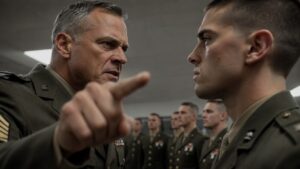
The Young Soldier Blocked An Old Man At The Gate Built From His Final Command
Chapter 1: The Old Man At The Lowered Barrier
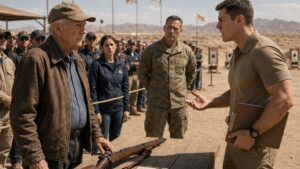
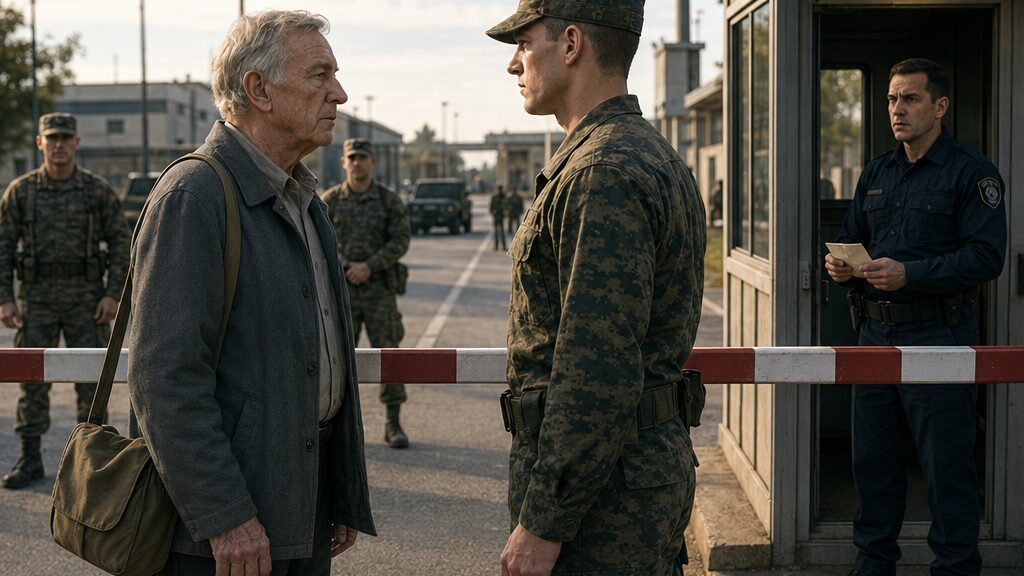
The red-and-white barrier arm came down inches from William Campbell’s chest.
It did not strike him. It did not need to. It stopped with a mechanical clack that sounded louder than it should have in the clean morning air, the painted metal trembling once before settling between him and the road into the base.
William stood still.
Behind the barrier, the road curved past a guard booth, a line of trimmed grass, and a row of flags hanging almost motionless in the heat. Beyond that, the low buildings of the base rose with the same beige walls and hard angles he remembered from decades ago, though the gatehouse was newer and the cameras were smaller. A sign near the entrance announced a memorial dedication that afternoon. The words were polished, official, and temporary, mounted on a frame that would be gone by sunset.
William’s left hand rested on the barrier arm. His fingers were thin now, the veins raised beneath spotted skin, but his grip was steady. In his right hand he held a folded paper invitation, softened at the creases from being opened and closed too many times during the ride over.
The young soldier stepped out from the shade of the booth.
He was tall, narrow through the shoulders, with a clipped haircut and a face still too new to the authority he carried. His camouflage uniform was sharp, his sleeves clean, his name tape flat across his chest: Miller. His eyes moved over William’s plain gray coat, worn shoes, old wristwatch, and the small canvas bag hanging from his shoulder.
“Sir, you need to step back from the barrier.”
William took one careful step back. “I’m here for the dedication.”
The soldier held out his hand, not quite rudely, but without warmth. William gave him the invitation.
Jason Miller unfolded it with two fingers, as if old paper might leave dust on him. His eyes moved across the printed seal, the event title, the date, and then the handwritten name near the bottom. He glanced toward the sign by the road, then back at William.
“This is not a visitor pass.”
“It came with the pass.”
“Then where is it?”
William touched the inside pocket of his coat. The motion was slow because his shoulder hurt in the mornings. He found the small plastic sleeve that had been mailed with the invitation and handed it over.
Jason scanned the card with a handheld device. It gave a dull sound, neither approval nor denial. He frowned and tried again.
“Expired format,” he said.
“It was sent last month.”
“This barcode is not reading.”
A car idled behind William, then another. A delivery van eased into the lane and stopped. Somewhere near the booth, a radio clicked and muttered. William could feel the attention gathering behind him before he saw it. People always looked when a line stopped. They looked first at the obstacle, then at the person who seemed to be causing it.
Jason lifted the invitation again. “William Campbell?”
“Yes.”
“You military?”
William looked past the soldier, down the base road, toward the place where the old gate used to stand before they rebuilt the entrance. He could see it if he let the morning blur a little: the older posts, the sand-colored wall, the floodlight that used to buzz at night. For a moment, the present thinned, and another morning pressed beneath it.
Then he blinked once. “A long time ago.”
Jason’s mouth tightened. “Branch?”
“Army.”
“Rank?”
William looked at the lowered barrier, at his own hand still resting near the painted stripe.
“Retired,” he said.
Jason waited. When no more came, he gave a short laugh through his nose, not amusement exactly, more disbelief dressed as patience. “Sir, everybody at this event is retired something. That doesn’t get you through the gate.”
“I understand.”
“Do you?”
William turned his eyes back to him.
Jason seemed to take that calm as resistance. He stepped closer, lowering his voice in a way that made nearby people listen harder. “This is a restricted military installation. You can’t just show up with an old piece of paper and expect us to wave you in.”
“I did not expect to be waved in.”
“Then what did you expect?”
William folded his empty hand behind his back. The gesture came from old habit, from years of standing while others spoke too much, from learning that silence could keep a room from catching fire.
“I expected the name to be checked.”
Jason looked at the invitation again. “I checked it.”
“You scanned it.”
That was the first moment the young man’s face changed. Not much. Just enough. A small hardening near the jaw, a little rise of color along the neck. William saw it and felt a weary disappointment, not anger. Men in uniform sometimes mistook correction for humiliation. He had seen it at every level.
A second uniformed man stood just inside the booth doorway. Dark navy work uniform, security patch, hands resting near his belt. He had been watching quietly, eyes moving between William and Jason. He was younger than William by decades, older than Jason by enough to know when a situation was bending the wrong way.
Jason turned slightly toward him. “Sergeant Davis, run it again inside.”
The man stepped forward. “I can take a look.”
Jason did not hand him the invitation yet. “No need to make this bigger than it is.”
William noticed that. He noticed everything now because noticing had become slower, sharper. The soldier did not want help. He wanted confirmation.
The cars behind him shifted. A window rolled down. Someone sighed loudly enough to be heard. A pair of younger recruits came walking along the sidewalk outside the gate, slowing as they saw the old man blocked at the arm.
Jason noticed them too.
“Sir, I’m going to ask you one more time to move out of the entry lane.”
William looked to the side. There was a narrow patch of concrete near the guard booth, just wide enough for someone to stand and be seen by everyone entering. A place for inconvenience.
“I will stand there if you check the name properly.”
Jason’s brows lifted. “That’s not how this works.”
“It should be.”
The words were quiet. They seemed to bother Jason more than if William had shouted.
The soldier stepped closer until the brim of his patrol cap cast a shadow across William’s coat. “You don’t decide how my gate works.”
William felt the old reflex in his body: to straighten fully, to let command enter the voice, to make the air around him change. It was still there, buried under age, grief, and the stubborn ache in his knees. He could have used it. He could have given his full name with the title in front of it and watched this young man’s face rearrange itself.
Instead, he looked at Jason’s name tape.
“Miller,” he said, softly.
Jason blinked.
“A gate is not yours because you stand at it.”
The recruits had stopped pretending not to watch. The delivery driver leaned slightly over his steering wheel. From the booth, Samuel Davis took half a step forward.
Jason’s cheeks colored. “Sir, I don’t know who you think you are, but standing here giving lessons isn’t helping your case.”
“I am not making a case.”
“Then what are you doing?”
William lifted the invitation with two fingers after Jason finally thrust it back at him. The paper shook once in the small wind from the idling vehicles, but his hand did not.
“I came because I was invited.”
Jason looked over William’s shoulder at the waiting line. “You came with bad paperwork.”
“Perhaps.”
“You came without a proper digital pass.”
“Apparently.”
“And now you’re refusing a direct instruction at a military gate.”
William’s eyes lowered to the barrier arm. Red. White. Red. White. Paint over metal. A simple device built to decide who moved forward and who remained outside. He remembered a different arm at a different gate being lifted by a shaking private after a night of sirens. He remembered the headlights of evac trucks, faces pressed to canvas, a voice on the radio asking for permission that no one wanted to give.
“I have waited in worse places,” he said.
Jason did not know what to do with that. So he mistook it for mockery.
“Step aside,” he snapped.
The command struck the air. Not loud enough to be formal, too loud to be private.
William felt the eyes on him fully now. The recruits. The driver. The second guard. The people in the cars. He felt, too, the familiar burn of being reduced to what showed: old coat, slow movements, outdated paper, no visible rank. Once, rooms had paused when he entered. He had never liked that pause. Now there was a different kind, uglier and more honest.
He moved to the side of the lane.
Not because Jason had earned obedience. Because the line behind him had not earned delay.
Jason followed close enough to keep control of the moment. “You can wait here until we determine what to do with you.”
William turned.
There was a slight tightening in Jason’s expression, the surprise of a man who expected shame and found steadiness.
“You can check the name again,” William said.
Jason stared at him.
Samuel Davis reached out at last. “Let me see the invitation.”
Jason hesitated.
“It’s procedure,” Samuel added.
That word did what courtesy had not. Jason handed it over.
Samuel unfolded the paper carefully, more carefully than Jason had. William watched the sergeant’s eyes move down the page. The event seal. The date. The printed unit motto faint along the bottom edge. The name.
William Campbell.
Samuel’s fingers stopped at the crease.
The morning noise continued around them: engines idling, radio static, a flag rope tapping metal somewhere above the booth. But Samuel had gone very still.
Jason noticed. “What?”
Samuel did not answer at once.
His eyes lifted from the invitation to William’s face, and something uncertain passed through them—recognition not yet trusted, memory not yet proof.
“Sir,” Samuel said, but his voice had changed.
Jason looked between them, irritated. “What is it?”
Samuel stared at the name again.
Then he stopped moving entirely.
Chapter 2: The Guard Who Remembered The Name
Samuel Davis had heard the name Campbell at a kitchen table long before he heard it at the gate.
His grandfather used to say it only when the house had gone quiet. Not during holidays, not when neighbors came by, not when anyone asked simple questions about old deployments and expected simple answers. The name came out late, usually after the old man had turned off the television and sat with both hands around a coffee mug he had stopped drinking from.
Campbell held the line, his grandfather had said once.
Samuel had been twelve then, too young to understand what kind of line could need holding by one man, too old to forget the way his grandfather looked when he said it.
Now the name sat under Samuel’s thumb on a folded invitation at the front gate, and an elderly man in a plain coat stood three feet away with his eyes on the lowered barrier.
Samuel looked for the first name again.
William.
Not proof. Not enough. There were many Campbells. William Campbell was not rare enough to stop a checkpoint over. But the bottom edge of the invitation carried a faded motto from the old unit crest, printed like decoration, easy to ignore unless a person had grown up hearing it spoken in a gravelly voice.
Hold until dawn.
Samuel swallowed.
Jason stood beside him, tense and impatient. “Well?”
“I need to run this inside.”
“You already heard me. The scanner rejected it.”
“The scanner rejected the barcode. Not the name.”
Jason gave a quick glance toward William, as if the old man might enjoy that distinction. William showed no sign of hearing it. He had taken one step farther from the lane so the delivery van could ease forward into the inspection space. His posture was careful but not weak, one hand holding the canvas bag strap, the other at his side.
Jason lowered his voice. “Davis, we have a blocked lane, VIP movement starting in less than an hour, and a paper invite that doesn’t scan. Don’t turn this into a project.”
Samuel looked through the booth window. The access terminal waited under fluorescent light, its screen open to the visitor log. “It takes thirty seconds.”
“It took thirty seconds outside.”
“Then it won’t hurt to take thirty more.”
Jason’s eyes narrowed. He outranked Samuel on the gate detail for the morning, and both of them knew it. Not by much, but enough for a young man to hold it like a shield.
“Fine,” Jason said. “Run it. Then we move him off the approach.”
Samuel stepped into the booth.
The air inside was cold from the old wall unit humming above the cabinet. It smelled of paper, plastic, and coffee that had been reheated too many times. He set the invitation beneath the desk lamp and smoothed the crease with two fingers.
William Campbell.
He typed the name into the visitor system.
No current record.
He tried again with the event code printed under the seal.
No matching visitor credential.
Jason leaned through the doorway. “Satisfied?”
Samuel ignored him and opened the ceremony access roster. The file loaded slowly, a spinning icon pulsing on the screen. Outside, he could see William through the glass, waiting in the sun. The old man had moved only enough to give others room. He did not check his watch. He did not peer into the booth. He did not try to catch Samuel’s eye.
That unsettled Samuel more than anger would have.
Most people denied entry argued because they wanted something. This man seemed to be measuring whether the place he had come to still remembered how to listen.
The roster opened.
Samuel searched Campbell.
Nothing.
Jason tapped the doorframe. “There.”
“Wait.”
“Davis.”
Samuel clicked into the attachment list. A public affairs aide had uploaded a revised VIP sheet that morning. Another file sat beneath it, older, labeled supplemental invitees. He opened it.
Names appeared in a narrow column. Some had rank. Some had family designations. Some had only initials and notes. He searched again.
Campbell.
The cursor jumped to a line near the bottom.
W. Campbell — mailed hard copy — legacy invite — verify through archive if required.
Samuel read it twice.
Jason’s impatience shifted into something sharper. “What does that mean?”
“It means he’s on a supplemental list.”
“Legacy invite?” Jason said. “That could mean anything.”
“It means he was invited.”
“It means somebody forgot to update the pass.”
Samuel looked back at the paper. “Maybe.”
Jason stepped fully into the booth now. “Then we handle it by protocol. No scan, no entry until command approves. He waits outside.”
“He is already waiting outside.”
“That’s what I said.”
“No,” Samuel said, quieter. “You said it like he was a problem.”
Jason’s face tightened. For a second, Samuel thought he had gone too far. But he kept his eyes on the screen.
He opened the base directory archive portal. It was not the system they used for normal visitors. Gate personnel rarely needed it. The login took his credentials, then made him confirm twice. A warning appeared about restricted historical records.
Jason let out a breath. “You’re digging through archives because an old man has a familiar last name?”
Samuel did not answer.
He typed William Campbell again.
The screen paused.
Outside, a group of soldiers approached the checkpoint on foot, slowing as Jason had done earlier. They looked toward William, then toward the booth. The old man became the center of the gate without asking for it. Samuel saw him glance briefly at the soldiers, not with embarrassment, but with a grave patience that made the scene feel smaller than it was.
The archive returned several entries.
Most were not accessible from the gate terminal. Some listed only initials, dates, command categories. One line stood out, grayed but visible:
Campbell, William A. — command-level record — archived clearance.
Samuel clicked it.
A red box opened.
RECORD ARCHIVED — COMMAND-LEVEL CLEARANCE REQUIRED.
He sat back.
Jason read it over his shoulder and frowned. “What the hell is command-level clearance doing on a visitor search?”
Samuel felt a chill move through him despite the cold air already blowing from the unit.
“I don’t know.”
“That could be a false hit.”
“It could.”
“But you don’t think it is.”
Samuel looked again at the invitation. Hold until dawn. His grandfather’s hands around the mug. His grandfather’s voice saying, They told us nobody was coming through that road. Campbell said roads don’t vote. Men do.
He had never understood the line. Not fully.
Jason shifted behind him, suddenly less eager to dismiss the screen but unwilling to admit it. “Call the event desk.”
Samuel picked up the phone mounted near the terminal.
Before dialing, he looked through the glass again. William had lowered himself onto the edge of a concrete planter near the booth, not quite sitting, not quite standing. His coat hung loose from his shoulders. His shoes were polished but old. The folded invitation was no longer in his hand; Samuel had it under the lamp, as if the man had surrendered the only proof he had and chosen to trust the people who had already failed him.
The phone rang four times.
A public affairs aide answered, breathless, with ceremony noise behind them.
“Gate One,” Samuel said. “I need verification on a supplemental invitee. William Campbell.”
There was a pause. Paper shuffled. Voices murmured away from the receiver.
“Campbell?” the aide said. “I don’t see him on the main sheet.”
“He’s on supplemental. Legacy invite.”
Another pause. “If he doesn’t have a scannable credential, hold him until after VIP movement. We’re swamped in here.”
Samuel closed his eyes for half a second. “The archive flags command-level clearance.”
“What?”
“That is what the system says.”
The aide’s tone changed. Not respect yet. Alarm. “Send that to Archives. Kathleen Moore is in the prep area. She handles historical verification.”
“How long?”
“We’re twenty minutes from rehearsal.”
“How long?” Samuel repeated.
“I don’t know. Send it now.”
The line clicked dead.
Jason folded his arms. “So he waits.”
Samuel set down the phone. “He waits because we don’t know enough. Not because he doesn’t matter.”
Jason looked toward the window. William had risen again. A vehicle with tinted windows approached the gate from the outer road and stopped behind the delivery van. A driver looked annoyed. A passenger in dress uniform checked a phone.
The gate was becoming exactly what Jason feared: visible, delayed, untidy.
Jason walked out first.
Samuel followed with the invitation, holding it flat now, no longer folded small. William turned toward them. He did not ask what they had found.
Jason spoke before Samuel could. “There’s an issue with your record.”
William nodded once.
“You’ll have to remain outside the secure line until verification.”
“I understand.”
Jason seemed annoyed that the old man offered him no resistance to push against. “This could take a while.”
William looked toward the sign announcing the memorial dedication. “I have time.”
Samuel heard something in that sentence. Not patience. Cost.
He stepped closer. “Mr. Campbell, may I ask who sent you this invitation?”
William’s eyes moved to him.
For the first time, Samuel felt the full attention of the old man. It was not harsh. It did not demand anything. But it settled on him with weight.
“The base did,” William said.
“Yes, sir. I mean, do you know which office?”
William looked at the booth, at Jason, at the line of vehicles, then back at Samuel. “A woman from the archive called three weeks ago. She said there was to be a dedication.”
“Kathleen Moore?”
“I believe so.”
Samuel’s grip tightened on the invitation.
Jason caught it. “You know her?”
“I know the name,” Samuel said.
Jason looked irritated again, but there was a crack of uncertainty in it now.
Samuel lowered his voice. “Mr. Campbell, there’s a motto on this invitation.”
William’s expression changed so slightly that Jason might not have seen it. Samuel did. A flicker behind the eyes, a door touched but not opened.
“Is there?” William asked.
“Hold until dawn.”
For a moment, the checkpoint seemed to fall away from the old man’s face. Samuel saw not surprise, but recognition carried like an old injury.
“Yes,” William said.
“My grandfather used to say that.”
William looked at Samuel’s name tape.
“Davis,” he said.
Samuel’s throat tightened. “Yes, sir.”
William did not ask the first name. He did not need to. Or perhaps he would not use memory as a tool until he had to.
“Many good men said it,” William replied.
Jason shifted, impatient with a conversation he did not understand. “Sergeant Davis, inside.”
Samuel looked once more at the old man, then at the barrier arm, still lowered in front of the road.
“Yes,” he said. “Inside.”
He returned to the booth and opened the archive request form. Under reason for access, he typed: Event verification. Possible legacy invitee at Gate One.
The system asked for the name again.
Samuel entered William Campbell.
This time a second warning appeared beneath the first:
RECORD ARCHIVED — COMMAND-LEVEL CLEARANCE.
Jason stared at the screen.
Neither of them spoke.
Chapter 3: The Ceremony That Forgot Its Guest
Kathleen Moore had corrected the memorial program seven times before noon, and each correction made the ceremony feel less true.
A comma after a unit designation. A retired rank placed before a donor’s name. A family representative moved from row three to row two because someone from public affairs had decided cameras would catch tears better there. The printed cards lay across the long table backstage in neat white stacks, each one bearing the dedication title in raised navy lettering.
GATE OF DAWN MEMORIAL DEDICATION.
Kathleen ran her thumb along the edge of the top card until it caught on a tiny flaw in the paper. She had argued against the title when they first proposed it. Not because it was wrong. Because it was too clean.
The old phrase had not been born under a banner or on a polished sign. It had come from a night of smoke, bad roads, broken radios, and people waiting for permission that did not arrive in time. History, once prepared for ceremony, tended to lose the smell of fear.
A public affairs aide hurried past with a box of ribbon. “They need the updated guest sheet at the lectern.”
“It’s on the clipboard.”
“The commander wants the VIP pronunciation list too.”
Kathleen lifted another folder from the table. “Here.”
The aide took it, then stopped. “There’s a gate delay.”
Kathleen did not look up. “Which gate?”
“Main.”
“That is unfortunate.”
“Some elderly civilian with an old invitation. Barcode won’t read.”
Kathleen’s hand paused over the program stack.
The aide kept talking. “Security is holding him. Sergeant Davis called asking about a supplemental name.”
“What name?”
“I don’t remember. Something common. They said legacy invite.” The aide shifted the ribbon box against one hip. “If you get a request from Gate One, can you just clear it fast? Rehearsal starts soon.”
Kathleen set the program down carefully. “What name?”
The aide frowned, thinking. “Campbell, maybe?”
The room seemed to lower around her.
Noise continued. Folding chairs scraped across the auditorium floor beyond the curtain. Someone tested a microphone and produced a short shriek of feedback. Two soldiers carried a framed enlargement of an old base photograph toward the front display. People moved with the intense, nervous energy of ceremonies that had been planned for months and still felt unready.
Kathleen heard only the name.
“William Campbell?” she asked.
The aide blinked. “Maybe. Is he on your list?”
Kathleen reached for the clipboard.
The main VIP list was clipped to the top, clean and current, sorted by row and protocol priority. Paul Taylor. Visiting command staff. Unit representatives. Families. Donors. Former officers whose titles had been checked and double-checked.
No Campbell.
She turned to the supplemental sheet beneath it. That list had been assembled from older correspondence, historical files, and invitations mailed before public affairs took over the final guest management. She had asked for it to be merged three days ago. Someone had told her it had been done.
Her eyes moved down the page.
W. Campbell — hard copy mailed — legacy invite — verify through archive if required.
Kathleen’s mouth went dry.
“Where is he now?”
“Gate One, I guess.”
“Still outside?”
“That’s what they said.”
Kathleen looked toward the auditorium doors. The framed photograph the soldiers had carried was now being propped near the stage, still covered with protective paper. It was one of several display images chosen for the dedication: the old gate in black and white, the first barracks, a convoy line in dawn light, a group of young soldiers standing beneath the original barrier arm.
And one command photograph, cropped carefully because the original had been damaged.
Kathleen had not looked at it closely in two weeks. She had looked at file labels, captions, dates, dimensions, approval stamps. She had not sat with the faces. That was how mistakes entered ceremonies: not through carelessness exactly, but through busyness wearing the mask of duty.
“Tell Gate One to hold respectfully,” she said.
The aide’s face tightened. “Respectfully?”
Kathleen was already moving. “Exactly that word.”
She crossed the backstage area, past the folded flags, past the brass stanchions, past a row of chairs reserved for guests whose importance had been measured in font size and seating order. At the side table, she lifted the protective paper from the framed command photograph.
There he was.
Not old. Not thin. Not in a gray coat.
A younger William Campbell stood near the original gate, shoulders squared beneath a field jacket, one hand holding a folded map, the other resting on a barrier arm painted in the same red-and-white stripes. Around him were men whose faces held the exhaustion of a long night. Behind them, vehicles waited nose to tail along a road wet with early light.
The caption beneath the image read:
Command Group At East Gate After Dawn Evacuation, Year Classified In Original Record.
Kathleen leaned closer.
The photograph had been selected because it showed the gate. Because the ceremony was about the gate. Because the modern entrance had been built over the old approach road, and the dedication committee wanted a visual bridge between past and present.
No one had asked whether the man in the photograph had been invited.
Kathleen felt heat rise behind her eyes, and she hated herself a little for it. Archives were supposed to prevent this. Records existed so memory would not depend on who looked impressive in a current suit or who had staff to answer emails.
She hurried back to the table and opened her laptop.
The archive portal demanded her credentials, then her second verification. She searched William Campbell. The record appeared in restricted format, more complete than what a gate terminal would show.
Campbell, William A.
Former commanding general.
Operational file sealed in part.
Associated event: Dawn Evacuation / East Gate command decision.
Related memorial infrastructure: Gate of Dawn dedication.
Kathleen exhaled slowly.
The ceremony, with its polished title and raised lettering, was not merely connected to him. It was built around the event he had commanded.
And he was outside.
She opened the guest program file, scanned the honored acknowledgments, and found language that made her stomach sink.
In recognition of the commanders, soldiers, and families whose courage held the gate until dawn.
Commanders. Plural. Safe, vague, ceremonial. No living burden attached.
She picked up the phone and called the gate.
Samuel Davis answered on the second ring.
“This is Kathleen Moore in Archives,” she said. “Is William Campbell still at Gate One?”
“Yes, ma’am.”
“How is he being treated?”
There was a pause.
That pause told her enough.
Samuel’s voice came back lower. “He is waiting outside the secure line.”
Kathleen closed her eyes. “Put no further pressure on him. Do not send him away. I’m verifying now.”
“Ma’am, the gate officer wants command approval.”
“He will have it.”
“Is he who I think he might be?”
Kathleen looked at the photograph again, at the younger man’s hand on the old barrier arm.
“He is more than the list says,” she replied.
Samuel was silent for one breath. “Understood.”
After she hung up, Kathleen pulled the physical archive box from the rolling cart beneath the display table. It had been brought over that morning for the historical exhibit, sealed with a temporary tag and her initials.
Inside were copies, not originals: declassified summaries, unit photographs, ceremony captions, casualty abstracts with blacked-out sections, and a folded reproduction of the order that had given the memorial its name.
The order was short. The kind written when there had been no room for elegance.
Hold east gate until civilian road clears. No withdrawal before dawn unless ordered by command. Campbell assumes responsibility.
Kathleen read the last sentence twice.
Assumes responsibility.
That was not a phrase men wrote casually.
A shadow fell across the table. Paul Taylor stood at the edge of the prep area in dress uniform, his face composed but tight with the strain of a ceremony already sliding off schedule.
“Moore,” he said. “I hear we have a gate problem.”
She looked up.
“We have a guest problem,” she said.
Paul glanced at the program stacks. “Meaning?”
Kathleen turned the photograph toward him.
He looked down, polite at first, then still.
“That’s Campbell?” he asked.
“Yes.”
“The Campbell?”
“Yes.”
Paul’s jaw worked once. “Why isn’t he on my main list?”
“Because he was on the supplemental sheet that was supposed to be merged.”
“Who missed it?”
Kathleen did not answer immediately. The question was natural. It was also too small.
“We all did,” she said.
Paul looked at her.
She laid the command order beside the photograph. “And there may be another omission.”
His eyes dropped to the page. “What kind?”
Kathleen reached back into the file box. Beneath the reproduction order was an older memorial draft, yellowed at the edges, marked COPY in red. Most of the names were cleanly typed. One line near the bottom had been crossed through in dark pencil, not erased, not explained.
She unfolded it fully.
Paul leaned closer.
The crossed-out name sat beneath William Campbell’s command signature, heavy and silent.
Kathleen looked toward the covered display, the neat chairs, the polished cards, the ceremony that had almost begun without the man at its center.
Then she looked back at the photograph.
A younger William stood beside the old gate with his hand on the barrier, not smiling, not triumphant. Just awake after a night no caption could carry.
Outside, at the modern checkpoint, an old man waited in the sun.
Chapter 4: The Officer Who Mistook Procedure For Honor
Jason Miller had been warned that the main gate was where mistakes became visible.
On his first morning assigned there, a senior noncommissioned officer had pointed at the road, the booth, the cameras, the barrier arm, and the sign that told civilians where to stop. Then he had said, “Every person who comes through here thinks their reason matters more than your procedure. Your job is to make sure procedure wins.”
Jason had liked that. It made the gate simple. It made him simple. He had spent the last six months feeling as if everyone on the base saw the newness on him before they saw the uniform. Too young for the responsibility. Too stiff. Too eager. Too worried about putting one foot wrong in front of people who knew how long he had been here.
At the gate, the rules were painted on the pavement.
Stop.
Show ID.
Wait.
Proceed only when directed.
The old man had done the first three and somehow still made Jason feel as if control were slipping.
Now William Campbell stood beside the concrete planter in the heat, the folded invitation gone into the booth, his canvas bag hanging from one shoulder. He was not complaining. That should have made the situation easier. Instead, his quietness seemed to press against everything Jason said.
A black SUV rolled to the checkpoint and stopped. Jason lifted a hand to hold it. The driver lowered the window and showed credentials. Jason checked them, scanned the badge, waved the SUV forward through the side lane. While it passed, the passenger in dress uniform looked toward William, then toward Jason, then away.
That glance stung.
Jason turned back to the booth. Samuel Davis was still at the terminal, one hand on the desk, reading something on the screen. He had that careful look people wore when they knew a piece of information and had not decided how dangerous it was.
Jason stepped inside. “What now?”
Samuel did not turn. “Archive request is pending.”
“Pending where?”
“Archives.”
“We don’t need Archives to tell us whether a visitor pass scans.”
“No, but we may need Archives to tell us why his record is restricted.”
Jason let out a short breath. “Restricted does not mean important. It means old. It means messy. Half these legacy files are bad data.”
Samuel finally looked at him. “Then why are you so mad at the data?”
The words hit too cleanly.
Jason glanced toward the window, toward William waiting outside. “Because while you chase ghosts, I have vehicles stacking up and a ceremony clock running.”
“Then send another lane active.”
“I did.”
“Then the gate is functioning.”
Jason lowered his voice. “You are undermining me in front of a civilian.”
Samuel’s expression did not change. “No. I am checking the name you refused to check.”
For a moment Jason saw himself from outside his own body: standing in the narrow booth, jaw tight, sleeves sharp, arguing over an old man who had not raised his voice once. He did not like the picture. It made him feel small, and feeling small made him reach harder for the authority he had.
“He can wait,” Jason said.
“He is waiting.”
“Outside the line.”
“Yes.”
“Then we’re done until command says otherwise.”
Samuel looked toward the screen again. “Command may already care.”
Jason followed his eyes.
The message remained on the terminal: RECORD ARCHIVED — COMMAND-LEVEL CLEARANCE REQUIRED.
Command-level.
The phrase sat there like a challenge. Jason hated the way it changed the air. He hated that Samuel had seen it first. He hated, most of all, the part of himself that wondered whether the old man outside had watched him build a mistake one sentence at a time.
He walked back out before that thought could settle.
William turned slightly as Jason approached.
“Mr. Campbell,” Jason said, more formal now, because formality was a wall too, “we are still verifying your invitation.”
“Thank you.”
“You will need to remain here until that is complete.”
“I will.”
Jason waited for the argument. None came.
A pair of younger recruits crossed near the sidewalk, glancing at William again. One slowed too much. Jason snapped, “Keep moving.”
They did.
William watched them go. “They are curious.”
“They have duties.”
“Yes,” William said. “Curiosity can interfere with duty. So can pride.”
Jason’s face warmed. “Is that supposed to mean something?”
William looked at him with tired eyes. “Only if it does.”
The old man’s calm was not passive. Jason understood that now. It was controlled. Measured. The kind of calm that did not need permission. It made Jason feel as if he were the one being inspected.
He stepped closer. “You have made your point.”
William’s brows lifted slightly. “Have I?”
“You think I’m being disrespectful.”
“I think you are being careless.”
The word struck harder than disrespectful would have.
Jason’s hands tightened at his sides. “Careless is letting someone through a secure gate because they look harmless.”
“Agreed.”
“Careless is accepting old paper because someone says it was mailed.”
“Agreed.”
“Careless is allowing emotion to override procedure.”
William nodded. “Also agreed.”
That stopped him.
The idling vehicles hummed. The barrier remained down, red and white across the lane. Jason looked at it because it was easier than looking at the old man.
William continued, softly. “But procedure begins with seeing the person in front of you clearly. If you start with contempt, every rule after that bends.”
Jason stared at him.
There it was again—the sentence that sounded less like an argument than a correction made in a room full of officers. Jason felt the sharp impulse to ask the question outright. Who are you? He swallowed it. Asking would admit that he had begun to doubt his own assumption.
A radio clipped to his vest crackled. Samuel’s voice came through.
“Miller, Gate One.”
Jason pressed the button. “Go.”
“Command line is calling.”
“About what?”
A pause.
“Campbell.”
Jason looked through the booth glass. Samuel had the phone in one hand and was staring out at him.
Jason walked back inside, slower this time.
The gate booth felt smaller. The fluorescent light seemed harsher. Samuel held the receiver out but covered the mouthpiece with his palm.
“It’s from the command office,” he said.
Jason took the phone. “Gate One, Miller.”
A controlled male voice answered. “This is the base commander’s office. We received an archive alert tied to a William Campbell at your gate.”
Jason straightened automatically. “Yes, sir. Visitor credential failed scan. We’re holding him outside secure access pending verification.”
“Is he alone?”
Jason looked through the glass. William stood near the planter with his coat buttoned despite the heat. “Yes, sir.”
“Condition?”
“Sir?”
“His condition. Is he standing? Seated? Does he require assistance?”
Jason felt Samuel’s eyes on him.
“He appears stable, sir.”
“Appears?”
Jason swallowed. “He is standing.”
Another pause. “Do not dismiss him. Do not remove him. Do not escalate contact. Commander Taylor is being notified.”
Jason’s grip on the receiver tightened. “Understood.”
The voice lowered by a fraction. “And, Miller?”
“Yes, sir?”
“Until we know exactly what is happening, remember that old paper sometimes outlasts new systems.”
The line clicked.
Jason set the receiver down carefully.
Samuel said nothing. That made it worse.
Outside, the barrier arm remained lowered across the road, and beyond it the base waited in full view. Jason had wanted the gate to prove he was disciplined. Instead, it had become a stage on which every hesitation showed.
He stepped out again.
William looked at him, not expectant, not triumphant.
Jason cleared his throat. “Command is reviewing your record.”
“I see.”
“They asked that you remain here.”
William nodded.
The answer was too generous. It left Jason nowhere to place his embarrassment. He wanted the old man to smirk or scold or demand an apology so he could resist. But William only stood there as if the young soldier’s discomfort belonged to the young soldier.
A staff vehicle approached from inside the base and stopped near the booth. A uniformed driver stepped out and spoke briefly to Samuel. More soldiers gathered at a distance now, their attention no longer casual. The word had moved somehow. It always did.
Jason forced himself to face the lane, but his thoughts kept circling the same question.
If William Campbell was no one, why had command called?
If he was someone, why had he stood in the sun and let Jason speak to him that way?
The booth phone rang again.
Samuel answered. His posture changed almost immediately.
Jason turned.
Samuel listened, then looked through the glass at William. His face had gone pale with recognition not yet spoken aloud.
“Yes, sir,” Samuel said into the phone. “He is still here.”
He listened again.
Then his eyes moved to Jason.
“Understood, sir.”
Samuel hung up.
Jason waited.
Samuel opened the booth door and stepped outside. He did not speak to Jason first. He looked at William.
“Mr. Campbell,” he said carefully, “Commander Taylor is on his way to the gate.”
William closed his eyes for half a breath.
When he opened them, he looked not relieved, but saddened.
Jason heard another vehicle approaching fast from inside the base.
Samuel turned to him then.
“The commander asked why General Campbell has not arrived.”
Chapter 5: The Photograph On The Archive Wall
Kathleen Moore carried the old photograph like something fragile enough to accuse everyone in the building.
The frame was heavier than it looked. Its glass caught the hallway lights as she moved, flashing the past in pieces: a wet road, a line of vehicles, a younger man’s hand on a striped barrier, soldiers standing with the stunned expressions of people who had made it through a night and did not yet know what it had cost.
Samuel walked beside her with the copied command order in a folder. He had come from the gate with dust on his boots and worry held tight in his jaw. He had not said much after reaching the archive room. He had looked at the photograph once, then looked away, as if staring too long would feel like trespass.
Paul Taylor moved ahead of them, phone at his ear, voice low and clipped. “Hold the ceremony start. No announcement yet. Keep guests seated. Do not improvise a reason.”
He ended the call and turned back. “Show me the file again.”
Kathleen stopped beneath the archive wall. There, under glass, were decades of base history arranged in a timeline: construction, deployments, storms survived, units activated and deactivated, names engraved when the institution chose to remember them. Near the center was a blank space where the new dedication plaque would be added after the ceremony.
Kathleen set the frame on a long cabinet.
“This is the command group photograph selected for today’s display,” she said. “The caption identifies the event but not all individuals. The central officer is William A. Campbell.”
Paul leaned in, studying the younger face. “I’ve seen this image in briefings.”
“Everyone has,” Kathleen said. “Usually cropped.”
Samuel opened the folder and laid out the copied order. The page looked plain, almost brutally plain. No ornament, no ceremonial language, just typed lines and signatures reproduced from an original that remained sealed elsewhere.
Paul read silently.
Kathleen watched his eyes reach the final line.
Campbell assumes responsibility.
He looked up. “This order is why the gate is named what it is.”
“Yes.”
“And he is standing outside that gate.”
“Yes.”
Paul’s face tightened. It was not anger yet. It was the discipline required not to waste time on anger before fixing the damage.
“Why was he not flagged as honored guest?”
Kathleen could have said public affairs failed to merge the lists. She could have said the supplemental sheet was mislabeled. She could have said the archive invitation went out late because the committee only approved legacy outreach after the final print deadline. All those things were true.
Instead, she touched the edge of the photograph.
“Because everyone assumed the past had already been handled.”
The hallway was quiet around them. Behind the auditorium doors, ceremony noise came muffled: chairs, footsteps, the low roll of voices.
Samuel cleared his throat. “Sir, there’s more.”
Paul turned.
Kathleen took the older memorial draft from the folder. The paper was a copy of a copy, its corners rounded with age despite the red reproduction mark. She unfolded it under the hallway light.
“These are the original proposed memorial names tied to the Dawn Evacuation,” she said. “Most match today’s plaque.”
“Most?”
She pointed to the bottom of the page.
The crossed-out line sat heavy beneath the others. The name had not been erased. Someone had drawn a dark pencil stroke through it, then another, as if one line had not been enough to make the person disappear.
Paul read the name silently.
Samuel read it too, then looked at Kathleen. “Why is it crossed out?”
“The file note says pending casualty classification.”
“Meaning?”
Kathleen hesitated. “Meaning the death occurred inside an operational window that remained partly sealed. The family may have received notice without the full circumstances.”
Paul’s voice was flat. “Was that unusual?”
“In that period? No. Was it right? That is another question.”
Samuel looked back toward the direction of the gate. “Is this why he came?”
Kathleen thought of William standing outside in the sun with no staff, no escort, no anger. “I think it may be.”
Paul picked up the order again. “Can we confirm his connection to the crossed-out name?”
“I found a linked casualty abstract.” Kathleen pulled another page from the folder. “The full file is restricted, but this summary names Campbell as the approving commander for the evacuation sequence and post-event casualty review.”
Samuel read over her shoulder. His face shifted.
“My grandfather said they were told the east road was lost,” he said quietly.
Kathleen looked at him.
“He said Campbell held it anyway.”
Paul glanced at Samuel. “Your grandfather served in the operation?”
“Yes, sir. He did not talk about it often.”
“Did he mention Campbell?”
Samuel let out a small breath. “He said the name like a prayer he didn’t believe he deserved.”
No one answered that.
Kathleen’s phone buzzed on the cabinet. A message from public affairs: Guests asking about delay. Need updated start time.
She ignored it.
Paul took the photograph into both hands. He had the look of a commander watching a ceremonial problem become a moral one. The schedule, the seating, the microphones, the polished cards—all of it had begun to feel like scenery around a missing truth.
“I need enough to confirm him publicly,” he said.
Kathleen nodded. “The photograph. The command order. The archive record. Your office can verify the restricted flag with higher headquarters if needed, but not before the ceremony.”
Paul looked at her. “Is there any doubt?”
“No.”
Samuel’s voice was low. “Sir, at the gate, he never said the rank.”
Paul turned to him.
“Jason asked enough questions that he could have. Mr. Campbell chose not to.”
Kathleen could see Paul understand the shape of it. Not just the error. The restraint. A man with every right to end a humiliation had endured it because using rank that way would have made the rank smaller.
Paul set the photograph down gently. “Where is Jason Miller?”
“At the gate,” Samuel said.
“Does he know?”
“He heard me say General Campbell.”
Paul’s jaw tightened. “Then he knows the first inch of it.”
Kathleen looked again at the crossed-out name. The line through it bothered her more each time she saw it. It was not neat. It looked personal, though she knew that was probably imagination. Records carried the marks of human haste, human fear, human decisions made under fluorescent lights by people who went home afterward.
“Commander,” she said, “if William came because of this name, confirming his rank will not be enough.”
“I know.”
“Do you?”
Paul accepted the question without offense. That made Kathleen respect him more.
“I know enough to ask him,” he said.
His aide appeared at the end of the hallway, breathless. “Sir, the guest families are seated. The veteran family representative is asking whether the dedication is delayed because of security.”
Paul looked toward the auditorium doors. “Tell them we are confirming a historical record.”
The aide nodded and disappeared.
Samuel gathered the copied pages. “Sir, should I return to the gate?”
“Yes. With me.”
Kathleen lifted the photograph again.
Paul noticed. “Bring it.”
They moved together down the corridor. Outside the archive wing, sunlight struck the floor through tall windows. Kathleen could see the modern gate in the distance through a gap between buildings: the booth, the line of vehicles, the bright slash of the barrier arm still down in one lane.
As they walked, she thought of all the ways institutions apologized to the dead while inconveniencing the living. Plaques were easy. Programs were easy. Raised lettering, polished brass, carefully rehearsed remarks. Harder was seeing an old man standing at the gate and understanding that history had arrived without an escort.
Near the exit, Samuel slowed.
Kathleen looked at him. “Sergeant?”
He was staring at the photograph she carried, but not at William.
“My grandfather is in that picture,” he said.
Paul stopped.
Samuel pointed to a young soldier near the edge of the frame, helmet pushed back, face turned away from the camera as if someone had called his name. The image was grainy there, but the posture held something familiar.
Kathleen softened her voice. “Are you sure?”
“No,” Samuel said. “But I know that slouch. He stood like that even old.”
For a moment the archive hallway held all of them in place: the current commander, the records keeper, the gate sergeant, the old photograph, and the unseen man waiting outside.
Then Kathleen turned the page beneath the photograph and saw the back of the copied roster. There were handwritten marks from the original file, notes beside several names, arrows showing vehicle assignments, casualty updates.
At the bottom, near the crossed-out name, someone had written a short instruction in faded pencil:
Notify family when authorized.
No initials. No date.
Kathleen stared at it.
Paul saw her expression. “What?”
She handed him the page.
His eyes moved to the note, then to the crossed-out name.
The silence changed again.
Samuel looked from one to the other. “That family was never told?”
Kathleen answered carefully. “Not fully. Maybe not at all.”
Paul folded the page once, not sharply, just enough to carry it.
“Then General Campbell did not come for the ceremony,” he said.
Kathleen looked out toward the gate.
“No,” she said. “I don’t think he did.”
They stepped into the sun.
In the distance, the red-and-white barrier remained lowered, and beside it William Campbell stood as if he had been waiting much longer than one morning.
Chapter 6: The General Who Would Not Use His Rank
William heard the command vehicle before he turned to see it.
The engine came from inside the base, not from the public road behind him. It approached quickly, then slowed near the booth. Dust lifted from the tires and settled along the curb. The red-and-white barrier arm remained down, casting a striped shadow across the lane.
Jason Miller stood a few steps away from William, rigid now in a different way than before. His authority had not vanished, but it no longer fit him comfortably. Samuel Davis came out of the booth first, followed by a man in dress uniform whose bearing made the gathered soldiers straighten without being told.
William recognized the type before he recognized the face.
Current command always carried its own weather.
Paul Taylor stepped around the front of the vehicle and came directly toward him. Behind him, Kathleen Moore held a framed photograph against her side. Samuel carried a folder. The sight of the photograph reached William before any words did.
He looked away.
Not fast enough.
“Sir,” Paul said.
The single word moved through the checkpoint. It passed from uniform to uniform, from the recruits near the sidewalk to the driver waiting in the SUV, to Jason Miller standing suddenly too close to the mistake he had made.
William did not correct him. He did not accept it either.
“Commander,” he said.
Paul stopped at a respectful distance. He did not salute. Not yet. William appreciated that more than the man could know.
“I’m Paul Taylor,” he said. “I command the installation.”
“I know.”
Paul’s eyes flickered, just slightly. “Then you have me at a disadvantage.”
“No,” William said. “You have a ceremony to begin.”
The words landed heavily. Paul looked toward the barrier, then toward Jason.
“General Campbell—”
William lifted one hand.
The title stopped in the air.
Jason’s face went pale enough that William felt no satisfaction in it. Shame had a way of making young men either better or crueler. He had seen both. He did not yet know which road this one would take.
“Mr. Campbell is sufficient at the gate,” William said.
Paul understood the rebuke beneath the courtesy. “Mr. Campbell, I owe you an apology.”
“No,” William replied.
Paul paused.
William looked past him to the booth, to the cameras, to the soldiers pretending not to stare. “Not first.”
Jason swallowed. The movement was small, but William saw it.
Paul turned slightly. “Miller.”
Jason stepped forward. “Sir.”
His voice had lost its sharp edge. Without it, he sounded very young.
“Mr. Campbell was invited to today’s dedication,” Paul said. “He should have been on the cleared list.”
Jason kept his eyes forward. “Yes, sir.”
“He was not.”
“Yes, sir.”
“That failure was ours before it was yours.”
Jason blinked, surprised by the shared burden.
Paul’s voice hardened. “Your manner after the failure was yours.”
Jason’s jaw tightened once. He turned to William. The words seemed to cost him because he was not yet sure what they were supposed to repair.
“Mr. Campbell, I apologize for how I spoke to you.”
William studied him.
There was fear in the young man’s face now. Fear of punishment. Fear of public embarrassment. Fear that a superior might have seen enough to mark him permanently. William knew those fears. They were common, and none of them were the right beginning.
“Do you?” William asked.
Jason faltered. “Sir?”
“Do you apologize because of how you spoke to me, or because of who you have now been told I am?”
The checkpoint went very quiet.
A flag rope tapped the pole near the booth.
Jason looked at William and had no practiced answer. That was good. Practiced answers were usually for avoiding truth.
“I don’t know,” Jason said at last.
Paul’s head turned slightly toward him. Samuel watched with his hands still around the folder. Kathleen held the photograph more tightly.
William nodded once. “That is better than the wrong answer.”
Jason looked down.
William let the silence sit long enough for the young man to feel it, not long enough to crush him.
“You were right to protect the gate,” William said. “You were wrong to make contempt part of the procedure.”
Jason’s eyes lifted.
“I have seen men use rules as shields because they were afraid of being seen without them,” William continued. “It does not make them evil. It makes them dangerous until they learn the difference.”
The words struck Jason harder than anger would have.
Paul stepped closer. “Mr. Campbell, we verified your record through Archives. The ceremony today should not begin without you.”
William looked at the framed photograph in Kathleen’s hands. “It should not begin falsely either.”
Kathleen moved forward, carefully. “I found the original memorial draft.”
William’s face changed then. Not dramatically. The years had trained his expression to hold under strain. But his left hand moved toward the inside pocket of his coat, where he had carried, since dawn, a folded copy of a letter he had never sent.
Kathleen opened the folder Samuel held and showed him the page.
William did not need to read the whole thing. His eyes found the crossed-out line with the unerring precision of pain long memorized.
For a moment, the gate, the soldiers, the modern booth, and the waiting cars seemed to recede.
He saw the old east road in pieces: headlights smeared by dust, a radio operator shouting over static, the map under his hand, the report that the last vehicle had not cleared, the voice asking whether to abandon the gate before dawn. He remembered the name at the bottom of the list because he had written it too many times afterward in rooms where no one wanted it spoken.
His fingers touched the paper but did not take it.
“You found him,” William said.
Kathleen’s voice was low. “I found the omission. Not the whole truth yet.”
“There is rarely a whole truth left in files.”
Paul watched him carefully. “Is this why you came?”
William looked down the road toward the memorial grounds. Guests would be seated now, waiting under a softened version of history. The gate would be dedicated. Words would be spoken about courage, duty, sacrifice. His name, apparently, would be restored to its place in the ceremony. The institution would correct its embarrassment.
But that was not why he had come.
Three weeks earlier, Kathleen Moore had called him with a formal invitation. She had spoken politely, explaining that the base was dedicating the rebuilt gate in honor of the Dawn Evacuation and that the archive had identified him as a legacy guest. He had listened, thanked her, and said he would consider attending.
Then he had asked one question.
“Will all the names be there?”
There had been a pause on the line. A small professional pause, the kind made by someone searching a document.
Kathleen had not known then. William had known by the shape of the silence.
Now, at the checkpoint, she looked at him as if she remembered that call.
“I came,” William said, “because one name was missing before. I needed to know whether it was still missing.”
Paul looked at the crossed-out line. “The plaque is already made.”
“Yes.”
“We can delay unveiling it.”
“Yes.”
“We can begin a review.”
William’s eyes rose to his. “A review is what people promise when they are afraid to decide.”
Paul absorbed that.
Around them, no one moved.
William reached into his coat and took out his own folded paper. It was older than the invitation, worn soft along the edges. He held it for a moment before giving it to Paul.
“This is a copy of my statement from the post-event casualty review. I kept it because the final summary did not carry all of it.”
Paul opened it carefully.
Kathleen leaned close enough to see, but not so close as to intrude.
Jason remained where he was, watching a story unfold that had already moved far beyond his gate.
Paul read the first lines, then looked up. “This identifies the soldier as part of the final road-clearing detail.”
“Yes.”
“The public record says the detail was withdrawn before dawn.”
“It was not.”
Samuel’s face tightened. “My grandfather said someone stayed behind to mark the road.”
William turned to him. “Many stayed longer than they were ordered to. One stayed because I asked him to.”
The sentence did not seek sympathy. That made it worse.
Paul lowered the paper. “And his family?”
“They received notice of death. They did not receive the reason. Classification took the rest. Time buried what classification left.”
Kathleen’s voice was barely above a whisper. “Why not come forward sooner?”
William looked toward the barrier arm. Red and white. Down and up. Permission and refusal.
“I tried through the channels that existed,” he said. “Then I became old enough that fewer people answered letters.”
The line settled over them more sharply than accusation.
Jason flinched.
William saw it but did not turn the knife. “That is not self-pity. It is a warning about institutions. They forget quietly.”
Paul folded the statement again. His face had changed. It was no longer the face of a commander managing a ceremony problem. It was the face of a man being handed responsibility in public.
“What do you want done?” Paul asked.
William gave the smallest shake of his head. “Not want. Need.”
Paul waited.
“If the gate is to carry that night, it cannot carry only the convenient parts.”
“The family is here,” Kathleen said.
William’s eyes moved to her.
Kathleen nodded. “A veteran family representative arrived this morning. I did not know the connection until now, but the surname matches the crossed-out line. They were invited as part of the legacy outreach.”
William closed his eyes briefly.
For the first time that morning, his steadiness seemed to bend.
Jason looked away.
Paul said, “We can bring them in before the ceremony.”
William opened his eyes. “Not as an afterthought.”
“No.”
“Not as a correction whispered backstage.”
“No.”
William looked at the barrier arm, still lowered across the lane where the trouble had begun. He stepped toward it, slowly. Jason moved as if to help, then stopped himself. William reached the striped metal and placed his hand on it exactly where he had rested it earlier.
The paint was warm now.
“All morning,” William said, “this gate has been doing what gates do. It has asked who may enter and who must wait outside.”
No one interrupted.
He looked at Jason, then at Paul.
“Raise it for the family first.”
Paul held his gaze.
“Then we will talk about your ceremony.”
Paul nodded once. “Yes, sir.”
William did not correct the sir this time. It had not been used as decoration.
Jason stepped toward the control panel, then hesitated. His hand hovered over the switch as if he understood that pressing it now meant more than moving a machine.
William watched him.
Jason looked back. “Mr. Campbell?”
“Yes.”
“I should have checked the name.”
William’s face softened, but only slightly. “Next time, check the person too.”
Jason pressed the switch.
The motor engaged. The red-and-white barrier arm lifted slowly out of William’s hand, rising between the gathered soldiers and the road beyond. No one clapped. No one spoke. The movement was enough.
As the lane opened, Paul turned toward the memorial grounds. “Mr. Campbell, will you allow me to escort you?”
William folded the invitation and placed it back inside his coat.
“Only if we stop before the plaque,” he said.
Paul looked at the archive pages in his hand. “Why?”
William’s eyes remained on the road ahead.
“Because I need to ask whether there is room for one more name.”
Chapter 7: The Name Added Before The Gate Opened
The family was waiting on the wrong side of the ceremony.
William saw them before they saw him: two older visitors near the far end of the memorial walkway, standing behind a row of seated guests because no one had told them where they belonged. The veteran family representative wore a dark jacket despite the afternoon heat. Beside them stood a younger relative holding a folded program with both hands, turning it over as if the paper might explain why they had been invited and then left uncertain.
The memorial grounds had been arranged with care. Rows of white chairs faced the new gate marker. Flags stood along the walkway, their edges lifting in the warm wind. A brass plaque remained covered by a dark cloth. Beyond it, the modern gate road stretched toward the checkpoint, where the barrier arm had lowered and risen all morning as if the base itself were breathing.
Guests turned as Paul Taylor escorted William into view.
The movement began quietly. A few heads first. Then a line of shoulders. Then the stillness that comes when a room, or a crowd, senses that the official order of things has changed. Some recognized the commander. Some noticed Kathleen Moore carrying the framed photograph. Others saw only an old man in a plain gray coat walking slowly beside uniformed authority, and tried to understand why the ceremony had waited for him.
William kept his eyes on the covered plaque.
He had imagined this walk differently. In the years after the evacuation, when sleep came poorly, he had imagined standing before a smaller room, a review board, a family kitchen, a letter desk, any place where a name could be returned without ceremony. He had not imagined flags or microphones. He had not imagined being old enough to measure every step.
Paul leaned slightly toward him. “We can move the family to the front before we begin.”
“Not move,” William said. “Invite.”
Paul heard the difference. He motioned to the public affairs aide, who hurried over, face tense from the strain of rearranging a ceremony in front of witnesses.
“Bring the family representative to the front,” Paul said. “Ask. Do not direct.”
The aide nodded and went.
Jason Miller stood near the edge of the walkway, no longer at the center of anything. His cap was tucked under one arm, his face composed with effort. Samuel Davis stood a few feet away from him, holding the folder of copied records. The two men did not speak, but something had shifted between them. Not friendship. Not absolution. A shared awareness of the morning’s weight.
Kathleen set the framed photograph on an easel near the plaque.
The protective paper had been removed. The old gate appeared beneath the afternoon sun: wet road, tired soldiers, the younger William Campbell with one hand on a red-and-white barrier arm that looked almost identical to the one at the modern checkpoint. Several guests leaned forward. A murmur moved through the rows as faces began comparing the man in the photograph to the old man standing before them.
William did not look at the photograph.
The family representative approached slowly with the aide. Their expression carried polite confusion, then unease as they saw the commander waiting for them, the crowd watching, the old photograph uncovered.
Paul stepped forward. “Thank you for coming. There is a record we need to correct before this dedication begins.”
The representative looked from Paul to William. “I’m sorry. We were told this was a historical ceremony.”
“It is,” Paul said. “That is why we need you here.”
William turned fully toward them.
He had spoken to rooms of generals, governors, committees, grieving parents, and soldiers waiting for orders that might not bring them home. None of that made this easier.
“I knew your family’s soldier,” he said.
The representative’s face changed. Not recognition. Defense. Families learned to protect old grief from official hands.
“You did?”
“Yes.”
The younger relative tightened their grip on the program.
William took the folded statement from Paul and held it, but did not read from it. The paper had already carried enough of what people were afraid to say aloud.
“On the night this gate is meant to remember,” he said, “there was a final road-clearing detail. The public summary did not tell the full story. One name was left off the memorial draft because the record was held back. I signed the review that allowed that silence to continue longer than it should have.”
The rows of guests had gone still.
The family representative looked toward the covered plaque. “Are you saying our name is not there?”
William’s fingers closed once around the statement.
“I am saying it should be.”
The words did not soften the injury. Nothing could. But they placed it in the open where everyone could see it.
Paul gestured to the plaque. “The cover has not been removed. The permanent correction will be made. Today, before any dedication, we will read the corrected name into the record.”
The representative’s eyes filled, but they did not look away from William. “Why now?”
Because I failed sooner, William thought.
He did not hide from the answer.
“Because I am still alive to say I should have pushed harder,” he said. “Because the base found the file. Because your family came. Because no gate should be named for a night while one of the people who held it is left outside the story.”
A sound moved through the crowd, not applause, not speech. A collective breath.
Jason looked down.
William saw him from the corner of his eye. He did not call attention to him. Shame did not need a spotlight to do its work.
Paul stepped to the microphone, but he did not begin with the printed remarks. He closed the folder on the lectern and looked over the seated guests, the soldiers standing at the edges, the family now in the front row, and the old man beside the photograph.
“This dedication was planned to honor courage,” Paul said. “Before we do that, we will honor accuracy. And humility. And the duty to see people clearly before we decide where they belong.”
He looked toward William, asking without words.
William gave a small nod.
Paul read the corrected name.
No music swelled. No one stood at first. The name entered the afternoon plainly, carried by the microphone across the chairs and flags and down the road toward the checkpoint. The family representative bowed their head. The younger relative pressed the program against their chest as if holding something closed and opened at the same time.
Only after the name was read did Paul introduce William.
Not with every title. Not with a list long enough to turn the moment into spectacle. He said simply that William Campbell had commanded the final evacuation tied to the gate, had carried responsibility for the decision that saved many, and had returned not to claim honor, but to restore it where it had been denied.
This time the silence was different.
Some people turned again toward the photograph. Others looked toward William’s plain coat, his old shoes, the folded invitation visible for a moment inside his pocket. What had seemed modest now seemed deliberate. What had seemed ordinary now seemed costly.
Paul stepped aside.
William moved to the microphone.
He did not want it. Everyone could see that. Perhaps that was why they listened so closely.
“I was stopped at the gate this morning,” he said.
The first row shifted. Jason did not move.
William continued, his voice low but steady. “The young soldier there had a duty to protect this installation. That duty matters. But there is another duty that does not appear on a scanner or a pass. It is the duty to remember that a person does not become worthy of respect only after a record confirms it.”
He let the words settle.
“I do not ask anyone here to honor me because of what I used to be. If you honor anything, honor the men and women whose names are easy to lose when history becomes convenient. Honor the families who waited for answers. Honor the old person at a gate, the quiet person in a hallway, the stranger with paper that does not scan. Check the record, yes. But check your heart before you decide they are nothing.”
No one clapped.
For several seconds, that restraint felt like the truest respect they could give him.
Then the family representative rose. Not quickly. Not theatrically. They stood because remaining seated no longer seemed possible. Others followed, chairs scraping softly against the pavement. The soldiers at the edges came to attention. Jason stood with them, eyes forward, face pale and wet at the corners though he did not wipe it.
William stepped away from the microphone before the moment could become too large.
Paul drew back the cloth from the plaque. The engraved names shone in the sun. Beside the permanent brass, on a small temporary card placed with care, was the corrected name read into record. It was not enough. It was a beginning. William accepted that because beginnings, unlike ceremonies, could still move.
When the formal portion ended, the crowd did not rush him. Perhaps Paul had warned them. Perhaps the speech had. People remained at a respectful distance as the family representative approached.
They held out their hand.
William took it.
“My family waited a long time,” they said.
“Yes,” William replied.
“You carried it too?”
William looked at the temporary card, then at the old photograph. “Not the way you did.”
The representative held his hand a moment longer. “But you came.”
It was not forgiveness. It did not pretend to be. That made it more merciful.
William bowed his head.
Afterward, as guests began moving slowly toward the reception area, he turned toward the gate road. The sun had shifted. The barrier arm at the checkpoint rose for a staff vehicle, lowered again, then rose once more. Its movement no longer looked mechanical to him. It looked like a question being answered again and again.
Paul walked beside him. “A car can take you back through.”
“I’ll walk.”
“It’s a distance.”
“I know.”
Samuel joined them halfway down the walkway, carrying the folder now closed. “Mr. Campbell.”
William stopped.
Samuel’s face held the uncertainty of someone approaching not a legend, but a man connected to family memory. “My grandfather may be in that photograph.”
William studied him. “What was he like when he was older?”
Samuel smiled faintly. “Stubborn. Quiet when it mattered. Loud about baseball.”
William’s eyes softened. “Then he may well have been one of mine.”
Samuel nodded, unable to speak for a moment.
At the checkpoint, Jason stood near the control panel. Another elderly visitor approached from the parking area, walking carefully with a cane, holding a program in one hand. Jason moved before anyone told him to. He stepped out from the booth, not hurried, not grand, and opened the pedestrian lane.
“Take your time,” he said.
The visitor nodded and passed through.
William watched.
Jason turned and saw him.
For a moment they faced each other across the place where the barrier had first stopped him. Jason seemed to consider speaking, then decided against filling the air. Instead, he stood straighter and gave a small, respectful nod.
William returned it.
Not absolution. Acknowledgment.
The red-and-white barrier lifted again, this time for the family representative’s vehicle. William stepped back from the lane and motioned for them to go first. The car rolled through slowly, past the booth, past Jason, past the sign that would soon be taken down.
Only after they had entered did William cross.
No one announced him. No one needed to.
He walked under the raised arm in his plain gray coat, the folded invitation back inside his pocket, the old canvas bag resting against his side. Beyond the checkpoint, the base road opened in both directions: one toward the ceremony, one toward the exit.
William chose the exit.
At the edge of the gate, he stopped once and looked back.
The barrier descended after him, then rose again for the next person.
This time, someone looked before deciding.
The story has ended.