The Flight Attendant Dismissed The Elderly Passenger Until The Captain Saw Her Name In The Aviation Archive
Chapter 1: The Woman With The Worn Flight Bag
The boarding line had stopped moving.
A man in a business suit was arguing with the gate agent about overhead-bin space, and the delay rippled backward through the jet bridge. People sighed. Phones appeared. A child began crying somewhere ahead.
Rebecca Carter waited without complaint.
She stood near the wall, one hand resting on the handle of a worn leather flight bag that looked older than some of the passengers boarding around her.
The bag had traveled farther than anyone here could guess.
Its brown leather had darkened with age. One corner had been stitched twice. A faded emblem was barely visible beneath decades of wear.
Most people would never notice it.
Rebecca preferred it that way.
At seventy-four, she had grown used to being overlooked.
Her gray hair was neatly tied back. Her coat was practical rather than fashionable. Her shoes had been polished carefully but showed years of use.
She looked like what most people saw first.
An elderly woman traveling alone.
Nothing more.
The line finally moved.
Rebecca stepped onto the aircraft and nodded politely to the flight attendant greeting passengers.
“Good afternoon.”
The attendant smiled automatically.
“Welcome aboard.”
Rebecca glanced into the cockpit as she passed.
The captain and first officer were completing preflight procedures.
For a brief second she noticed the captain studying a weather display.
A yellow line stretched across the screen.
Storm activity.
She kept walking.
Old habits died slowly.
Seat 14A.
Window.
Exactly where she liked to sit.
Not because of the view.
Because she could see the wing.
A younger woman was already seated beside her.
The woman smiled as Rebecca settled in.
“Need help with your bag?”
Rebecca shook her head gently.
“No, thank you.”
The woman watched her lift the old flight bag into the overhead compartment with surprising ease.
“I’m Maria.”
“Rebecca.”
Maria fastened her seatbelt.
“Traveling for work?”
Rebecca smiled.
“Not anymore.”
“Retired?”
“Yes.”
Maria nodded.
“My mother says retirement sounds wonderful.”
Rebecca looked out the window.
“It depends what you’re retiring from.”
Maria laughed softly.
Before she could ask more, passengers continued filing into the cabin.
The aircraft slowly filled.
A flight attendant moved through the aisle checking bags.
This one wore a badge identifying her as Heather Lopez.
She looked efficient.
Alert.
Slightly tense.
The kind of employee who measured success by keeping everything under control.
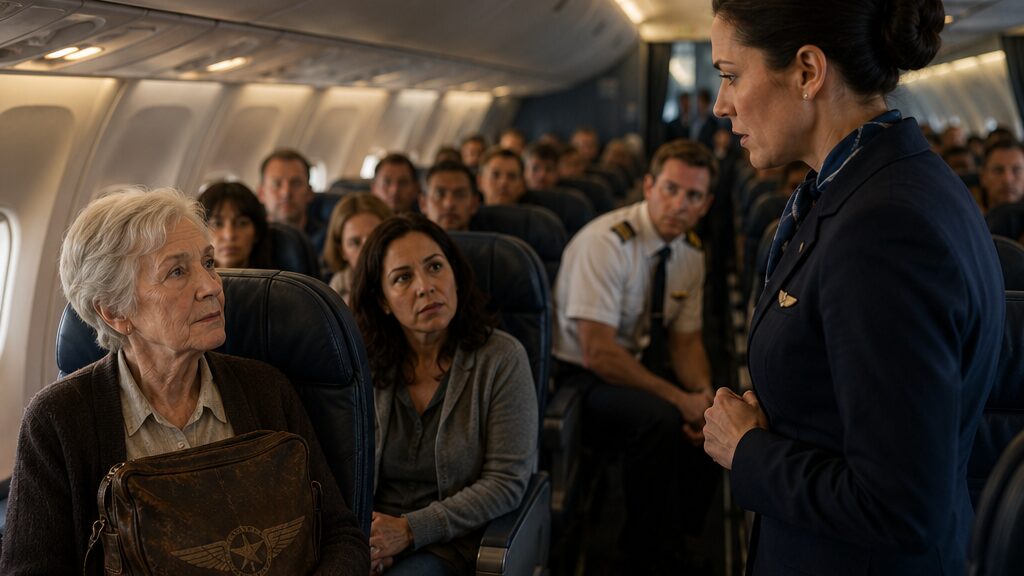
Heather paused near Rebecca’s row.
Her eyes moved immediately toward the overhead compartment.
“Ma’am, is that your bag?”
Rebecca looked up.
“Yes.”
“It’s fairly large.”
“It fits within the requirements.”
Heather examined it.
Something about her expression suggested she disagreed.
“It should be fine.”
Then she moved on.
A small interaction.
Forgettable.
Except Rebecca noticed the way Heather’s attention lingered.
As though the old woman with the battered bag might become a problem later.
The aircraft pushed back twenty minutes behind schedule.
The captain’s voice filled the cabin.
“Good afternoon, ladies and gentlemen. This is Captain Ryan Anderson speaking…”
His voice was calm and professional.
Rebecca listened carefully.
Most passengers didn’t.
Most were already watching movies or scrolling through messages.
But Rebecca listened.
When he mentioned weather complications farther west, she turned slightly toward the cockpit.
Storm systems.
Unexpected strengthening.
Interesting.
Maria noticed.
“You really pay attention to this stuff.”
Rebecca smiled faintly.
“I spent a lot of years around airplanes.”
“What did you do?”
The question lingered.
Rebecca watched ground crews move below the wing.
“A little bit of everything.”
It wasn’t exactly a lie.
The engines started.
The familiar vibration traveled through the floor.
For a moment Rebecca felt something tighten inside her chest.
Not fear.
Memory.
Thousands of departures.
Thousands of decisions.
Thousands of people entrusted to others.
The feeling passed.
The aircraft taxied.
As they approached the runway, Maria pointed toward the flight bag visible through the open edge of the compartment.
“That thing looks important.”
Rebecca followed her gaze.
The bag.
The same bag she had carried on some of the hardest days of her life.
The same bag her husband had given her decades earlier.
The same bag she could never bring herself to replace.
“It reminds me of people I miss.”
Maria’s smile faded.
“Oh.”
“That’s enough reason to keep something.”
Maria nodded.
“I think so too.”
The aircraft accelerated.
The runway blurred.
Moments later the city dropped away beneath them.
Rebecca watched clouds rise toward the wing.
The familiar sensation of climbing never entirely left her.
Not after all these years.
Not after everything.
An hour into the flight, the seatbelt sign switched off.
Passengers relaxed.
Flight attendants began beverage service.
Heather reached their row.
“What can I get you?”
“Coffee, please,” Rebecca said.
Heather handed her a cup.
A little too quickly.
Coffee sloshed over the rim.
A few drops landed on Rebecca’s tray table.
“Careful,” Heather said.
As though Rebecca had caused it.
Then she moved on.
Maria frowned.
“That wasn’t your fault.”
Rebecca wiped the spill with a napkin.
“It wasn’t important.”
Maria looked unconvinced.
“You let things go pretty easily.”
Rebecca stared at the dark coffee.
No.
Not easily.
Just selectively.
There were battles worth fighting.
And battles that accomplished nothing.
The flight continued.
Clouds thickened outside.
Several passengers glanced nervously through windows.
The ride grew rougher.
Not dangerous.
Just uncomfortable.
Rebecca studied the wing again.
Then the weather visible beyond it.
Something felt wrong.
Not yet alarming.
Just wrong.
The captain’s earlier route crossed her mind.
A memory followed.
Charts.
Storm behavior.
Air corridors.
Wind shifts.
Patterns she had spent decades learning.
The thought stayed with her.
Across the aisle, Heather spoke quietly with another flight attendant.
Their expressions looked strained.
A few minutes later the cabin intercom chimed.
Captain Anderson announced updated routing due to worsening weather.
Rebecca sat very still.
Listening.
Every word mattered.
When the announcement ended, she looked toward the cockpit door.
Then toward the darkening clouds ahead.
Something inside her settled into focus.
The same feeling she used to experience before difficult decisions.
Maria noticed the change immediately.
“You okay?”
Rebecca nodded.
“Probably.”
“Probably?”
Rebecca’s eyes remained on the storm beyond the wing.
For the first time since boarding, concern appeared in her expression.
Very small.
Very controlled.
But unmistakable.
Then she quietly said something that made no sense to Maria at all.
“I hope they’ve seen the latest briefing.”
Maria stared.
“What briefing?”
Rebecca didn’t answer.
Instead she looked toward the cockpit once more.
As though she knew something nobody else did.
And for the first time, Maria began to wonder who the elderly woman beside her really was.
Chapter 2: A Warning Nobody Wanted To Hear
The turbulence arrived gradually.
A shiver through the aircraft.
Then another.
Then a long rolling movement that caused several passengers to look up from their screens.
The seatbelt sign illuminated.
A chime echoed through the cabin.
Flight attendants secured carts and returned to their jump seats.
Outside the window, clouds towered above the wing.
Rebecca studied them carefully.
Years of experience had taught her that storms often revealed themselves before instruments did.
Not because machines were wrong.
Because people sometimes interpreted them too confidently.
Maria gripped her armrest.
“I hate flying through weather.”
Rebecca kept her voice calm.
“The airplane is stronger than it looks.”
The statement seemed oddly specific.
Maria noticed.
Again.
The aircraft shook harder.
A baby cried somewhere behind them.
A businessman cursed under his breath.
The captain came over the intercom.
His tone remained composed.
“Ladies and gentlemen, we’re expecting about fifteen minutes of moderate turbulence.”
Rebecca listened closely.
Moderate.
Maybe.
Maybe not.
Something still bothered her.
A detail she couldn’t fully explain.
A route adjustment.
Timing.
Storm growth.
The kind of concern built from experience rather than certainty.
She looked toward the front of the aircraft.
The cockpit door remained closed.
Flight attendants sat facing the cabin.
Heather Lopez appeared irritated by the growing anxiety among passengers.
Several call buttons illuminated overhead.
People wanted reassurance.
Heather wanted order.
The aircraft jolted sharply.
Gasps spread through the cabin.
Coffee splashed.
Luggage shifted.
Rebecca’s eyes narrowed.
That wasn’t the turbulence.
That felt like a course correction.
Maria swallowed.
“Is that normal?”
Rebecca hesitated.
Then she answered honestly.
“Not entirely.”
A few minutes later the ride smoothed unexpectedly.
Passengers relaxed.
Conversations resumed.
Heather stood and began moving through the aisle again.
“Everyone doing okay?”
Her smile looked practiced.
Tired.
As she approached Row 14, Rebecca made a decision.
Not because she wanted attention.
Because she had spent too many years remaining silent when she shouldn’t.
“Heather.”
The flight attendant stopped.
“Yes?”
Rebecca lowered her voice.
“I’d appreciate it if someone could verify the latest weather briefing.”
Heather blinked.
“What do you mean?”
“The storm system ahead may have expanded faster than expected.”
Heather stared for a second.
Then glanced toward Maria as if seeking confirmation that she had heard correctly.
“I’m sure the pilots are aware of the weather, ma’am.”
“I’m sure they are.”
Rebecca remained calm.
“That’s not what I said.”
Heather’s expression tightened.
“Captain Anderson has access to current information.”
“I know.”
Heather frowned.
Rebecca immediately realized her mistake.
Not the concern.
The wording.
People noticed when elderly passengers spoke with unusual certainty.
Heather folded her arms.
“Have you worked in aviation?”
A simple question.
Rebecca considered answering.
Instead she said, “A long time ago.”
The answer satisfied no one.
Especially Heather.
“Well, thank you for your concern.”
Her tone suggested the conversation was over.
She started to walk away.
Then the aircraft hit another pocket of rough air.
Hard enough to force several passengers back into their seats.
A nervous murmur spread through the cabin.
Rebecca looked out the window again.
The cloud formation was worse.
Much worse.
And now she was certain.
She raised her hand.
Not dramatically.
Just enough.
“Heather.”
The flight attendant turned.
Visible frustration crossed her face.
“Yes?”
“You may want to verify the weather briefing again.”
The words carried through the nearby rows.
Several passengers looked over.
Heather stared.
For a moment the cabin became uncomfortably quiet.
Then she smiled the way people smiled when they believed they were being patient.
“Ma’am, please remain seated.”
“I am seated.”
“The flight crew is handling the situation.”
Rebecca nodded.
“I understand.”
“Then let’s allow them to do that.”
Several passengers had begun watching.
Maria shifted awkwardly.
Heather’s voice grew firmer.
“This isn’t something passengers need to worry about.”
Rebecca held her gaze.
Not challenging.
Not defensive.
Simply calm.
The contrast somehow made Heather more uncomfortable.
“You should focus on your own flight experience.”
A few people chuckled quietly.
The implication was clear.
Confused elderly passenger.
Backseat pilot.
Unwanted advice.
Rebecca looked away first.
Not because she felt defeated.
Because there was nothing left to say.
“Very well.”
Heather moved on.
The moment ended.
At least for everyone else.
Maria leaned closer.
“What was that about?”
Rebecca watched the clouds.
“I hope I’m wrong.”
Wrong about what?
Maria wanted to ask.
But something in Rebecca’s expression stopped her.
The woman wasn’t trying to sound important.
She looked genuinely worried.
Ten minutes later another announcement arrived.
Captain Anderson informed passengers that a diversion might become necessary.
A wave of concern swept through the cabin.
Maria stared at Rebecca.
Rebecca said nothing.
Near the front galley, Heather exchanged worried looks with another attendant.
The diversion hadn’t been expected.
Passengers began connecting dots.
Some glanced toward Row 14.
Most quickly looked away.
The turbulence returned.
This time stronger.
Heather walked rapidly toward the cockpit.
As she passed Rebecca’s row, her eyes briefly dropped to the overhead compartment.
The old flight bag had shifted slightly.
A corner of the faded insignia was visible.
Heather barely noticed it.
But another person did.
A pilot emerging from the cockpit for a momentary crew consultation.
His gaze lingered.
Only for a second.
Then he disappeared behind the door again.
Rebecca never saw him looking.
She was focused on the storm.
And on a question she hadn’t asked herself in years.
Whether experience still mattered when nobody knew where it came from.
Chapter 3: The Captain’s Uneasy Recognition
Captain Ryan Anderson disliked uncertainty.
Weather could be unpredictable.
Passengers could be unpredictable.
Mechanical systems occasionally surprised everyone.
But uncertainty born from missing information bothered him most.
The aircraft had begun its diversion south.
Radar displays glowed across the cockpit.
The first officer monitored route changes while Ryan reviewed incoming weather updates.
The storm cell had expanded faster than expected.
Exactly as the elderly passenger had suggested.
Not proof.
Just coincidence.
Yet the thought remained.
“Cabin’s getting restless,” the first officer said.
Ryan nodded.
“Understandably.”
He studied the display again.
Something else nagged at him.
Not the weather.
The woman.
Heather’s report replayed in his mind.
An older passenger had insisted they recheck the briefing.
Most people wouldn’t phrase it that way.
They would say the weather looked bad.
Or ask questions.
Not reference briefings.
The language felt familiar.
Professional.
Deliberate.
Ryan rubbed his jaw.
“Keep an eye on this heading.”
“I’ve got it.”
Ryan unfastened his harness and stepped into the small area behind the cockpit.
Heather was waiting.
“We may have some delays after landing.”
Ryan nodded.
“Expected.”
Then his attention drifted past her.
Toward the cabin.
Toward Row 14.
The woman sat quietly beside the window.
No complaints.
No dramatic gestures.
No attempts to attract attention.
That made the situation stranger.
People seeking attention usually kept seeking it.
She had returned to silence.
Ryan started back toward the cockpit.
Then something caught his eye.
The bag.
The worn leather flight bag stored above her row.
A faded insignia partially visible beneath decades of wear.
Ryan stopped.
Only for a moment.
The emblem looked familiar.
Not because he recognized it clearly.
Because it stirred a memory.
A photograph.
An old briefing room.
A history display at an aviation conference years ago.
Something.
He couldn’t place it.
Heather noticed him looking.
“Everything okay?”
Ryan nodded.
“Fine.”
But he wasn’t convinced.
Back in the cockpit, he couldn’t stop thinking about the insignia.
Or the woman.
Or the weather warning.
The pieces didn’t fit together.
Yet somehow they felt connected.
Below them, the storm shifted again.
Ryan made another routing adjustment.
This time before air traffic control recommended it.
A decision based partly on instinct.
Partly on experience.
And partly on a quiet voice in Row 14 he couldn’t quite explain.
An hour later they began descending toward an alternate airport.
The diversion had become unavoidable.
Passengers would miss connections.
Airline operations would be disrupted.
Nobody would be happy.
Ryan delivered the announcement.
When he finished, he looked through the cockpit doorway toward the cabin.
Row 14 remained calm.
The elderly woman simply folded her hands and watched the clouds.
As if diversions were part of life.
As if she had seen far worse.
For reasons he couldn’t explain, Ryan suddenly wanted to know her name.
Not because she had been right.
Because she seemed familiar to a part of aviation history he had nearly forgotten.
And somewhere deep in his memory, a faded emblem on an old leather bag continued to demand recognition.
Chapter 4: Names Hidden In The Archive
The aircraft touched down smoothly despite the weather.
Most passengers applauded out of relief.
Rebecca remained seated.
She had never understood applauding a safe landing. Good pilots deserved respect, but competence was supposed to look ordinary.
Outside, rain streaked across the windows.
The diverted airport was smaller than their destination. Terminal lights glowed through gray sheets of weather.
Passengers immediately began checking phones.
Missed meetings.
Missed connections.
Missed plans.
The cabin filled with frustration.
Heather moved through the aisle trying to maintain order.
“Please remain seated until we reach the gate.”
Nobody seemed interested in listening.
Maria glanced toward Rebecca.
“You called it.”
Rebecca looked out the window.
“I hoped I wouldn’t.”
“You knew that storm was a problem.”
“I suspected.”
“That’s more than most people.”
Rebecca smiled faintly.
“Experience helps.”
Before Maria could ask another question, the aircraft reached the gate.
Passengers stood immediately.
The overhead bins opened.
The old flight bag emerged from its compartment.
Rebecca carefully lifted it down.
The faded emblem briefly caught the light.
Maria noticed it again.
“What is that symbol?”
Rebecca looked at the worn leather.
“Something from a long time ago.”
Not a lie.
Not an answer.
Across the cabin, Captain Ryan Anderson stepped out of the cockpit to speak with crew members.
His eyes found the bag almost immediately.
The emblem.
Again.
A strange feeling pulled at his memory.
He had seen it before.
Not recently.
Years ago.
Somewhere connected to military aviation history.
He watched Rebecca walk slowly toward the front of the aircraft.
Not frail.
Not confused.
Measured.
Deliberate.
Like someone accustomed to moving through important spaces without rushing.
Heather intercepted her near the door.
“We’ll be arranging alternate transportation as soon as possible.”
Rebecca nodded.
“Thank you.”
Heather hesitated.
Then added, “The captain appreciated passenger patience today.”
Passenger patience.
Rebecca almost smiled.
“Please tell him he made the right decision.”
Heather blinked.
“What decision?”
“The second route correction.”
The flight attendant stared.
Rebecca continued walking.
Heather watched her disappear into the terminal.
For reasons she couldn’t explain, the exchange bothered her.
Meanwhile, Ryan stood near the jet bridge speaking with airline operations.
His thoughts kept returning to the emblem.
Finally he asked.
“The elderly woman in Fourteen A.”
Heather looked surprised.
“What about her?”
“The one who mentioned the weather.”
“Oh.”
Something in her tone suggested annoyance.
Ryan noticed.
“Who is she?”
“No idea.”
Heather shrugged.
“Just a passenger.”
Ryan looked toward the terminal windows.
Rain hammered the glass.
“I’m not sure about that.”
An hour later, airline operations had become a mess.
Diversions from multiple flights created delays throughout the region.
At a temporary operations center inside the airport, John Brown reviewed passenger issues while coordinating aircraft schedules.
John had spent twenty years with the airline.
Most crises became paperwork eventually.
Weather merely accelerated the process.
A call from Ryan interrupted him.
“I need a favor.”
John laughed.
“That’s never good.”
Ryan explained.
An elderly passenger.
A weather warning.
A military-looking emblem.
An odd feeling of familiarity.
John listened patiently.
When Ryan finished, silence followed.
“You called me for that?”
“I know it sounds ridiculous.”
“A little.”
Ryan rubbed his forehead.
“Can you check something?”
“What exactly?”
“The insignia.”
John sighed.
“I’ll see what I can find.”
After hanging up, he expected to forget about it.
Instead curiosity won.
The aviation industry was small.
History lingered in unexpected places.
He accessed an internal archive database maintained jointly with several aviation museums.
Photographs.
Historical partnerships.
Military transport programs.
Retired commanders.
Old records.
At first nothing appeared.
Then he expanded the search.
A faded insignia surfaced in a photograph from nearly thirty years earlier.
John leaned forward.
The image showed a command center.
Large aircraft.
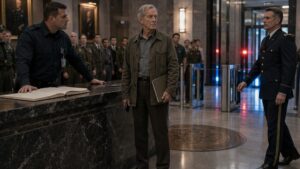
Military transport crews.
Senior leadership.
The emblem matched.
Exactly.
His expression changed.
He opened another file.
Then another.
A name appeared repeatedly.
Rebecca Carter.
John stared.
The file wasn’t ordinary.
It contained references to strategic airlift operations, humanitarian missions, and command appointments.
The deeper he searched, the quieter the room around him seemed to become.
Years earlier, Rebecca Carter had overseen some of the largest airlift operations in the country.
Thousands of personnel.
Thousands of flights.
Disaster response missions.
Evacuations.
International operations.
John sat back slowly.
“You’re kidding.”
He opened an archived photograph.
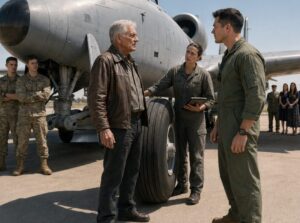
A much younger Rebecca stood beside transport aircraft.
Confident.
Focused.
The same eyes.
The same face.
Just decades younger.
John felt a strange chill.
The elderly passenger from Row 14 wasn’t merely someone with aviation experience.
She had once occupied one of the most significant leadership positions in military aviation.
And somehow she had boarded a commercial flight carrying an old bag while nobody recognized her.
Including him.
Including everyone.
John immediately called Ryan back.
The captain answered after one ring.
“What did you find?”
John looked at the photograph again.
Then at the name beneath it.
For a moment he struggled to believe it himself.
“Ryan,” he said quietly.
“I think you need to tell me exactly what happened on that airplane.”
Chapter 5: The General Nobody Recognized
Ryan listened without interrupting.
John explained what he had found.
The archive records.
The photographs.
The command history.
The humanitarian operations.
The years of service.
Each detail made the silence on Ryan’s end longer.
When John finished, neither man spoke for several seconds.
Finally Ryan exhaled.
“You’re sure?”
“As sure as I can be.”
“Rebecca Carter?”
“Retired Air Force General.”
Ryan looked across the operations office.
Passengers moved through the terminal carrying bags and coffee cups.
Most had no idea that one of the most accomplished aviation leaders of her generation was sitting somewhere among them.
He suddenly remembered the conference.
Years ago.
A display honoring major airlift operations.
A photograph.
A name.
That was where he had seen the insignia.
And the face.
Older now.
But unmistakably the same person.
Ryan stood.
“Where is she?”
“No idea.”
“Find out.”
John laughed softly.
“Now you sound worried.”
“I am.”
Not because of her rank.
Because of what had happened.
Because she had offered help.
Because nobody had listened.
Across the terminal, Rebecca sat near a large window overlooking the rain-soaked runway.
Her flight bag rested beside her chair.
Maria remained nearby.
Most passengers had dispersed.
Neither woman seemed in a hurry.
“You still haven’t told me what you used to do,” Maria said.
Rebecca smiled.
“You’ve been very patient.”
“I’ve been very curious.”
“Those aren’t always the same thing.”
Maria laughed.
Then noticed something unusual.
Several airline employees were moving through the terminal looking around.
Searching.
One of them pointed.
Another nodded.
Their attention settled on Rebecca.
Maria frowned.
“Are they looking for you?”
Rebecca followed her gaze.
A moment later Ryan Anderson approached.
Not quickly.
Not dramatically.
But with obvious purpose.
Heather Lopez walked several steps behind him.
Her expression looked confused.
Ryan stopped in front of Rebecca.
For the first time all day, he seemed uncertain.
Rebecca looked up calmly.
“Captain.”
The simple greeting startled him.
“You know who I am.”
“You introduced yourself before departure.”
A faint smile touched her face.
“I listened.”
Ryan almost smiled back.
Then he noticed the flight bag again.
The emblem.
The photographs.
Everything John had described suddenly felt real.
“Ms. Carter…”
Rebecca waited.
Ryan chose his next words carefully.
“May I sit down?”
Maria’s eyes widened.
The captain was asking permission.
Rebecca nodded.
“Of course.”
Ryan sat across from her.
Heather remained standing.
Several nearby passengers noticed the interaction.
Conversation slowly faded.
Not entirely.
Just enough.
“I spoke with operations,” Ryan said.
Rebecca looked toward the rain outside.
“I assumed you might.”
“You could have told us.”
“I could have.”
Ryan lowered his voice.
“Why didn’t you?”
Rebecca considered the question.
Then answered honestly.
“Because the weather didn’t care what rank I used to hold.”
The words landed harder than Ryan expected.
Nearby, Heather stared at her.
Confusion gave way to realization.
Then disbelief.
“Wait,” Heather said quietly.
Ryan looked at her.
John was approaching now, carrying a tablet.
He stopped beside them.
Without speaking, he turned the screen around.
An old photograph filled the display.
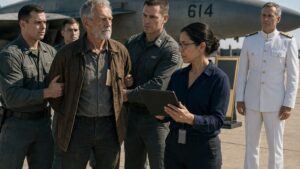
A younger Rebecca stood in front of a transport aircraft surrounded by crews and officers.
The caption beneath it identified her.
General Rebecca Carter.
For a moment nobody moved.
Maria looked from the photograph to the woman beside her.
Back to the photograph.
Again.
Heather’s face lost color.
The terminal noise seemed to disappear.
Not completely.
Just enough to create a strange pocket of silence around them.
The reveal didn’t arrive like thunder.
It arrived like recognition.
A truth settling into place.
Ryan spoke first.
“You commanded strategic airlift operations.”
Rebecca nodded once.
“Many years ago.”
John shook his head.
“Not just many years ago.”
He looked at the records.
“You coordinated relief missions across multiple continents.”
Rebecca’s expression remained unchanged.
“With thousands of other people.”
Heather swallowed.
The memory of Row 14 returned immediately.
Please remain seated.
Let’s allow them to do that.
Passenger patience.
Every word felt different now.
Painfully different.
Not because Rebecca had been important.
Because Heather suddenly understood how little she had actually seen.
Rebecca noticed the discomfort.
“You don’t need to look like that.”
Heather blinked.
“I owe you an apology.”
“Perhaps.”
The honesty surprised everyone.
Rebecca’s voice remained gentle.
“But not because of my past.”
Nobody answered.
She rested a hand on the old flight bag.
The leather creaked softly.
“You should treat people well before you know who they are.”
The terminal remained quiet.
Not out of awe.
Out of shame.
And for the first time all day, Heather Lopez truly understood what she had missed.
Chapter 6: What Service Was Really For
The terminal slowly returned to motion.
Passengers resumed conversations.
Announcements echoed overhead.
Rain continued striking the windows.
Yet something had changed.
Not because people had learned Rebecca Carter had once been a general.
Because they had suddenly realized how confidently they had assumed she was not.
Rebecca remained seated.
The old flight bag rested beside her chair.
Its leather looked even more worn against the polished airport floor.
John stood nearby, still holding the tablet.
Ryan sat across from Rebecca.
Heather remained standing.
For the first time all day, she seemed uncertain what to do with her hands.
Maria quietly watched everything.
The moment felt larger than any of them expected.
Eventually Heather spoke.
“I was rude to you.”
Rebecca looked up.
“You were impatient.”
Heather shook her head.
“No.”
The word came out quickly.
“I was rude.”
Rebecca studied her for a moment.
There was no defensiveness left.
No attempt to explain herself.
Only discomfort.
The honest kind.
The kind people felt when they could no longer avoid seeing themselves clearly.
Heather lowered her eyes.
“I thought you were trying to tell the crew how to do their jobs.”
“I understand.”
“I didn’t listen.”
Rebecca nodded.
“You didn’t.”
The simple agreement somehow felt heavier than criticism.
Heather exhaled.
“I am sorry.”
Silence followed.
Not awkward silence.
Thoughtful silence.
Passengers drifted past without noticing the weight of the conversation.
Outside, an aircraft taxied through the rain.
Rebecca watched it for several seconds before speaking.
“When I was younger, I used to think authority meant having answers.”
Nobody interrupted.
“Then I spent years discovering it mostly meant responsibility.”
Ryan listened carefully.
Rebecca rarely volunteered information.
When she did, every word seemed deliberate.
“I made decisions that affected people I would never meet. Families. Crews. Entire communities.”
Her gaze remained on the rain-soaked runway.
“And every time something went wrong, rank stopped mattering.”
Heather frowned slightly.
“What mattered?”
“Whether people came home.”
The answer settled over the group.
Simple.
Unadorned.
True.
Rebecca turned back toward Heather.
“If someone looks unimportant, you still owe them respect.”
Heather nodded immediately.
“I know.”
Rebecca offered a faint smile.
“No.”
The flight attendant blinked.
“You know it now.”
The words were gentle.
That made them harder to ignore.
John quietly excused himself to handle operations issues.
Before leaving, he paused.
“General Carter.”
Rebecca visibly winced.
John noticed.
“So you don’t like being called that.”
She almost laughed.
“I spent thirty years hearing it.”
“Fair enough.”
He smiled.
“But thank you.”
“For what?”
John looked toward the runways.
“For a lot of flights most people never knew happened.”
Rebecca didn’t answer.
She never knew what to do with gratitude directed at old accomplishments.
Too many people had contributed.
Too many names had been forgotten.
After John left, Ryan leaned forward.
“There is something I’d like to ask.”
Rebecca nodded.
“You trusted your instincts today.”
“I trusted experience.”
Ryan smiled.
“Same thing sometimes.”
“Sometimes.”
He glanced toward the old flight bag.
“You still carry that everywhere?”
Rebecca followed his gaze.
The bag.
The one object she had never replaced.
“Almost everywhere.”
“Why?”
For a long moment she didn’t answer.
Then she reached down and pulled the bag onto her lap.
The brass clasps clicked softly as she opened it.
The gesture immediately drew everyone’s attention.
Inside were no classified documents.
No dramatic records.
No hidden proof of authority.
Only ordinary things.
A notebook.
Reading glasses.
Travel papers.
And beneath them, a worn photograph.
Rebecca picked it up carefully.
The edges had softened with age.
Ryan leaned slightly closer.
A younger Rebecca stood beside a smiling man in flight gear.
Both looked impossibly young.
The photograph had been taken near a transport aircraft.
“My husband,” Rebecca said.
Her voice carried a quiet warmth.
“He flew?”
“He did.”
She ran a thumb gently across the image.
“He gave me this bag.”
Maria looked at the photograph.
“What happened to him?”
Rebecca closed her eyes briefly.
“Twenty-one years ago.”
Nobody needed further explanation.
The silence that followed felt respectful rather than uncomfortable.
Heather looked away.
Ryan did the same.
Rebecca returned the photograph to the bag.
Then closed it.
The leather creaked softly.
For the first time all day, the bag no longer seemed connected to rank.
Or history.
Or command.
It looked like what it truly was.
A memory.
A promise carried forward.
Hours later, airline representatives arranged transportation to the city where Rebecca had originally been headed.
Ryan personally walked her toward the departure area.
Neither spoke much.
The airport had grown quieter.
The storm was finally moving east.
As they reached the entrance, Ryan stopped.
“There was a memorial dedication, wasn’t there?”
Rebecca looked surprised.
“How did you know?”
“You mentioned traveling for a reason.”
She nodded.
“A crew memorial.”
Ryan glanced at the flight bag.
“The people from the photograph?”
“Some of them.”
He understood immediately.
Not everything.
Just enough.
Rebecca extended her hand.
Ryan shook it.
Firm.
Steady.
“Thank you for listening eventually,” she said.
The captain smiled.
“I’m sorry it took so long.”
Rebecca looked toward the busy terminal around them.
“It usually does.”
Then she picked up the old flight bag and continued walking.
Heather watched her go from across the concourse.
And for the first time since joining the airline, she found herself paying attention to every elderly traveler she passed.
Chapter 7: Leaving With The Same Old Bag
The memorial stood on a grassy rise overlooking a small aviation museum.
By the time Rebecca arrived, the rain had ended.
The clouds had broken apart into pale evening light.
Cars lined the parking area.
Visitors moved quietly among displays and plaques.
No one rushed.
No one argued.
The atmosphere felt different from airports.
Different from command centers.
Different from every place where urgency had once governed her life.
Rebecca walked slowly toward the dedication site.
The old flight bag hung from her shoulder.
The leather looked almost golden beneath the setting sun.
A few people recognized her.
Most did not.
She preferred it that way.
Near the entrance, a volunteer handed out programs.
“Welcome.”
Rebecca accepted one.
Her name appeared inside.
Not prominently.
Not as the focus of the event.
Just among several surviving leaders and crew members connected to the operation being remembered.
Exactly as she had requested.
She found a seat near the back.
Far from the podium.
Far from the cameras.
The ceremony began.
Families listened as speakers described an airlift mission from decades earlier.
Names were read aloud.
Some belonged to pilots.
Some belonged to crew chiefs.
Some belonged to mechanics.
Others belonged to people history rarely noticed.
Rebecca listened quietly.
The years seemed to fold inward.
Faces returned.
Voices returned.
Laughter returned.
The memories carried both warmth and loss.
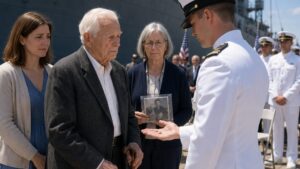
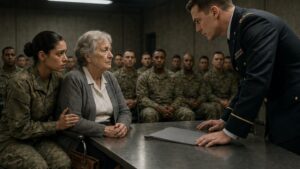
At one point a large photograph appeared on a display screen.
A younger Rebecca stood among dozens of airmen.
The image remained only briefly.
Yet it was enough.
A reminder that entire lives eventually became photographs.
Records.
Stories.
Then memories.
Nothing more.
A speaker invited several guests to stand.
Rebecca reluctantly rose.
Polite applause followed.
Nothing excessive.
Nothing dramatic.
She appreciated that.
When she sat again, an elderly widow beside her smiled.
“My husband served on one of those flights.”
Rebecca nodded.
“I remember many of them.”
The woman studied her carefully.
Then recognition appeared.
Not rank.
Not title.
Recognition.
“I know who you are.”
Rebecca smiled.
“Maybe.”
The widow laughed softly.
“My husband spoke about you once.”
Rebecca looked surprised.
“What did he say?”
The woman’s eyes brightened.
“He said you knew everyone’s name.”
The answer caught Rebecca completely off guard.
After everything.
After all the years.
After every operation.
That was what remained.
Not command.
Not authority.
A simple memory.
She felt her throat tighten unexpectedly.
The widow touched her arm.
“He respected you.”
Rebecca looked toward the stage.
For several seconds she could not speak.
Finally she managed a quiet reply.
“I respected him too.”
As evening deepened, the ceremony concluded.
Visitors slowly dispersed.
Families lingered near memorial stones.
Photographs were taken.
Stories were shared.
Rebecca remained behind after most people left.
The hill grew quiet.
Wind moved gently through nearby trees.
She walked toward a memorial wall engraved with names.
Some she knew immediately.
Others required a moment.
Time changed details.
Not affection.
Not grief.
Her hand rested lightly against the cool stone.
For a while she simply stood there.
No speeches.
No audience.
No rank.
Only memory.
Eventually she sat on a nearby bench.
The flight bag beside her.
The same bag she had carried onto the airplane.
The same bag Heather had viewed with suspicion.
The same bag Ryan had recognized.
The same bag her husband had given her decades earlier.
It contained no proof anyone needed anymore.
No authority.
No command.
Only reminders.
Rebecca looked toward the horizon.
The last sunlight faded behind distant clouds.
For the first time in a long while, she felt something ease inside her.
Not because people had remembered who she was.
Because she no longer needed them to.
The flight attendants would continue working.
The captain would continue flying.
Passengers would continue making assumptions.
The world would continue moving forward.
That was how it should be.
Yet perhaps a few people would pause before judging someone too quickly.
Perhaps Heather would.
Perhaps Ryan already had.
Perhaps Maria would remember the lesson longer than either of them.
Rebecca smiled faintly.
A quiet satisfaction settled over her.
Service had never been about being recognized.
It had been about carrying responsibility when it mattered.
And dignity had never come from rank.
It came from how a person treated others when rank was gone.
The evening air cooled.
Rebecca stood.
She lifted the old flight bag onto her shoulder.
Then she walked away from the memorial at the same measured pace she had carried through airports, command centers, and decades of life.
The bag was still worn.
Still ordinary.
Still hers.
And that was enough.
The story has ended.