The Old Veteran Waited Outside In The Rain Until One Paper Changed How They Spoke To Him
Chapter 1: The Man With The Wet Packet Outside The Glass Doors
Robert Walker arrived before the building unlocked, but the rain had already found the weak seam in the envelope.
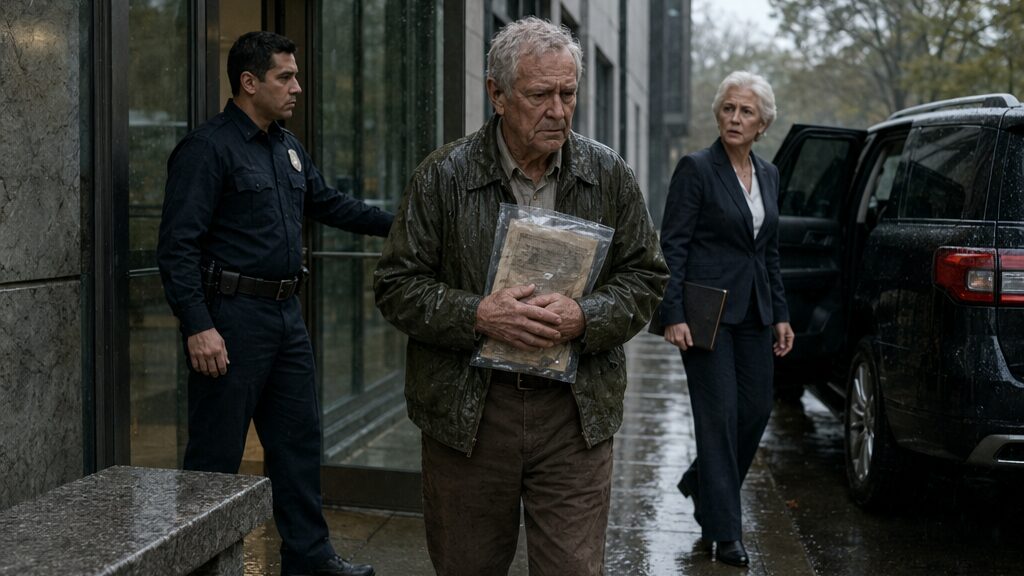
He stood under the narrow lip of concrete above the VA records annex entrance, holding the packet against his chest with both hands. The doors were dark glass, reflecting a bent old man in an olive jacket, brown pants damp at the cuffs, and shoes polished badly enough to show where the leather had cracked. Behind the reflection, the lobby lights came on one row at a time.
The packet was thick, softened at the corners, sealed inside two layers of clear plastic Robert had bought from a grocery store the night before. Even through the plastic, he could feel the old paper inside shifting when his fingers trembled.
He did not like that his hands did that now.
The rain ticked off the metal frame above him. Cars moved past the curb without stopping. Across the parking lot, the flag hung heavy and dark, its stripes clinging to themselves.
Robert checked the time on his watch. Twenty-three minutes before opening.
He had planned for forty.
A young security officer appeared inside the lobby and looked toward the glass. Robert straightened a little. His back objected. He ignored it. The officer unlocked one of the doors, opened it no farther than necessary, and leaned his shoulder into the gap.
“Sir, the building doesn’t open until eight.”
Robert nodded. “I know.”
“You have an appointment?”
“I was told to come early.”
The officer’s eyes went to the packet. Not unkindly. Just quickly, the way people looked at something they expected to be trouble.
“Appointments start at eight-thirty,” he said. “Intake won’t see anybody before then.”
“I can wait.”
The officer glanced over his shoulder into the lobby. “You can’t wait right here. We have staff coming in, deliveries, vehicles pulling up.”
Robert looked at the sidewalk. He was not blocking it. There was enough room for three men younger than him to pass without turning sideways.
Still, he nodded.
“There’s a bench over there.” The officer pointed to a low stone ledge along the wall, away from the door and just beyond the edge of the overhang. “You can sit there until the lobby opens.”
Robert looked at the bench. Rain speckled it steadily.
The officer seemed to notice that at the same time. His mouth tightened as if he wished the bench had been dry. “Sorry. That’s the only place outside the entrance.”
Robert moved the packet under his jacket. “All right.”
He stepped away from the door. His left knee dragged on the first step; he made the second cleaner. He had learned long ago that pain became louder when a man gave it an audience.
The bench was cold through his trousers. Rain ran along the stone beside his thigh and gathered at the seam where the wall met the walkway. He placed the packet on his lap, under both hands, and bowed his head just enough to shield it.
The officer remained near the door. Robert could feel him watching, not continuously but in checks: a look, a turn away, another look. A man making sure a problem did not become larger.
Robert had been called worse things than a problem.
By eight o’clock, people began slipping through the entrance with badges in plastic holders. Most did not look at him. One woman with a coffee cup glanced down at the packet and then at his shoes. A man carrying a laptop bag walked wide around him though there was no need. Someone inside laughed at something Robert could not hear.
At eight-ten, the officer stepped outside again.
“Sir?”
Robert raised his head.
“What’s your name?”
“Robert Walker.”
“Mr. Walker, do you have a confirmation number?”
Robert shifted the packet carefully. “It’s written on the intake letter.”
“Can I see it?”
Robert opened the outer plastic but not the inner sleeve. His fingers found the newer letter by feel. He slid it out halfway, keeping the older pages covered.
The officer came down the step but did not take the letter. He bent slightly, reading upside down.
Jonathan Ramirez. That was the name on his security badge.
“Mr. Walker,” Jonathan said, “this date is for yesterday.”
Robert looked down at the letter. He knew the date. He had looked at it until the numbers stayed behind his eyelids.
“Yes.”
“So you missed the appointment.”
“No.” Robert folded the letter back beneath the plastic. “The bus from my county didn’t run yesterday after the bridge closed. I called. A woman told me if I came before intake closed today, it could still be received.”
Jonathan looked uncomfortable now. “Who told you that?”
“I didn’t get her name.”
“You need a name for that kind of exception.”
“I know.”
The rain thickened. It tapped harder against the packet, each drop small and sharp.
Jonathan adjusted his jacket. “I’m not trying to give you a hard time. But if your appointment was yesterday, intake may not take it.”
Robert looked through the glass at the lobby. There was a reception desk, a row of chairs, a sign with arrows, and beyond that a hallway where people carried files without looking hurried. He had imagined this building many times, though never accurately. In his mind it had always been older, with heavier doors.
“It only has to be received,” Robert said.
“For your claim?”
“No.”
Jonathan waited. Robert did not add more.
The officer gave a small sigh, not annoyed exactly, but placed between policy and pity. “When the doors open to the public, you can check at the window. Until then, stay clear of the entry.”
Robert nodded once.
“I can wait,” he said again.
Jonathan went back inside.
The words sat with Robert after the door closed.
I can wait.
He had said it too often in his life. In aid stations. In county offices. In hospitals with old magazines. Beside beds where machines breathed for people who could not. Once beside a phone that never rang back.
He smoothed the plastic over the packet. Beneath the top letter, beneath the newer forms, beneath the copies and certified statements and a photograph he had not looked at this morning, lay the page he had carried in three different boxes, four houses, and one drawer beside his bed for longer than some men stayed remembered.
The page was not impressive. It had no gold seal. No ribbon. No signature from a general. It was stained brown along one edge and torn where it had once been folded too fast. Names ran in columns that no modern scanner liked. One column was wrong.
That was why Robert had come.
At eight-thirty, the lobby opened to the public. Jonathan held the door for two men in ball caps, a woman with a cane, and a younger man pushing an older one in a wheelchair. When Robert stood, Jonathan watched him with a softened expression.
“Take your time,” the officer said.
Robert did.
The lobby smelled of wet coats, floor cleaner, and coffee. The overhead lights made everything look flatter than it should. A television mounted in the corner played muted news. Three people sat under a sign that said RECORDS INTAKE. The window beneath it was closed.
Robert stood at the end of a short line.
When his turn came, the glass slid open.
The woman behind the window had reading glasses on a chain and a stack of forms by her elbow. Her badge said Mary Smith. She looked at Robert’s wet jacket, then the packet, then the clock.
“Name?”
“Robert Walker.”
“Appointment confirmation?”
Robert gave her the letter.
Mary typed. Her nails clicked lightly against the keys.
“This appointment was yesterday.”
“Yes, ma’am.”
“You’ll need to reschedule.”
“I was told it could be received today if I came before intake closed.”
“Who told you that?”
“I didn’t get her name.”
Mary’s face did not change, but something behind it closed a little. “Sir, we can’t process exceptions without documentation.”
Robert drew in a breath through his nose. “Could you look at the packet?”
“What kind of packet?”
“A correction request.”
“For your records?”
“For a service record.”
“Yours?”
Robert hesitated.
“No.”
Mary looked past him at the line forming again. “If it isn’t your record, you need authorization from the veteran or next of kin.”
“The veteran is deceased.”
“Then you need next-of-kin authorization.”
“I have a statement.”
“From the next of kin?”
“No.”
Mary slid his appointment letter back beneath the glass. “Then I can’t accept it.”
The packet seemed heavier on Robert’s forearm.
“It has to be received today,” he said.
“Sir, I understand, but incomplete submissions can’t be logged.”
“It isn’t incomplete.”
Mary’s eyes moved to the packet. “May I see the first page?”
Robert unfastened the plastic and slid out the top sheet: the modern correction form, filled by hand because the online portal had rejected the older record number every time. Mary took it, glanced at the form, and turned to the second page before Robert could stop her.
The edge of the old roster showed beneath the plastic.
Mary paused only long enough to see that it was not a standard form.
“This is not acceptable as a primary document,” she said.
“It’s the field list.”
“It’s damaged.”
“Yes.”
“And handwritten.”
Robert’s hand tightened.
Mary reached for a red stamp near her keyboard. “I’m going to mark this as incomplete so there’s a note in the system that you came in. You can resubmit once you have proper supporting documentation.”
Robert watched the stamp come down.
INCOMPLETE.
The red word landed across the intake slip, clean and wet.
Mary pushed the slip back to him without touching the old page.
Robert looked at the stamp until the letters stopped being letters and became something heavier.
Incomplete.
He gathered the packet with both hands.
“Sir,” Mary said, already looking at the next person in line, “you’ll need to step aside.”
Robert placed the stamped slip beneath the plastic, above the old roster. He closed the sleeve carefully so the rain could not get in any farther.
Then he stepped out of the line, past the chairs, past Jonathan at the entrance, and back through the glass doors into the rain.
The bench was wetter now.
Robert sat down anyway.
Chapter 2: The Clerk Who Saw Only A Broken Form
Mary Smith had been working records intake long enough to know that paper could arrive with grief attached to it.
She had seen folded discharge copies carried in Bible covers, death certificates pressed flat inside grocery bags, photographs with names written on the back by hands that no longer wrote steadily. Every week someone came to the window believing one document could undo years of confusion. Sometimes it could. Usually it could not.
The system did not care how long someone had driven.
It did not care if their son had taken off work, if their knees hurt, if the original file had burned or flooded or been misentered by a clerk who had retired before Mary was born. The system cared about legible forms, matching numbers, authorization, deadlines, and whether a record could be scanned without jamming the feeder.
Mary did not love this. She simply knew it.
Still, after Robert Walker returned outside, she watched him through the glass.
He sat on the stone bench with his shoulders slightly forward, the packet across his lap. Rain traced the lines in his jacket and darkened the fabric at his elbows. He did not pace. He did not shout. He did not press the door buzzer. He sat as if waiting were an assignment someone had given him, and he intended to complete it properly.
Mary told herself she had done what she could.
The next person in line needed a copy of a separation form. The one after that had a pension question. The receptionist asked whether Mary had seen the memo about the deputy director’s visit. A phone rang. The printer jammed. A man in the waiting area coughed hard enough that everyone looked at him and then pretended not to.
For forty minutes, Robert remained on the bench.
At nine-thirty, Mary carried a stack of intake slips to the side office. Robert’s slip sat on top because the red ink had not fully dried when she placed it there. INCOMPLETE. She turned it facedown.
The senior records supervisor stood by the copier, frowning at a schedule.
“Any early problems?” the supervisor asked.
“Just a walk-in with an expired appointment.”
“Claim?”
“Correction request. Not his own record.”
“Authorization?”
“Not proper.”
“Then don’t let it sit in the queue. We’re already backed up.”
“I stamped it incomplete.”
“Good.”
Mary turned to leave, then stopped. “He said someone told him he could come today if it was received before close.”
The supervisor looked up. “Did he have a name?”
“No.”
“Then no one told him.”
Mary nodded because that was the expected answer.
When she returned to the window, the rain had softened to mist. Robert had taken the packet out again. He had not opened it fully. He was smoothing the edges of the plastic with two fingers, slow and precise, pressing each corner flat as if the gesture could repair what time had done.
Mary looked away.
At ten-fifteen, Jonathan Ramirez came to the window and leaned one elbow against the counter.
“That old gentleman,” he said quietly.
Mary kept typing. “Mr. Walker?”
“He still out there?”
“Yes.”
“You’re sure he can’t wait inside?”
Mary glanced toward the lobby chairs. “If he doesn’t have a valid appointment, he’s not supposed to occupy intake seating. We’ve got the compliance visit today.”
Jonathan looked back toward the entrance. “He’s not bothering anybody.”
“I didn’t say he was.”
“His jacket’s soaked.”
Mary stopped typing. “Jonathan.”
“I know. I’m just saying.”
“The moment we let one person wait without an appointment, everybody else wants to know why.”
“He’s not everybody.”
She looked at him then.
Jonathan’s face flushed slightly. He was young enough to still be embarrassed by his own sympathy.
Mary softened her voice. “Did he tell you what he wanted?”
“Something about a service record. Said it wasn’t for him.”
Mary looked at the stack of pending forms beside her keyboard. “That’s the problem.”
Jonathan nodded, but not as if he agreed. “He say whose?”
Mary touched the edge of Robert’s turned-over slip. “Frank Baker.”
“Relative?”
“I don’t know.”
“Friend?”
Mary did not answer.
Jonathan glanced outside again. “He keeps checking the packet like it’s breathing.”
The phrase unsettled her because it was too close to what she had noticed and refused to name.
Mary drew the slip from the stack and turned it over. The red stamp had dried. Beneath Robert Walker’s name was the correction subject line, written in careful block letters:
BAKER, FRANK — SERVICE STATUS CORRECTION / EVACUATION ROSTER
The record number beside it had too many digits for the current system. Or too few. Older military records had their own stubborn language. Mary had seen enough mismatched formats to know some were real.
She had not checked this one.
She looked toward the bench again. Robert had raised his head. For one second, their eyes met through the glass. He did not glare at her. That would have been easier. He simply looked at her, then lowered his gaze to the packet.
Mary slid the slip back under the pile.
At ten-forty, a delivery cart blocked the entrance, and Jonathan asked Robert to move farther down the wall.
Robert stood, slow but steady, and tucked the packet under his jacket. One of the delivery workers brushed past him with a wet cardboard box.
“Sorry, sir,” Jonathan said.
Robert nodded. “I can wait.”
Mary heard it through the opening door.
The words were not weak. They were practiced.
When the delivery cart was gone, Robert did not return to the bench immediately. He stood near the curb, looking at the building as if measuring how long a man could remain outside a place that had already taken his paper and still not accepted it.
Mary’s phone rang.
“Records intake, this is Mary.”
A woman from administration spoke fast. “Deputy Director Lewis is five minutes out. Black SUV at the east curb. Make sure the front entry is clear. No congestion, no unscheduled visitors near the door.”
Mary looked at Robert.
“Understood,” she said.
She hung up and called to Jonathan. “Deputy Director Lewis is arriving at the east curb. They want the front clear.”
Jonathan’s jaw tightened. “All right.”
He stepped outside into the rain.
Mary watched him approach Robert. She could not hear the first sentence, but she saw Robert look toward the curb, then back at the officer. Jonathan gestured gently away from the entrance. Robert nodded again.
That nod bothered Mary more than anger would have.
She left the window and walked to the lobby door, stopping just inside the glass.
Robert had returned to the stone bench. His packet lay on his lap. The red INCOMPLETE stamp showed faintly through the plastic, bright as a fresh mark on skin.
At the far end of the curb, a black SUV turned into the drive.
Chapter 3: The SUV Stopped Where No One Expected It To Stop
Deborah Lewis hated arriving through the front.
It turned every visit into a small ceremony, and she had no patience for small ceremonies. A vehicle at the curb, a driver stepping out, staff straightening themselves behind glass, someone pretending the day had been smooth before she had even removed her seat belt. She preferred side doors and conference rooms where the coffee was already bad and the problems had no ribbon around them.
But the compliance team had scheduled the front entrance, so the driver pulled the black SUV along the east curb at ten-forty-six, wipers clearing rain from the windshield in hard, impatient arcs.
Deborah closed the folder on her lap.
Through the glass entrance, she saw the usual picture: lobby lights, intake sign, security officer near the door, staff visible behind the counter.
Then she saw the old man on the bench.
He sat beyond the dry overhang, not quite in the path of the entrance but close enough to be a question. His jacket was wet at the shoulders. His trousers clung darkly at the knees. A packet lay on his lap beneath both hands, protected with the unconscious care of someone holding either proof or ashes.
Deborah’s first thought was that someone should have brought him inside.
Her second thought was that someone probably had a reason ready for why they had not.
The driver opened her door.
“Ma’am.”
Deborah stepped out into the rain, tucking her folder under one arm. Jonathan Ramirez moved quickly from the entrance.
“Deputy Director Lewis,” he said. “Good morning.”
“Good morning.” She looked past him. “Who is that gentleman?”
Jonathan turned, though he already knew. “Walk-in. Appointment issue. Intake couldn’t process him.”
“Has he been waiting outside?”
Jonathan’s mouth opened, closed. “Yes, ma’am.”
“For how long?”
“I’m not exactly sure.”
Deborah gave him a look. Not sharp. Precise.
He lowered his voice. “Since before opening.”
Rain spotted the front of Deborah’s suit jacket. She began walking toward the bench.
Jonathan moved with her. “Ma’am, the entrance is set for your walkthrough. Administration asked us to keep—”
“Then this is part of the walkthrough.”
Robert had seen the SUV arrive, but he had not moved until the woman began coming toward him. He put one hand on the bench and stood carefully. His knee stiffened halfway up. He did not reach for help. The packet stayed tucked against his ribs beneath his other arm.
Deborah stopped a few feet away.
“Mr. Walker?” she asked.
Robert’s eyes flicked to Jonathan, then back to her. He had not expected his name in her mouth.
“Yes, ma’am.”
“I’m Deborah Lewis. Deputy director for this annex.”
Robert nodded once. “Robert Walker.”
“I understand you brought a correction request.”
“Yes, ma’am.”
“May I ask why you’re outside?”
Behind Deborah, Jonathan looked at the pavement.
Robert did not. “I was told to wait clear of the doors.”
“By whom?”
Robert’s silence protected Jonathan more than any answer could have.
Deborah understood it and looked down at the packet.
“May I see what you brought?”
Robert’s fingers tightened. Not from refusal. From habit. The packet had become part of how he held himself upright.
He opened the outer plastic. “The top forms got wet at the corner. The older page is inside another sleeve.”
“Take your time.”
That was the first thing anyone had said to him that morning which did not mean hurry.
Robert slid out the packet and handed it to her with both hands. Deborah accepted it the same way.
The plastic was cold. Inside were modern forms, a copy of an intake letter, several statements, and beneath them a folded page on paper that had aged from white to something closer to weak tea. One corner was missing. A brown stain ran along the margin. Names had been written in cramped block letters, some nearly dissolved by time.
Mary had come to the glass door. Through the reflection Deborah saw her standing inside, watching.
Deborah shifted the top page just enough to see the old roster.
Her face changed before she spoke.
Not dramatically. She did not gasp or step back. Her expression simply lost its administrative smoothness. The corners of her mouth settled. Her eyes narrowed with concentration, then widened very slightly as recognition arrived.
“This isn’t a benefits supplement,” she said.
“No, ma’am.”
Deborah held the roster closer, shielding it from the rain with her folder. “This is a field evacuation list.”
Robert looked past her shoulder, for just a moment, toward the flag hanging wet in the parking lot.
“Yes, ma’am.”
Deborah scanned the columns. The roster was not formatted like the digitized personnel sheets stacked inside the building. It was rough, immediate, made by someone recording bodies before memory could fail. She had seen similar pages only in archive training and once in a contested case that had kept her awake for a week.
Her thumb stopped near the lower right corner.
There, written beside the last cluster of names, were three initials and a date. The letters had blurred, but not enough.
R.W.
Deborah looked up.
Jonathan had stopped moving.
Mary stood behind the glass with one hand near her badge.
Deborah’s voice lowered. “Mr. Walker, are these your initials?”
Robert’s gaze stayed on the packet. “Yes, ma’am.”
“You made this list?”
“Part of it.”
“Where?”
His jaw shifted once. “Near the evacuation road.”
Deborah waited.
Robert did not continue.
That restraint changed the space around them. Rain fell against the curb. A car passed in the drive, slowed, then moved on. Inside the lobby, no one opened the door.
Deborah turned slightly toward Jonathan. “Officer Ramirez.”
“Yes, ma’am.”
“Please step back from Mr. Walker.”
Jonathan blinked, then moved half a pace back.
“And open the door.”
He turned at once.
Deborah looked toward the glass. Mary moved away from the door before Jonathan reached it.
“Mr. Walker,” Deborah said, “would you allow me to bring this inside and review it properly?”
Robert looked at the packet in her hands. “I’d rather carry it.”
“Of course.”
She handed it back immediately, careful not to bend the sleeve. Robert received it against his chest.
That small exchange did more to silence Jonathan than any reprimand would have.
Deborah stepped aside, leaving a clear path to the entrance. “Then will you come in with me?”
Robert looked at the doorway. Earlier, he had passed through it as an inconvenience. Now the same door stood open, Jonathan holding it with both hands.
The officer did not smile. He stood straighter than he had before.
“Sir,” Jonathan said, softer now.
Robert walked toward the door.
At the threshold, Mary stood behind the intake counter, her face pale with the uneasy knowledge that she had stamped something she had not understood. Robert did not look at her long. He did not need to. He carried the packet through the lobby, leaving small drops of rain behind him on the tile.
Deborah walked beside him, not ahead.
The waiting room quieted without anyone asking it to.
Near the hallway, Deborah stopped. “Mr. Walker, before we go any farther, I need to ask one question.”
Robert turned toward her.
She held his gaze now, not the packet.
“Were you the medic on this list?”
For the first time that morning, Robert’s hand moved away from the plastic sleeve and touched the place on his left jacket front where no badge, pin, or medal sat.
“Yes, ma’am,” he said. “But it’s Frank Baker’s name I came about.”
Chapter 4: The Name That Was Missing From The Right Column
The records review room had no windows.
It sat behind the intake area, past a locked door and a short hallway where framed policy notices hung in silver frames. The room was small enough that Robert could hear the clock above the cabinet, each second landing against the silence. A rectangular table filled most of the space. A scanner sat on a side cart. Beside it was a box of archival gloves, a lamp with a bent neck, and a stack of clean blotting paper.
Deborah did not put the packet on the bare table.
She asked the receptionist for towels first, then asked Mary Smith to bring archival sleeves from storage. Her voice was calm, but it had changed. It no longer moved around Robert as if he were a schedule problem. It made space for him.
“Mr. Walker,” she said, “would you like to sit?”
Robert remained standing for a moment, the packet still against his chest. The room was warm after the rain. His jacket steamed faintly at the shoulders. He felt suddenly aware of the water on the floor beneath him.
“Yes, ma’am,” he said.
Jonathan had followed them as far as the doorway and stopped there, uncertain whether he belonged inside. Deborah looked at him.
“Officer Ramirez, please stay nearby. We may need you to witness chain of custody.”
“Yes, ma’am.”
Robert sat. He set the packet down only after Deborah placed two sheets of blotting paper in front of him.
Mary came in carrying a pale blue folder and a box of thin gloves. Her eyes went straight to the red stamp visible through the plastic. She looked away quickly.
“I found the preservation sleeves,” she said.
“Thank you,” Deborah said. “Please close the door.”
Mary did.
The room tightened around them.
Deborah sat across from Robert. Mary stood near the side cart, one hand on the glove box. For a few seconds, no one touched anything.
Then Robert opened the packet.
He removed the modern form first. The intake letter. The stamped slip. A copy of a death notice. A typed statement he had prepared at the library because his printer at home jammed on every third page. He laid each sheet in a careful stack, aligning the corners with the edge of the blotting paper.
The old roster came last.
It did not unfold easily. Paper remembered being closed. Robert eased it open with two fingers and a patience that made Mary stop moving.
The page lay between them, stained, creased, and stubbornly present.
Deborah put on gloves before she leaned closer. “May I?”
Robert nodded.
She did not lift the page. She bent over it, reading from left to right, then top to bottom. Mary moved nearer, but Deborah did not invite her to touch it.
“Evacuation list,” Deborah said softly. “Hand recorded. No unit letterhead.”
“There wasn’t any left dry.”
Mary looked at Robert.
He kept his eyes on the page.
Deborah traced above the columns without touching. “These are names of personnel evacuated?”
“Some personnel. Some civilian workers. Some attached drivers. Anybody we loaded before the road went bad.”
“And this correction concerns Frank Baker.”
Robert reached into the modern stack and removed a copy of the official record. He laid it beside the roster.
Frank Baker’s name appeared on both pages. On the official copy, the classification beside his name was clean, typed, and wrong.
ABSENT FROM UNIT MOVEMENT.
Deborah’s eyes settled on the phrase.
Robert had hated those four words for years. They were neat words. They wore a shirt and tie. They did not smell like smoke or mud. They did not know what it was to hold a man’s shoulder down while another man tied a bandage with shaking hands.
Mary read the line and then looked at the roster.
On the old field page, Frank Baker’s name sat in a lower column where the ink had blurred. Beside it was a half-legible mark. Not absent. Not cleared. Not finished.
“Why was he recorded that way?” Deborah asked.
“Because the list was damaged before it reached command,” Robert said. “Because some names got copied from the wrong column. Because the second page disappeared.”
“Was there a second page?”
“Yes.”
“Do you have it?”
“No.”
The answer sat there.
Mary shifted beside the cart. Deborah did not react. She only moved her attention back to the paper.
“What do you have, Mr. Walker?”
Robert pointed to the lower corner. His finger did not touch the page. “My initials. Time mark. Triage notation beside Frank’s name.”
Deborah leaned closer. “This mark?”
“Yes.”
“It’s difficult to read.”
“I know.”
“What does it say?”
Robert swallowed. The room smelled of damp paper now, faint but distinct.
“Wounded. Delayed carry. Route hold.”
Mary’s face changed at the last two words.
Deborah heard it too. “Route hold?”
Robert folded his hands in his lap. They looked older to him under the fluorescent light. Spots on the skin. Tendons raised. A fine tremor in the right thumb.
“There was a bend in the road near a drainage cut. The vehicles couldn’t turn if the path crowded. Frank and two others stayed back to keep people moving in order.”
“Frank was not absent.”
“No, ma’am.”
“He was behind the main evacuation.”
“Yes, ma’am.”
“And wounded?”
Robert looked at the official record again, at the typed wrongness of it. “Yes.”
Deborah sat back slightly.
Mary touched the edge of the blue folder she had brought. “If the original official record says absent, and this page is damaged, we need corroboration.”
Deborah looked at her, not sharply. “We need to understand what we have before deciding what we need.”
Mary lowered her eyes. “Yes, ma’am.”
Robert closed his fingers around the arms of the chair. “I brought what I have.”
“I believe you did,” Deborah said. “But to reopen the file, we need a sworn statement connecting your field note to the event. The statement you submitted explains the error, but it doesn’t place you as the person who made the notation.”
Robert’s mouth went dry.
Deborah waited long enough that he understood she had not missed the silence.
“I wrote my name on the form,” he said.
“You did. But you did not state that you were the medic who marked Frank Baker as wounded and delayed. You did not describe how the notation was made. You did not explain why the second page was lost.”
Robert’s eyes moved to the roster.
The lower right corner had once been whole. He remembered it whole. Then he remembered it wet. Then torn. Then pressed beneath a tin cup to keep it from blowing off a crate while someone shouted for morphine he no longer had.
He pulled himself back to the room.
“I wrote enough,” he said.
Deborah’s voice remained quiet. “For intake, maybe. Not for correction.”
Mary looked as if she wanted to apologize, but the words had no place to land.
Deborah removed her gloves and folded them together. “Mr. Walker, I can open a preliminary review based on the document, but if we want the record changed, you will likely need to provide a sworn statement today.”
“Today?”
“The submission deadline attached to this case closes at five. Because it was rejected once before, the system may archive it automatically.”
Robert looked toward the door. Past it were the lobby, the glass entrance, the bench, the rain. He had thought getting inside would be the hard part. He had thought, foolishly, that once the paper reached a table, the paper would speak.
Paper did not speak. Men did. And men left things out when the truth had teeth.
“What would I have to say?” he asked.
Deborah did not soften the answer. “Where you were. What you saw. Why Frank Baker’s classification is wrong. And why your notation should be accepted as service evidence.”
Robert breathed out slowly.
Mary pulled a chair from the wall and sat near the cart, no longer standing over him. That, too, was a change.
Deborah opened the blue folder. “There is another matter. Because the record concerns a deceased veteran, we may need to notify next of kin if the file is reopened.”
Robert’s head lifted.
“No,” he said.
Deborah paused. “No?”
“Not yet.”
“If the case moves forward, they have a right to—”
“Not until you know whether you can fix it.”
Mary watched him. “Mr. Walker, the family may want to know someone is trying.”
Robert looked at her then, and she seemed to understand that trying was not always mercy.
“They lived with the first mistake,” he said. “Don’t give them a second one.”
No one answered.
A phone rang somewhere beyond the wall. The clock kept counting.
Deborah closed the folder halfway. “I’ll hold the notification until we confirm whether the review can be opened. But I cannot promise it will stay internal.”
Robert nodded once. That was all he could ask.
Mary stood. “I’ll check the digital archive for Baker, Frank.”
She left the room with the blue folder. Through the opening door, Robert heard the muffled lobby and rain tapping the glass.
Deborah looked at the old roster again.
“You kept it a long time,” she said.
Robert smoothed one edge of the plastic sleeve.
“I can wait,” he said, but this time the words sounded less like patience than punishment.
Before Deborah could answer, Mary returned too quickly, the blue folder clutched against her side.
“The notification flag already triggered,” she said.
Deborah stood. “How?”
“When I searched the file. The next-of-kin contact request was automated.”
Robert’s hands went still.
Mary looked at him, pale now. “I’m sorry.”
Deborah took the folder. “Who was notified?”
Mary swallowed.
“Frank Baker’s son.”
Chapter 5: The Son Who Believed His Father Left
By the time Frank Baker’s son arrived, the rain had stopped but the sky had not cleared.
Robert sat in the conference room with the packet on the table in front of him. It had been moved into a preservation sleeve now, the old roster separated from the newer forms by a clean sheet. The sleeve made the page look more official and more fragile at the same time. He did not like the distance it created. The paper had spent too many years close to his hands to look comfortable behind archival plastic.
Deborah stood near the wall phone, speaking in low tones to the senior records supervisor. Mary sat with a laptop open, entering notes with a carefulness that had not been there in the morning. Every few minutes she glanced at Robert, then back to the screen.
Jonathan remained outside the conference room door.
Robert could see him through the narrow window. The officer stood straighter now, hands folded in front of him, no longer glancing at Robert as if measuring risk. When someone passed too close to the door with a coffee cup, Jonathan shifted half a step to block the path.
Robert looked away.
He did not want guarding.
He wanted Frank’s name moved from the wrong column.
The door opened before Deborah could finish her call.
A man stepped in with rain-dark hair, a work jacket, and the hard expression of someone who had driven too fast while trying not to think. He was in his fifties, broad through the shoulders, with a face that had likely resembled Frank Baker’s before anger settled into it.
“Who’s Robert Walker?” he asked.
Deborah lowered the phone. “Sir, I’m Deborah Lewis. We spoke briefly—”
“I asked who Robert Walker was.”
Robert stood.
The man turned to him.
For a moment, neither moved. The son’s eyes ran over Robert’s wet jacket, his old shoes, his careful hands resting near the packet.
“You?” he said.
Robert nodded. “Yes.”
The man gave a short, humorless breath. “You’re the one digging up my father’s file?”
Deborah stepped forward. “This review was opened because new material was submitted—”
“My family got a call saying there was a correction request.” He did not look at her. “After all these years. No warning. No letter. Just a call.”
Mary’s fingers froze above the keyboard.
Deborah said, “That notification was premature. I apologize.”
The man pointed at Robert. “Did you ask them to call me?”
“No,” Robert said.
“Then why are you here?”
The question landed plainly. It deserved a plain answer. Robert looked at the packet.
“Because the record is wrong.”
The man’s face tightened. “You think we don’t know what the record says?”
Robert did not answer.
“My mother knew what it said. She read it until the paper tore. My grandmother wrote letters for fifteen years. Everybody told them the same thing. Absent from unit movement.” He said the words with practiced bitterness. “That was the polite way they put it.”
Robert felt Deborah watching him, waiting to see if he would defend himself.
He did not.
The son took a step closer to the table. “So what are you now? Some witness they found? Some man who remembered something before he died?”
Mary looked down.
Robert accepted the words because part of them was true.
“I should have come sooner,” he said.
The man blinked, as if the answer had not matched the fight he had brought in with him.
“You knew him?”
“Yes.”
“You served with him?”
“Yes.”
“And you waited until now?”
Robert’s right hand trembled beside the chair. He placed it flat on the table, not on the packet.
“Yes.”
The room became very still.
The son looked at Deborah. “Is this official? Is this going to change anything? Or are you people about to give my family one more version of maybe?”
Deborah did not reach for authority. She looked at the table, then back at him.
“We do not know yet. That is the honest answer. Mr. Walker brought a field evacuation roster with notation that may support reopening your father’s classification. We need his sworn statement before we can determine whether the correction can proceed.”
“May support.” The man laughed once. “That sounds familiar.”
Robert’s eyes stayed on the packet. “He was not absent.”
The son turned back to him. “Don’t say that like you get to hand it over clean.”
Robert took the blow without moving.
“My mother spent half her life trying to hear somebody say that,” the son said. “She died with that word still sitting in our house. Absent. Like he walked off. Like he chose not to come home right.”
Mary’s eyes shone, but she kept them lowered.
Robert had imagined Frank’s family many times. In his mind they had remained distant, almost symbolic, protected by the idea that the truth would reach them only when it was whole enough to carry. He had not imagined this man in a work jacket standing across from him, wearing years of inherited humiliation in his jaw.
“I’m sorry,” Robert said.
The son’s voice hardened. “For what?”
Robert looked up.
For the first time since the man entered, their eyes held.
“For not fixing it when your mother was alive.”
The son’s anger did not disappear. It changed shape. It became less certain where to strike.
Deborah pulled out a chair. “Would you sit with us for a few minutes? You don’t have to decide anything today.”
“I didn’t decide to be called here.”
“I know.”
The man stayed standing.
Robert reached for the top modern page, not the old roster. “Your father’s name is here.”
“I know where his name is.”
“Not on this one.”
That stopped him.
Robert slid the protected old roster slightly forward, but not all the way across the table. He did not offer it like proof. He placed it where the son could choose to look.
The man stared at it for several seconds before leaning down.
The roster did not mean anything at first. Robert could see that. It was only old ink, columns, damage, marks made in a system no family should have had to decode. Then the man found the name.
BAKER, FRANK.
His mouth moved once without sound.
Beside the name was the blurred notation Robert had avoided expanding for decades.
The son pointed. “What does that say?”
Robert closed his eyes briefly.
“Wounded. Delayed carry. Route hold.”
“What does route hold mean?”
Deborah turned toward Robert but did not answer for him.
Robert saw the road again in a single flash: mud running around tires, a boy with a bandaged eye, Frank’s hand raised at the bend, telling the next vehicle to wait, wait, wait.
“It means he stayed where people could still get past him,” Robert said. “It means he was not gone.”
The son looked at the page a long time.
When he straightened, his anger had not left, but something old had cracked underneath it.
“You wrote this?”
Robert nodded.
“Then why didn’t anyone believe it?”
“Because part of the list was lost.”
“Lost by who?”
Robert did not answer quickly enough.
The son saw it. “By you?”
Mary looked up.
Deborah said, “We do not know that—”
“I know what I’m asking.”
Robert sat down slowly. His body seemed to accept gravity all at once.
“It was in my kit,” he said.
The son stared at him.
Robert kept his voice level. “The second page. I put it in my aid kit after I copied what I could. We were moving wounded. The kit was hit with water and mud when the ditch gave way. Some of it stayed. Some didn’t.”
“So my father’s name got ruined because of a bag?”
“No.” Robert’s jaw tightened. “Your father’s name got ruined because men who weren’t there trusted the cleaner page.”
The son looked at the table. His hands had curled into fists, but his voice, when it came, was quieter.
“And you?”
“I signed what I had.”
“You signed the wrong thing?”
Robert looked at the roster. “I signed too little.”
The room held that.
Deborah sat across from him. “Mr. Walker.”
Robert knew what she was asking before she said it.
He had written statements before. Short ones. Safe ones. Enough to say the official record did not match the field conditions. Enough to request review. Enough to avoid the one detail he had carried in silence because naming it felt like placing his own hand on the error.
But now Frank’s son stood in front of him.
Not a file. Not a next-of-kin contact. A man who had grown up under a word that should never have touched his father’s name.
Robert looked at him.
“There’s one detail,” Robert said, “I never put in writing.”
The son’s face went still.
Deborah did not move.
Mary’s hands rested motionless on the laptop.
Robert touched the edge of the preservation sleeve, not the paper inside.
“If I say it,” he said, “it won’t make me look better.”
Frank’s son swallowed.
“Good,” he said. “Then maybe it’s true.”
Chapter 6: The Statement Robert Walker Refused To Soften
Deborah had a statement template ready in less than ten minutes.
Mary printed it on heavy white paper and placed it beside the old roster. The clean page looked almost offensive next to the damaged one. Its margins were even. Its lines were blank. Its purpose was simple: turn memory into acceptable evidence.
Robert sat with a pen in his right hand.
He had signed thousands of things in his life. Forms at hospitals. Lease renewals. Insurance notices. Funeral home paperwork for a wife whose absence still lived in the kitchen chair across from his. But the pen felt different now. Too light for what it was asking him to carry.
Frank’s son sat at the far end of the table. He had refused coffee. He had refused water. He had not refused to stay.
Deborah stood beside Robert’s chair, reading from the template.
“We can keep the language limited,” she said. “For the preliminary review, you only need to establish that you personally made the notation and that it indicates Mr. Baker was wounded and delayed during evacuation.”
Robert looked at the blank page.
“Limited how?”
Deborah chose her words carefully. “You don’t have to include every condition of the evacuation. You don’t have to assign responsibility for the damaged page. You don’t have to describe anything that is not necessary for the record.”
Frank’s son looked up sharply. “Not necessary for who?”
Deborah accepted the question. “For reopening the file.”
Robert set the pen down.
The small sound touched every person in the room.
Mary’s eyes moved from Robert to Deborah. Jonathan stood beyond the glass panel, visible but silent. The senior records supervisor had come in once, asked about timing, and left with a frown when Deborah told him she would call him.
Robert touched the roster sleeve with two fingers.
“What happens if I write it your way?” he asked.
Deborah sat opposite him. “The case may reopen. We would preserve the roster, attach your statement, and request classification review.”
“May.”
“Yes.”
“And if I write it all?”
Deborah did not answer at once.
“It may still reopen,” she said. “But it may also invite questions about chain of custody, why earlier statements omitted details, why the second page was never recovered. It could complicate the review.”
Robert almost smiled. Not because anything was funny.
“Truth usually does.”
Deborah folded her hands. “I’m not asking you to lie.”
“No.”
“I’m trying to keep the correction focused.”
Robert looked toward Frank’s son. The man stared back, no forgiveness offered, no comfort either. That was fair.
Robert picked up the pen again.
“Your father was behind the third truck,” he said.
The son’s throat moved.
Robert kept his eyes on the paper, but the room thinned around him. The table, the fluorescent lights, the quiet laptop, Deborah’s folder — all of it slipped back until there was rain of another kind, heavier, warmer, carrying dirt down the side of the road.
“He had a strip of cloth tied around his upper arm. Not a proper bandage. Just something pulled tight enough to slow the bleeding. He was angry about it because he wanted both hands free.”
No one interrupted.
“There was a drainage cut on the west side of the road. Vehicles had to swing wide or they’d slide in. Civilians were mixed with our people. Some were carrying bundles. Some were carrying children. The drivers couldn’t see the bend until they were on top of it.”
The pen hovered above the page.
“Frank stood there and kept the line from breaking. I told him to get in the truck. He told me to load the ones who couldn’t stand.”
Frank’s son closed his eyes.
Robert continued, each sentence plain because any decoration would dishonor it.
“I marked him delayed carry. Route hold. Wounded. I meant to move him on the next vehicle.”
His hand began to tremble harder. He put the pen down, waited, then picked it up again.
“The next vehicle didn’t come the way it was supposed to.”
Deborah lowered her gaze to the table.
Mary’s laptop screen dimmed. She did not touch it.
Robert saw Frank’s hand again, palm down, ordering calm without rank. He saw the boy with the bandaged eye crying without sound. He saw his own aid kit sliding from the crate when the ditch wall broke under the rear tire. He saw papers darken. Ink bleed. The second sheet tear when he tried to pull it free with wet hands.
“I had the roster in my kit,” Robert said. “Two pages. I put it there so it wouldn’t blow away. When the kit went down, the second page was damaged beyond reading. I kept the first because it still had names.”
“Did my father’s full notation continue on the second page?” Frank’s son asked.
Robert looked at him.
“Yes.”
The man’s lips pressed together.
Robert nodded, once, as if agreeing to the judgment before it was spoken. “I should have written a statement then. I should have made them hear it then. But we were moved, and then moved again, and then the official copy came back cleaner than what I had. By the time I saw what it said, there were other wounded, other forms, other men needing signatures.”
He stopped.
That was the excuse. Not all of it, but enough to poison the truth if left there.
He looked at the blank statement.
“And then I waited because I was ashamed.”
The words entered the room quietly.
Frank’s son’s anger seemed to lose its footing.
Robert began to write.
His handwriting was slower than it had been that morning on the intake form. He printed each line because cursive had become less reliable. Deborah did not guide him. Mary did not type. The pen moved over the page with small pauses where Robert’s hand had to settle.
I, Robert Walker, state that I served as a medic during the evacuation in which Frank Baker was recorded as absent from unit movement.
He paused, breathed, wrote again.
I personally marked Frank Baker as wounded, delayed carry, route hold. That notation meant he was present, wounded, and holding position to allow movement of evacuees through the road bend.
The room waited.
Robert did not use Deborah’s shorter version.
He wrote about the second page.
He wrote that it had been in his aid kit.
He wrote that the kit was damaged during the evacuation.
He wrote that he did not pursue correction with sufficient force when the official copy later omitted or misread Frank Baker’s status.
The pen slipped once. Mary moved as if to offer a tissue for the ink blot, then stopped herself. Robert covered the blot with the edge of his hand until it dried.
Deborah read each line upside down from across the table. Somewhere after the third paragraph, her expression changed again. Not recognition this time. Something more difficult.
She was no longer managing a case. She was receiving a burden.
When Robert finished the first page, Mary placed a second sheet beside it without speaking.
Frank’s son stood abruptly and walked to the wall. For a moment Robert thought he would leave. Instead the man faced the framed policy notice and put one hand against the wall beneath it. His shoulders rose and fell once.
Robert continued writing.
There was one sentence he crossed out.
I failed him.
He stared at the words. Then he drew a single line through them, not enough to hide them.
Below it, he wrote:
I failed to protect the record of what he did.
When he finished, his hand ached up to the elbow.
He signed at the bottom.
ROBERT WALKER.
The signature looked thin but legible.
Deborah turned the statement toward herself. “May I read it aloud for accuracy?”
“No,” Frank’s son said.
Everyone looked at him.
He turned from the wall. His eyes were red but dry. “Not aloud.”
Deborah nodded. “All right.”
She read silently. Mary read after her. Then the statement was placed beneath the old roster, the new page and the damaged page aligned carefully, as if one could hold the other upright.
Deborah looked at Robert. “This is enough to proceed.”
Robert nodded.
She stood, took the folder, and opened the conference room door.
“Please ask the supervisor to come in,” she told Jonathan.
The senior records supervisor arrived with a tablet and a face already prepared for delay. Deborah gave him the clipped version first: field roster, sworn statement, next-of-kin present, correction request requiring immediate receipt.
The supervisor checked the tablet. “The submission window closed at five.”
Deborah looked at the wall clock.
Five-fourteen.
No one spoke.
The supervisor tapped the screen. “The system won’t accept a new filing after deadline without prior receipt.”
Mary pushed her chair back.
Robert looked at the stamped slip lying in the packet stack. Red ink. Morning rain. Incomplete.
Deborah saw it at the same time.
But before she could reach for it, the supervisor said, “If it wasn’t accepted this morning, it’s late.”
Chapter 7: The Door Opened Differently Before He Went Home
Robert reached for the stamped slip before anyone else did.
His hand moved slowly across the table, not because he wanted drama, but because the day had taken most of the steadiness from his fingers. The red word still sat across the intake slip as clearly as it had that morning.
INCOMPLETE.
He turned the page so the senior records supervisor could see the lower corner.
Mary had written the time there.
8:43 A.M.
Not because she had meant to save anything. Not because she had understood the old roster. Because procedure had required a time mark before the stamp came down.
Robert placed one finger beside the notation.
“It was received then,” he said.
The supervisor looked at the paper. “It was reviewed then. Not received.”
Mary stood.
The chair behind her scraped lightly against the floor.
“I stamped it,” she said.
Everyone turned toward her.
She looked at the supervisor first, then at Deborah, then at Robert. “I marked it incomplete at eight forty-three. I entered his name and the subject line into intake notes. I didn’t accept the packet for processing, but I did create a record of his submission.”
The supervisor frowned. “Incomplete submissions are not active filings.”
“No,” Mary said. Her voice shook once, then steadied. “But the system note proves he presented it before the deadline.”
The supervisor tapped the tablet again. “That doesn’t mean—”
“It means he did what he was told to do,” Robert said.
The words were not loud, but they stopped the room.
Robert kept his hand on the slip. “I came before opening. I came with the packet. I stood where I was told to stand. I sat where I was told to sit. I stepped aside when I was told to step aside. I did not leave.”
The supervisor’s eyes moved to him.
Robert held the look. He had spent too much of the day protecting other people from discomfort. He would not do it now.
“I can wait,” he said, “but Frank Baker should not have to.”
No one moved.
Frank’s son looked down at the table, at the roster beneath its sleeve, at the new statement beneath that, at the red stamp that had begun as dismissal and now sat there like an accidental witness.
Deborah picked up the intake slip. She did not snatch it. She handled it with the same care she had used for the old roster.
“Mary,” she said, “open the submission log.”
Mary returned to the laptop. Her fingers moved quickly, then paused.
“The entry is still there.”
“Read it.”
Mary swallowed. “Walker, Robert. Correction request. Baker, Frank. Service status correction slash evacuation roster. Walk-in. Appointment expired. Marked incomplete pending supporting documentation.”
“At what time?”
“Eight forty-three.”
Deborah turned to the supervisor. “The packet was presented before deadline. Staff marked it incomplete instead of preserving and routing it. That is our error, not his.”
The supervisor’s expression remained guarded, but it no longer held the same certainty. “Deputy Director Lewis, accepting it this way may be challenged.”
“Then we will document why.”
“The system—”
“Has a manual override for timely-presented legacy records.”
The supervisor stopped.
Mary looked up.
Deborah held out her hand. “Please give me the tablet.”
The supervisor hesitated only a moment before handing it over.
Deborah entered her credentials. The room waited through the small sounds of the screen responding to her touch. Robert watched the packet instead. The old roster lay still under plastic. Frank’s name sat in the damaged column, not yet corrected, but no longer alone.
Deborah selected a field, typed, stopped, and looked at Mary.
“Scan the intake slip first. Then the statement. Then the roster at archival resolution. Do not feed the original through the machine.”
Mary nodded. “Flatbed only.”
“Chain-of-custody note?”
“I’ll enter it.”
“Use my authority code.”
“Yes, ma’am.”
Jonathan stepped into the doorway without being called. “Do you need a witness signature?”
Deborah looked at him. “Yes. And Mr. Walker’s permission before you handle anything.”
Jonathan turned to Robert.
The difference was small enough that anyone else might have missed it. His shoulders were squared, but not stiff. His eyes no longer slid to the packet as if it were suspicious. They stopped at Robert’s face first.
“Mr. Walker,” he said, “may I carry the sleeve to the scanner table?”
Robert looked at him for a moment.
This was not honor in the way ceremonies pretended honor looked. No music. No flag folded into a triangle. No line of men with raised hands. Just a young security officer asking before touching what he had earlier treated as something in the way.
Robert slid the preservation sleeve toward him.
“Yes,” he said. “Keep it flat.”
Jonathan placed both hands under the sleeve. “I will.”
He carried it to the side table like something breakable, because it was.
Mary prepared the scanner bed. She wiped it once, then again, though it was already clean. Jonathan lowered the sleeve carefully. Mary adjusted the lamp above the old page until the faint ink became sharper on the preview screen.
Frank’s son moved closer but did not crowd them. When the name appeared enlarged on the monitor, he drew in a breath through his nose.
BAKER, FRANK.
For the first time all afternoon, he looked less angry than afraid of wanting too much from a piece of paper.
Mary saved the image. Then she scanned the intake slip, the red stamp bright and undeniable. Then Robert’s statement, each page aligned so carefully that Deborah did not have to correct her once.
The supervisor watched from the end of the table, silent now. His silence was not surrender exactly. It was the sound of procedure making room for conscience because someone with authority had forced the door.
Deborah finished the override and turned the tablet toward Robert.
“Timely-presented legacy correction request,” she said. “Received eight forty-three A.M. Reviewed under deputy authority. Pending classification correction.”
Robert read the words slowly.
Received.
Not accepted out of pity. Not rescued by emotion. Received because he had come, waited, and stayed.
His throat tightened, but his face did not change.
Frank’s son looked at him. “What happens now?”
Deborah answered him, not over him. “The file will be reopened. The roster and Mr. Walker’s sworn statement will go into review. Because you are next of kin, you’ll receive notice of each step. I cannot promise the final decision today.”
The man’s jaw tightened.
Deborah added, “But I can promise it will not disappear tonight.”
That seemed to matter.
He looked at Robert. “You really stood out there all morning for this?”
Robert touched the edge of the packet, now thinner without the old roster inside it.
“I came for the deadline.”
“That’s not what I asked.”
Robert met his eyes.
“Yes,” he said.
The son looked down, then away. His hands opened and closed once at his sides. “My mother would’ve wanted to see that page.”
“I know.”
The man turned back sharply, but Robert did not look away.
“I know,” Robert said again, and this time the words carried no defense. “I’m sorry she didn’t.”
For a while, no one spoke.
Then Frank’s son reached toward the table, stopped before touching the sleeve, and looked at Mary. “May I?”
Mary looked to Deborah, then to Robert.
Robert nodded.
Mary said, “The sleeve, yes. Just the edge.”
The son touched the edge of the preservation sleeve with two fingers. Not Frank’s name. Not the ink. Just the clear margin protecting it.
“My father didn’t leave,” he said.
It was not a question.
Robert’s answer was immediate. “No.”
The man closed his eyes.
Deborah looked at the supervisor. “Prepare a family access copy before the son leaves. Not the original scan file. A certified viewing copy.”
The supervisor nodded once. “Yes, Deputy Director.”
Mary turned back to the laptop.
Robert sat back. The room had grown quieter, not empty, but settled. The clock still ticked, yet the seconds no longer seemed to be taking something from him.
When the packet was logged, scanned, copied, and sealed, Deborah placed the original roster and the sworn statement into a preservation folder. She wrote the file number by hand on the front, then had Mary enter the same number digitally. The clean folder did not erase the damage inside it. It gave the damage a place to be believed.
Deborah slid the folder toward Robert for a final look before it went into custody.
He did not open it.
“Frank’s in there?” he asked.
Deborah’s voice softened. “Yes.”
“And the statement?”
“Yes.”
Robert nodded. “Then it can stay.”
Jonathan carried the preservation folder to the locked records cart after Robert gave permission. This time, Mary walked beside him, holding the chain-of-custody form, her steps measured to match his. The supervisor signed where Deborah indicated. Frank’s son received a certified viewing copy in a plain envelope and held it against his chest for a moment before lowering it.
No one saluted.
No one clapped.
The waiting room outside had thinned to a few tired people and the blue glow of the muted television. Evening had pressed itself against the glass doors. The rain had stopped, but water still ran along the curb in narrow silver lines.
Robert stood slowly.
His body reminded him of every hour on the bench, every step through the hallway, every sentence written after years of not writing it. Deborah moved as if to offer an arm, then stopped.
“Would you like assistance?” she asked.
Robert looked at her.
That was another change. Not help pushed at him. Help offered.
“No, ma’am,” he said. “But thank you.”
Frank’s son stood near the conference room door, the envelope in his hand.
“I don’t know what to say to you,” he said.
Robert adjusted his damp jacket. “You don’t have to say anything.”
“That doesn’t seem right.”
“Most of it wasn’t.”
The son looked down at the envelope, then back at Robert. “If they correct it… I’d like to bring a copy to my mother’s grave.”
Robert nodded.
The man hesitated. “You could come.”
The invitation entered the room quietly and stayed there.
Robert did not answer right away. He thought of all the years he had stayed away from Frank’s family because shame had disguised itself as respect. He thought of the roster in the folder, the statement beneath it, the words he had crossed out but not hidden.
I failed him.
I failed to protect the record of what he did.
“If the correction comes through,” Robert said, “I’ll come if you still want me there.”
The son nodded once. It was not forgiveness. It was not friendship. It was a door not closed all the way.
Deborah walked Robert to the lobby.
Mary came out from behind the intake window before he reached it. She held the stamped slip, now scanned and copied, in a separate sleeve.
“Mr. Walker,” she said.
Robert stopped.
Mary looked at the red word on the page. “I’m sorry I didn’t look at the old document.”
He did not rescue her from the apology.
She took a breath. “I saw a broken form.”
Robert looked at her hands around the sleeve. They were careful now.
“Most people do,” he said.
Mary’s eyes filled, but she nodded. “I’ll make sure legacy packets are flagged for review before they’re rejected.”
Deborah heard it. “Put that in tomorrow’s intake procedure draft.”
Mary looked at her. “Yes, ma’am.”
Robert continued toward the entrance.
Jonathan reached the glass doors before him and opened one side fully. In the morning, he had held the door narrow, his body in the gap. Now he stood clear of the threshold.
The air outside smelled washed and cold. The stone bench was still wet under the fading light. Robert looked at it as he passed.
Deborah looked too.
“No veteran carrying original records waits outside in weather again,” she said to Jonathan, but not loudly enough to make it a performance.
Jonathan answered in the same tone. “Yes, ma’am.”
Then he looked at Robert. “Mr. Walker, do you need me to call a ride?”
“My bus comes at six-ten.”
“It’s five-forty.”
“I can wait.”
Jonathan glanced at the bench.
Robert saw the old habit cross his face, the simple assumption of where waiting belonged. Then Jonathan corrected himself.
“There are chairs inside,” he said. “And coffee, if you want it.”
Robert almost refused. He had spent the whole day refusing what did not matter so he could hold on to what did. But the packet was no longer in his arms. Frank’s name was no longer only in his keeping.
He looked through the open door at the lobby.
“All right,” he said.
Jonathan held the door wider.
Robert stepped back inside.
Behind the counter, Mary removed the CLOSED sign from the intake window and replaced it with a handwritten note: LEGACY RECORDS — ASK BEFORE TURNING AWAY.
It was crooked. Deborah straightened it with two fingers, then left it there.
Robert sat in a lobby chair near the window, not outside on the wet stone. Frank’s son sat two chairs away with the envelope on his lap. Neither man spoke for several minutes.
At six, Deborah returned with a printed receipt. She handed it to Robert, not over him, not through a window, but directly.
“Received,” she said.
Robert read the word again.
Outside, the flag had loosened in the wind and lifted from itself, one stripe at a time.
Robert folded the receipt once and placed it inside his jacket pocket, over his heart, where no medal rested and none was needed.
When his bus arrived, Jonathan opened the door before Robert reached for it.
Frank Baker’s son stood.
“Mr. Walker.”
Robert turned.
The man held the envelope carefully now, by the edges. “Thank you for coming back.”
Robert looked at him, then at the records hallway where the original roster had disappeared into custody, no longer lost, no longer just carried.
“I should have come sooner,” he said.
“Yes,” the son said.
The answer was hard. It was also clean.
Robert nodded.
Then he stepped through the open door, past Jonathan, past the dry threshold, and out toward the bus under an evening sky that had finally stopped raining.
Behind him, the glass doors closed without shutting him out.
The story has ended.