They Restrained the Old Man Beside the Fighter Jet Until the Base Records Revealed His Command
Chapter 1: The Invitation They Said Could Not Be Real
The guard slid Jack Williams’s invitation back beneath the glass as if it carried something contagious.
“This code doesn’t exist.”
Jack looked down at the card resting between them. Its cream surface had yellowed at the edges, and the blue ink in the lower corner had faded almost to gray. Above the old protocol number, the words CALDER AIR FORCE BASE—AIRCRAFT 614 RETIREMENT remained clear enough.
“It existed when they mailed it,” Jack said.
The young airman behind the visitor counter glanced toward the growing line. Families in summer clothes waited with printed passes and phones already open to digital tickets. Beyond the checkpoint windows, morning light flashed against hangar roofs. A fighter crossed the sky somewhere out of sight, leaving a hard metallic roar that made the glass tremble.
The airman typed the number again.
“No match.”
“Try the name.”
“I did.”
Jack watched the reflected movement of people behind him rather than the irritation gathering on the airman’s face. At seventy-four, he had learned that impatience often arrived before cruelty and sometimes prevented it. He placed both hands on the counter. The cuffs of his brown field jacket were polished from years of wear. A small dark stain remained near the right wrist, too deeply worked into the fabric to wash out.
“Jack Williams,” he said. “The invitation came from the ceremony office.”
The airman’s gaze moved from Jack’s gray beard to his old boots and then to the dented sedan visible in the parking area.
“Do you have military identification?”
“Not current.”
“A driver’s license?”
Jack passed it through the slot.
The airman examined it, checked the screen, and handed it back. “You’re not in the visitor system.”
“I can see that.”
“The ceremony is restricted.”
“I was invited.”
“Sir, what you have is a paper card with a retired access code. It may be an old souvenir. It may have been copied.”
Jack’s fingers tightened once around the license.
Behind him, a child asked why the old man was taking so long. The child’s mother whispered something Jack could not hear. A ceremony volunteer approached with a tablet and a bright practiced smile.
“Is there a problem?”
The airman showed her the invitation. She frowned at it, then at Jack.
“These were sent digitally,” she said.
“Not all of them.”
“Everyone on our list received a QR pass.”
“Then your list is shorter than your mailing list.”
Her smile thinned. “Do you know someone participating today?”
Jack looked past her toward the base. From the right angle, through two layers of fencing, he could see the pointed nose of aircraft 614 on the flight line. Its gray skin caught the sun along the canopy. A row of temporary display boards stood near the viewing area, each carrying photographs from the aircraft’s service history.
He had not seen the jet in twenty-seven years.
The envelope inside his jacket seemed heavier against his ribs. Rebecca Hill was written across the front in his own hand.
“I came for the aircraft,” he said.
The volunteer exchanged a glance with the airman.
“We get veterans who feel connected to certain units,” she said gently. “But without verified access—”
“Look under former command protocol.”
The airman paused.
“What command?”
“The protocol category.”
“Which command did you serve under?”
Jack’s attention remained on the distant aircraft. “The one attached to the number on that card.”
The answer changed the airman’s expression. Not recognition. Suspicion.
A security lieutenant approached from the interior gate, drawn by the stalled line. He was young enough that the new silver bars on his uniform still seemed brighter than the rest of him. His name strip read MILLER.
“What’s holding us up?”
The airman passed him the invitation.
Lieutenant Ryan Miller studied it for less than five seconds. “This format was discontinued years ago.”
“So I’ve been told,” Jack said.
Ryan looked at the license, the jacket, and Jack’s hands. “Were you sent here by one of the veterans’ groups?”
“No.”
“Are you meeting a guest?”
“Rebecca Hill is expected.”
Ryan checked the ceremony roster on the volunteer’s tablet. His finger moved down the screen.
“Rebecca Hill is listed as a family representative. You are not listed with her.”
“I didn’t say I was.”
“Then how do you know her?”
Jack felt the edge of the envelope through the jacket. “Her father flew 614.”
Ryan searched the display information. “The aircraft had several pilots.”
“Yes.”
“Which one was her father?”
“Daniel Scott.”
The volunteer scrolled. “There’s no Daniel Scott on the featured crew list.”
Jack turned fully toward her.
“Let me see that.”
She hesitated, then angled the tablet without giving it to him. The ceremony page showed photographs, dates, unit assignments, and a polished timeline of deployments. Jack read faster than she expected. His eyes moved past names he remembered, some living, some dead.
Daniel was absent.
Not misplaced. Not shortened into a group reference. Gone.
The noise of the checkpoint receded. Jack saw, for one instant, a wet runway under floodlights and a strip of firelight flickering across low clouds. He heard a voice through static saying he could still see the other aircraft, that he would stay with them a little longer.
“Sir?” Ryan said.
Jack lifted his gaze.
“That history is incomplete.”
“The material was reviewed by the base historian.”
“Then the historian reviewed the wrong file.”
Ryan’s posture hardened. “You need to step away from the counter.”
Jack folded the invitation carefully and returned it to his jacket. “Who controls access to the flight line this morning?”
“I do.”
“Who controls the aircraft archive?”
“That has nothing to do with your entry.”
“It has everything to do with why I came.”
The families behind him had stopped pretending not to listen. Ryan noticed. His jaw shifted.
“Mr. Williams, you have no valid pass and no current credentials. I’m asking you to return to the public parking area. Someone from veterans’ services can speak with you there.”
Jack regarded him for a moment. The lieutenant was not enjoying this. He was protecting the clean movement of the morning, the unbroken line, the impression that nothing unexpected could happen under his watch.
Jack knew that kind of fear. It often wore the uniform of certainty.
“I have waited in worse places,” he said. “But that aircraft will not be retired under a false record.”
Ryan lowered his voice. “Do not make this more difficult.”
“I’m not the one who removed a man’s name.”
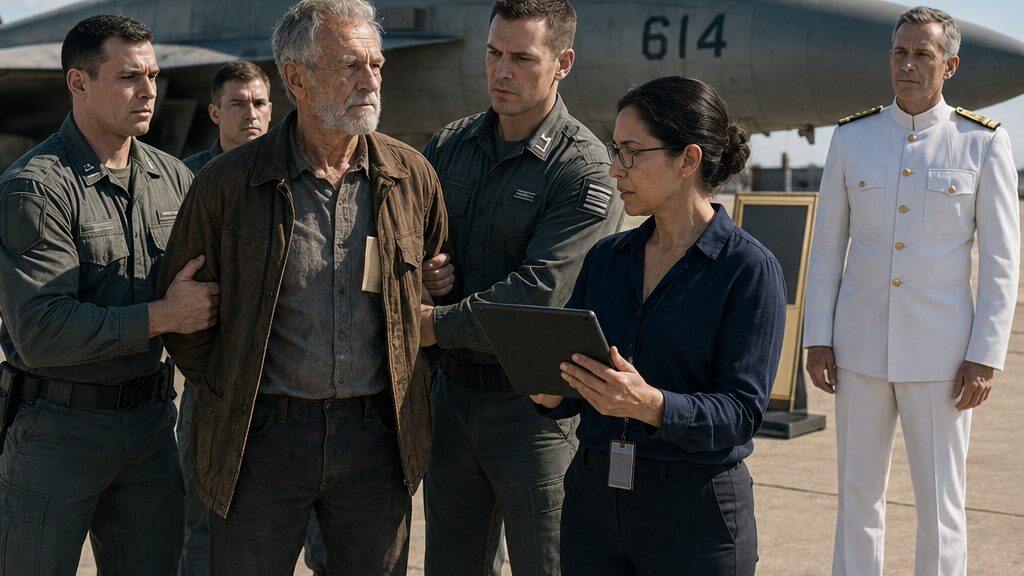
The lieutenant signaled to an airman at the gate. Not an arrest. Not yet. A visible escort.
Jack stepped away before anyone touched him.
The volunteer called after him. “Mr. Williams, veterans’ services is to your left.”
He did not answer.
He crossed the visitor lobby and went out into the heat. His sedan waited in the row where he had left it, dust along the rear window and one tire turned slightly toward the exit. He stood beneath the awning and watched guests stream through the gate with their phones raised.
Then he looked east.
Past the parking lot, a service road curved toward the maintenance hangars. In the years when he had commanded Calder, supply trucks had used a narrow pedestrian access near the fuel depot. The perimeter had been rebuilt since then, but the road remained, and so did the red warning beacon above the service gate.
Jack touched the envelope inside his jacket.
He had promised himself he would deliver it without disturbing anyone.
That promise no longer seemed possible.
He turned away from his car and began walking toward the service road.
Chapter 2: The Old Man Security Pulled Away From Aircraft 614
The service gate had changed, but the wind had not.
It came hard across the open concrete, carrying hot dust, jet fuel, and the sharp mineral smell of sun-struck metal. Jack stopped twenty yards from the barrier and studied the layout. A badge reader stood where a guard shack had once been. Beyond it, maintenance vehicles moved between painted lanes. Aircraft 614 rested farther out on the ceremonial apron, separated from the operational flight line by rope stanchions and temporary boards.
A catering truck rolled toward the gate.
The driver lowered his window, tapped a badge, and waited for the barrier to rise. Jack did not attempt to slip behind it. He moved to the side and raised one hand toward the security airman checking the truck’s rear seal.
“I need the ceremony access officer.”
The airman looked him over. “Visitor entrance is on the west side.”
“I came from there.”
“Then you need to go back.”
“Lieutenant Miller refused to verify an archived code.”
The airman’s eyes narrowed. “Stay where you are.”
Jack stayed.
The truck passed through. The barrier descended. A second airman came from the small control shelter, one hand resting near his radio.
“What archived code?”
Jack recited the sequence printed on the invitation.
Neither man recognized it.
“That sounds like an old challenge phrase,” the second airman said.
“It was an access category.”
“For what?”
“Command movement during restricted operations.”
The first airman gave a brief, uncomfortable laugh. “Sir, nobody calls it that anymore.”
“I know.”
“Who gave you the phrase?”
Jack looked through the fence at 614. Its retirement markings had been painted beneath the canopy. Someone had polished the skin around the nose, but not enough to hide the uneven rectangle on the left side where an emblem had once been removed.
“No one gave it to me.”
A radio crackled. The second airman answered, listened, and looked at Jack with a new expression.
“Lieutenant Miller is coming.”
Ryan arrived in a security vehicle less than two minutes later. He stepped out before it had fully settled, anger contained behind procedural calm.
“I told you to return to public parking.”
“You told me I had no access through the visitor checkpoint.”
“And now you’re testing a service gate.”
“I’m asking you to check the aircraft archive.”
“You are interfering with a restricted event.”
Jack nodded toward the jet. “The panel below the canopy used to carry a black compass crossed by a silver wing. It was removed after the Talon Reach review. Your ceremony timeline begins six months after that.”
Ryan’s gaze flickered toward the aircraft before returning to Jack.
“That information could be online.”
“It isn’t.”
“Then you may have served here.”
“I did.”
“So did thousands of people.”
Jack withdrew the folded invitation. “The archive will connect this code to 614.”
Ryan did not take it. “You’ve already been denied entry.”
“The invitation was not fake.”
“That is not the only issue anymore.”
“What is the issue?”
Ryan stepped closer. “The issue is that you came to a controlled access point after being directed away from the base. You’re quoting obsolete security language and making claims about restricted records. I need you to come with us to the visitor holding area.”
Jack glanced past him. A maintenance crew had wheeled a display board into position beside 614. He could see the title across the top: FORTY YEARS OF SERVICE.
Beneath it, photographs formed a chronological line.
There was a gap where the Talon Reach mission should have been.
Jack stepped sideways for a clearer view.
Ryan moved to block him. “Sir.”
“I need to read that board.”
“No.”
“Daniel Scott’s name should be on it.”
“Step back.”
Jack did not. He walked two measured paces toward the apron.
Ryan caught his arm.
The touch pulled the jacket sleeve tight across Jack’s shoulder. For a moment neither man moved.
“Release me,” Jack said.
Ryan’s face had gone pale around the mouth. “Do not resist.”
“I am not resisting.”
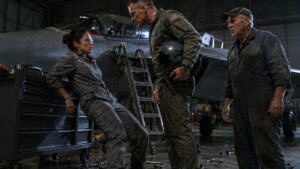
The two airmen took Jack’s other arm and turned him away from the flight line. The movement was practiced but harder than necessary. Pain traveled through Jack’s left shoulder. His envelope pressed against his chest.
Several ceremony workers stopped to watch.
A staff vehicle approached from the hangar. A tall officer in a white formal uniform stepped out, gold at his shoulders catching the sunlight. Colonel Nicholas Clark, according to the introduction Jack had read in the ceremony notice. Current wing commander. Jack had seen his photograph, though they had never met.
A woman carrying a tablet followed him.
Nicholas’s eyes moved from the guards to Jack. “What happened?”
Ryan kept hold of Jack’s arm. “Unauthorized individual attempting to enter the restricted apron after being denied at the visitor center.”
“I was invited,” Jack said.
Ryan spoke over him. “The document is obsolete and does not verify.”
The woman with the tablet approached. Her civilian badge identified her as Sarah Lopez, Command Archive and Protocol.
“May I see it?” she asked.
Ryan handed her the invitation.
Sarah examined the faded code, then entered it. The tablet chimed softly.
NO CURRENT ACCESS RECORD.
Ryan released a breath through his nose, vindicated. “There.”
Jack looked at Sarah. “That is the current directory.”
“Yes, sir.”
“Check aircraft history, not the guest list.”
Ryan tightened his grip. “We’re done checking.”
Sarah did not lower the tablet. “What should I search?”
“Tail number six-one-four. Former call sign Black Lantern.”
One of the maintenance workers turned at the words.
Sarah typed.
A file category appeared, then stopped behind a permissions request.
“Black Lantern isn’t in the ceremony record,” she said.
“No,” Jack replied. “It was removed with the emblem beneath the canopy.”
Nicholas glanced toward the bare rectangle on the aircraft’s side.
Jack continued. “Open legacy command authorization. Category Ash Meridian.”
Sarah stared at him.
Nicholas’s expression altered by a fraction. “That category was discontinued before I entered service.”
“It was discontinued because it failed during Talon Reach.”
Ryan shook his head. “Sir, he could have collected these terms from former personnel.”
Jack met his eyes. “Then verify them.”
“You are in no position to give instructions.”
“That is why I am asking.”
For the first time, Jack pulled slightly against the hands holding him—not to break free, but because the pressure on his shoulder had reached the point where silence would have looked like surrender.
The airmen reacted instantly, drawing his arms back.
The envelope slipped from inside his jacket and fell to the concrete.
Rebecca Hill’s name faced upward.
Jack stopped moving.
Nicholas saw it. “Who is she?”
“Daniel Scott’s daughter.”
“What do you want with her?”
“To give her what should have been given years ago.”
Ryan looked toward Nicholas. “Colonel, we should move him inside.”
“Wait,” Sarah said.
Her thumb moved across the screen. She had switched directories.
A black archive page replaced the ceremony interface. She entered the old category, then tail number 614. A warning asked for command-level confirmation. Nicholas supplied it.
The wind pressed Jack’s jacket against his ribs. The airmen still held him. A camera phone had appeared in the hands of a worker near the display boards, then lowered when Nicholas looked over.
Sarah read silently.
“What does it say?” Nicholas asked.
“The aircraft record is linked to a restricted command profile.”
“Open it.”
She did.
An old official photograph filled the top of the screen. Jack had been younger by nearly three decades, clean-shaven, his hair dark at the sides. Under the image appeared a sequence of assignments and titles.
Sarah’s face changed before she spoke.
Nicholas took one step closer to the tablet.
Ryan looked from the screen to Jack and back again.
“Lieutenant General Jack Williams,” Sarah said quietly. “Retired. Former commander, Calder Air Force Base. Former deputy commander, Air Combat Operations.”
The hands left Jack’s arms.
No one ordered them to.
Jack bent slowly and picked up the envelope. He brushed dust from Rebecca’s name, slid it inside his jacket, and straightened the sleeve Ryan had twisted.
The movement seemed louder than the aircraft engines beyond the apron.
Nicholas began, “General Williams—”
“Jack is sufficient.”
Ryan’s face had emptied of certainty. “Sir, I—”
Jack looked at him. “You should have checked before you touched me.”
Ryan lowered his eyes.
Nicholas stepped forward. “We were not informed you were attending.”
“You were. Your system forgot how to read its own invitation.”
Sarah still held the tablet between them. The archived photograph remained visible.
Nicholas glanced toward the ceremony area. “We’ll escort you to the distinguished guest section.”
“No.”
The answer unsettled them more than anger would have.
Jack pointed toward the tablet.
“Now search Daniel Scott.”
Chapter 3: The Name Missing From the Ceremony Program
Sarah Lopez had spent twelve years teaching old records to speak to new systems, but she had never seen a room become obedient so quickly.
Ten minutes earlier, Jack Williams had been held by both arms on the flight line. Now doors opened before he reached them.
The operations room overlooked aircraft 614 through a wall of reinforced glass. Ceremony schedules filled one screen. Weather, security, and airfield status filled three others. A staff member brought coffee without being asked. Another offered to find Jack a formal jacket.
He declined both.
Jack removed his brown field jacket only because the operations room was cold. He folded it once and placed it over the back of a chair. Without it, he looked smaller. His gray shirt hung loosely at the shoulders, and Sarah noticed the faint tremor in his left hand when he reached for the table.
Ryan stood near the door, silent.
Nicholas directed everyone else out except Sarah and the ceremony coordinator. When the room settled, he gestured toward the chair at the head of the table.
“Please.”
Jack chose the one beside it.
Nicholas noticed but did not argue. “General—Jack—I want to begin by apologizing for what occurred.”
Jack looked through the glass at 614. “Begin with the record.”
“We will. But your treatment was unacceptable.”
“It was unacceptable before you knew my rank.”
The ceremony coordinator studied the floor.
Ryan shifted near the door.
Jack turned to him. “Do you disagree?”
“No, sir.”
“Would you have released me if that tablet had shown I repaired vending machines here in 1989?”
Ryan’s throat moved. “I should have handled the verification differently.”
“That was not my question.”
“No,” Ryan said. “I probably would not have.”
Jack gave a single nod. He did not look satisfied.
Sarah connected her tablet to the main display. “I searched Daniel Scott under the ceremony database. There are three references, but none are biographical.”
She opened the first.
A maintenance log listed Captain Daniel Scott as assigned pilot during an avionics replacement cycle. The second was a routine crew roster. The third appeared in an operational casualty index under a group heading: CREW LOST DURING OPERATIONS.
No photograph. No description. No mission citation.
The ceremony coordinator leaned forward. “Our historical material came from the approved public archive.”
“That phrase is the problem,” Jack said.
Sarah searched the deeper aircraft record. Tail number 614 appeared across hundreds of entries: inspections, deployments, repairs, pilot assignments, weapons modifications, and retirement reviews. Daniel’s name occurred repeatedly for four years and then stopped.
The timeline prepared for the ceremony skipped from a training deployment to a modernization package six months later.
Between them lay an empty stretch of dates.
Sarah enlarged it on the wall display.
“There should be an operational entry here,” she said.
“There was,” Jack replied.
Nicholas folded his arms. “Talon Reach?”
Jack’s eyes moved to him.
“You recognized the authorization category outside,” Nicholas said. “I studied the review at command school. Only the summary.”
“Most people did.”
“The operation was classified after the loss.”
“The operation was classified before the loss. The loss made the classification useful.”
Sarah looked at him. “Useful to whom?”
Jack did not answer.
Nicholas stepped toward the screen. “The public summary says a rescue attempt was aborted after navigation failure and hostile weather. One pilot was lost.”
“One pilot was named Daniel Scott.”
“And 614 was involved?”
Jack nodded.
The ceremony coordinator opened her printed program. “The approved aircraft narrative mentions an interrupted recovery mission, but no names. It says the records remain incomplete.”
“They are not incomplete,” Jack said. “They are separated.”
Sarah returned to the legacy archive and followed the authorization chain attached to Black Lantern. The file structure branched into command decisions, maintenance warnings, communications logs, and sealed testimony. Several documents were locked behind retirement-era restrictions that should have expired years earlier.
One item carried Jack’s authorization code.
She selected it.
A warning filled the display:
RESTRICTED COMMAND STATEMENT
TALON REACH REVIEW
AUTHORIZING OFFICER: WILLIAMS, JACK
STATUS: SEALED BY REQUEST
SUBJECT: COMMAND RESPONSIBILITY ACCEPTED
Sarah felt the atmosphere shift again, but differently this time.
Outside, workers tested the ceremony sound system. A few notes of music drifted through the reinforced glass and disappeared beneath the ventilation fans.
Nicholas read the title twice. “You sealed your own statement.”
“Yes.”
“Why?”
“Because it contained names that were not supposed to become arguments.”
“Daniel’s?”
“And others.”
The ceremony coordinator turned pages as if the answer might be printed somewhere she had missed. “The program has already gone to every guest. The opening remarks refer to the approved historical record.”
Jack looked at her. “Then the opening remarks are wrong.”
“We can amend a verbal introduction, but changing the official historical display this close to the event would require review.”
“By whom?”
“Public affairs, command history, legal—”
“The aircraft will be retired in less than three hours.”
“That is why a full review isn’t realistic.”
Jack leaned back. For the first time, weariness showed openly on his face.
Sarah looked at the folded jacket. The dark mark near the cuff appeared almost black beneath the fluorescent lights.
Nicholas said, “We can place you in the distinguished guest section while we investigate. Your presence alone would mean a great deal to the squadron.”
Jack’s eyes hardened.
“You think I crossed the country to sit beneath a canopy while you announce the wrong history?”
“I think we can honor your service without making an unverified change.”
“My service is not the missing part.”
Nicholas held his gaze. “Then help me understand what is.”
Jack pointed to the blank portion of the timeline.
“A pilot stayed in the air after his recall. That is the fact your summary kept. It omitted why he stayed. It omitted who came home because he did. Then it buried his name beneath a phrase broad enough to mean nobody.”
The room was silent.
Sarah searched Daniel’s personnel record. A restricted marker redirected her to the sealed review. The system would not proceed without authorization from the original commanding officer or a legal release.
She looked at Jack.
“You can open it.”
“I can request it.”
“The record says you are the surviving authorizing officer.”
Jack’s right hand moved toward the jacket cuff, though the jacket hung beyond his reach. His fingers closed on empty air before settling on the table.
Ryan spoke from the doorway.
“Was Captain Scott under your command?”
Jack did not look at him. “Yes.”
“Did he disobey your order?”
Nicholas turned sharply, but Jack raised a hand.
“That is the question the record was built to answer,” he said.
“And did it?”
Jack stared at the words on the display: COMMAND RESPONSIBILITY ACCEPTED.
“It answered the question command wanted answered.”
Sarah felt her earlier awe thinning into unease. This was no forgotten honor waiting to be restored by opening the correct screen. Jack had not merely disappeared from the base’s memory. He had placed part of that memory behind a locked door himself.
A knock sounded.
The ceremony coordinator opened it a few inches. A staff member whispered to her and handed over another printed program.
She looked toward Jack.
“Rebecca Hill has arrived.”
Jack’s face changed—not with surprise, but with the recognition of a moment he had delayed too long.
“Where is she?”
“In the hangar reception area. She asked why her father’s name isn’t on the aircraft display.”
The coordinator held up the program.
“She says the only reference to him is this.”
Jack did not move.
Sarah already knew the line.
Crew lost during operations.
The door opened wider.
A woman stood beyond it with the ceremony program folded in one hand. Her eyes passed over Nicholas, Sarah, and Ryan before stopping on Jack.
She looked first at his face.
Then at the brown jacket hanging from the chair.
“General Williams,” Rebecca Hill said. “Why does this base remember my father as if he never had a name?”
Chapter 4: The Order Jack Williams Never Tried to Defend
Rebecca’s question remained in the doorway after every other sound in the operations room had faded.
Jack rose too quickly. The chair legs scraped the floor, and pain caught in his left shoulder where the guards had pulled it back. He steadied himself against the table before anyone could offer help.
Rebecca noticed.
She was in her mid-forties, with Daniel’s narrow face and the same habit of holding anger very still. The folded program in her hand had been crushed along one edge. She looked past Jack toward the display, where COMMAND RESPONSIBILITY ACCEPTED remained in white letters against a black archive screen.
“You knew I was coming,” she said.
Jack touched the envelope beneath his shirt. “Yes.”
“And you still planned to let me sit through this?”
“No.”
“You planned something. You carried my name onto the flight line.”
Nicholas stepped forward. “Ms. Hill, perhaps we should move this conversation somewhere private.”
Rebecca’s eyes stayed on Jack. “It has been private for twenty-seven years.”
Jack put on his field jacket. The familiar weight settled over his shoulders, hiding the envelope again. “There’s an empty briefing room beside the archive office.”
Rebecca gave a brief, humorless nod. “Of course you know where everything is.”
The room had once been used for weather briefings. Most of the equipment had been removed, leaving pale rectangles on the walls where maps and monitors had hung. A long table occupied the center. Through a narrow window, the wing of aircraft 614 cut across the bright sky.
Sarah brought the tablet. Nicholas followed. Ryan remained outside after Nicholas told him to return to security duties, though Jack saw him through the glass, standing motionless in the corridor before he finally walked away.
Rebecca placed the program on the table.
The line about Daniel sat near the bottom of the aircraft’s service history.
CREW LOST DURING OPERATIONS.
“My father was not crew,” she said. “He was a pilot. He had a name. He had a wife and a child. But every time I requested records, I received the same paragraph about an aborted mission and an officer who ignored recall orders.”
Jack sat across from her.
“Your father remained in restricted airspace after recall,” he said.
“So the paragraph was true.”
“It was incomplete.”
“You signed it.”
Jack looked at the tablet. Sarah had opened the index but not the sealed statement. Beside the file title appeared his old command authorization code.
“Yes.”
Rebecca leaned back as if distance might make him easier to understand. “My mother believed you blamed him.”
“I never said that.”
“You never said anything.”
That landed where accusation could not.
Nicholas took the chair near the wall rather than joining them at the table. Sarah stood beside the archive console, waiting.
Jack rested his right hand over the stained cuff of his jacket. The mark was small, no larger than two fingers pressed together. Under the fluorescent light it looked like grease. It had not begun as grease.
“Talon Reach was supposed to recover two pilots from a damaged aircraft crossing the northern range,” he said. “Weather closed faster than predicted. Ground navigation failed. Communications began dropping in and out.”
Rebecca watched him without blinking.
“Aircraft 614 carried your father. He located the damaged jet when the rest of us had lost it. I ordered him to mark their heading and return.”
“But he stayed.”
“Yes.”
“Why?”
“The full answer is in the sealed record.”
“Then open it.”
Nicholas spoke carefully. “The file includes operational details that may affect people beyond this room. Some are dead. Some are not.”
Rebecca turned on him. “My father is dead too.”
Jack’s fingers tightened around the cuff. The fabric had been new that night, issued before a cold-weather inspection. He remembered standing near the runway while rain drove sideways beneath the floodlights. A fuel line had ruptured on a maintenance cart after an alarm sounded. Someone had wiped the spray from his sleeve, but the stain had remained.
He had waited in that jacket until dawn, long after the other aircraft returned.
“Daniel’s decision was reviewed as possible insubordination,” Jack said.
Rebecca’s mouth hardened. “And you agreed?”
“I agreed to accept command responsibility for the mission.”
“That isn’t the same thing.”
“No.”
“Did you order him to stay?”
“No.”
“Did you order him to leave?”
“Yes.”
She looked toward the window, where 614 sat motionless beyond the glass. “Then why did you protect him?”
Jack did not answer.
Sarah shifted beside the console. “The sealed statement may explain why the public file omits his name. It appears to have been separated from the ordinary casualty record when the review closed.”
“By whose request?” Rebecca asked.
Sarah looked at Jack.
Rebecca followed her gaze. “Yours.”
“The request prevented the review finding from being attached to Daniel’s public service record,” Jack said.
“And it also erased everything else.”
“At the time, the alternative was worse.”
“For whom?”
“For your father.”
Her hand flattened over the program. “You decided that.”
“Yes.”
“And then you vanished.”
Jack looked down at the stain on his cuff. “I attended the funeral.”
“You stood in the back.”
“Your mother did not want command representatives near the family.”
“She did not want you near us. She thought you had sent him into weather he couldn’t survive and blamed him when he didn’t come home.”
Jack lifted his eyes. “I know.”
“You let her believe it.”
“The investigation was classified.”
“That is a regulation, not an answer.”
Nicholas glanced toward Jack, but did not intervene.
Jack had spent years explaining difficult decisions in rooms full of officers. He had spoken before review boards, committees, and families waiting for news. Language had once been a tool he could place exactly where it was needed.
Now every sentence seemed designed to protect him.
“I thought silence was the last thing I could still do for him,” he said.
Rebecca stared at him. “You were wrong.”
“Yes.”
The admission altered her expression, but did not soften it.
Sarah touched the archive screen. “There is another problem. Even if General Williams authorizes review, the file may contain protected testimony from surviving personnel.”
“Can it be separated?” Nicholas asked.
“Possibly. Legal would need to examine the attachments.”
“The ceremony begins in less than two hours.”
Jack looked at Nicholas. “Then postpone it.”
“The guests are already arriving.”
“So is the truth.”
Nicholas rose and walked to the window. Below, workers adjusted ropes around 614. The ceremonial podium had been rolled into place.
“This aircraft’s history has been approved at multiple levels,” he said. “Opening a sealed command record today could damage reputations without giving anyone time to respond.”
Jack’s voice remained low. “A polished omission already damaged one.”
Nicholas turned. “And if the file shows Captain Scott ignored a direct order?”
“Then the record should show why.”
Rebecca looked from one man to the other. “That is what neither of you has said.”
Jack felt the envelope against his chest again, its paper softened from years of being handled and returned to storage.
He had believed he came to deliver it.
Now he understood that the envelope had been the easier task.
Rebecca picked up the program and opened it to the history page. She pressed one finger against the line that had reduced Daniel to an unnamed loss.
“Does the sealed file prove my father disobeyed orders,” she asked, “or does it prove you lied to protect someone else?”
Chapter 5: The Daughter Who Thought the General Had Blamed Him
Rebecca had imagined meeting Jack Williams many times, but never with his worn jacket hanging from his shoulders and her father’s aircraft visible behind him.
In her earliest version, she had been a child and he had come to their house in full uniform. He would kneel so she did not have to look up at him and tell her something precise enough to make death understandable.
Later versions were less forgiving. She would meet him in a courthouse corridor or outside a veterans’ event. She would ask one question, and his face would betray the answer before he could retreat behind official language.
She had never imagined him looking old.
That disturbed her more than she wanted to admit.
Nicholas arranged for the hangar reception area to be cleared. Rows of tables stood beneath banners printed with aircraft 614’s tail number. Coffee urns steamed near one wall. Framed photographs had been placed on easels for guests to view before the ceremony.
Jack moved slowly among them, searching.
Rebecca followed at a distance. Sarah remained with Nicholas in the archive office to begin the legal review.
Near the last table, Jack stopped before a photograph taken under harsh floodlights. A group of pilots and maintenance personnel stood beside 614. Most were smiling badly, as people did after a long shift when someone insisted on recording the moment.
Daniel stood near the nose, one hand resting on the ladder.
Jack was behind him in a clean brown field jacket.
Rebecca came closer.
“That’s the one,” she said.
Jack did not ask what she meant.
“My mother kept a copy in a drawer. She cut you out.”
He looked at the photograph. “I don’t blame her.”
“The jacket is the same.”
“Yes.”
“You kept it for twenty-seven years?”
“It still worked.”
She almost laughed, but anger stopped it. “Is that why you wore it today? So someone would recognize you?”
“No.”
“Then why?”
Jack touched the stained cuff. “I wore it because this was the last place it meant anything.”
Rebecca studied the stain. In the old photograph, the sleeve was clean.
“What happened to it?”
“Later that night, a fuel line split near the runway.”
“The night my father died.”
“Yes.”
The hangar doors stood partly open, allowing the wind to move through. It stirred the edges of the photographs and carried distant announcements from the ceremony area.
Rebecca walked to the next easel. The picture showed aircraft 614 during a training deployment. Her father’s name appeared in the caption there, small but readable.
“So they didn’t forget him completely.”
“No.”
“They remembered the years that were easy.”
Jack stood beside her.
She unfolded the ceremony program again. “I wrote to you after my mother died.”
“I received the letter.”
“You never answered.”
“No.”
“Why?”
He considered the question longer than she thought it deserved. “Because every answer began with information I could not release, and ended with an apology I did not know how to make.”
“You were a general. You knew how to write difficult letters.”
“I knew how to write official ones.”
“That is not better.”
“No.”
His agreement irritated her. She had spent years preparing for denial. Remorse offered no surface to strike.
A scholarship display stood across the hangar, decorated with photographs of students who had received funding for aviation and engineering programs. The title read THE DANIEL SCOTT FUTURE FLIGHT AWARD.
Rebecca looked at it, then back at Jack.
“You know about that.”
“Yes.”
“The donor was anonymous.”
Jack said nothing.
Her pulse changed.
“My mother thought it came from the squadron.”
“Part of it did.”
“And the rest?”
Jack’s gaze moved toward the open hangar doors.
Rebecca walked to the display. A small plaque thanked an unnamed retired officer for establishing the original endowment. She had read those words before without imagining a face.
“You paid for it.”
“I contributed.”
“How long?”
“Until it could sustain itself.”
“You could send money, but you couldn’t write three sentences to my mother.”
Jack’s jaw tightened. It was the first defensive movement she had seen from him.
“The money required nothing from her.”
“That is exactly the problem.”
He looked at her.
“You chose the kind of help that let you stay hidden,” she said. “You could tell yourself you were protecting us without ever hearing what we needed.”
Jack lowered his eyes.
Rebecca felt a brief, dangerous satisfaction, then hated it. He looked not defeated but exposed, and exposure was not the same as truth.
“My mother died believing Daniel had made a selfish choice,” she said. “She believed he stayed because he wanted to be a hero.”
“He did not.”
“You knew that.”
“Yes.”
“And you let her carry it.”
“I believed the classified finding would eventually be corrected.”
“You commanded the base.”
“I did not command time.”
“No. You only trusted it to do what you were afraid to do.”
Jack stepped away from the photographs. The light through the open doors showed the deep lines around his mouth.
“You are right,” he said.
Rebecca folded her arms. “Do not agree with me just because you think accepting blame is honorable.”
His head lifted.
“That may work in a review,” she continued. “It does not work with me. I need to know what happened.”
“I intend to tell you.”
“When the lawyers approve it?”
“When the file is opened.”
“You still need a document between us.”
“The document contains voices besides mine.”
“And without it?”
“Without it, you would have only my version.”
She looked at the old photograph again. Daniel’s grin seemed careless until she noticed the fatigue beneath it.
“What was he like under your command?”
Jack’s face softened, though the answer did not come easily. “Impatient with bad planning. Patient with frightened people. He spoke too quickly on the radio when he thought someone was wasting time.”
Rebecca remembered her father correcting a bicycle chain while explaining every tool as if she were already old enough to understand.
“He hated ceremonies,” she said.
“Yes.”
“He would have hated this.”
“He would have objected to the banners.”
“And attended anyway.”
“For the maintainers.”
They shared the memory without having shared the man in the same years.
A tone sounded from Jack’s pocket. He removed an old phone and read a message.
“Sarah found the mission packet,” he said. “She can separate the protected testimony, but the command statement must be opened first.”
Rebecca looked at the envelope shape beneath his jacket. “Is that what you came to give me?”
“Yes.”
“What is it?”
“Something your father wrote before the mission.”
Her breath caught, but she did not reach for it.
“You had that all this time?”
“Yes.”
“Why?”
Jack’s hand covered the envelope through the fabric. “Because after the funeral, your mother returned everything sent from command. I told myself I would deliver it when the review was complete. Then when the classification changed. Then when you were older.”
“And after I wrote to you?”
He had no answer that did not sound like fear.
Rebecca moved closer until only the corner of the display table separated them.
“Does that envelope explain what happened?”
“No.”
“Then keep it for now.”
Surprise crossed his face.
“I do not want another piece of my father without the truth attached to it.”
A maintenance cart passed outside. Its wheels rattled across a seam in the concrete.
Rebecca looked at aircraft 614 beyond the hangar, then at the jacket from the photograph.
“When we open that file,” she said, “I want one question answered before anything else.”
Jack waited.
“Does it prove my father disobeyed your order,” she asked, “or does it prove you lied to protect someone else?”
Chapter 6: What the Sealed Mission Record Said About Daniel Scott
The secure archive room had no windows.
Jack had approved its construction during his command, when records still arrived in locked cases and officers signed paper logs before entering. Now the shelves were gone. Two consoles stood beneath recessed lights, and a tablet rested in the center of the table like an object awaiting judgment.
Sarah had separated the protected testimony from the command packet. Nicholas stood beside her. Rebecca sat across from Jack, the ceremony program closed beneath her hands.
On the tablet, aircraft 614’s final mission path appeared as a thin blue line.
It traveled north, curved over the range, and then doubled back.
A second line, amber and broken, represented the damaged aircraft carrying two young pilots. During the navigation blackout, it drifted east toward higher terrain.
Sarah enlarged the map.
“At 21:14, command issued recall to all recovery aircraft,” she said. “At 21:16, Captain Scott acknowledged.”
The audio transcript appeared beside the lines.
614 ACKNOWLEDGES RECALL. VISUAL CONTACT INTERMITTENT. DAMAGED AIRCRAFT UNABLE TO HOLD HEADING.
Rebecca leaned forward.
Sarah continued. “At 21:18, Captain Scott reported that the other aircraft’s navigation system had failed completely.”
Jack remembered each second without needing the screen.
He had been in the operations center, listening to Daniel’s voice break through static. The weather wall showed a storm swallowing the northern range. Senior command had ordered the recovery terminated. Too many aircraft were already exposed.
Jack had repeated the recall himself.
Daniel answered.
UNDERSTOOD. MARKING THEIR SOUTHWEST CORRIDOR.
But 614 did not turn south.
The blue line remained beside the broken amber one.
“What did he do?” Rebecca asked.
Jack spoke before Sarah could read it.
“He used his own aircraft as their reference point.”
Rebecca looked at the map. “He guided them?”
“For thirty-one minutes.”
“In that weather?”
“Yes.”
Nicholas read the next portion. “The damaged aircraft regained limited control and followed 614 through the mountain corridor.”
“They could see his lights,” Jack said. “Sometimes only for a few seconds.”
Sarah advanced the record.
At 21:39, the amber line turned south.
The blue line continued west, then became irregular.
“Daniel reported an electrical failure,” Sarah said. “He had also lost fuel faster than the initial estimate.”
Rebecca’s hands tightened over the program. “Did he know?”
“He knew before the second recall,” Jack said.
“And stayed anyway.”
“Yes.”
The protected witness summary appeared next. The two surviving pilots had testified that without 614’s position lights and radio calls, they would have entered the eastern ridge.
Rebecca read the words silently.
“He saved them.”
“He brought them far enough south for ground navigation to recover them,” Jack said.
“What happened to him?”
“His systems failed before he reached the alternate runway.”
The tablet showed the blue line ending several miles west of Calder.
No one spoke for a moment.
Rebecca’s voice was smaller when she asked, “Then why did the review call it insubordination?”
Nicholas looked toward Jack.
Jack rested his hands on the table. The stained cuff touched its edge.
“Because the mission had been ordered closed,” he said. “Daniel acknowledged recall and remained. Under the regulations, that decision required review.”
“But the pilots lived.”
“That did not erase the order.”
“So you accepted responsibility.”
“Not immediately.”
Sarah opened the command sequence.
The initial review recommendation classified Daniel’s continued action as unauthorized deviation resulting in loss of aircraft and life. A second document recommended notation of reckless noncompliance in his service record.
Rebecca stopped reading.
“No.”
Jack remembered the review room: polished table, closed blinds, officers speaking carefully because every word might later appear before a committee. They had praised Daniel’s intent while reducing his final choice to a breach of discipline.
“The command above Calder wanted a clean conclusion,” Jack said. “The recovery had failed. An aircraft was lost. Weather forecasting had been wrong, maintenance warnings had not been elevated, and the navigation blackout exposed a weakness no one wanted examined publicly.”
Sarah brought up the maintenance attachments. Several reports had warned of intermittent electrical faults in 614’s emergency systems. Each carried signatures from maintainers and routing marks showing they had moved upward without action.
Nicholas’s face tightened.
“These warnings were not included in the public review,” he said.
“No,” Jack replied.
“Who withheld them?”
“The operational headquarters overseeing Talon Reach.”
Rebecca looked at him. “That is who you protected.”
“Not by intention.”
“But you did.”
Jack accepted the words.
The review board had offered him two paths. Allow the finding against Daniel to stand, preserving the operation’s official chain of command, or accept responsibility for authorizing continued recovery conditions and request that the pilot finding be sealed with the command record.
“I signed a statement saying the failure was mine,” Jack said. “I stated that the mission conditions, recall timing, and aircraft readiness were command responsibilities. The board withdrew the notation against Daniel.”
“And sealed everything,” Rebecca said.
“Yes.”
“Why not expose the maintenance warnings?”
“Because doing so then would have revealed the recovery route, the navigation weakness, and the identities of the surviving pilots. The operation remained classified.”
“That explains then.”
Jack looked at her.
“It does not explain twenty-seven years.”
“No.”
Sarah scrolled to later review dates. The operational details had been partially declassified nine years earlier. The sealed command statement, however, had remained restricted by request of the authorizing officer.
Jack’s name appeared beneath it.
Rebecca stared at the screen. “You renewed the seal.”
“Twice.”
“Why?”
The room seemed to contract around the question.
Jack had rehearsed answers over the years. Daniel’s reputation had been protected. The survivors had rebuilt their lives. The old headquarters had dispersed. Reopening the record might invite arguments about whether Daniel had acted bravely or irresponsibly.
Each explanation contained truth.
None contained enough.
“I told myself that as long as the finding against him stayed buried, he was safe,” Jack said.
“Safe from what?”
“Being debated by people who had not been there.”
“He was already dead.”
“Yes.”
“Then who were you protecting?”
Jack looked at the tablet, at the blue line ending before the runway.
“Myself.”
Nicholas lowered his gaze.
Jack continued because stopping would turn the admission into another controlled fragment.
“If the record opened, I would have to face your family. I would have to explain why I ordered him home and why he stayed. I would have to say that I knew his choice saved two men, but I let the official silence become the story everyone remembered.”
Rebecca’s eyes shone, though her voice remained steady. “You thought accepting blame made you loyal.”
“I did.”
“It made you absent.”
“Yes.”
Sarah turned the tablet so the authorization panel faced Jack.
The release required three confirmations. One acknowledged that protected testimony had been removed. One authorized declassification of his command statement. The last allowed the base history office to amend the public aircraft record.
Nicholas said, “Once this is released, the maintenance failures and the upper-command review will become part of the historical record. There may be an inquiry.”
“There should have been one years ago.”
“It may also reopen criticism of Captain Scott’s refusal to return.”
Rebecca looked at Jack. “Will you defend him this time?”
Jack did not reach for the tablet immediately.
“He disobeyed a recall order,” he said. “I will not turn him into someone flawless to make the story easier.”
Rebecca’s expression tightened.
“But the record will also say why he stayed, who came home, what he knew about his aircraft, and what command failed to do before he took off. The whole truth can withstand questions. Silence cannot.”
He entered the first confirmation.
The tablet requested his archived command code.
His fingers paused over the screen. He could hear rain against an old operations window, Daniel’s voice through static, the final acknowledgment that never became a return.
Jack entered the code.
The second confirmation opened.
He approved it.
Before the final authorization, Sarah displayed the proposed public summary. It named Daniel Scott. It named the two surviving pilots only by protected designation. It included the maintenance warnings, Jack’s recall order, Daniel’s decision to remain, and the finding that his guidance enabled the damaged aircraft to clear the mountain corridor.
No decoration. No claim of perfection.
A record.
Rebecca read it twice.
“Do you want anything changed?” Jack asked.
She looked at the sentence describing Daniel’s choice.
“No.”
Jack pressed the final authorization.
RELEASE APPROVED appeared on the tablet.
For several seconds, no one moved.
Then Nicholas’s phone vibrated. He read the message from the ceremony staff.
“Guests are being seated,” he said. “The program begins in forty-five minutes.”
Sarah glanced at the digital schedule. “The displays can be updated, but printed programs cannot.”
“The opening remarks can,” Jack said.
Nicholas looked at him. “Public affairs will resist changing a reviewed historical narrative minutes before a live event.”
“Then let them resist.”
“They will argue that the ceremony cannot become an investigation.”
“It does not need to.”
Nicholas waited.
Jack closed the old program beneath Rebecca’s hands.
“Name Daniel. Name the maintainers whose warnings were ignored. State that the prior summary was incomplete and that a corrected record has been released. Do not turn him into a symbol. Do not turn me into one either.”
“The event was prepared to recognize the aircraft and its service.”
“Then recognize the service that cost something.”
Nicholas studied him. “We had intended to introduce you once your identity was confirmed.”
“I will not be introduced as guest of honor.”
“You are a former commander of this base.”
“That is not why I came.”
Nicholas’s posture became formal without becoming cold. “What are you asking me to do?”
Jack looked through the sealed room as if he could see the flight line beyond it.
“Stop the program you prepared,” he said. “Correct it.”
“And if command refuses?”
Jack placed the tablet between them.
“Then hold the ceremony without me.”
Chapter 7: The Ceremony Could Honor the Truth or Continue Without Him
Nicholas Clark had spent the morning preparing for every kind of failure except the truth.
He had alternate seating plans for heat, wind, rain, medical emergencies, delayed aircraft movement, and a visiting official arriving without notice. He had rehearsed what to say if the sound system failed and where to move the families if lightning appeared beyond the western ridge.
There was no contingency for discovering, forty minutes before the ceremony, that the approved history was false by omission.
The staging office stood behind the temporary platform, separated from the flight line by canvas walls that snapped in the wind. The public-affairs officer read the amended summary from Sarah’s tablet, then removed his glasses.
“We cannot put this into opening remarks without review.”
“The review has been released,” Nicholas said.
“A retired commander authorized release of his own statement less than twenty minutes ago.”
“A statement supported by maintenance reports, flight records, and witness testimony.”
“That does not make it ready for public distribution.”
Sarah stood near the folding table, updating the ceremony tablets one by one. On each screen, the old timeline disappeared and a new entry appeared beneath aircraft 614:
TALON REACH RECOVERY MISSION
CAPTAIN DANIEL SCOTT
GUIDANCE ACTION ENABLED DAMAGED AIRCRAFT TO CLEAR NORTHERN RIDGE
The public-affairs officer pointed toward the display. “That language alone will generate questions.”
“It should,” Sarah said.
The ceremony coordinator held a stack of printed programs against her chest. “We have four hundred copies with the old wording.”
“Leave them on the chairs,” Nicholas said.
She stared at him. “Colonel?”
“We cannot pretend they do not exist. Announce that the historical record was corrected this afternoon and direct guests to the digital version.”
The officer shook his head. “That exposes the base to embarrassment.”
Nicholas looked through the opening in the canvas wall.
Jack stood beyond the VIP enclosure beside Rebecca. Neither had taken a seat. Jack’s field jacket moved in the wind, its brown fabric plain against the white uniforms and summer dresses around him. Several retired officers had recognized him. They kept glancing his way, uncertain whether to approach.
Jack ignored the reserved car that had been brought to the staging lane.
“He was restrained on our flight line because we refused to verify his identity,” Nicholas said. “Embarrassment has already occurred.”
“That incident can be handled internally.”
Jack had not asked for it to remain internal. He had not asked for it to become public either. His condition concerned Daniel, the maintainers, and the record.
That made Nicholas more ashamed than any demand for punishment would have.
The public-affairs officer lowered his voice. “Command will ask why you changed a reviewed ceremony minutes before it began.”
“I will tell them.”
“You may be relieved before you finish telling them.”
“Then someone else can close the event.”
Silence settled over the staging office.
Nicholas had entered the morning believing command meant removing uncertainty before it reached other people. Jack had reminded him that certainty could be manufactured by excluding inconvenient facts.
Ryan appeared at the entrance.
His uniform was still neat, but the confidence he had worn at the checkpoint was gone. He carried a single printed page.
“Colonel, may I speak with you?”
Nicholas followed him behind the canvas partition.
Ryan held out the page. It was the access incident report, already completed.
“I included the delay in archive verification and my order to restrain Mr. Williams.”
“General Williams.”
Ryan’s face tightened. “Yes, sir.”
Nicholas did not take the report. “Would you have written it differently if the tablet had shown he was an unemployed civilian?”
Ryan looked toward the ground.
“That is the question he asked you,” Nicholas said.
“I know.”
“And?”
“I might have described him as agitated.”
“Was he?”
“He stepped toward the aircraft after I ordered him back.”
“That is not what I asked.”
Ryan breathed in. “No. Not until we took his arms.”
Nicholas took the report and read it. Ryan had crossed out one phrase and rewritten it by hand. The original wording remained faintly visible:
SUBJECT BECAME COMBATIVE.
The replacement read:
SUBJECT ATTEMPTED TO CONTINUE TOWARD DISPLAY; NO STRIKE, THREAT, OR ATTEMPT TO EVADE.
“Why are you showing me this?”
“Because I wrote the first version before we identified him.”
Nicholas met his eyes.
Ryan continued. “I made his behavior fit what I had already decided he was.”
From the ceremony area came the soft rise of conversation as guests found their seats.
“What do you expect me to do?” Nicholas asked.
“Whatever the regulations require.”
“Jack did not request your removal.”
Ryan looked surprised.
“He requested a verification rule,” Nicholas said. “Before physical escalation, when an elderly or apparently confused visitor presents no immediate danger, security must make a second identity and purpose check.”
Ryan absorbed that slowly. “After what I did, that is all he asked?”
“That is not all. He asked that you understand why the rule is necessary.”
Ryan looked at the old programs stacked inside the staging office.
“I do.”
“Not because he was a general.”
Ryan’s jaw tightened. “No, sir.”
Nicholas returned the report. “Submit it exactly as written. Then bring me a draft procedure before the end of the day.”
“Yes, sir.”
As Ryan turned away, Nicholas called him back.
“Lieutenant.”
Ryan stopped.
“You will remain on duty for the ceremony.”
The young officer’s face showed neither relief nor disappointment.
“You will watch what happens when an institution corrects itself in public,” Nicholas said. “Then you will decide whether your report is complete.”
Inside, Sarah handed Nicholas the final tablet. The revised program was ready.
The public-affairs officer stood with his arms folded. “What are you going to say?”
Nicholas looked again toward Jack and Rebecca.
Jack had taken the envelope from inside his jacket. He held it at his side but had not given it to her. Rebecca watched the ceremony platform, waiting to see whether the base would restore her father’s name or ask her to accept another delay.
Nicholas removed the prepared opening remarks from his folder.
He tore them once across the middle.
The ceremony coordinator flinched.
“Begin with the aircraft,” he said. “Then the maintainers. Then Captain Scott. General Williams will be introduced only if he chooses to enter.”
“And if he does not?”
Nicholas placed the amended tablet on top of the torn speech.
“Then we will tell the truth without using him as proof that it matters.”
The first music cue sounded across the flight line.
Guests turned toward the platform. Uniformed personnel took their places. On the digital displays beside aircraft 614, the old timeline vanished.
Jack remained outside the VIP enclosure with Rebecca.
Nicholas walked toward the podium, carrying no prepared speech, while the entire base waited to discover which history he would choose.
Chapter 8: He Kept the Worn Jacket and Gave the Honor Away
At sunset, aircraft 614 no longer looked polished.
The lowering light revealed every repaired seam, every replaced panel, every faint difference in the gray paint. Its years showed plainly now. Jack preferred it that way.
Nicholas stood at the podium without the speech that had been approved that morning.
He began with the aircraft’s service dates. Then he spoke about the maintainers who had kept it flying through heat, sand, winter storms, and long nights when repairs were measured against departures before dawn.
When he reached Talon Reach, his voice slowed.
“The history distributed for today’s ceremony was incomplete,” he said. “A corrected record was authorized this afternoon. It acknowledges maintenance warnings that were not included in the original public account. It also restores the name of Captain Daniel Scott.”
Rebecca did not move beside Jack.
Across the seated crowd, several heads turned toward her.
Nicholas did not ask her to stand.
He described Daniel’s recall, his decision to remain near a damaged aircraft, and the two pilots who cleared the northern ridge by following 614’s lights and radio calls. He did not call the choice flawless. He did not reduce it to disobedience. He gave the facts enough room to remain difficult.
Then he named the maintenance personnel whose warnings had been routed upward and ignored.
The maintenance chief lowered his head.
On the display beside the aircraft, the corrected mission path appeared: one broken amber line, one steady blue line remaining beside it until the mountains were behind them.
Jack watched Rebecca read her father’s name.
Only after the account was complete did Nicholas look toward him.
“Lieutenant General Jack Williams, retired, commanded Calder during that mission. His statement accepting command responsibility was released today. He has asked not to be honored for carrying a truth he should have shared sooner.”
The crowd became still.
Jack had expected surprise. He had not expected relief.
For years, people had remembered fragments: a failed recovery, a lost pilot, a commander who accepted blame and disappeared from public military life. The corrected record did not transform the past into victory. It simply returned the missing people to it.
Nicholas left the podium.
No one applauded immediately. The silence was too full for that.
Then the maintenance chief stood. Not for Jack. He faced aircraft 614 and remained standing.
Others followed slowly—retired squadron members, current airmen, families. The gesture spread without instruction.
Jack stayed where he was outside the enclosure.
Rebecca turned to him. “Are you going to speak?”
“Only if you want me to.”
“My father hated ceremonies.”
“He did.”
“He would say this is already too much.”
“He would complain about the banners.”
A small smile touched her mouth and disappeared.
“Say what the record cannot,” she said.
Jack walked toward the platform.
No escort preceded him. No announcement repeated his rank. His boots sounded against the concrete, and the old jacket moved around his thin frame in the evening wind.
Ryan stood near the edge of the flight line. His eyes met Jack’s briefly, then lowered.
At the podium, Jack looked at the tablet rather than the crowd. Daniel’s name remained on the screen beside the mission line.
“Captain Scott was ordered home,” Jack said. “He acknowledged that order and stayed long enough to guide another aircraft out.”
His voice carried without force.
“That choice should be examined honestly. Service is not improved by pretending difficult decisions were simple. But honesty also requires saying what his choice accomplished, what failures placed him there, and who returned because he remained.”
He rested one hand against the podium.
“I accepted responsibility for the mission. Later, I mistook silence for responsibility. Those are not the same thing.”
Rebecca stood alone beside the empty VIP chairs.
Jack looked toward her.
“Daniel’s family received an official account without his courage and without command’s failures. I told myself I was protecting his name from argument. In truth, I was protecting myself from the people who had the right to question me.”
The wind lifted the corner of the corrected program on the tablet stand.
Jack pressed it flat.
“No rank makes that silence noble. No rank makes a person worthy of ordinary decency either. This morning, I was treated differently only after a screen displayed what I once commanded. The treatment before that was wrong even if the screen had found nothing.”
Ryan’s face tightened.
Jack did not look at him again.
“The correction made today should remain after everyone forgets who stood at this podium. Verify before you dismiss. Listen before you decide what an old coat, an outdated document, or a slow answer means. And when an institution discovers that its history is easier than the truth, choose the truth.”
He stepped away before the crowd could turn the moment into something larger.
There was applause then, but Jack was already walking toward Rebecca.
She held out her hand.
He removed the envelope from inside his jacket.
The paper was worn along every fold. Her name, written recently, covered an older notation beneath it. Jack passed it to her without explanation.
Rebecca opened the flap carefully.
Inside was a single sheet in Daniel’s handwriting.
Jack had read it only once, on the morning after the mission, when Daniel’s personal effects were brought to command. It was not a farewell. Daniel had written it before takeoff because Rebecca had been struggling with a school assignment about fear.
Being afraid does not mean you stop, the note said. It means you look carefully at what matters enough to continue.
Rebecca read the sentence twice.
“My mother never saw this?”
“She returned the package before opening it.”
“And you kept it.”
“Yes.”
“For all these years.”
“Yes.”
She folded the note along its original crease. Jack waited for anger. He would not have resisted it.
Instead, Rebecca looked toward the digital archive display.
“I don’t want this to disappear into another drawer.”
“What do you want done with it?”
“Scan it into his record. The original can stay with the archive if they preserve it properly.”
Jack glanced at her. “You are certain?”
“I spent too long believing his last choice belonged only to the people who judged it.”
Sarah approached from beside the display. Rebecca handed her the note and asked what preservation would require. Sarah answered quietly, taking the paper with both hands.
Near the checkpoint road, Ryan removed a printed notice from a temporary board. Jack recognized the header from the morning:
NO CURRENT ACCESS RECORD — ENTRY DENIED.
Ryan replaced it with a newly issued procedure sheet requiring secondary verification before non-emergency physical intervention. He smoothed each corner against the board, then stepped back to read it as if it had been written for him alone.
The guests gradually left. The reserved car waited beside the staging lane, its rear door open.
Jack ignored it.
He and Rebecca walked to aircraft 614 after the ropes were removed. The metal had cooled beneath the evening air. Up close, the bare rectangle below the canopy remained visible where the Black Lantern emblem had once been painted.
Rebecca touched the panel.
“Should they restore it?”
Jack considered the empty shape. “No.”
“Why not?”
“Because removal is part of what happened.”
She nodded.
Jack placed his hand against the aircraft’s skin. For years, he had remembered Daniel through the final broken radio call, the dark runway, and the stain on his sleeve. Now the record held more than the ending.
He withdrew his hand and straightened the brown jacket where security had gripped it that morning.
Rebecca fell into step beside him.
Behind them, the tablet beside 614 still displayed Daniel Scott’s name. Ahead, the reserved car remained waiting, but Jack turned toward the ordinary visitor lot.
This time, he did not walk there alone.
The story has ended.