They Filmed the Old Veteran on the Rain Train Until His Service Dog Wouldn’t Move
Chapter 1: The Dog in the Red Vest Would Not Move
The train lurched hard enough to make the boy with the phone laugh.
James Harris felt the shift through the soles of his boots before anyone else seemed to notice it. The wet floor gave a little under the rubber heel of the young man standing too close. A shoulder bumped a pole. Somewhere behind James, a paper grocery bag slid against a seat frame and stopped with a soft scrape.
The dog did not move.
That was what mattered.
James kept two fingers hooked through the short handle sewn into the red vest and held his breathing behind his teeth until the train steadied. The golden dog lay pressed against his left knee, damp fur darkened along the spine from the rain that had followed them down the station stairs. The vest had a darker patch near the shoulder where water had soaked through. James smoothed it once with his thumb, the way he had been taught not to do too often, and felt the dog’s ribs rise and fall.
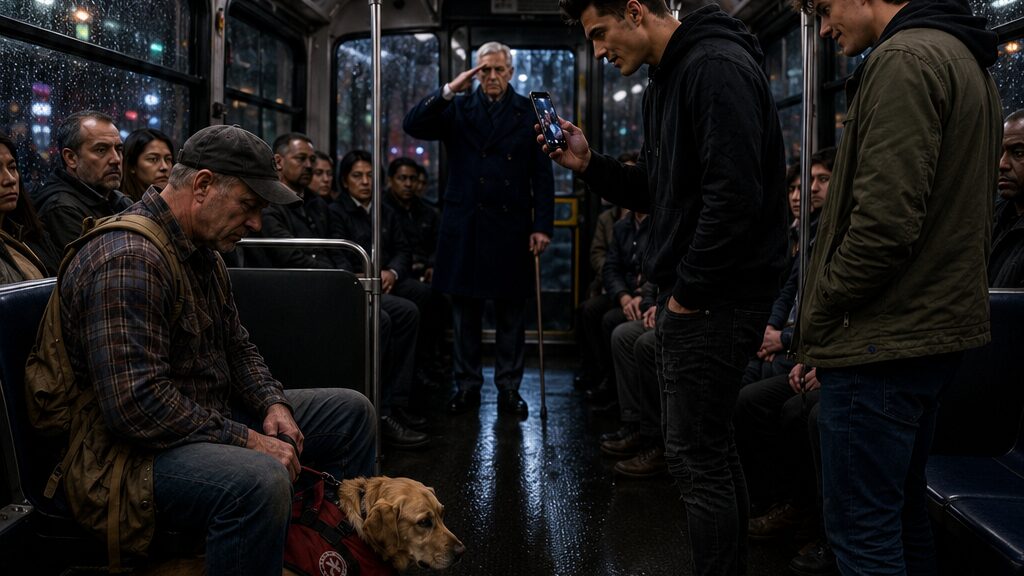
“See?” the boy with the phone said. “He’s blocking the whole aisle.”
The phone was not aimed at the dog. It was aimed at James’s face.
James turned his chin toward the window. The black glass showed him only in pieces: the pale line of his cheek, the brim of his old cap, the plaid shirt beneath his brown work vest. Rain ran outside the window in quick silver threads. Beyond it, tunnel lights slid by and broke apart.
The veterans’ clinic envelope sat folded in his inner pocket. The nurse had told him to try not to stand too long on the ride home. He had nodded, because nodding was easier than explaining that standing was not always the worst part. Crowds were worse. Sudden hands were worse. Voices too close to the ear were worse. A narrow aisle with no clear exit could turn a clean train car into another corridor if he let his mind drift even an inch.
The dog’s name was not printed anywhere on the vest. James had asked for it that way.
“Sir,” said the other young man, the one in white sneakers, “you can’t just take up all this space.”
He was not shouting. That made it worse in some way. Shouting would have given James something clear to step around. This voice was amused, half-polished for the passengers, half-cruel for the camera.
James looked down at the dog’s ear. “Stay.”
The dog’s eyes moved once toward him, then settled.
The young man with the phone leaned closer. His jacket sleeve brushed the air over the dog’s back. “He talks to the dog but not people.”
A woman across the aisle lowered her eyes to her purse. A man in a work shirt looked at the phone, then at James, then back at the floor. The train was crowded enough that everyone could pretend there was no room to help. That was one of the things James had learned about public places. People were rarely as empty of feeling as they looked. They were only waiting for someone else to be first.
James did not want anyone to be first.
He wanted the next stop. He wanted the doors to open and the rain-heavy air from the platform to come in. He wanted to get home, hang the red vest by the door, rinse the dog’s paws, and sit at his small kitchen table without being seen by strangers.
“You got papers for that thing?” the boy with the phone asked.
James heard a few seats shift. Someone breathed in sharply. The dog remained still, shoulder pressed to James’s shin.
“He’s a service dog,” James said.
The words came out low and flat, worn smooth from use. They were not an invitation.
“Everybody says that now.” The boy tilted the phone as if improving the angle. “I’m just asking. People fake that stuff all the time.”
The train rocked again. White Sneakers planted his feet wider, blocking what little open aisle remained. He was young enough to believe balance was strength. James noticed the untied edge of one shoelace, the rainwater beading on the toe, the quick glance he gave the camera before speaking again.
“Maybe if the dog moved, people could actually get through.”
James’s fingers tightened, then loosened. The dog felt it and did not react. Good dog. Steady dog.
“Let him stay where he’s trained to stay,” James said.
For a moment, the line held the air.
Then the phone boy smiled.
“Trained to block everybody?”
A laugh came from somewhere behind him. Not loud. Not brave. Enough.
James swallowed. His throat had gone dry. He could feel the train wheels beneath him, metal rhythm under metal rhythm, and under that another sound that did not belong there: rain hammering on a roof that was not a train roof, boots slapping through water, someone yelling for a medic, someone else yelling not to leave the dog.
He pressed his thumb against the red vest seam.
Not now.
White Sneakers bent down slightly, hands spread. “Come on, sir. Just move him. Nobody’s attacking you.”
The dog lifted his head.
James’s hand settled at once. Not a jerk. Not panic. Two fingers down. A quiet pressure. The dog lowered his head again, but his eyes stayed open.
The boy with the phone caught it. “Oh, he’s getting mad now.”
“He’s not mad,” James said.
“Then why’s he staring?”
Because you are crowding him. Because you are standing where his exit should be. Because he has been trained better than you have.
James said none of it.
The train lights flickered once as they entered a darker stretch of tunnel. The window became more mirror than glass. In it James saw the phone glow, the two young men above him, the dog in the red vest, and his own hand resting like a clamp against the only thing in the car that still knew what to do.
At the far end, the doors between cars opened.
A white-haired man stepped in with a folded black umbrella in one hand and a cane in the other. His coat was dark and wet at the shoulders. He paused when the train shifted, bracing the cane against the floor. His face turned toward the aisle.
James noticed him only because the dog noticed him.
The dog did not rise. He only turned his eyes.
The white-haired man looked first at the boys, then at James’s hand on the vest, then at the space the dog had chosen between James and the aisle. Something changed in his face. Not surprise. Not pity. Recognition came over him slowly, like a shade being pulled from a window.
The phone boy noticed the pause and swung the camera slightly. “Now we got an audience.”
The white-haired man took one step forward. The cane tapped on the floor, clean and sharp. He did not look at the camera.
He looked at James.
Then he raised his right hand.
It was not large. It was not theatrical. His fingers trembled a little before they settled at his brow.
The train seemed to lose its sound.
James felt the salute before he understood that everyone else had seen it. His back tightened. His hand froze on the red vest. The dog lifted his head again, not alarmed this time, only attentive.
The boy with the phone gave a short laugh that failed halfway through. “What is this?”
The white-haired man held the salute.
James looked away first.
He did not want it. Not here. Not in front of the camera. Not with rain on his shoes and clinic papers in his pocket. Not with the dog working hard against his knee and strangers suddenly hungry for whatever story might make the old man worth respecting.
The cane slipped, or perhaps the man let it fall. It struck the aisle floor and rolled once until it stopped against the base of a pole. The sound made White Sneakers step back.
No one laughed.
The white-haired man lowered his hand, bent carefully, and recovered the cane. His knees gave him trouble. James saw that too. Old bodies announced themselves even when old men did not want them to.
“Sir,” the man said.
Only that.
James could have nodded. He could have asked him not to. He could have stayed hidden inside the small blank space he had built for himself over years of buses, clinic waiting rooms, grocery lines, pharmacy counters, and strangers who saw the dog before they saw him.
Instead, he looked at the dog. “Easy.”
The dog’s tail moved once against the wet floor.
The phone boy was still recording. James could see the dark circle of the lens over the edge of the case. It looked less like an eye than a hole.
White Sneakers had backed into a seated passenger’s knee and muttered an apology without looking. The passengers had lifted their faces now. That was the other thing James knew about people. Once someone else had made it safe to care, they could look almost decent.
The train began to slow.
The next station lights appeared in the rain-streaked windows, blurred yellow and white. James shifted his weight forward. The dog’s body tensed in readiness, waiting for the signal. His joints protested before he even stood. He could feel the clinic day inside his bones.
The white-haired man stepped aside, clearing a path with the cane.
James pushed one hand against the seat. The dog stayed exactly where he had been trained to stay, blocking the aisle just enough to give James the space to rise without someone crowding his left side.
“Please don’t make him work harder tonight,” James whispered.
The words were for the boys, for the dog, for the white-haired man, for himself. He did not know who heard them.
But Timothy Garcia’s phone did.
The red light of recording stayed on as the doors opened.
Chapter 2: The Clip That Made Strangers Laugh
The red vest hung from the hook beside the apartment door, still damp along the lower edge.
James had placed a towel beneath it before breakfast. A thin line of water had gathered there overnight, darkening the wood floor in the shape of a small, crooked river. He stood over it with a mug of coffee going cold in his hand and thought of the train aisle.
The dog slept on the rug near the kitchen table, paws twitching once in a dream. Without the vest, he looked less official, almost young. Just a golden dog with rain-dried fur and one ear folded wrong.
James liked him best that way.
He had already rinsed the paws, checked between the toes, dried the belly, and cleaned the handle where his own hand had gripped too hard. The dog had eaten. The pill organizer on the counter had one empty square. The clinic papers lay unopened beside the toaster.
The phone rang at 8:17.
James let it ring twice before he answered. “Morning, Laura.”
“You saw it?”
He closed his eyes.
No hello. No weather. No soft path into the thing.
“Saw what?”
“Dad.”
The dog lifted his head at the change in her voice. James turned away from the vest and looked out the kitchen window. The alley behind the building was wet and gray. A delivery truck idled near the curb with its hazard lights blinking.
“I got home fine,” he said.
“That is not what I asked.”
He heard movement on her end. A car door, maybe. Wind. She was probably in the parking lot outside her office, holding the phone too tightly, trying not to sound frightened by turning it into anger.
“It’s online,” she said. “Some kid posted it. People are sharing it.”
James took a breath through his nose. The coffee smelled burnt. “People share all kinds of things.”
“This is you.”
He looked at the dog. “Is the dog clear in it?”
There was a pause. “What?”
“Can they see his vest?”
“Dad, they can see everything. They can see those boys standing over you. They can see the dog. They can see you looking—” She stopped.
“Looking what?”
“Small.”
The word entered the room and sat down.
James moved the mug from one hand to the other. “That’s just the angle.”
“It’s edited. I can tell there’s something cut before you talk. It starts with one of them saying you’re blocking the aisle. Then you say, ‘Let him stay where he’s trained to stay.’ And then people are commenting like you’re being rude.”
The dog stood, stretched, and came to James’s side. He pressed his head lightly against James’s thigh. Not a command. Not yet. A question.
James rested his fingers behind the dog’s ear. “Don’t read comments.”
“You’re worried about comments?”
“I’m not.”
“You asked if they can see his vest.”
James did not answer.
Laura’s voice changed. The anger thinned, and what remained was worse. “Are you worried they’ll report him?”
The kitchen seemed to narrow. James could see every object too clearly: the dish towel folded by the sink, the empty chair across from him, the red vest hanging by the door, the clinic envelope with his name printed in block letters.
“People see a dog in a place they don’t want a dog,” he said. “They decide things.”
“He is allowed to be there.”
“I know.”
“You have paperwork.”
“I know.”
“Then why are you acting like you did something wrong?”
The dog leaned harder against his leg.
James looked at the vest. The red was not bright anymore. Years of washing had softened it. One patch had been replaced twice. The handle was worn smooth where his palm found it without needing to look. Most people saw the vest and thought permission. He saw work. He saw a living creature asked to notice the tremor in his hand before he did.
“I don’t want him pulled into a review,” James said.
Laura exhaled sharply. “He’s a dog, Dad. You’re the one they humiliated.”
“He was working.”
“So were you, apparently. Working very hard not to let anybody help you.”
There it was. The old argument in new clothes.
James turned from the window. “I don’t need you coming over.”
“I’m already on my way.”
“Laura.”
“No. You can be mad when I get there.”
The call ended.
James stood with the dead phone in his hand until the screen went black. He did not own a smartphone. Laura had tried to give him one twice, and twice he had returned it, once in the original box and once after using it for three days and deciding it made the world too close.
The knock came twenty-six minutes later.
Laura had her own key, but she knocked when she was upset. She said it was respect. James suspected it was a warning.
When he opened the door, she was holding her phone in one hand and a paper bag in the other. Her dark hair was pinned badly, as if she had done it at a red light. She looked past him first, checking the room, then the dog, then the vest.
“Breakfast,” she said, lifting the bag.
“I ate.”
“Toast doesn’t count.”
He stepped aside.
She put the bag on the table, kissed the top of the dog’s head, and tried to look casual while studying the red vest. James saw her see the damp edge. He saw her notice that he had cleaned the handle.
“You shouldn’t watch it,” she said.
“I wasn’t planning to.”
“You should know what’s in it.”
“Those are different things.”
Her mouth tightened. She set the phone on the table, screen down, as though the video might leak out through the glass.
“They’re saying you refused to move for a mother with a stroller.”
“There was no stroller.”
“I know.”
“There was a man with a grocery bag.”
“I know.”
“He never asked to pass.”
“I know that too.”
James sat. His knee ached from the train and from standing too long over the vest. The dog settled beside him, head on paws, body angled between James and the door.
Laura took the chair across from him, the one that had been her mother’s. She had learned not to ask before sitting there. Grief did not need every chair preserved forever, but James still noticed.
“The boy who posted it wrote, ‘Old guy loses it over service dog on train.’”
James stared at the table grain.
“He made you the problem,” she said.
James said nothing.
“And people are laughing.”
A long time ago, laughter had been useful. Men laughed when they were too tired to speak. They laughed at bad coffee, mud in boots, rain coming sideways through torn canvas. Laughter could keep a room alive when everything else in it wanted to stop breathing.
This was not that.
Laura unlocked the phone. The screen lit her face from below. James looked away, but he heard the tinny sound before she muted it: train noise, a young voice, a short burst of laughter.
The dog raised his head.
“No,” James said.
Laura turned the phone off at once.
Not paused. Off.
“I’m sorry,” she said.
“He doesn’t like that sound.”
“I know.”
James reached down. The dog’s ears were warm under his fingers.
Laura folded both hands around the phone. “We need to report it.”
“No.”
“Dad.”
“No.”
“You don’t even know what I’m going to say.”
“I know the shape of it.”
“The shape of it is that two grown men harassed a disabled veteran on public transit and posted it online.”
James looked at her then. “Don’t say it like that.”
“Like what?”
“Like you’re writing the headline.”
Her face changed, hurt crossing it before she tucked it away. “I’m trying to help.”
“I know.”
“Do you?”
The apartment was quiet except for the faint hum of the refrigerator and the wet hiss of tires below the window. James rubbed the dog’s ear slowly.
Laura looked at the vest again. “This isn’t just about you not liking attention.”
“No.”
“What is it, then?”
James could have told her about the boy’s shoe too close to the dog’s paw. About the way the phone had made the aisle feel smaller. About how one wrong move from the dog, one startled bark, one half-second of confusion could become a clip with a caption, and then a complaint, and then a question from someone behind a desk about whether the dog was truly necessary.
Instead he said, “He did his job.”
Laura’s eyes shone. She blinked it back angrily. “And who does yours?”
The question landed harder than she meant it to.
Before James could answer, her phone buzzed against the table. She looked down. Her expression hardened.
“What?”
“It’s from the transit authority. I filled out the online contact form before I came.”
“Laura.”
“I didn’t file a formal complaint. I asked what process exists.”
“That’s the same door.”
“Maybe it needs opening.”
The phone buzzed again. She read silently, then turned the screen toward him.
James did not touch it. He leaned close enough to see the official header, the polite spacing, the words incident review and service animal positioning and customer conduct.
At the bottom, there was a scheduled time.
His name was there too.
The dog stood and pressed against his knee.
James looked past the phone to the red vest hanging by the door, drying slowly in the morning light.
Chapter 3: The Complaint Room With No Windows
The complaint room had no windows, though the wall poster showed a smiling family boarding a train under a painted blue sky.
James sat beneath the poster with the red vest folded on his lap. The dog lay beside his chair, unvested for the meeting because Michelle Davis had said over the phone that the office was not a “transit environment” and that James could decide whether the dog was “medically required” during discussion.
Laura had nearly taken the phone from his hand when she heard that. James had simply said the dog would come.
Now the dog was here, head resting on his paws, body positioned diagonally between James and the closed door. James had not told him to do that. Some things, once learned, became a kind of quiet faith.
Michelle Davis sat across the table with a tablet, a paper folder, and a pen she clicked only when she was reading. She was younger than Laura but carried herself like someone trained to speak evenly under fluorescent lights. Her blouse was neat. Her badge was clipped straight. Her expression had the careful softness of a person who had been told softness prevented lawsuits.
“We appreciate you coming in, Mr. Harris,” she said.
James nodded.
Laura sat to his right. She had promised not to interrupt unless he looked at her. She had lasted four minutes.
“I’d like it noted that my father did not request this meeting,” she said.
Michelle’s eyes moved to her. “It is noted that you contacted our office regarding the incident.”
“I asked about options.”
“That contact opened a review.”
James put one hand lightly on the folded vest. “We’re here now.”
Laura sat back, unhappy but silent.
Michelle looked down at the tablet. “We have received several reports related to a video recorded on the Green Line Tuesday evening. Some reports express concern about harassment of a passenger with a service animal. Others express concern about aisle obstruction and passenger movement.”
“Aisle obstruction,” Laura repeated.
James did not look at her.
Michelle’s pen clicked once. “That is the language used in the reports.”
“Reports from people who saw an edited clip.”
“Some reports referenced the clip, yes.”
James rubbed the edge of the vest between thumb and forefinger. The fabric was dry now, but he could still see where the rain had darkened it. The dog’s breathing stayed even.
Michelle turned the tablet slightly, not enough for him to see the screen. “Mr. Harris, do you recall whether your dog was positioned fully under your control at the time of the incident?”
“Yes.”
“And was the animal blocking the center aisle?”
James looked at her.
She did not look cruel. That was the trouble. Cruelty had a face a man could measure. This was policy speaking through a woman who perhaps went home tired and fed a cat and called her mother on Sundays.
“He was placed where he’s trained to be,” James said.
“Could you describe that placement?”
“Between me and the aisle.”
“Partially in the aisle?”
“Between me and the aisle.”
Michelle’s pen hovered. “For safety?”
“Yes.”
“Whose safety?”
James felt Laura turn toward him. He kept his eyes on Michelle.
“Mine,” he said. Then, after a moment, “And his.”
Michelle typed something. “Can you explain the specific function?”
The room changed.
Not visibly. The poster still showed the smiling family. The fluorescent light still hummed above the table. The dog still breathed beside his chair. But the air tightened around the question.
Specific function.
James had met those words before. On forms. In clinics. At counters. From people who did not mean harm but wanted the secret shape of a wound before granting permission to carry it.
“He keeps space,” James said.
Michelle waited.
“In crowds,” he added.
More waiting.
Laura shifted in her chair. James knew she wanted him to say panic episodes. Medical necessity. Trauma response. Use the approved words. Build the bridge. Cross it.
He kept his hand on the vest.
“When a train shifts or people crowd in,” he said, “he braces. He guides. He blocks if he has to.”
“Blocks passengers?”
“No.”
“What does he block?”
James looked down at the dog. One brown eye opened, checking him.
“Me,” James said.
Michelle’s pen stopped.
Laura’s hand moved beneath the table. She did not touch him, but he felt the nearness of it.
The word had come out before he could dress it properly. He disliked that. Words should be clean or kept back. But once spoken, this one sat on the table like something taken from a pocket and placed in public view.
Michelle’s voice softened further. “You mean he interrupts a medical episode?”
James nodded once.
“Is there documentation from a healthcare provider?”
Laura leaned forward. “Yes.”
James closed his eyes briefly.
Michelle looked between them. “We are not questioning the legitimacy of the animal, Mr. Harris. We’re trying to determine whether passenger education or staff follow-up is needed.”
“It sounds like you’re trying to determine if he was in the way,” Laura said.
Michelle took a breath. “I understand this is sensitive.”
“No,” Laura said. “It’s humiliating. That’s different.”
James’s hand lifted from the vest. The movement was small, but Laura stopped.
Michelle pressed her lips together, then set down the pen. “Mr. Harris, I watched the clip that has been circulated. I understand it may not show the full context. I also understand why it upset your family.”
“It didn’t upset my family,” James said quietly. “It upset my daughter.”
Laura looked at him, wounded again.
James kept going because stopping would be worse. “I was there. The dog was there. Those boys were there. Your train was there.”
Michelle sat back slightly.
“The clip is not the place where it happened,” James said.
For the first time, Michelle seemed to hear him outside the form.
The dog sat up. His ears angled toward the hall. A cane tapped somewhere beyond the door, once, then again, slow and deliberate.
Michelle glanced over her shoulder. “We may have another staff member joining briefly. He witnessed part of the incident.”
James felt the vest go still beneath his hand.
The door opened before Laura could ask who.
The white-haired man from the train stood in the hallway with one hand on a black cane and the other holding his folded umbrella, though there was no rain inside. His dark coat was buttoned wrong at the middle, as if he had dressed in a hurry or no longer cared about such things.
His eyes found James.
Not the dog. Not the vest. James.
The room seemed to tilt backward through years.
The man did not salute this time. He only placed the tip of the cane carefully inside the doorway and said, in a voice worn thin by age but steady in its center, “Leave the light low and keep them breathing.”
James’s fingers closed around the red vest.
No one in the room moved.
That phrase did not belong under fluorescent lights. It belonged in a wet corridor with smoke caught under the ceiling and men coughing into torn sleeves. It belonged to hands working in the dark. It belonged to a night James had folded away so carefully that even Laura had only ever seen its edges.
The dog rose fully now and leaned against James’s knee.
Michelle looked from one old man to the other. Laura whispered, “Dad?”
James did not answer her.
Stephen Lee stood in the doorway with his cane planted hard enough that his knuckles had gone pale.
James looked at him and felt the old shame rise, not hot, not sudden, but deep and cold as floodwater.
Then he lowered his eyes to the red vest on his lap and said nothing.
Chapter 4: The Man With the Cane Remembered the Phrase
Stephen Lee did not step fully into the complaint room until Michelle asked him to.
Even then, he moved as if the doorway belonged to someone else. The cane came first, rubber tip placed carefully on the gray carpet. His shoes followed, polished but old, with rain marks dried in uneven lines across the leather. He kept his folded umbrella tucked beneath one arm. In the train, James had seen him only as a shape against the far doors, an old man in a dark coat raising his hand. Under the office lights, Stephen looked smaller and more breakable, but his eyes had not softened.
Michelle stood. “Mr. Lee witnessed part of the event and worked with transit operations for thirty-one years. He asked to provide a statement.”
“I asked to see him,” Stephen said.
Michelle looked at James, then at Laura. “Only if Mr. Harris is comfortable.”
James was not comfortable. The word did not apply. Comfort was a chair by a window, the dog asleep near the kitchen, coffee before the city woke. Comfort was an empty aisle.
This was something else.
“You can sit,” James said.
Stephen nodded once and lowered himself into the chair closest to the door. It took effort. He did not hide it, but he did not ask anyone to help. James understood the difference.
The dog watched him.
Stephen noticed. “Good dog.”
“He is,” James said.
Laura looked between them. “Dad, who is this?”
James rubbed one thumb across the folded red vest. The old phrase still hung in the room.
Leave the light low and keep them breathing.
It had been years since anyone had said it aloud. Decades since James had heard it in a voice that knew where it came from. Not a slogan. Not a line from a movie. A field instruction passed from one exhausted medic to another when light drew attention, when panic killed faster than blood loss, when men were too frightened to understand that being kept breathing was sometimes the only victory left.
Stephen leaned both hands on the cane handle. “I knew of your father before I knew his name.”
Laura’s face tightened. “From the service?”
Stephen looked at James, asking permission without words.
James stared at the floor. The dog’s tail shifted once. “Don’t make it bigger than it was.”
Stephen’s mouth moved in something that was not quite a smile. “Men always say that when it was big enough to carry them the rest of their lives.”
Michelle’s pen lay untouched on the table now. She seemed unsure whether this had become part of the review or something no policy covered.
James stood slowly, vest in hand. “I need air.”
“There’s a bench near the station entrance,” Michelle said at once. “Quieter this time of day.”
James clipped the red vest back onto the dog before they left the room. His hands knew each strap. Neck first. Chest next. Handle checked. The dog stood still, patient under the ritual. When James straightened, the room was looking at the vest differently.
That was what he hated. Not the respect. The sudden hunger in people once an ordinary thing began to glow with meaning.
He stepped into the hall.
Stephen followed with the cane. Laura stayed close but did not touch him. Michelle remained behind for several seconds, then came after them, carrying the folder like it had lost its authority.
The station bench sat beyond a glass partition overlooking the tracks. The afternoon platform below was almost empty. A worker in an orange vest walked along the edge with a broom. Somewhere a recorded voice announced a delay in a cheerful tone that made no sense.
James sat at one end of the bench. The dog settled against his legs. Stephen took the other end, leaving space between them wide enough for silence.
Laura stood a few feet away. Michelle stayed near the wall.
Stephen looked out through the glass. “I was in receiving the night after that evacuation. Different unit. Same field hospital. They brought men in soaked through, half of them with no tags left where anyone could find them. The power kept failing.”
James closed his fingers on the dog’s handle. “A lot of men worked that night.”
“Yes.”
“That’s all.”
Stephen looked down at his cane. “I remember a stretcher coming in with two men on it because there weren’t enough stretchers. One alive. One almost. The medic walking beside them had his arm wrapped in canvas and kept telling everyone to leave the light low.”
James could feel Laura’s attention on his face. He did not turn.
Stephen continued, quiet now. “Someone said he had carried men through a flooded corridor after the north wall gave way. Someone said a dog team had gone in before the collapse. Someone said the handler didn’t come out.”
The dog raised his head at the shift in James’s breathing.
“People said many things,” James said.
“Yes.” Stephen tapped one finger against the cane handle. “But not all of them were stories.”
James’s jaw tightened. “You saluted me on that train.”
“I did.”
“You shouldn’t have.”
Stephen accepted the rebuke with a small nod. “I thought those boys needed to know they were standing in front of someone they didn’t understand.”
“They didn’t need a show.”
“It wasn’t for show.”
“There was a phone.”
“I saw.”
“Then you knew what it would become.”
Stephen’s face changed. Regret, not defense. “I knew what was happening in that car. I didn’t know what would happen after.”
James looked toward the platform below. The worker with the broom had paused near a puddle, pushing water away from the yellow line.
Laura came closer. “Dad, why didn’t you ever tell me?”
He did not answer right away. He watched the broom move water in thin arcs. That was what memory did if he let it. It gathered, spread, found the low places.
“Because you were my daughter,” he said. “Not my witness.”
Laura folded her arms, but her anger had nowhere to stand.
Michelle spoke from the wall. “Mr. Harris, if there is relevant service-related context that affects your use of the animal, it could help us resolve the reports.”
James turned then.
Michelle stopped.
The old irritation rose in him, sharper than shame. “Relevant.”
She lowered her eyes. “I’m sorry.”
Stephen looked at the red vest. “His dog is trained because he knows what happens when a crowd closes wrong.”
James’s hand stilled.
“Don’t,” he said.
Stephen leaned back. “I’m not telling your story. I’m telling them the door they’re about to shut.”
“What door?”
“The one behind you.” Stephen’s voice remained mild. “Every old man who needs a little extra space. Every woman with a dog who doesn’t look disabled enough. Every person who cannot explain the worst thing that ever happened to them while strangers are tapping their feet.”
James looked away first.
Below them, a train entered the station. It slowed with a sigh, lights sliding across the glass. For one moment he saw their reflections layered over it: Laura worried and rigid, Michelle with the folder pressed to her chest, Stephen bent over his cane, himself seated with an old dog in a red vest.
No, not old. Not yet. Working.
Stephen’s cane slipped slightly against the floor. James reached before thinking and steadied it with his boot.
Stephen looked down, then at him.
“Still watching the weak side,” he said.
James withdrew his foot. “Habit.”
“Discipline.”
“Habit is quieter.”
Stephen smiled faintly. “So are you.”
That cut deeper than James wanted. He stood. The dog rose immediately.
Laura stepped forward. “Dad?”
“I’m going home.”
Michelle moved as if to stop him, then thought better of it. “The review isn’t complete.”
“It can wait.”
Stephen’s cane tapped once. “It may not wait long.”
James looked back.
Stephen’s expression had gone hard again. “The clip is circulating through rider forums. People are calling for stricter service-animal rules on crowded trains. Clear-aisle enforcement. Mandatory repositioning. Removal if a dog obstructs passenger flow.”
Michelle’s face tightened. She had not wanted it said that plainly.
Laura turned on her. “You knew?”
Michelle said, “There have been internal discussions. Nothing has been decided.”
James felt the dog’s body press against his knee. The red vest sat bright under the station lights, too visible, too easy for strangers to reduce to a rule.
Stephen rose slowly with the cane. “That boy cut the clip down to the part that made you look unreasonable.”
James said nothing.
“If they write a rule from that lie,” Stephen said, “it won’t be aimed only at you.”
The train doors below opened. No one got off. No one got on. After a few seconds, they closed again.
James watched the empty car slide away into the tunnel.
Chapter 5: The Rule Written for the Wrong Man
By the end of the week, the red vest had been cleaned twice and still looked to James as if the train floor had marked it permanently.
He carried it folded under one arm when he entered the transit board meeting room. The dog walked at his left side without the vest for the first few steps, calm but watchful, until James paused near the back wall and put the vest on him. He had considered leaving it off. He had considered making the room look at him without the bright fabric announcing need before person.
But the meeting was about people who needed the world to make room without demanding a performance first.
So the vest went on.
The room was not built for comfort. Long tables faced a raised counter where three officials sat with microphones and water bottles. A screen on one wall showed the paused frame of Timothy Garcia’s video. James was caught mid-sentence, eyes lowered, one hand on the dog’s vest. The angle made him look stubborn and cornered. Jack Moore’s white sneakers were visible near the dog’s front paws. Timothy’s caption sat along the bottom, frozen in bright letters.
Old guy refuses to move service dog during rush hour.
James looked at it once, then looked away.
Laura stood beside him with a folder of documents. Stephen sat near the aisle, cane upright between his knees. Michelle Davis stood near the front table, speaking quietly with another transit employee. She looked tired in a way James recognized: not from work alone, but from realizing the work had become human.
A few members of the public sat scattered in rows. Some were ordinary riders. Some had dogs. One woman held a folded white cane across her lap. An older man in a cap stared at the screen with his mouth set hard. Near the back, Timothy sat with his phone in both hands. Jack was beside him, arms folded, one knee bouncing.
Timothy looked younger without the train around him. Not innocent. Just young. The kind of young that mistook discomfort for injustice if it happened to him and comedy if it happened to someone else.
Jack saw James first. His knee stopped bouncing.
Timothy looked up a second later. His face changed, then flattened into defense.
James took a seat near the center aisle. The dog settled beneath the chair but angled outward, red vest visible under the table edge.
The meeting began with language.
James had always distrusted language that arrived in stacks. Michelle introduced the review. A board member referred to “competing passenger access needs.” Another mentioned “viral public concern.” Someone read a proposed adjustment: service animals should remain clear of aisles except when actively boarding, exiting, or performing a task that could be verbally identified upon staff request.
Laura’s hand tightened around the folder.
James did not move.
Verbally identified.
He pictured a crowded train and a stranger in uniform asking, in front of everyone, What task is your dog performing? He pictured a veteran, a woman, a child, anyone with a wound hidden under ordinary clothes, trying to decide how much of themselves to hand over for the right to ride home.
Michelle spoke next. Her voice was careful, but not as smooth as before. “The incident that prompted these discussions involved an edited recording. We do not yet have the complete context.”
A board member looked down the table. “But the public concern is real.”
“So is the risk of overcorrection,” Michelle said.
James looked at her then.
She did not look back, but one hand pressed flat against her folder as if steadying it.
Public comments opened.
A rider complained about dogs on trains. A woman with the folded white cane spoke about being questioned by strangers who thought she “didn’t look blind enough” because she could read large print on her phone. A man said he had nearly tripped over a service dog once and did not want to be made the villain for wanting safe aisles.
Each person held a piece of truth. That made the room harder, not easier.
Then Timothy was called.
He stood too fast, chair legs scraping. Jack looked down at his shoes.
Timothy approached the small microphone with his phone still in hand. He did not look at James.
“I didn’t mean for it to become this big,” he said.
No one responded.
“I posted what happened. People are acting like I attacked him. I didn’t touch him. I asked him to move the dog because people couldn’t get by.”
James felt the dog’s head shift beneath the table.
Timothy glanced once toward him, then away. “Everybody keeps saying I should’ve known he was a veteran. How was I supposed to know that?”
The room stayed still.
“He never told us he was anybody,” Timothy said.
James looked directly at him.
Timothy’s mouth closed.
There it was, said plainly enough for everyone to hear. Anybody. As if dignity began only after a person produced credentials. As if the default setting for an old man with a dog should be suspicion until upgraded by biography.
James’s fingers rested on the dog’s vest under the table.
Laura leaned close. “Dad.”
He did not stand yet.
Michelle looked toward him, not pushing. Stephen’s cane gave one soft tap against the floor, accidental or not.
The board member at the center said, “Mr. Harris, would you like to respond?”
James had planned not to. He had told Laura in the car that he would sit, listen, and leave if the room became hungry. He had told the dog to work easy today. He had told himself that his pride was not the issue.
But pride was a clever thing. It could hide inside silence and call itself restraint.
James rose.
The dog stood with him, close enough that the red vest brushed his pant leg. He walked to the microphone. The room watched the slow journey: one old man, one dog, one narrow aisle remade in carpet and policy.
He stopped beside Timothy, not behind him, not in front of him. Beside him.
Timothy stared at the microphone.
James looked at the screen where his lowered face waited in the paused video.
“I was trying to get home,” James said.
His voice sounded smaller than he wanted, but it carried.
“That’s all I was doing.”
The board member leaned toward the microphone. “Mr. Harris, could you explain whether the dog was performing a task at that moment?”
Laura closed her eyes.
James looked at the dog. The dog looked back, steady and ready.
“Yes,” James said.
The board member waited.
James let the silence stretch just long enough for the room to feel what it had asked from him.
“He was keeping people from crowding my left side,” James said. “He was giving me space to stand if the train stopped hard. He was watching my breathing. He was doing what he was trained to do.”
A woman in the second row lowered her head.
James turned slightly toward Timothy. “You asked why I didn’t tell you I was anybody.”
Timothy swallowed.
“I didn’t know I had to be somebody before you’d leave me alone.”
The words did not rise. They did not accuse. That was why they struck the room cleanly.
Jack shifted in his chair, face red now. Timothy stared at the microphone as if it had betrayed him.
James continued, “If your rule says a person has to explain the private function of a service dog to every employee, every rider, every young man with a phone, you are writing a rule for the wrong problem.”
Michelle looked down at her papers.
“The problem was not that my dog was in the aisle,” James said. “The problem was that a stranger thought filming me was easier than asking if I needed room.”
His breath caught at the end. The dog pressed against his leg at once. James felt the pressure and hated that everyone could see it, then accepted that everyone needed to.
He stepped back from the microphone.
The central board member thanked him, though the words sounded inadequate and knew it.
Timothy’s face had changed. Defense had not left, but something had cracked through it. Confusion, maybe. Shame, maybe. Not enough. But something.
As James returned to his seat, Timothy spoke without turning fully.
“He still didn’t say all that on the train,” he muttered.
James stopped.
The room heard it.
Timothy lifted his chin, trapped now by his own voice. “I mean—how was I supposed to know?”
James turned slowly.
This time he did not look away. He let Timothy have the full weight of his attention, not anger, not performance, just an old man tired of being translated badly by strangers.
“You weren’t,” James said. “You were supposed to be decent before you knew.”
The room went quiet.
Timothy’s phone slipped lower in his hand.
Chapter 6: What the Old Medic Refused to Use
They moved James into a side room because Michelle said the meeting needed a short recess.
James knew better. The room had gone too still after his last sentence. People wanted time to recover from plainness. Officials wanted time to decide which part of the truth could fit into minutes and which part had to be managed.
The side room held a small round table, four chairs, a coat rack, and a coffee machine with an empty pot. No windows again. Transit seemed fond of rooms that did not allow anyone to look out.
Laura came in first, carrying the folder like a shield. Stephen followed, cane tapping softly. Michelle held the door for James and the dog, then hesitated when Timothy appeared in the hallway.
“He should come in,” James said.
Laura turned. “Dad.”
“He should.”
Timothy stood with his phone in his hand, face pale beneath the overhead lights. Jack remained outside, visible through the half-open door for a moment before he backed away toward the meeting room.
Michelle looked at Timothy. “This is not a disciplinary interview. If you come in, you listen.”
Timothy nodded.
Inside, no one sat at first.
The dog did not like the room. James felt it in the leash before the dog made any visible change. Too small. Too many people. Door behind. Table in the center. James gave two fingers down and the dog settled beside his left leg, still wearing the red vest.
Laura placed her folder on the table. “We have documentation. Clinic letters. Training certification. Records from the veterans’ program. If they want proof, we can give proof.”
“I know,” James said.
“You shouldn’t have to, but if this is what stops the rule—”
“It won’t stop the rule.”
Michelle removed her badge clip from the edge of her jacket and set it on the table, as if she needed one less official thing on her. “It may help revise it.”
Stephen leaned both hands on the cane. “There’s another kind of proof.”
James looked at him sharply.
Stephen did not retreat. “Not medals. Not rank. Not a newspaper story. Just enough to show why a man like you might not explain himself while two boys crowd him.”
“No.”
Laura looked between them. “What proof?”
“No,” James said again.
Timothy stood near the door, silent now.
Stephen’s voice remained low. “They’re already making you explain the dog. You can choose the shape of it.”
“The shape is mine.”
“Yes.”
“Then don’t put your hands on it.”
Stephen accepted that. He lowered his eyes.
Laura opened the folder anyway, but slower now. “Dad, this isn’t about pride.”
James almost laughed, but the sound would have come out wrong. “People always say that when they want a man to spend it.”
“I want you protected.”
“I am not the only one in that room.”
“Exactly. That’s why—”
“No.” He turned toward her. “That is why I have to be careful.”
She stopped.
James reached down and touched the edge of the red vest. There was a small patch near the underside seam, darker than the rest. Most people never noticed it. It had been resewn during the dog’s second year, after the original thread began to fray. The fabric was not from the vest manufacturer. It was older, softer, a red dulled almost brown by time and washing.
His thumb found the patch as if it were a scar.
Laura saw the movement. So did Stephen.
Michelle did not ask. Timothy watched with the uneasy attention of someone realizing a thing he had mocked was not a prop.
“The first dog I ever trusted wasn’t mine,” James said.
The room changed again, but this time no one interrupted.
“He belonged to a handler who could get him through places men didn’t want to enter. Flooded hallways. Broken doors. Rooms with too much smoke. That dog would go low when everybody else froze. He knew how to find breathing.”
Laura’s face softened with hurt.
James kept his eyes on the vest. “One night the corridor filled too fast. Rain, broken pipes, roof giving way, I don’t know anymore. Everything sounded like water and metal. We moved who we could. The handler went back because the dog had found someone.”
Stephen closed his eyes.
James’s voice thinned, but did not break. “I came out with two men. Not him.”
No one moved.
“The dog came out later with a piece of red rescue blanket caught in his harness. I don’t know how. Maybe someone tied it there. Maybe it snagged. Maybe memory makes better patterns than truth.”
He rubbed the dark patch once. “Years after, when they told me a service dog might help me ride trains, stand in lines, sit in waiting rooms without counting exits until my heart forgot its job, I said no. Then I said no again. Then Laura stopped asking for a while.”
Laura turned her face away.
“When I finally said yes, I asked them to sew this inside the vest. Not where people could see. Not for honor. Just so I’d remember the dog was not there to make me look wounded. He was there to help me keep moving.”
Timothy’s phone was still in his hand. He looked down at it as though surprised to find it there.
James lifted his gaze to him. “On the train, when your friend stepped close, the dog shifted. Not because he was angry. Because he was working. When you leaned in with that phone, he had to watch you, watch me, watch the aisle, watch the stop. That is a lot to ask from a good dog because a young man wants a clip.”
Timothy’s mouth opened. Nothing came.
Laura wiped under one eye quickly, angry at the tear.
Michelle sat down as if her knees had given out. “Mr. Harris, I am sorry.”
James shook his head. “Don’t spend it too fast.”
She understood enough to be quiet.
Stephen looked at the floor. “I should not have saluted you in front of that phone.”
James breathed once, slowly. “You saw me.”
“I did.”
“I wasn’t ready to be seen.”
“I know that now.”
James looked at him then, and the old resentment loosened by a thread. Stephen had done the wrong thing for the right reason. There were many graves filled by worse combinations.
Laura pushed the folder toward him. “Then what do you want?”
James looked at the papers. Documentation. Certificates. Proof that would make him legitimate in the eyes of people who should not have needed his wound measured.
Then he looked at Timothy.
“I want the original video.”
Timothy flinched. “I posted what—”
“The original.”
Timothy’s hand tightened around the phone. “It’s not that different.”
James said nothing.
The silence did its work.
Timothy looked toward Michelle, then Laura, then back at James. “I cut some at the beginning.”
“How much?” Michelle asked.
“Not much.”
“How much?” Laura said.
Timothy swallowed. “Maybe fifteen seconds.”
James waited.
Timothy’s voice dropped. “He said not to crowd the dog. He said it could cause a medical problem if the dog couldn’t task.”
Laura’s chair scraped back an inch.
Michelle’s eyes closed briefly.
“And then?” James asked.
Timothy stared at the table. “Jack laughed. I said something. Then I started the part I posted.”
“The part that made me look like I refused for no reason.”
Timothy nodded once.
James’s anger came then, not hot enough to burn, but heavy. He let himself feel it. The old habit was to pack anger away before it showed. But there were times when a man owed the truth at least a place to stand inside him.
Laura spoke carefully. “We can use that.”
“No,” James said.
“Dad.”
“No.”
Michelle looked up. “Mr. Harris, the unedited recording matters.”
“It does.”
“Then we should submit it.”
“We will.”
Timothy blinked.
James turned to him. “Not as a weapon.”
Timothy looked confused enough to seem almost like a boy.
“You brought people to that train who weren’t there,” James said. “All those strangers laughing at a thing they didn’t understand. You’re going to bring them back the truth. Plain. No crying into the camera. No speech about what you learned. No making yourself the center of it.”
Timothy’s face flushed.
Laura’s voice softened despite herself. “Dad, he also needs consequences.”
“He will have them.”
“What consequences?” Timothy asked, wary now.
James smoothed the dark patch inside the vest. His hand no longer trembled.
“Tomorrow evening,” he said, “you bring the original video to the platform where it happened. You show Michelle. You show Stephen. You show my daughter. Then you post the correction from there.”
Timothy shifted. “On the platform?”
“Yes.”
“Why?”
James looked at him, not unkindly. “Because that is where you made me smaller.”
The words settled.
Timothy lowered his phone and placed it face-down on the table.
Stephen’s cane tapped once, softer than before.
James stood. The dog rose with him, red vest steady against his side.
“And after that?” Timothy asked.
James paused at the door.
“After that,” he said, “you ride one stop with us and keep your phone in your pocket.”
Chapter 7: One Stop in Silence Beside the Old Man
The platform looked smaller when James returned to it on purpose.
The rain had stopped, but the station still held the weather. Water clung to the black rails below and gathered in the seams of the concrete. Every passing train pushed up a damp metallic smell. The overhead lights shone in the puddles as if the whole platform had been wiped down and not dried.
James stood near the same section of yellow line where he had boarded the train three nights before. The dog waited beside him in the red vest, body close to James’s left leg, head level, eyes moving without hurry. James had brushed the vest before leaving home. He had smoothed the dark inner patch once, then left it alone.
Laura stood behind him with her arms folded, not in anger this time. More like she was holding herself still. Stephen Lee sat on the bench nearest the pillar, cane upright between his shoes. Michelle Davis waited a few steps away with a transit folder tucked beneath one arm and no badge visible on her jacket. She had said she was there as part of the review. James had not argued. People sometimes needed a name for why they chose to witness something.
Timothy Garcia arrived late.
James heard his sneakers on the stairs before he saw him. The sound came down unevenly, quick at first, then slower when he reached the platform and saw who was waiting. He wore a dark hoodie, jeans, and no expression that lasted longer than a second. His phone was in his hand. Not raised. Not hidden. Just there, the way a guilty object stayed guilty even when carried plainly.
Jack Moore was not with him.
Timothy stopped several feet away. “He didn’t want to come.”
James nodded once.
Timothy looked at Laura, then Michelle, then Stephen. He avoided the dog until the dog looked directly at him. Then Timothy looked away.
“I have it,” he said.
Michelle stepped forward. “The original file?”
“Yeah.”
“Not a screen recording of the posted version?”
“No. The original.”
His voice had an edge, but it was thin. Shame made some people humble. It made others sound irritated at the inconvenience of feeling it.
James understood that too.
Michelle took out a small tablet from her folder. “You can send it here. I’ll confirm the timestamp and length.”
Timothy worked the phone with both thumbs. His hands were not steady. James watched without satisfaction. A train was due in six minutes. The display board above them blinked through delays and destinations.
Laura came closer to James. “You don’t have to stand through this.”
“Yes,” he said. “I do.”
The dog leaned lightly against his knee.
Michelle’s tablet chimed. She opened the file. Timothy stared at the floor while she checked it. The first sound that came out was train noise from three nights ago, sudden and small through the tablet speaker. James felt the dog’s body tighten.
“Mute it,” he said.
Michelle did at once.
They watched in silence.
The unedited video began before James had known he was the center of it. The camera was angled low at first, catching Jack’s white sneakers near the dog’s paws, the wet floor, the bottom edge of the red vest. Then Timothy’s voice, soundless now but visible in the movement of his mouth as the camera rose.
Michelle turned on captions generated by the device. They came imperfectly, but enough.
You can’t block the aisle like that.
Then James on the screen, older somehow than he felt inside his own body, looking up without lifting his chin.
Please don’t crowd him. He’s tasking.
Jack laughing. Timothy saying something not caught clearly.
James again.
If he can’t task, I can have a medical problem. Give him room.
The camera dipped, then jumped. Someone had said something offscreen. Jack stepped closer instead of back. The dog’s head turned sharply, then settled when James touched the vest.
Only after that did the part begin that Timothy had posted.
Let him stay where he’s trained to stay.
Michelle stopped the video.
Laura’s breath came out hard, but she said nothing. Stephen’s hand closed around the cane. Timothy still stared at the floor.
James looked not at Timothy but at the dark track below the platform.
There it was. Proof. Not full proof. Not the kind that told who he had been or what the red patch meant. Only enough to show that the lie had been made by cutting away the part where he had asked for room like a man, not demanded worship like a symbol.
It should have felt better than it did.
Michelle lowered the tablet. “This will be entered into the review. The proposed language will not move forward as written.”
Laura looked at her quickly. “Not as written?”
Michelle held her gaze. “We are withdrawing the passenger-identification requirement. We’ll work with disability-access advisors before any policy changes. And we’ll add guidance about harassment and recording incidents involving service animals.”
Laura’s face softened by a fraction.
James said, “Good.”
Timothy looked up then. “So what do I post?”
James turned toward him.
The boy held the phone chest-high, not filming, just waiting with it. The platform lights made his face look tired and younger than it should have. For the first time, James noticed a small crack across the corner of his phone screen.
“The truth,” James said.
“I know, but how?”
“Plainly.”
Timothy swallowed. “I can say I edited it wrong.”
“You edited it to make me wrong.”
Timothy’s face flushed. “Yeah.”
James waited.
“I edited it to make you wrong,” Timothy said.
The words were ugly. They needed to be. Some things lost meaning when polished.
Michelle handed him the tablet back for reference. Timothy did not take it. He opened his phone and began recording himself, then stopped almost immediately.
“No,” James said.
Timothy lowered the phone. “What?”
“Not your face first.”
Timothy looked confused.
“You made yourself the doorway last time,” James said. “Don’t do it again.”
Stephen’s eyes moved to James, and for a moment there was something like pride in them, but he kept it quiet.
Timothy turned the phone toward the tracks, the platform, the yellow line, the empty stretch where the train would arrive. The red vest appeared at the edge of the frame, not centered. James appreciated that more than he wanted to.
Timothy took one breath.
“I posted a video from this platform earlier this week,” he said, voice low but clear. “I cut out the beginning. The man in the video warned us not to crowd his service dog because the dog was working and because crowding him could cause a medical issue. I left that out and made it look like he refused to move for no reason.”
He stopped, looked at James, then continued.
“That was wrong. The original has been given to transit review. Don’t use my edited clip to argue against service-dog riders. I’m deleting it.”
He ended the recording.
No tears. No dramatic apology. No speech about becoming better. Just the facts, held awkwardly in a young man’s mouth.
“Post it,” James said.
Timothy’s thumb hovered. “Right now?”
“Yes.”
He posted it.
Then he opened the old clip. James could see the frozen image again: his lowered face, the red vest, the caption. Timothy stared at it for a long second. His thumb moved. A warning box appeared. He tapped again.
The clip disappeared.
Laura looked away, blinking.
Michelle wrote something in her folder. Stephen rested both hands on his cane and looked down the tunnel.
The approaching train announced itself first as wind, then light. James felt the platform tremble through the soles of his shoes. The dog shifted into position, calm and ready. Timothy stepped back from the yellow line before anyone told him to.
When the doors opened, the car was not crowded, but it was not empty either. James entered first. The dog boarded at his left, then angled into the space beside the nearest forward-facing seat. James sat. The dog placed himself partly between James and the aisle, exactly where he belonged.
Timothy remained on the platform until Laura said, “One stop.”
He stepped in.
Stephen followed slowly, cane tapping once on the metal threshold. Michelle boarded last and stood near the doors. No one arranged themselves like a ceremony. No one knew, except the few who knew. That was enough.
Timothy stood across from James, one hand around the pole. His other hand stayed empty at his side. The phone was in his pocket.
The train moved.
For the first few seconds, no one spoke. The wheels found their rhythm. The tunnel lights passed over Timothy’s face in bands of shadow and pale yellow. He looked at the dog, then at James.
“I’m sorry,” he said.
James watched him.
Timothy added, “Not because you’re a veteran. I mean, that too. But not just that.”
The dog’s ear flicked.
“I’m sorry because you asked me to give him room,” Timothy said. “And I made that into something else.”
James looked down at the red vest. A few strands of golden fur had caught along the seam. The dark inner patch was hidden, as it should be.
“All right,” he said.
Timothy waited, maybe for more. Forgiveness with shape. A hand extended. A lesson completed. James gave him none of that. Not out of cruelty. Out of respect for what apology could and could not repair.
Laura sat across the aisle, watching her father as if seeing a door in him she had spent years knocking on from the wrong side.
Stephen said nothing. His cane rested between his knees, rubber tip planted firmly on the floor. Once, when the train swayed, James reached down with his boot and stopped the cane from sliding. Stephen glanced at him but did not comment.
The next station approached.
As the train slowed, an older woman waited near the doors with a walker, bracing herself against the movement. She had boarded from the rear car at some point, or perhaps James had not noticed her until now. The aisle between her and the door was narrow. People shifted with the familiar half-reluctance of commuters protecting inches.
Timothy saw her.
He stepped back at once, turning his body sideways to clear the path. He did not make a show of it. He did not look around to see who noticed. He simply moved before she had to ask.
The woman guided the walker through the opened doors and onto the platform. She did not thank him. She was busy with the gap, the wheels, her own balance.
Timothy stayed out of the way until she was clear.
James watched him through the reflection in the rain-dark window. Not redemption. Not yet. Maybe not ever in the clean way stories liked to promise. But a small correction, made without a camera, counted more than a large one performed for strangers.
The doors chimed.
Laura stood. Michelle stepped off first. Stephen rose carefully, and Timothy moved to give him space too. James put one hand on the dog’s vest.
“Ready,” he said.
The dog stood.
On the platform, Stephen waited with the cane. Laura stood beside him. Michelle was speaking quietly into her phone, already turning the evening into policy language. Timothy remained near the train door until James stepped down.
For one moment, the aisle behind James was clear.
He looked back into the car. Seats, poles, damp floor, tired faces. Nothing sacred. Nothing solved. Just a public place where people carried things no one else could see.
The dog leaned into his leg.
James rested his hand on the red vest, not to hide it and not to show it. Only to feel the living warmth beneath.
Then he walked toward the stairs at his own pace, and this time no one tried to hurry him.
The story has ended.